Overview
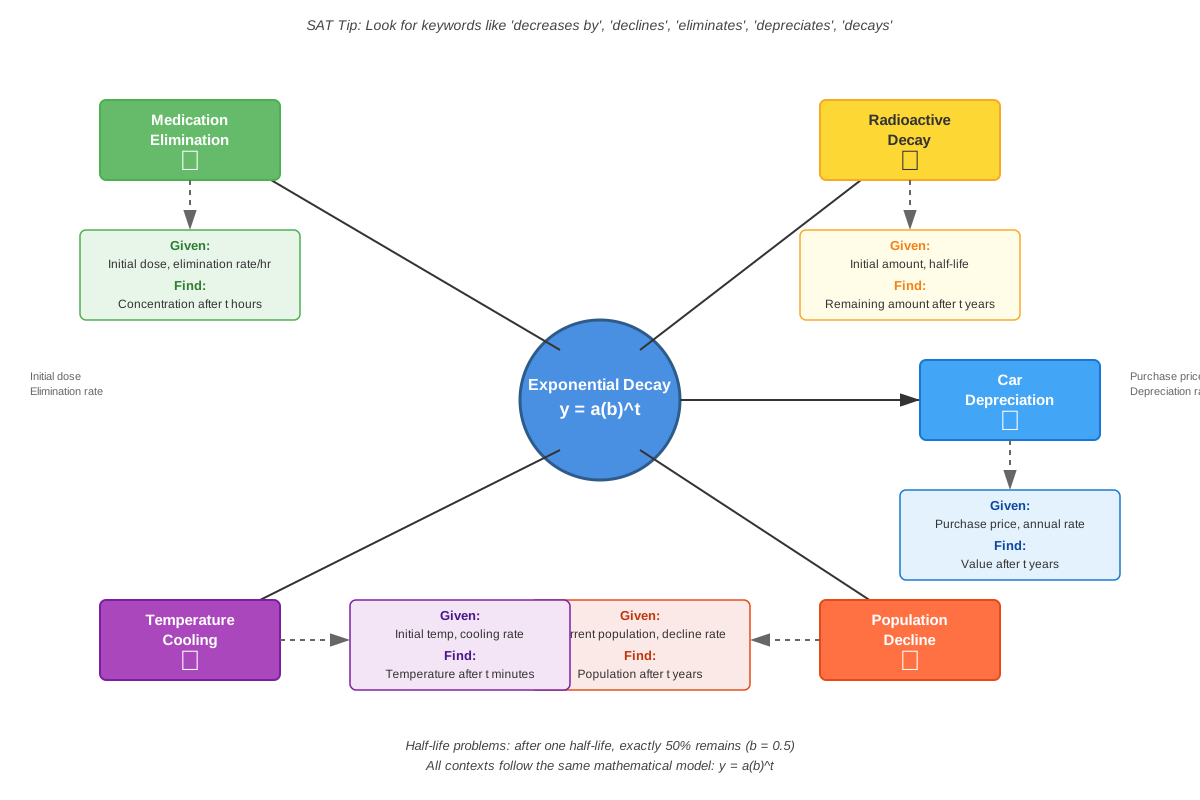
Exponential decay is a fundamental mathematical concept that describes how quantities decrease at a rate proportional to their current value. Unlike linear decrease, where a fixed amount is subtracted in each time period, exponential decay involves a percentage reduction that creates a characteristic curved pattern. On the SAT, this topic appears regularly in both calculator and no-calculator sections, testing students' ability to recognize decay patterns, manipulate exponential expressions, and interpret real-world scenarios involving depreciation, radioactive decay, population decline, and medication elimination from the body.
Understanding exponential decay is crucial for SAT success because it bridges multiple mathematical domains. Questions may require algebraic manipulation of exponential expressions, interpretation of function behavior, analysis of graphs, or application of percentage concepts. The College Board frequently embeds exponential decay within word problems that require students to extract relevant information, construct appropriate models, and make predictions about future values. Mastery of this topic typically accounts for 2-4 questions per test, making it a high-yield area for score improvement.
The relationship between exponential decay and other math concepts is extensive. It connects directly to exponent rules, function notation, graphing transformations, and logarithms. Students who understand exponential decay can more easily grasp compound interest (which is exponential growth), geometric sequences, and the behavior of rational functions. This topic also reinforces proportional reasoning and percentage calculations, skills that appear throughout the SAT Math section. The ability to recognize when a situation involves exponential rather than linear change is a critical analytical skill tested across multiple question types.
Learning Objectives
- [ ] Identify key features of exponential decay functions including initial value, decay factor, and rate of decay
- [ ] Explain how exponential decay appears on the SAT in various contexts and question formats
- [ ] Apply exponential decay formulas to answer SAT-style questions involving real-world scenarios
- [ ] Distinguish between exponential decay and exponential growth based on equation structure
- [ ] Convert between different forms of exponential decay expressions (percentage form, decimal form, fraction form)
- [ ] Interpret graphs of exponential decay functions and extract meaningful information
- [ ] Solve for unknown variables in exponential decay equations using algebraic techniques
Prerequisites
- Exponent rules and properties: Essential for manipulating exponential expressions and simplifying decay equations
- Basic algebra and equation solving: Required to isolate variables and solve for unknown quantities in decay problems
- Percentage calculations: Necessary to understand decay rates expressed as percentages and convert between forms
- Function notation: Needed to interpret f(t) notation and understand input-output relationships in decay models
- Coordinate graphing: Helpful for visualizing decay functions and interpreting graphical representations
Why This Topic Matters
Exponential decay models countless real-world phenomena that students encounter in science, economics, and everyday life. Medication dosage calculations rely on exponential decay to determine how drugs are eliminated from the bloodstream. Car values depreciate exponentially, affecting financial decisions about purchases and insurance. Radioactive materials decay exponentially, which is fundamental to carbon dating, nuclear medicine, and environmental science. Population biologists use exponential decay to model endangered species decline, while economists apply it to analyze inflation's impact on purchasing power.
On the SAT, exponential decay appears in approximately 2-4 questions per test, representing roughly 4-7% of the Math section. These questions typically fall into several categories: direct calculation problems requiring students to evaluate decay functions at specific times, word problems asking students to construct decay models from contextual information, graph interpretation questions testing understanding of decay behavior, and algebraic manipulation problems involving solving for decay rates or time values. The College Board particularly favors questions that combine exponential decay with other topics, such as systems of equations or data interpretation.
Common SAT question formats include: "A car purchased for $25,000 depreciates at 15% per year. What is its value after 5 years?"; "The graph shows the amount of a radioactive substance over time. Which equation best models this relationship?"; "A medication has a half-life of 6 hours. If 400mg is administered, how much remains after 18 hours?"; and "Which of the following equations represents a quantity that decreases by 20% each year?" These questions test not just computational ability but also conceptual understanding of what exponential decay means and how it differs from other types of change.
Core Concepts
The General Form of Exponential Decay
The standard equation for exponential decay is:
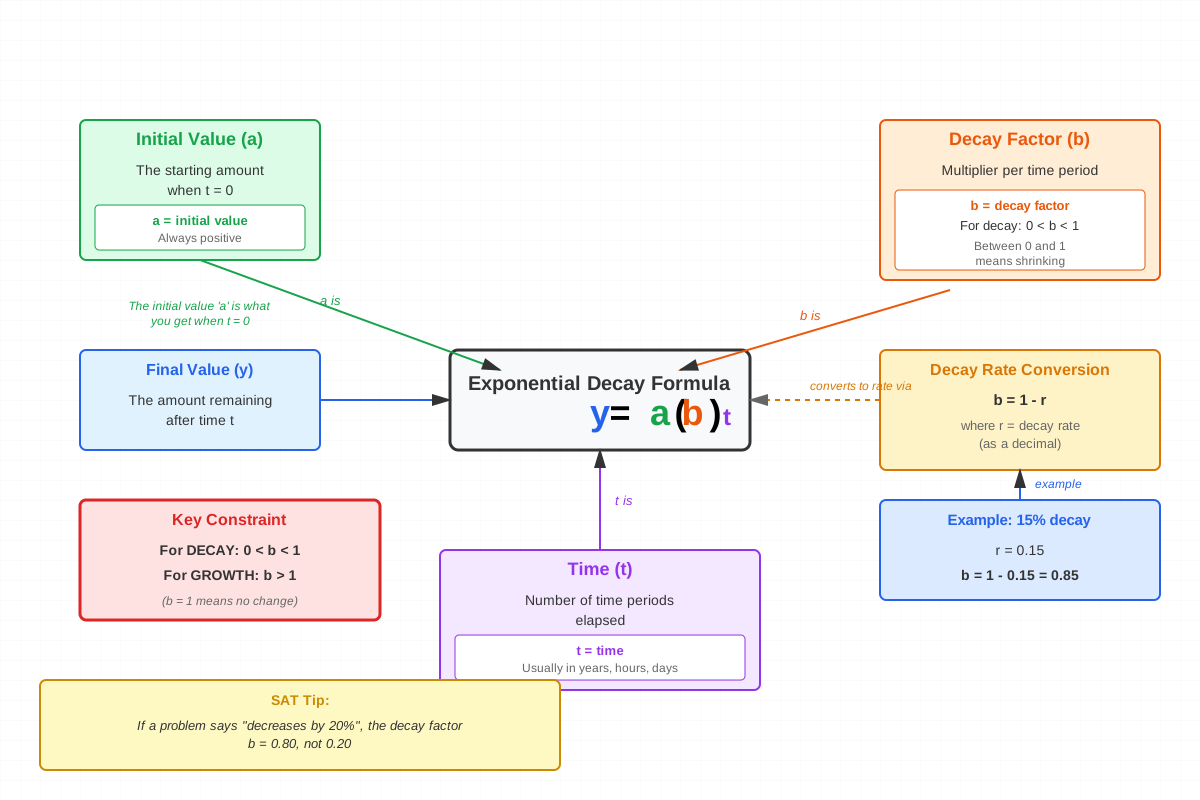
y = a(1 - r)^t or y = a·b^t where 0 < b < 1In this formula:
- y represents the final amount after decay
- a represents the initial amount (the starting value when t = 0)
- r represents the decay rate expressed as a decimal (e.g., 0.15 for 15% decay)
- t represents time (in whatever units the problem specifies)
- b represents the decay factor, equal to (1 - r)
The key characteristic that identifies exponential decay is that the base of the exponent is between 0 and 1. When b < 1, raising it to increasing powers produces smaller and smaller values, creating the decay pattern. For example, if b = 0.8, then 0.8¹ = 0.8, 0.8² = 0.64, 0.8³ = 0.512, showing progressive decrease.
Decay Rate vs. Decay Factor
Understanding the distinction between decay rate and decay factor is crucial for SAT exponential decay problems:
| Term | Symbol | Meaning | Example |
|---|---|---|---|
| Decay Rate | r | The percentage decrease per time period | 25% = 0.25 |
| Decay Factor | b | The multiplier applied each period; equals (1 - r) | 1 - 0.25 = 0.75 |
| Retention Rate | (1 - r) | The percentage that remains after each period | 75% remains |
If a problem states "decreases by 30% each year," the decay rate r = 0.30, and the decay factor b = 1 - 0.30 = 0.70. This means 70% of the quantity remains after each year. Students must be careful not to use the decay rate directly as the base; the correct base is always (1 - r).
Half-Life Problems
Half-life is a special case of exponential decay where the time required for a quantity to reduce to half its value is constant. The half-life formula is:
y = a(1/2)^(t/h) or y = a(0.5)^(t/h)Where:
- h represents the half-life period
- t/h represents the number of half-lives that have elapsed
For example, if a radioactive substance has a half-life of 8 years and starts with 1000 grams, after 8 years there will be 500 grams, after 16 years there will be 250 grams, and after 24 years there will be 125 grams. The exponent t/h tells us how many half-life periods have passed.
Identifying Exponential Decay from Equations
On the SAT, students must quickly identify whether an equation represents decay or growth:
Exponential Decay indicators:
- Base between 0 and 1: y = 100(0.85)^t
- Form (1 - r) where r is positive: y = 50(1 - 0.20)^t
- Negative exponent with base greater than 1: y = 200(2)^(-t)
- Fraction as base: y = 300(3/4)^t
NOT Exponential Decay:
- Base greater than 1 with positive exponent: y = 100(1.15)^t (this is growth)
- Form (1 + r): y = 50(1 + 0.20)^t (this is growth)
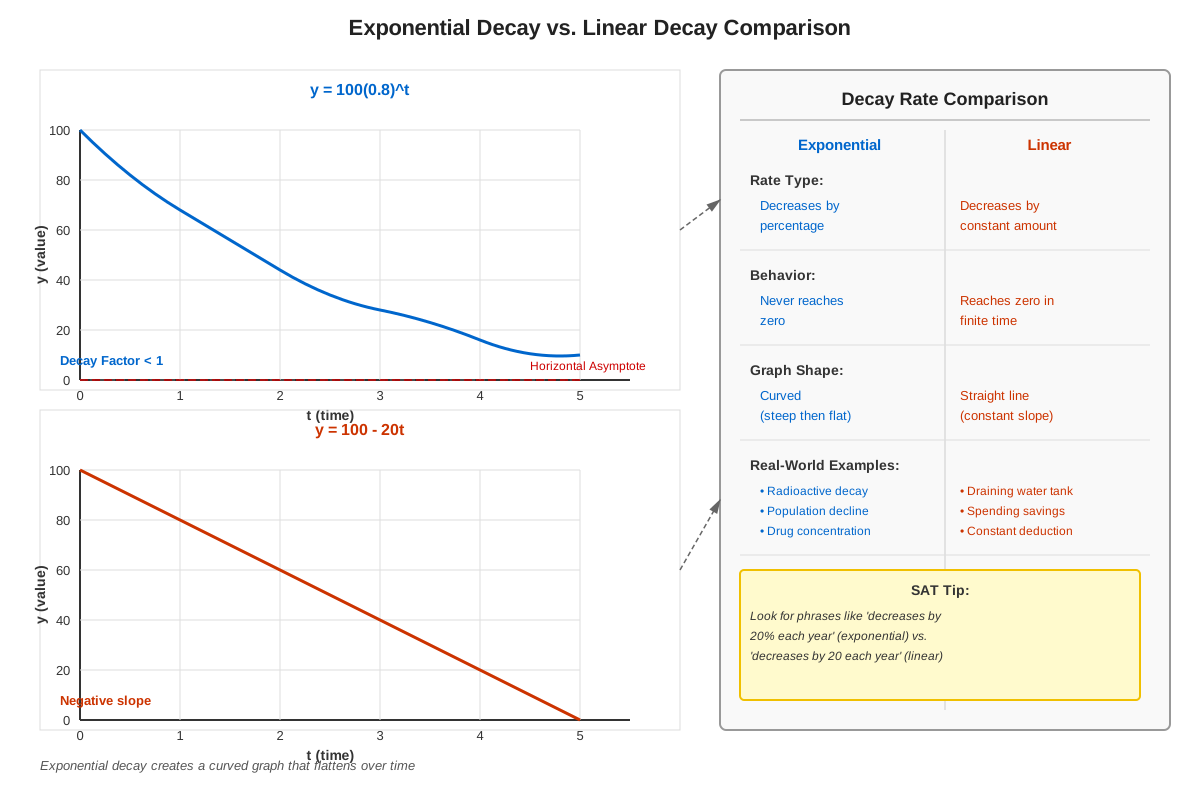
- Linear decrease: y = 100 - 15t (this is linear, not exponential)
Graphical Features of Exponential Decay
Exponential decay functions have distinctive graphical characteristics that appear frequently on SAT questions:
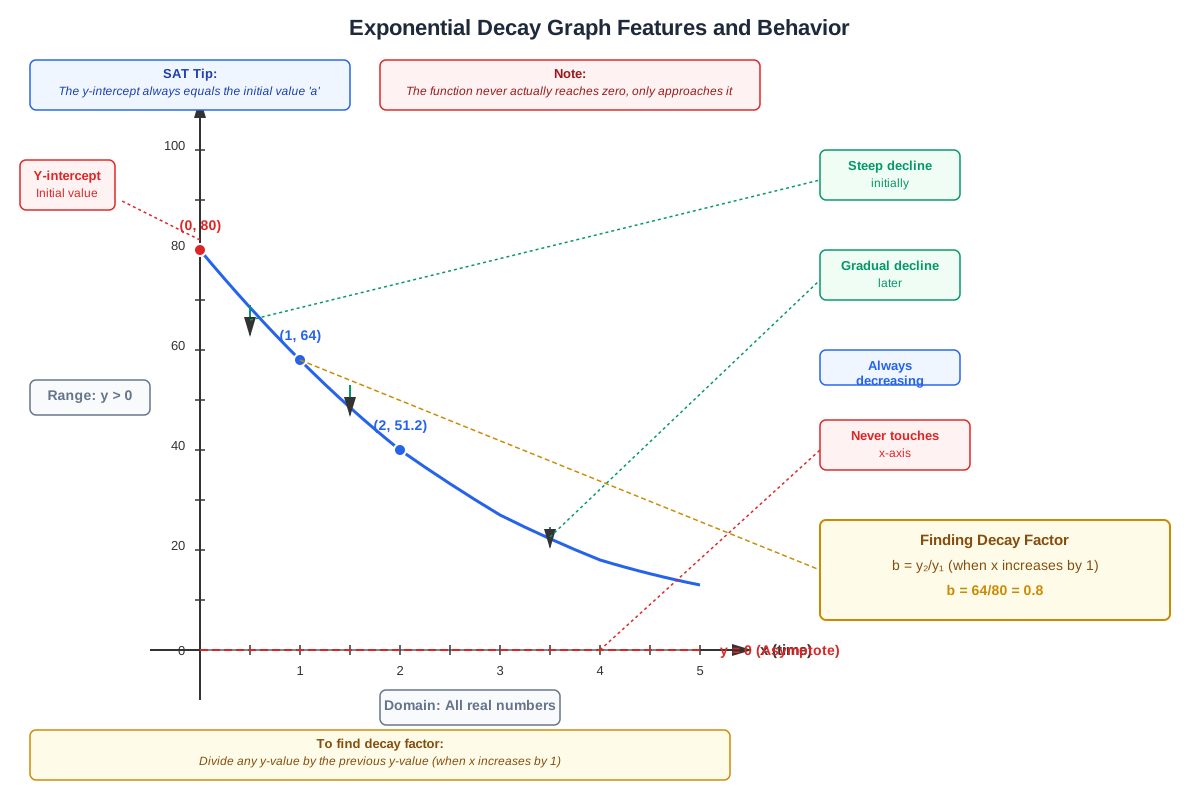
- Y-intercept: Always equals the initial value (a), since any number to the zero power equals 1
- Shape: Curves downward (concave up), decreasing rapidly at first then more slowly
- Asymptote: Approaches but never reaches the x-axis (y = 0 is a horizontal asymptote)
- Domain: All real numbers (or all non-negative numbers in real-world contexts)
- Range: All positive real numbers (y > 0)
- Decreasing behavior: Always decreasing; the function never increases
When comparing multiple decay functions graphically, the one with the smaller decay factor (larger decay rate) decreases more steeply. A function with b = 0.5 decays faster than one with b = 0.8.
Converting Between Forms
SAT questions often require converting between different representations of exponential decay:
Percentage form to equation:
"Decreases by 18% annually" → y = a(1 - 0.18)^t = a(0.82)^t
Decimal form to percentage:
y = 500(0.93)^t → Decay factor is 0.93, so decay rate is 1 - 0.93 = 0.07 = 7% decrease
Fraction form to decimal:
y = 200(4/5)^t → 4/5 = 0.8, so this represents 20% decay per period
Half-life to general form:
Half-life of 10 years → y = a(0.5)^(t/10) = a(0.5^(1/10))^t ≈ a(0.933)^t
Concept Relationships
The concepts within exponential decay form a hierarchical structure. The general exponential decay formula serves as the foundation, from which all other concepts derive. Understanding the decay factor (1 - r) is essential before students can work with decay rates, since the factor is what actually appears in the equation while the rate is how problems typically present information. This relationship (decay rate → decay factor → exponential equation) represents the most common translation students must perform.
Half-life problems are a specialized application of the general decay formula, where the decay factor is always 0.5 and the exponent involves division by the half-life period. This connects back to the general form through substitution: setting b = 0.5 and t = nh (where n is the number of half-lives) produces the half-life formula. Students who master the general form can derive the half-life formula rather than memorizing it separately.
Graphical interpretation connects to all other concepts by providing visual representation of the mathematical relationships. The y-intercept corresponds to the initial value (a), the steepness of the curve reflects the decay rate (larger r means steeper decline), and the asymptotic behavior illustrates that exponential decay never reaches zero. Graph analysis questions often require students to work backward from visual features to determine the underlying equation.
The relationship to prerequisite topics is direct: exponent rules enable manipulation of decay expressions (such as rewriting (0.5)^(t/h) as (0.5^(1/h))^t), percentage skills allow conversion between decay rates and factors, and algebraic equation solving permits finding unknown variables like time or initial amount. These prerequisites → exponential decay concepts → SAT problem solving represents the learning progression.
High-Yield Facts
⭐ The decay factor is always (1 - r), not r itself; if something decreases by 25%, multiply by 0.75, not 0.25
⭐ Exponential decay functions have a base between 0 and 1 when written in the form y = a·b^t
⭐ The y-intercept of an exponential decay graph always equals the initial value (a)
⭐ After one half-life period, exactly 50% of the original amount remains; after two half-lives, 25% remains; after three half-lives, 12.5% remains
⭐ Exponential decay never reaches zero; the function approaches but never touches the x-axis
- A negative exponent with a base greater than 1 can represent decay: 100(2)^(-t) = 100(1/2)^t
- The decay rate as a percentage equals (1 - decay factor) × 100%
- Exponential decay decreases by the same percentage (not the same amount) in each time period
- When comparing two decay functions with the same initial value, the one with the smaller decay factor decreases faster
- The domain of exponential decay functions in real-world contexts is typically t ≥ 0 (non-negative time)
- Converting between time units requires adjusting the exponent: yearly decay of 20% equals monthly decay of approximately 1.85%
- Exponential decay functions are always concave up (curving upward) even though they're decreasing
Quick check — test yourself on Exponential decay so far.
Try Flashcards →Common Misconceptions
Misconception: Using the decay rate as the base in the exponential function (e.g., writing y = 100(0.20)^t for 20% decay)
Correction: The base must be the decay factor (1 - r), not the decay rate r. For 20% decay, the correct base is 0.80, giving y = 100(0.80)^t. The decay rate tells you what percentage is lost; the decay factor tells you what percentage remains.
Misconception: Believing exponential decay eventually reaches zero
Correction: Exponential decay approaches zero asymptotically but never actually reaches it. Mathematically, no matter how large t becomes, b^t (where 0 < b < 1) is always positive, just increasingly small. In practical applications, we might round to zero, but the mathematical function never equals zero.
Misconception: Thinking exponential decay and linear decay are the same thing
Correction: Linear decay subtracts a constant amount each period (y = a - rt), while exponential decay multiplies by a constant factor each period (y = a·b^t). Exponential decay starts fast and slows down; linear decay proceeds at a constant rate. A car losing $2,000 in value each year is linear; losing 15% of its value each year is exponential.
Misconception: Confusing the number of half-lives with the half-life period
Correction: The half-life period (h) is the time for one halving to occur. The number of half-lives is t/h. If the half-life is 5 hours and 15 hours have passed, that's 15/5 = 3 half-lives, meaning the amount has halved three times: original → 1/2 → 1/4 → 1/8.
Misconception: Assuming that if something decays by 50% twice, it's completely gone
Correction: Each 50% decay is applied to the current amount, not the original. Starting with 100: after first 50% decay, 50 remains; after second 50% decay, 25 remains (50% of 50). This is why exponential decay never reaches zero—each reduction is a percentage of what's left.
Misconception: Believing a larger decay factor means faster decay
Correction: A larger decay factor means slower decay. The decay factor represents what remains, so b = 0.9 (90% remains, 10% lost) decays more slowly than b = 0.7 (70% remains, 30% lost). Larger decay rate means faster decay; larger decay factor means slower decay.
Worked Examples
Example 1: Car Depreciation Problem
Problem: A car is purchased for $28,000 and depreciates at a rate of 18% per year. What is the value of the car after 4 years, rounded to the nearest dollar?
Solution:
Step 1: Identify the components of the exponential decay formula.
- Initial value (a) = $28,000
- Decay rate (r) = 18% = 0.18
- Time (t) = 4 years
- We need to find y (final value)
Step 2: Calculate the decay factor.
- Decay factor (b) = 1 - r = 1 - 0.18 = 0.82
- This means 82% of the value remains each year
Step 3: Write the exponential decay equation.
- y = a(1 - r)^t
- y = 28,000(0.82)^4
Step 4: Calculate the result.
- (0.82)^4 = 0.82 × 0.82 × 0.82 × 0.82 ≈ 0.4521
- y = 28,000 × 0.4521 ≈ 12,659
Answer: The car is worth approximately $12,659 after 4 years.
Connection to learning objectives: This problem demonstrates applying exponential decay to a real-world SAT-style question, identifying the key features (initial value, decay rate, time), and converting the decay rate to the proper decay factor before calculation.
Example 2: Half-Life with Multiple Steps
Problem: A radioactive isotope has a half-life of 12 days. If a sample initially contains 800 grams of the isotope, how many grams remain after 36 days?
Solution:
Step 1: Determine how many half-lives have elapsed.
- Half-life period (h) = 12 days
- Total time (t) = 36 days
- Number of half-lives = t/h = 36/12 = 3 half-lives
Step 2: Apply the half-life formula.
- y = a(1/2)^(t/h)
- y = 800(1/2)^3
- y = 800(1/2)^3 = 800 × 1/8 = 100
Alternative approach (thinking through each half-life):
- After 12 days (1 half-life): 800 × 1/2 = 400 grams
- After 24 days (2 half-lives): 400 × 1/2 = 200 grams
- After 36 days (3 half-lives): 200 × 1/2 = 100 grams
Step 3: Verify the answer makes sense.
- Three halvings: 800 → 400 → 200 → 100 ✓
- The amount decreased but didn't reach zero ✓
- Each step reduced the amount by 50% of what remained ✓
Answer: 100 grams of the isotope remain after 36 days.
Connection to learning objectives: This problem illustrates identifying exponential decay in a scientific context, applying the specialized half-life formula, and explaining how exponential decay appears on the SAT in word problem format. It also demonstrates the relationship between the general decay formula and the half-life formula.
Exam Strategy
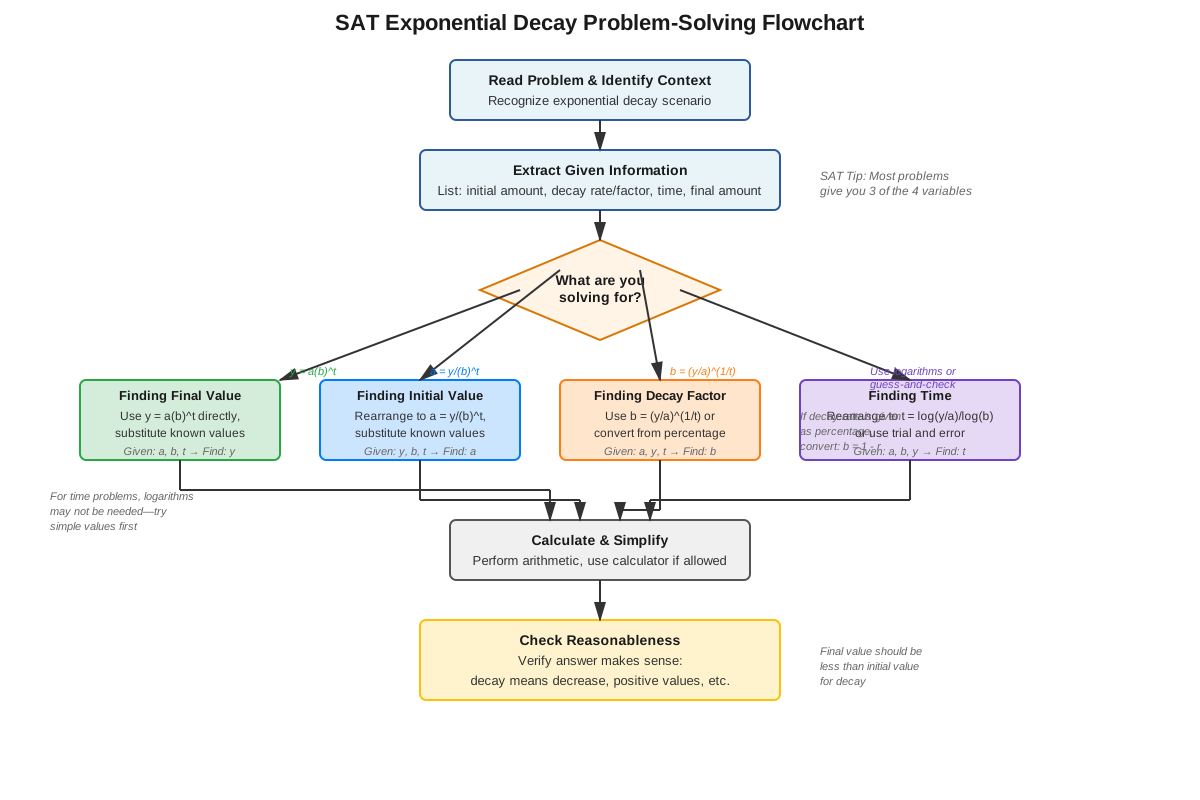
When approaching SAT exponential decay questions, begin by identifying whether the problem involves decay or growth. Look for keywords: "decreases," "depreciates," "decays," "reduces," "loses value," "half-life," and "elimination" all signal decay. Conversely, "increases," "grows," "appreciates," and "compounds" indicate growth. This distinction is crucial because using a growth formula for a decay problem (or vice versa) guarantees an incorrect answer.
Next, extract the three essential pieces of information: initial value (a), decay rate or factor (r or b), and time (t). The question will provide two of these and ask for the third, or provide all three and ask you to evaluate the function. Create a mental checklist: "What do I start with? What's the rate of decrease? How much time passes? What am I solving for?" Write down these values to avoid confusion during calculation.
Trigger phrases and their meanings:
- "Decreases by X% per [time unit]" → decay rate r = X/100, decay factor b = 1 - X/100
- "Retains X% per [time unit]" → decay factor b = X/100 directly
- "Half-life of [time]" → use formula y = a(0.5)^(t/h)
- "What percent remains?" → calculate y/a × 100%
- "After how many [time units]?" → solve for t
For multiple-choice questions, use process of elimination strategically. If the question asks for the value after decay, eliminate any answer choices larger than the initial value (decay can't increase the amount). If comparing equations, eliminate any with bases greater than 1 or with addition in the form (1 + r). When a question provides a graph, eliminate equations whose y-intercept doesn't match the graph's y-intercept.
Time allocation: Straightforward calculation problems should take 45-60 seconds. Word problems requiring model construction may take 90-120 seconds. Don't spend more than 2 minutes on any single exponential decay question; if you're stuck, mark it and return later. The calculation itself is usually simple—the challenge is setting up the equation correctly.
For questions asking "which equation represents...," work backward: test the answer choices by plugging in t = 0 (should give the initial value) and t = 1 (should give the value after one period of decay). This verification method is often faster than trying to construct the equation from scratch.
Memory Techniques
Mnemonic for the decay formula structure: "A Big Turtle" = A·B^T
- A = initial Amount
- B = Base (decay factor, between 0 and 1)
- T = Time
Visualization for decay vs. growth: Picture a melting ice cube for decay (getting smaller but never completely disappearing) versus a growing plant for growth. When you see an equation, ask: "Is this ice melting or a plant growing?"
Half-life memory trick: "Half-life = Half-left" after one period. After two periods, "half of half" = 1/4. After three periods, "half of half of half" = 1/8. The pattern is (1/2)^n where n is the number of half-lives.
Decay factor vs. decay rate: Remember "Factor is what's left, rate is what left"
- Decay factor = what's left (remaining)
- Decay rate = what left (departed)
- Factor + Rate = 1 (or 100%)
Acronym for problem-solving steps: "WRITE"
- What are you solving for?
- Rate: identify the decay rate and convert to decay factor
- Initial value: find the starting amount
- Time: determine the time period
- Evaluate: plug into formula and calculate
Visual for base values: Imagine a number line from 0 to 2. Mark 1 in the middle. Decay bases live between 0 and 1 (left of center), growth bases live between 1 and infinity (right of center). If you see 0.85, it's left of 1 = decay. If you see 1.15, it's right of 1 = growth.
Summary
Exponential decay describes quantities that decrease by a constant percentage per time period, following the formula y = a(1 - r)^t or y = a·b^t where 0 < b < 1. The critical distinction between decay rate (the percentage lost) and decay factor (the percentage remaining) is fundamental: the decay factor (1 - r) serves as the base in the exponential equation. On the SAT, exponential decay appears in contexts including depreciation, radioactive decay, medication elimination, and population decline. Key features include an initial value (y-intercept), a base between 0 and 1, asymptotic behavior approaching but never reaching zero, and a characteristic curved graph that decreases rapidly at first then more gradually. Half-life problems represent a special case where the decay factor is 0.5 and the exponent involves the ratio t/h. Success on SAT exponential decay questions requires identifying the problem type, extracting relevant information, converting decay rates to decay factors, applying the appropriate formula, and interpreting results in context. Students must distinguish exponential decay from linear decrease and exponential growth, recognize various forms of decay equations, and work comfortably with both algebraic and graphical representations.
Key Takeaways
- The decay factor is (1 - r), not r; for 30% decay, multiply by 0.70 each period, not 0.30
- Exponential decay bases are always between 0 and 1; bases greater than 1 indicate growth
- The y-intercept of any exponential decay graph equals the initial value (a)
- Half-life problems use the formula y = a(0.5)^(t/h) where h is the half-life period
- Exponential decay never reaches zero—it approaches the x-axis asymptotically
- Each time period reduces the quantity by the same percentage, not the same amount
- SAT questions test both computational skills and conceptual understanding of decay behavior
Related Topics
Exponential Growth: The inverse of exponential decay, using bases greater than 1 to model increasing quantities. Mastering decay makes growth intuitive since the formulas are structurally identical with different base values. Essential for compound interest and population growth problems.
Logarithms: The inverse operation of exponentiation, used to solve for time or rate in exponential equations. Understanding exponential decay provides the foundation for logarithmic problem-solving, particularly when questions ask "how long until..." or "what rate produces..."
Geometric Sequences: Discrete versions of exponential functions where each term is found by multiplying the previous term by a constant ratio. The decay factor in exponential decay corresponds to the common ratio in geometric sequences.
Function Transformations: Exponential decay functions can be translated, reflected, and stretched. Understanding the basic decay function enables analysis of more complex transformed versions that appear in advanced SAT questions.
Rational Functions and Asymptotes: The asymptotic behavior of exponential decay (approaching but never reaching zero) connects to horizontal asymptotes in rational functions, reinforcing understanding of limiting behavior.
Practice CTA
Now that you've mastered the core concepts of exponential decay, it's time to solidify your understanding through practice. Attempt the practice questions to test your ability to identify decay features, construct equations from word problems, and solve for unknown variables. Use the flashcards to reinforce key formulas, definitions, and problem-solving strategies. Remember: exponential decay questions are high-yield on the SAT, and consistent practice with this topic can significantly boost your Math score. Each problem you solve strengthens your pattern recognition and builds the confidence you need to tackle these questions quickly and accurately on test day. You've got this!
Sign up free to keep reading
Create a free AnvayaPrep account to finish this SAT guide on Exponential decay — plus flashcards and practice questions.