Overview
Fractional exponents represent one of the most elegant and powerful concepts in algebra, bridging the gap between exponential notation and radical expressions. On the SAT, this topic appears frequently in both the calculator and no-calculator sections, testing students' ability to manipulate expressions, simplify complex terms, and solve equations involving powers and roots. Understanding fractional exponents is not merely about memorizing conversion rules—it's about recognizing that expressions like x^(1/2) and √x are two different notations for the same mathematical relationship. This dual representation allows students to choose the most efficient approach when solving problems, often transforming seemingly complex radical expressions into manageable exponential forms.
The importance of fractional exponents on the SAT cannot be overstated. These expressions appear in polynomial simplification, equation solving, function analysis, and word problems involving growth and decay. Students who master fractional exponents gain a significant advantage because they can fluidly move between radical and exponential notation, selecting whichever form makes the problem easier to solve. This flexibility is particularly valuable when dealing with multiple-choice questions where answer choices may be presented in different formats.
Within the broader landscape of math on the SAT, fractional exponents connect directly to several critical areas: exponent rules, radical operations, polynomial functions, and rational expressions. They serve as a foundation for understanding more advanced topics like exponential functions and logarithms, while simultaneously requiring solid knowledge of basic arithmetic operations with fractions. Mastering this topic strengthens overall algebraic fluency and problem-solving efficiency—two qualities that directly translate to higher SAT scores.
Learning Objectives
- [ ] Identify key features of fractional exponents and recognize their relationship to radical expressions
- [ ] Explain how fractional exponents appears on the SAT, including common question formats and difficulty levels
- [ ] Apply fractional exponents to answer SAT-style questions involving simplification, evaluation, and equation solving
- [ ] Convert seamlessly between radical notation and fractional exponent notation in both directions
- [ ] Simplify complex expressions involving fractional exponents using exponent rules
- [ ] Evaluate numerical expressions with fractional exponents without a calculator
- [ ] Solve equations containing fractional exponents by applying inverse operations
Prerequisites
- Integer exponents and exponent rules: Understanding properties like x^a · x^b = x^(a+b) is essential because these same rules apply to fractional exponents
- Radical notation and simplification: Familiarity with square roots, cube roots, and higher-order roots provides the conceptual foundation for understanding fractional exponents
- Operations with fractions: Adding, subtracting, multiplying, and dividing fractions is necessary for manipulating fractional exponents
- Order of operations: Knowing when to apply exponents versus other operations prevents common calculation errors
- Basic algebraic manipulation: Skills in factoring, distributing, and combining like terms are required for simplifying expressions with fractional exponents
Why This Topic Matters
Fractional exponents appear in numerous real-world applications that make them relevant beyond standardized testing. Scientists use fractional exponents to model phenomena like radioactive decay, population growth, and compound interest. Engineers apply them in calculations involving surface area-to-volume ratios, which scale with fractional powers. In physics, many relationships between variables involve fractional exponents, such as Kepler's laws of planetary motion. Even in everyday contexts, understanding fractional exponents helps with financial literacy, particularly when calculating investment returns over partial time periods.
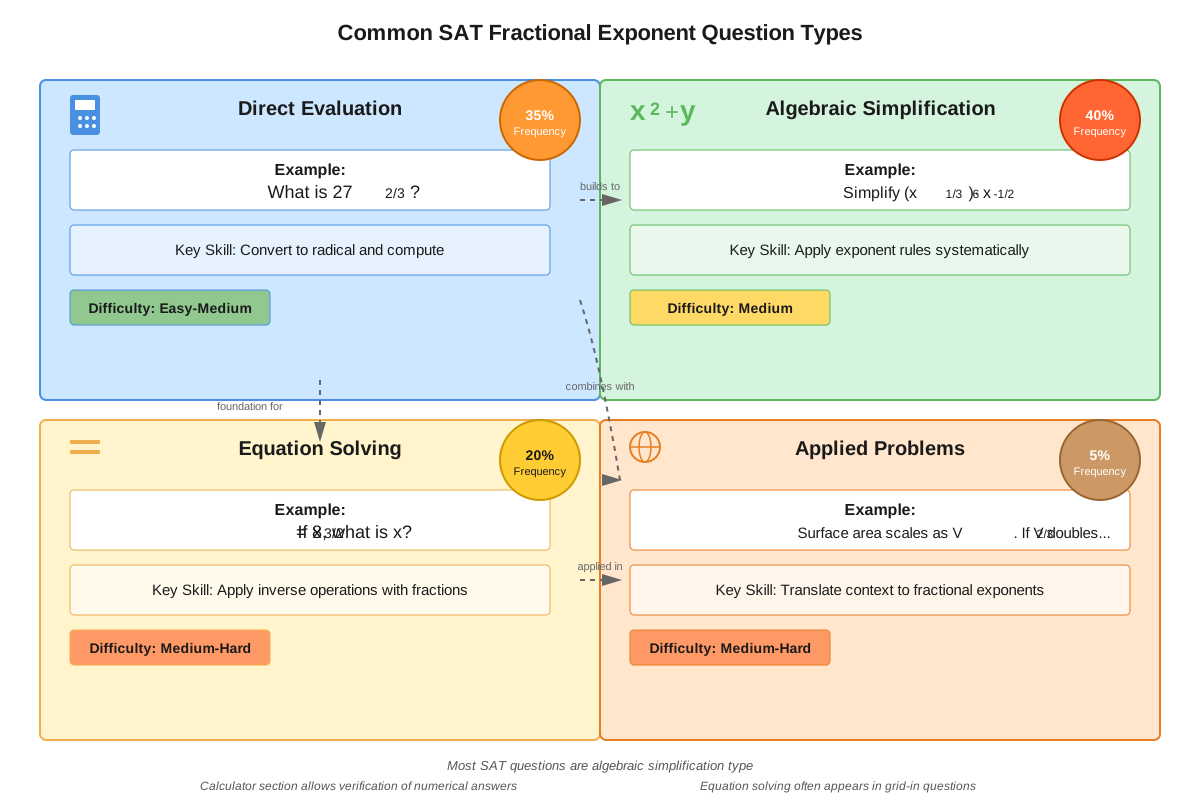
On the SAT, fractional exponents appear with remarkable consistency. Statistical analysis of recent SAT administrations shows that approximately 2-4 questions per test directly involve fractional exponents, with additional questions incorporating them as part of more complex problems. These questions typically appear in the Heart of Algebra and Passport to Advanced Math content domains. The difficulty level ranges from medium to hard, with easier questions testing basic conversion and simplification, while harder questions embed fractional exponents within multi-step problems involving functions, equations, or word problems.
Common question formats include: simplifying expressions with fractional exponents, converting between radical and exponential notation, evaluating numerical expressions, solving equations where the variable has a fractional exponent, and identifying equivalent expressions among multiple-choice options. The SAT particularly favors questions that require students to recognize that different-looking expressions are actually equivalent—for example, recognizing that x^(2/3) and (∛x)² represent the same value. Questions may also involve negative fractional exponents, combining the concepts of reciprocals and roots.
Core Concepts
Definition and Fundamental Relationship
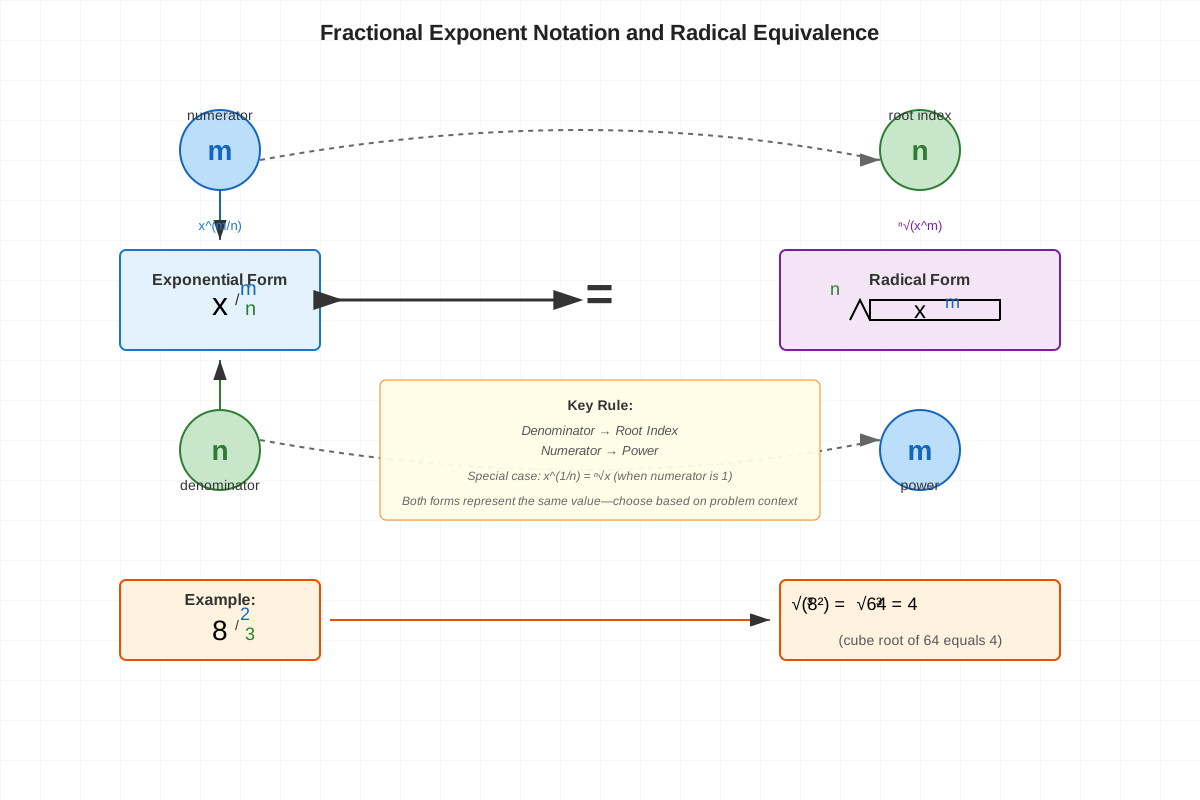
A fractional exponent is an exponent expressed as a fraction, written in the form x^(m/n) where m and n are integers and n ≠ 0. The fundamental relationship that defines fractional exponents is:
x^(m/n) = ⁿ√(x^m) = (ⁿ√x)^mThis equation reveals that a fractional exponent represents both a power and a root operation. The denominator (n) indicates the root to be taken, while the numerator (m) indicates the power. This dual interpretation provides flexibility in how to approach calculations and simplifications.
For example, 8^(2/3) can be evaluated in two ways:
- Take the cube root first, then square: (∛8)² = 2² = 4
- Square first, then take the cube root: ∛(8²) = ∛64 = 4
Both methods yield the same result, but one may be computationally easier depending on the numbers involved. Generally, taking the root first (using the denominator) is more efficient because it reduces the size of the numbers before applying the power.
Unit Fractions as Exponents
The simplest fractional exponents have a numerator of 1, written as x^(1/n). These expressions represent pure root operations:
- x^(1/2) = √x (square root)
- x^(1/3) = ∛x (cube root)
- x^(1/4) = ⁴√x (fourth root)
- x^(1/n) = ⁿ√x (nth root)
Understanding this relationship is crucial because it forms the foundation for all fractional exponents. When students see x^(1/2), they should immediately recognize it as equivalent to the square root of x. This recognition allows for quick conversions and simplifications on the SAT, where time efficiency matters significantly.
Applying Exponent Rules to Fractional Exponents
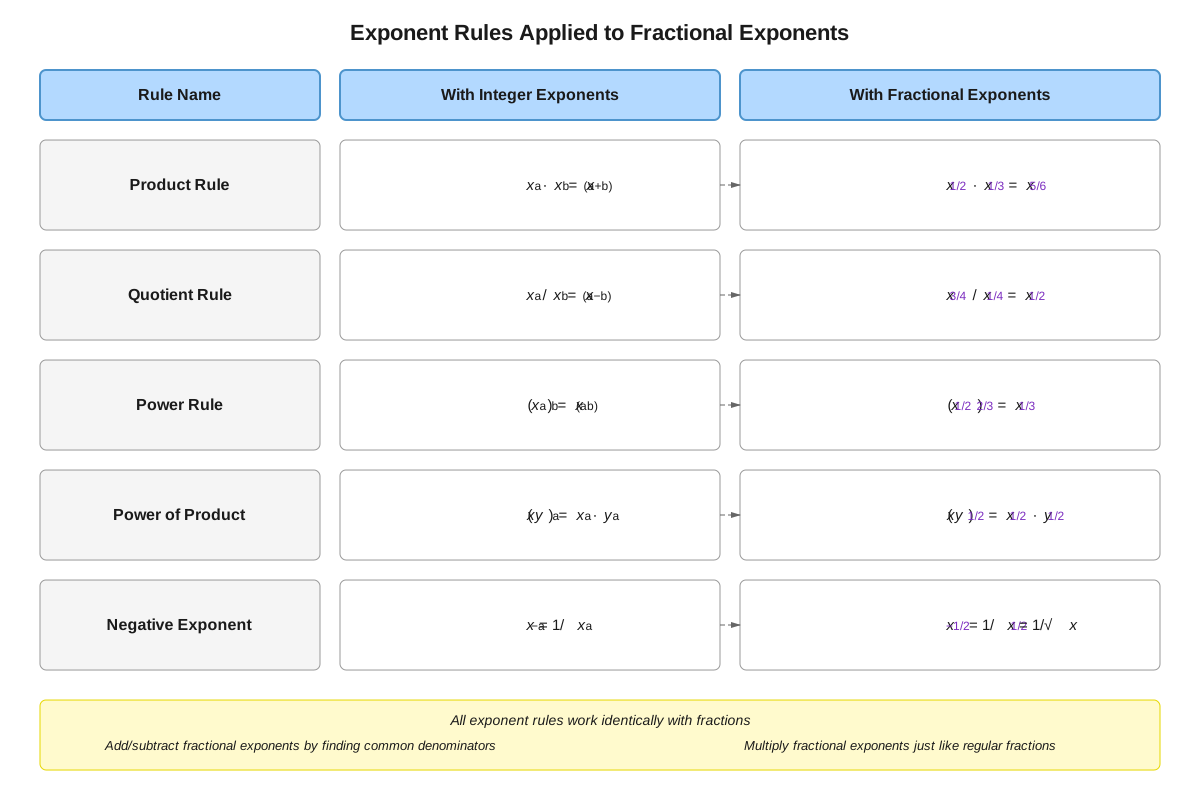
All standard exponent rules apply equally to fractional exponents. This consistency is what makes fractional exponents so powerful—they follow the same algebraic principles as integer exponents.
| Rule Name | General Form | Example with Fractional Exponents |
|---|---|---|
| Product Rule | x^a · x^b = x^(a+b) | x^(1/2) · x^(1/3) = x^(5/6) |
| Quotient Rule | x^a / x^b = x^(a-b) | x^(3/4) / x^(1/4) = x^(1/2) |
| Power Rule | (x^a)^b = x^(ab) | (x^(2/3))^(3/2) = x^1 = x |
| Power of Product | (xy)^a = x^a · y^a | (8x)^(1/3) = 2x^(1/3) |
| Power of Quotient | (x/y)^a = x^a / y^a | (x/16)^(1/2) = x^(1/2)/4 |
When applying these rules, remember that adding or subtracting fractional exponents requires finding common denominators, just as with regular fraction arithmetic. For instance, x^(1/2) · x^(1/3) requires converting to x^(3/6) · x^(2/6) = x^(5/6).
Negative Fractional Exponents
Negative fractional exponents combine two concepts: reciprocals (from negative exponents) and roots (from fractional exponents). The general rule is:
x^(-m/n) = 1 / x^(m/n) = 1 / ⁿ√(x^m)For example:
- 16^(-1/2) = 1/16^(1/2) = 1/4
- 27^(-2/3) = 1/27^(2/3) = 1/(∛27)² = 1/9
On the SAT, questions involving negative fractional exponents often test whether students can correctly apply both the reciprocal and root operations in the proper sequence. A common approach is to first convert the negative exponent to a reciprocal, then evaluate the positive fractional exponent.
Simplifying Expressions with Fractional Exponents
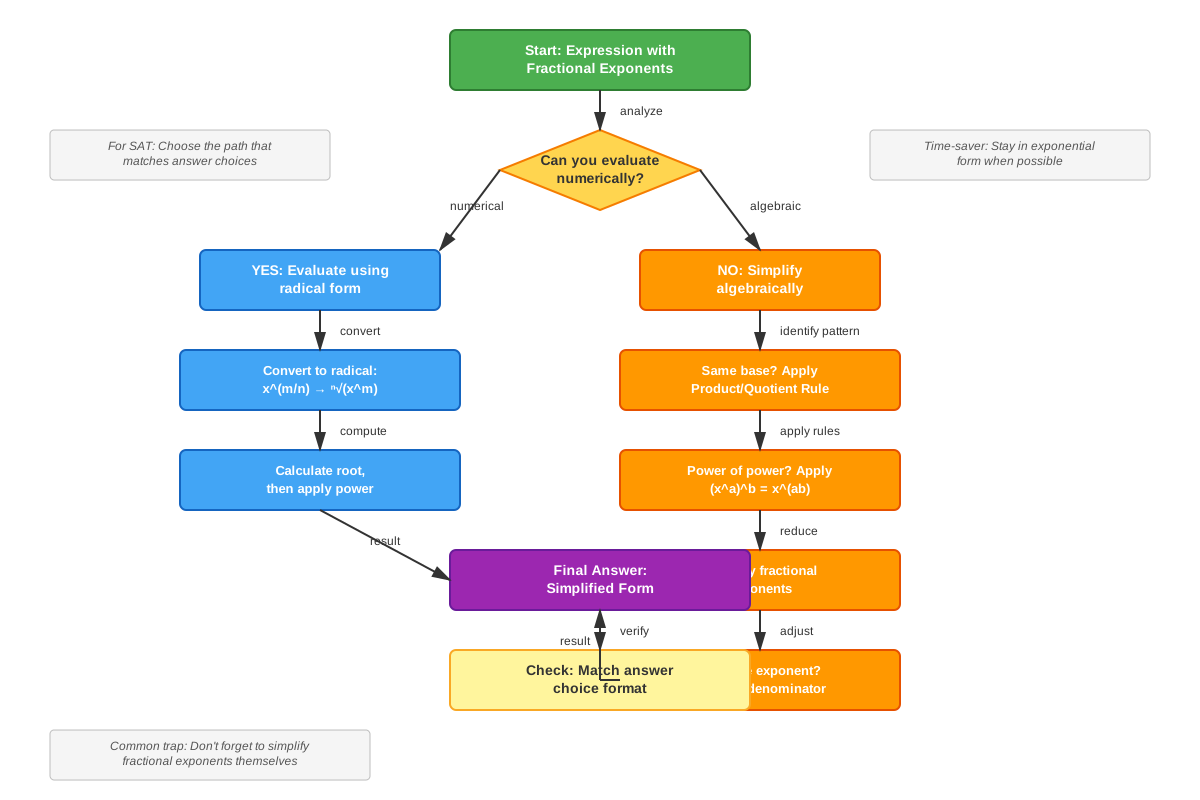
Simplification problems on the SAT require systematic application of exponent rules. The general strategy involves:
- Convert all terms to exponential form if they're written as radicals
- Apply exponent rules to combine like bases
- Simplify fractional exponents by performing fraction arithmetic
- Convert back to radical form if the answer choices use radical notation
Consider simplifying: (x^(1/2) · x^(3/4)) / x^(1/4)
Step 1: Apply the product rule to the numerator: x^(1/2 + 3/4) = x^(5/4)
Step 2: Apply the quotient rule: x^(5/4) / x^(1/4) = x^(5/4 - 1/4) = x^(4/4) = x^1 = x
Evaluating Numerical Expressions
The SAT frequently asks students to evaluate expressions with fractional exponents without a calculator. Success requires recognizing perfect powers and choosing the most efficient evaluation order.
Key perfect powers to memorize:
- Perfect squares: 1, 4, 9, 16, 25, 36, 49, 64, 81, 100, 121, 144
- Perfect cubes: 1, 8, 27, 64, 125, 216
- Powers of 2: 2, 4, 8, 16, 32, 64, 128, 256
- Powers of 3: 3, 9, 27, 81, 243
When evaluating 64^(2/3), recognize that 64 = 4³, so taking the cube root first gives 4, then squaring yields 16. Alternatively, recognize that 64 = 2^6, so 64^(2/3) = (2^6)^(2/3) = 2^4 = 16.
Solving Equations with Fractional Exponents
To solve equations where the variable has a fractional exponent, apply the reciprocal exponent to both sides. If the equation is x^(m/n) = k, then raise both sides to the power n/m:
(x^(m/n))^(n/m) = k^(n/m)
x = k^(n/m)
For example, to solve x^(2/3) = 16:
- Raise both sides to the 3/2 power: (x^(2/3))^(3/2) = 16^(3/2)
- Simplify the left side: x^1 = x
- Evaluate the right side: 16^(3/2) = (√16)³ = 4³ = 64
- Solution: x = 64
Always verify solutions, especially when dealing with even roots, as extraneous solutions can arise.
Concept Relationships
The concepts within fractional exponents form a hierarchical structure. At the foundation lies the definition of fractional exponents as representing both powers and roots. This definition leads directly to unit fraction exponents, which establish the connection between x^(1/n) and nth roots. Understanding unit fractions enables comprehension of general fractional exponents x^(m/n), which combine power and root operations.
The exponent rules (product, quotient, and power rules) serve as the operational framework that connects all fractional exponent concepts. These rules enable simplification of expressions, which is the most common task on the SAT. Simplification skills then support equation solving, where students must manipulate expressions to isolate variables with fractional exponents.
Negative fractional exponents represent a synthesis of multiple concepts: they require understanding of negative exponents (reciprocals), fractional exponents (roots and powers), and the order in which these operations should be applied. This makes them among the most challenging concepts for students but also among the most valuable for SAT success.
The relationship map flows as follows:
Basic exponent rules → Definition of fractional exponents → Unit fraction exponents → General fractional exponents → Simplification techniques → Equation solving and Numerical evaluation
Connections to prerequisite topics include: integer exponents provide the rule framework, radical operations offer alternative notation and conceptual understanding, and fraction arithmetic enables manipulation of the exponents themselves. Related topics that build on fractional exponents include exponential functions, logarithms, and polynomial functions with non-integer degrees.
Quick check — test yourself on Fractional exponents so far.
Try Flashcards →High-Yield Facts
⭐ The fundamental conversion: x^(m/n) = ⁿ√(x^m) = (ⁿ√x)^m, where the denominator indicates the root and the numerator indicates the power
⭐ Unit fraction exponents equal roots: x^(1/n) = ⁿ√x, making x^(1/2) = √x and x^(1/3) = ∛x
⭐ All standard exponent rules apply to fractional exponents: product rule, quotient rule, and power rule work identically with fractions as with integers
⭐ Negative fractional exponents: x^(-m/n) = 1/x^(m/n), combining reciprocal and root operations
⭐ When evaluating, take the root first: For x^(m/n), computing (ⁿ√x)^m is usually easier than ⁿ√(x^m) because it keeps numbers smaller
- Adding/subtracting fractional exponents requires common denominators: x^(1/2) · x^(1/3) = x^(3/6) · x^(2/6) = x^(5/6)
- Perfect powers are essential for no-calculator evaluation: Memorize squares through 12², cubes through 6³, and powers of 2 and 3
- The power rule with fractional exponents: (x^(a/b))^(c/d) = x^(ac/bd), requiring multiplication of fractions
- Zero as a base: 0^(m/n) = 0 for any positive m/n, but 0^(-m/n) is undefined
- Fractional exponents with coefficients: (ax)^(m/n) = a^(m/n) · x^(m/n), allowing separation of numerical and variable parts
- Equivalent expressions: x^(2/4) = x^(1/2) because fractional exponents can be reduced like regular fractions
- Domain considerations: x^(1/n) requires x ≥ 0 when n is even (to avoid imaginary numbers on the SAT)
Common Misconceptions
Misconception: The denominator of a fractional exponent represents the power and the numerator represents the root.
Correction: It's the opposite—the denominator indicates which root to take (x^(1/n) = ⁿ√x), while the numerator indicates the power. For x^(2/3), take the cube root and then square, not the square root and then cube.
Misconception: x^(1/2) + x^(1/2) = x^1 = x
Correction: Adding terms with the same base and exponent means adding coefficients, not exponents. x^(1/2) + x^(1/2) = 2x^(1/2), just as x + x = 2x. Exponents are only added when multiplying terms with the same base: x^(1/2) · x^(1/2) = x^1 = x.
Misconception: (x + y)^(1/2) = x^(1/2) + y^(1/2)
Correction: Exponents do not distribute over addition. (x + y)^(1/2) = √(x + y), which cannot be simplified further. The power of a sum rule only applies to multiplication: (xy)^(1/2) = x^(1/2) · y^(1/2).
Misconception: When solving x^(2/3) = 8, simply take the cube root of both sides to get x^2 = 2.
Correction: To isolate x, raise both sides to the reciprocal power (3/2), not just apply the denominator. The correct process is (x^(2/3))^(3/2) = 8^(3/2), giving x = (√8)³ = (2√2)³ = 16√2.
Misconception: Negative fractional exponents make the result negative.
Correction: Negative exponents create reciprocals, not negative numbers. 4^(-1/2) = 1/4^(1/2) = 1/2, which is positive. The sign of the exponent affects the position (numerator vs. denominator), not the sign of the result.
Misconception: x^(2/3) and x^(3/2) are equivalent expressions.
Correction: These represent different operations. x^(2/3) means (∛x)², while x^(3/2) means (√x)³. For x = 4: 4^(2/3) = (∛4)² ≈ 2.52, but 4^(3/2) = (√4)³ = 2³ = 8. Fractional exponents cannot be "flipped" without changing the value.
Misconception: Fractional exponents can only be applied to positive numbers.
Correction: While even roots of negative numbers create complex numbers (which the SAT avoids), odd roots of negative numbers are real. (-8)^(1/3) = -2 because the cube root of -8 is -2. However, (-8)^(2/3) is problematic because it could be interpreted as (∛(-8))² = 4 or as ∛((-8)²) = ∛64 = 4, though the SAT typically avoids such ambiguity.
Worked Examples
Example 1: Simplifying Complex Expressions
Problem: Simplify the expression (8x^6)^(2/3) / (4x^2)^(1/2)
Solution:
Step 1: Apply the power rule to each term in the numerator.
- (8x^6)^(2/3) = 8^(2/3) · (x^6)^(2/3)
- 8^(2/3) = (∛8)² = 2² = 4
- (x^6)^(2/3) = x^(6·2/3) = x^4
- So the numerator becomes: 4x^4
Step 2: Apply the power rule to each term in the denominator.
- (4x^2)^(1/2) = 4^(1/2) · (x^2)^(1/2)
- 4^(1/2) = √4 = 2
- (x^2)^(1/2) = x^(2·1/2) = x^1 = x
- So the denominator becomes: 2x
Step 3: Simplify the fraction.
- (4x^4) / (2x) = (4/2) · (x^4/x) = 2 · x^(4-1) = 2x³
Answer: 2x³
This problem demonstrates the importance of applying exponent rules systematically and recognizing perfect powers (8 = 2³ and 4 = 2²) to evaluate fractional exponents without a calculator. This connects to Learning Objective 3 (applying fractional exponents to SAT-style questions) and Learning Objective 5 (simplifying complex expressions).
Example 2: Solving Equations with Fractional Exponents
Problem: If (x - 3)^(3/2) = 27, what is the value of x?
Solution:
Step 1: Identify the reciprocal exponent needed to isolate the base.
- The variable expression has exponent 3/2
- The reciprocal is 2/3
- We'll raise both sides to the 2/3 power
Step 2: Apply the reciprocal exponent to both sides.
- [(x - 3)^(3/2)]^(2/3) = 27^(2/3)
- Left side: (x - 3)^(3/2 · 2/3) = (x - 3)^1 = x - 3
Step 3: Evaluate the right side.
- 27^(2/3) = (∛27)²
- ∛27 = 3 (because 3³ = 27)
- 3² = 9
- So 27^(2/3) = 9
Step 4: Solve for x.
- x - 3 = 9
- x = 12
Step 5: Verify the solution.
- (12 - 3)^(3/2) = 9^(3/2) = (√9)³ = 3³ = 27 ✓
Answer: x = 12
This problem illustrates the equation-solving technique of applying reciprocal exponents and the importance of verification. It connects to Learning Objective 3 (applying fractional exponents to SAT questions) and Learning Objective 7 (solving equations with fractional exponents). The SAT frequently embeds variables within expressions raised to fractional powers, making this a high-yield problem type.
Exam Strategy
When approaching sat fractional exponents questions on the SAT, begin by identifying whether the question asks for simplification, evaluation, conversion, or equation solving. This initial classification determines the appropriate strategy. For simplification problems, immediately convert all radical notation to exponential form, as this makes applying exponent rules more systematic and reduces errors.
Trigger words and phrases to watch for include: "equivalent to," "simplified form," "which expression," and "value of." When a question asks which expression is "equivalent to" a given expression, the answer choices often mix radical and exponential notation—practice converting between forms quickly. Questions asking for "simplified form" require complete simplification, meaning all exponent rules have been applied and no further reduction is possible.
Process-of-elimination strategies are particularly effective with fractional exponents. If answer choices contain different exponents, you can often eliminate options by checking the exponent arithmetic. For instance, if you're multiplying x^(1/2) · x^(1/3), any answer choice with an exponent other than 5/6 can be immediately eliminated. Similarly, if evaluating a numerical expression, calculate the approximate magnitude—if you're evaluating 16^(3/4), recognize it must be less than 16 but greater than 1, eliminating any answer choices outside this range.
For time allocation, straightforward conversion or simplification problems should take 30-45 seconds, while multi-step problems involving equations or complex expressions may require 60-90 seconds. If a problem requires more than two minutes, mark it for review and move on—the SAT rewards efficient time management. On no-calculator sections, prioritize problems with perfect powers (4, 8, 9, 16, 25, 27, etc.) as these can be evaluated exactly.
Strategic approaches for specific question types:
- Simplification: Convert to exponential form → Apply exponent rules → Reduce fractions → Convert back if needed
- Evaluation: Identify perfect powers → Choose root-first or power-first based on numbers → Calculate step-by-step
- Equation solving: Isolate the term with fractional exponent → Apply reciprocal exponent → Solve → Verify
- Equivalence: Convert all expressions to the same form (preferably exponential) → Compare exponents directly
Memory Techniques
Mnemonic for the fundamental relationship: "Denominator Digs for the root" (both start with D) helps remember that the denominator indicates which root to take, while the numerator indicates the power.
Visualization strategy: Picture fractional exponents as a two-step process represented by a fraction bar. The bottom (denominator) is the foundation—you must take the root first (dig down to the foundation). The top (numerator) is what you build—you raise to that power second (build up from the foundation).
Acronym for exponent rules: PQPP (Product, Quotient, Power, Power-of-Product)
- Product: Add exponents when multiplying
- Quotient: Subtract exponents when dividing
- Power: Multiply exponents when raising a power to a power
- Power-of-Product: Distribute the exponent to each factor
Memory aid for negative fractional exponents: "Negative flips, fraction splits"—negative exponents flip the base to the denominator (create a reciprocal), while the fraction splits into root (denominator) and power (numerator) operations.
Perfect powers memory palace: Associate perfect squares with common objects (4 = car wheels, 9 = baseball innings, 16 = ounces in a pound, 25 = quarter-century), perfect cubes with 3D objects (8 = octagon sides, 27 = 3×3×3 Rubik's cube), and powers of 2 with computer memory (2, 4, 8, 16, 32, 64, 128, 256 MB/GB).
Reciprocal exponent rhyme: "To solve for x when powers are split, flip the fraction—that's the trick!" This reminds students that solving x^(m/n) = k requires raising both sides to the n/m power.
Summary
Fractional exponents represent a powerful mathematical tool that unifies exponential and radical notation, appearing consistently on the SAT in various question formats. The core principle—that x^(m/n) equals both ⁿ√(x^m) and (ⁿ√x)^m—enables flexible problem-solving approaches. All standard exponent rules (product, quotient, and power rules) apply to fractional exponents, making them predictable and systematic to manipulate. Success requires recognizing perfect powers for efficient evaluation, understanding that denominators indicate roots while numerators indicate powers, and knowing how to apply reciprocal exponents when solving equations. Negative fractional exponents combine reciprocal and root operations, requiring careful attention to order of operations. The ability to convert seamlessly between radical and exponential notation, simplify complex expressions by applying exponent rules with proper fraction arithmetic, and evaluate numerical expressions without a calculator distinguishes high-scoring students. Mastery of fractional exponents strengthens overall algebraic fluency and provides a foundation for advanced topics in functions and equations.
Key Takeaways
- Fractional exponents connect exponential and radical notation through the relationship x^(m/n) = ⁿ√(x^m) = (ⁿ√x)^m, where the denominator indicates the root and numerator indicates the power
- All standard exponent rules apply to fractional exponents: add exponents when multiplying like bases, subtract when dividing, and multiply exponents when raising a power to a power
- When evaluating x^(m/n), taking the root first (using the denominator) typically produces smaller, more manageable numbers than raising to the power first
- Negative fractional exponents require two operations: x^(-m/n) = 1/x^(m/n), creating a reciprocal and then applying the fractional exponent
- To solve equations with fractional exponents, raise both sides to the reciprocal power: if x^(m/n) = k, then x = k^(n/m)
- Memorizing perfect squares through 144, perfect cubes through 216, and powers of 2 and 3 enables efficient no-calculator evaluation
- Converting all terms to exponential notation before simplifying reduces errors and makes applying exponent rules more systematic
Related Topics
Radical Expressions and Operations: Building directly on fractional exponents, this topic explores addition, subtraction, multiplication, and division of radicals, as well as rationalizing denominators. Mastering fractional exponents makes radical operations more intuitive because students can convert to exponential form when radicals become complex.
Exponential Functions: These functions use variable exponents (f(x) = a^x) and frequently appear on the SAT in growth and decay contexts. Understanding fractional exponents provides the foundation for analyzing exponential functions with non-integer inputs and outputs.
Rational Expressions: These algebraic fractions often contain terms with fractional exponents in numerators and denominators. Simplifying rational expressions requires the same exponent rules mastered in this topic.
Polynomial Functions: While most polynomials have integer exponents, understanding fractional exponents helps students recognize that functions like f(x) = x^(3/2) represent valid polynomial-like functions and prepares them for calculus concepts.
Logarithms: As the inverse operation of exponentiation, logarithms build directly on exponent concepts. The relationship between fractional exponents and roots parallels the relationship between logarithms and exponential functions.
Practice CTA
Now that you've mastered the core concepts of fractional exponents, it's time to solidify your understanding through active practice. Attempt the practice questions designed specifically for this topic—they mirror actual SAT question formats and difficulty levels. Work through each problem systematically, applying the strategies and techniques covered in this guide. Use the flashcards to reinforce key definitions, perfect powers, and conversion relationships until they become automatic. Remember, the difference between knowing these concepts and scoring points on test day lies in deliberate practice. Every problem you solve strengthens your pattern recognition and builds the confidence needed to tackle fractional exponents quickly and accurately under timed conditions. You've invested the time to learn—now invest the effort to practice, and watch your SAT math score reflect your mastery!
Sign up free to keep reading
Create a free AnvayaPrep account to finish this SAT guide on Fractional exponents — plus flashcards and practice questions.