Overview
Powers of ten are one of the most fundamental and frequently tested concepts in SAT math. This topic involves understanding how numbers can be expressed as multiples of 10 raised to various exponents, such as 10², 10³, or 10⁻¹. Mastering powers of ten is essential not only for direct calculation questions but also for scientific notation problems, order of magnitude comparisons, and real-world applications involving very large or very small numbers. The SAT regularly tests students' ability to manipulate these expressions, convert between standard and exponential forms, and perform operations with powers of ten efficiently.
The importance of powers of ten extends far beyond isolated calculation problems. This concept serves as a bridge between basic arithmetic and more advanced algebraic thinking, particularly when dealing with exponential expressions and scientific notation. Students who develop fluency with powers of ten gain significant advantages in time management during the exam, as many complex-looking problems can be simplified dramatically using these principles. Additionally, understanding powers of ten strengthens number sense and estimation skills, which are invaluable for checking answers and eliminating unreasonable options.
Powers of ten connect directly to broader mathematical concepts including exponent rules, scientific notation, logarithms, and place value systems. This topic appears across multiple question types on the SAT, from straightforward computational problems to word problems involving scientific contexts, data interpretation questions with large datasets, and multi-step algebraic manipulations. The ability to recognize when to apply powers of ten and to execute these operations accurately under time pressure distinguishes high-scoring students from those who struggle with efficiency.
Learning Objectives
- [ ] Identify key features of powers of ten, including positive and negative exponents
- [ ] Explain how powers of ten appears on the SAT across different question formats
- [ ] Apply powers of ten to answer SAT-style questions efficiently and accurately
- [ ] Convert between standard notation and powers of ten notation fluently
- [ ] Perform multiplication and division operations with powers of ten using exponent rules
- [ ] Estimate and compare magnitudes using powers of ten
- [ ] Recognize and simplify expressions involving powers of ten in scientific notation
Prerequisites
- Basic exponent rules: Understanding that exponents represent repeated multiplication is essential for grasping why 10³ = 1,000
- Place value system: Knowledge of ones, tens, hundreds, thousands places provides the foundation for understanding how powers of ten relate to decimal positions
- Integer operations: Ability to add, subtract, and work with positive and negative integers is necessary for manipulating exponents
- Multiplication and division: Fluency with basic operations enables quick mental calculations with powers of ten
Why This Topic Matters
Powers of ten appear in countless real-world contexts, from scientific measurements (distances in astronomy, sizes of microorganisms) to financial calculations (national budgets, population statistics) to technological specifications (computer memory, data transfer rates). Understanding powers of ten enables efficient communication about quantities that would otherwise require unwieldy strings of zeros. In professional fields including science, engineering, economics, and data analysis, powers of ten notation is the standard language for expressing measurements and making comparisons across vastly different scales.
On the SAT, powers of ten questions appear with remarkable frequency, typically showing up in 3-5 questions per test across both the calculator and no-calculator sections. These questions may be presented as straightforward computational problems worth quick points, or they may be embedded within more complex word problems, scientific notation conversions, or data interpretation scenarios. The College Board particularly favors questions that combine powers of ten with other concepts such as unit conversions, percent calculations, or algebraic expressions. Students who can quickly recognize and manipulate powers of ten gain significant time advantages that can be redirected to more challenging problems.
Common SAT question formats include: converting between standard and scientific notation; performing operations (multiplication, division) with numbers expressed as powers of ten; comparing magnitudes of quantities; solving word problems involving very large or small measurements; and simplifying algebraic expressions containing powers of ten. The topic also appears frequently in data interpretation questions where students must read values from graphs or tables and perform calculations involving orders of magnitude.
Core Concepts
Understanding Powers of Ten Notation
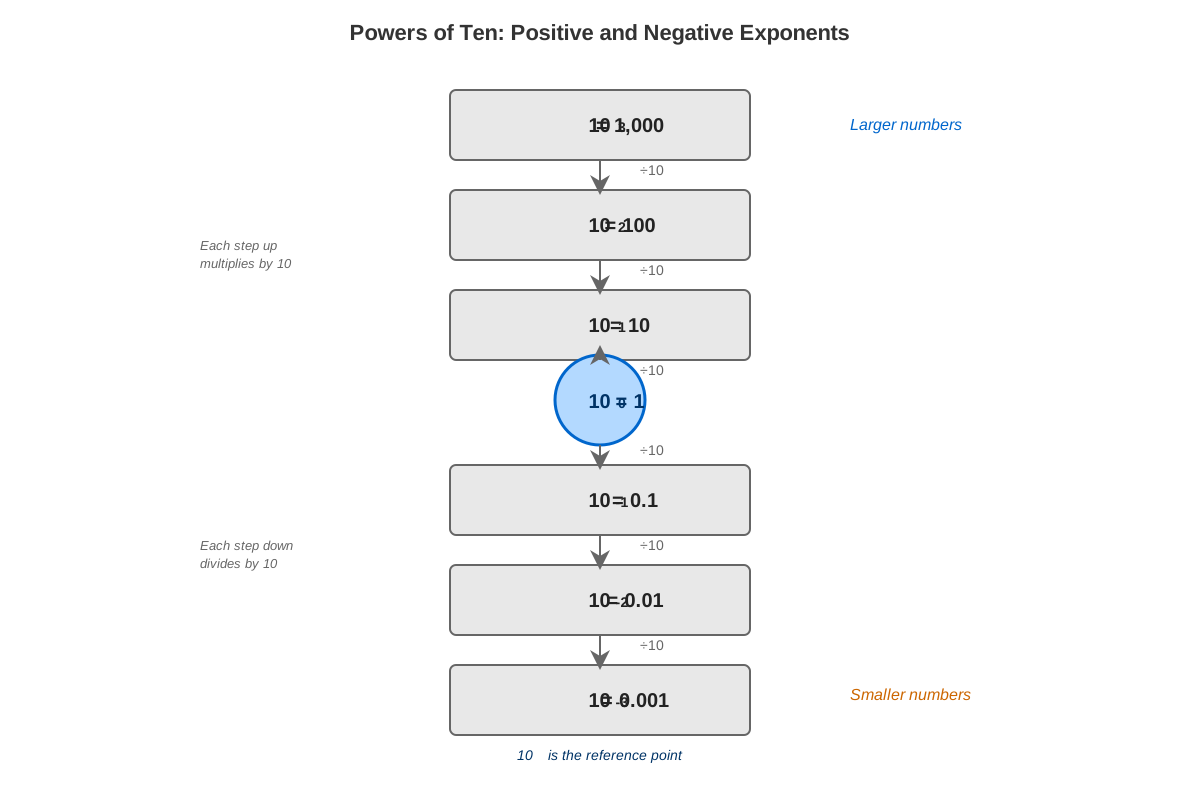
A power of ten is an expression where 10 is raised to an exponent, written as 10ⁿ where n is any integer. The exponent indicates how many times 10 is multiplied by itself. For positive exponents, 10¹ = 10, 10² = 100, 10³ = 1,000, and so forth. Each increase in the exponent by 1 represents multiplication by 10, which shifts the decimal point one place to the right and adds one zero to the number.
For negative exponents, the pattern reverses: 10⁻¹ = 0.1, 10⁻² = 0.01, 10⁻³ = 0.001. Negative exponents represent division by powers of ten, or equivalently, fractions with 1 in the numerator. The expression 10⁻ⁿ equals 1/(10ⁿ). Each decrease in the exponent by 1 represents division by 10, shifting the decimal point one place to the left.
The special case of 10⁰ equals 1, following the general exponent rule that any non-zero number raised to the zero power equals 1. This fact is frequently tested on the SAT in contexts where students must simplify expressions or recognize equivalent forms.
Multiplication and Division with Powers of Ten
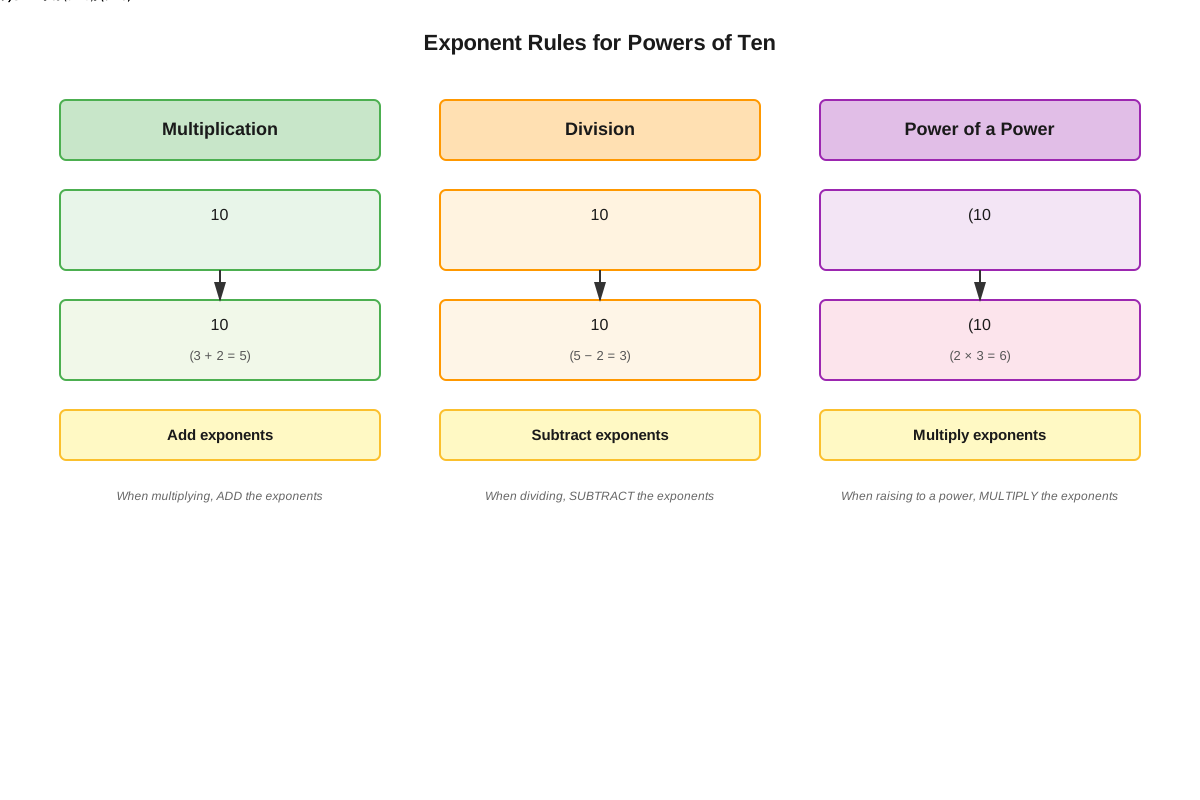
When multiplying powers of ten, the fundamental rule is to add the exponents: 10ᵃ × 10ᵇ = 10⁽ᵃ⁺ᵇ⁾. For example, 10³ × 10⁴ = 10⁷, which can be verified by recognizing that 1,000 × 10,000 = 10,000,000. This rule applies regardless of whether the exponents are positive or negative: 10⁵ × 10⁻² = 10³.
When dividing powers of ten, the rule is to subtract the exponents: 10ᵃ ÷ 10ᵇ = 10⁽ᵃ⁻ᵇ⁾. For instance, 10⁶ ÷ 10² = 10⁴, corresponding to 1,000,000 ÷ 100 = 10,000. This subtraction rule also works with negative exponents: 10³ ÷ 10⁻¹ = 10⁴.
These operations become particularly powerful when combined with coefficients. To multiply 3 × 10⁴ by 2 × 10⁵, multiply the coefficients (3 × 2 = 6) and add the exponents (4 + 5 = 9) to get 6 × 10⁹. Similarly, to divide (8 × 10⁷) by (2 × 10³), divide the coefficients (8 ÷ 2 = 4) and subtract the exponents (7 - 3 = 4) to get 4 × 10⁴.
Scientific Notation and Powers of Ten
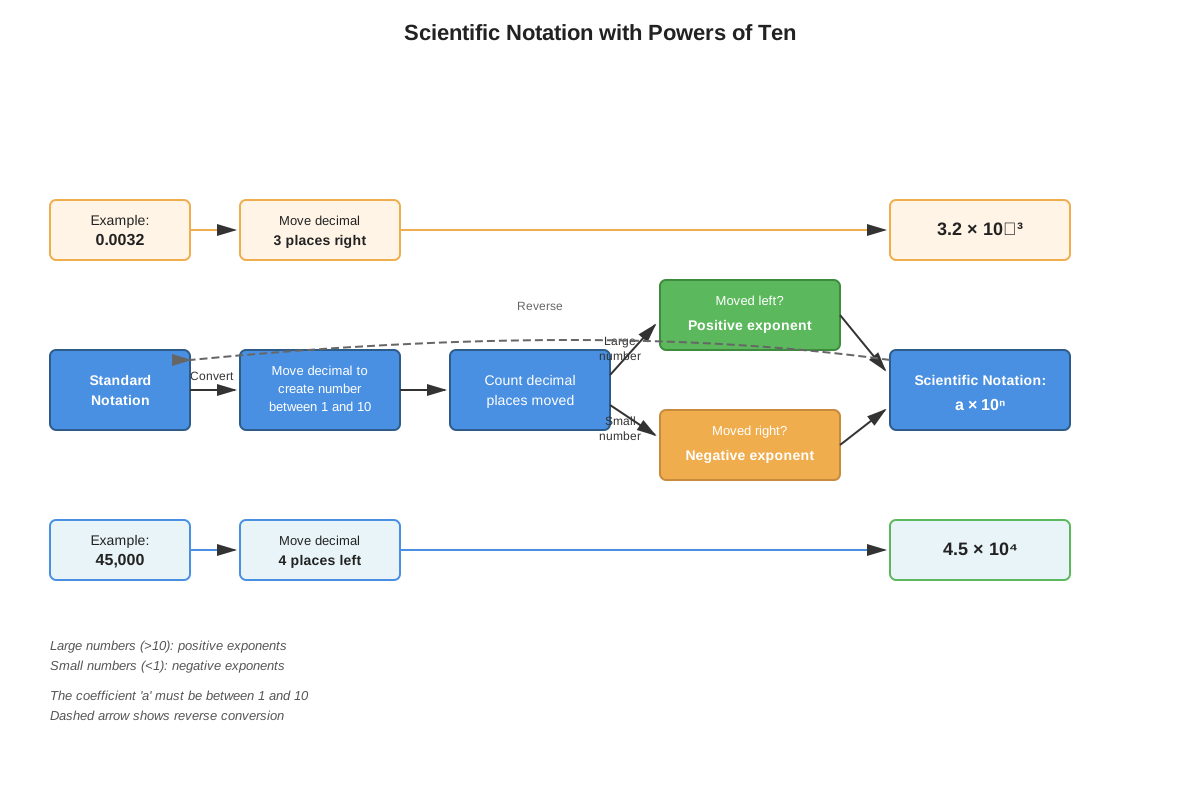
Scientific notation expresses numbers as a product of a coefficient between 1 and 10 (including 1 but not 10) and a power of ten. This format is written as a × 10ⁿ where 1 ≤ a < 10 and n is an integer. For example, 4,500 in scientific notation is 4.5 × 10³, and 0.00067 is 6.7 × 10⁻⁴.
To convert from standard notation to scientific notation, move the decimal point until only one non-zero digit remains to its left. Count how many places the decimal moved: if moved left, the exponent is positive; if moved right, the exponent is negative. For 850,000, the decimal moves 5 places left, yielding 8.5 × 10⁵. For 0.0042, the decimal moves 3 places right, yielding 4.2 × 10⁻³.
Converting from scientific notation to standard notation reverses this process. A positive exponent means moving the decimal point to the right (making the number larger), while a negative exponent means moving it to the left (making the number smaller). The expression 3.2 × 10⁴ becomes 32,000 (decimal moved 4 places right), and 7.1 × 10⁻² becomes 0.071 (decimal moved 2 places left).
Order of Magnitude and Estimation
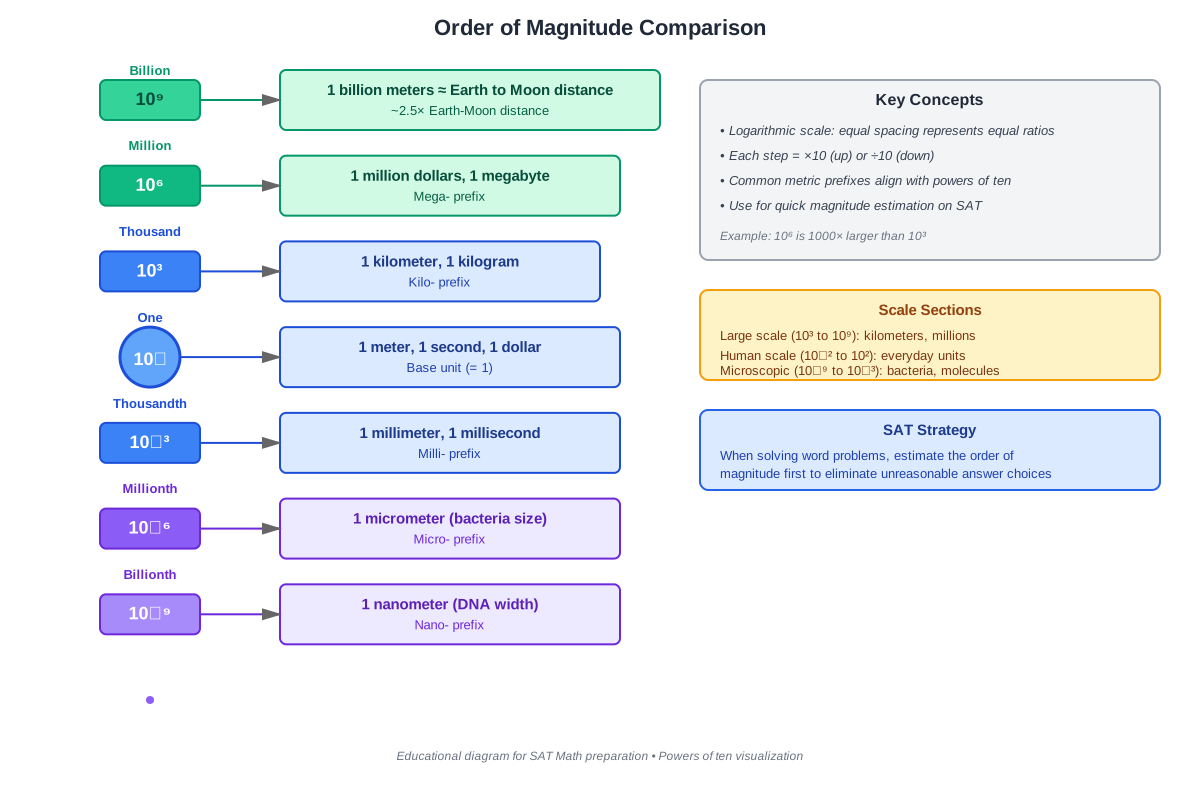
The order of magnitude of a number refers to the power of ten closest to that number. This concept is crucial for estimation and comparison problems on the SAT. A number's order of magnitude is determined by the exponent when the number is expressed in scientific notation. For instance, 3,500 (3.5 × 10³) has an order of magnitude of 10³, while 0.0082 (8.2 × 10⁻³) has an order of magnitude of 10⁻³.
Comparing orders of magnitude allows rapid assessment of relative sizes. A number with an order of magnitude of 10⁶ is approximately 1,000 times larger than a number with an order of magnitude of 10³ (since 10⁶ ÷ 10³ = 10³ = 1,000). This skill is particularly valuable for eliminating unreasonable answer choices and checking whether calculated answers make sense.
Powers of Ten in Algebraic Expressions
Powers of ten frequently appear in algebraic contexts on the SAT, requiring students to simplify expressions, solve equations, or manipulate formulas. When simplifying expressions like (10²)³, apply the power rule: multiply the exponents to get 10⁶. When expressions contain variables alongside powers of ten, treat the powers of ten separately using standard exponent rules.
For example, to simplify (5x² × 10⁴) ÷ (2x × 10²), separate the numerical coefficients, variables, and powers of ten: (5/2) × (x²/x) × (10⁴/10²) = 2.5x × 10² = 2.5 × 10² × x.
Concept Relationships
The core concepts within powers of ten build upon each other in a logical progression. Understanding basic powers of ten notation → enables recognition of patterns in multiplication and division → which leads to mastery of scientific notation → which facilitates order of magnitude comparisons → all of which combine to support algebraic manipulation of expressions containing powers of ten.
Powers of ten connect directly to prerequisite knowledge of place value, as each power of ten corresponds to a specific position in the decimal system. The relationship to basic exponent rules is fundamental: powers of ten are simply a specific application of general exponent principles where the base is always 10. This topic also bridges to more advanced concepts including logarithms (where log₁₀(10ⁿ) = n) and exponential growth models.
Within the broader SAT Math curriculum, powers of ten support problem-solving in multiple areas: unit conversion problems (converting between meters and kilometers involves powers of ten), percent problems (where 100% = 10²/10²), probability calculations with large sample spaces, and data analysis questions involving population statistics or scientific measurements. Mastery of powers of ten also enhances mental math capabilities, enabling quick estimation that improves efficiency across all math question types.
Quick check — test yourself on Powers of ten so far.
Try Flashcards →High-Yield Facts
⭐ 10ⁿ has exactly n zeros after the 1 when n is a positive integer (10³ = 1,000 has three zeros)
⭐ When multiplying powers of ten, add the exponents: 10ᵃ × 10ᵇ = 10⁽ᵃ⁺ᵇ⁾
⭐ When dividing powers of ten, subtract the exponents: 10ᵃ ÷ 10ᵇ = 10⁽ᵃ⁻ᵇ⁾
⭐ 10⁰ = 1, which is essential for simplifying expressions and solving equations
⭐ 10⁻ⁿ = 1/(10ⁿ), meaning negative exponents represent reciprocals or fractions
- Moving a decimal point one place to the right multiplies by 10 (increases the exponent by 1)
- Moving a decimal point one place to the left divides by 10 (decreases the exponent by 1)
- In scientific notation, the coefficient must be between 1 and 10 (1 ≤ a < 10)
- The difference in exponents between two powers of ten tells you how many times larger one is than the other
- (10ᵃ)ᵇ = 10⁽ᵃˣᵇ⁾, meaning when raising a power of ten to another power, multiply the exponents
- Any number can be expressed as a coefficient times an appropriate power of ten
- Powers of ten with the same exponent can be added or subtracted by combining coefficients: 3 × 10⁴ + 5 × 10⁴ = 8 × 10⁴
Common Misconceptions
Misconception: 10³ means 10 × 3 = 30 → Correction: 10³ means 10 × 10 × 10 = 1,000. The exponent indicates how many times 10 is multiplied by itself, not multiplication of 10 by the exponent.
Misconception: When multiplying powers of ten, multiply the exponents → Correction: When multiplying powers of ten, add the exponents. Multiplication of exponents occurs only when raising a power to another power: (10²)³ = 10⁶.
Misconception: 10⁻² = -100 → Correction: 10⁻² = 1/100 = 0.01. Negative exponents indicate reciprocals (division), not negative numbers. The result is always positive when the base is positive.
Misconception: In scientific notation, 45.6 × 10³ is correct → Correction: Scientific notation requires the coefficient to be between 1 and 10. The correct form is 4.56 × 10⁴ (move the decimal one place left and increase the exponent by 1).
Misconception: 10⁰ = 0 → Correction: 10⁰ = 1. Any non-zero number raised to the zero power equals 1, which follows from the division rule: 10³ ÷ 10³ = 10⁽³⁻³⁾ = 10⁰ = 1.
Misconception: To convert 0.005 to scientific notation, the exponent should be positive → Correction: Numbers less than 1 require negative exponents in scientific notation. 0.005 = 5 × 10⁻³ because the decimal moves 3 places to the right.
Misconception: Powers of ten can only be whole numbers → Correction: While SAT questions typically use integer exponents, powers of ten can have any real number as an exponent (10^0.5 = √10 ≈ 3.162).
Worked Examples
Example 1: Scientific Notation Operations
Problem: The mass of Earth is approximately 6 × 10²⁴ kilograms, and the mass of the Moon is approximately 7.5 × 10²² kilograms. How many times greater is Earth's mass than the Moon's mass?
Solution:
To find how many times greater Earth's mass is, divide Earth's mass by the Moon's mass:
(6 × 10²⁴) ÷ (7.5 × 10²²)
Separate the coefficients and powers of ten:
(6 ÷ 7.5) × (10²⁴ ÷ 10²²)
Calculate the coefficient division:
6 ÷ 7.5 = 0.8
Apply the exponent subtraction rule:
10²⁴ ÷ 10²² = 10⁽²⁴⁻²²⁾ = 10²
Combine the results:
0.8 × 10² = 80
Answer: Earth's mass is 80 times greater than the Moon's mass.
Connection to Learning Objectives: This problem demonstrates applying powers of ten to SAT-style questions by combining division of coefficients with exponent subtraction rules, a common question format involving scientific notation and real-world contexts.
Example 2: Simplifying Expressions with Powers of Ten
Problem: Simplify the expression: (4 × 10⁵) × (3 × 10⁻²) ÷ (6 × 10²)
Solution:
First, handle the multiplication in the numerator:
(4 × 10⁵) × (3 × 10⁻²)
Multiply coefficients: 4 × 3 = 12
Add exponents: 10⁵ × 10⁻² = 10⁽⁵⁺⁽⁻²⁾⁾ = 10³
Numerator result: 12 × 10³
Now divide by the denominator:
(12 × 10³) ÷ (6 × 10²)
Divide coefficients: 12 ÷ 6 = 2
Subtract exponents: 10³ ÷ 10² = 10⁽³⁻²⁾ = 10¹
Final result: 2 × 10¹ = 2 × 10 = 20
Answer: 20
Connection to Learning Objectives: This example demonstrates identifying key features of powers of ten (positive and negative exponents) and applying multiple exponent rules in sequence, which is essential for multi-step SAT problems involving algebraic manipulation.
Exam Strategy
When approaching SAT questions involving powers of ten, first identify whether the problem requires conversion (between standard and scientific notation), computation (multiplication or division), or comparison (order of magnitude). Questions explicitly showing powers of ten notation signal that exponent rules should be applied directly, while word problems involving very large or small numbers often benefit from converting to powers of ten notation before calculating.
Trigger words and phrases to watch for include: "scientific notation," "times greater/smaller," "order of magnitude," measurements with metric prefixes (kilo-, mega-, milli-, micro-), and contexts involving astronomy, microbiology, population statistics, or financial data with large numbers. Phrases like "approximately how many times" or "what is the ratio" often indicate division of powers of ten.
For process of elimination, immediately eliminate answer choices with incorrect orders of magnitude. If a problem involves multiplying two numbers around 10³ and 10⁴, the answer must be near 10⁷, allowing elimination of choices near 10⁵ or 10¹⁰. Check whether answer choices are in proper scientific notation format—coefficients outside the 1-10 range indicate incorrect answers. When comparing magnitudes, eliminate choices that reverse the relationship (claiming a smaller number is larger).
Time allocation for powers of ten questions should be efficient: straightforward conversion or computation problems should take 30-45 seconds, while multi-step word problems may require 60-90 seconds. If a problem seems to require extensive calculation, look for opportunities to simplify using powers of ten before computing. Mental math with powers of ten is often faster than calculator use, particularly for multiplication and division where exponent rules apply cleanly.
Exam Tip: Always express your final answer in the format requested. If the question asks for scientific notation, ensure your coefficient is between 1 and 10. If it asks for standard notation, complete the conversion fully.
Memory Techniques
Mnemonic for exponent operations: "Multiply → Add, Divide → Subtract" (MADS). When you multiply powers of ten, add exponents; when you divide, subtract exponents.
Visualization for negative exponents: Picture a fraction with 1 on top. 10⁻³ is "one over 10³" or 1/1000. The negative sign means "flip it" into a denominator.
Decimal movement rule: "Positive → Push right, Negative → Nudge left." Positive exponents push the decimal point to the right (making numbers larger), while negative exponents nudge it to the left (making numbers smaller).
Scientific notation check: Remember "1-10 Club"—the coefficient in scientific notation must be a member of the exclusive club between 1 and 10. If your coefficient is 45.6, it's not in the club; adjust to 4.56 and increase the exponent.
Zero exponent memory: "Anything to the zero power equals one" can be remembered as "Zero is the hero that makes everything one."
Summary
Powers of ten represent a fundamental mathematical concept that appears frequently on the SAT, requiring students to understand exponential notation, perform operations using exponent rules, and convert between standard and scientific notation. Mastery involves recognizing that 10ⁿ represents 10 multiplied by itself n times for positive exponents, while negative exponents indicate reciprocals. The core operational rules—adding exponents when multiplying, subtracting when dividing—enable efficient calculation with very large or small numbers. Scientific notation combines a coefficient between 1 and 10 with an appropriate power of ten, facilitating comparisons and computations across vastly different scales. Success on SAT questions requires not only computational accuracy but also strategic thinking about when to apply powers of ten notation, how to estimate orders of magnitude, and how to eliminate unreasonable answer choices quickly. Students who develop fluency with these concepts gain significant advantages in both accuracy and speed across multiple question types.
Key Takeaways
- Powers of ten follow standard exponent rules: add exponents when multiplying (10³ × 10⁴ = 10⁷), subtract when dividing (10⁶ ÷ 10² = 10⁴)
- Negative exponents represent reciprocals: 10⁻ⁿ = 1/(10ⁿ), always producing positive decimal values less than 1
- Scientific notation requires a coefficient between 1 and 10 multiplied by a power of ten, enabling efficient representation of extreme values
- Converting between notations involves counting decimal places moved: left movement creates positive exponents, right movement creates negative exponents
- Order of magnitude comparisons allow rapid estimation and answer checking by examining the difference in exponents
- The special case 10⁰ = 1 frequently appears in simplification problems and equation solving
- Mental math with powers of ten is often faster than calculator use, particularly when exponent rules apply directly
Related Topics
Exponent Rules with Other Bases: While this guide focuses on base 10, the same operational rules apply to any base (2ⁿ, 3ⁿ, etc.). Mastering powers of ten provides a foundation for understanding exponential expressions more broadly, which appear in growth and decay problems, compound interest calculations, and geometric sequences.
Logarithms: Logarithms are the inverse operation of exponentiation. Understanding that log₁₀(10ⁿ) = n connects directly to powers of ten and appears in advanced SAT problems involving exponential equations and scientific applications.
Unit Conversions: Many unit conversions involve powers of ten (1 kilometer = 10³ meters, 1 milligram = 10⁻³ grams). Mastery of powers of ten makes metric system conversions straightforward and supports dimensional analysis problems.
Percent and Ratio Problems: Percents can be expressed as powers of ten (100% = 10²/10²), and many ratio problems involving large numbers benefit from powers of ten notation for simplification.
Practice CTA
Now that you've mastered the core concepts of powers of ten, it's time to solidify your understanding through active practice. Attempt the practice questions to test your ability to recognize patterns, apply exponent rules, and solve problems efficiently under timed conditions. Use the flashcards to reinforce key facts and rules until they become automatic. Remember, fluency with powers of ten isn't just about getting individual questions correct—it's about building the number sense and efficiency that will elevate your performance across the entire SAT Math section. Every practice problem you complete strengthens your mathematical intuition and brings you closer to your target score!
Sign up free to keep reading
Create a free AnvayaPrep account to finish this SAT guide on Powers of ten — plus flashcards and practice questions.