Overview
Exponent rules form one of the most fundamental and frequently tested concepts in SAT math. These rules govern how to manipulate expressions involving powers and bases, allowing students to simplify complex algebraic expressions, solve equations, and work with exponential growth and decay problems. Mastery of exponent rules is not merely about memorizing formulas—it requires understanding the logical structure behind each rule and recognizing when and how to apply them in various contexts.
On the SAT, exponent rules appear across multiple question types, from straightforward simplification problems to complex multi-step algebraic manipulations embedded within word problems. The College Board consistently includes 3-5 questions per test that directly or indirectly require fluency with exponent rules. These questions often serve as gatekeepers between score ranges, as students who can quickly and accurately apply exponent rules gain significant time advantages and avoid common algebraic errors that lead to incorrect answers.
Understanding exponent rules creates a foundation for success across the entire SAT Math section. These rules connect directly to polynomial operations, rational expressions, radical expressions, exponential functions, and scientific notation—all topics that appear regularly on the exam. Additionally, exponent rules are essential for solving equations involving exponential growth and decay, which frequently appear in both calculator and no-calculator sections. The ability to recognize equivalent exponential forms allows students to identify correct answers even when they appear in unfamiliar formats, making this topic truly high-yield for test preparation.
Learning Objectives
- [ ] Identify key features of exponent rules and recognize when each rule applies
- [ ] Explain how exponent rules appears on the SAT across different question formats
- [ ] Apply exponent rules to answer SAT-style questions efficiently and accurately
- [ ] Simplify complex expressions involving multiple exponent rules in a single problem
- [ ] Convert between exponential and radical notation fluently
- [ ] Recognize equivalent exponential expressions written in different forms
- [ ] Solve equations requiring strategic application of exponent rules
Prerequisites
- Basic arithmetic operations: Understanding multiplication and division is essential because exponents represent repeated multiplication
- Order of operations (PEMDAS): Exponents must be evaluated in the correct sequence relative to other operations
- Variable manipulation: Comfort working with algebraic expressions containing variables is necessary for applying rules symbolically
- Negative numbers: Understanding how negative signs interact with exponents prevents common sign errors
- Fraction operations: Many exponent rules produce fractional results that require simplification
Why This Topic Matters
Exponent rules have extensive real-world applications across science, finance, and technology. Exponential growth models describe population dynamics, compound interest calculations, viral spread patterns, and radioactive decay. Computer scientists use powers of 2 to understand data storage and processing capabilities. Engineers apply exponent rules when working with scientific notation to handle extremely large or small measurements. Understanding these rules enables students to model and solve practical problems involving rapid change and scaling.
On the SAT specifically, exponent rules appear in approximately 10-15% of all math questions, making this one of the highest-yield topics for focused study. Questions involving exponents appear in both the calculator and no-calculator sections, across multiple difficulty levels. The College Board tests exponent rules through direct simplification problems, equation-solving questions, word problems involving exponential growth or decay, and questions requiring students to recognize equivalent expressions. Many students lose points not because they don't know the rules, but because they apply them incorrectly under time pressure or fail to recognize when a rule should be used.
Common SAT question formats include: simplifying expressions with multiple exponent operations, solving exponential equations by creating common bases, working with negative and fractional exponents, converting between radical and exponential notation, and identifying equivalent forms of exponential expressions. The test frequently combines exponent rules with other algebraic concepts, requiring students to execute multi-step solutions efficiently. Questions may also present exponents in word problems about compound interest, population growth, or scientific measurements, requiring students to set up and solve exponential equations.
Core Concepts
Product Rule for Exponents
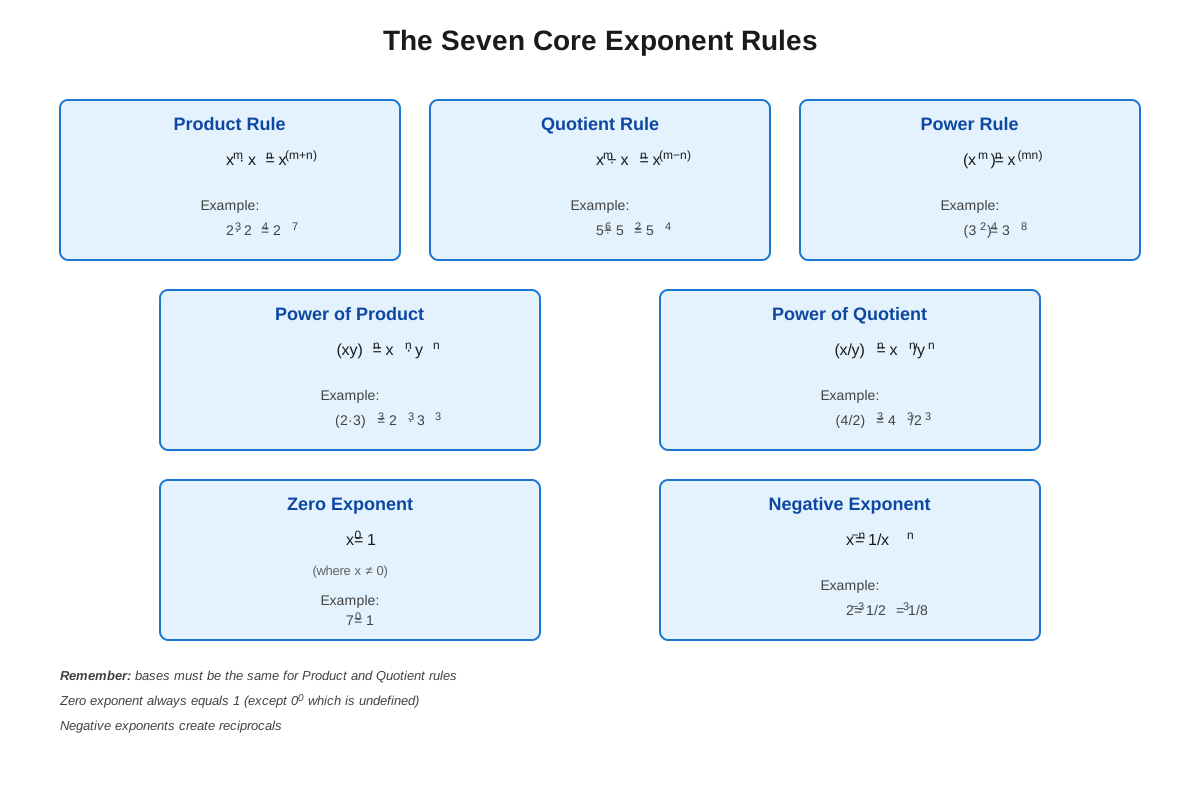
The product rule states that when multiplying two powers with the same base, add the exponents:
a^m × a^n = a^(m+n)This rule emerges logically from the definition of exponents. Since a^3 means a × a × a and a^2 means a × a, multiplying them gives (a × a × a) × (a × a) = a^5. The bases must be identical for this rule to apply. For example, 2^3 × 2^4 = 2^7 = 128, but 2^3 × 3^4 cannot be simplified using this rule because the bases differ.
SAT applications: The product rule frequently appears in simplification problems and when solving exponential equations. Students must recognize that x^5 × x^3 = x^8, not x^15 (a common error from multiplying exponents instead of adding them).
Quotient Rule for Exponents
The quotient rule states that when dividing two powers with the same base, subtract the exponents:
a^m ÷ a^n = a^(m-n)This rule follows from canceling common factors. For instance, a^5 ÷ a^2 = (a × a × a × a × a)/(a × a) = a^3. The order of subtraction matters: the exponent in the numerator minus the exponent in the denominator. When the denominator has a larger exponent, the result will have a negative exponent.
SAT applications: This rule is essential for simplifying rational expressions and appears frequently in fraction-based problems. Students must remember that x^7/x^3 = x^4, and that x^2/x^5 = x^(-3) = 1/x^3.
Power Rule for Exponents
The power rule states that when raising a power to another power, multiply the exponents:
(a^m)^n = a^(m×n)This rule reflects repeated application of the base exponent. For example, (a^2)^3 means a^2 × a^2 × a^2, which equals a^6. This is one of the most commonly misapplied rules, as students sometimes add exponents instead of multiplying them.
SAT applications: The power rule appears in problems requiring multiple steps of simplification and in equations where both sides must be raised to a power. Recognizing that (x^3)^4 = x^12 is crucial for solving many SAT problems efficiently.
Power of a Product Rule
When raising a product to a power, distribute the exponent to each factor:
(ab)^n = a^n × b^nThis rule allows exponents to be distributed across multiplication. For example, (2x)^3 = 2^3 × x^3 = 8x^3. This rule extends to any number of factors within the parentheses.
SAT applications: This rule is essential for expanding expressions and for recognizing equivalent forms. Students must recognize that (3x^2)^2 = 9x^4, requiring both the coefficient and variable to be squared.
Power of a Quotient Rule
When raising a quotient to a power, distribute the exponent to both numerator and denominator:
(a/b)^n = a^n/b^nThis rule is the division counterpart to the power of a product rule. For example, (x/2)^3 = x^3/8.
SAT applications: This rule frequently appears in problems involving fractions raised to powers and in simplification of complex rational expressions.
Zero Exponent Rule
Any non-zero base raised to the power of zero equals one:
a^0 = 1 (where a ≠ 0)This rule maintains consistency with the quotient rule. Since a^n ÷ a^n = 1, and using the quotient rule gives a^(n-n) = a^0, it follows that a^0 = 1.
SAT applications: This rule appears in simplification problems and when evaluating expressions. Students must remember that (5x^2y^3)^0 = 1, regardless of the complexity of the base.
Negative Exponent Rule
A negative exponent indicates a reciprocal:
a^(-n) = 1/a^nNegative exponents do not make the result negative; they indicate division. For example, 2^(-3) = 1/8, not -8. This rule also works in reverse: 1/a^n = a^(-n).
SAT applications: Negative exponents appear frequently in simplification problems and when converting between forms. Students must recognize that x^(-2) = 1/x^2 and that 1/x^(-3) = x^3.
Fractional Exponent Rule
Fractional exponents represent roots:
a^(1/n) = ⁿ√a
a^(m/n) = ⁿ√(a^m) = (ⁿ√a)^m
The denominator of the fractional exponent indicates the root, while the numerator indicates the power. For example, 8^(2/3) = (∛8)^2 = 2^2 = 4.
SAT applications: Converting between radical and exponential notation is a common SAT task. Students must recognize that √x = x^(1/2) and ∛(x^2) = x^(2/3).
Comparison Table of Exponent Rules
| Rule Name | Formula | Example | Common Error |
|---|---|---|---|
| Product Rule | a^m × a^n = a^(m+n) | x^3 × x^5 = x^8 | Multiplying exponents: x^15 |
| Quotient Rule | a^m ÷ a^n = a^(m-n) | x^7 ÷ x^2 = x^5 | Dividing exponents: x^3.5 |
| Power Rule | (a^m)^n = a^(m×n) | (x^2)^4 = x^8 | Adding exponents: x^6 |
| Power of Product | (ab)^n = a^n × b^n | (2x)^3 = 8x^3 | Not distributing: 2x^3 |
| Zero Exponent | a^0 = 1 | (3x)^0 = 1 | Thinking it equals 0 |
| Negative Exponent | a^(-n) = 1/a^n | x^(-2) = 1/x^2 | Making result negative |
Concept Relationships
The exponent rules form an interconnected system where each rule builds upon the fundamental definition of exponents as repeated multiplication. The product rule and quotient rule are inverse operations, just as multiplication and division are inverses in basic arithmetic. Understanding this relationship helps students remember that one involves adding exponents while the other involves subtracting them.
The power rule extends the product rule by considering what happens when the repeated multiplication itself is repeated. This creates a multiplicative relationship between exponents rather than an additive one. The power of a product rule and power of a quotient rule demonstrate how the power rule distributes across multiplication and division operations, maintaining consistency with the distributive property from basic algebra.
The zero exponent rule and negative exponent rule emerge as special cases when applying the quotient rule. When the exponents in a quotient are equal, subtraction yields zero; when the denominator's exponent exceeds the numerator's, subtraction yields a negative result. This logical progression shows that these aren't arbitrary rules but natural consequences of consistent mathematical reasoning.
The fractional exponent rule bridges exponent rules with radical expressions, creating a unified framework for understanding both powers and roots. This connection is crucial because it allows students to convert between forms strategically, choosing whichever representation makes a problem easier to solve.
Relationship map:
Definition of exponents → Product Rule → Quotient Rule → Zero Exponent Rule → Negative Exponent Rule
Definition of exponents → Power Rule → Power of Product/Quotient Rules
Negative Exponent Rule + Root operations → Fractional Exponent Rule
These rules collectively enable simplification of polynomial expressions, solution of exponential equations, manipulation of radical expressions, and work with scientific notation—all essential SAT skills.
Quick check — test yourself on Exponent rules so far.
Try Flashcards →High-Yield Facts
⭐ When multiplying powers with the same base, add the exponents: x^a × x^b = x^(a+b)
⭐ When dividing powers with the same base, subtract the exponents: x^a ÷ x^b = x^(a-b)
⭐ When raising a power to a power, multiply the exponents: (x^a)^b = x^(ab)
⭐ Any non-zero number raised to the zero power equals 1: x^0 = 1 (x ≠ 0)
⭐ A negative exponent creates a reciprocal: x^(-a) = 1/x^a
- When raising a product to a power, distribute the exponent to all factors: (xy)^a = x^a × y^a
- When raising a quotient to a power, distribute the exponent to numerator and denominator: (x/y)^a = x^a/y^a
- A fractional exponent's denominator indicates the root: x^(1/n) = ⁿ√x
- A fractional exponent's numerator indicates the power: x^(m/n) = (ⁿ√x)^m
- Exponent rules only apply directly when bases are identical
- The order of operations requires evaluating exponents before multiplication or division (except what's in parentheses)
- Negative exponents do not make the answer negative; they indicate reciprocals
- When no exponent is written, the implied exponent is 1: x = x^1
Common Misconceptions
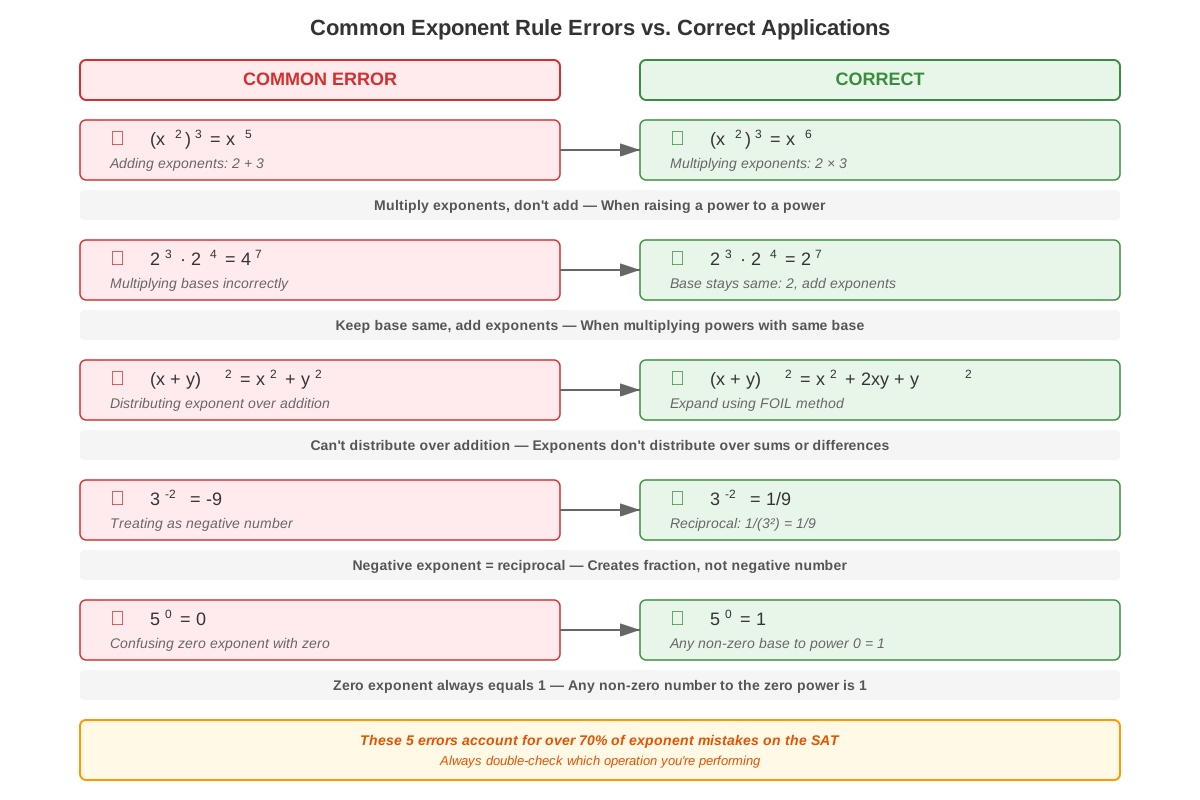
Misconception: When multiplying powers with the same base, multiply the exponents (x^2 × x^3 = x^6)
Correction: Add the exponents when multiplying: x^2 × x^3 = x^5. Multiplication of bases leads to addition of exponents, not multiplication of exponents.
Misconception: A negative exponent makes the entire result negative (x^(-2) = -x^2)
Correction: A negative exponent indicates a reciprocal, not a negative value: x^(-2) = 1/x^2. The result's sign depends on the base, not the exponent.
Misconception: The zero exponent rule means the result is zero (x^0 = 0)
Correction: Any non-zero base raised to the zero power equals 1: x^0 = 1. This maintains consistency with the quotient rule since x^n/x^n = 1.
Misconception: When raising a product to a power, only the first factor gets the exponent ((2x)^3 = 2x^3)
Correction: Distribute the exponent to all factors: (2x)^3 = 2^3 × x^3 = 8x^3. Every factor inside the parentheses must be raised to the power.
Misconception: Exponent rules can be applied when bases are different (x^2 × y^3 = xy^5)
Correction: Exponent rules for products and quotients require identical bases. When bases differ, expressions generally cannot be combined using these rules.
Misconception: When raising a power to a power, add the exponents ((x^2)^3 = x^5)
Correction: Multiply the exponents when raising a power to a power: (x^2)^3 = x^6. This represents x^2 multiplied by itself three times.
Misconception: Fractional exponents make the result a fraction (4^(1/2) = 4/2 = 2)
Correction: While 4^(1/2) does equal 2, this is because the fractional exponent indicates a root: 4^(1/2) = √4 = 2, not because of division.
Worked Examples
Example 1: Multi-Step Simplification
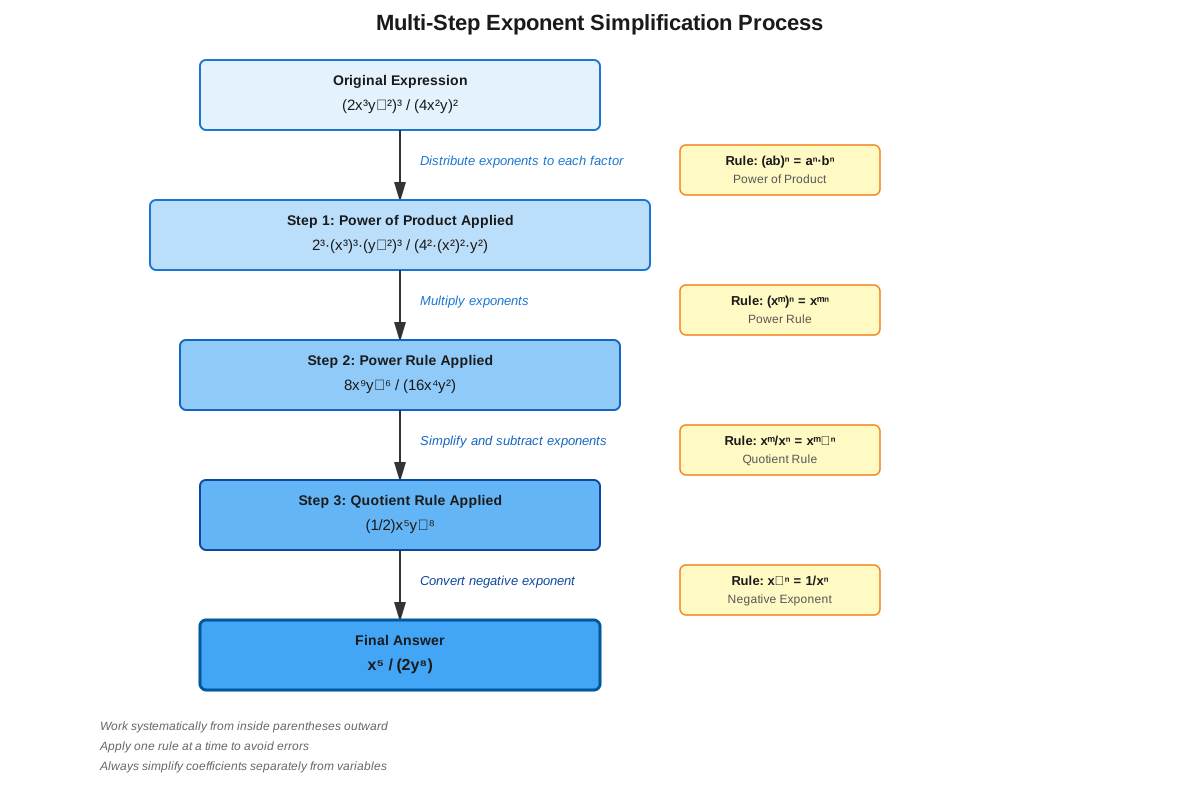
Problem: Simplify the expression: (2x^3y^2)^3 × (x^2y)^(-2) ÷ (4x^4y^3)
Solution:
Step 1: Apply the power of a product rule to (2x^3y^2)^3
- Distribute the exponent 3 to each factor
- 2^3 × (x^3)^3 × (y^2)^3 = 8x^9y^6
Step 2: Apply the power of a product rule to (x^2y)^(-2)
- Distribute the exponent -2 to each factor
- (x^2)^(-2) × y^(-2) = x^(-4) × y^(-2) = x^(-4)y^(-2)
Step 3: Rewrite the expression with simplified terms
- 8x^9y^6 × x^(-4)y^(-2) ÷ (4x^4y^3)
Step 4: Apply the product rule to combine the first two terms
- 8x^9y^6 × x^(-4)y^(-2) = 8x^(9-4)y^(6-2) = 8x^5y^4
Step 5: Apply the quotient rule to divide by the third term
- 8x^5y^4 ÷ 4x^4y^3 = (8/4) × x^(5-4) × y^(4-3) = 2xy
Final Answer: 2xy
Connection to learning objectives: This problem demonstrates the application of multiple exponent rules in sequence (power of product, product rule, quotient rule, negative exponents), showing how SAT questions combine concepts to test comprehensive understanding.
Example 2: Equation Solving with Exponents
Problem: If 2^(x+3) = 32^(x-1), what is the value of x?
Solution:
Step 1: Express both sides with the same base
- Notice that 32 = 2^5
- Rewrite the equation: 2^(x+3) = (2^5)^(x-1)
Step 2: Apply the power rule to the right side
- (2^5)^(x-1) = 2^(5(x-1)) = 2^(5x-5)
- Equation becomes: 2^(x+3) = 2^(5x-5)
Step 3: Since the bases are equal, the exponents must be equal
- x + 3 = 5x - 5
Step 4: Solve for x
- 3 + 5 = 5x - x
- 8 = 4x
- x = 2
Step 5: Verify the solution
- Left side: 2^(2+3) = 2^5 = 32
- Right side: 32^(2-1) = 32^1 = 32 ✓
Final Answer: x = 2
Connection to learning objectives: This problem illustrates how exponent rules enable equation solving by creating common bases, a high-yield SAT strategy. It demonstrates the power rule and the principle that equal bases imply equal exponents.
Exam Strategy
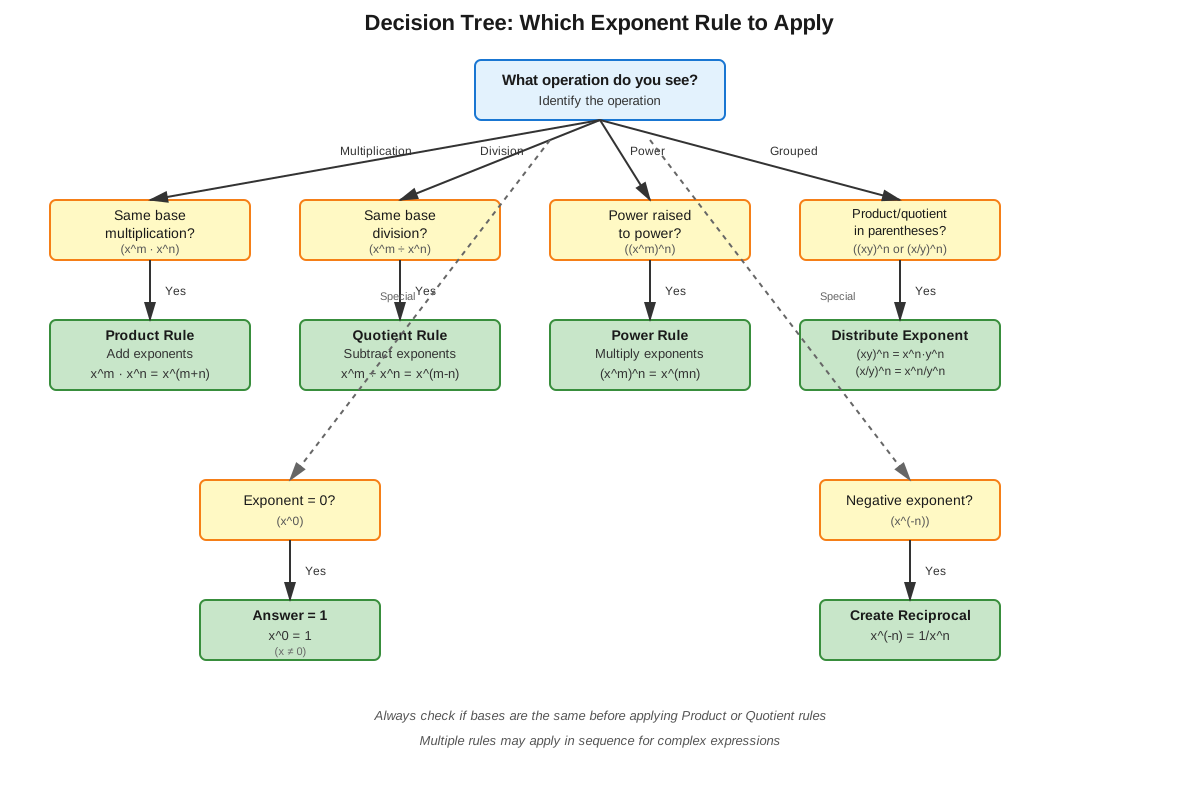
When approaching SAT questions involving exponent rules, begin by identifying which rules apply. Look for opportunities to create common bases when solving equations—this is often the key to unlocking exponential equations. If bases cannot be made identical, consider whether the problem requires numerical evaluation instead of algebraic manipulation.
Trigger words and phrases to watch for include: "simplify," "equivalent to," "which expression equals," "solve for," and "if x^a = b, then." Questions asking for "equivalent expressions" often test whether students can recognize the same expression written with different exponent forms. Problems stating "which of the following is equal to" frequently require applying multiple exponent rules in sequence.
Process-of-elimination strategies: When answer choices contain exponents, check the signs of exponents first—negative versus positive exponents dramatically change the form. Eliminate answers with incorrect exponent operations (like adding when you should multiply). If a problem involves specific numbers, consider plugging in simple values to test answer choices, though this should be a backup strategy rather than the primary approach.
Time allocation: Most exponent rule questions should take 45-90 seconds. If a problem requires more than two minutes, reassess the approach—there's likely a more efficient path. Practice recognizing patterns quickly: seeing (x^3)^2 should immediately trigger "multiply exponents" without conscious deliberation. For the no-calculator section, be prepared to work with fractional and negative exponents without computational aids.
Common SAT tactics: The test often presents expressions that look complex but simplify dramatically when rules are applied correctly. Don't be intimidated by expressions with multiple variables and exponents—work systematically through one rule at a time. When stuck, try working backwards from answer choices or substituting simple numbers (like x = 2) to eliminate impossible answers. Remember that the SAT rewards efficiency: the fastest path usually involves recognizing which rule applies and executing it cleanly rather than trying multiple approaches.
Memory Techniques
MADSPM - Mnemonic for remembering when to add, subtract, or multiply exponents:
- Multiply same bases → Add exponents (Product rule)
- Divide same bases → Subtract exponents (Quotient rule)
- Power to a power → Multiply exponents (Power rule)
Visualization for negative exponents: Picture a negative exponent as a "flip" signal—it flips the base from numerator to denominator (or vice versa). Visualize x^(-2) as a fraction with 1 on top and x^2 on bottom.
Fractional exponent memory aid: "Denominator = Root, Numerator = Power" or think "Down for root, Up for power" (denominator down, numerator up). For x^(2/3), the bottom number (3) tells you the root (cube root), and the top number (2) tells you the power (squared).
Zero exponent anchor: Remember that anything to the zero power equals 1 by thinking "zero effort = one result." Alternatively, remember that x^3 ÷ x^3 must equal 1 (anything divided by itself is 1), and by the quotient rule, this equals x^0.
Product vs. Power rule distinction: When you see multiplication between bases (x^2 × x^3), think "multiply means add" (add the exponents). When you see exponents stacked (x^2)^3, think "power means multiply" (multiply the exponents). The operation between bases is opposite to the operation on exponents.
Summary
Exponent rules provide the systematic framework for manipulating expressions involving powers, forming an essential foundation for SAT Math success. The seven core rules—product, quotient, power, power of a product, power of a quotient, zero exponent, and negative exponent—all derive logically from the definition of exponents as repeated multiplication. Mastery requires not just memorization but understanding when each rule applies and how to combine multiple rules in complex problems. The product rule adds exponents when multiplying same bases, the quotient rule subtracts when dividing, and the power rule multiplies when raising powers to powers. Special cases include the zero exponent always equaling one and negative exponents indicating reciprocals. Fractional exponents bridge to radical expressions, with denominators indicating roots and numerators indicating powers. SAT questions test these rules through direct simplification, equation solving, and recognition of equivalent expressions, often combining multiple rules in a single problem. Success requires systematic application, attention to detail with signs and operations, and the ability to recognize which rule applies in various contexts.
Key Takeaways
- When multiplying powers with the same base, add exponents; when dividing, subtract exponents; when raising a power to a power, multiply exponents
- Negative exponents create reciprocals (flip the base), not negative values; zero exponents always equal 1 for non-zero bases
- Exponent rules require identical bases to apply—different bases cannot be combined using these rules
- Fractional exponents represent roots (denominator) and powers (numerator), providing an alternative notation to radicals
- Distribute exponents across products and quotients: (ab)^n = a^n × b^n and (a/b)^n = a^n/b^n
- SAT questions frequently combine multiple exponent rules in sequence, requiring systematic step-by-step application
- Creating common bases is the key strategy for solving exponential equations on the SAT
Related Topics
Radical Expressions and Equations: Mastering exponent rules, particularly fractional exponents, provides the foundation for working with radicals. Converting between exponential and radical notation enables strategic problem-solving approaches.
Polynomial Operations: Exponent rules are essential for multiplying, dividing, and factoring polynomials. The product and quotient rules apply directly when combining like terms and simplifying polynomial expressions.
Exponential Functions and Growth: Understanding exponent rules enables analysis of exponential functions, including growth and decay models that appear in SAT word problems involving compound interest, population dynamics, and scientific applications.
Scientific Notation: Manipulating numbers in scientific notation requires fluent application of exponent rules, particularly the product and quotient rules, when multiplying or dividing very large or very small quantities.
Rational Expressions: Simplifying complex fractions involving variables with exponents requires combining exponent rules with fraction operations, building toward more advanced algebraic manipulation.
Practice CTA
Now that you've mastered the core concepts of exponent rules, it's time to solidify your understanding through active practice. Complete the practice questions to test your ability to apply these rules under timed conditions, simulating the actual SAT experience. Use the flashcards to reinforce quick recall of each rule and its applications—speed and accuracy with exponent rules will save you valuable time on test day and unlock correct answers across multiple question types. Remember, exponent rules appear in 10-15% of SAT Math questions, making this practice time one of your highest-yield investments in score improvement. Approach each practice problem systematically, and review any mistakes carefully to identify which specific rule or application needs reinforcement. Your confidence with exponents will translate directly to points on test day!
Sign up free to keep reading
Create a free AnvayaPrep account to finish this SAT guide on Exponent rules — plus flashcards and practice questions.