Overview
Unit conversions represent one of the most practical and frequently tested skills in SAT Math. This topic requires students to transform measurements from one unit to another—whether converting inches to feet, hours to minutes, or miles per hour to feet per second. The SAT tests unit conversions both as standalone problems and embedded within more complex word problems involving rates, proportions, and real-world scenarios. Mastering this skill is essential because it appears across multiple question types and difficulty levels throughout the exam.
The importance of unit conversions extends beyond simple arithmetic. These problems test a student's ability to set up proportional relationships correctly, track units systematically, and avoid calculation errors under time pressure. The College Board frequently embeds unit conversion challenges within science-based contexts (physics problems involving speed or density), financial scenarios (currency or rate calculations), and geometric applications (area and volume with mixed units). Students who develop fluency with unit conversions gain a significant advantage, as these questions often serve as "giveaway" points for well-prepared test-takers.
Within the broader SAT Math curriculum, unit conversions connect directly to ratios, rates, and proportions—forming the foundation for more advanced problem-solving. This topic also reinforces dimensional analysis skills that appear in algebra, functions, and data interpretation questions. Understanding how units behave during multiplication and division operations helps students verify their answers and catch errors before submitting responses, making it an invaluable metacognitive tool for the entire exam.
Learning Objectives
- [ ] Identify key features of unit conversions and recognize when they are required in SAT problems
- [ ] Explain how unit conversions appears on the SAT across different question formats and contexts
- [ ] Apply unit conversions to answer SAT-style questions accurately and efficiently
- [ ] Convert between metric and customary units using appropriate conversion factors
- [ ] Set up and solve multi-step conversion problems involving compound units (rates)
- [ ] Verify answer reasonableness by checking unit consistency throughout calculations
Prerequisites
- Basic multiplication and division: Essential for applying conversion factors and scaling quantities proportionally
- Understanding of fractions: Conversion factors are often expressed as fractions, requiring comfort with fraction multiplication
- Ratio and proportion fundamentals: Unit conversions are essentially proportional relationships between different measurement systems
- Order of operations: Multi-step conversions require proper sequencing of mathematical operations
- Basic measurement familiarity: Recognition of common units (inches, feet, meters, seconds, hours) and their relative sizes
Why This Topic Matters
Unit conversions appear in everyday life constantly—from cooking (converting tablespoons to cups) to travel (kilometers to miles) to construction (square feet to square yards). Professionals in engineering, medicine, science, and finance use unit conversions daily, making this skill both academically and practically valuable. The ability to move fluidly between measurement systems demonstrates quantitative literacy that extends far beyond test-taking.
On the SAT, unit conversion questions appear with remarkable frequency. Approximately 8-12% of SAT Math questions involve unit conversions either as the primary skill tested or as a necessary step within a larger problem. These questions appear in both the calculator and no-calculator sections, across multiple-choice and grid-in formats. The College Board particularly favors unit conversions in:
- Rate problems: Converting miles per hour to feet per second, or dollars per hour to cents per minute
- Geometry applications: Converting between square inches and square feet, or cubic centimeters and liters
- Science contexts: Problems involving density, concentration, or speed that require consistent units
- Word problems: Real-world scenarios where information is given in mixed units requiring standardization
The predictability of unit conversion questions makes them high-yield study targets. Students who master the systematic approach to these problems can reliably earn points that less-prepared test-takers often miss due to careless unit tracking or setup errors.
Core Concepts
Understanding Conversion Factors
A conversion factor is a ratio that expresses how many of one unit equal another unit. For example, since 12 inches equal 1 foot, we can write the conversion factor as either 12 inches/1 foot or 1 foot/12 inches. The key insight is that any conversion factor equals 1 (since the numerator and denominator represent the same quantity), so multiplying by a conversion factor doesn't change the actual amount—only its representation.
When applying conversion factors, students must choose the orientation that cancels unwanted units. If converting 36 inches to feet, multiply by (1 foot/12 inches) so the inches cancel:
36 inches × (1 foot / 12 inches) = 3 feetThe inches units cancel algebraically, leaving feet as the final unit. This dimensional analysis approach provides both a calculation method and a built-in error-checking system.
Common SAT Conversion Factors
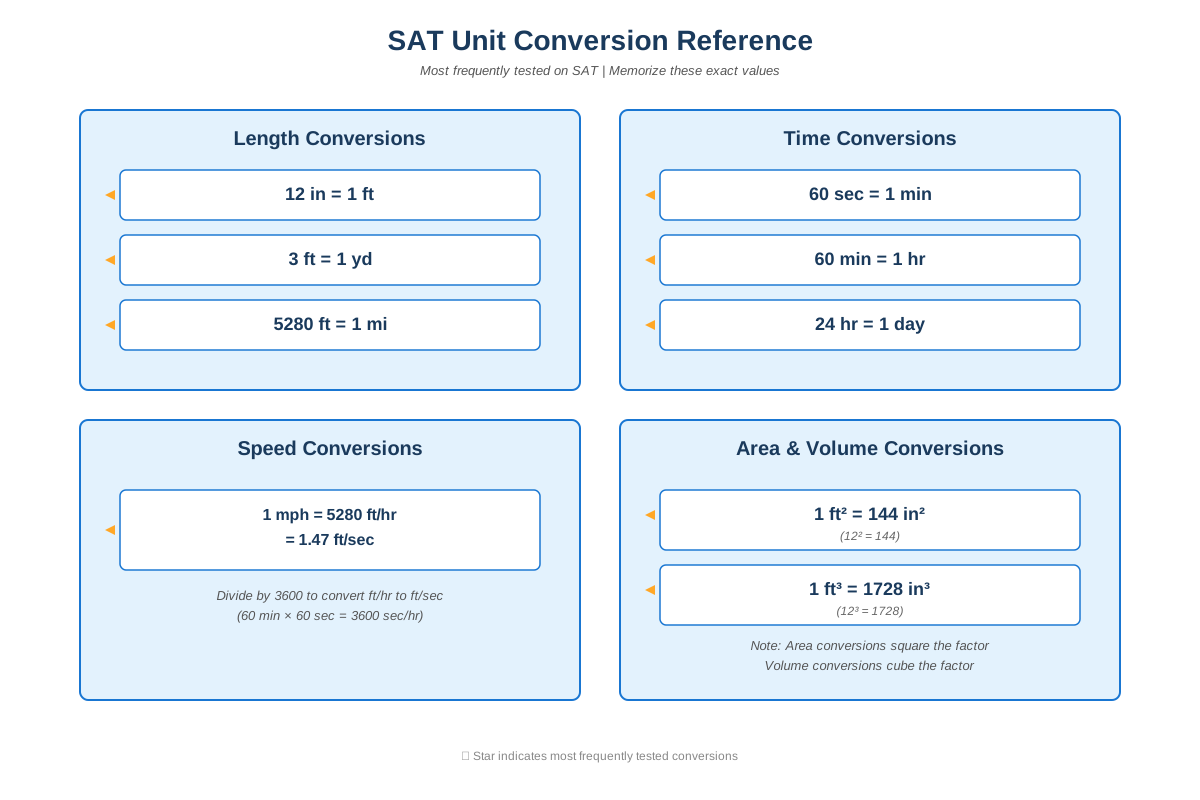
The SAT expects students to know certain conversion factors without reference materials. While some conversions appear in the reference information box, many do not. Essential conversions include:
| Category | Conversion | Factor |
|---|---|---|
| Length (Customary) | 1 foot | 12 inches |
| Length (Customary) | 1 yard | 3 feet |
| Length (Customary) | 1 mile | 5,280 feet |
| Length (Metric) | 1 meter | 100 centimeters |
| Length (Metric) | 1 kilometer | 1,000 meters |
| Time | 1 minute | 60 seconds |
| Time | 1 hour | 60 minutes |
| Time | 1 hour | 3,600 seconds |
| Weight (Customary) | 1 pound | 16 ounces |
| Volume (Customary) | 1 gallon | 4 quarts |
| Volume (Metric) | 1 liter | 1,000 milliliters |
Single-Step Conversions
The simplest unit conversion problems require applying one conversion factor. The process follows these steps:
- Identify the starting unit and target unit
- Select the appropriate conversion factor
- Set up the multiplication so unwanted units cancel
- Perform the calculation
- Verify the answer makes sense
For example, converting 180 minutes to hours:
- Starting unit: minutes
- Target unit: hours
- Conversion factor: 60 minutes = 1 hour
- Setup: 180 minutes × (1 hour / 60 minutes) = 3 hours
- Verification: 3 hours is reasonable since 180 is three times 60
Multi-Step Conversions
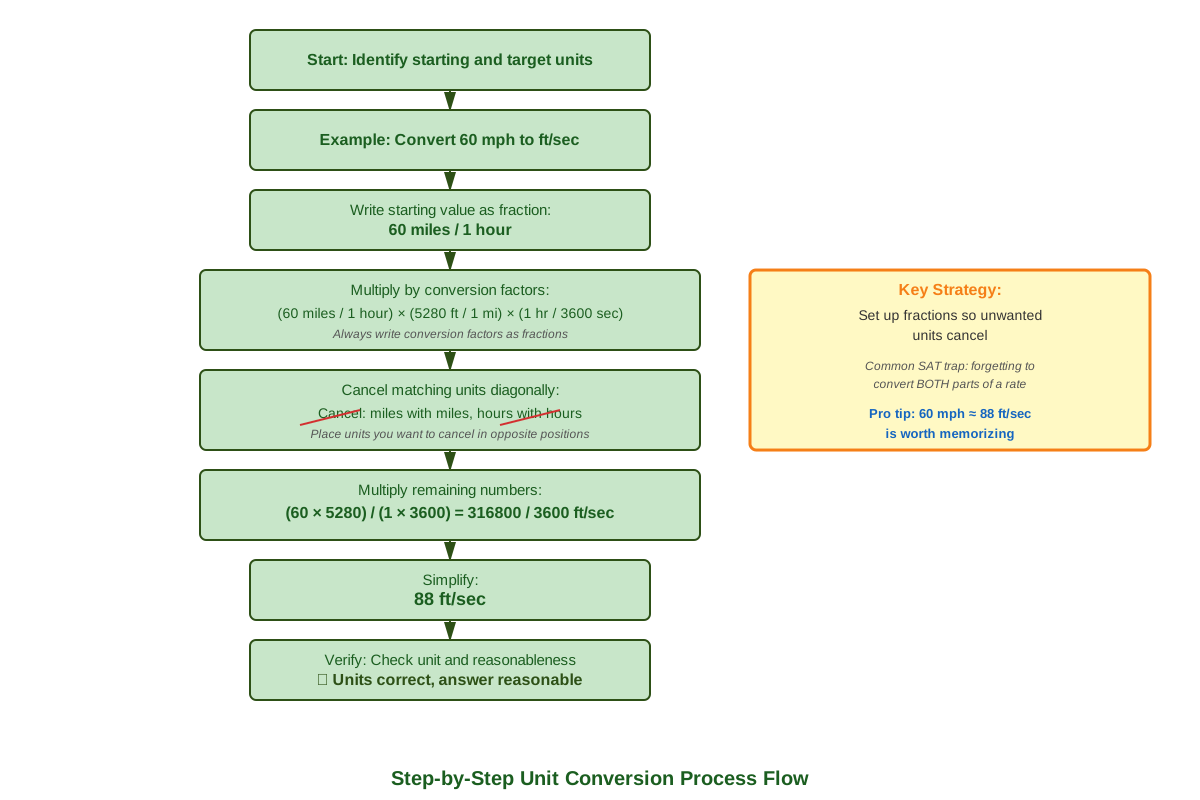
Many SAT problems require chaining multiple conversion factors together. For instance, converting miles per hour to feet per second requires converting both the distance unit (miles to feet) and the time unit (hours to seconds).
To convert 60 miles per hour to feet per second:
60 miles/hour × (5,280 feet / 1 mile) × (1 hour / 3,600 seconds) = 88 feet/secondNotice how units cancel systematically: miles cancels with miles, hours cancels with hours, leaving feet/second. The calculation becomes: (60 × 5,280) / 3,600 = 88.
Square and Cubic Unit Conversions
Converting area or volume units requires special attention because the conversion factor must be squared or cubed. This is where many students make errors.
When converting square units, square the linear conversion factor:
- Since 1 foot = 12 inches, then 1 square foot = 144 square inches (12²)
- To convert 5 square feet to square inches: 5 × 144 = 720 square inches
When converting cubic units, cube the linear conversion factor:
- Since 1 yard = 3 feet, then 1 cubic yard = 27 cubic feet (3³)
- To convert 2 cubic yards to cubic feet: 2 × 27 = 54 cubic feet
Setting Up Conversion Equations
For complex problems, setting up the conversion equation correctly is more important than calculation speed. The systematic approach:
- Write the given quantity with its units
- Multiply by conversion factors as fractions
- Arrange each fraction so unwanted units cancel
- Check that final units match the target
- Calculate only after verifying the setup
This methodical approach prevents the most common error: multiplying when you should divide, or vice versa.
Conversion in Context Problems
The SAT rarely asks straightforward "convert X to Y" questions. Instead, conversions appear embedded in word problems. Students must:
- Recognize when units don't match and conversion is needed
- Identify which units need conversion
- Execute the conversion as part of a larger solution
- Interpret the final answer in the correct units
For example: "A car travels 300 feet in 5 seconds. What is its speed in miles per hour?" This requires converting feet to miles and seconds to hours before calculating speed.
Concept Relationships
Unit conversions build directly on ratio and proportion concepts. Each conversion factor represents a proportional relationship between two ways of measuring the same quantity. The fundamental principle—that multiplying by a ratio equal to 1 doesn't change the quantity—connects to the algebraic property of multiplicative identity.
Within the topic itself, concepts flow logically: Conversion factors → Single-step conversions → Multi-step conversions → Compound unit conversions → Area/volume conversions. Each level adds complexity while relying on the same underlying principle of dimensional analysis.
Unit conversions connect forward to numerous SAT topics. In rate problems, conversions standardize units before calculating speed, density, or price per unit. In geometry, conversions allow area and volume calculations when dimensions use different units. In function problems, understanding how input and output units relate helps interpret graphs and tables. In data analysis, converting units makes datasets comparable.
The relationship map: Ratios and Proportions → Conversion Factors → Dimensional Analysis → Rate Calculations → Applied Problem Solving. Mastering the middle steps (conversion factors and dimensional analysis) unlocks success in the applied problems that constitute most SAT questions.
Quick check — test yourself on Unit conversions so far.
Try Flashcards →High-Yield Facts
⭐ Conversion factors equal 1, so multiplying by them changes representation but not quantity
⭐ Always arrange conversion factors so unwanted units cancel algebraically
⭐ When converting rates, convert both numerator and denominator units separately
⭐ Square the linear conversion factor when converting area units (1 ft = 12 in, so 1 ft² = 144 in²)
⭐ Cube the linear conversion factor when converting volume units (1 yd = 3 ft, so 1 yd³ = 27 ft³)
- There are 5,280 feet in one mile—this conversion appears frequently on the SAT
- One hour equals 3,600 seconds (60 minutes × 60 seconds)
- The metric system uses powers of 10: kilo- (1,000), centi- (1/100), milli- (1/1,000)
- When units appear in denominators, their conversion factors flip (seconds in denominator requires hours/seconds)
- Multi-step conversions can be done in any order as long as units cancel correctly
- Checking unit consistency throughout a problem catches setup errors before calculation
- The SAT provides some conversion factors in the reference box but not all commonly needed ones
- Converting between metric and customary systems (meters to feet) requires memorizing approximate conversion factors
Common Misconceptions
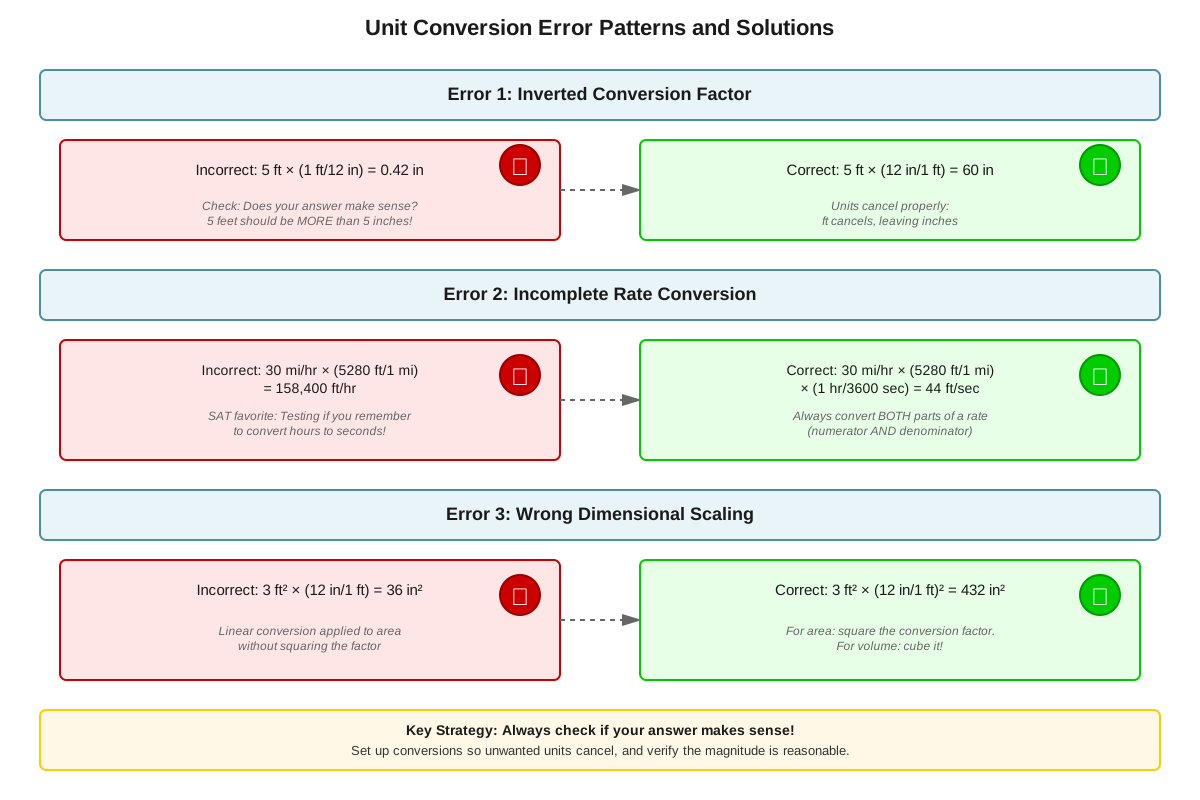
Misconception: Conversion factors can be applied in either direction without changing the setup.
Correction: The orientation of the conversion factor matters critically. To cancel units properly, the unit you want to eliminate must appear in opposite positions (numerator in one place, denominator in the other). Always set up conversions so unwanted units cancel algebraically.
Misconception: To convert area units, simply multiply by the linear conversion factor.
Correction: Area conversions require squaring the linear conversion factor because area is two-dimensional. If 1 foot = 12 inches, then 1 square foot = 144 square inches (12²), not 12 square inches. Similarly, volume conversions require cubing the factor.
Misconception: When converting rates like miles per hour to feet per second, you can convert just the numerator or just the denominator.
Correction: Both the numerator and denominator must be converted to their target units. Converting 60 mph to feet per second requires changing miles to feet AND hours to seconds, then simplifying the resulting fraction.
Misconception: Larger units always convert to smaller numbers, and smaller units always convert to larger numbers.
Correction: When converting TO a larger unit (inches to feet), the number gets smaller. When converting TO a smaller unit (feet to inches), the number gets larger. The relationship depends on the direction of conversion, not the starting point.
Misconception: All necessary conversion factors are provided in the SAT reference box.
Correction: The SAT reference information includes some conversions but not all. Students must memorize common conversions like inches to feet (12), feet to yards (3), feet to miles (5,280), seconds to minutes (60), and minutes to hours (60).
Misconception: You can convert units after performing calculations with mixed units.
Correction: Units must be standardized BEFORE performing calculations. Adding 2 feet and 15 inches requires converting to the same unit first. Calculating with mixed units produces incorrect results.
Worked Examples
Example 1: Multi-Step Rate Conversion
Problem: A cyclist travels at 20 miles per hour. What is this speed in feet per second? Round to the nearest whole number.
Solution:
Step 1: Identify what needs conversion. We need to convert miles to feet and hours to seconds.
Step 2: Set up the conversion with factors arranged for cancellation:
20 miles/hour × (5,280 feet / 1 mile) × (1 hour / 3,600 seconds)Step 3: Verify units cancel correctly:
- "miles" in numerator cancels with "mile" in denominator
- "hour" in denominator cancels with "hour" in numerator
- Remaining units: feet/second ✓
Step 4: Calculate:
(20 × 5,280) / 3,600 = 105,600 / 3,600 = 29.33...Step 5: Round to nearest whole number: 29 feet per second
Step 6: Verify reasonableness: 20 mph is a moderate cycling speed, and 29 feet per second (about 30 feet per second) seems reasonable—the cyclist covers about 30 feet each second.
Connection to Learning Objectives: This problem demonstrates applying unit conversions to compound units (rates) and shows how multi-step conversions appear in SAT contexts.
Example 2: Area Conversion in Context
Problem: A rectangular garden measures 15 feet by 8 feet. Fertilizer costs $0.03 per square inch. What is the total cost to fertilize the entire garden?
Solution:
Step 1: Calculate area in square feet:
Area = 15 feet × 8 feet = 120 square feetStep 2: Recognize the unit mismatch—area is in square feet but cost is per square inch. Convert square feet to square inches.
Step 3: Apply the squared conversion factor (since 1 foot = 12 inches, 1 square foot = 144 square inches):
120 square feet × (144 square inches / 1 square foot) = 17,280 square inchesStep 4: Calculate total cost:
17,280 square inches × $0.03/square inch = $518.40Step 5: Verify reasonableness: The garden is 120 square feet, which is 17,280 square inches. At 3 cents per square inch, the cost should be substantial—$518.40 makes sense.
Connection to Learning Objectives: This problem shows how unit conversions appear embedded in real-world contexts, requires recognizing when conversion is necessary, and demonstrates the critical importance of squaring the conversion factor for area units.
Exam Strategy
When approaching sat unit conversions problems on the SAT, begin by reading carefully to identify all units mentioned. Circle or underline each unit as you encounter it—this prevents missing a required conversion. Before calculating anything, determine whether all units match. If they don't, plan your conversion strategy before touching the calculator.
Trigger words and phrases that signal unit conversion problems include:
- "Convert..." or "express in terms of..."
- Mixed units in the same problem (feet and inches, hours and minutes)
- Rate problems with "per" (miles per hour, dollars per pound)
- "How many..." followed by a different unit than given
- Area or volume problems with linear measurements in different units
For process of elimination on multiple-choice questions, check units first. If answer choices have different units, eliminate any that don't match what the question asks for. Use estimation to eliminate unreasonable magnitudes—if converting from a smaller unit to a larger unit, the number should decrease, allowing you to eliminate answers that increase.
Time allocation: Simple single-step conversions should take 30-45 seconds. Multi-step conversions or conversions embedded in word problems may require 90-120 seconds. If a problem requires more than two minutes, mark it and return later—you may be overcomplicating the approach.
Set up the conversion equation completely before calculating. Write out the multiplication with all conversion factors, verify that units cancel properly, then calculate. This takes an extra 10-15 seconds but prevents the most common errors. On no-calculator section problems, look for opportunities to simplify before multiplying large numbers—often factors cancel to make mental math easier.
Exam Tip: Always write units throughout your work, even in scratch calculations. This habit catches errors immediately and ensures you answer in the requested units.
Memory Techniques
"Five Tomatoes" for feet in a mile: 5,280 feet = 1 mile. Visualize five tomatoes to remember 5-2-8-0.
"Dirty Dozen" for inches in a foot: 12 inches = 1 foot. The number 12 appears in "dozen."
"Square the Square, Cube the Cube": When converting area (square units), square the conversion factor. When converting volume (cubic units), cube the conversion factor.
"Cancel Culture": Visualize units as things you want to "cancel out" of your life. Set up conversions so unwanted units cancel, leaving only what you want.
"Sixty-Sixty-Thirty-Six": Time conversions use 60 (seconds per minute, minutes per hour), and 60 × 60 = 3,600 (seconds per hour).
The "Fraction Flip": When a unit appears in the denominator (like "per second"), flip the conversion factor. If converting seconds to hours in a denominator, use (seconds/hour) not (hours/second).
Visualization for area conversions: Picture a 1-foot by 1-foot square. Inside it, draw a 12×12 grid of inch squares. Counting them gives 144 square inches, reinforcing that 1 ft² = 144 in².
Summary
Unit conversions form an essential SAT Math skill that appears across multiple question types and difficulty levels. The fundamental principle involves multiplying by conversion factors—ratios equal to 1 that change unit representation without changing quantity. Success requires knowing common conversion factors (12 inches per foot, 5,280 feet per mile, 60 seconds per minute, 3,600 seconds per hour), setting up conversions so units cancel algebraically, and applying special rules for area (square the factor) and volume (cube the factor). Most SAT problems embed conversions within larger contexts—rate problems, geometry applications, or word problems—requiring students to recognize when conversion is necessary before executing it correctly. The systematic approach of writing out all units, arranging conversion factors for cancellation, verifying setup before calculating, and checking answer reasonableness provides both accuracy and confidence. Mastering unit conversions delivers reliable points on the SAT while building quantitative reasoning skills applicable far beyond the exam.
Key Takeaways
- Conversion factors are ratios equal to 1 that change unit representation without changing the actual quantity being measured
- Dimensional analysis (tracking units algebraically) provides both a calculation method and an error-checking system
- Area conversions require squaring the linear conversion factor; volume conversions require cubing it
- Multi-step conversions for rates require converting both numerator and denominator units separately
- Always standardize units before calculating—mixed units in the same calculation produce incorrect results
- Common SAT conversions (feet/mile, inches/foot, seconds/hour) must be memorized as they're not always provided
- Set up the complete conversion equation first, verify unit cancellation, then calculate—this prevents the most common errors
Related Topics
Rates and Unit Rates: Building on unit conversions, rate problems involve calculating speed, price per unit, or other ratios where units differ between numerator and denominator. Mastering conversions enables solving complex rate problems efficiently.
Proportional Relationships: Unit conversions are special cases of proportional reasoning. Understanding how quantities scale proportionally deepens comprehension of both topics.
Dimensional Analysis in Science Contexts: Physics and chemistry problems on the SAT often require unit conversions for density, concentration, or energy calculations. The same conversion principles apply in these applied contexts.
Geometry with Mixed Units: Area and volume problems frequently present dimensions in different units, requiring conversion before calculation. This topic directly applies conversion skills to geometric reasoning.
Function Interpretation: Understanding how input and output units relate in functions helps interpret graphs, tables, and equations—skills that build on unit conversion foundations.
Practice CTA
Now that you've mastered the core concepts of unit conversions, it's time to cement your understanding through practice. Attempt the practice questions to apply these strategies to SAT-style problems, and use the flashcards to reinforce essential conversion factors and techniques. Remember: unit conversions are high-yield, predictable points on the SAT—students who practice systematically can answer these questions quickly and confidently, building momentum for the entire Math section. Your investment in mastering this topic will pay dividends across multiple question types on test day!
Sign up free to keep reading
Create a free AnvayaPrep account to finish this SAT guide on Unit conversions — plus flashcards and practice questions.