Overview
Rationalizing denominators is a fundamental algebraic technique that involves eliminating radicals (square roots, cube roots, etc.) from the denominator of a fraction. This process transforms expressions like 1/√2 into equivalent forms with rational denominators, such as √2/2. While the mathematical value remains unchanged, the rationalized form is considered the standard, simplified format in math and is essential for correctly answering SAT questions.
On the SAT, rationalizing denominators appears regularly in both the calculator and no-calculator sections, often embedded within larger algebraic problems involving simplification, equation solving, or geometric applications. The College Board expects students to recognize when rationalization is necessary and to execute the technique flawlessly under time pressure. Questions may present answer choices in rationalized form, requiring students to transform their work to match, or they may ask students to simplify complex expressions where rationalization is an intermediate step.
Understanding this topic connects directly to broader concepts in the Exponents and Radicals unit, including radical operations, conjugate multiplication, and algebraic simplification. Mastery of sat rationalizing denominators strengthens overall algebraic fluency and prepares students for more advanced topics in polynomial operations and rational expressions. The technique also reinforces the fundamental principle that mathematical expressions can take multiple equivalent forms, and recognizing these equivalences is crucial for success on standardized tests.
Learning Objectives
- [ ] Identify key features of rationalizing denominators
- [ ] Explain how rationalizing denominators appears on the SAT
- [ ] Apply rationalizing denominators to answer SAT-style questions
- [ ] Execute single-radical rationalization using multiplication by √n/√n
- [ ] Apply conjugate multiplication to rationalize denominators containing binomials with radicals
- [ ] Recognize when an expression requires rationalization to match SAT answer choices
- [ ] Simplify complex fractions involving multiple radical terms through systematic rationalization
Prerequisites
- Operations with radicals: Students must understand how to multiply, divide, and simplify radical expressions, as rationalization relies on these fundamental operations
- Properties of exponents: Rationalization often involves converting between radical and exponential notation (√x = x^(1/2)), making exponent rules essential
- Multiplying binomials: The FOIL method or distributive property is necessary when working with conjugates to rationalize binomial denominators
- Equivalent fractions: Understanding that multiplying numerator and denominator by the same value preserves equality is the foundational principle of rationalization
- Simplifying radicals: Before rationalizing, students must be able to reduce radicals to simplest form (e.g., √12 = 2√3)
Why This Topic Matters
Rationalizing denominators serves both practical and conventional purposes in mathematics. Historically, this technique emerged when calculations were performed by hand, and division by irrational numbers was computationally difficult. While calculators have reduced this practical concern, the convention persists because rationalized forms often reveal mathematical relationships more clearly and facilitate further algebraic manipulation.
On the SAT, rationalization questions appear in approximately 2-4 questions per test, representing roughly 3-5% of the total math score. These questions most commonly appear as:
- Direct simplification problems requiring students to rationalize and simplify an expression
- Equation-solving questions where rationalization is an intermediate step
- Answer-matching scenarios where the correct answer is presented in rationalized form
- Geometry problems involving distances, areas, or special right triangles that produce radical expressions
The SAT specifically tests this skill because it assesses multiple competencies simultaneously: algebraic manipulation, attention to mathematical conventions, and the ability to recognize equivalent expressions. Students who cannot rationalize denominators will struggle to match their answers to the provided choices, even when their mathematical reasoning is otherwise correct. Additionally, rationalization frequently appears in grid-in questions where students must produce the simplified form independently, making mastery non-negotiable for achieving top scores.
Core Concepts
What Is Rationalization?
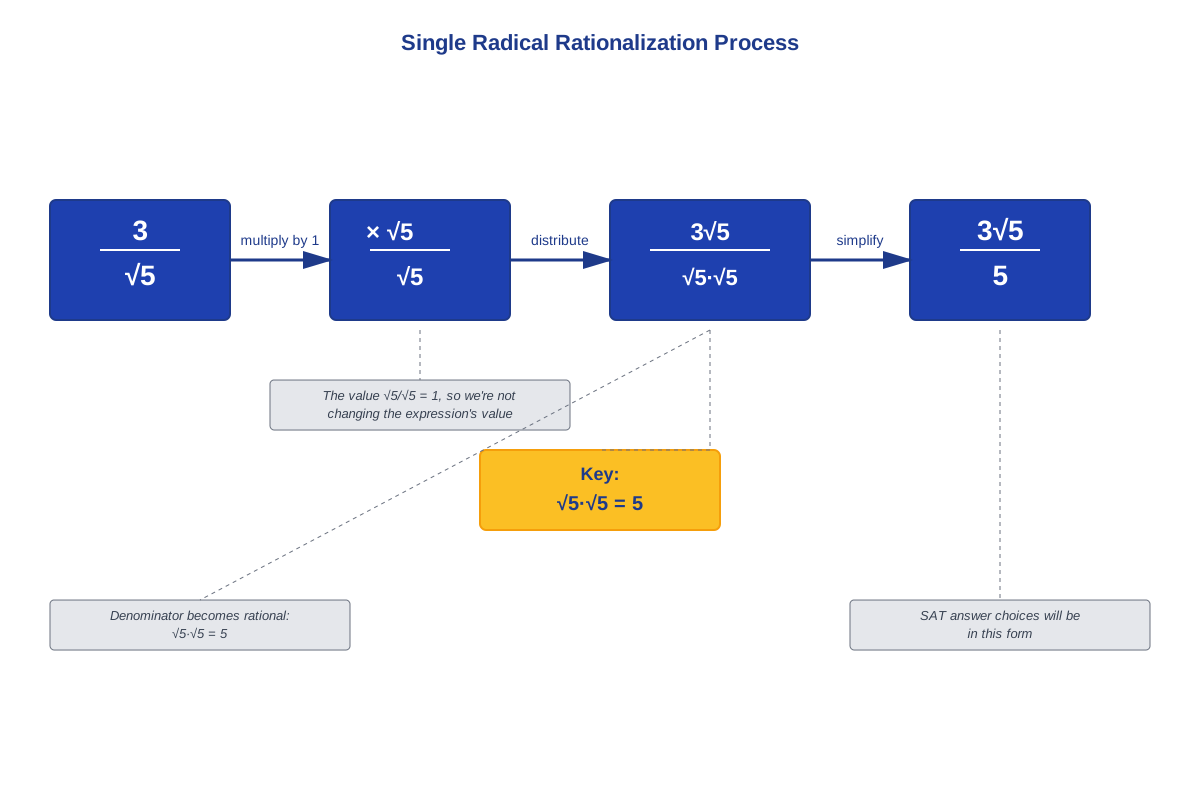
Rationalizing denominators is the process of eliminating radical expressions from the denominator of a fraction by multiplying both numerator and denominator by a strategically chosen expression. The goal is to transform the denominator into a rational number (a number that can be expressed as a ratio of integers) while maintaining the fraction's value.
The fundamental principle underlying rationalization is that multiplying any fraction by a form of 1 (such as √2/√2 or (3+√5)/(3+√5)) does not change its value. This allows us to manipulate the form of an expression without altering its mathematical meaning.
Single-Radical Rationalization
When a denominator contains a single radical term, rationalization follows a straightforward procedure:
Step-by-step process:
- Identify the radical in the denominator
- Multiply both numerator and denominator by that same radical
- Simplify the resulting expression
- Reduce the fraction if possible
Example structure:
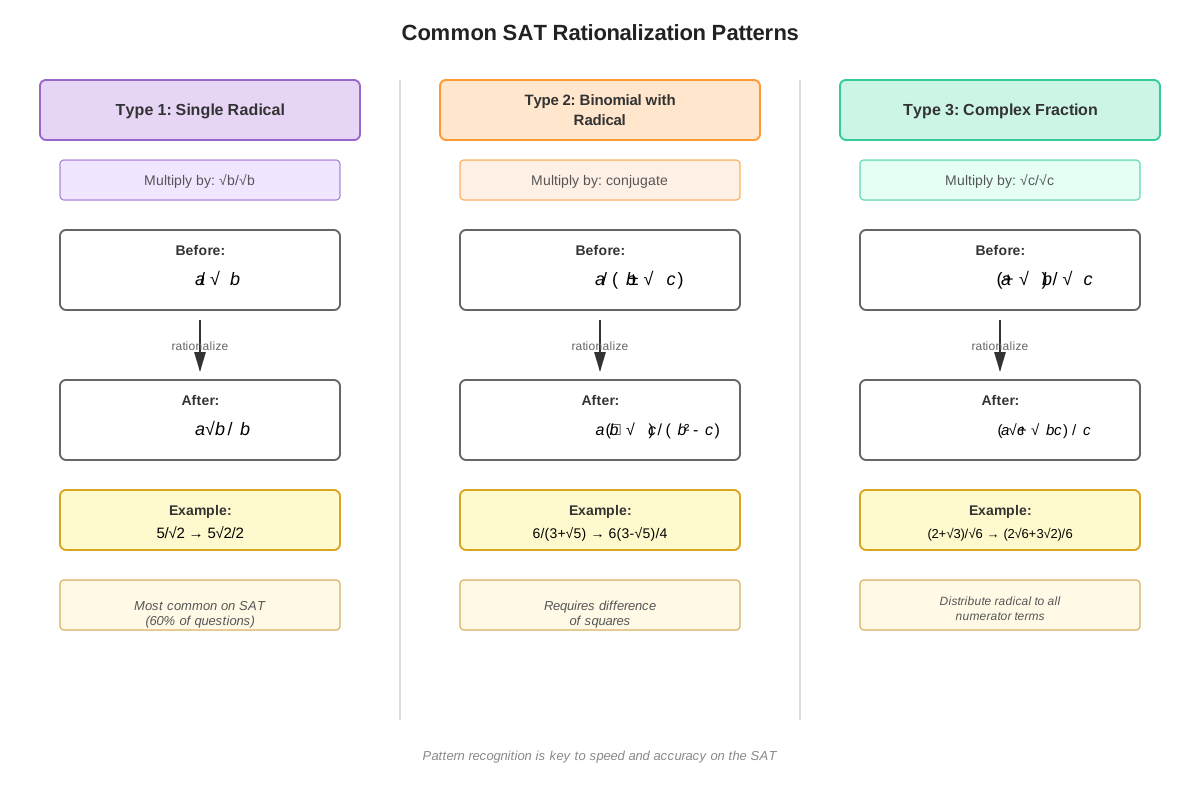
a/√b = (a/√b) × (√b/√b) = (a√b)/(√b × √b) = (a√b)/bThe key insight is that √b × √b = b, which eliminates the radical from the denominator. This works because multiplying a square root by itself produces the radicand (the number under the radical sign).
Common patterns:
| Original Form | Multiply By | Rationalized Form |
|---|---|---|
| 1/√2 | √2/√2 | √2/2 |
| 3/√5 | √5/√5 | 3√5/5 |
| 2/√x | √x/√x | 2√x/x |
| 5/(2√3) | √3/√3 | 5√3/6 |
Rationalization with Cube Roots and Higher-Order Radicals
When denominators contain cube roots or higher-order radicals, the process requires more careful consideration. For a cube root ∛a, we need to create a perfect cube in the denominator.
For cube roots:
To rationalize 1/∛2, we cannot simply multiply by ∛2/∛2 because ∛2 × ∛2 = ∛4, which still contains a radical. Instead, we need ∛2 × ∛2 × ∛2 = ∛8 = 2. Therefore, we multiply by ∛4/∛4:
1/∛2 = (1/∛2) × (∛4/∛4) = ∛4/(∛2 × ∛4) = ∛4/∛8 = ∛4/2General principle: For ∛a, multiply by ∛(a^(3-n))/∛(a^(3-n)) where n is the current power under the radical.
Conjugate Rationalization
When a denominator contains a binomial with at least one radical term (such as 2 + √3 or √5 - √2), single-radical multiplication will not eliminate all radicals. Instead, we use the conjugate method.
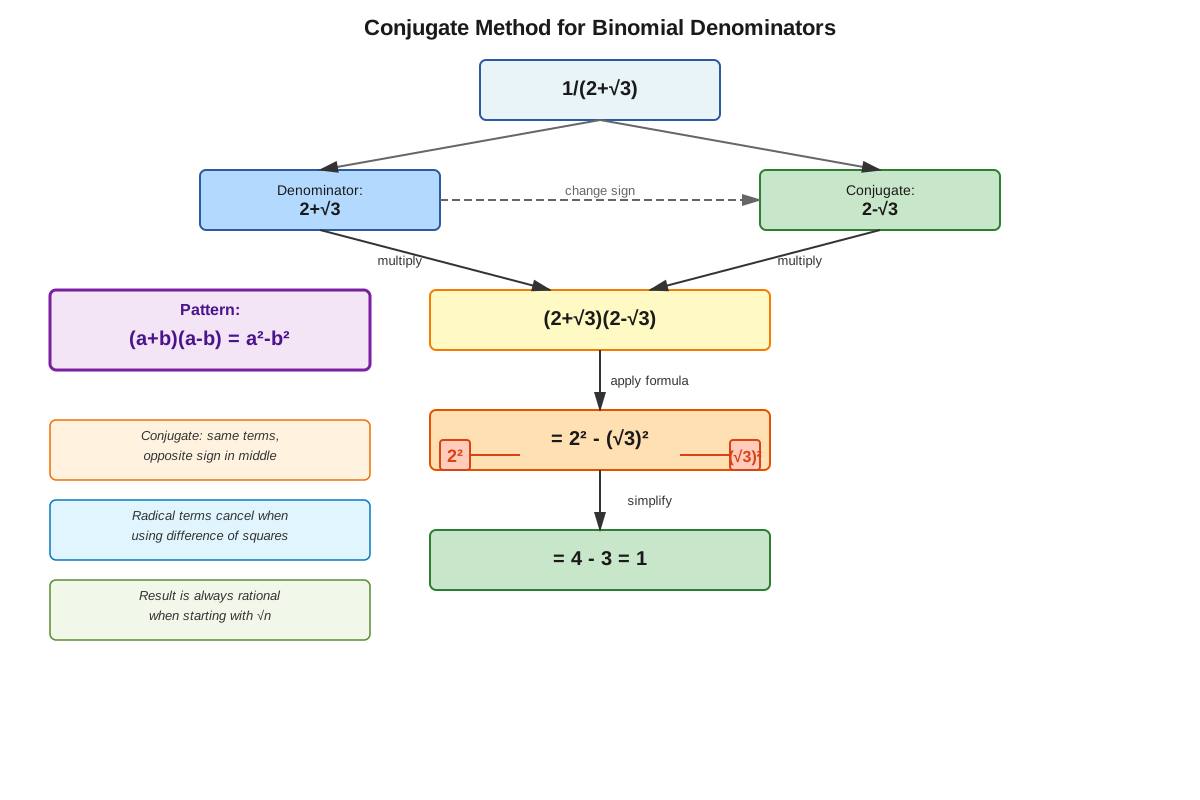
The conjugate of a binomial a + b is a - b (and vice versa). When we multiply conjugates, we apply the difference of squares pattern:
(a + b)(a - b) = a² - b²This is powerful because if b = √c, then b² = c, eliminating the radical.
Conjugate pairs:
| Expression | Conjugate |
|---|---|
| 2 + √3 | 2 - √3 |
| √5 - 1 | √5 + 1 |
| √7 + √2 | √7 - √2 |
| 3 - 2√5 | 3 + 2√5 |
Rationalization process with conjugates:
- Identify the binomial denominator
- Determine its conjugate
- Multiply both numerator and denominator by the conjugate
- Apply the difference of squares formula to the denominator
- Distribute in the numerator
- Simplify completely
Example:
1/(2 + √3) = [1/(2 + √3)] × [(2 - √3)/(2 - √3)]
           = (2 - √3)/[(2 + √3)(2 - √3)]
           = (2 - √3)/(4 - 3)
           = (2 - √3)/1
           = 2 - √3
Simplification After Rationalization
After rationalizing, the resulting expression often requires additional simplification. This may involve:
- Factoring common terms from numerator and denominator
- Reducing fractions to lowest terms
- Combining like terms in the numerator
- Simplifying radicals that appear in the numerator
For example, after rationalizing 6/(2√3), we get 6√3/6, which simplifies to √3.
Complex Rationalization Scenarios
Some SAT problems combine multiple concepts:
Nested radicals: Expressions like 1/√(2 + √3) require working from the inside out, though these are rare on the SAT.
Multiple fractions: Problems may require rationalizing several terms before combining them.
Rationalization within equations: Sometimes rationalization is necessary to solve an equation or to isolate a variable.
Concept Relationships
The process of rationalizing denominators builds directly on simplifying radicals, as expressions must be in simplest radical form before rationalization can be completed effectively. For instance, recognizing that √12 = 2√3 allows for more efficient rationalization and final simplification.
Rationalization → connects to → Multiplying radicals: The core operation in rationalization is radical multiplication, particularly the principle that √a × √a = a. Without fluency in radical multiplication, students cannot execute rationalization.
Conjugate multiplication → extends from → Difference of squares: The conjugate method relies entirely on the algebraic identity (a + b)(a - b) = a² - b², which students learn in polynomial operations. This connection demonstrates how seemingly separate algebraic topics integrate in practice.
Equivalent fractions → underlies → Rationalization validity: The entire rationalization process depends on the principle that multiplying numerator and denominator by the same non-zero value creates an equivalent fraction. This foundational concept from elementary mathematics justifies why rationalization preserves the expression's value.
Within the broader Exponents and Radicals unit, rationalization serves as a bridge between radical operations and rational expressions. It prepares students for more advanced work with complex fractions and demonstrates that mathematical expressions can be transformed into equivalent but more useful forms—a principle that extends throughout algebra and calculus.
High-Yield Facts
⭐ Multiplying both numerator and denominator by the same radical eliminates that radical from the denominator because √a × √a = a
⭐ The conjugate of a + √b is a - √b; multiplying conjugates eliminates radicals through the difference of squares formula
⭐ After rationalization, always simplify by reducing common factors between numerator and denominator
⭐ SAT answer choices are always presented in rationalized form; if your answer contains a radical in the denominator, it requires further simplification
⭐ For denominators with cube roots ∛a, multiply by ∛(a²)/∛(a²) to create a perfect cube
- Rationalization does not change the numerical value of an expression, only its form
- When the denominator is a√b (a coefficient times a radical), multiply by √b/√b and remember to multiply the coefficient in the denominator by itself
- The expression 1/√2 rationalizes to √2/2, not √2 (a common error is forgetting the denominator becomes 2)
- Conjugate rationalization always produces a rational denominator because (a + √b)(a - √b) = a² - b, which contains no radicals
- If a denominator contains √x + √y, the conjugate is √x - √y, and the rationalized denominator will be x - y
- Grid-in questions on the SAT will not accept answers with radicals in the denominator
- Rationalizing before adding or subtracting fractions with radical denominators often simplifies the problem significantly
Quick check — test yourself on Rationalizing denominators so far.
Try Flashcards →Common Misconceptions
Misconception: Rationalization changes the value of the expression.
Correction: Rationalization only changes the form of the expression. Since we multiply by a fraction equal to 1 (like √2/√2), the value remains identical. The expressions 1/√2 and √2/2 are mathematically equivalent and will produce the same decimal value.
Misconception: To rationalize 1/√2, multiply only the denominator by √2.
Correction: Both the numerator and denominator must be multiplied by √2 to maintain the expression's value. Multiplying only the denominator would change the value of the fraction. The correct process is (1/√2) × (√2/√2) = √2/2.
Misconception: The conjugate of 2 + √3 is 2 + √3 (the same expression).
Correction: The conjugate requires changing the sign between the terms. The conjugate of 2 + √3 is 2 - √3. The purpose of using conjugates is that their product eliminates radicals: (2 + √3)(2 - √3) = 4 - 3 = 1.
Misconception: After rationalizing 6/(2√3) to get 6√3/6, the answer is complete.
Correction: The expression must be simplified further by reducing the fraction. Since both numerator and denominator contain a factor of 6, the final simplified answer is √3. Always check for common factors after rationalization.
Misconception: To rationalize 1/∛2, multiply by ∛2/∛2.
Correction: This multiplication would give ∛2/∛4, which still contains a radical in the denominator. For cube roots, you must create a perfect cube. Multiply by ∛4/∛4 to get ∛4/∛8 = ∛4/2, which has a rational denominator.
Misconception: If the denominator is √2 + √3, multiply by √2/√2 to eliminate the first radical.
Correction: When the denominator contains a sum or difference of radicals, you must use the conjugate method. Multiply by (√2 - √3)/(√2 - √3) to eliminate both radicals simultaneously through the difference of squares pattern.
Misconception: Rationalized form is always simpler or shorter than the original expression.
Correction: Rationalized form is the standard mathematical convention, but it may actually be longer. For example, 1/(1 + √2) rationalizes to -1 + √2, which is not necessarily "simpler" but is the accepted standard form. The SAT requires answers in this conventional form.
Worked Examples
Example 1: Single-Radical Rationalization with Coefficient
Problem: Simplify and rationalize: 8/(3√2)
Solution:
Step 1: Identify the radical in the denominator. Here we have √2 in the denominator, along with a coefficient of 3.
Step 2: Multiply both numerator and denominator by √2:
8/(3√2) × (√2/√2) = (8√2)/(3√2 × √2)Step 3: Simplify the denominator. Remember that √2 × √2 = 2:
= (8√2)/(3 × 2) = (8√2)/6Step 4: Reduce the fraction by dividing both numerator and denominator by their greatest common factor, which is 2:
= (4√2)/3Final Answer: 4√2/3
Connection to Learning Objectives: This example demonstrates the application of rationalization to SAT-style problems, showing how to handle coefficients in the denominator and emphasizing the importance of complete simplification—a key feature that distinguishes correct SAT answers.
Example 2: Conjugate Rationalization
Problem: Rationalize and simplify: 6/(√5 - 2)
Solution:
Step 1: Identify that the denominator is a binomial containing a radical: √5 - 2
Step 2: Determine the conjugate by changing the sign: √5 + 2
Step 3: Multiply both numerator and denominator by the conjugate:
6/(√5 - 2) × [(√5 + 2)/(√5 + 2)] = [6(√5 + 2)]/[(√5 - 2)(√5 + 2)]Step 4: Expand the numerator using distribution:
= (6√5 + 12)/[(√5 - 2)(√5 + 2)]Step 5: Apply the difference of squares formula to the denominator. Remember: (a - b)(a + b) = a² - b²
= (6√5 + 12)/[(√5)² - (2)²]
= (6√5 + 12)/(5 - 4)
= (6√5 + 12)/1
Step 6: Simplify:
= 6√5 + 12Step 7: Factor out the common factor of 6 (optional, but good practice):
= 6(√5 + 2)Final Answer: 6√5 + 12 or 6(√5 + 2)
Connection to Learning Objectives: This example illustrates the conjugate method, a key feature of rationalizing denominators that frequently appears on the SAT. It shows how difference of squares eliminates radicals and demonstrates the multi-step algebraic reasoning the SAT tests.
Exam Strategy
When approaching rationalization questions on the SAT, follow this systematic approach:
Recognition triggers: Watch for these phrases and formats that signal rationalization may be required:
- "Simplify the expression"
- "Which of the following is equivalent to..."
- Answer choices that contain radicals in numerators but not denominators
- Fractions with √ symbols in the denominator
- Grid-in questions involving radical expressions
Step-by-step approach:
- Scan answer choices first: If all choices are in rationalized form, you know your final answer must be too
- Identify the denominator type: Single radical or binomial with radical(s)
- Choose the appropriate method: Direct multiplication for single radicals, conjugate for binomials
- Execute carefully: Write out each step to avoid arithmetic errors
- Simplify completely: Reduce fractions and combine like terms
- Verify: Check that no radicals remain in the denominator
Process of elimination tips:
- Eliminate any answer choice with a radical in the denominator—these are never correct on the SAT
- If you've rationalized correctly but your answer doesn't match the choices, check for unsimplified fractions or radicals
- For conjugate problems, the denominator should be a simple integer or rational number after rationalization
- If answer choices differ only in signs or coefficients, double-check your arithmetic in the numerator expansion
Time allocation:
- Single-radical rationalization: 30-45 seconds
- Conjugate rationalization: 60-90 seconds
- Complex problems requiring multiple steps: 2-3 minutes
Exam Tip: If you're running short on time and encounter a rationalization problem, remember that you can check your answer by converting to decimal form on your calculator. While this doesn't teach the technique, it can help you verify your work or choose between two similar answer choices.
Calculator usage: While rationalization is an algebraic skill, you can use your calculator to verify equivalence. For example, 1/√2 and √2/2 both equal approximately 0.707. However, grid-in questions require the exact rationalized form, not decimal approximations.
Memory Techniques
Mnemonic for the rationalization process: "MISS"
- Multiply by the radical (or conjugate)
- Identify what's in the denominator after multiplication
- Simplify the denominator (should be rational)
- Simplify the entire fraction (reduce if possible)
Conjugate visualization: Think of conjugates as "opposite twins"—they look almost identical but have opposite signs. When they meet (multiply), they cancel out the radical "magic" and leave only rational numbers behind.
Acronym for checking your work: "RAND"
- Radicals eliminated from denominator?
- All fractions reduced to lowest terms?
- Numerator simplified and like terms combined?
- Double-check arithmetic?
Memory aid for difference of squares: Remember the phrase "First squared minus Last squared" when multiplying conjugates. For (√5 - 2)(√5 + 2), think: (√5)² - (2)² = 5 - 4 = 1.
Visual pattern for single radicals: Create a mental image of a "radical sandwich":
   a        √b        a√b
  ---  ×   ---  =    ---
  √b        √b        b
The radical "moves up" to the numerator while the denominator becomes rational.
Rhyme for conjugates: "Change the sign, and you'll be fine—multiply to make it rational every time!"
Summary
Rationalizing denominators is an essential algebraic technique that transforms fractions containing radicals in the denominator into equivalent expressions with rational denominators. The process relies on multiplying both numerator and denominator by strategically chosen expressions—either the radical itself for single-radical denominators or the conjugate for binomial denominators containing radicals. The fundamental principle is that this multiplication by a form of 1 preserves the expression's value while changing its form to meet mathematical conventions. For single radicals, multiply by √n/√n to eliminate √n from the denominator. For binomial denominators like a + √b, multiply by the conjugate (a - √b)/(a - √b) and apply the difference of squares formula to eliminate radicals. After rationalization, complete simplification is crucial—reduce fractions, combine like terms, and ensure no radicals remain in the denominator. On the SAT, this skill appears regularly in both multiple-choice and grid-in formats, and answer choices are always presented in rationalized form. Mastery requires understanding both the mechanical process and the underlying algebraic principles, particularly radical multiplication and the difference of squares pattern.
Key Takeaways
- Rationalizing denominators eliminates radicals from the denominator by multiplying by a strategic form of 1, preserving the expression's value while changing its form
- For single-radical denominators (a/√b), multiply both numerator and denominator by √b/√b to get a√b/b
- For binomial denominators containing radicals (a/(c + √d)), multiply by the conjugate (c - √d)/(c - √d) and apply difference of squares
- SAT answer choices are always in rationalized form—any radical in your denominator indicates incomplete work
- Complete simplification after rationalization is essential: reduce fractions, combine like terms, and factor when possible
- The conjugate method works because (a + √b)(a - √b) = a² - b, which eliminates the radical through the difference of squares formula
- Rationalization appears in 2-4 questions per SAT, often embedded in larger problems involving equations, geometry, or algebraic simplification
Related Topics
Simplifying Radical Expressions: Before rationalizing, students must be able to reduce radicals to simplest form (√50 = 5√2). Mastering rationalization builds on this foundation and prepares students for more complex radical operations.
Operations with Complex Numbers: The conjugate method used in rationalization directly parallels the technique for dividing complex numbers, where multiplying by the conjugate (a - bi)/(a - bi) eliminates imaginary components from the denominator.
Rational Expressions and Complex Fractions: Rationalization is a specific application of the broader skill of simplifying rational expressions. Students who master rationalization will find it easier to work with algebraic fractions containing polynomials.
Geometric Applications: Many geometry problems involving special right triangles (30-60-90 and 45-45-90) produce radical expressions that require rationalization, particularly when calculating distances, areas, or trigonometric ratios.
Equation Solving with Radicals: When solving radical equations, rationalization often appears as an intermediate step, particularly when isolating variables or checking solutions.
Practice CTA
Now that you've mastered the concepts and strategies for rationalizing denominators, it's time to put your knowledge into action! Work through the practice questions to reinforce these techniques and build the speed and accuracy you need for test day. Each problem you solve strengthens your algebraic fluency and brings you closer to your target SAT score. Remember, rationalization is a high-yield topic that appears consistently on the exam—your investment in practice now will pay dividends when you encounter these questions under timed conditions. Challenge yourself with the flashcards to cement the key concepts and procedures in your memory. You've got this!
Sign up free to keep reading
Create a free AnvayaPrep account to finish this SAT guide on Rationalizing denominators — plus flashcards and practice questions.