Overview
Radicals are mathematical expressions that involve roots, most commonly square roots, cube roots, and higher-order roots. On the SAT math section, radicals appear frequently across both calculator and no-calculator portions, testing students' ability to simplify, manipulate, and solve equations involving these expressions. Understanding radicals is not merely about memorizing rules—it requires recognizing patterns, applying properties systematically, and connecting radical expressions to their exponential equivalents.
The SAT consistently includes sat radicals questions that range from straightforward simplification problems to complex multi-step equations embedded within word problems or geometric contexts. Students who master radicals gain a significant advantage because these concepts appear in approximately 10-15% of SAT math questions, either as the primary focus or as a necessary step in solving more complex problems. Radicals intersect with numerous other mathematical domains including algebra, geometry, and functions, making them a foundational skill that supports success across the entire math section.
Beyond isolated radical problems, the SAT tests whether students can recognize when to convert between radical and exponential notation, simplify expressions efficiently, rationalize denominators, and solve radical equations while checking for extraneous solutions. This topic connects directly to exponent rules, polynomial operations, and equation-solving strategies, forming an essential bridge between basic arithmetic operations and advanced algebraic manipulation required for top-tier SAT performance.
Learning Objectives
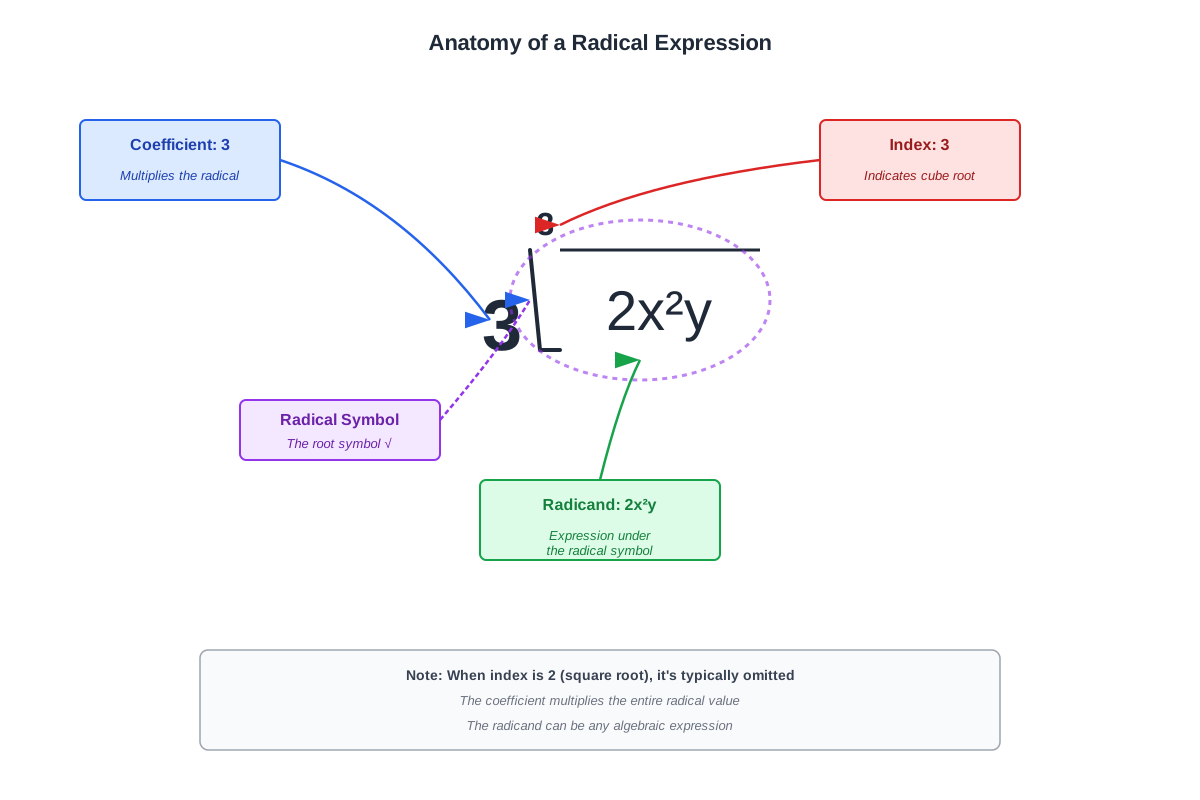
- [ ] Identify key features of radicals including index, radicand, and coefficient
- [ ] Explain how radicals appears on the SAT across different question types and difficulty levels
- [ ] Apply radicals to answer SAT-style questions involving simplification, operations, and equations
- [ ] Convert fluently between radical notation and exponential notation
- [ ] Simplify radical expressions by identifying and extracting perfect powers
- [ ] Perform arithmetic operations (addition, subtraction, multiplication, division) with radical expressions
- [ ] Solve radical equations and identify extraneous solutions through verification
Prerequisites
- Basic exponent rules: Understanding properties like x^m · x^n = x^(m+n) is essential because radicals are fractional exponents
- Prime factorization: Needed to identify perfect squares, cubes, and other perfect powers within radicands for simplification
- Algebraic manipulation: Combining like terms and distributing are fundamental operations when working with radical expressions
- Equation-solving techniques: Isolating variables and performing inverse operations form the foundation for solving radical equations
- Properties of equality: Understanding that performing the same operation to both sides maintains equality is crucial when squaring both sides of radical equations
Why This Topic Matters
Radicals appear in numerous real-world applications including physics formulas (velocity, acceleration), engineering calculations (stress analysis, signal processing), financial models (compound interest with continuous compounding), and geometric relationships (distance formula, Pythagorean theorem). The ability to manipulate radical expressions is fundamental to STEM fields and quantitative reasoning across disciplines.
On the SAT, radicals appear in approximately 3-5 questions per test, representing roughly 5-8% of the total math section. These questions span multiple formats: direct simplification problems worth quick points, radical equations requiring multi-step solutions, geometry problems involving the Pythagorean theorem or distance formula, and complex algebraic expressions where radicals appear as intermediate steps. The College Board specifically tests whether students can recognize equivalent forms of radical expressions, a skill that appears in both multiple-choice and grid-in questions.
Common SAT question types include: simplifying radical expressions with numerical or variable radicands, rationalizing denominators, solving equations where the variable appears under a radical sign, identifying equivalent expressions among answer choices, and applying radical concepts within coordinate geometry or right triangle contexts. Questions often combine radicals with other algebraic concepts, testing integrated mathematical reasoning rather than isolated skills.
Core Concepts
Radical Notation and Components
A radical expression consists of three main components: the radical symbol (√), the index (the small number indicating which root to take), and the radicand (the expression under the radical symbol). In the expression ∛(27), the index is 3, and the radicand is 27. When no index is written, the index is understood to be 2, indicating a square root.
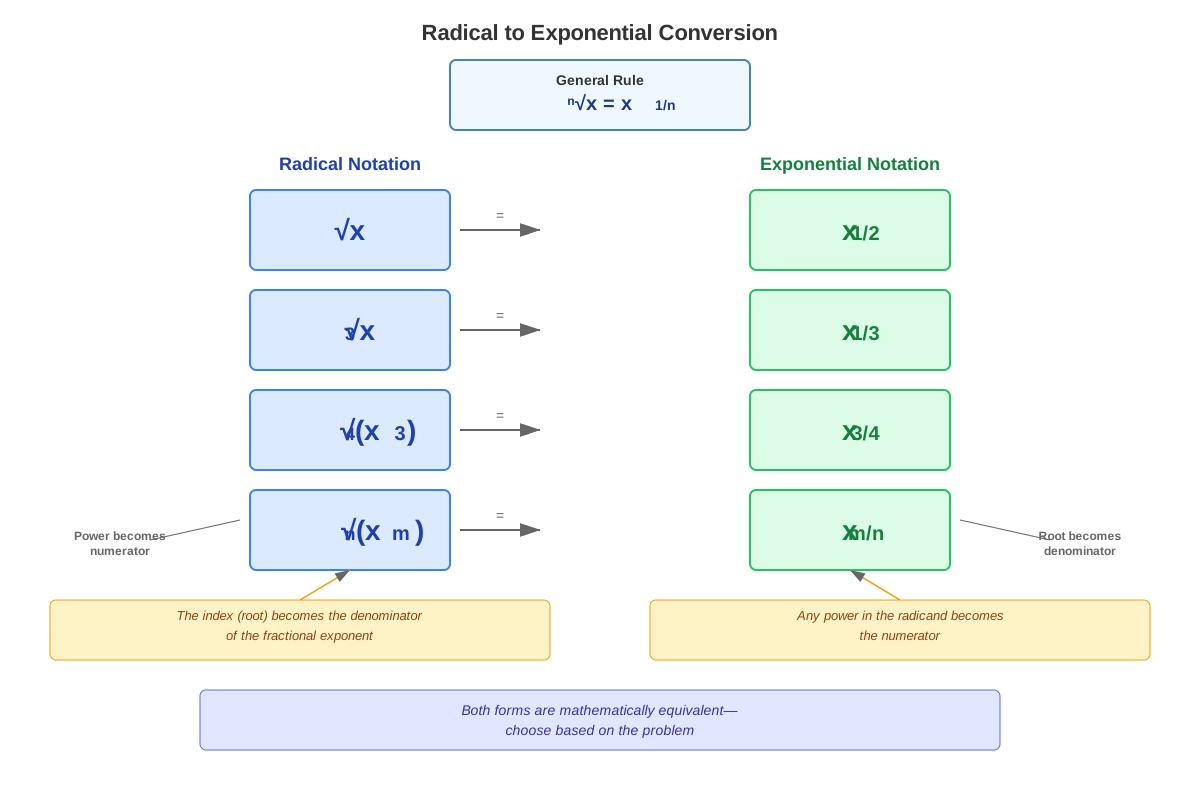
The general form of a radical is: ⁿ√x, where n is the index and x is the radicand. The expression asks: "What number, when raised to the nth power, equals x?" This fundamental question connects radicals directly to exponents through the relationship: ⁿ√x = x^(1/n).
Relationship Between Radicals and Exponents
Every radical can be expressed as an exponent with a fractional power, and conversely, every fractional exponent can be written as a radical. This equivalence is crucial for SAT problems:
ⁿ√(x^m) = x^(m/n)For example:
- √x = x^(1/2)
- ∛(x²) = x^(2/3)
- ⁴√(x³) = x^(3/4)
This relationship allows students to apply exponent rules to radical expressions, often simplifying complex problems significantly. When multiplying radicals with the same index, students can either work within radical notation or convert to exponential form.
Simplifying Radical Expressions
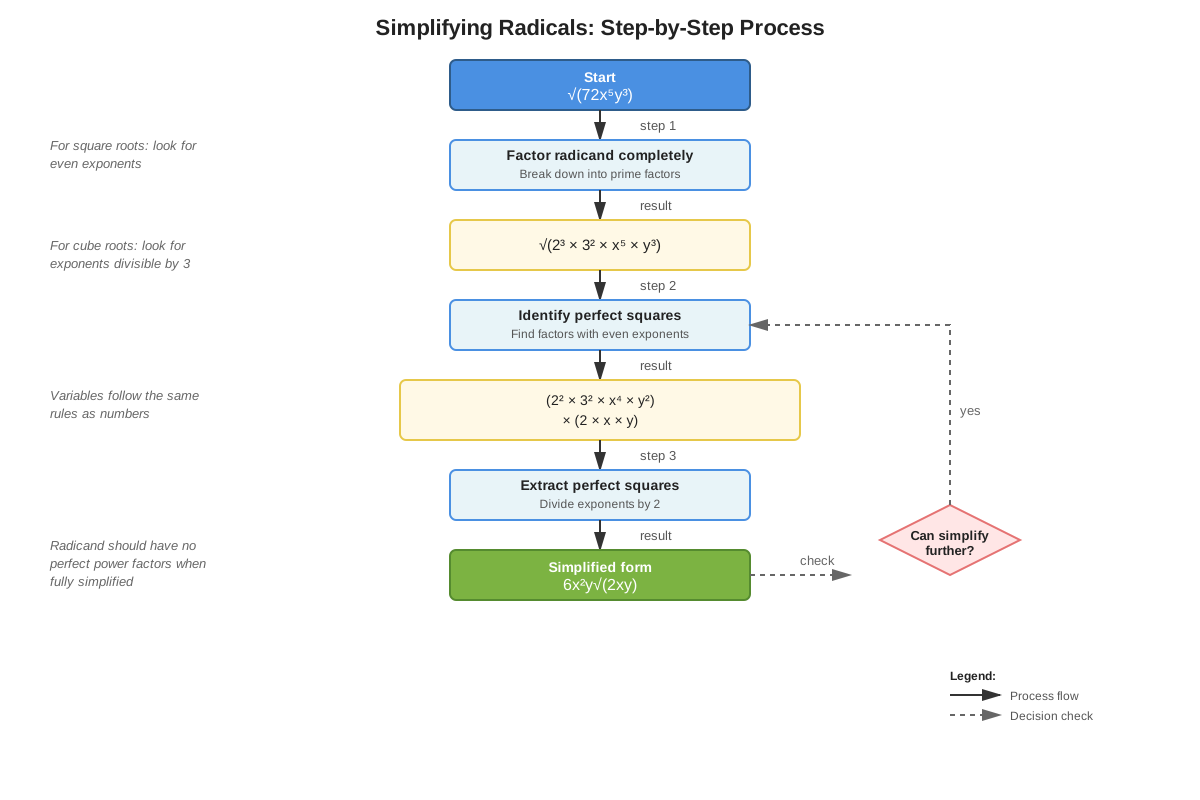
Simplification requires identifying perfect powers within the radicand that match the index. A perfect square (4, 9, 16, 25...) can be completely removed from a square root. A perfect cube (8, 27, 64...) can be completely removed from a cube root.
The systematic process for simplifying radicals:
- Factor the radicand into prime factors or identify perfect powers
- Group factors according to the index (pairs for square roots, triples for cube roots)
- Extract perfect powers from under the radical
- Multiply coefficients outside the radical together
- Multiply remaining factors inside the radical together
Example: Simplify √72
- Factor: 72 = 36 × 2 = 6² × 2
- Extract the perfect square: √(6² × 2) = 6√2
For variables, apply the same principle: √(x⁸) = x⁴ because x⁸ = (x⁴)²
Operations with Radicals
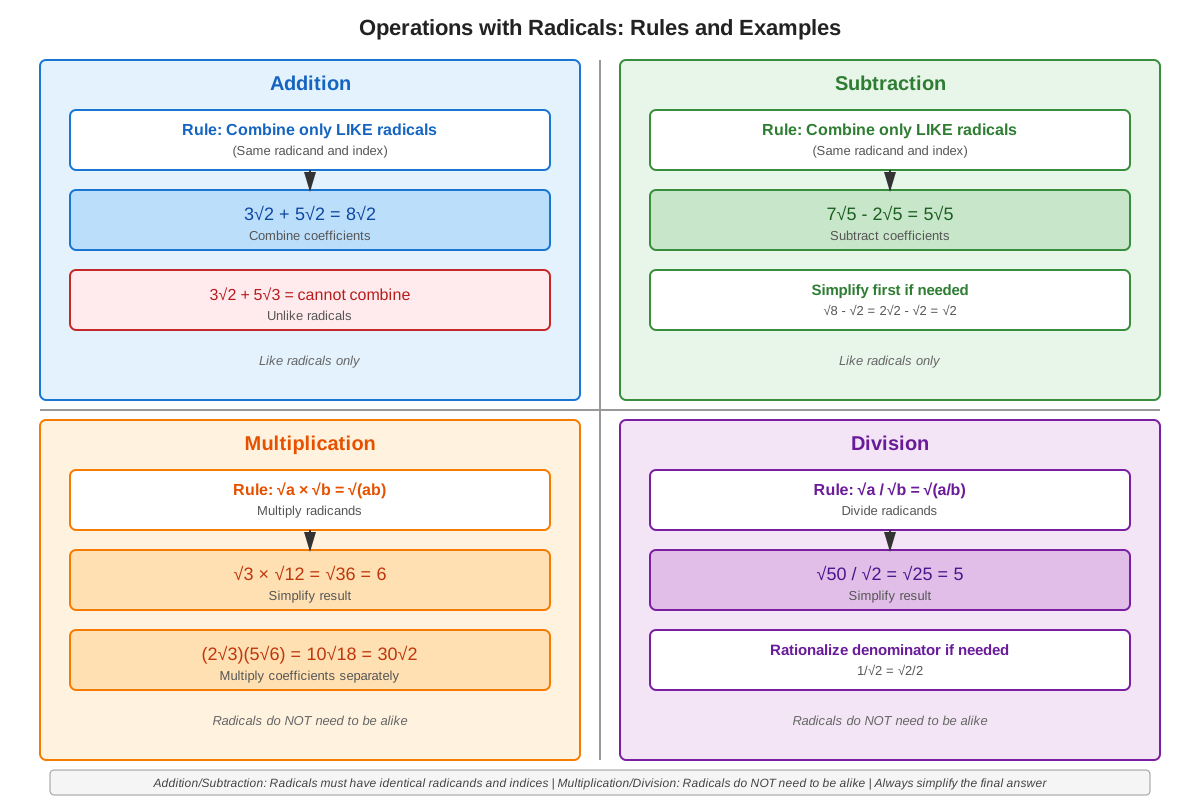
Addition and Subtraction: Only like radicals (same index and same radicand) can be combined, similar to combining like terms in algebra.
- 3√5 + 7√5 = 10√5 (like radicals)
- 2√3 + 4√2 cannot be simplified further (unlike radicals)
Multiplication: Radicals with the same index can be multiplied by multiplying their coefficients and their radicands separately:
a√x · b√y = ab√(xy)Example: 3√2 · 5√6 = 15√12 = 15√(4·3) = 15·2√3 = 30√3
Division: Similar to multiplication, divide coefficients and radicands separately:
(a√x)/(b√y) = (a/b)√(x/y)Rationalizing Denominators
The SAT expects answers without radicals in denominators. Rationalizing involves multiplying both numerator and denominator by an expression that eliminates the radical from the denominator.
For simple radical denominators, multiply by the radical itself:
5/√3 = (5/√3) · (√3/√3) = 5√3/3For binomial denominators containing radicals, multiply by the conjugate (same terms with opposite sign):
1/(2+√3) = 1/(2+√3) · (2-√3)/(2-√3) = (2-√3)/(4-3) = 2-√3This technique uses the difference of squares pattern: (a+b)(a-b) = a² - b²
Solving Radical Equations
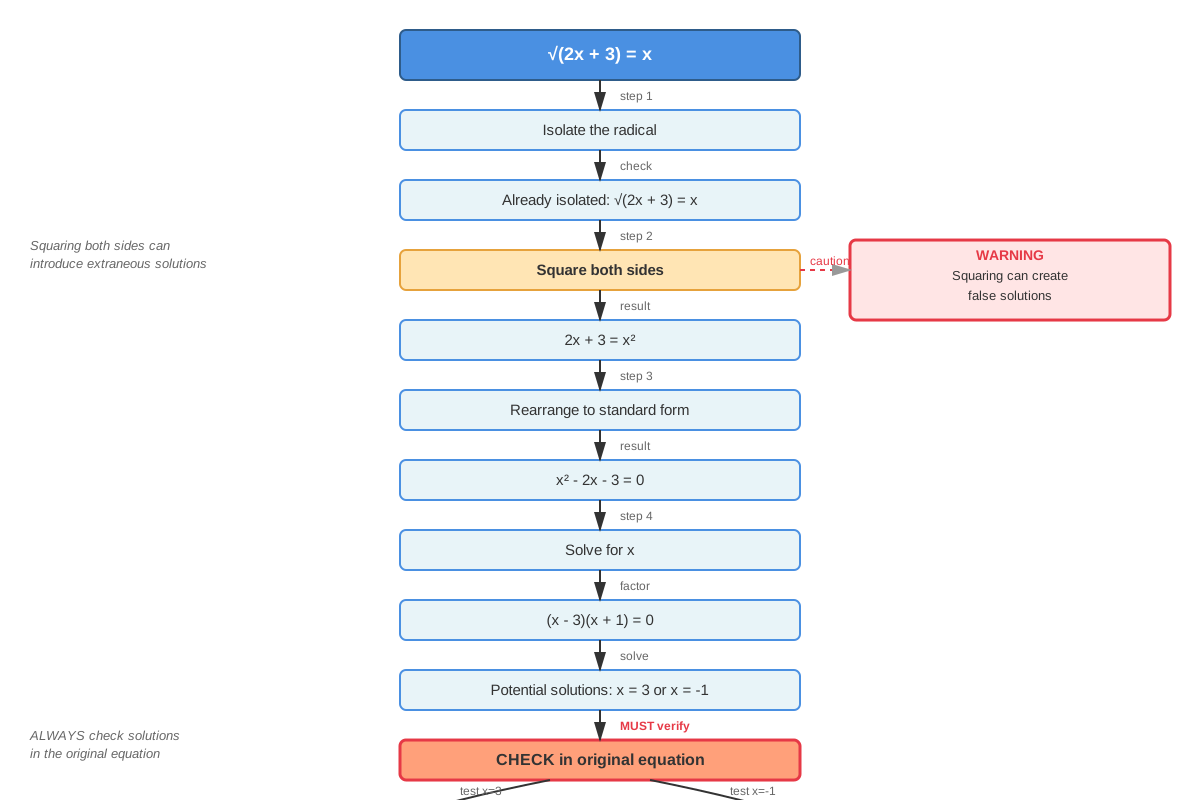
Radical equations contain variables within radical expressions. The solution process involves:
- Isolate the radical on one side of the equation
- Raise both sides to the power matching the index
- Solve the resulting equation using standard algebraic techniques
- Check all solutions in the original equation to identify extraneous solutions
Extraneous solutions arise because squaring both sides is not a reversible operation—it can introduce solutions that don't satisfy the original equation.
Example: Solve √(x+3) = x-3
- Square both sides: x+3 = (x-3)²
- Expand: x+3 = x²-6x+9
- Rearrange: 0 = x²-7x+6
- Factor: 0 = (x-6)(x-1)
- Potential solutions: x = 6 or x = 1
- Check x = 6: √(6+3) = √9 = 3, and 6-3 = 3 ✓
- Check x = 1: √(1+3) = √4 = 2, but 1-3 = -2 ✗
- Valid solution: x = 6 only
Properties of Radicals
| Property | Formula | Example |
|---|---|---|
| Product Property | √(ab) = √a · √b | √20 = √4 · √5 = 2√5 |
| Quotient Property | √(a/b) = √a/√b | √(9/4) = √9/√4 = 3/2 |
| Power Property | (√a)ⁿ = a^(n/2) | (√5)² = 5 |
| Root of a Power | ⁿ√(aᵐ) = a^(m/n) | ³√(8²) = 8^(2/3) = 4 |
Concept Relationships
The core concepts within radicals form an interconnected system where each skill builds upon previous understanding. Radical notation and components serves as the foundation → enabling conversion between radical and exponential forms → which facilitates simplification of radical expressions → allowing efficient operations with radicals → supporting rationalization of denominators → and ultimately enabling solving radical equations.
Radicals connect backward to prerequisite topics: exponent rules provide the theoretical foundation for manipulating radicals as fractional exponents, prime factorization enables identification of perfect powers for simplification, and algebraic manipulation skills transfer directly to combining like radical terms.
Forward connections extend to advanced topics: radicals appear in quadratic formula applications, distance and midpoint formulas in coordinate geometry, trigonometric identities involving rationalization, and complex numbers where √(-1) = i. The simplification techniques learned with radicals directly parallel polynomial factoring strategies, creating a unified approach to algebraic manipulation.
Within the Exponents and Radicals unit, radicals represent the inverse operation to exponentiation, creating a bidirectional relationship where x^(1/n) and (x^n) are inverse operations, similar to how addition and subtraction or multiplication and division form inverse pairs.
High-Yield Facts
⭐ The radical ⁿ√x equals x^(1/n), allowing conversion between radical and exponential notation for easier manipulation
⭐ Only like radicals (same index and same radicand) can be added or subtracted directly
⭐ When squaring both sides of an equation, always check solutions in the original equation to eliminate extraneous solutions
⭐ To rationalize a denominator with a binomial containing a radical, multiply by the conjugate (change the sign between terms)
⭐ The product property √(ab) = √a · √b works in both directions and is essential for both simplifying and multiplying radicals
- A simplified radical has no perfect power factors in the radicand, no fractions under the radical, and no radicals in the denominator
- The domain of √x (even roots) requires x ≥ 0, while odd roots like ³√x accept all real numbers
- √(x²) = |x| for even roots because the principal root is always non-negative
- Radicals with different indices cannot be directly multiplied or divided without first converting to exponential form
- The expression (a+√b)(a-√b) always equals a²-b, eliminating the radical through difference of squares
Quick check — test yourself on Radicals so far.
Try Flashcards →Common Misconceptions
Misconception: √(a+b) = √a + √b → Correction: The radical of a sum cannot be split into separate radicals. √(9+16) = √25 = 5, but √9 + √16 = 3 + 4 = 7. The square root function is not distributive over addition.
Misconception: √(x²) = x for all values of x → Correction: √(x²) = |x| because the principal square root is always non-negative. If x = -3, then √((-3)²) = √9 = 3 = |-3|, not -3.
Misconception: All solutions obtained after squaring both sides of an equation are valid → Correction: Squaring both sides can introduce extraneous solutions that don't satisfy the original equation. Always substitute solutions back into the original equation to verify.
Misconception: Radicals with different radicands can be combined like 2√3 + 5√2 = 7√5 → Correction: Only like radicals (identical index and radicand) can be combined. 2√3 + 5√2 cannot be simplified further, just as 2x + 5y cannot be combined.
Misconception: To rationalize 1/(2+√3), multiply by √3/√3 → Correction: When the denominator is a binomial containing a radical, multiply by the conjugate (2-√3)/(2-√3) to eliminate the radical using the difference of squares pattern.
Misconception: ³√(-8) is undefined or not a real number → Correction: Odd-indexed roots of negative numbers are real and negative. ³√(-8) = -2 because (-2)³ = -8. Only even-indexed roots of negative numbers are undefined in the real number system.
Worked Examples
Example 1: Simplifying Complex Radical Expressions
Problem: Simplify completely: (3√12 + 2√27) / √3
Solution:
Step 1: Simplify each radical in the numerator by factoring out perfect squares.
- √12 = √(4·3) = 2√3
- √27 = √(9·3) = 3√3
Step 2: Substitute simplified radicals back into the expression.
- (3·2√3 + 2·3√3) / √3
- (6√3 + 6√3) / √3
Step 3: Combine like radicals in the numerator.
- 12√3 / √3
Step 4: Divide radicals with the same index.
- 12√3 / √3 = 12·(√3/√3) = 12·1 = 12
Answer: 12
This problem demonstrates the importance of simplifying radicals before performing operations (Learning Objective: Apply radicals to answer SAT-style questions). The SAT frequently presents expressions that appear complex but simplify to rational numbers, testing whether students can recognize and execute the complete simplification process.
Example 2: Solving a Radical Equation with Extraneous Solutions
Problem: Solve for x: √(2x+5) - 3 = x - 5
Solution:
Step 1: Isolate the radical term on one side.
- √(2x+5) = x - 5 + 3
- √(2x+5) = x - 2
Step 2: Square both sides to eliminate the radical.
- (√(2x+5))² = (x-2)²
- 2x + 5 = x² - 4x + 4
Step 3: Rearrange into standard form.
- 0 = x² - 4x - 2x + 4 - 5
- 0 = x² - 6x - 1
Step 4: Apply the quadratic formula since this doesn't factor nicely.
- x = (6 ± √(36+4))/2
- x = (6 ± √40)/2
- x = (6 ± 2√10)/2
- x = 3 ± √10
Step 5: Check both potential solutions in the original equation.
For x = 3 + √10 ≈ 6.16:
- Left side: √(2(3+√10)+5) - 3 = √(11+2√10) - 3
- Right side: (3+√10) - 5 = -2+√10 ≈ 1.16
- Note: √(11+2√10) = √10 + 1 (this can be verified by squaring)
- Left side: (√10+1) - 3 = √10 - 2 ≈ 1.16 ✓
For x = 3 - √10 ≈ -0.16:
- Left side: √(2(3-√10)+5) - 3 = √(11-2√10) - 3
- Right side: (3-√10) - 5 = -2-√10 ≈ -5.16
- Note: √(11-2√10) = √10 - 1
- Left side: (√10-1) - 3 = √10 - 4 ≈ -0.84
- This does not equal -2-√10 ≈ -5.16 ✗
Answer: x = 3 + √10 only
This example illustrates the critical importance of checking solutions when solving radical equations (Learning Objective: Solve radical equations and identify extraneous solutions). The SAT specifically tests whether students understand that squaring both sides can introduce invalid solutions.
Exam Strategy
When approaching SAT radical questions, first identify the question type: simplification, operation, equation-solving, or equivalence recognition. Each type requires a different strategic approach, and recognizing the type immediately saves valuable time.
Trigger words and phrases that signal radical questions include: "simplify," "rationalize," "equivalent to," "solve for," "which expression equals," and geometric contexts mentioning "distance" or "Pythagorean theorem." When you see these phrases combined with square root symbols or fractional exponents, activate your radical-solving protocols.
For simplification questions, work systematically: factor the radicand, identify perfect powers matching the index, extract those factors, and verify no further simplification is possible. The SAT answer choices often differ only in their level of simplification, so incomplete simplification leads to selecting a distractor.
For equation-solving questions, always isolate the radical before squaring, and budget time to check your solution. The SAT frequently includes extraneous solutions among answer choices specifically to catch students who skip verification. If checking seems time-consuming, at least verify that your solution makes the radicand non-negative and produces a valid equation.
Process-of-elimination strategies: If answer choices contain radicals, check whether denominators are rationalized (SAT answers always are). Eliminate choices with radicals in denominators unless the question specifically asks for an intermediate step. For numerical answers, estimate the value: √50 is between √49 = 7 and √64 = 8, closer to 7, so approximately 7.1. This estimation can eliminate obviously incorrect choices.
Time allocation: Simple radical simplification should take 30-45 seconds. Radical equations requiring squaring and checking may need 90-120 seconds. If a radical problem exceeds two minutes, mark it for review and move forward—these questions are worth the same single point as easier questions.
Exam Tip: When answer choices are in different forms (some with radicals, some with decimals, some with exponents), convert to the form that appears most frequently among choices. The test-makers are signaling the expected format.
Memory Techniques
PERC for the radical simplification process:
- Prime factorization or identify Perfect powers
- Extract factors that match the index
- Remove perfect powers from under the radical
- Combine coefficients outside and factors inside
"Like Likes Like" for radical operations: Just as "like terms" in algebra must match to combine (2x + 3x), "like radicals" must have matching indices and radicands to add or subtract (2√3 + 5√3).
"Conjugate Eliminates" for rationalization: When you see a binomial with a radical in the denominator, immediately think "multiply by the conjugate" (flip the middle sign). Visualize the difference of squares pattern: (a+b)(a-b) = a² - b² eliminates the middle terms.
"Square and Check" for radical equations: Create a mental checkpoint after squaring both sides. Visualize a stop sign reminding you that squaring creates a one-way street—you must verify the destination (solution) is actually on the original path (equation).
Exponential Translation: When radicals seem complicated, remember "Root becomes reciprocal" in exponential form. The nth root becomes the exponent 1/n. Visualize: √ → ^(1/2), ³√ → ^(1/3), ⁴√ → ^(1/4).
The "Perfect Powers Pyramid": Memorize perfect squares up to 15² = 225, perfect cubes up to 5³ = 125, and perfect fourth powers up to 3⁴ = 81. Visualize these as a pyramid where each level represents a different power, allowing quick recognition during simplification.
Summary
Radicals represent roots and are fundamental to SAT math success, appearing in 5-8% of questions across multiple contexts. Mastery requires understanding the relationship between radicals and fractional exponents (ⁿ√x = x^(1/n)), systematic simplification by extracting perfect powers, and fluent execution of operations with radical expressions. Only like radicals—those with identical indices and radicands—can be combined through addition or subtraction, while multiplication and division follow specific rules involving coefficients and radicands separately. Rationalizing denominators, particularly using conjugates for binomial denominators, ensures answers match SAT format requirements. Solving radical equations demands careful isolation of the radical, raising both sides to the appropriate power, and critically, checking all solutions to eliminate extraneous results introduced by the squaring process. Success with radicals requires recognizing when to convert between radical and exponential notation, applying properties systematically, and maintaining vigilance about domain restrictions and solution validity. Students who internalize these concepts and practice strategic approaches gain both speed and accuracy on this high-yield topic.
Key Takeaways
- Radicals and fractional exponents are equivalent: ⁿ√x = x^(1/n), enabling flexible problem-solving approaches
- Simplification requires identifying and extracting perfect powers that match the radical's index
- Only like radicals (same index and radicand) can be added or subtracted directly
- Rationalize denominators by multiplying by the radical itself for monomials or by the conjugate for binomials
- Always check solutions when solving radical equations because squaring both sides can introduce extraneous solutions
- The product and quotient properties (√(ab) = √a·√b and √(a/b) = √a/√b) work bidirectionally for simplification and multiplication
- Domain awareness is critical: even roots require non-negative radicands, while odd roots accept all real numbers
Related Topics
Exponent Rules and Properties: Mastering radicals naturally leads to deeper understanding of exponential expressions, as radicals are fractional exponents. This connection enables solving exponential equations and understanding exponential growth models.
Quadratic Equations and the Quadratic Formula: The quadratic formula produces solutions involving radicals (√(b²-4ac)), requiring simplification skills developed in this topic. Understanding radical manipulation is essential for expressing quadratic solutions in simplest form.
Complex Numbers: When even roots of negative numbers arise, the radical concept extends to imaginary numbers where √(-1) = i. This progression builds on radical foundations while expanding the number system.
Distance and Midpoint Formulas: Coordinate geometry applications frequently involve radicals through the distance formula d = √((x₂-x₁)² + (y₂-y₁)²), directly applying radical simplification in geometric contexts.
Rational Exponents and Exponential Functions: Converting between radical and exponential notation prepares students for exponential and logarithmic functions, where fractional exponents appear in growth and decay models.
Practice CTA
Now that you've mastered the core concepts of radicals, it's time to solidify your understanding through active practice. The practice questions and flashcards are specifically designed to mirror SAT question formats and difficulty levels, giving you the repetition needed to build speed and confidence. Each practice problem reinforces the strategies and techniques covered in this guide, helping you recognize patterns and avoid common traps. Remember, mastery comes not just from understanding concepts but from applying them repeatedly under test-like conditions. Challenge yourself with the practice materials—your SAT math score will reflect the effort you invest now!
Sign up free to keep reading
Create a free AnvayaPrep account to finish this SAT guide on Radicals — plus flashcards and practice questions.