Overview
Scientific notation is a standardized method of expressing very large or very small numbers using powers of 10. This mathematical convention allows for efficient representation of numbers that would otherwise require many zeros, making calculations more manageable and reducing the likelihood of errors. On the SAT, scientific notation appears regularly in both calculator and no-calculator sections, testing students' ability to manipulate exponential expressions, perform operations with numbers in scientific form, and interpret real-world data presented in this format.
Understanding scientific notation is essential for SAT success because it bridges multiple mathematical domains. Questions involving scientific notation often combine exponent rules, order of magnitude comparisons, and practical problem-solving. The College Board frequently embeds scientific notation within word problems related to astronomy, biology, chemistry, and economics—contexts where extremely large or small quantities naturally occur. Students who master this topic gain a significant advantage, as these questions typically appear 2-4 times per test and often serve as gateway problems to more complex multi-step questions.
The relationship between scientific notation and broader math concepts is fundamental. Scientific notation relies heavily on exponent properties, making it an integral part of the Exponents and Radicals unit. It connects directly to concepts like multiplication and division of powers, negative exponents, and the laws of exponents. Additionally, scientific notation serves as a practical application of place value understanding and decimal manipulation. Mastery of this topic strengthens computational fluency and prepares students for advanced topics in algebra, including exponential growth and decay, logarithms, and polynomial operations.
Learning Objectives
- [ ] Identify key features of scientific notation
- [ ] Explain how scientific notation appears on the SAT
- [ ] Apply scientific notation to answer SAT-style questions
- [ ] Convert between standard form and scientific notation with accuracy
- [ ] Perform arithmetic operations (multiplication, division, addition, subtraction) with numbers in scientific notation
- [ ] Compare and order numbers expressed in scientific notation
- [ ] Interpret scientific notation in real-world contexts and word problems
Prerequisites
- Exponent rules and properties: Understanding how to multiply, divide, and raise powers to powers is essential for manipulating scientific notation expressions
- Place value system: Recognizing the value of digits in different positions enables accurate conversion between standard and scientific notation
- Decimal operations: Facility with moving decimal points and performing arithmetic with decimals is necessary for scientific notation conversions
- Order of operations: Correctly sequencing mathematical operations ensures accurate calculations when working with scientific notation
Why This Topic Matters
Scientific notation serves as the universal language for expressing quantities that span enormous ranges—from the mass of subatomic particles (approximately 9.11 × 10⁻³¹ kilograms for an electron) to astronomical distances (about 9.46 × 10¹⁵ meters in a light-year). In professional fields including engineering, medicine, computer science, and environmental science, scientific notation enables precise communication and calculation with extreme values. Understanding this notation system is not merely an academic exercise; it represents a fundamental literacy skill for interpreting scientific data, news reports about national budgets, and technological specifications.
On the SAT, scientific notation questions appear with notable frequency—typically 2-4 questions per test across both the calculator and no-calculator sections. These questions account for approximately 3-6% of the total math score, making them high-yield content for focused study. The College Board tests scientific notation through multiple question types: direct conversion problems, arithmetic operations requiring exponent manipulation, word problems involving real-world contexts (population growth, astronomical distances, microscopic measurements), and data interpretation questions where students must compare or order quantities.
Common SAT question formats include: (1) converting a number from standard form to scientific notation or vice versa; (2) multiplying or dividing numbers in scientific notation and expressing the result in proper form; (3) comparing the magnitude of two or more quantities expressed in scientific notation; (4) solving word problems where scientific notation simplifies calculations; and (5) interpreting graphs or tables containing data in scientific notation. Questions often appear in contexts involving national debt, cellular biology, space exploration, computer memory, or chemical concentrations—scenarios where the numbers naturally require exponential representation.
Core Concepts
Definition and Structure of Scientific Notation
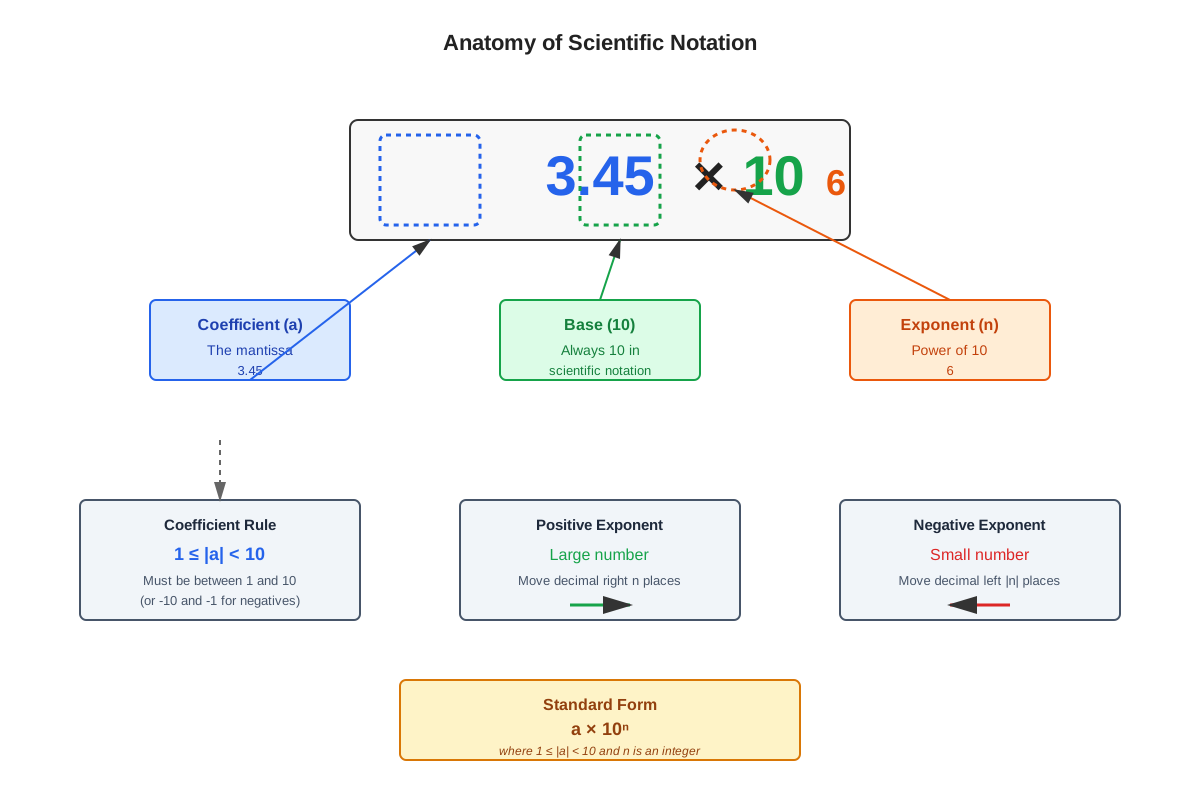
Scientific notation (also called standard form or exponential notation) expresses a number as the product of two factors: a coefficient and a power of 10. The standard format is a × 10ⁿ, where a is a number greater than or equal to 1 but less than 10 (1 ≤ a < 10), and n is an integer representing the exponent. This structure ensures a unique representation for each number and maintains consistency across scientific and mathematical communication.
The coefficient (a) contains all significant figures of the original number, positioned so that exactly one non-zero digit appears before the decimal point. The exponent (n) indicates how many places the decimal point has moved from its position in the coefficient to its position in the original number. A positive exponent indicates a large number (the decimal moves right), while a negative exponent indicates a small number (the decimal moves left).
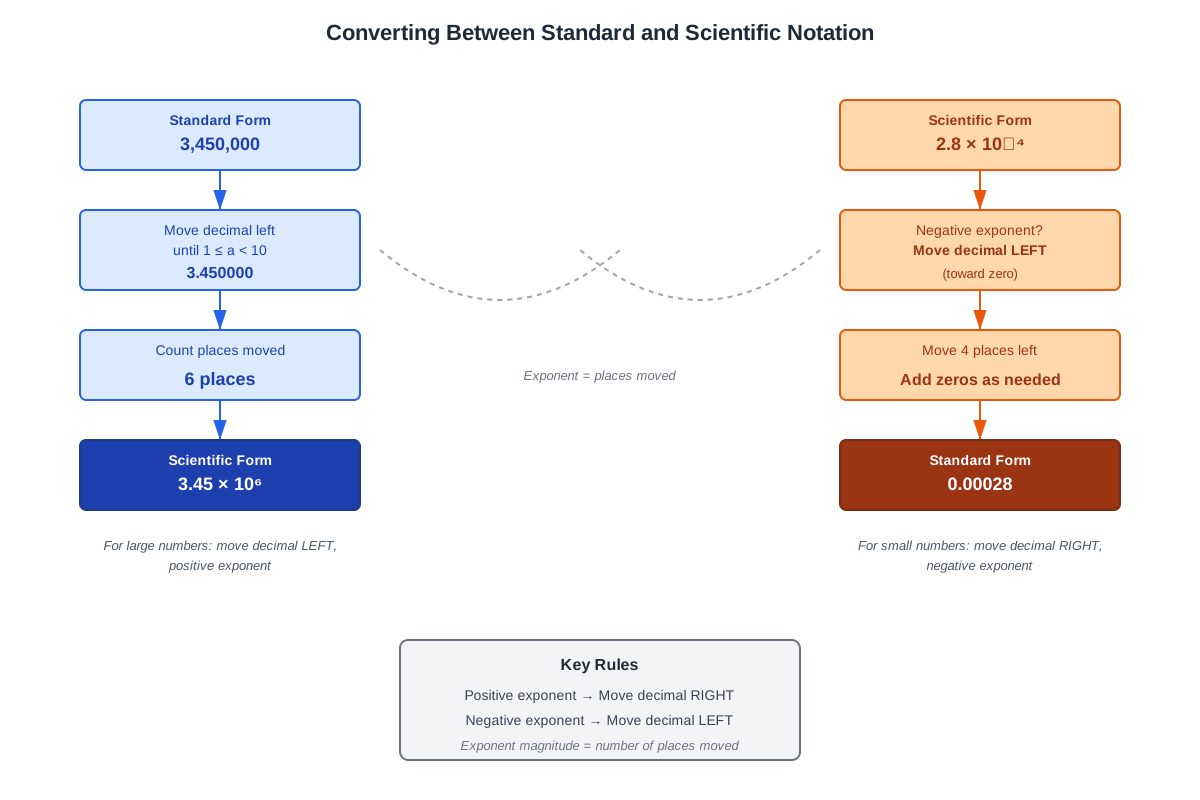
For example, the number 4,500,000 in scientific notation becomes 4.5 × 10⁶ because the decimal point moves 6 places to the left from its position after the last zero to its position between 4 and 5. Conversely, 0.0000067 becomes 6.7 × 10⁻⁶ because the decimal point moves 6 places to the right.
Converting from Standard Form to Scientific Notation
The conversion process follows a systematic procedure:
- Identify the significant digits: Locate all non-zero digits and any zeros between them or after them if they're significant
- Place the decimal point: Position it after the first non-zero digit
- Count the moves: Determine how many places the decimal point moved from its original position
- Assign the exponent: Use a positive exponent if the original number was ≥ 10, negative if it was between 0 and 1
- Write in proper form: Express as a × 10ⁿ
For large numbers (≥ 10): Count how many places the decimal moves left. This count becomes the positive exponent.
- Example: 850,000,000 → 8.5 × 10⁸ (decimal moved 8 places left)
For small numbers (between 0 and 1): Count how many places the decimal moves right. This count becomes the negative exponent.
- Example: 0.00000312 → 3.12 × 10⁻⁶ (decimal moved 6 places right)
Converting from Scientific Notation to Standard Form
To convert from scientific notation back to standard form, reverse the process:
- Identify the exponent: Note whether it's positive or negative
- Move the decimal point: Shift it the number of places indicated by the absolute value of the exponent
- Direction of movement: Move right for positive exponents, left for negative exponents
- Add zeros as needed: Fill in placeholder zeros to complete the number
For positive exponents: Move the decimal point right, adding zeros as necessary.
- Example: 3.7 × 10⁵ → 370,000 (decimal moved 5 places right)
For negative exponents: Move the decimal point left, adding zeros as necessary.
- Example: 2.9 × 10⁻⁴ → 0.00029 (decimal moved 4 places left)
Multiplying Numbers in Scientific Notation
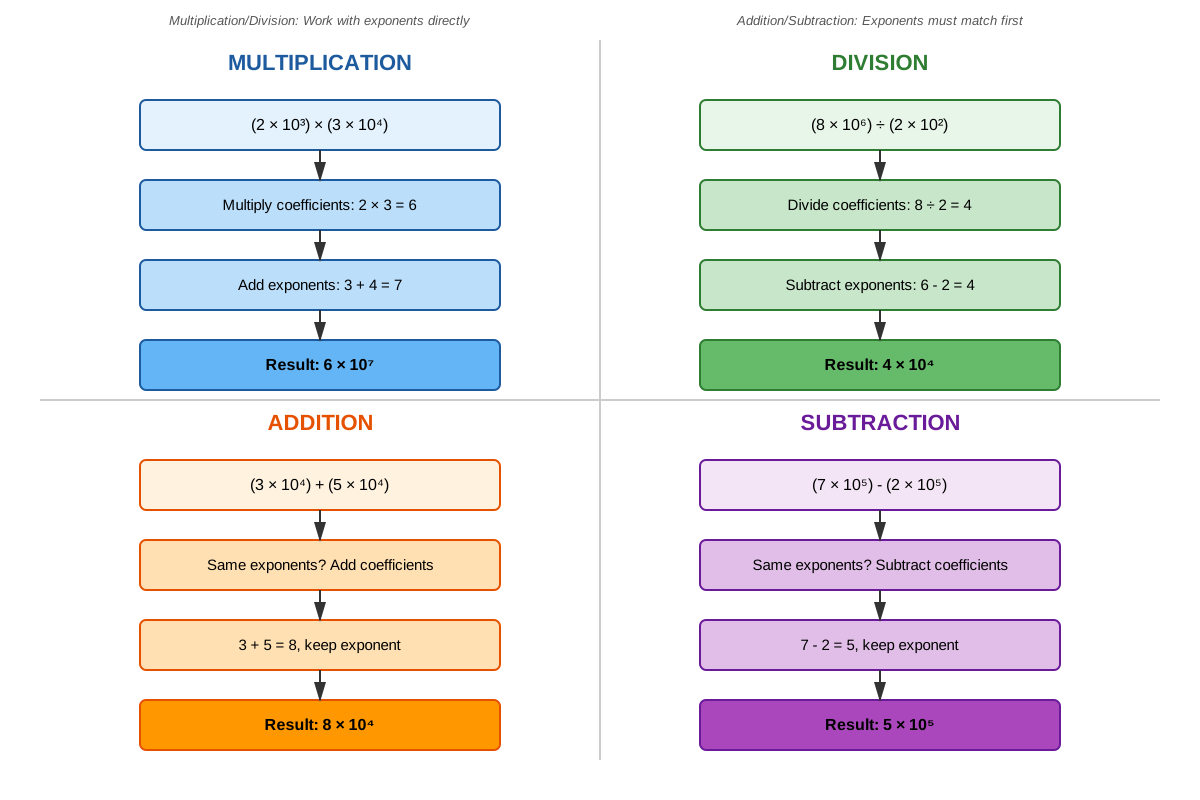
When multiplying numbers in scientific notation, apply the product rule for exponents: multiply the coefficients and add the exponents.
Process:
- Multiply the coefficients (a₁ × a₂)
- Add the exponents (n₁ + n₂)
- Adjust if necessary to maintain proper form (coefficient between 1 and 10)
Example: (3 × 10⁴) × (2 × 10⁵) = (3 × 2) × 10⁴⁺⁵ = 6 × 10⁹
If the coefficient product is not between 1 and 10, adjust:
Example: (4 × 10³) × (5 × 10²) = 20 × 10⁵ = 2.0 × 10¹ × 10⁵ = 2.0 × 10⁶
Dividing Numbers in Scientific Notation
Division follows the quotient rule for exponents: divide the coefficients and subtract the exponents.
Process:
- Divide the coefficients (a₁ ÷ a₂)
- Subtract the exponents (n₁ - n₂)
- Adjust if necessary to maintain proper form
Example: (8 × 10⁷) ÷ (2 × 10³) = (8 ÷ 2) × 10⁷⁻³ = 4 × 10⁴
If the coefficient quotient is not between 1 and 10, adjust:
Example: (3 × 10⁸) ÷ (6 × 10⁵) = 0.5 × 10³ = 5 × 10⁻¹ × 10³ = 5 × 10²
Adding and Subtracting Numbers in Scientific Notation
Addition and subtraction require the exponents to be equal before combining coefficients. This process is more complex than multiplication or division.
Process:
- Equalize exponents: Adjust one or both numbers so they have the same power of 10
- Combine coefficients: Add or subtract the coefficients
- Maintain the common exponent: Keep the shared power of 10
- Adjust to proper form: If needed, convert the result to standard scientific notation
Example: (5.2 × 10⁴) + (3.1 × 10³)
- Convert to same exponent: (5.2 × 10⁴) + (0.31 × 10⁴)
- Add coefficients: (5.2 + 0.31) × 10⁴ = 5.51 × 10⁴
Comparing Magnitudes
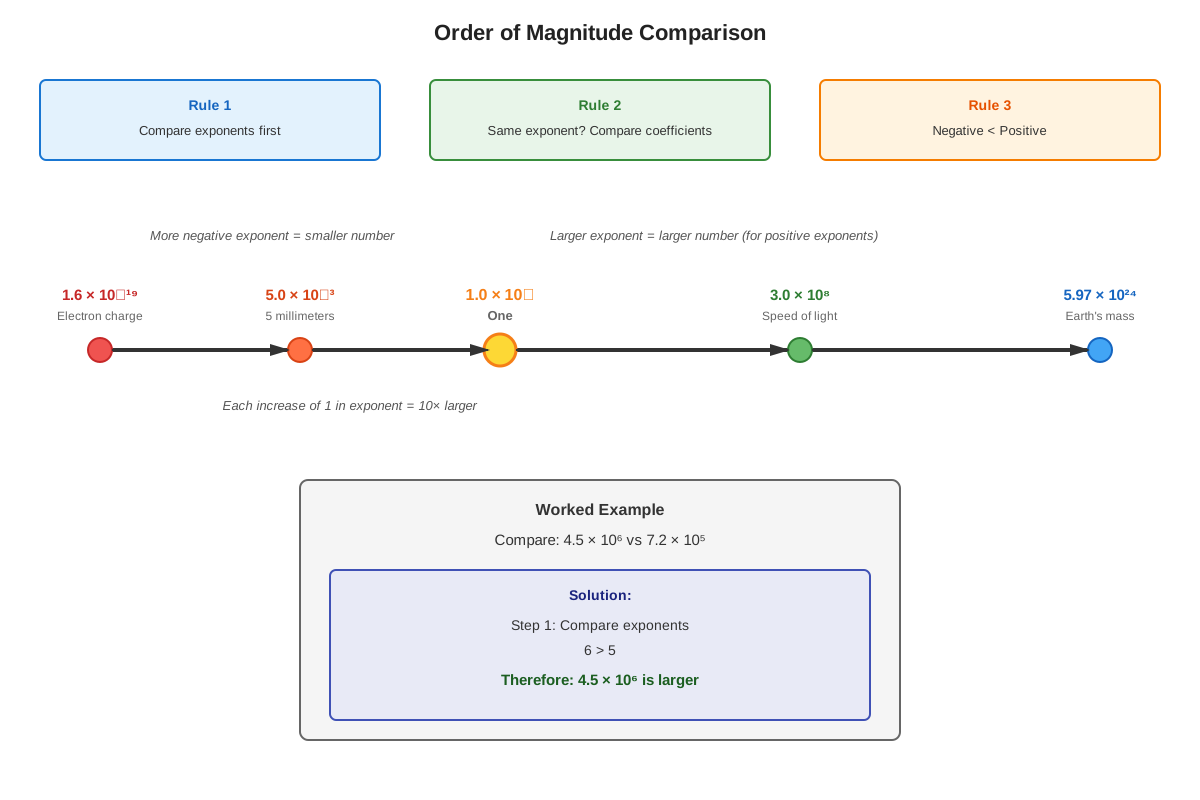
Comparing numbers in scientific notation requires examining both the exponent and coefficient:
| Comparison Scenario | Method | Example |
|---|---|---|
| Different exponents | Larger exponent = larger number (for positive numbers) | 3 × 10⁸ > 9 × 10⁵ |
| Same exponent | Compare coefficients | 7.2 × 10⁴ > 6.8 × 10⁴ |
| Negative exponents | More negative exponent = smaller number | 4 × 10⁻⁶ < 4 × 10⁻³ |
Concept Relationships
Scientific notation fundamentally depends on exponent properties, particularly the rules for multiplying and dividing powers with the same base. The conversion process relies on understanding place value and decimal manipulation—moving the decimal point is equivalent to multiplying or dividing by powers of 10.
The relationship flow: Place Value Understanding → enables → Decimal Point Movement → facilitates → Scientific Notation Conversion → requires → Exponent Rules → enables → Operations in Scientific Notation → supports → Magnitude Comparisons and Problem Solving.
Within the topic itself, proper form (coefficient between 1 and 10) serves as the foundation for all other operations. Conversion skills (both directions) are prerequisite to arithmetic operations, which in turn enable real-world problem solving. The ability to compare magnitudes synthesizes all previous skills and represents the highest level of mastery.
Scientific notation connects forward to exponential functions, logarithms (the inverse of exponential notation), and polynomial operations where similar coefficient and exponent manipulation occurs. It also relates laterally to unit conversions and dimensional analysis in science contexts.
Quick check — test yourself on Scientific notation so far.
Try Flashcards →High-Yield Facts
⭐ Scientific notation format: a × 10ⁿ where 1 ≤ a < 10 and n is an integer
⭐ Positive exponents indicate numbers greater than or equal to 10; negative exponents indicate numbers between 0 and 1
⭐ To multiply in scientific notation: multiply coefficients and add exponents
⭐ To divide in scientific notation: divide coefficients and subtract exponents (numerator exponent minus denominator exponent)
⭐ The exponent indicates the number of decimal places moved: positive means moved left (large number), negative means moved right (small number)
- When converting from standard to scientific notation, count decimal moves from the original position to the new position after the first non-zero digit
- Numbers equal to or greater than 1 but less than 10 have an exponent of 0 (e.g., 5.7 = 5.7 × 10⁰)
- To add or subtract numbers in scientific notation, exponents must be equal first
- A coefficient of 10 or greater requires adjustment: move decimal left one place and increase exponent by 1
- A coefficient less than 1 requires adjustment: move decimal right one place and decrease exponent by 1
- The number 1 in scientific notation is 1.0 × 10⁰
- When comparing numbers with different exponents, the exponent determines magnitude (assuming positive numbers)
- Scientific notation preserves significant figures, making it valuable for precision in scientific measurements
- Zero cannot be expressed in standard scientific notation (though 0 × 10ⁿ is sometimes used informally)
- Calculator displays often show scientific notation as "3.5E8" meaning 3.5 × 10⁸
Common Misconceptions
Misconception: The coefficient in scientific notation can be any number.
Correction: The coefficient must be greater than or equal to 1 and strictly less than 10 (1 ≤ a < 10). If a calculation produces a coefficient outside this range, the number must be adjusted to proper form.
Misconception: When multiplying numbers in scientific notation, you multiply the exponents.
Correction: When multiplying, you add the exponents (using the product rule: 10ᵐ × 10ⁿ = 10ᵐ⁺ⁿ). You multiply the coefficients but add the exponents.
Misconception: A larger exponent always means a larger number.
Correction: This is only true for positive numbers. For negative exponents, a more negative exponent indicates a smaller number (e.g., 10⁻⁶ < 10⁻³). Also, the coefficient matters when exponents are equal.
Misconception: To convert 0.00045 to scientific notation, the exponent is positive because you're moving the decimal point.
Correction: The exponent is negative (-4) because the original number is less than 1. The direction you move the decimal during conversion determines the sign: moving right (for small numbers) produces negative exponents.
Misconception: You can add numbers in scientific notation by simply adding both the coefficients and the exponents.
Correction: To add or subtract, the exponents must first be equal. Only then can you add the coefficients while keeping the common exponent unchanged.
Misconception: 3.5 × 10⁴ and 35 × 10³ are different numbers.
Correction: These represent the same value (35,000), but only 3.5 × 10⁴ is in proper scientific notation form. While mathematically equivalent, SAT questions typically require answers in proper form.
Misconception: When dividing exponents, you divide them (e.g., 10⁶ ÷ 10² = 10³).
Correction: When dividing powers with the same base, you subtract the exponents (10⁶ ÷ 10² = 10⁶⁻² = 10⁴), using the quotient rule.
Worked Examples
Example 1: Multi-Step Conversion and Operation
Problem: The mass of Earth is approximately 5,970,000,000,000,000,000,000,000 kilograms, and the mass of Mars is approximately 6.39 × 10²³ kilograms. How many times greater is Earth's mass than Mars's mass? Express your answer in scientific notation.
Solution:
Step 1: Convert Earth's mass to scientific notation.
- Identify the significant digits: 5.97
- Count decimal places moved: from the end (after 24 zeros) to after the 5 = 24 places left
- Earth's mass = 5.97 × 10²⁴ kg
Step 2: Set up the division to find how many times greater.
- Ratio = (Earth's mass) ÷ (Mars's mass)
- Ratio = (5.97 × 10²⁴) ÷ (6.39 × 10²³)
Step 3: Divide the coefficients.
- 5.97 ÷ 6.39 ≈ 0.934
Step 4: Subtract the exponents.
- 10²⁴ ÷ 10²³ = 10²⁴⁻²³ = 10¹
Step 5: Combine the results.
- 0.934 × 10¹
Step 6: Adjust to proper scientific notation form.
- 0.934 × 10¹ = 9.34 × 10⁻¹ × 10¹ = 9.34 × 10⁰ = 9.34
Answer: Earth's mass is approximately 9.34 times greater than Mars's mass (or 9.34 × 10⁰ in scientific notation).
Connection to Learning Objectives: This problem requires identifying proper scientific notation form, converting from standard to scientific notation, and applying division operations—demonstrating mastery of multiple core skills in a realistic SAT context.
Example 2: Addition with Different Exponents
Problem: A laboratory has two samples of bacteria. Sample A contains 3.5 × 10⁶ bacteria, and Sample B contains 4.8 × 10⁵ bacteria. What is the total number of bacteria in both samples combined? Express your answer in scientific notation.
Solution:
Step 1: Recognize that addition requires equal exponents.
- Current form: (3.5 × 10⁶) + (4.8 × 10⁵)
- Exponents are different (6 and 5)
Step 2: Convert to the same exponent (choose the larger exponent, 10⁶).
- Keep Sample A as is: 3.5 × 10⁶
- Convert Sample B: 4.8 × 10⁵ = 0.48 × 10⁶
(Move decimal left one place, increase exponent by 1)
Step 3: Add the coefficients.
- (3.5 × 10⁶) + (0.48 × 10⁶) = (3.5 + 0.48) × 10⁶
- = 3.98 × 10⁶
Step 4: Verify proper form.
- Coefficient 3.98 is between 1 and 10 ✓
- Answer is in proper scientific notation
Answer: The total number of bacteria is 3.98 × 10⁶.
Connection to Learning Objectives: This example demonstrates the critical skill of adding numbers in scientific notation by first equalizing exponents—a common SAT question type that tests both conceptual understanding and procedural fluency.
Exam Strategy
When approaching SAT scientific notation questions, begin by identifying what the question asks: conversion, operation, comparison, or interpretation. Read carefully to determine whether the answer must be in scientific notation or standard form, as the College Board sometimes accepts either format but often specifies one.
Trigger words and phrases to watch for:
- "Express in scientific notation" or "write in the form a × 10ⁿ" → requires proper scientific notation format
- "How many times greater/smaller" → indicates division operation
- "Combined total" or "altogether" → indicates addition (equalize exponents first)
- "Difference between" → indicates subtraction (equalize exponents first)
- "Product of" → indicates multiplication (multiply coefficients, add exponents)
Process-of-elimination strategies:
- Eliminate answers with incorrect exponent signs (positive vs. negative)
- Eliminate answers where the coefficient is not between 1 and 10 (unless the question doesn't require proper form)
- Check order of magnitude: if multiplying two numbers around 10⁴, the answer should be around 10⁸, not 10²
- For comparison questions, eliminate answers that contradict basic exponent relationships
Time allocation: Scientific notation questions typically require 45-90 seconds. Spend 10-15 seconds reading and identifying the operation needed, 30-60 seconds performing calculations, and 10-15 seconds checking that your answer is in the requested form. If a question involves multiple steps (conversion plus operation), budget up to 2 minutes.
Calculator tips: Most scientific calculators handle scientific notation using an "EE" or "EXP" button. However, be cautious—calculators may display results in non-standard form (like 35E4 instead of 3.5E5). Always verify and adjust to proper form before selecting your answer. For no-calculator sections, practice mental estimation to check reasonableness.
Exam Tip: When in doubt about exponent operations, remember "MADSPM"—Multiply Add, Divide Subtract, Power Multiply. This reminds you to add exponents when multiplying, subtract when dividing, and multiply exponents when raising a power to a power.
Memory Techniques
MADSPM Mnemonic: For exponent operations
- Multiply → Add exponents
- Divide → Subtract exponents
- Power → Multiply exponents
"Large is Positive, Little is Negative": Remember that positive exponents represent large numbers (≥10), while negative exponents represent little numbers (between 0 and 1).
"The Decimal Dance": Visualize the decimal point "dancing" across the number:
- Dancing right (toward smaller place values) = negative exponent
- Dancing left (toward larger place values) = positive exponent
"1-10 Club": The coefficient must be a member of the "1-10 Club"—at least 1 but never quite reaching 10. If your coefficient isn't in the club, adjust it!
Finger Counting Method: When converting, use your fingers to count decimal places moved. Start with your finger on the original decimal position, count as you move to the new position. The number of fingers used equals the absolute value of the exponent.
"Same Exponent to Add": For addition/subtraction, remember this rhyme: "Same exponent to add, different when you multiply—that's not bad!"
Summary
Scientific notation is a powerful mathematical tool for expressing extremely large or small numbers in the compact form a × 10ⁿ, where the coefficient a falls between 1 and 10, and n is an integer exponent. Mastery requires fluency in converting between standard and scientific notation by counting decimal place movements, understanding that positive exponents indicate large numbers while negative exponents indicate small numbers. Operations in scientific notation follow specific rules: multiplication requires multiplying coefficients and adding exponents, division requires dividing coefficients and subtracting exponents, while addition and subtraction demand equalizing exponents before combining coefficients. On the SAT, scientific notation appears in 2-4 questions per test, often embedded in real-world contexts involving astronomy, biology, economics, or technology. Success depends on recognizing proper form, applying exponent rules accurately, and maintaining precision throughout multi-step calculations. Students who master these skills gain both computational efficiency and the ability to interpret scientific data—essential capabilities for SAT success and future STEM coursework.
Key Takeaways
- Scientific notation expresses numbers as a × 10ⁿ where 1 ≤ a < 10, enabling efficient representation of extreme values
- Positive exponents indicate numbers ≥ 10; negative exponents indicate numbers between 0 and 1
- Multiplication: multiply coefficients and add exponents; Division: divide coefficients and subtract exponents
- Addition and subtraction require equalizing exponents before combining coefficients
- Always verify that final answers are in proper scientific notation form (coefficient between 1 and 10)
- The exponent's absolute value indicates how many decimal places moved; the sign indicates direction
- SAT questions frequently test scientific notation in real-world contexts requiring both conversion and operational skills
Related Topics
Exponent Properties and Laws: Deepening understanding of exponent rules (product rule, quotient rule, power rule) provides the foundation for advanced manipulation of scientific notation and prepares students for exponential functions.
Logarithms: As the inverse operation of exponentiation, logarithms offer an alternative way to work with very large and small numbers, building directly on scientific notation concepts.
Exponential Growth and Decay: Real-world applications of exponential functions often require scientific notation to express initial values, growth rates, and final quantities in contexts like population dynamics and radioactive decay.
Unit Conversions and Dimensional Analysis: Scientific notation frequently appears in chemistry and physics problems requiring conversion between units, where maintaining proper form ensures accuracy.
Significant Figures: Understanding which digits are meaningful in scientific measurements connects directly to the coefficient in scientific notation, essential for laboratory sciences and data analysis.
Practice CTA
Now that you've mastered the core concepts of scientific notation, it's time to solidify your understanding through active practice. Challenge yourself with the practice questions designed specifically to mirror SAT question formats and difficulty levels. Use the flashcards to reinforce key facts and operations until they become automatic. Remember, scientific notation questions are high-yield content—investing 20 minutes in focused practice now can directly translate to points on test day. Approach each practice problem systematically, checking your work for proper form and accuracy. You've built the foundation; now make it unshakeable through deliberate practice!
Sign up free to keep reading
Create a free AnvayaPrep account to finish this SAT guide on Scientific notation — plus flashcards and practice questions.