Overview
Function tables are a fundamental representation of mathematical relationships that appear frequently on the SAT exam. A function table displays input values (typically x-values) alongside their corresponding output values (typically y-values or f(x) values), allowing students to analyze patterns, identify function rules, and understand how changes in input affect output. On the SAT, function tables serve as a bridge between abstract algebraic expressions and concrete numerical relationships, making them an essential tool for solving problems across multiple math domains.
Understanding function tables is critical for SAT success because they appear in approximately 8-12% of all math questions, spanning both the calculator and no-calculator sections. These questions test not only the ability to read and interpret tables but also to recognize patterns, determine function types (linear, quadratic, exponential), identify key features like rate of change, and translate between different representations of functions. Mastery of function tables directly supports performance on questions involving equations, graphs, and real-world modeling scenarios.
Function tables connect to broader mathematical concepts including coordinate geometry, algebraic expressions, sequences and series, and data analysis. They provide a concrete method for verifying algebraic work, testing function properties, and solving systems of equations. Students who develop fluency with function tables gain a powerful problem-solving tool that accelerates their ability to tackle complex multi-step problems and verify answers efficiently under timed conditions.
Learning Objectives
- [ ] Identify key features of function tables including input-output pairs, domain, range, and patterns
- [ ] Explain how function tables appears on the SAT in various question formats and contexts
- [ ] Apply function tables to answer SAT-style questions involving pattern recognition and function identification
- [ ] Determine whether a function table represents a linear, quadratic, or exponential relationship
- [ ] Calculate missing values in function tables using identified patterns or function rules
- [ ] Translate between function tables, equations, and graphs to solve multi-representation problems
Prerequisites
- Basic function notation: Understanding f(x) notation is essential for interpreting what function tables represent and how to evaluate functions at specific values
- Coordinate pairs: Recognizing that each row in a function table represents an (x, y) coordinate pair enables connection to graphical representations
- Linear equations: Familiarity with slope and y-intercept helps identify linear patterns in tables
- Exponent rules: Understanding exponential growth and decay patterns supports recognition of exponential functions in tabular form
- Arithmetic operations: Proficiency with addition, subtraction, multiplication, and division is necessary for calculating differences and ratios between consecutive values
Why This Topic Matters
Function tables serve as a universal language in mathematics, science, economics, and engineering. In real-world applications, tables organize experimental data, financial projections, population growth models, and physical measurements. Scientists use function tables to identify relationships between variables, economists track market trends over time, and engineers model system behaviors. The ability to extract meaningful patterns from tabular data is a foundational skill for data literacy in the modern world.
On the SAT, function tables appear in multiple question types with high frequency. Approximately 3-4 questions per test directly involve function tables, while many additional questions benefit from table-based problem-solving strategies. Common question formats include: identifying the equation that matches a given table, completing missing table values, determining function type from patterns, comparing rates of change, and solving word problems where creating a function table simplifies the solution process. These questions typically appear in both multiple-choice and student-produced response formats.
The SAT specifically tests function tables in contexts involving real-world scenarios (population growth, financial calculations, physics problems), pure mathematical relationships (evaluating algebraic expressions), and comparative analysis (determining which function grows faster). Questions often combine function tables with other representations, requiring students to match tables to graphs or equations. The ability to quickly recognize patterns and translate between representations provides a significant time advantage on test day.
Core Concepts
Structure and Components of Function Tables
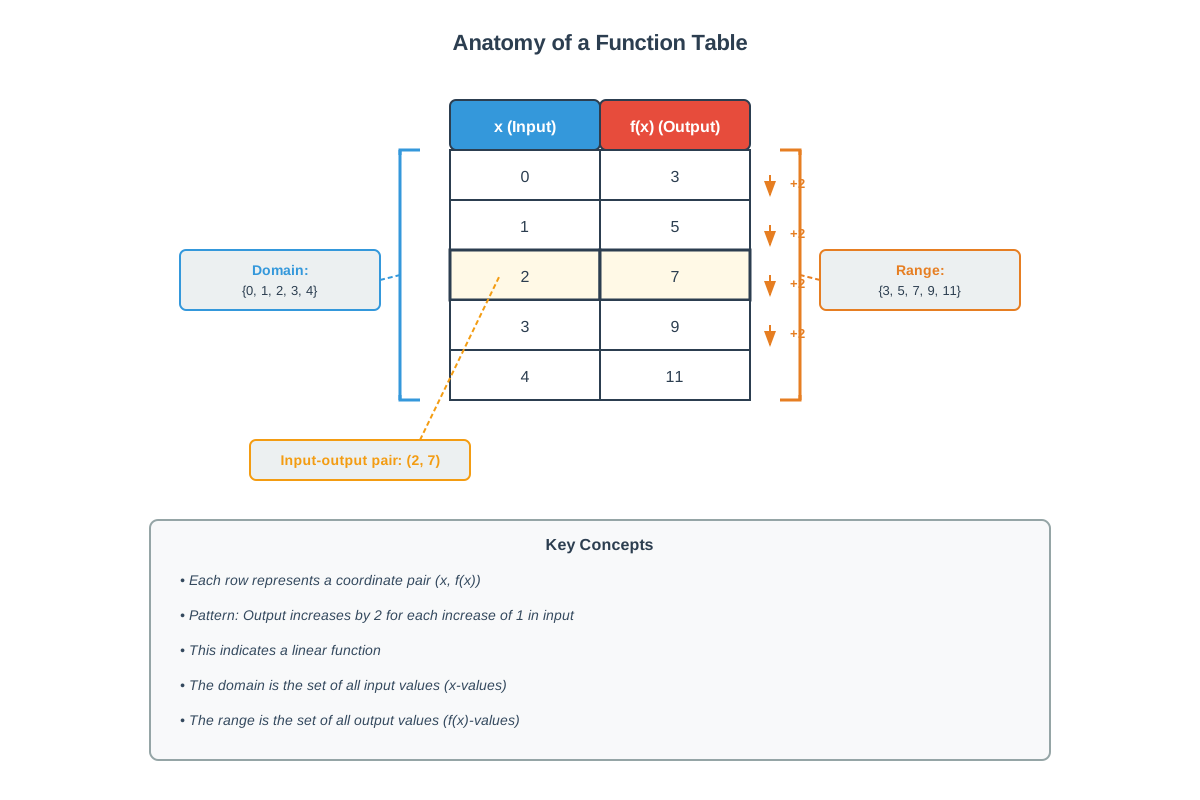
A function table is an organized display of ordered pairs where each input value corresponds to exactly one output value, satisfying the definition of a function. The standard format presents input values (independent variable) in the left column and output values (dependent variable) in the right column. Headers typically use variable notation like x and y, or function notation like x and f(x).
The domain of a function table consists of all input values listed, while the range includes all output values shown. On the SAT, tables may show complete or partial domains, and students must often determine whether patterns continue beyond displayed values. Each row represents a complete ordered pair (x, y) that could be plotted on a coordinate plane.
| x | f(x) |
|---|---|
| 0 | 3 |
| 1 | 5 |
| 2 | 7 |
| 3 | 9 |
This simple table shows four ordered pairs: (0,3), (1,5), (2,7), and (3,9). The domain is {0, 1, 2, 3} and the range is {3, 5, 7, 9}.
Identifying Linear Functions in Tables
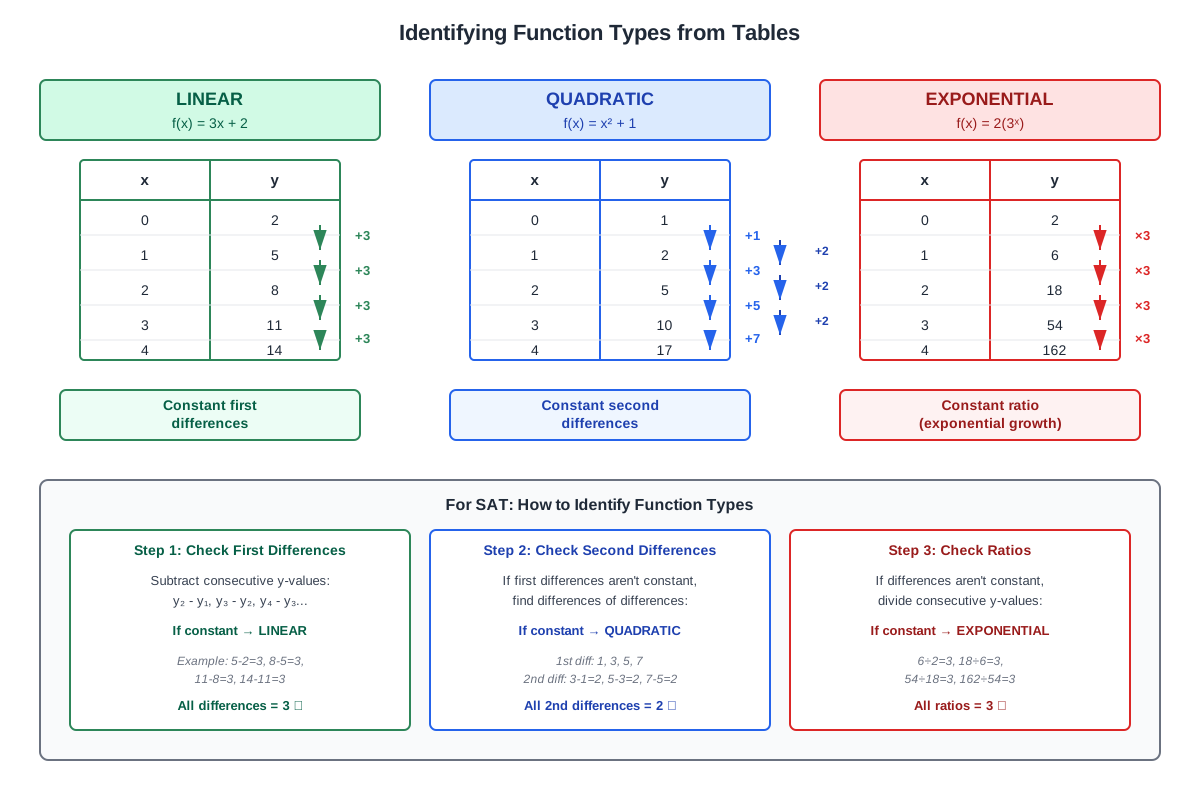
Linear functions in tables exhibit constant differences between consecutive output values when input values increase by a constant amount. This constant difference represents the slope or rate of change of the function. To identify linearity, calculate the difference between consecutive y-values (Δy) and verify it remains constant.
For a linear function f(x) = mx + b, the slope m equals Δy/Δx. When x-values increase by 1, the slope equals the constant difference in y-values. The y-intercept b can be found by identifying the output value when x = 0, or by working backward using the slope.
Steps to identify linear functions:
- Calculate differences between consecutive output values
- Verify differences are constant
- Determine slope from the constant difference
- Find y-intercept (if x = 0 appears) or calculate using point-slope form
- Write equation in form f(x) = mx + b
Recognizing Exponential Functions in Tables
Exponential functions display constant ratios between consecutive output values rather than constant differences. When each output value is multiplied by the same factor to produce the next value, the relationship is exponential. This constant multiplier is called the common ratio or growth/decay factor.
For exponential functions f(x) = a·b^x, the value b represents the common ratio, and a represents the initial value (when x = 0). Growth occurs when b > 1, while decay occurs when 0 < b < 1.
| x | g(x) |
|---|---|
| 0 | 2 |
| 1 | 6 |
| 2 | 18 |
| 3 | 54 |
To verify exponential behavior: 6/2 = 3, 18/6 = 3, 54/18 = 3. The constant ratio of 3 confirms this is exponential with equation g(x) = 2·3^x.
Identifying Quadratic Functions in Tables
Quadratic functions show neither constant first differences nor constant ratios, but they exhibit constant second differences. When you calculate differences between consecutive outputs, then calculate differences of those differences, quadratic functions produce a constant value.
For quadratic functions f(x) = ax² + bx + c, the constant second difference equals 2a (when x-values increase by 1). This property provides a reliable method for identifying quadratic relationships and determining the leading coefficient.
| x | h(x) | 1st Diff | 2nd Diff |
|---|---|---|---|
| 0 | 1 | - | - |
| 1 | 4 | 3 | - |
| 2 | 9 | 5 | 2 |
| 3 | 16 | 7 | 2 |
The constant second difference of 2 confirms quadratic behavior. Since 2a = 2, we know a = 1, suggesting h(x) = x² + bx + c.
Completing Function Tables
SAT questions frequently present partially completed tables and ask students to determine missing values. The strategy depends on identifying the function type first, then applying the appropriate pattern or equation.
For linear functions: Use the constant difference to add or subtract from known values. Alternatively, determine the equation and substitute the x-value.
For exponential functions: Use the common ratio to multiply or divide known values. Work forward or backward through the table using this multiplier.
For quadratic or other functions: Determine the equation from given points, then substitute to find missing values. Sometimes pattern recognition without finding the explicit equation is faster.
Translating Between Representations
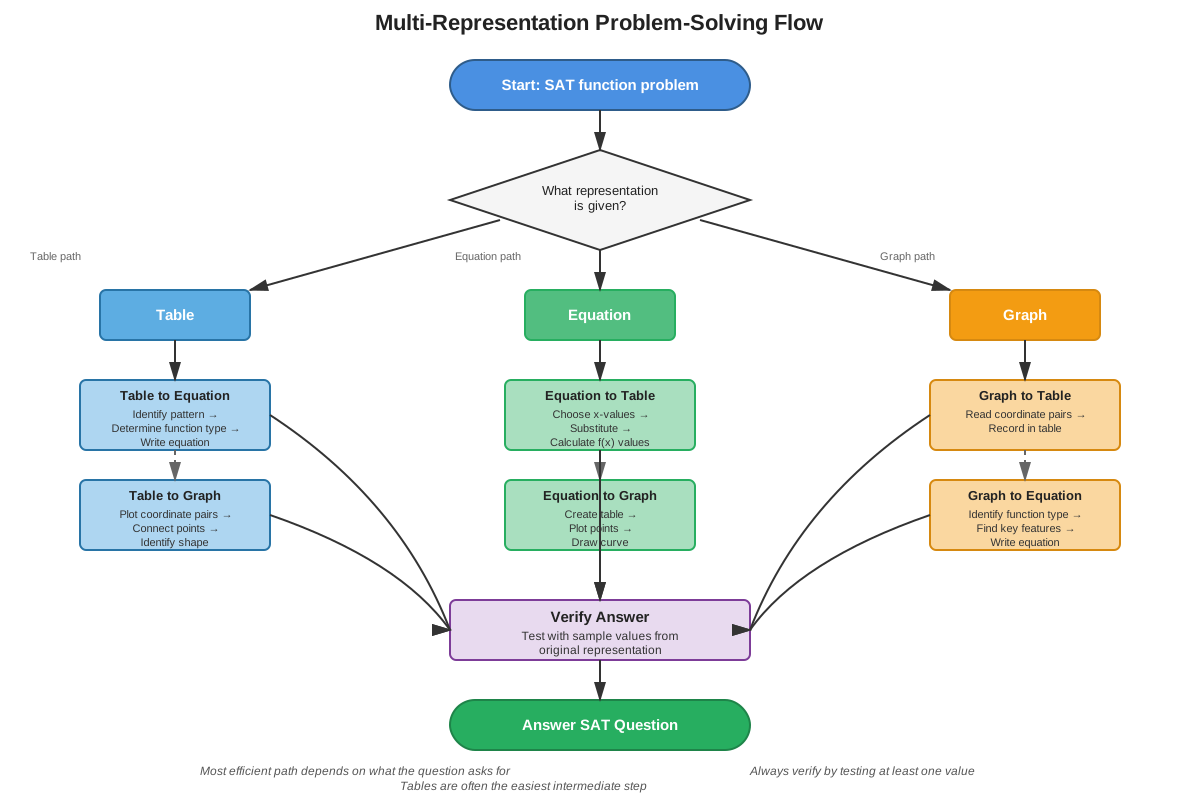
The SAT emphasizes connections between function tables, equations, and graphs. Students must fluidly move between these representations. Given a table, one might need to identify the matching equation from multiple choices. Given an equation, one might need to complete a table or verify which table matches.
Table to equation: Identify function type, determine key parameters (slope and intercept for linear; base and initial value for exponential; coefficients for quadratic), then write the equation.
Equation to table: Substitute each x-value into the equation and calculate corresponding y-values. This process verifies whether a given table matches a proposed equation.
Table to graph: Plot ordered pairs from the table on a coordinate plane. The pattern of points reveals the function's shape and key features like intercepts, vertex, or asymptotes.
Concept Relationships
Function tables serve as a central hub connecting multiple mathematical concepts. The relationship begins with basic function notation → which enables interpretation of function tables → which supports pattern recognition → leading to function type identification (linear, exponential, quadratic).
Within function tables themselves, understanding ordered pairs connects to domain and range identification, while difference calculations lead to rate of change analysis. For linear functions, constant differences connect directly to slope, which relates to linear equations. For exponential functions, constant ratios connect to growth factors and exponential equations.
Function tables bridge to coordinate geometry because each table row represents a plottable point. This connection enables graphical analysis and visual pattern recognition. Tables also connect to systems of equations when comparing two functions to find intersection points—the x-value where both functions produce the same output.
The progression flows: arithmetic operations → pattern recognition in sequences → function tables → algebraic expressions → function graphs → function transformations. Mastering function tables enables students to tackle more complex topics like function composition, inverse functions, and piecewise functions.
Quick check — test yourself on Function tables so far.
Try Flashcards →High-Yield Facts
⭐ Linear functions in tables show constant differences between consecutive y-values when x-values increase by equal amounts
⭐ Exponential functions in tables show constant ratios between consecutive y-values
⭐ The slope of a linear function equals Δy/Δx, which is the constant difference when Δx = 1
⭐ Quadratic functions display constant second differences in function tables
⭐ Every row in a function table represents an ordered pair (x, y) that can be plotted on a coordinate plane
- The y-intercept of a linear function appears in the table when x = 0
- For exponential functions f(x) = a·b^x, the value a appears when x = 0, and b is the common ratio
- If a table shows y-values increasing at an increasing rate, the function is likely exponential or quadratic with positive leading coefficient
- Negative slopes in linear functions produce decreasing y-values as x increases
- A function table must pass the vertical line test concept: each x-value appears at most once with exactly one corresponding y-value
- Tables with evenly spaced x-values make pattern recognition significantly easier
- The domain shown in a table may be discrete (specific values only) or represent a continuous function
Common Misconceptions
Misconception: All tables with increasing y-values represent linear functions → Correction: Exponential and quadratic functions also increase, but at different rates. Always check whether differences or ratios are constant to determine function type.
Misconception: The first y-value in a table is always the y-intercept → Correction: The y-intercept only appears when x = 0. If the table starts at x = 1 or another value, you must calculate or extrapolate to find the y-intercept.
Misconception: If differences between y-values aren't constant, the relationship isn't a function → Correction: Non-constant differences simply indicate a non-linear function. Exponential, quadratic, and many other function types are valid functions despite lacking constant differences.
Misconception: Exponential functions always grow faster than linear functions → Correction: For small x-values or small growth factors, linear functions may initially produce larger outputs. Exponential functions eventually surpass linear functions, but not necessarily within the domain shown in a table.
Misconception: You need to find the equation before completing a function table → Correction: Often, recognizing the pattern (constant difference or ratio) allows direct calculation of missing values without determining the explicit equation, saving valuable time.
Misconception: Function tables always show integer values → Correction: SAT function tables may include fractions, decimals, or irrational numbers. Don't assume patterns must involve whole numbers.
Misconception: The x-values in a function table must start at zero → Correction: Tables can begin at any x-value. The domain shown is often selected to highlight specific function features or simplify calculations.
Worked Examples
Example 1: Identifying Function Type and Equation
Problem: The table below shows values of function f. Determine whether f is linear, exponential, or quadratic, and find its equation.
| x | f(x) |
|---|---|
| 1 | 8 |
| 2 | 11 |
| 3 | 14 |
| 4 | 17 |
Solution:
Step 1: Calculate first differences between consecutive f(x) values.
- 11 - 8 = 3
- 14 - 11 = 3
- 17 - 14 = 3
Step 2: Since first differences are constant (all equal 3), this is a linear function with slope m = 3.
Step 3: Use point-slope form with any point, such as (1, 8):
- f(x) = mx + b
- 8 = 3(1) + b
- 8 = 3 + b
- b = 5
Step 4: Write the equation: f(x) = 3x + 5
Step 5: Verify with another point (2, 11):
- f(2) = 3(2) + 5 = 6 + 5 = 11 ✓
Connection to learning objectives: This example demonstrates identifying key features (constant differences), determining function type (linear), and applying pattern recognition to find the equation.
Example 2: Completing a Table with Exponential Function
Problem: The function g is exponential. Complete the table by finding the missing values.
| x | g(x) |
|---|---|
| 0 | 5 |
| 1 | 15 |
| 2 | ? |
| 3 | ? |
| 4 | 405 |
Solution:
Step 1: Identify the common ratio using known consecutive values.
- Common ratio = 15/5 = 3
Step 2: Verify this ratio works throughout the table by checking if it reaches the known value at x = 4.
- If the pattern continues: 5, 15, 45, 135, 405
- Check: 5 × 3^4 = 5 × 81 = 405 ✓
Step 3: Calculate missing values using the common ratio:
- g(2) = 15 × 3 = 45
- g(3) = 45 × 3 = 135
Step 4: Write the equation for verification: g(x) = 5 · 3^x
Step 5: Verify g(4):
- g(4) = 5 · 3^4 = 5 · 81 = 405 ✓
Connection to learning objectives: This example applies exponential pattern recognition, demonstrates completing tables using constant ratios, and shows how to verify answers using the exponential equation form.
Exam Strategy
When approaching sat function tables questions, begin by scanning the table structure to identify the x-value spacing. Evenly spaced inputs simplify pattern recognition. Next, quickly calculate first differences between consecutive y-values—if constant, you've identified a linear function and can proceed directly to finding the slope and y-intercept.
Trigger words and phrases that signal function table questions include: "the table shows values of function f," "which equation represents the relationship," "complete the table," "based on the values in the table," and "the function shown in the table." Questions asking to "determine the type of function" or "identify the pattern" explicitly test function table analysis skills.
Process of elimination strategies work powerfully with function tables. When given multiple equation choices, substitute one x-value from the table into each equation. Any equation that doesn't produce the correct y-value can be immediately eliminated. Often, testing x = 0 or x = 1 quickly eliminates 2-3 options. For remaining choices, test one additional point to confirm the correct answer.
Time allocation: Spend 15-20 seconds identifying the function type through difference or ratio calculations. Spend another 20-30 seconds determining the equation or completing missing values. Reserve 10-15 seconds for verification by testing your answer with a point from the table. If a question seems complex, consider whether creating your own function table might simplify a word problem—this strategy often saves time on multi-step problems.
For questions asking which graph matches a table, focus on key features rather than plotting all points: check the y-intercept, determine whether the function increases or decreases, and identify the general shape (straight line, curve, exponential growth). These features eliminate options faster than careful point-by-point plotting.
Memory Techniques
LCD mnemonic for function identification:
- Linear = constant Differences
- Constant ratios = exponential
- Differences of differences = quadratic
"Difference Detective" visualization: Picture yourself as a detective examining clues. First differences are your initial clues (linear), ratios are your second investigation method (exponential), and second differences are your deep investigation (quadratic).
"Table to Equation Highway" mental map:
- Enter the highway by calculating patterns
- Choose your lane: differences (linear lane), ratios (exponential lane), or second differences (quadratic lane)
- Exit at equation destination using identified parameters
Acronym RISE for exponential functions:
- Ratio is constant
- Initial value when x = 0
- Same multiplier each step
- Equation form: a·b^x
Slope memory trick: "Slope is the STEP" - when x increases by 1 in a linear table, the y-value takes a STEP equal to the slope.
Summary
Function tables represent mathematical relationships through organized input-output pairs, serving as a critical bridge between equations, graphs, and real-world data on the SAT. Mastery requires recognizing three primary function types: linear functions with constant differences, exponential functions with constant ratios, and quadratic functions with constant second differences. Students must efficiently identify patterns, determine equations from tables, complete missing values, and translate between tabular, algebraic, and graphical representations. The key to success lies in systematic analysis—calculating first differences or ratios immediately upon encountering a table, then applying the appropriate method for the identified function type. Function tables appear in 8-12% of SAT math questions across diverse contexts, making them a high-yield topic that rewards focused practice. Understanding that each table row represents a coordinate pair connects tabular analysis to broader mathematical concepts including coordinate geometry, rate of change, and function behavior, enabling students to approach complex multi-representation problems with confidence and efficiency.
Key Takeaways
- Function tables display ordered pairs where each input corresponds to exactly one output, with each row representing a plottable coordinate point
- Linear functions show constant differences between consecutive outputs; exponential functions show constant ratios; quadratic functions show constant second differences
- The slope of a linear function equals the constant difference when x-values increase by 1, and the y-intercept appears when x = 0
- Identifying function type first (through difference or ratio analysis) determines the most efficient strategy for completing tables or finding equations
- Function tables connect directly to equations and graphs, requiring fluency in translating between all three representations
- Systematic verification using table values eliminates incorrect equation choices quickly and confirms calculated answers
- Creating function tables can simplify complex word problems by organizing information and revealing patterns
Related Topics
Function Graphs: Understanding how to plot points from function tables and interpret graphical features like intercepts, slopes, and curvature builds directly on table analysis skills and enables visual problem-solving strategies.
Systems of Equations: Comparing two function tables to find common output values (intersection points) extends single-function analysis to multi-function problems, a frequent SAT question type.
Function Transformations: Recognizing how changes in function equations affect table values (shifts, stretches, reflections) deepens understanding of function behavior and parameter effects.
Sequences and Series: Arithmetic and geometric sequences follow the same patterns as linear and exponential functions, making function table skills directly applicable to sequence problems.
Rate of Change: Analyzing how quickly function values change connects table analysis to calculus concepts and real-world applications involving velocity, growth rates, and optimization.
Practice CTA
Now that you've mastered the core concepts of function tables, it's time to solidify your understanding through active practice. Attempt the practice questions to apply pattern recognition skills, test your ability to identify function types quickly, and build confidence with SAT-style problems. Use the flashcards to reinforce key definitions and strategies until they become automatic. Remember: function tables appear on every SAT, and the systematic approach you've learned here will serve you across multiple question types. Your investment in mastering this high-yield topic will pay dividends on test day—start practicing now to transform understanding into points!
Sign up free to keep reading
Create a free AnvayaPrep account to finish this SAT guide on Function tables — plus flashcards and practice questions.