Overview
The rate of change is one of the most fundamental concepts in SAT math, serving as the cornerstone for understanding linear relationships, functions, and real-world problem-solving. At its core, rate of change describes how one quantity changes in relation to another—whether it's the speed of a car, the cost per item, or the slope of a line on a coordinate plane. On the SAT, this concept appears frequently across multiple question types, from straightforward slope calculations to complex word problems involving proportional relationships. Mastering rate of change is not merely about memorizing formulas; it requires developing an intuitive understanding of how quantities interact and change together.
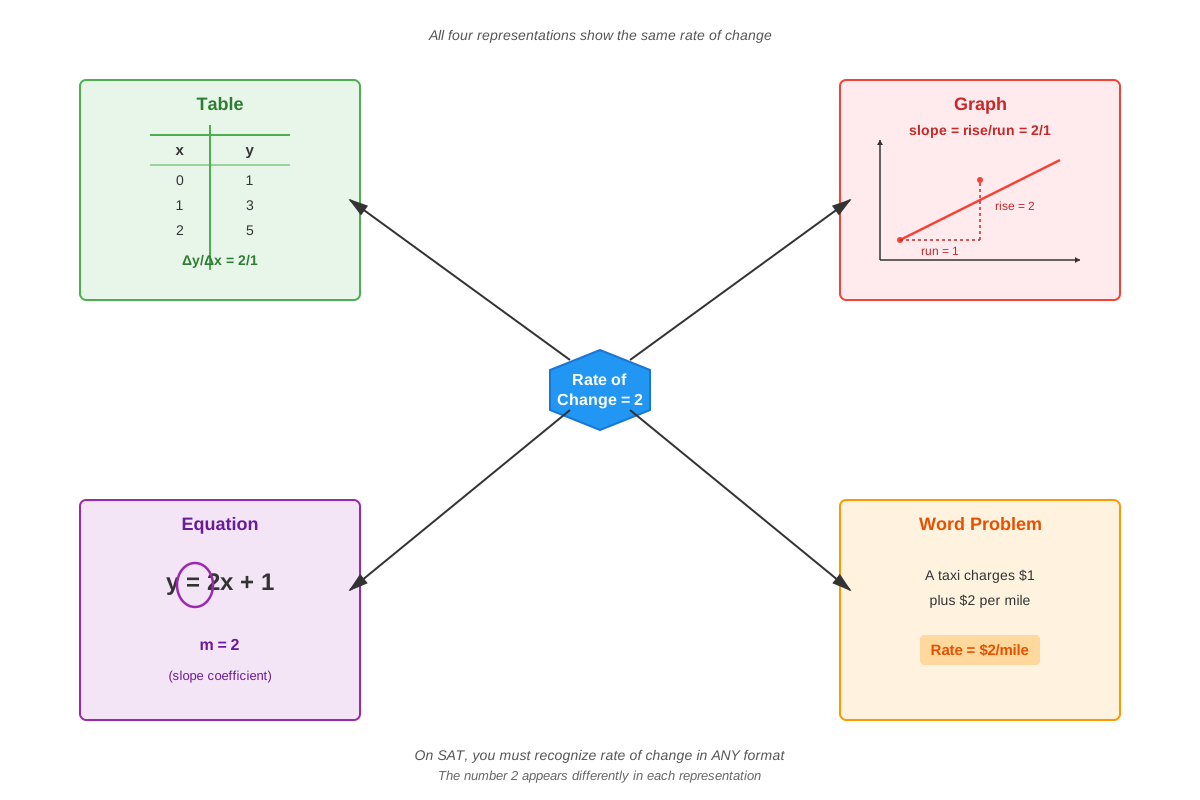
The SAT tests rate of change in various contexts, making it essential to recognize this concept regardless of how it's presented. Students might encounter it as the slope of a linear function, the unit rate in a word problem, or the constant of proportionality in a real-world scenario. Questions may ask students to calculate rate of change from tables, graphs, equations, or verbal descriptions. The ability to move fluidly between these different representations is crucial for success on the exam.
Understanding rate of change creates a foundation for more advanced mathematical concepts tested on the SAT, including systems of equations, quadratic functions, and data analysis. It connects directly to the broader unit of linear functions, where rate of change manifests as slope—the measure of a line's steepness and direction. This topic also bridges algebraic thinking with geometric visualization, requiring students to interpret numerical relationships spatially and translate between symbolic and graphical representations.
Learning Objectives
- [ ] Identify key features of rate of change in various representations (tables, graphs, equations, and word problems)
- [ ] Explain how rate of change appears on the SAT across different question formats and contexts
- [ ] Apply rate of change to answer SAT-style questions efficiently and accurately
- [ ] Calculate rate of change from two points using the slope formula
- [ ] Distinguish between positive, negative, zero, and undefined rates of change
- [ ] Interpret the meaning of rate of change in real-world contexts and word problems
- [ ] Connect rate of change to the slope-intercept form of linear equations
Prerequisites
- Basic algebraic operations: Addition, subtraction, multiplication, and division with integers, fractions, and decimals are essential for calculating rate of change accurately
- Coordinate plane understanding: Familiarity with plotting points, identifying coordinates, and understanding the x-y axis system enables visualization of rate of change graphically
- Fraction and ratio operations: Rate of change calculations often involve fractions, and understanding how to simplify and compare ratios is fundamental
- Understanding of variables: Recognizing that variables represent quantities and can change in relation to one another is necessary for interpreting rate of change in equations
- Basic function notation: Knowing what f(x) represents and how to evaluate functions helps when working with linear functions and their rates of change
Why This Topic Matters
Rate of change extends far beyond the classroom, appearing in countless real-world applications that students encounter daily. From calculating fuel efficiency (miles per gallon) to understanding salary rates (dollars per hour), from analyzing population growth (people per year) to measuring internet speed (megabytes per second), rate of change quantifies how our world operates. Financial literacy depends on understanding rates—interest rates, inflation rates, and investment returns all involve this fundamental concept. In science and engineering, rate of change describes velocity, acceleration, chemical reaction rates, and countless other phenomena.
On the SAT, rate of change questions appear with remarkable frequency, typically comprising 8-12% of the math section questions. This translates to approximately 4-6 questions per test, making it one of the highest-yield topics for focused study. The College Board consistently includes rate of change across both the calculator and no-calculator portions, testing it through multiple question formats: multiple-choice, grid-in, and as part of multi-step problems. Questions range from straightforward slope calculations worth 1 point to complex word problems that integrate rate of change with other concepts.
The SAT presents rate of change in diverse contexts: business scenarios involving profit and cost, science contexts with speed and distance, social science situations with population and time, and pure mathematical problems with abstract functions. Questions might provide a graph and ask students to identify the rate of change, present a table requiring calculation of the constant rate, describe a scenario verbally and ask for the equation, or give an equation and request interpretation of the rate's meaning. This versatility makes rate of change an essential skill that appears not just in dedicated linear function questions but also embedded within data analysis, problem-solving, and advanced math questions.
Core Concepts
Definition and Fundamental Understanding
The rate of change represents how much one quantity changes relative to the change in another quantity. Mathematically, it is calculated as the ratio of the change in the dependent variable (typically y) to the change in the independent variable (typically x). This concept is synonymous with slope when discussing linear functions on a coordinate plane.
The formal definition states:
Rate of Change = (Change in y) / (Change in x) = Δy / Δx = (y₂ - y₁) / (x₂ - x₁)Where (x₁, y₁) and (x₂, y₂) are any two distinct points on a line. The Greek letter delta (Δ) represents "change in" and is commonly used in mathematical notation. This formula, often called the slope formula, is the most important equation for calculating rate of change and must be memorized for SAT success.
Types of Rate of Change
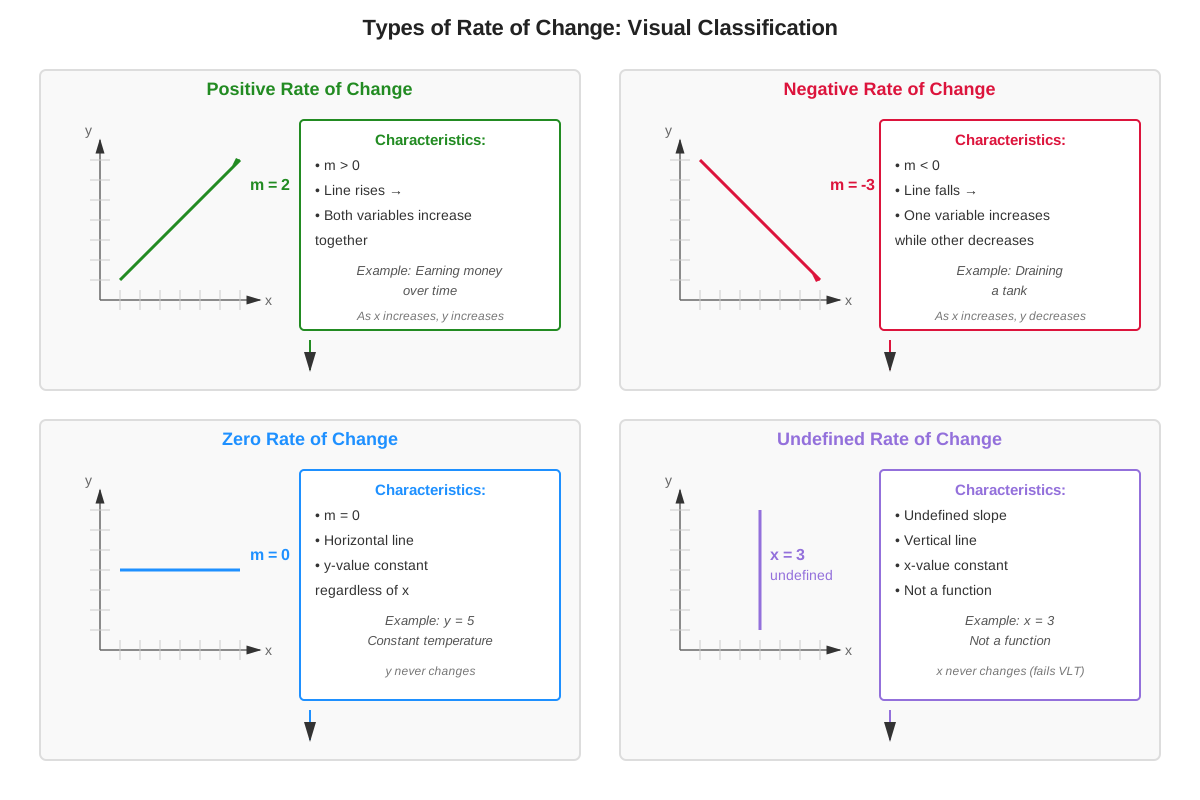
Rate of change can be classified into four distinct categories based on its value and behavior:
| Type | Value | Visual Appearance | Real-World Example |
|---|---|---|---|
| Positive | m > 0 | Line rises from left to right | Temperature increasing over time |
| Negative | m < 0 | Line falls from left to right | Account balance decreasing with withdrawals |
| Zero | m = 0 | Horizontal line | Constant speed on cruise control |
| Undefined | Division by zero | Vertical line | Time standing still at one moment |
Positive rate of change indicates that as the independent variable increases, the dependent variable also increases. The steeper the line, the greater the rate of change. For example, if a car travels 60 miles per hour, the rate of change of distance with respect to time is +60.
Negative rate of change shows an inverse relationship where the dependent variable decreases as the independent variable increases. A slope of -3 means that for every 1 unit increase in x, y decreases by 3 units. This might represent water draining from a tank at 3 gallons per minute.
Zero rate of change indicates no change in the dependent variable regardless of changes in the independent variable. This creates a horizontal line and represents constant values, such as a flat monthly subscription fee that doesn't change with usage.
Undefined rate of change occurs when the change in x equals zero (vertical line), creating division by zero in the slope formula. This represents an impossible scenario in most real-world contexts, as it would mean a quantity changes without any passage of time or change in the independent variable.
Calculating Rate of Change from Different Representations
From Two Points
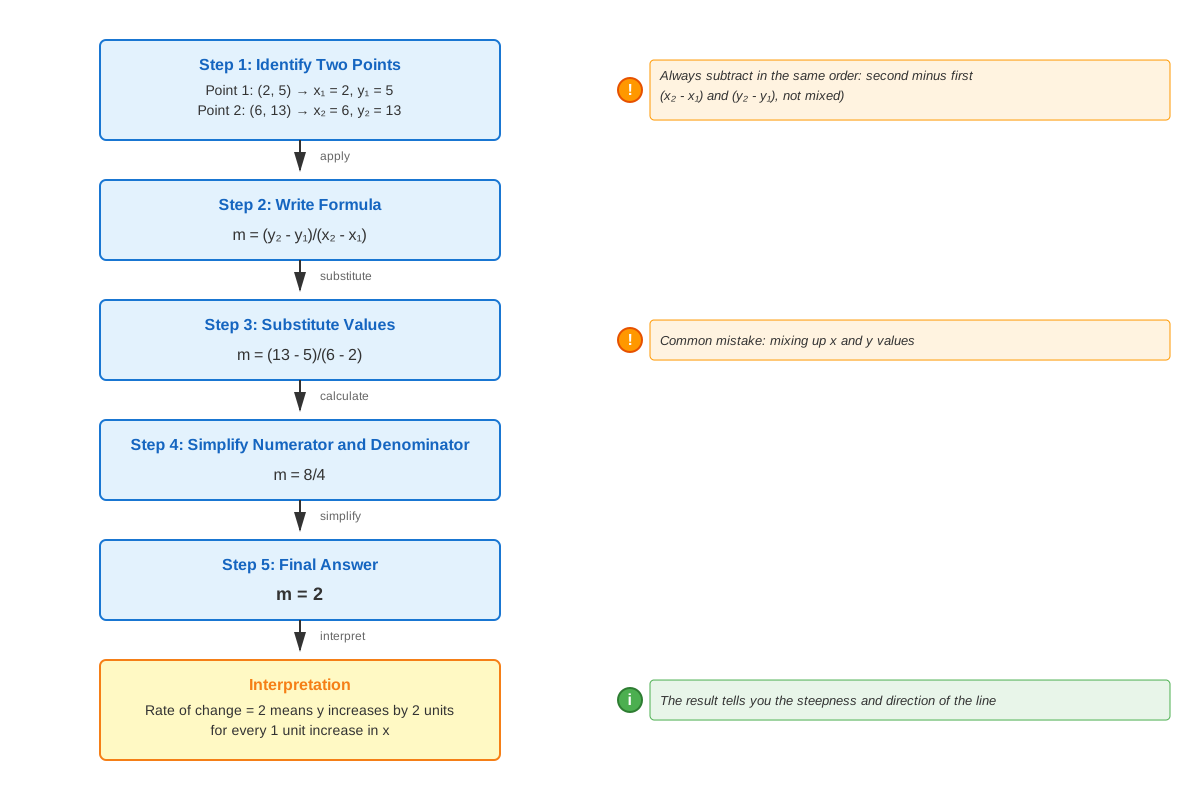
Given two points (x₁, y₁) and (x₂, y₂), apply the slope formula directly:
- Identify the coordinates of both points clearly
- Subtract the y-coordinates: y₂ - y₁
- Subtract the x-coordinates: x₂ - x₁ (in the same order)
- Divide the change in y by the change in x
- Simplify the resulting fraction if possible
The order of subtraction matters—always subtract in the same order for both coordinates to avoid sign errors.
From a Table
When given a table of values, select any two rows and treat them as coordinate pairs. For linear relationships, the rate of change remains constant between any two points. To verify linearity, calculate the rate of change between multiple pairs of points—if all calculations yield the same result, the relationship is linear.
From a Graph
On a coordinate plane, identify two clear points where the line passes through grid intersections. Use these coordinates in the slope formula. Alternatively, use the "rise over run" method: count the vertical change (rise) and horizontal change (run) between two points, then express as a fraction.
From an Equation
In the slope-intercept form y = mx + b, the coefficient m represents the rate of change directly. In standard form Ax + By = C, solve for y to convert to slope-intercept form, or use the formula m = -A/B. In point-slope form y - y₁ = m(x - x₁), the value m is explicitly the rate of change.
Interpreting Rate of Change in Context
The SAT frequently requires students to interpret what a rate of change means within a real-world scenario. The rate of change always has units derived from the dependent variable divided by the independent variable. For example:
- If y represents dollars and x represents hours, the rate of change is dollars per hour ($/hr)
- If y represents miles and x represents gallons, the rate of change is miles per gallon (mpg)
- If y represents population and x represents years, the rate of change is people per year
When interpreting, always state: "For every [1 unit of independent variable], the [dependent variable] changes by [rate of change value] [units]." This complete interpretation demonstrates full understanding and is often required for full credit on SAT questions.
Rate of Change and Linear Functions
In linear functions, the rate of change is constant—this constancy defines linearity. The equation y = mx + b encodes the rate of change as m, while b represents the initial value or y-intercept. Understanding that m controls the steepness and direction of the line while b controls the vertical position is crucial for graphing and equation-writing tasks.
The rate of change determines how quickly the function values increase or decrease. A larger absolute value of the rate of change means a steeper line and more rapid change. Comparing rates of change between different linear functions allows determination of which relationship changes more quickly.
Concept Relationships
Rate of change serves as the connecting thread between multiple mathematical representations and concepts. The relationship begins with the fundamental ratio of change in y to change in x, which manifests as slope in geometric contexts. This slope directly translates to the coefficient m in the algebraic representation y = mx + b, creating a bridge between algebra and geometry.
The concept flow follows this pattern: Coordinate pairs → Rate of change calculation → Slope → Linear equation → Graphical representation. Each step builds upon the previous, and students must be able to move bidirectionally through this sequence.
Rate of change connects to prerequisite knowledge of ratios and proportions, as it fundamentally represents a ratio. It extends to more advanced topics including systems of equations (where comparing rates of change determines intersection points), parallel and perpendicular lines (where rates of change have specific relationships), and even calculus concepts (where rate of change becomes instantaneous rather than average).
Within the linear functions unit, rate of change relates to:
- Y-intercept: Together they define a unique line
- X-intercept: Can be found using rate of change and y-intercept
- Parallel lines: Share identical rates of change
- Perpendicular lines: Have rates of change that are negative reciprocals
- Direct variation: Represents rate of change through the origin
Understanding these relationships enables students to solve complex multi-step problems that integrate several concepts simultaneously, a common SAT strategy for testing deeper understanding.
Quick check — test yourself on Rate of change so far.
Try Flashcards →High-Yield Facts
⭐ The rate of change formula is (y₂ - y₁)/(x₂ - x₁), and the order of subtraction must be consistent for both coordinates
⭐ In the equation y = mx + b, the rate of change is always the coefficient m
⭐ A positive rate of change creates a line that rises from left to right; a negative rate of change creates a line that falls from left to right
⭐ For linear functions, the rate of change is constant between any two points on the line
⭐ The units of rate of change are always [dependent variable units] per [independent variable units]
- A horizontal line has a rate of change of zero; a vertical line has an undefined rate of change
- Parallel lines have equal rates of change (identical slopes)
- Perpendicular lines have rates of change that are negative reciprocals (if one slope is m, the other is -1/m)
- The steeper the line, the greater the absolute value of the rate of change
- Rate of change can be calculated from any two distinct points on a line, and the result will always be the same for linear relationships
- When comparing two linear functions, the one with the greater rate of change increases (or decreases) more rapidly
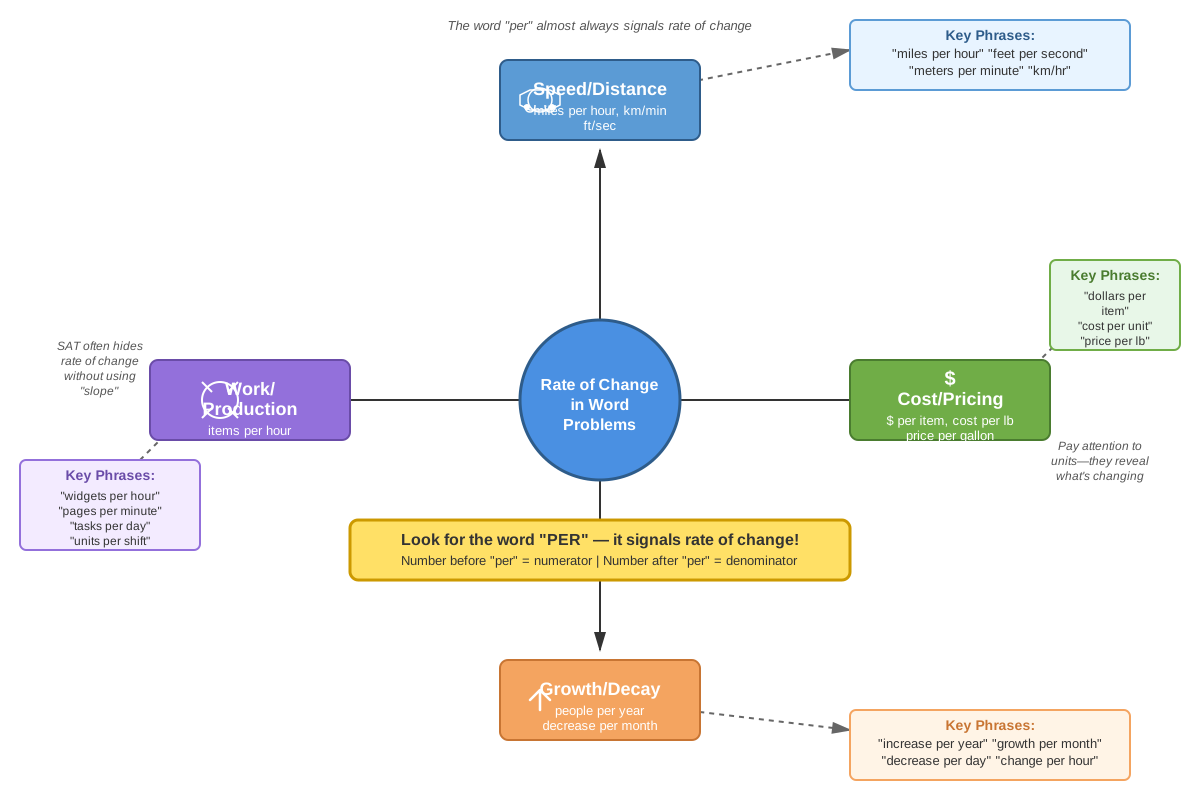
- In word problems, phrases like "per," "each," "every," and "rate of" signal rate of change
- The rate of change represents the amount the y-value changes when x increases by exactly 1 unit
Common Misconceptions
Misconception: The rate of change formula can be applied with coordinates in any order without affecting the result.
Correction: While you can choose which point is (x₁, y₁) and which is (x₂, y₂), you must maintain consistent order in both the numerator and denominator. Mixing the order (such as calculating y₂ - y₁ but x₁ - x₂) will produce the wrong sign for the rate of change.
Misconception: A steeper line always means a larger rate of change value.
Correction: Steepness relates to the absolute value of the rate of change. A line with slope -5 is steeper than a line with slope 2, even though -5 < 2. When comparing steepness, compare |m| values, not the actual m values.
Misconception: Rate of change and y-intercept are the same thing in a linear equation.
Correction: In y = mx + b, m is the rate of change (slope) and b is the y-intercept (where the line crosses the y-axis). These are distinct features: rate of change describes how the line tilts, while y-intercept describes where it crosses the vertical axis.
Misconception: If a table shows y-values increasing, the rate of change must be positive.
Correction: Rate of change depends on the relationship between changes in both variables. If x-values are decreasing while y-values are increasing, the rate of change is actually negative. Always calculate using the formula rather than making assumptions from one variable alone.
Misconception: The rate of change between two points on a curve is the same as the rate of change between two other points on the same curve.
Correction: Constant rate of change is a defining characteristic of linear functions only. For non-linear functions (parabolas, exponentials, etc.), the rate of change varies at different points. This is why the SAT specifies "linear" when testing rate of change concepts.
Misconception: A rate of change of zero means nothing is happening or the function doesn't exist.
Correction: A zero rate of change indicates a constant value—the dependent variable remains the same regardless of changes in the independent variable. This is perfectly valid and represents a horizontal line, such as a fixed monthly fee or a constant temperature.
Misconception: In word problems, the rate of change is always the first number mentioned.
Correction: The rate of change must be identified by understanding which quantity depends on which. Look for "per" language and determine which variable is independent (usually time, quantity, or distance) and which is dependent (usually cost, total, or amount).
Worked Examples
Example 1: Calculating Rate of Change from Two Points
Problem: A line passes through the points (-3, 7) and (5, -1). What is the rate of change of this line?
Solution:
Step 1: Identify the coordinates clearly.
- Point 1: (x₁, y₁) = (-3, 7)
- Point 2: (x₂, y₂) = (5, -1)
Step 2: Apply the rate of change formula.
m = (y₂ - y₁)/(x₂ - x₁)Step 3: Substitute the values.
m = (-1 - 7)/(5 - (-3))Step 4: Simplify the numerator and denominator.
m = (-8)/(5 + 3) = -8/8Step 5: Calculate the final answer.
m = -1Answer: The rate of change is -1.
Interpretation: This means that for every 1 unit increase in x, the y-value decreases by 1 unit. The negative rate indicates the line falls from left to right, and the absolute value of 1 indicates a moderate slope (45-degree angle downward).
Connection to Learning Objectives: This example demonstrates the application of the rate of change formula to answer SAT-style questions and identifies the key feature of negative slope.
Example 2: Rate of Change in a Real-World Context
Problem: A water tank contains 450 gallons of water. Water is being drained at a constant rate, and after 6 hours, the tank contains 270 gallons. Write an equation that models the amount of water W in the tank after t hours, and interpret the rate of change in context.
Solution:
Step 1: Identify the two points in (time, water) format.
- Initial point: (0, 450) — at time 0, there are 450 gallons
- Later point: (6, 270) — at time 6 hours, there are 270 gallons
Step 2: Calculate the rate of change.
m = (270 - 450)/(6 - 0) = -180/6 = -30Step 3: Interpret the rate of change.
The rate of change is -30 gallons per hour. This means the tank loses 30 gallons of water every hour.
Step 4: Write the equation using slope-intercept form W = mt + b.
- m = -30 (rate of change)
- b = 450 (initial amount, the y-intercept)
- Equation: W = -30t + 450
Step 5: Verify the equation with the given point.
When t = 6: W = -30(6) + 450 = -180 + 450 = 270 ✓
Answer: The equation is W = -30t + 450, where the rate of change of -30 gallons per hour represents the constant drainage rate.
Connection to Learning Objectives: This example shows how rate of change appears in SAT word problems, requires interpretation in context, and connects to writing linear equations—all key SAT skills.
Exam Strategy
When approaching SAT questions involving rate of change, begin by identifying what type of representation is provided: equation, graph, table, or word problem. Each requires a slightly different approach, but all ultimately connect to the same underlying concept.
Trigger words and phrases that signal rate of change questions include:
- "slope," "rate," "per," "each," "every," "constant rate"
- "how much does [variable] change when [other variable] increases by..."
- "linear relationship," "constant increase/decrease"
- "for every," "unit rate," "speed," "velocity"
- Questions asking to "interpret the meaning of m" in an equation
Process-of-elimination strategies specific to rate of change:
- Check the sign first: If the problem describes an increasing relationship, eliminate any negative answer choices for rate of change (and vice versa)
- Verify units: The correct answer must have units that make sense (dependent variable per independent variable)
- Test with given points: If answer choices are equations or rate values, substitute a given point to eliminate incorrect options quickly
- Compare magnitudes: If the question asks which of several functions has the greatest rate of change, you can often eliminate options by comparing absolute values without full calculation
Time allocation advice: Rate of change questions typically require 45-90 seconds depending on complexity. Straightforward slope calculations from two points should take under 60 seconds. Word problems requiring interpretation and equation-writing may need up to 90 seconds. If a question requires more than 2 minutes, mark it and return later—you may be overcomplicating the approach.
Strategic approach sequence:
- Read the entire question carefully, identifying what is given and what is asked (15 seconds)
- Determine the representation type and select the appropriate method (10 seconds)
- Execute the calculation or analysis (30-45 seconds)
- Check that your answer makes sense in context (10-15 seconds)
- Verify units and sign if applicable (5-10 seconds)
Exam Tip: On calculator-permitted sections, use your calculator for arithmetic but write down the setup first. This prevents input errors and allows you to catch mistakes in your mathematical reasoning before calculating.
For grid-in questions involving rate of change, remember that answers can be negative (indicated by filling in the negative bubble), but they cannot be mixed numbers—convert to improper fractions or decimals. If your calculated rate of change doesn't fit the grid, recheck your calculation rather than rounding inappropriately.
Memory Techniques
Mnemonic for the slope formula: "You Yell Over Xylophone Xrays" represents (Y₂ - Y₁) / (X₂ - X₁), helping remember the order and structure.
Visualization for positive vs. negative slope: Picture yourself walking along the line from left to right. If you're walking uphill, the slope is positive. If you're walking downhill, the slope is negative. If you're walking on flat ground, the slope is zero.
Acronym for slope types: PNZU
- Positive: rises left to right
- Negative: falls left to right
- Zero: horizontal
- Undefined: vertical
Memory device for units: "Dependent Over Independent" (DOI) reminds you that rate of change units are always dependent variable units divided by independent variable units.
Rhyme for consistency: "Same order top and bottom, or your answer will be rotten" — reminds students to maintain consistent subtraction order in the slope formula.
Visual anchor for slope-intercept form: Think of y = mx + b as a recipe: m (rate of change) is the multiplier that determines how much y changes, and b is the base or starting amount. The multiplier affects the rate, the base affects the starting position.
Contextual memory hook: "Per means divide" — whenever you see "per" in a word problem (miles per hour, dollars per item), you're dealing with a rate of change that involves division.
Summary
Rate of change is the mathematical expression of how one quantity changes in relation to another, calculated as the ratio of change in the dependent variable to change in the independent variable. On the SAT, this concept appears as slope in linear functions and manifests across multiple representations: equations (as the coefficient m in y = mx + b), graphs (as the steepness and direction of a line), tables (as the constant ratio between consecutive values), and word problems (as unit rates and proportional relationships). The fundamental formula (y₂ - y₁)/(x₂ - x₁) must be applied with consistent subtraction order to obtain the correct sign. Rate of change can be positive (rising line), negative (falling line), zero (horizontal line), or undefined (vertical line), and its interpretation always includes units derived from the context. Mastering rate of change requires fluency in calculating it from any representation, interpreting its meaning in real-world contexts, and recognizing its constant nature in linear relationships—skills that appear in approximately 8-12% of SAT math questions and serve as foundational knowledge for more advanced mathematical concepts.
Key Takeaways
- The rate of change formula (y₂ - y₁)/(x₂ - x₁) is essential and must be memorized; maintain consistent subtraction order to get the correct sign
- In linear equations of the form y = mx + b, the rate of change is always the coefficient m, representing how much y changes for each unit increase in x
- Rate of change is constant for linear functions but varies for non-linear functions—this constancy defines linearity
- Always interpret rate of change with proper units (dependent variable per independent variable) and in complete contextual sentences on the SAT
- The sign of the rate of change indicates direction (positive = increasing, negative = decreasing), while the absolute value indicates steepness
- Rate of change can be calculated from any two points on a line, from tables by treating rows as coordinate pairs, from graphs using rise over run, or directly from equations in slope-intercept form
- Recognizing trigger words like "per," "rate," "each," and "every" helps identify rate of change questions quickly on the SAT
Related Topics
Slope-Intercept Form (y = mx + b): Understanding rate of change is prerequisite to mastering slope-intercept form, where m represents the rate of change and b represents the y-intercept. This form is the most common way linear equations appear on the SAT.
Parallel and Perpendicular Lines: These concepts build directly on rate of change—parallel lines have identical rates of change, while perpendicular lines have rates of change that are negative reciprocals of each other.
Systems of Linear Equations: Comparing rates of change between two linear functions helps determine whether lines intersect, are parallel, or are identical, which is essential for solving systems algebraically and graphically.
Direct and Inverse Variation: Direct variation (y = kx) represents a special case where the rate of change passes through the origin, while inverse variation introduces non-constant rates of change.
Quadratic Functions and Average Rate of Change: While linear functions have constant rate of change, quadratic functions introduce the concept of average rate of change over an interval, extending the foundational understanding developed here.
Practice CTA
Now that you've mastered the core concepts of rate of change, it's time to solidify your understanding through active practice. Complete the practice questions to test your ability to calculate, interpret, and apply rate of change in various SAT-style contexts. Use the flashcards to reinforce key formulas, definitions, and strategies until they become automatic. Remember, rate of change appears on virtually every SAT, making this one of the highest-yield topics for your study time. Each practice problem you solve builds the pattern recognition and problem-solving speed essential for test day success. You've got this—let's put your knowledge into action!
Sign up free to keep reading
Create a free AnvayaPrep account to finish this SAT guide on Rate of change — plus flashcards and practice questions.