Overview
Interpreting graphs is one of the most frequently tested skills on the SAT math section, appearing in approximately 15-20% of all questions across both calculator and no-calculator portions. This fundamental skill requires students to extract meaningful information from visual representations of data, functions, and relationships. Rather than simply reading numbers off a chart, sat interpreting graphs questions demand that students analyze trends, identify key features, make predictions, and understand the real-world context that graphs represent.
The ability to interpret graphs connects directly to the broader Functions and Nonlinear Models unit because graphs serve as the visual language of functions. Every function can be represented graphically, and understanding how to read these visual representations is essential for analyzing function behavior, identifying transformations, and solving complex problems. Whether dealing with linear functions, quadratic functions, exponential growth, or more complex nonlinear relationships, graph interpretation skills provide the foundation for understanding how mathematical relationships behave across their domains.
Mastering graph interpretation is critical not only for direct "read the graph" questions but also for solving multi-step problems that require synthesizing information from multiple sources. Students who excel at interpreting graphs can quickly identify maximum and minimum values, determine intervals of increase and decrease, recognize symmetry and periodicity, and translate between different representations of the same relationship. This skill set directly impacts performance on questions involving systems of equations, optimization problems, data analysis, and real-world modeling scenarios that appear throughout the SAT math section.
Learning Objectives
- [ ] Identify key features of interpreting graphs including intercepts, maxima, minima, and intervals of increase/decrease
- [ ] Explain how interpreting graphs appears on the SAT across different question formats and contexts
- [ ] Apply interpreting graphs to answer SAT-style questions involving functions, data analysis, and real-world scenarios
- [ ] Determine rates of change and average rates of change from graphical representations
- [ ] Compare multiple graphs to identify relationships between variables and functions
- [ ] Translate between graphical, algebraic, and verbal representations of the same relationship
- [ ] Analyze the behavior of functions at specific points and over intervals using graphical information
Prerequisites
- Basic coordinate plane understanding: Students must know how to locate points using (x, y) coordinates, as all graph interpretation relies on understanding the relationship between horizontal and vertical axes
- Function notation and terminology: Familiarity with f(x) notation and terms like domain, range, and function values enables students to connect algebraic and graphical representations
- Linear equations and slope: Understanding how slope represents rate of change provides the foundation for interpreting steepness and direction in any graph
- Basic algebraic manipulation: The ability to solve simple equations helps when extracting specific values or solving for unknowns based on graphical information
Why This Topic Matters
Graph interpretation skills extend far beyond the SAT into virtually every quantitative field. Scientists use graphs to visualize experimental data and identify trends. Economists rely on graphs to understand market behavior and make predictions. Engineers interpret graphs to optimize designs and troubleshoot problems. Medical professionals analyze graphs of vital signs, drug concentrations, and population health trends. In an increasingly data-driven world, the ability to quickly and accurately extract meaning from visual representations of information is an essential literacy skill.
On the SAT specifically, graph interpretation questions appear with remarkable frequency and variety. Approximately 8-12 questions per test directly involve reading or analyzing graphs, representing roughly 15-20% of the total math score. These questions appear in multiple formats: some ask students to read specific values, others require identifying trends or patterns, and still others demand that students make predictions or solve problems using graphical information. Graph interpretation questions commonly appear in the context of real-world scenarios (population growth, business revenue, scientific experiments), making them some of the most practical and applicable questions on the exam.
The SAT tests graph interpretation through several common question types: identifying coordinates of specific points (especially intercepts and extrema), determining intervals where functions increase or decrease, comparing rates of change across different intervals, matching graphs to verbal descriptions or equations, and solving problems that require synthesizing information from multiple graphs or combining graphical and algebraic information. Questions may involve linear graphs, parabolas, exponential curves, circles, or more complex functions, and they frequently incorporate real-world contexts that require students to understand what the axes represent and what the graph's features mean in practical terms.
Core Concepts
Reading Coordinates and Key Points
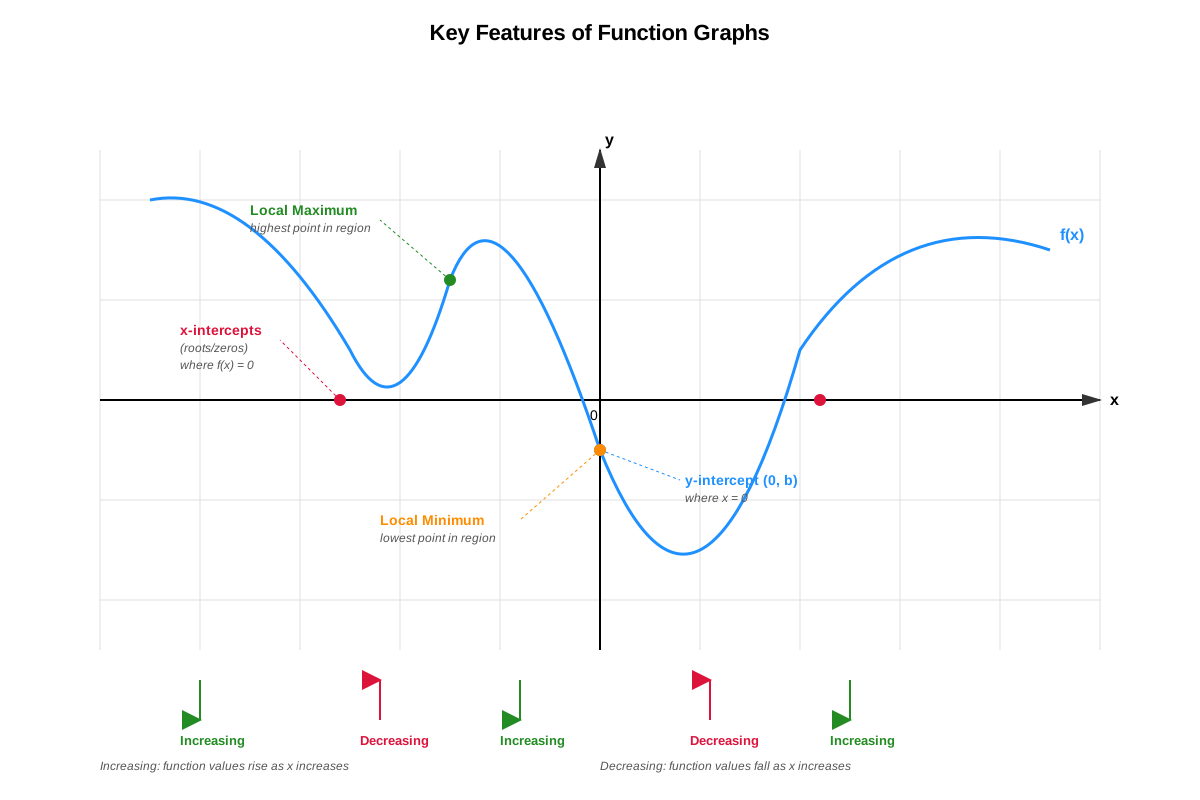
The foundation of graph interpretation is the ability to accurately read coordinates from a graph. Every point on a graph represents an ordered pair (x, y), where the x-coordinate indicates the horizontal position and the y-coordinate indicates the vertical position. On the SAT, students must be able to identify specific points, especially those with special significance: intercepts (where the graph crosses the axes), maxima (highest points), minima (lowest points), and points where the function changes behavior.
X-intercepts (also called zeros or roots) occur where the graph crosses the x-axis, meaning the y-value equals zero. These points are written as (x, 0) and represent solutions to the equation f(x) = 0. Y-intercepts occur where the graph crosses the y-axis, meaning the x-value equals zero, written as (0, y). For functions, there can be multiple x-intercepts but only one y-intercept (since functions can only have one output for x = 0).
When reading coordinates from a graph, pay careful attention to the scale of each axis. SAT graphs may use scales other than 1 unit per gridline—axes might count by 2s, 5s, 10s, or even fractional amounts. Always check the labeled values on each axis before reading any coordinates.
Intervals of Increase and Decrease
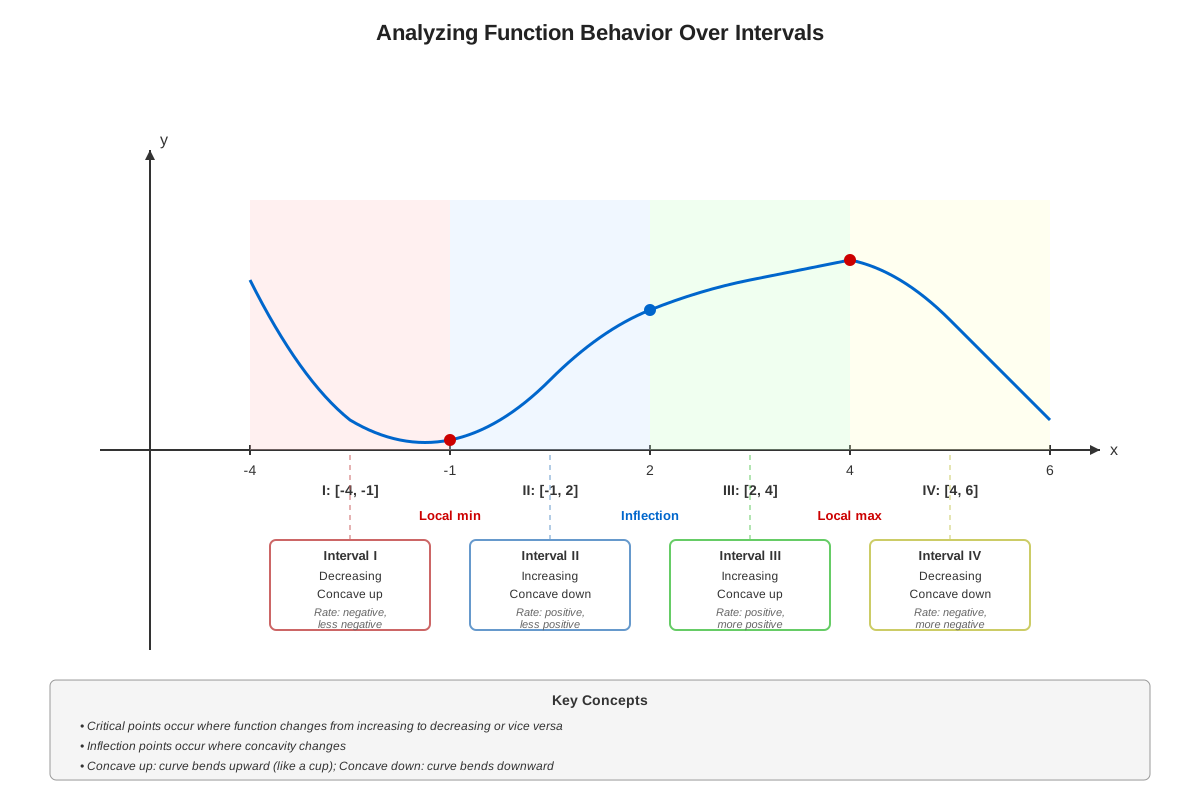
A function increases on an interval when, as x-values get larger, y-values also get larger (the graph goes upward from left to right). A function decreases on an interval when, as x-values get larger, y-values get smaller (the graph goes downward from left to right). A function is constant on an interval when y-values remain the same as x-values change (the graph is horizontal).
These intervals are always described using x-values, not y-values. For example, if a function increases from x = -2 to x = 3, we say "the function increases on the interval (-2, 3)" or "the function increases for -2 < x < 3." The SAT frequently asks students to identify these intervals or to determine where a function reaches its maximum or minimum value.
Critical points occur where a function changes from increasing to decreasing (a local maximum) or from decreasing to increasing (a local minimum). At these points, the graph has a horizontal tangent line or a sharp corner. Identifying these points is crucial for understanding function behavior and solving optimization problems.
Rate of Change and Slope
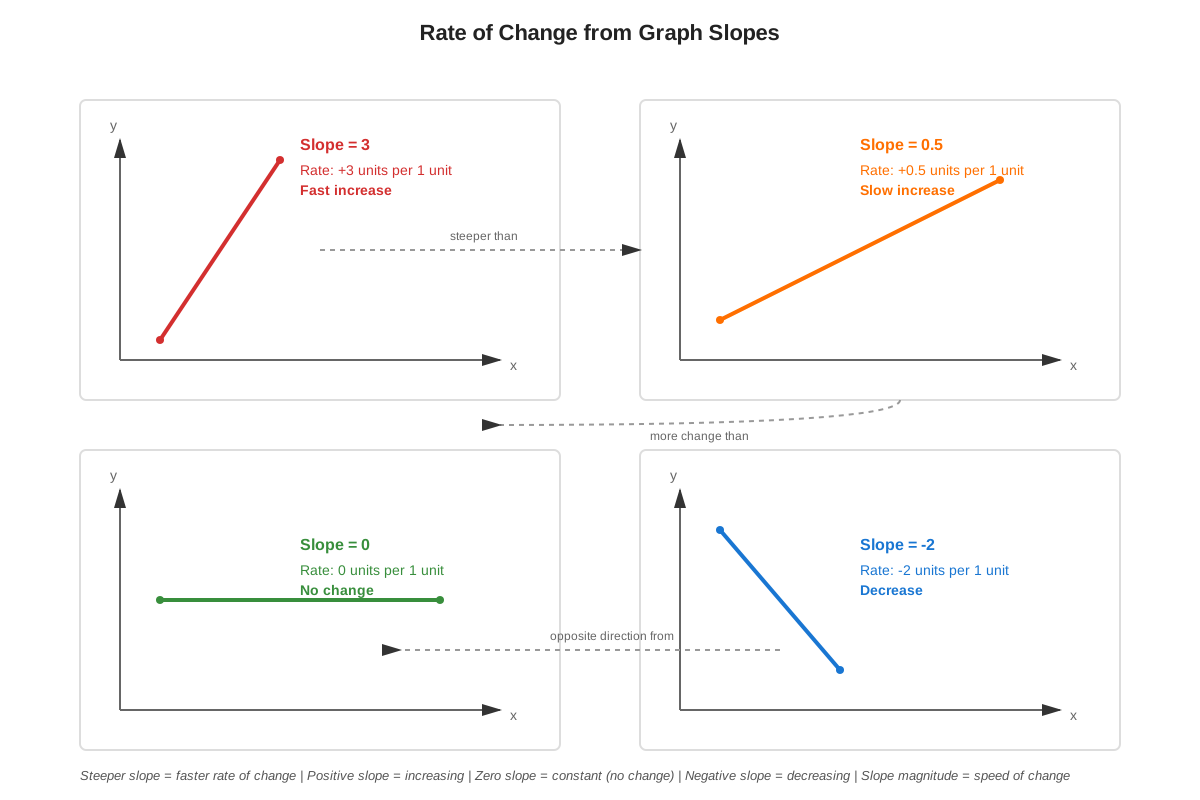
The rate of change of a function describes how quickly the y-values change relative to changes in x-values. Graphically, this is represented by the steepness of the graph. For linear functions, the rate of change is constant and equals the slope. For nonlinear functions, the rate of change varies across the domain.
The average rate of change over an interval [a, b] is calculated as:
Average Rate of Change = (f(b) - f(a)) / (b - a)This represents the slope of the secant line connecting the points (a, f(a)) and (b, f(b)). Graphically, a steeper line indicates a greater rate of change. Positive slopes indicate increasing functions, negative slopes indicate decreasing functions, and zero slope indicates constant functions.
On the SAT, students must often compare rates of change across different intervals or between different functions. A graph that is steeper over one interval has a greater rate of change than over a flatter interval. This concept connects directly to real-world interpretations: in a distance-time graph, steeper sections represent faster speeds; in a revenue graph, steeper sections represent faster growth.
Comparing Multiple Graphs
Many SAT questions present multiple graphs simultaneously and ask students to compare them or identify relationships. When comparing graphs, focus on:
| Comparison Feature | What to Look For |
|---|---|
| Intercepts | Which graph crosses axes at higher/lower values |
| Maximum/Minimum Values | Which function reaches greater extremes |
| Intervals of Increase/Decrease | Where each function rises or falls |
| Rate of Change | Which function changes more rapidly |
| Domain and Range | What x and y values each function covers |
| Symmetry | Whether functions are even, odd, or neither |
When graphs represent related quantities (like supply and demand, or two different investments), look for points of intersection, which often represent equilibrium points or moments when the two quantities are equal.
Translating Between Representations
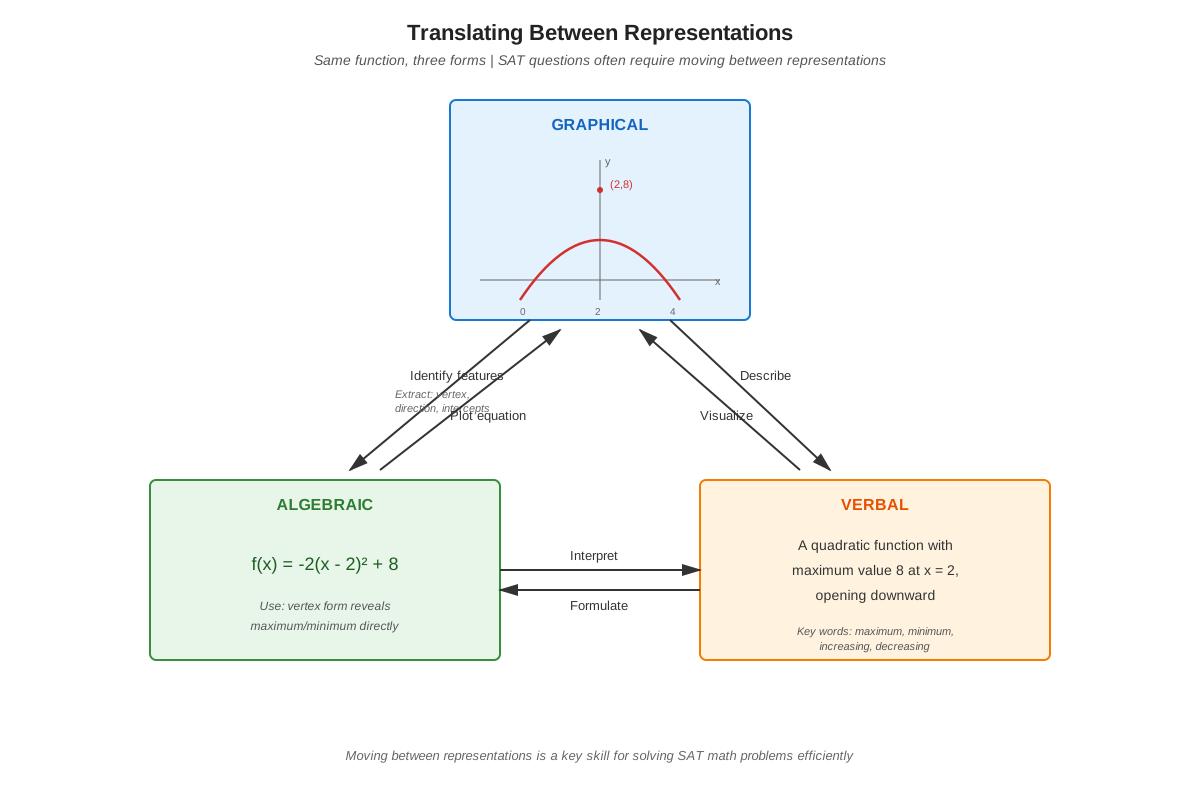
A crucial skill for SAT success is translating between different representations of the same relationship: graphical, algebraic (equations), numerical (tables), and verbal (word descriptions). Each representation highlights different features:
- Graphs make visual patterns, trends, and extrema immediately apparent
- Equations precisely define the relationship and enable exact calculations
- Tables show specific input-output pairs clearly
- Verbal descriptions connect mathematical relationships to real-world contexts
SAT questions frequently provide information in one representation and ask questions that require thinking in another. For example, a question might show a graph and ask which equation matches it, or provide an equation and ask about the graph's behavior. Success requires understanding that these are different views of the same underlying relationship.
Context and Units
SAT graph interpretation questions almost always include real-world contexts. Understanding what the axes represent is essential for correct interpretation. The x-axis typically represents the independent variable (time, quantity produced, distance traveled), while the y-axis represents the dependent variable (population, cost, temperature).
Pay careful attention to units. If the y-axis represents "Population (in thousands)" and you read a value of 50, the actual population is 50,000. If the x-axis represents "Time (in hours)" and you're asked about what happens after 30 minutes, you need to look at x = 0.5, not x = 30.
The context also determines the meaningful domain. A graph showing "number of items sold" should only be interpreted for non-negative x-values, and often only for whole numbers. A graph showing "height of a projectile over time" is only meaningful from launch until landing.
Concept Relationships
The concepts within graph interpretation form a hierarchical structure. Reading coordinates serves as the foundation—students cannot identify intercepts, maxima, or minima without first being able to accurately read points from a graph. This basic skill leads directly to identifying key features (intercepts, extrema, and critical points), which in turn enables students to describe intervals of increase and decrease.
Understanding intervals of increase and decrease connects to rate of change analysis. Recognizing where a function increases or decreases most rapidly requires comparing steepness across different intervals, which is fundamentally about comparing rates of change. This concept bridges to comparing multiple graphs, where students must analyze and contrast the behavior of different functions using all the previously developed skills.
All of these skills converge in translating between representations. To match a graph to an equation, students must identify key features from the graph (intercepts, shape, extrema) and recognize how these features appear in algebraic form. To answer questions about real-world contexts, students must combine graph reading skills with context and units interpretation, understanding both the mathematical and practical meaning of graphical features.
The relationship map flows as follows:
Coordinate Reading → Identifying Key Features → Analyzing Intervals → Rate of Change → Comparing Graphs → Translation Between Representations → Applied Problem Solving
These graph interpretation skills connect to prerequisite knowledge of the coordinate plane and linear functions while enabling progression to more advanced topics like function transformations, systems of equations (where graphs intersect), and calculus concepts (where rate of change becomes instantaneous rather than average).
High-Yield Facts
⭐ Intercepts are among the most frequently tested features: X-intercepts occur where y = 0, and y-intercepts occur where x = 0
⭐ Always check the scale of both axes before reading any values: SAT graphs frequently use scales other than 1 unit per gridline
⭐ A function increases on an interval when the graph goes upward from left to right: Intervals are always described using x-values, not y-values
⭐ The average rate of change over an interval equals the slope of the line connecting the endpoints: This is calculated as (change in y) / (change in x)
⭐ Maximum and minimum values occur at peaks and valleys of the graph: These are y-values, not x-values, though questions often ask for the x-value where they occur
- A steeper graph indicates a greater rate of change, whether positive or negative
- Points of intersection between two graphs represent x-values where the two functions have equal outputs
- The domain of a function is the set of all x-values for which the graph exists; the range is the set of all y-values
- Horizontal line segments indicate intervals where the function is constant (rate of change equals zero)
- When graphs represent real-world contexts, the units on each axis determine how to interpret numerical values
- Symmetry about the y-axis indicates an even function; symmetry about the origin indicates an odd function
- The y-intercept of a function f(x) equals f(0), which can be found algebraically by substituting x = 0
- Negative slopes indicate decreasing functions; positive slopes indicate increasing functions
- The highest or lowest point on a graph over a specific interval may occur at an endpoint rather than at a critical point
- When comparing rates of change, compare the steepness of the graphs over the same interval
Quick check — test yourself on Interpreting graphs so far.
Try Flashcards →Common Misconceptions
Misconception: The highest point on a graph is always the maximum value of the function.
Correction: The maximum value refers to the y-coordinate of the highest point, not the point itself. Additionally, a function may have a local maximum (highest in a region) that is not the global maximum (highest overall), or the maximum may occur at an endpoint of the domain rather than at a peak.
Misconception: If a graph is above the x-axis, the function is increasing.
Correction: Being above the x-axis means the function has positive values (y > 0), which is completely different from increasing. A function increases when y-values get larger as x-values increase, regardless of whether the function is positive or negative. A function can be positive and decreasing, or negative and increasing.
Misconception: The rate of change is the same as the y-value.
Correction: The rate of change describes how fast y is changing relative to x (the steepness), not the value of y itself. A function can have a large y-value but a small rate of change (nearly flat), or a small y-value but a large rate of change (very steep).
Misconception: When reading a graph, the scale is always 1 unit per gridline.
Correction: SAT graphs frequently use different scales on each axis, and these scales may be 2, 5, 10, or even fractional values per gridline. Always check the labeled values on the axes to determine the scale before reading any coordinates.
Misconception: The x-coordinate of the maximum point is the maximum value.
Correction: The maximum value of a function is the y-coordinate of the highest point, not the x-coordinate. The x-coordinate tells you where (at what input) the maximum occurs, while the y-coordinate tells you what the maximum value is.
Misconception: If two graphs intersect, they have the same equation.
Correction: Intersection points represent x-values where two different functions happen to have the same output value. The functions remain distinct; they simply share one or more points in common. At an intersection point (a, b), both functions equal b when x = a.
Misconception: A graph that looks flat has a rate of change of zero everywhere.
Correction: Visual appearance can be deceiving, especially when axes have different scales. A graph that appears nearly flat may actually have a small but non-zero rate of change. Always calculate the rate of change using actual coordinates rather than relying solely on visual assessment.
Worked Examples
Example 1: Analyzing Function Behavior from a Graph
Problem: The graph of function f is shown below. The graph passes through points (-3, 0), (0, 4), (2, 6), and (5, 0). For which of the following intervals is the function decreasing and positive?
A) -3 < x < 0
B) 0 < x < 2
C) 2 < x < 5
D) -3 < x < 5
Solution:
Step 1: Identify what "decreasing" means graphically.
A function is decreasing when the graph goes downward from left to right (as x increases, y decreases).
Step 2: Identify what "positive" means graphically.
A function is positive when the graph is above the x-axis (y > 0).
Step 3: Analyze each interval.
For interval A (-3 < x < 0):
- At x = -3, y = 0 (on the x-axis)
- At x = 0, y = 4 (above the x-axis)
- The graph goes upward from left to right, so the function is INCREASING, not decreasing
- Eliminate option A
For interval B (0 < x < 2):
- At x = 0, y = 4
- At x = 2, y = 6
- The graph goes upward from left to right, so the function is INCREASING, not decreasing
- Eliminate option B
For interval C (2 < x < 5):
- At x = 2, y = 6 (above the x-axis, so positive)
- At x = 5, y = 0 (on the x-axis)
- The graph goes downward from left to right, so the function is DECREASING
- Throughout most of this interval (from x = 2 until just before x = 5), the function is above the x-axis, so it is POSITIVE
- This interval satisfies both conditions
For interval D (-3 < x < 5):
- This is the entire domain shown
- The function is not decreasing over this entire interval (it increases from -3 to 2)
- Eliminate option D
Answer: C
This problem addresses the learning objective of identifying key features and applying graph interpretation to SAT-style questions. The key insight is that both conditions (decreasing AND positive) must be satisfied simultaneously throughout the interval.
Example 2: Comparing Rates of Change
Problem: The graph shows the distance traveled by two cars, Car A and Car B, over a 4-hour period. During which interval is Car A traveling faster than Car B?
[Graph description: Car A's distance increases from (0,0) to (2, 100) to (4, 150). Car B's distance increases from (0, 0) to (2, 60) to (4, 200).]
A) 0 < t < 2 only
B) 2 < t < 4 only
C) Both intervals
D) Neither interval
Solution:
Step 1: Understand what "traveling faster" means graphically.
Speed is the rate of change of distance with respect to time. Graphically, this is represented by the slope (steepness) of the distance-time graph. A steeper graph indicates faster travel.
Step 2: Calculate the rate of change for Car A in the first interval (0 to 2 hours).
Rate of change = (100 - 0) / (2 - 0) = 100/2 = 50 miles per hour
Step 3: Calculate the rate of change for Car B in the first interval (0 to 2 hours).
Rate of change = (60 - 0) / (2 - 0) = 60/2 = 30 miles per hour
Step 4: Compare the rates in the first interval.
Car A: 50 mph
Car B: 30 mph
Car A is traveling faster during 0 < t < 2.
Step 5: Calculate the rate of change for Car A in the second interval (2 to 4 hours).
Rate of change = (150 - 100) / (4 - 2) = 50/2 = 25 miles per hour
Step 6: Calculate the rate of change for Car B in the second interval (2 to 4 hours).
Rate of change = (200 - 60) / (4 - 2) = 140/2 = 70 miles per hour
Step 7: Compare the rates in the second interval.
Car A: 25 mph
Car B: 70 mph
Car B is traveling faster during 2 < t < 4.
Step 8: Determine the answer.
Car A is traveling faster than Car B only during the first interval (0 < t < 2).
Answer: A
This problem demonstrates the application of rate of change concepts to a real-world context. The key insight is that rate of change must be calculated for each interval separately, and "faster" means greater rate of change (steeper slope), not greater distance traveled. This addresses the learning objectives of applying graph interpretation to SAT-style questions and determining rates of change from graphical representations.
Exam Strategy
When approaching SAT graph interpretation questions, begin by investing 10-15 seconds in understanding the graph before reading the question. Identify what each axis represents, check the scale on both axes, and note any key features (intercepts, maxima, minima, intersections). This upfront investment prevents errors caused by misreading scales or misunderstanding what the graph represents.
Trigger words and phrases that indicate graph interpretation questions include:
- "According to the graph..."
- "Which of the following intervals..."
- "At what value of x does..."
- "The maximum/minimum value..."
- "The graph of function f is shown..."
- "For how many values of x..."
- "The rate of change..."
- "Increasing/decreasing"
When you see these phrases, immediately focus on the visual information and prepare to extract specific features.
For process of elimination, use these strategies:
- If a question asks about an interval, eliminate any answer choice that includes x-values outside the visible domain of the graph
- If asked about maximum or minimum values, eliminate choices that confuse x-coordinates with y-coordinates
- For rate of change questions, eliminate choices that would require the graph to be steeper or flatter than it actually appears
- When matching graphs to equations, eliminate choices that have the wrong number of intercepts or the wrong general shape
Time allocation for graph interpretation questions should be approximately 45-60 seconds for straightforward "read the graph" questions and 90-120 seconds for questions requiring calculations or comparisons. If a question requires reading multiple values and performing calculations, don't rush—accuracy is more important than speed, and these questions are often worth the same as simpler ones.
A powerful strategy is to mark key points directly on the graph (if testing on paper) or visualize them clearly (if testing digitally). Circle intercepts, draw horizontal lines at maxima and minima, and mark points mentioned in the question. This visual organization prevents errors and makes patterns more apparent.
For questions involving real-world contexts, always translate the mathematical answer back to the context before selecting your answer. If you calculate that the maximum occurs at x = 3, and the x-axis represents "time in hours," make sure the question is asking for the time (3 hours) rather than the maximum value itself (the y-coordinate at x = 3).
Memory Techniques
RISE - Remember the direction of Increasing functions:
- Right
- Increasing
- Slope
- Elevates (goes up from left to right)
MAX-Y, MIN-Y - When asked for maximum or minimum values:
- MAX-Y: The maximum is the Y-coordinate of the highest point
- MIN-Y: The minimum is the Y-coordinate of the lowest point
(This prevents the common error of giving the x-coordinate instead)
SCALE CHECK - Before reading any graph, check:
- Scale on x-axis
- Count the units
- Axis labels
- Look for key points
- Examine the context
ROC = SLOPE - For rate of change:
- Rate
- Of
- Change equals the SLOPE of the line connecting two points
ZIP - For finding intercepts:
- Zero the Input for y-intercept (set x = 0)
- Zero the Product for x-intercept (set y = 0)
Visualize graphs as stories told from left to right: As you move from left to right (increasing x), the graph tells you what happens to the y-value. An upward story means increasing, a downward story means decreasing, and a flat story means constant. This narrative approach helps students remember that we always read graphs in the left-to-right direction.
Summary
Interpreting graphs is a foundational skill for SAT math success, appearing in 15-20% of questions across multiple contexts and question types. Mastery requires the ability to accurately read coordinates while paying careful attention to axis scales, identify key features including intercepts, maxima, minima, and critical points, and analyze function behavior over intervals by determining where functions increase, decrease, or remain constant. Students must understand that rate of change is represented graphically by steepness and can be calculated as the slope between two points. Success on SAT graph interpretation questions demands the ability to translate between graphical, algebraic, and verbal representations of relationships while maintaining awareness of real-world contexts and units. The most common errors involve misreading scales, confusing x-coordinates with y-coordinates when identifying extrema, and misunderstanding the difference between positive values and increasing behavior. Students who systematically check scales, mark key points, and translate mathematical findings back to the given context will consistently answer these high-yield questions correctly.
Key Takeaways
- Always check the scale on both axes before reading any coordinates or making comparisons—SAT graphs frequently use scales other than 1 unit per gridline
- Maximum and minimum values refer to y-coordinates (outputs), not x-coordinates, though questions may ask where (at what x-value) these extrema occur
- A function increases when the graph goes upward from left to right; being above the x-axis (positive) is completely different from increasing
- Rate of change is represented by steepness (slope) and is calculated as (change in y) / (change in x) between two points
- Intercepts are among the most frequently tested features: x-intercepts occur where y = 0, and y-intercepts occur where x = 0
- When comparing multiple graphs or analyzing intervals, focus on specific features (intercepts, extrema, steepness) rather than overall appearance
- Context matters—always understand what the axes represent and translate mathematical answers back to the real-world situation before selecting an answer
Related Topics
Function Transformations: Understanding how graphs shift, stretch, compress, and reflect builds directly on graph interpretation skills. Once students can identify key features of a base graph, they can predict how transformations will affect those features.
Systems of Equations: Graphical solutions to systems involve finding intersection points of multiple graphs, requiring all the graph interpretation skills developed in this topic plus the ability to analyze relationships between functions.
Quadratic Functions and Parabolas: These nonlinear functions require specialized graph interpretation skills, including identifying vertices (which are extrema), axes of symmetry, and understanding how the coefficient of x² affects the graph's shape and direction.
Exponential and Logarithmic Functions: These functions exhibit distinctive graphical behavior (rapid growth/decay, asymptotes) that requires advanced graph interpretation skills to analyze and compare.
Data Analysis and Statistics: Interpreting scatter plots, histograms, and other statistical graphs extends the core graph interpretation skills to data contexts, adding concepts like correlation, distribution, and outliers.
Practice CTA
Now that you've mastered the core concepts of interpreting graphs, it's time to put your knowledge into action! The practice questions and flashcards are specifically designed to reinforce the high-yield concepts covered in this guide and mirror the format and difficulty of actual SAT questions. Each practice problem provides an opportunity to apply the strategies you've learned, build speed and accuracy, and identify any remaining areas for improvement. Remember, graph interpretation is a skill that improves dramatically with deliberate practice—students who work through multiple practice problems consistently outperform those who only study theory. Challenge yourself to work through the practice set, time yourself to build test-day stamina, and review any mistakes carefully to understand where your reasoning went astray. You've built a strong foundation; now strengthen it through application!
Sign up free to keep reading
Create a free AnvayaPrep account to finish this SAT guide on Interpreting graphs — plus flashcards and practice questions.