Overview
Maximum and minimum values represent the highest and lowest points that a function can reach, and understanding these concepts is fundamental to success on the SAT math section. These critical points appear in various contexts throughout the exam, from analyzing parabolas and quadratic functions to interpreting real-world scenarios involving optimization problems. The ability to identify, calculate, and interpret maximum and minimum values is not merely an isolated skill—it connects deeply to understanding function behavior, graph interpretation, and practical problem-solving.
On the SAT, sat maximum and minimum questions frequently appear in both the calculator and no-calculator sections, often integrated within word problems, function analysis tasks, and data interpretation scenarios. Students encounter these concepts when working with quadratic functions, absolute value functions, and even piecewise functions. The exam tests not only computational ability but also conceptual understanding: recognizing where extrema occur, explaining what they represent in context, and using them to make informed decisions about function behavior.
Mastery of maximum and minimum concepts provides a foundation for understanding broader mathematical ideas including function transformations, domain and range restrictions, and optimization in real-world contexts. This topic bridges algebraic manipulation with graphical interpretation, requiring students to move fluidly between different representations of functions. The SAT particularly emphasizes the practical applications of these concepts, asking students to determine optimal values in scenarios ranging from business profit models to geometric area problems.
Learning Objectives
- [ ] Identify key features of maximum and minimum values in functions
- [ ] Explain how maximum and minimum concepts appear on the SAT
- [ ] Apply maximum and minimum principles to answer SAT-style questions
- [ ] Determine maximum and minimum values from graphs, tables, and equations
- [ ] Distinguish between local and absolute extrema in various function types
- [ ] Interpret the meaning of maximum and minimum values in real-world contexts
- [ ] Use vertex form and completing the square to find extrema of quadratic functions
Prerequisites
- Quadratic functions and parabolas: Understanding the basic shape and properties of quadratic functions is essential since these functions always have either a maximum or minimum value at their vertex
- Function notation and evaluation: The ability to substitute values and evaluate functions is necessary for testing potential maximum or minimum points
- Coordinate plane and graphing: Reading and interpreting graphs allows students to visually identify where maximum and minimum values occur
- Basic algebraic manipulation: Solving equations and manipulating expressions enables students to find exact coordinates of extrema
- Domain and range concepts: Understanding the set of possible input and output values helps determine where extrema can exist
Why This Topic Matters
Maximum and minimum concepts have profound real-world applications that extend far beyond the classroom. Businesses use these principles to maximize profit and minimize costs, engineers apply them to optimize designs and minimize material usage, and scientists employ them to find optimal conditions in experiments. Understanding extrema helps in making informed decisions about resource allocation, efficiency improvements, and strategic planning across virtually every quantitative field.
On the SAT, maximum and minimum questions appear with high frequency, typically showing up in 3-5 questions per exam. These questions span multiple formats: some present graphs requiring visual identification of extrema, others provide equations demanding algebraic manipulation to find vertex coordinates, and still others embed optimization within word problems requiring translation from context to mathematical model. The College Board particularly favors questions that combine multiple skills, such as interpreting a quadratic model in context and then determining what the maximum or minimum value represents practically.
Common SAT question types include: identifying the vertex of a parabola from its equation; determining whether a quadratic function has a maximum or minimum based on its leading coefficient; finding the optimal value in a real-world scenario modeled by a quadratic function; reading maximum or minimum values from graphs or tables; and comparing extrema across different function representations. The exam also tests whether students understand that maximum and minimum values refer to the output (y-value) of the function, not the input where it occurs.
Core Concepts
Understanding Maximum and Minimum Values
A maximum value of a function is the greatest output value (y-coordinate) that the function achieves, while a minimum value is the smallest output value. These are also called extrema (singular: extremum). It's crucial to distinguish between the location where an extremum occurs (the x-coordinate) and the extremum itself (the y-coordinate). For example, if a function has a maximum at the point (3, 7), the maximum value is 7, and it occurs when x = 3.
Absolute vs. Local Extrema
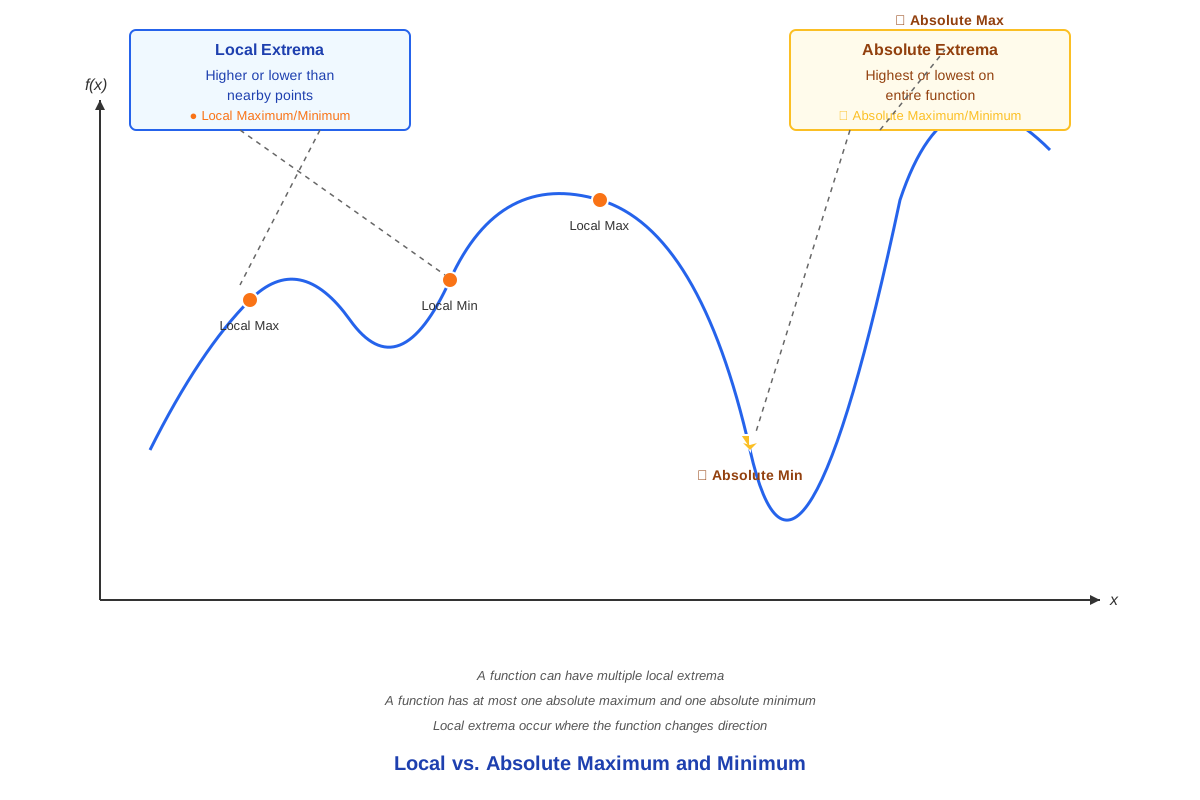
Absolute extrema (also called global extrema) are the highest or lowest values across the entire domain of a function. A function can have at most one absolute maximum and one absolute minimum. Local extrema (also called relative extrema) are the highest or lowest values within a specific neighborhood or interval. A function might have multiple local maxima or minima. On the SAT, most questions focus on absolute extrema, particularly for quadratic functions which have exactly one absolute extremum at their vertex.
Maximum and Minimum in Quadratic Functions
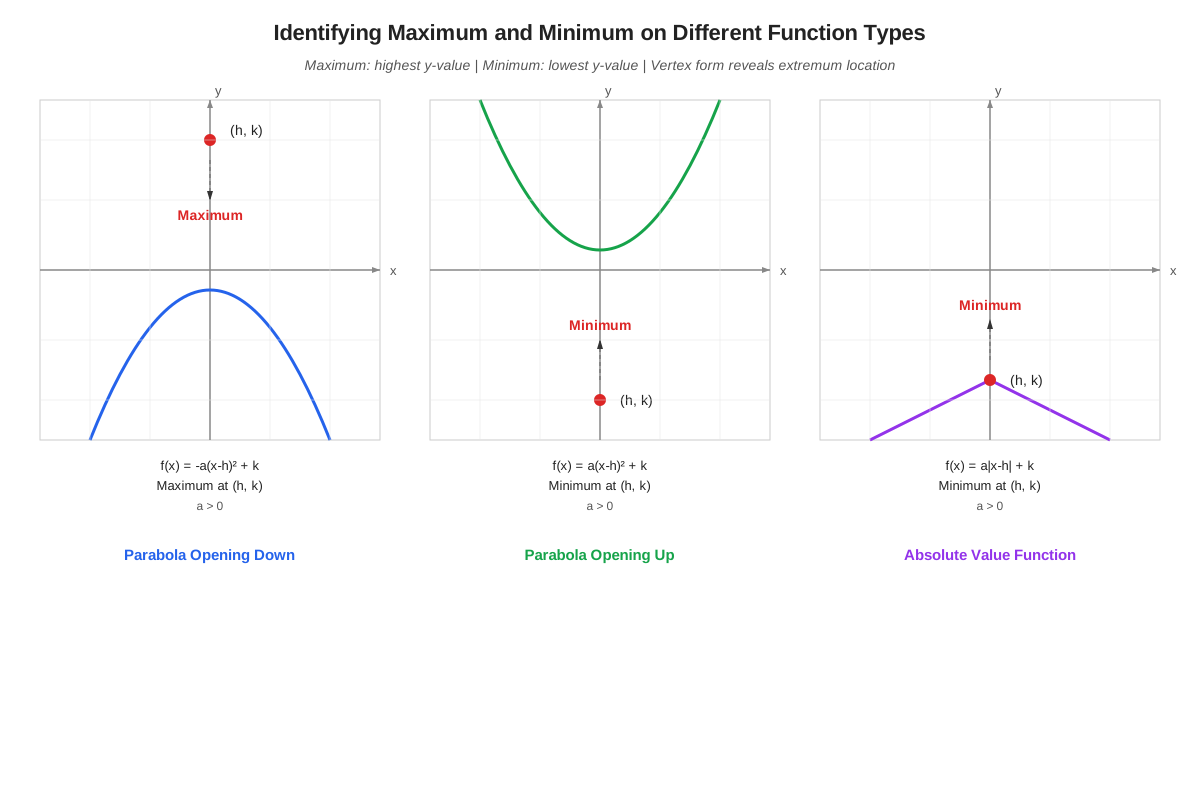
Quadratic functions in the form f(x) = ax² + bx + c always have either a maximum or minimum at their vertex. The sign of the leading coefficient a determines which type:
| Leading Coefficient | Parabola Opens | Vertex Contains |
|---|---|---|
| a > 0 (positive) | Upward | Minimum value |
| a < 0 (negative) | Downward | Maximum value |
The vertex represents the turning point of the parabola, and its y-coordinate gives the extremum value. This is one of the most tested concepts on the SAT.
Finding Extrema: Vertex Form
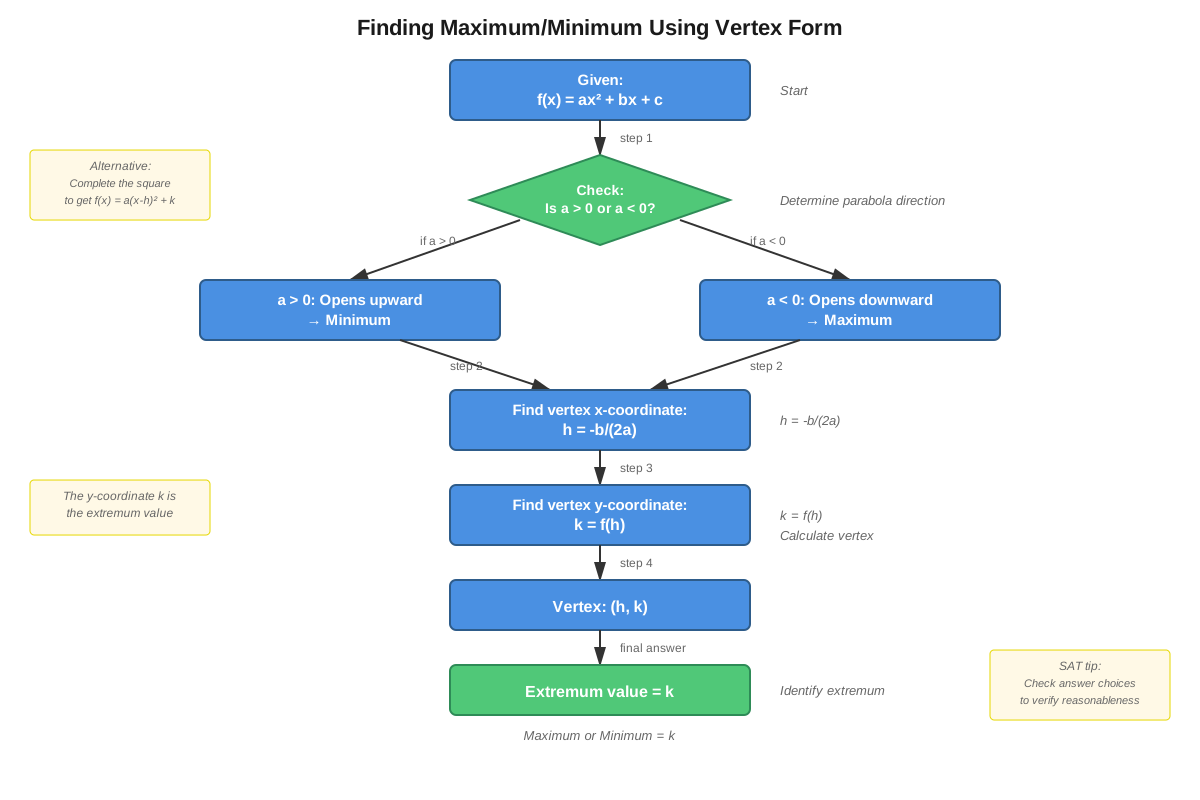
The vertex form of a quadratic function is f(x) = a(x - h)² + k, where (h, k) represents the vertex coordinates. In this form, the extremum value is immediately visible as k. If a > 0, then k is the minimum value; if a < 0, then k is the maximum value. This form is particularly useful on the SAT because it allows instant identification of extrema without additional calculation.
Finding Extrema: Standard Form
When a quadratic is given in standard form f(x) = ax² + bx + c, the x-coordinate of the vertex can be found using the formula:
x = -b/(2a)After finding this x-coordinate, substitute it back into the original function to find the y-coordinate, which is the maximum or minimum value. This two-step process is essential for SAT questions that provide quadratics in standard form.
Finding Extrema: Completing the Square
Completing the square transforms a quadratic from standard form to vertex form, revealing the extremum. The process involves:
- Factor out the leading coefficient from the x² and x terms
- Take half of the coefficient of x, square it, and add/subtract inside the parentheses
- Simplify to vertex form
This method is particularly valuable when the vertex formula isn't easily applicable or when the SAT question requires showing work algebraically.
Extrema from Graphs and Tables
The SAT frequently presents functions graphically or in table form. From a graph, the maximum is the highest point on the curve (greatest y-value) and the minimum is the lowest point (smallest y-value). Look for turning points, endpoints, or peaks and valleys. From a table, scan all y-values to identify the largest and smallest. Be cautious: the extremum might occur between table values if the function is continuous, though SAT questions typically design tables to include extrema.
Domain Restrictions and Extrema
When a function has a restricted domain, extrema might occur at the boundaries rather than at interior turning points. For example, if f(x) = x² is restricted to the domain [2, 5], the minimum occurs at x = 2 (the left endpoint) rather than at the vertex x = 0 (which is outside the domain). Always check whether domain restrictions affect where extrema can occur.
Interpreting Extrema in Context
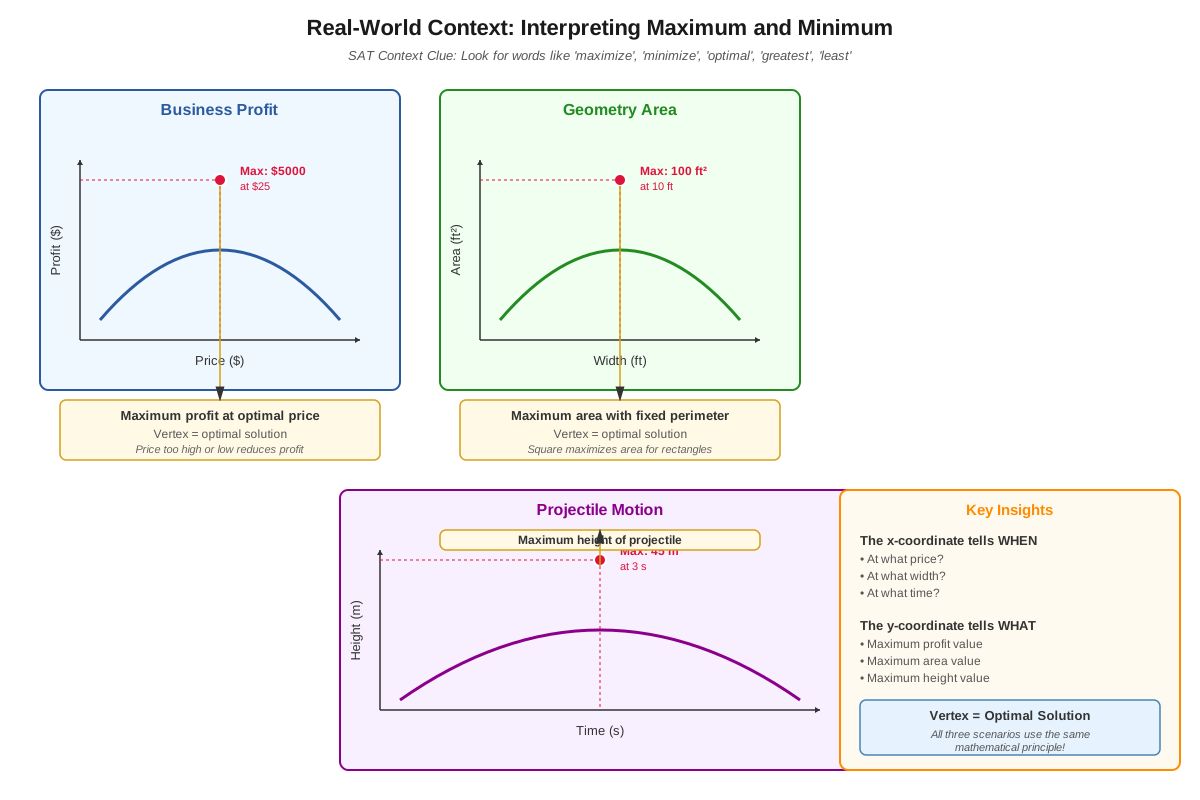
SAT word problems require translating mathematical extrema into real-world meaning. If a function models profit P(x) where x represents units sold, the maximum value of P represents the greatest possible profit, and the x-value where it occurs represents the optimal number of units to sell. Always read carefully to determine what the variables represent and what the question asks for—the extremum value itself or the input where it occurs.
Concept Relationships
The concepts within maximum and minimum form a logical progression: understanding what extrema are → recognizing how parabola orientation determines extremum type → learning methods to find extrema algebraically → applying these methods to real-world contexts. The relationship flows as: Definition of extrema → Connection to quadratic function properties → Algebraic techniques (vertex form, vertex formula, completing the square) → Graphical and tabular interpretation → Contextual application.
Maximum and minimum concepts connect directly to prerequisite knowledge of quadratic functions, as parabolas are the primary function type with guaranteed extrema on the SAT. The vertex of a parabola, previously studied as a geometric feature, now gains functional significance as the location of the extremum. Domain and range knowledge connects because the extremum value helps define the range of a function—for a parabola opening upward with minimum k, the range is [k, ∞).
These concepts also relate forward to more advanced topics: understanding extrema prepares students for calculus concepts of optimization, connects to systems of equations when finding intersection points that might represent maxima or minima in combined scenarios, and links to data analysis when interpreting the highest or lowest values in datasets. The relationship map: Quadratic functions → Vertex identification → Maximum/minimum determination → Optimization applications → Real-world problem solving.
Quick check — test yourself on Maximum and minimum so far.
Try Flashcards →High-Yield Facts
- ⭐ For a quadratic function f(x) = ax² + bx + c, if a > 0 the function has a minimum; if a < 0 it has a maximum
- ⭐ The maximum or minimum value is the y-coordinate of the vertex, not the x-coordinate
- ⭐ In vertex form f(x) = a(x - h)² + k, the extremum value is k
- ⭐ The x-coordinate of the vertex in standard form is found using x = -b/(2a)
- ⭐ A parabola has exactly one maximum or one minimum, never both
- The vertex represents the turning point where the function changes from increasing to decreasing (or vice versa)
- For restricted domains, extrema may occur at boundary points rather than at the vertex
- In word problems, the maximum or minimum often represents an optimal value (maximum profit, minimum cost, etc.)
- When comparing function values in a table, the extremum is the largest or smallest y-value shown
- The axis of symmetry of a parabola passes through the vertex where the extremum occurs
- A quadratic function's range is determined by its extremum: [k, ∞) for minimum k or (-∞, k] for maximum k
- The discriminant b² - 4ac doesn't directly give extrema but can confirm a quadratic has real solutions
- Absolute value functions have a minimum at their vertex but no maximum (they extend to infinity)
- In real-world contexts, the units of the extremum match the units of the output variable
Common Misconceptions
Misconception: The maximum or minimum is the x-coordinate of the vertex.
Correction: The maximum or minimum is the y-coordinate of the vertex. The x-coordinate tells you where the extremum occurs, but the extremum itself is the output value.
Misconception: All functions have both a maximum and a minimum.
Correction: Many functions have neither (like linear functions that extend infinitely in both directions) or only one (like parabolas that have either a maximum or minimum but not both). Only functions on restricted domains or certain bounded functions have both.
Misconception: If a > 0, the vertex is at a maximum.
Correction: If a > 0, the parabola opens upward, so the vertex is at a minimum. The parabola extends upward infinitely, so there's no maximum. If a < 0, the parabola opens downward and has a maximum at the vertex.
Misconception: The vertex formula x = -b/(2a) gives the maximum or minimum value.
Correction: This formula gives the x-coordinate where the extremum occurs. You must substitute this x-value back into the original function to find the actual maximum or minimum value (the y-coordinate).
Misconception: In vertex form f(x) = a(x - h)² + k, the extremum is h.
Correction: The extremum value is k, not h. The point (h, k) is the vertex, where h is the x-coordinate (location) and k is the y-coordinate (the actual extremum value).
Misconception: A function can have multiple absolute maxima or minima.
Correction: A function can have at most one absolute maximum and one absolute minimum. However, it can have multiple local maxima or minima. For SAT purposes, focus on absolute extrema, especially for quadratic functions.
Misconception: Completing the square changes the function.
Correction: Completing the square is an algebraic manipulation that rewrites the function in a different form but doesn't change the function itself or its graph. It's simply a different way of expressing the same relationship.
Worked Examples
Example 1: Finding Maximum from Standard Form
Problem: A ball is thrown upward, and its height h in feet after t seconds is modeled by h(t) = -16t² + 48t + 4. What is the maximum height the ball reaches?
Solution:
Step 1: Identify that this is a quadratic function with a = -16, b = 48, and c = 4.
Step 2: Since a = -16 < 0, the parabola opens downward, confirming the function has a maximum.
Step 3: Find the t-coordinate of the vertex using the formula:
t = -b/(2a) = -48/(2(-16)) = -48/(-32) = 1.5Step 4: The maximum occurs at t = 1.5 seconds. Now substitute this back into the original function to find the maximum height:
h(1.5) = -16(1.5)² + 48(1.5) + 4
h(1.5) = -16(2.25) + 72 + 4
h(1.5) = -36 + 72 + 4
h(1.5) = 40Answer: The maximum height is 40 feet.
Connection to Learning Objectives: This example demonstrates applying maximum concepts to SAT-style questions and interpreting extrema in real-world contexts (projectile motion).
Example 2: Comparing Extrema Across Representations
Problem: Function f is defined by f(x) = 2(x - 3)² - 8. Function g is shown in the table below. Which function has the greater minimum value?
| x | g(x) |
|---|---|
| 0 | -5 |
| 1 | -7 |
| 2 | -8 |
| 3 | -7 |
| 4 | -5 |
Solution:
Step 1: Analyze function f. It's in vertex form f(x) = a(x - h)² + k with a = 2, h = 3, and k = -8.
Step 2: Since a = 2 > 0, the parabola opens upward and has a minimum at the vertex.
Step 3: The minimum value of f is k = -8 (the y-coordinate of the vertex).
Step 4: Analyze function g from the table. Scan all g(x) values: -5, -7, -8, -7, -5.
Step 5: The smallest value in the table is -8, which appears at x = 2.
Step 6: Assuming the table shows the minimum (typical for SAT questions), the minimum value of g is -8.
Step 7: Compare: Both functions have a minimum value of -8.
Answer: Both functions have the same minimum value of -8.
Connection to Learning Objectives: This example demonstrates identifying extrema from different representations (vertex form and table) and comparing maximum and minimum values across functions.
Exam Strategy
When approaching sat maximum and minimum questions, first identify what form the function is presented in. If it's in vertex form, immediately extract the extremum value (k). If it's in standard form, decide whether to use the vertex formula or complete the square based on the numbers involved—use the formula for straightforward coefficients, complete the square when the question seems to expect algebraic work.
Trigger words to watch for include: "maximum," "minimum," "greatest," "smallest," "highest," "lowest," "optimal," "peak," "vertex," and "turning point." In word problems, phrases like "maximize profit," "minimize cost," "greatest height," or "least amount" signal extremum questions. Also watch for "what value of x" versus "what is the maximum/minimum"—these ask for different parts of the vertex.
For process of elimination, immediately eliminate answer choices that confuse x and y coordinates. If a question asks for the maximum value and you've determined the vertex is at (3, 7), eliminate any answer choice of 3. Also eliminate choices that give the wrong type of extremum—if the parabola opens upward (a > 0), eliminate any answer suggesting a maximum exists. Check whether answer choices are in the correct units based on the context.
Time allocation: Simple vertex form questions should take 30-45 seconds. Standard form questions requiring the vertex formula need 60-90 seconds. Word problems with context interpretation may require 90-120 seconds. If a question requires completing the square and you're uncomfortable with the process, consider whether the vertex formula or testing answer choices might be faster approaches.
Exam Tip: Always verify whether the question asks for the extremum value itself or the input where it occurs. This is the most common source of errors on maximum and minimum questions.
Memory Techniques
Mnemonic for parabola orientation: "Positive Points Up" — when a is positive, the parabola points upward and has a minimum. Conversely, when a is negative, the parabola opens downward and has a maximum.
Vertex form memory aid: Think of vertex form as "a(x - h)² + k" where h is horizontal (x-coordinate) and k is the key value (the extremum). The letter k comes after h in the alphabet, just as you find k (the extremum) after identifying h (the location).
Vertex formula visualization: Remember x = -b/(2a) by visualizing a fraction with "bottom" (denominator) containing 2a and "b" on top (numerator). The negative sign reminds you that the vertex is often shifted from the origin.
Maximum vs. Minimum: Create a visual: draw a U shape for "Upward = Under = minimum at bottom" and an upside-down U (∩) for "Downward = Down = maximum at top."
Y-coordinate reminder: "Y ask for the extremum? Because it's the Y-coordinate!" This helps remember that maximum and minimum values are y-coordinates, not x-coordinates.
Summary
Maximum and minimum values represent the extreme output values of functions, with maximum being the greatest y-value and minimum being the smallest. For quadratic functions—the primary focus on the SAT—exactly one extremum exists at the vertex, with the type determined by the leading coefficient: positive coefficients create upward-opening parabolas with minima, while negative coefficients create downward-opening parabolas with maxima. Students must master multiple methods for finding extrema: recognizing them immediately in vertex form f(x) = a(x - h)² + k where the extremum is k, calculating them from standard form using x = -b/(2a) to find the vertex location then substituting to find the value, and identifying them from graphs and tables. Critical to success is distinguishing between the location where an extremum occurs (x-coordinate) and the extremum value itself (y-coordinate), as SAT questions deliberately test this distinction. Real-world applications require interpreting extrema in context, understanding that maximum and minimum values often represent optimal solutions in practical scenarios.
Key Takeaways
- The maximum or minimum value is always the y-coordinate of the vertex, not the x-coordinate
- For f(x) = ax² + bx + c: if a > 0, there's a minimum; if a < 0, there's a maximum
- In vertex form f(x) = a(x - h)² + k, the extremum value is immediately visible as k
- Use the formula x = -b/(2a) to find where the extremum occurs in standard form, then substitute to find the value
- A quadratic function has exactly one extremum—either a maximum or a minimum, never both
- Always check what the question asks for: the extremum value, the location where it occurs, or the interpretation in context
- Domain restrictions can cause extrema to occur at boundary points rather than at the vertex
Related Topics
Function Transformations: Understanding how vertical and horizontal shifts affect the location and value of extrema builds directly on maximum and minimum concepts, showing how transformations move the vertex and change extremum values.
Systems of Equations: Finding intersection points of functions sometimes involves identifying where one function reaches a maximum or minimum relative to another, combining extrema concepts with solving systems.
Quadratic Inequalities: Determining when a quadratic function is above or below a certain value requires understanding where the maximum or minimum occurs and how the function behaves relative to that extremum.
Polynomial Functions: While quadratics have one extremum, higher-degree polynomials can have multiple local maxima and minima, extending these concepts to more complex functions.
Calculus Preview - Optimization: Maximum and minimum concepts form the foundation for calculus-based optimization, where derivatives are used to find extrema of more complex functions in real-world applications.
Practice CTA
Now that you've mastered the core concepts of maximum and minimum values, it's time to solidify your understanding through practice. Work through the practice questions to test your ability to identify extrema in various forms, apply the vertex formula accurately, and interpret maximum and minimum values in real-world contexts. Use the flashcards to reinforce key formulas and concepts until they become automatic. Remember: the SAT rewards both conceptual understanding and computational accuracy, so practice both identifying what questions ask for and executing the calculations correctly. You've built a strong foundation—now strengthen it through deliberate practice!
Sign up free to keep reading
Create a free AnvayaPrep account to finish this SAT guide on Maximum and minimum — plus flashcards and practice questions.