Overview
Model selection is a critical skill tested on the SAT Math section that requires students to analyze data patterns and choose the most appropriate mathematical function to represent a real-world situation. This topic bridges algebraic understanding with data interpretation, asking students to determine whether a linear, quadratic, exponential, or other type of function best fits a given scenario or dataset. The ability to select the correct model is fundamental to solving complex word problems and interpreting graphical information accurately.
On the SAT, sat model selection questions typically present students with a table of values, a scatter plot, a verbal description of a situation, or a combination of these elements. Students must then identify which type of function—linear, quadratic, exponential, or occasionally polynomial—best represents the relationship between variables. These questions assess not just computational ability but also conceptual understanding of how different functions behave and what real-world phenomena they model effectively.
This topic is essential because it appears frequently throughout the math section and connects directly to functions, data analysis, and problem-solving in context. Model selection questions often carry significant point value and require integration of multiple mathematical concepts including rate of change, growth patterns, and function behavior. Mastering this skill enables students to tackle advanced problems involving predictions, extrapolations, and real-world applications that form the backbone of SAT's Problem Solving and Data Analysis domain as well as the Passport to Advanced Math domain.
Learning Objectives
- [ ] Identify key features of model selection
- [ ] Explain how model selection appears on the SAT
- [ ] Apply model selection to answer SAT-style questions
- [ ] Distinguish between linear, quadratic, and exponential models based on data patterns
- [ ] Analyze rate of change to determine appropriate function types
- [ ] Evaluate the reasonableness of a selected model in context
- [ ] Interpret graphical representations to select appropriate mathematical models
Prerequisites
- Linear functions and slope: Understanding constant rate of change is essential for recognizing when linear models are appropriate versus when nonlinear models are needed
- Quadratic functions and parabolas: Knowledge of quadratic behavior (vertex, symmetry, second differences) enables identification of quadratic models
- Exponential functions: Familiarity with exponential growth and decay patterns is necessary to distinguish these models from polynomial functions
- Function notation and evaluation: The ability to work with f(x) notation and substitute values is required for testing and verifying models
- Basic data interpretation: Reading tables, scatter plots, and graphs forms the foundation for analyzing which model fits data
Why This Topic Matters
Model selection represents one of the most practical applications of mathematics in real-world contexts. Scientists use model selection to predict population growth, economists apply it to forecast market trends, engineers employ it to design structures, and medical researchers utilize it to understand disease progression. The ability to recognize patterns in data and select appropriate mathematical representations is a fundamental skill across STEM fields and data-driven decision-making in business and policy.
On the SAT, model selection questions appear with high frequency, typically comprising 3-5 questions per test administration. These questions appear in both the calculator and no-calculator sections, often as medium to hard difficulty problems worth significant points. According to College Board data, approximately 15-20% of SAT Math questions involve some aspect of function modeling or model selection, making it one of the highest-yield topics for focused study.
Model selection commonly appears in several formats on the exam: tables showing x and y values where students must identify the function type; word problems describing real-world scenarios requiring students to choose the appropriate model; scatter plots with questions about which function best fits the data; and comparison questions asking students to distinguish between multiple potential models. Questions may also ask students to use a selected model to make predictions or to explain why one model is more appropriate than another in a given context.
Core Concepts
Understanding Different Function Types
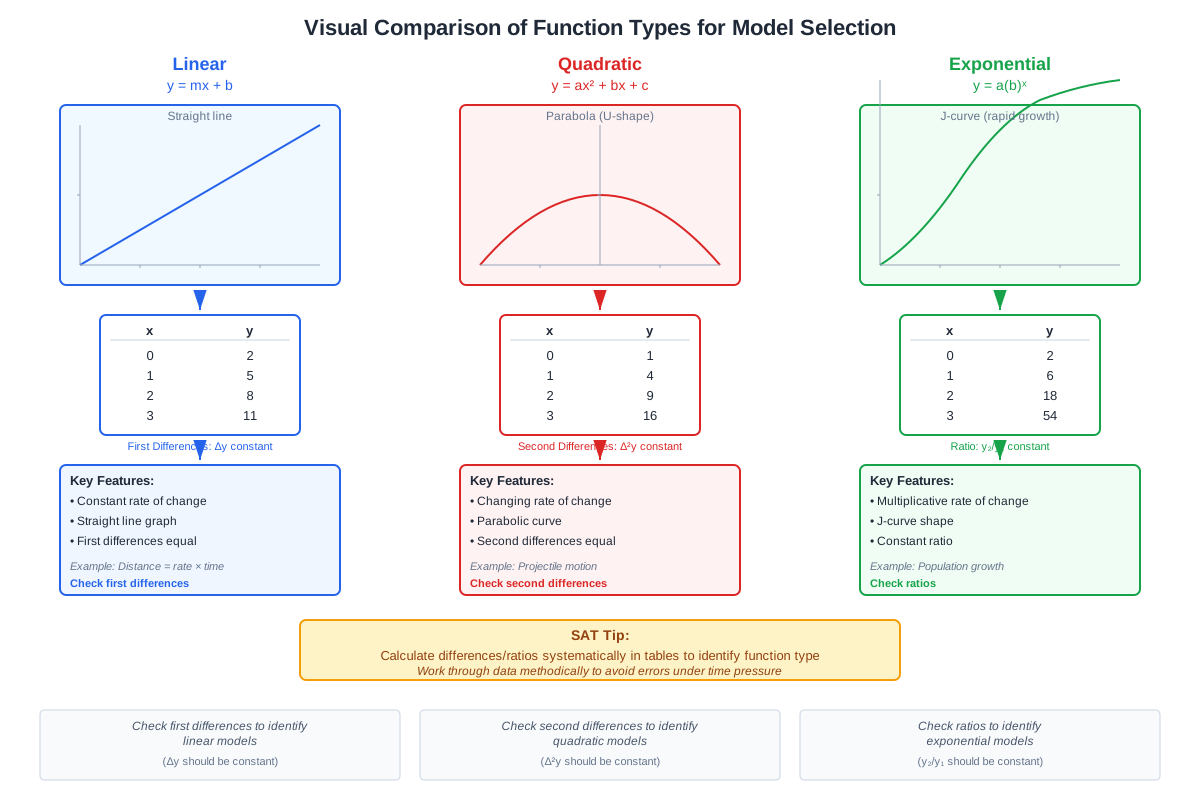
The foundation of model selection lies in recognizing the distinctive characteristics of different function families. Linear models represent situations with constant rate of change, where the dependent variable increases or decreases by the same amount for each unit increase in the independent variable. These models take the form f(x) = mx + b, where m represents the constant rate of change (slope) and b represents the initial value (y-intercept). Linear models are appropriate for situations involving steady growth, constant speed, or fixed pricing structures.
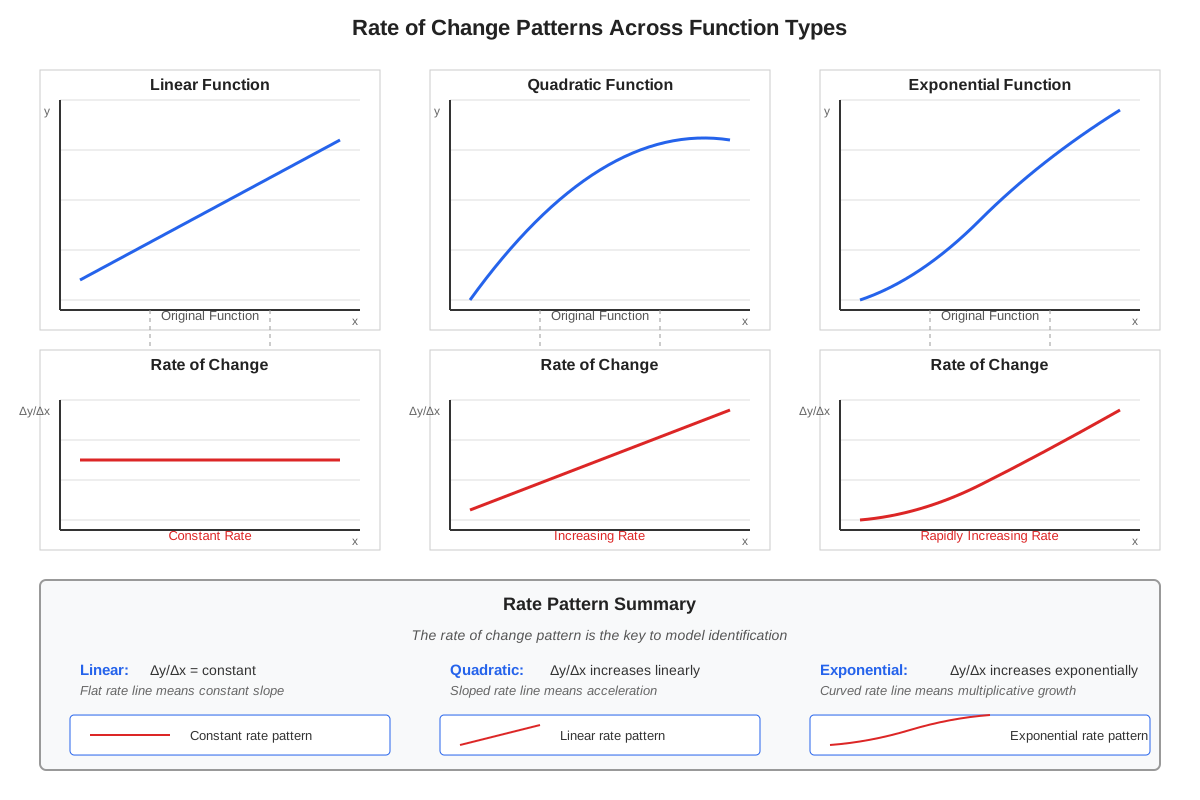
Quadratic models represent situations where the rate of change itself is changing at a constant rate. These models follow the form f(x) = ax² + bx + c and produce parabolic graphs. Quadratic models are characterized by having a maximum or minimum point (vertex) and symmetry. They appropriately model projectile motion, area optimization problems, and situations involving acceleration. A key identifier of quadratic data is that second differences (the differences of differences) remain constant.
Exponential models represent situations with constant percentage change rather than constant absolute change. These models take the form f(x) = a(b)^x or f(x) = ae^(kx), where the output is multiplied by a constant factor for each unit increase in the input. Exponential models are appropriate for compound interest, population growth, radioactive decay, and viral spread. The distinguishing feature is that the ratio between consecutive y-values remains constant when x-values increase by equal intervals.
Analyzing Rate of Change Patterns
The most reliable method for model selection involves analyzing how the dependent variable changes as the independent variable increases. For linear models, calculate first differences by subtracting consecutive y-values when x-values increase by 1. If these differences are constant (or very close to constant with real-world data), a linear model is appropriate.
For quadratic models, first differences will not be constant, but second differences will be. Calculate first differences, then calculate the differences of those differences. If the second differences are constant, the data follows a quadratic pattern. This two-step process is essential for distinguishing quadratic from other nonlinear models.
For exponential models, examine ratios rather than differences. Divide each y-value by the previous y-value (when x increases by constant intervals). If these ratios are constant, an exponential model is appropriate. This ratio test is the definitive method for identifying exponential relationships.
Contextual Clues for Model Selection
Beyond numerical analysis, the SAT frequently provides contextual information that suggests the appropriate model type. Certain keywords and scenario descriptions strongly indicate specific function types:
| Context Type | Typical Keywords | Appropriate Model |
|---|---|---|
| Constant rate | per, each, every, constant speed, steady | Linear |
| Area/geometry | area, squared, dimensions, optimization | Quadratic |
| Projectile motion | thrown, launched, height over time, gravity | Quadratic |
| Percentage growth | percent increase, doubles, triples, compounds | Exponential |
| Decay/depreciation | half-life, decreases by %, loses value | Exponential |
| Acceleration | speeding up, slowing down, changing rate | Quadratic or higher |
Visual Pattern Recognition
When presented with scatter plots or graphs, visual inspection provides immediate clues about model type. Linear models produce points that cluster around a straight line, with no curvature. The pattern shows consistent upward or downward progression without bending.
Quadratic models produce a distinctive U-shape (opening upward) or inverted U-shape (opening downward). The graph shows symmetry around a vertical line through the vertex, and the rate of increase or decrease accelerates as you move away from the vertex.
Exponential models show rapid increase or decrease that accelerates dramatically. Exponential growth curves start slowly and then rise steeply, while exponential decay curves drop quickly at first and then level off, approaching but never reaching zero. Unlike quadratic curves, exponential curves are not symmetric and continue accelerating indefinitely in one direction.
Testing and Verifying Models
Once a model type is hypothesized, verification involves substituting values and checking predictions. Select several data points from the given information and test whether they satisfy the proposed model equation. For SAT questions, you may be given multiple model options and asked to determine which best fits the data.
The verification process includes: (1) substituting x-values into the proposed equation and checking if the resulting y-values match the data; (2) checking if the model makes sense for extreme values or extrapolations; (3) considering whether the model's behavior aligns with the real-world context; and (4) comparing residuals (differences between actual and predicted values) if multiple models seem plausible.
Concept Relationships
Model selection integrates multiple mathematical concepts into a unified decision-making process. The relationship begins with data analysis → which leads to → pattern recognition → which informs → function type identification → which enables → model selection → which allows for → predictions and applications.
Within the topic itself, understanding rate of change analysis serves as the foundation for distinguishing between model types. This connects directly to first differences (for linear models), second differences (for quadratic models), and ratios (for exponential models). Each of these analytical tools provides evidence that flows into the final model selection decision.
The topic connects backward to prerequisite knowledge of individual function types. Students must understand linear functions to recognize constant rate of change, quadratic functions to identify parabolic patterns, and exponential functions to spot constant percentage change. These prerequisites provide the vocabulary and conceptual framework for model selection.
Looking forward, model selection enables more advanced topics including regression analysis, curve fitting, residual analysis, and interpolation and extrapolation. The skill of choosing appropriate models is fundamental to statistics, calculus, and applied mathematics courses beyond the SAT.
High-Yield Facts
⭐ Linear models have constant first differences when x-values increase by equal intervals
⭐ Quadratic models have constant second differences when x-values increase by equal intervals
⭐ Exponential models have constant ratios between consecutive y-values when x-values increase by equal intervals
⭐ Context clues like "percent increase" or "doubles every" indicate exponential models
⭐ Projectile motion and area problems typically require quadratic models
- Linear models graph as straight lines; quadratic models graph as parabolas; exponential models graph as curves that accelerate continuously
- When first differences increase or decrease in a pattern, consider a quadratic model
- Exponential decay approaches but never reaches zero, while linear decay can reach and pass through zero
- The y-intercept in any model represents the initial value when x = 0
- If a situation involves something being multiplied repeatedly (compound interest, population doubling), use an exponential model
- Quadratic models have exactly one maximum or minimum point (the vertex)
- For real-world data, differences or ratios may be approximately constant rather than exactly constant
- When comparing models, the one that produces values closest to all given data points is typically correct
- Negative slopes in linear models indicate decreasing relationships; positive slopes indicate increasing relationships
- The coefficient 'a' in a quadratic model determines whether the parabola opens upward (a > 0) or downward (a < 0)
Quick check — test yourself on Model selection so far.
Try Flashcards →Common Misconceptions
Misconception: Any curved graph represents an exponential function → Correction: Curves can represent quadratic, exponential, or other function types. Quadratic curves are symmetric with a single vertex, while exponential curves continuously accelerate in one direction without symmetry. Always test differences and ratios to distinguish between them.
Misconception: If data points don't form a perfect pattern, no model is appropriate → Correction: Real-world data rarely fits models perfectly. Look for approximate patterns in differences or ratios. The SAT expects students to identify the best-fitting model even when data shows minor variations due to measurement error or real-world complexity.
Misconception: Exponential models always increase → Correction: Exponential models can represent both growth (when the base is greater than 1) and decay (when the base is between 0 and 1). Radioactive decay, depreciation, and cooling are all exponential decay situations.
Misconception: A situation involving time always requires a linear model → Correction: Time can be the independent variable in any type of model. The relationship between time and the dependent variable determines the model type, not the mere presence of time as a variable.
Misconception: Second differences only matter for quadratic models → Correction: While constant second differences definitively indicate a quadratic model, examining second differences is also useful for ruling out quadratic models. If second differences are not constant, the model is not quadratic (it might be exponential, cubic, or another type).
Misconception: The model with the highest y-values is always exponential → Correction: The magnitude of y-values doesn't determine model type; the pattern of change does. A linear model with a steep slope might produce larger values than an exponential model with a small base over a limited domain.
Misconception: You need to find the exact equation to select a model → Correction: Model selection only requires identifying the function type (linear, quadratic, exponential), not determining specific parameter values. Focus on pattern recognition rather than equation-solving.
Worked Examples
Example 1: Table Analysis
Problem: A biologist tracks bacterial population over time. The table shows the population P at time t hours:
| t (hours) | 0 | 1 | 2 | 3 | 4 |
|---|---|---|---|---|---|
| P (thousands) | 5 | 10 | 20 | 40 | 80 |
Which type of function best models this relationship?
Solution:
Step 1: Examine the context. The problem involves population growth, which could be linear or exponential. The word "population" suggests possible exponential growth.
Step 2: Calculate first differences:
- 10 - 5 = 5
- 20 - 10 = 10
- 40 - 20 = 20
- 80 - 40 = 40
The first differences are not constant (5, 10, 20, 40), so this is not linear.
Step 3: Calculate second differences:
- 10 - 5 = 5
- 20 - 10 = 10
- 40 - 20 = 20
The second differences are not constant (5, 10, 20), so this is not quadratic.
Step 4: Calculate ratios:
- 10/5 = 2
- 20/10 = 2
- 40/20 = 2
- 80/40 = 2
The ratios are constant (all equal 2), indicating an exponential model.
Step 5: Verify with context. The population doubles each hour, which is characteristic of exponential growth. The model is P(t) = 5(2)^t.
Answer: An exponential function best models this relationship because the population multiplies by a constant factor (2) each hour.
Example 2: Contextual Model Selection
Problem: A ball is thrown upward from ground level. Its height h, in feet, depends on the time t, in seconds, after it is thrown. Which of the following types of functions best models the relationship between h and t?
A) Linear, because the ball travels at constant speed
B) Linear, because height increases then decreases uniformly
C) Quadratic, because gravity causes constant acceleration
D) Exponential, because the ball's speed changes continuously
Solution:
Step 1: Analyze the physical situation. A ball thrown upward experiences gravitational acceleration, which is constant at approximately -32 ft/s² (or -9.8 m/s²).
Step 2: Consider what happens to the ball. It rises with decreasing speed, reaches a maximum height where velocity is zero, then falls with increasing speed. This describes a parabolic path.
Step 3: Recall that constant acceleration produces quadratic position functions. The general equation for projectile motion is h(t) = -16t² + v₀t + h₀, which is quadratic.
Step 4: Eliminate incorrect options:
- Options A and B suggest linear models, but the ball's velocity changes (not constant speed), and the rate of height change varies
- Option D suggests exponential, but exponential functions don't have maximum values and don't decrease after increasing
- Option C correctly identifies the quadratic nature due to constant acceleration
Step 5: Verify the model makes sense. A quadratic function with negative leading coefficient opens downward, having a maximum point (the peak height) and symmetric behavior, which matches the ball's trajectory.
Answer: C) Quadratic, because gravity causes constant acceleration, which produces a quadratic relationship between height and time.
Exam Strategy
When approaching model selection questions on the SAT, begin by quickly scanning for contextual clues before diving into calculations. Words like "percent," "doubles," "triples," or "half-life" immediately suggest exponential models, while "area," "projectile," or "optimization" suggest quadratic models. This initial assessment saves time and guides your analytical approach.
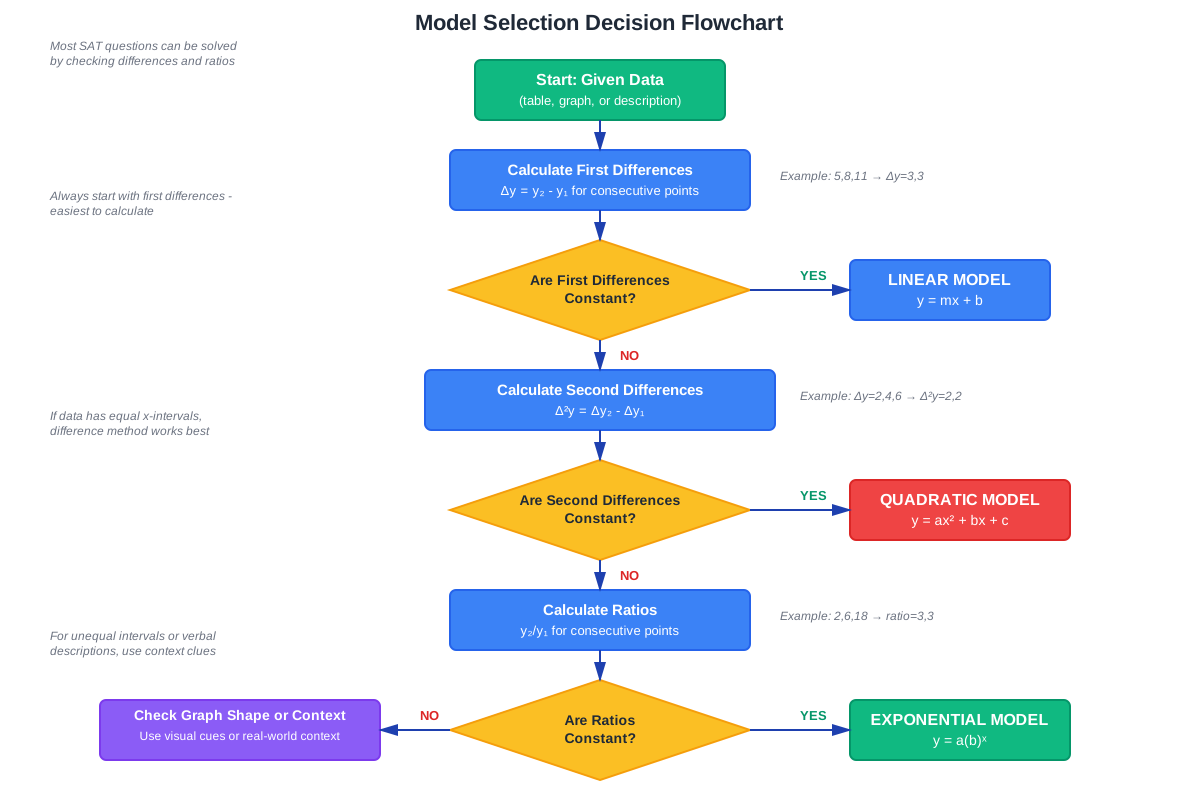
For questions presenting data tables, systematically test differences and ratios. Start with first differences since they're quickest to calculate. If first differences are constant, you've identified a linear model and can stop. If not, calculate second differences for quadratic identification. Only if both difference tests fail should you calculate ratios for exponential models. This hierarchical approach prevents unnecessary calculations.
Exam Tip: When time is limited, visual inspection of answer choices can eliminate options. If answer choices include specific equations, substitute one or two data points to eliminate incorrect models quickly.
Watch for trigger phrases that indicate specific model types. "Increases by the same amount" signals linear; "increases by increasing amounts" suggests quadratic or exponential; "increases by the same percentage" or "multiplies by" definitively indicates exponential. These phrases often appear in the question stem or answer explanations.
Process of elimination is particularly powerful for model selection questions. If you can rule out one or two model types based on context or a single calculation, your probability of selecting the correct answer increases dramatically. For instance, if first differences are clearly not constant, immediately eliminate any linear model options.
Allocate approximately 1-2 minutes for straightforward model selection questions involving tables or clear contexts. More complex questions that require both model selection and subsequent calculations may warrant 2-3 minutes. If a question seems to require extensive calculation, look for shortcuts based on pattern recognition or elimination strategies.
Memory Techniques
DIFFERENCE mnemonic for systematic model testing:
- Determine first differences
- Identify if constant (linear)
- Find second differences
- Figure if constant (quadratic)
- Examine ratios
- Recognize constant ratios (exponential)
- Evaluate context
- Narrow to best model
- Confirm with verification
- Eliminate wrong answers
"LQE" (Linear-Quadratic-Exponential) visualization: Picture a straight ruler (Linear), a basketball arc (Quadratic), and a hockey stick (Exponential) to remember the three main model shapes.
"PERCENT = EXPONENTIAL" association: Whenever you see percentage change, growth rates, or multiplicative relationships, immediately think exponential. The word "percent" should trigger "exponential" in your mind.
"Second Differences = Second Power" connection: Remember that constant second differences indicate a quadratic model, and quadratic means the highest power is 2 (second power). This creates a memorable link between the analytical method and the model type.
Context Categories acronym "PAM":
- Projectiles and Percentages (Quadratic and Exponential)
- Area and Acceleration (Quadratic)
- Multiplication and Motion at constant speed (Exponential and Linear)
Summary
Model selection is a high-yield SAT Math topic that requires students to analyze data patterns and contextual information to determine whether linear, quadratic, or exponential functions best represent given relationships. The key to mastering this skill lies in systematic analysis of rate of change: constant first differences indicate linear models, constant second differences indicate quadratic models, and constant ratios indicate exponential models. Context clues provide additional guidance, with percentage-based changes suggesting exponential models, projectile motion and area problems suggesting quadratic models, and constant rates suggesting linear models. Success on SAT model selection questions requires both computational skills (calculating differences and ratios) and conceptual understanding (recognizing how different function types behave in real-world contexts). Students must be able to quickly identify model types from tables, graphs, and verbal descriptions, then apply their selected models to make predictions or solve problems. The ability to eliminate incorrect model types through strategic testing and to verify selected models through substitution completes the skill set necessary for consistent success on these high-frequency exam questions.
Key Takeaways
- Model selection questions appear frequently on the SAT and require identifying whether linear, quadratic, or exponential functions best fit given data or contexts
- Systematic analysis of first differences (linear), second differences (quadratic), and ratios (exponential) provides the most reliable method for model identification
- Context clues like "percent increase," "doubles," or "area" often indicate the appropriate model type before calculations begin
- Linear models have constant rate of change; quadratic models have changing rate of change with symmetry; exponential models have constant percentage change
- Visual pattern recognition—straight lines, parabolas, or accelerating curves—provides quick model identification from graphs
- Real-world data may show approximate rather than perfect patterns; select the best-fitting model even with minor variations
- Verification through substitution and contextual reasonableness checks ensures model selection accuracy
Related Topics
Function Transformations: Understanding how functions shift, stretch, and reflect builds on model selection by showing how basic models adapt to different situations. Mastering model selection provides the foundation for recognizing how transformed functions maintain their fundamental characteristics.
Regression and Line of Best Fit: This advanced topic extends model selection by introducing methods for finding the specific equation that best fits data points. Model selection skills are prerequisite for understanding when linear regression is appropriate versus when nonlinear regression is needed.
Systems of Equations: Many SAT problems combine model selection with systems, requiring students to find where two different models intersect or to solve for parameters that make models consistent with given conditions.
Data Analysis and Statistics: Model selection connects directly to interpreting statistical data, making predictions, and understanding trends. The ability to choose appropriate models enhances interpretation of real-world datasets.
Calculus Concepts (Advanced): For students continuing to AP Calculus, model selection provides essential background for understanding derivatives (rate of change) and how different function types behave under differentiation and integration.
Practice CTA
Now that you've mastered the core concepts of model selection, it's time to solidify your understanding through practice. Attempt the practice questions designed specifically for this topic, focusing on applying the systematic difference and ratio tests you've learned. Work through the flashcards to reinforce quick recognition of model types from contextual clues. Remember, model selection is one of the highest-yield topics on the SAT—every minute you invest in practice translates directly to points on test day. Challenge yourself to identify models quickly and accurately, and you'll build the confidence needed to tackle even the most complex function problems the SAT presents!
Sign up free to keep reading
Create a free AnvayaPrep account to finish this SAT guide on Model selection — plus flashcards and practice questions.