Overview
The zeros of functions represent one of the most fundamental and frequently tested concepts in SAT math. A zero of a function is any input value (x-value) that produces an output of zero, meaning it's where the function crosses or touches the x-axis when graphed. Understanding zeros is essential because they reveal critical information about a function's behavior, structure, and real-world applications. On the SAT, questions about zeros appear in multiple formats: identifying zeros from graphs, finding zeros algebraically, determining the number of zeros, and interpreting what zeros mean in context.
Mastering zeros of functions provides the foundation for understanding polynomial behavior, solving equations, and analyzing function transformations. The SAT frequently integrates this topic with quadratic functions, factoring, the quadratic formula, and graphical analysis. Students who can quickly identify and work with zeros gain a significant advantage on test day, as these skills apply to approximately 10-15% of SAT math questions either directly or indirectly.
The concept of zeros connects deeply to the broader mathematical landscape of functions and equations. Zeros are also called roots, solutions, or x-intercepts, and these terms are used interchangeably on the SAT. Understanding this topic strengthens algebraic reasoning, enhances graph interpretation skills, and builds the analytical thinking required for higher-level mathematics. The ability to move fluidly between algebraic and graphical representations of zeros is a hallmark of mathematical proficiency that the SAT specifically assesses.
Learning Objectives
- [ ] Identify key features of zeros of functions from equations and graphs
- [ ] Explain how zeros of functions appears on the SAT in various question formats
- [ ] Apply zeros of functions to answer SAT-style questions efficiently
- [ ] Determine the number of zeros a function has using multiple methods
- [ ] Convert between different representations of zeros (algebraic, graphical, and contextual)
- [ ] Analyze the relationship between factors of polynomials and their zeros
- [ ] Interpret the meaning of zeros in real-world application problems
Prerequisites
- Linear equations and solving for variables: Essential for finding zeros by setting functions equal to zero and solving
- Factoring polynomials: Required to find zeros of quadratic and higher-degree polynomials efficiently
- Quadratic formula: Necessary when factoring is not possible or practical
- Coordinate plane and graphing: Needed to visualize zeros as x-intercepts and interpret graphical information
- Function notation: Understanding f(x) notation is fundamental to working with zeros conceptually
Why This Topic Matters
In real-world applications, zeros represent critical transition points where quantities change from positive to negative or vice versa. Engineers use zeros to find break-even points in cost analysis, physicists use them to determine when objects return to ground level in projectile motion, and economists use them to identify equilibrium points in supply and demand models. The practical significance of zeros extends to any scenario where finding when something equals zero provides meaningful information.
On the SAT, zeros of functions appear in approximately 3-5 questions per test, making this a high-yield topic for score improvement. Questions typically fall into several categories: identifying zeros from graphs (most common), finding zeros algebraically from equations, determining how many zeros exist, and interpreting zeros in context-based word problems. The College Board specifically tests whether students can connect algebraic and graphical representations, making this a critical skill for the exam.
Common SAT question formats include: providing a graph and asking which equation matches based on zeros, giving an equation and asking for the sum or product of zeros, presenting a real-world scenario where zeros represent meaningful events, and asking students to determine how changes to a function affect its zeros. The topic frequently appears in both the calculator and no-calculator sections, emphasizing the importance of both computational fluency and conceptual understanding.
Core Concepts
Definition and Terminology
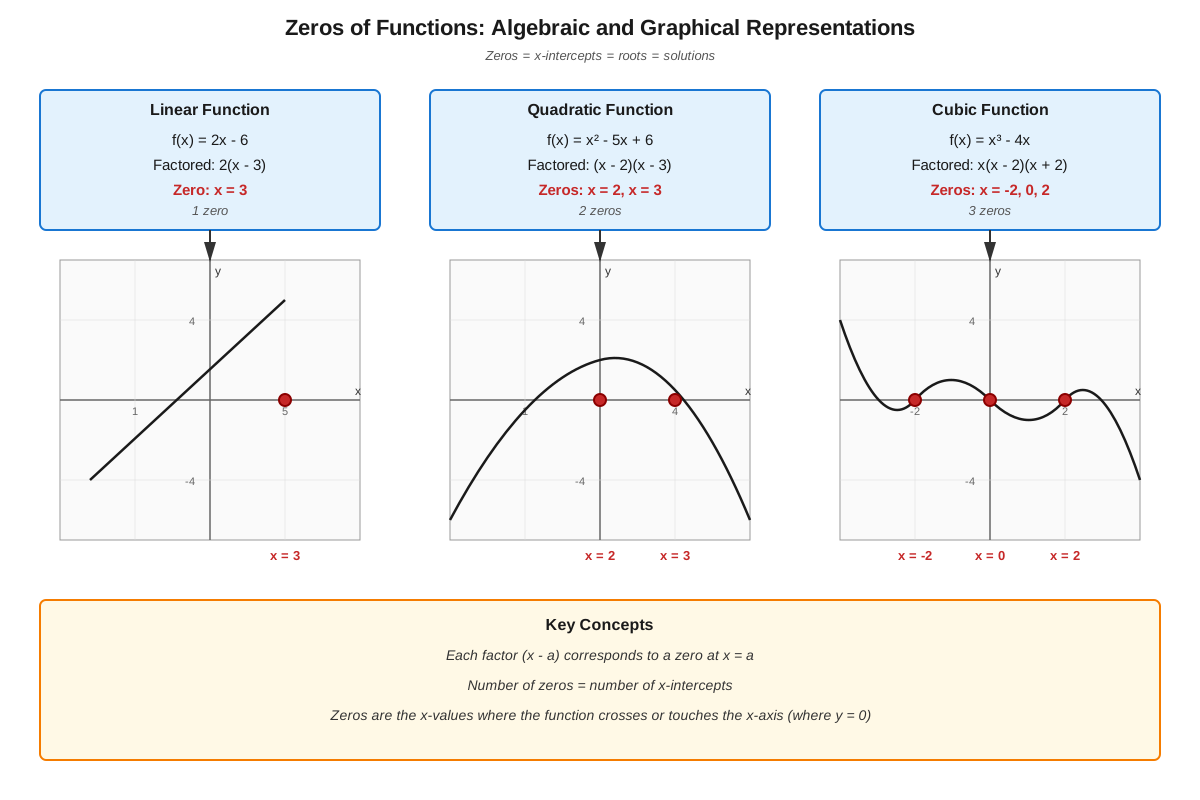
A zero of a function is any value of x for which f(x) = 0. These values are also called roots, solutions, or x-intercepts of the function. All these terms are used interchangeably on the SAT zeros of functions questions, so recognizing each is crucial. When a function has a zero at x = a, this means that the point (a, 0) lies on the graph of the function.
For example, if f(x) = x² - 4, the zeros are x = 2 and x = -2 because f(2) = 0 and f(-2) = 0. These are the points where the parabola crosses the x-axis at (2, 0) and (-2, 0).
Finding Zeros Algebraically
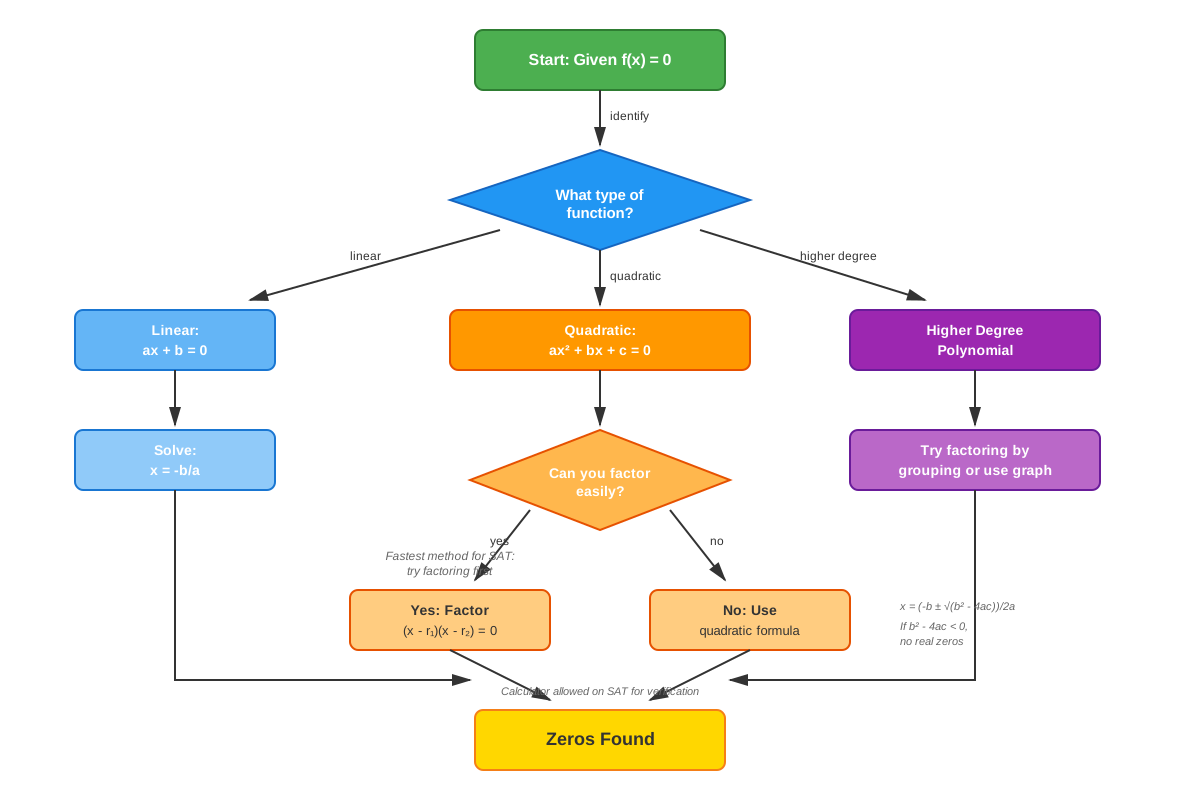
To find zeros algebraically, set the function equal to zero and solve for x. The method depends on the type of function:
For Linear Functions: f(x) = mx + b
- Set mx + b = 0
- Solve for x: x = -b/m
- Linear functions always have exactly one zero (unless m = 0)
For Quadratic Functions: f(x) = ax² + bx + c
Three primary methods exist:
- Factoring: If the quadratic factors as (x - p)(x - q) = 0, then the zeros are x = p and x = q
- Quadratic Formula: x = (-b ± √(b² - 4ac))/(2a)
- Completing the Square: Useful for certain forms but less common on the SAT
For Higher-Degree Polynomials: Factor completely and set each factor equal to zero. For example, if f(x) = x³ - 4x = x(x² - 4) = x(x - 2)(x + 2), the zeros are x = 0, x = 2, and x = -2.
The Discriminant and Number of Zeros
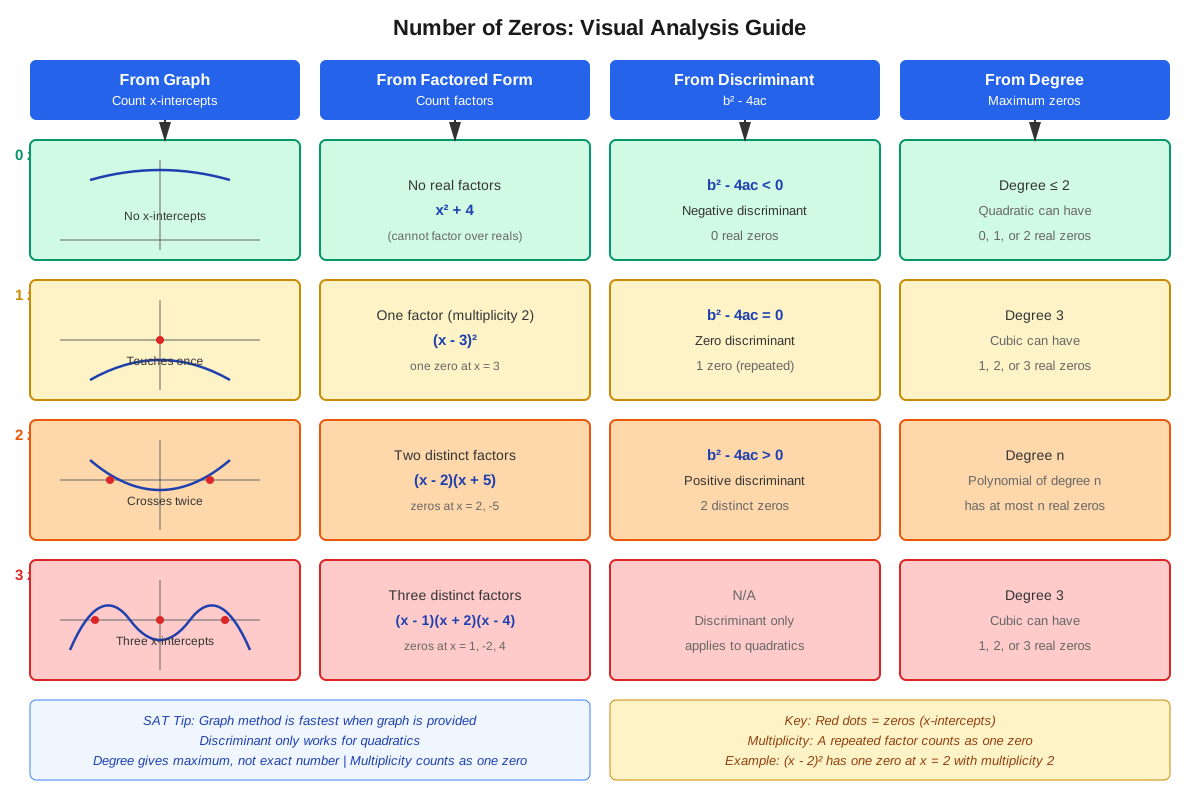
For quadratic functions, the discriminant (b² - 4ac) determines the number of real zeros:
| Discriminant Value | Number of Real Zeros | Graphical Interpretation |
|---|---|---|
| b² - 4ac > 0 | Two distinct real zeros | Parabola crosses x-axis twice |
| b² - 4ac = 0 | One real zero (repeated) | Parabola touches x-axis once (vertex on x-axis) |
| b² - 4ac < 0 | No real zeros | Parabola doesn't touch x-axis |
This concept is frequently tested on the SAT, particularly in questions asking "How many solutions does the equation have?" or "For what value of k does the equation have exactly one solution?"
Graphical Identification of Zeros
When given a graph, zeros are identified as the x-coordinates where the function crosses or touches the x-axis. Key observations:
- Crossing the x-axis: Indicates a zero with odd multiplicity (usually multiplicity 1)
- Touching but not crossing: Indicates a zero with even multiplicity (usually multiplicity 2)
- Number of turning points: A polynomial of degree n has at most n - 1 turning points and at most n zeros
Relationship Between Factors and Zeros
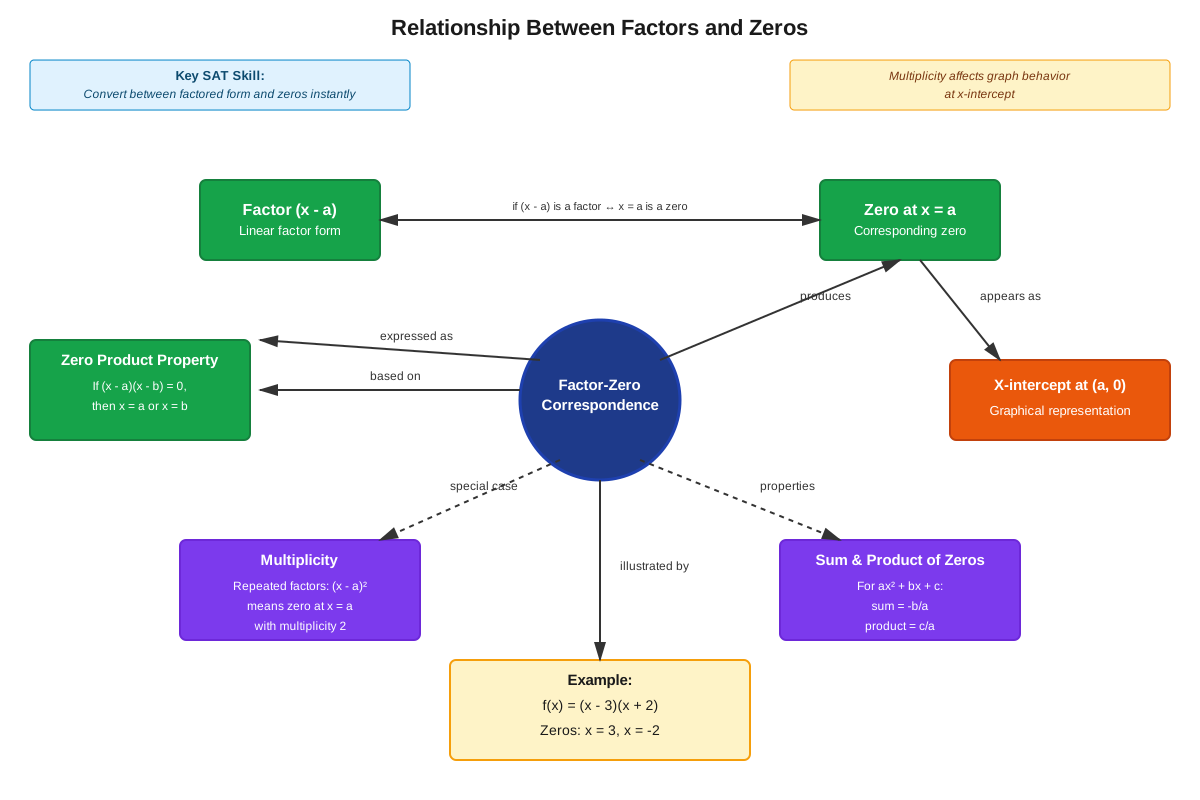
This is one of the most important connections for SAT success. If x = a is a zero of f(x), then (x - a) is a factor of f(x), and vice versa. This bidirectional relationship allows students to:
- Write a function given its zeros: If zeros are x = 2 and x = -3, then f(x) = a(x - 2)(x + 3) for some constant a
- Find zeros from factored form: If f(x) = (x - 5)(x + 1), zeros are x = 5 and x = -1
- Verify solutions: Substitute potential zeros back into the original function
Sum and Product of Zeros
For a quadratic function f(x) = ax² + bx + c with zeros r and s:
- Sum of zeros: r + s = -b/a
- Product of zeros: rs = c/a
These relationships, known as Vieta's formulas, allow students to find information about zeros without actually calculating them—a valuable time-saving technique on the SAT.
Zeros in Context
SAT questions frequently present zeros within real-world scenarios. The key is interpreting what a zero means in context:
- Projectile motion: h(t) = -16t² + v₀t + h₀, zeros represent when the object is at ground level
- Business applications: P(x) = revenue - cost, zeros represent break-even points
- Population models: Zeros might represent when a population reaches zero (extinction)
Always read carefully to understand what the variable represents and what a zero means for that specific situation.
Concept Relationships
The concepts within zeros of functions form an interconnected web of understanding. Algebraic methods for finding zeros (factoring, quadratic formula) → produce numerical values → which correspond to graphical x-intercepts → which can be interpreted in context for real-world problems. This algebraic-graphical-contextual triangle represents the three primary ways the SAT tests this topic.
The factor-zero relationship serves as the bridge between polynomial structure and function behavior. Understanding that (x - a) is a factor if and only if x = a is a zero enables bidirectional problem-solving: moving from zeros to equations and from equations to zeros. This connection extends to the discriminant concept, which predicts the number of zeros without actually finding them, demonstrating how different mathematical tools provide complementary information.
Zeros of functions connect to prerequisite knowledge of solving equations (zeros are solutions to f(x) = 0), factoring (the primary method for finding zeros), and graphing (zeros are x-intercepts). Looking forward, understanding zeros prepares students for polynomial division, rational functions (where zeros of the numerator create x-intercepts), and systems of equations (where solutions represent simultaneous zeros).
The relationship map: Function equation → Set equal to zero → Solve algebraically → Zeros/roots/solutions ↔ Graphical x-intercepts → Contextual interpretation → Real-world meaning
High-Yield Facts
⭐ A zero of f(x) is any x-value where f(x) = 0; these are also called roots, solutions, or x-intercepts
⭐ If (x - a) is a factor of f(x), then x = a is a zero of f(x), and vice versa
⭐ For quadratics, the discriminant b² - 4ac determines the number of real zeros: positive = 2, zero = 1, negative = 0
⭐ Graphically, zeros are the x-coordinates where the function crosses or touches the x-axis (y = 0)
⭐ For a quadratic ax² + bx + c with zeros r and s: sum = -b/a and product = c/a
- A polynomial of degree n has at most n real zeros
- A zero with even multiplicity causes the graph to touch but not cross the x-axis
- A zero with odd multiplicity causes the graph to cross the x-axis
- To find zeros algebraically, always start by setting the function equal to zero
- Linear functions have exactly one zero (unless the line is horizontal with no x-intercept)
- The x-coordinate of a parabola's vertex is the average of its two zeros (when they exist)
- In factored form f(x) = a(x - r)(x - s), the zeros are immediately visible as r and s
- Complex (non-real) zeros always come in conjugate pairs for polynomials with real coefficients
- The Fundamental Theorem of Algebra states that a polynomial of degree n has exactly n zeros (counting multiplicity and complex zeros)
- On the SAT, "solutions to the equation" means the same thing as "zeros of the function"
Quick check — test yourself on Zeros of functions so far.
Try Flashcards →Common Misconceptions
Misconception: The zero of a function is the y-intercept where the graph crosses the y-axis.
Correction: Zeros are x-intercepts (where y = 0), not y-intercepts (where x = 0). The y-intercept is found by evaluating f(0), which is completely different from finding where f(x) = 0.
Misconception: If a quadratic has a discriminant of zero, it has no solutions.
Correction: A discriminant of zero means exactly one real solution (a repeated root). A negative discriminant means no real solutions. Students often confuse these conditions.
Misconception: The zeros of f(x) = (x - 3)(x + 2) are x = 3 and x = 2.
Correction: The zeros are x = 3 and x = -2. When the factor is (x + 2), set it equal to zero: x + 2 = 0, so x = -2. The sign changes when solving.
Misconception: A function can have an unlimited number of zeros.
Correction: Polynomial functions have a maximum number of zeros equal to their degree. A quadratic (degree 2) has at most 2 real zeros, a cubic (degree 3) has at most 3, and so on.
Misconception: If a graph touches the x-axis at a point, that point is not a zero.
Correction: Touching the x-axis still counts as a zero; it's a zero with even multiplicity (typically multiplicity 2). The graph doesn't cross the axis, but the x-coordinate is still a zero.
Misconception: The sum of zeros formula -b/a applies to all functions.
Correction: This formula specifically applies to quadratic functions in the form ax² + bx + c. It doesn't apply to linear functions, higher-degree polynomials (without modification), or non-polynomial functions.
Misconception: Finding zeros and solving equations are different processes.
Correction: They are the same process. Finding zeros of f(x) means solving f(x) = 0. The SAT uses both phrasings interchangeably to test whether students understand this equivalence.
Worked Examples
Example 1: Finding Zeros Algebraically and Interpreting Graphically
Problem: The function f(x) = 2x² - 8x + 6 represents the height (in meters) of a ball above the ground, where x is the time in seconds after it's thrown. Find the zeros of this function and explain what they represent.
Solution:
Step 1: Set the function equal to zero.
2x² - 8x + 6 = 0Step 2: Factor out the common factor of 2.
2(x² - 4x + 3) = 0
x² - 4x + 3 = 0
Step 3: Factor the quadratic.
(x - 3)(x - 1) = 0Step 4: Apply the zero product property.
x - 3 = 0  or  x - 1 = 0
x = 3 or x = 1Answer: The zeros are x = 1 and x = 3.
Interpretation: Since x represents time in seconds and f(x) represents height in meters, the zeros represent the times when the ball is at ground level (height = 0). The ball is at ground level at t = 1 second and t = 3 seconds. This means the ball was thrown from ground level at t = 1 second and returned to ground level at t = 3 seconds, spending 2 seconds in the air.
Connection to Learning Objectives: This example demonstrates identifying zeros algebraically (factoring method), applying the concept to an SAT-style question, and interpreting zeros in a real-world context.
Example 2: Using the Discriminant and Sum/Product of Zeros
Problem: For what value of k does the equation x² + 6x + k = 0 have exactly one real solution? If the equation x² - 5x + c = 0 has two solutions whose product is 6, what is the value of c?
Solution Part A:
Step 1: Recall that exactly one real solution occurs when the discriminant equals zero.
b² - 4ac = 0Step 2: Identify a, b, and c from x² + 6x + k = 0.
a = 1, b = 6, c = kStep 3: Substitute into the discriminant formula.
(6)² - 4(1)(k) = 0
36 - 4k = 0
Step 4: Solve for k.
36 = 4k
k = 9
Answer Part A: k = 9
Solution Part B:
Step 1: Recall that for ax² + bx + c = 0, the product of zeros equals c/a.
Product of zeros = c/aStep 2: Identify a from x² - 5x + c = 0.
a = 1Step 3: Set up the equation using the given product.
c/1 = 6
c = 6
Answer Part B: c = 6
Verification: We can verify by noting that if c = 6, the equation is x² - 5x + 6 = 0, which factors as (x - 2)(x - 3) = 0, giving zeros of 2 and 3. The product is indeed 2 × 3 = 6. ✓
Connection to Learning Objectives: This example demonstrates using the discriminant to determine the number of zeros and applying Vieta's formulas (sum and product of zeros) to solve SAT-style problems efficiently without finding the actual zeros.
Exam Strategy
When approaching SAT questions about zeros of functions, follow this systematic process:
Step 1: Identify what the question is asking. Look for key phrases: "solutions to the equation," "x-intercepts," "roots," "where the graph crosses the x-axis," or "zeros." All these phrases mean the same thing.
Step 2: Determine the given format. Is the function presented as an equation, a graph, a table, or in words? Your approach depends on the format:
- Equation given: Set equal to zero and solve algebraically
- Graph given: Identify x-intercepts visually
- Context given: Translate to mathematical meaning
Step 3: Choose the most efficient method. For quadratics:
- If it factors easily, factor
- If factoring isn't obvious within 10 seconds, use the quadratic formula
- If the question asks about the number of solutions (not the actual values), check the discriminant
Trigger words and phrases to watch for:
- "How many solutions" → Think discriminant or count x-intercepts
- "Sum of the solutions" → Use -b/a for quadratics
- "Product of the solutions" → Use c/a for quadratics
- "Crosses the x-axis" → Finding zeros
- "The equation has no real solutions" → Discriminant is negative
Process-of-elimination tips:
- If a graph is shown, eliminate any answer choice that doesn't match the number of visible x-intercepts
- If given zeros, eliminate equations that don't have those values as factors
- For "how many solutions" questions, eliminate answers that don't match the discriminant's prediction
Time allocation: Spend no more than 60-90 seconds on straightforward "find the zeros" questions. If you're spending more time, you may be using an inefficient method. For complex multi-step problems involving zeros, allocate up to 2 minutes.
Exam Tip: Always verify your answer by substituting back into the original equation when time permits. This catches sign errors and arithmetic mistakes.
Memory Techniques
Mnemonic for Discriminant Outcomes: "Positive Two, Zero One, Negative None"
- Positive discriminant → Two real zeros
- Zero discriminant → One real zero
- Negative discriminant → No real zeros
Acronym for Zero Terminology: "ZRSX" (pronounced "zir-six")
- Zeros
- Roots
- Solutions
- X-intercepts
All mean the same thing!
Visualization Strategy: Picture a function as a roller coaster track and the x-axis as the ground. Zeros are where the track touches or crosses the ground. This mental image helps remember that:
- Crossing = odd multiplicity
- Touching = even multiplicity
- Above ground = positive y-values
- Below ground = negative y-values
Factor-Zero Sign Flip: Remember "FLIP" - Factor to Locate Intercepts, Plus becomes minus
- Factor (x - 3) → zero is x = 3 (the sign flips)
- Factor (x + 5) → zero is x = -5 (the sign flips)
Sum and Product Formulas: "SNOOPY" - Sum is Negative Over, Product is Over Positive Y
- Sum = -b/a (negative b over a)
- Product = c/a (c over a, both positive positions in the formula)
Summary
Zeros of functions represent the x-values where a function equals zero, appearing as x-intercepts on graphs and solutions to equations. This fundamental concept connects algebraic manipulation, graphical interpretation, and real-world problem-solving. On the SAT, students must recognize that zeros, roots, solutions, and x-intercepts are synonymous terms used interchangeably. Finding zeros algebraically involves setting the function equal to zero and solving through factoring, the quadratic formula, or other appropriate methods depending on the function type. The discriminant (b² - 4ac) predicts the number of real zeros for quadratic functions without requiring calculation of actual values. Graphically, zeros appear where functions cross or touch the x-axis, with crossing indicating odd multiplicity and touching indicating even multiplicity. The bidirectional relationship between factors and zeros—where (x - a) is a factor if and only if x = a is a zero—enables efficient problem-solving in both directions. Vieta's formulas provide shortcuts for finding sums and products of zeros without calculating individual values. Understanding zeros in context requires interpreting what x = 0 means for the specific real-world scenario presented. Mastery of this topic requires fluency in moving between algebraic, graphical, and contextual representations.
Key Takeaways
- Zeros, roots, solutions, and x-intercepts are identical concepts—recognize all terms on the SAT
- Set f(x) = 0 and solve to find zeros algebraically; use factoring first, then the quadratic formula if needed
- The discriminant b² - 4ac determines the number of real zeros: positive = 2, zero = 1, negative = 0
- Factor-zero relationship works both ways: (x - a) is a factor ↔ x = a is a zero
- Graphical zeros are x-coordinates where the function touches or crosses the x-axis (where y = 0)
- Sum of zeros = -b/a and product of zeros = c/a for quadratics—use these shortcuts on the SAT
- Always interpret zeros in context for word problems—understand what x = 0 means for the situation
Related Topics
Quadratic Functions and Parabolas: Understanding zeros is essential for analyzing parabolas, finding vertices, and determining the axis of symmetry. The vertex's x-coordinate is the average of the two zeros when they exist.
Polynomial Functions: Zeros of higher-degree polynomials extend the concepts learned here. The Fundamental Theorem of Algebra and polynomial division build directly on zero-finding skills.
Rational Functions: Zeros of the numerator create x-intercepts in rational functions, while zeros of the denominator create vertical asymptotes. This distinction is crucial for advanced function analysis.
Systems of Equations: Solutions to systems represent simultaneous zeros of multiple functions. Graphically, these are intersection points, connecting zeros to coordinate geometry.
Function Transformations: Understanding how shifts, stretches, and reflections affect zeros prepares students for more complex function manipulation questions on the SAT and in future mathematics courses.
Practice CTA
Now that you've mastered the core concepts of zeros of functions, it's time to solidify your understanding through practice! Attempt the practice questions to apply these strategies to authentic SAT-style problems. Use the flashcards to reinforce key definitions, formulas, and relationships until they become automatic. Remember, the difference between knowing these concepts and scoring points on test day is practice. Each problem you work through builds the pattern recognition and problem-solving speed essential for SAT success. You've got this—start practicing now!
Sign up free to keep reading
Create a free AnvayaPrep account to finish this SAT guide on Zeros of functions — plus flashcards and practice questions.