Overview
The exterior angle theorem is a fundamental principle in geometry that establishes a precise relationship between the exterior angle of a triangle and its remote interior angles. This theorem states that the measure of an exterior angle of a triangle equals the sum of the measures of the two non-adjacent (remote) interior angles. Understanding this theorem is crucial for solving a wide variety of geometric problems efficiently, particularly those involving triangles, parallel lines, and polygon angle relationships.
For SAT math test-takers, mastering the exterior angle theorem is essential because it appears frequently in both multiple-choice and grid-in questions within the geometry section. The College Board consistently tests students' ability to recognize exterior angles, calculate missing angle measures, and apply the theorem in multi-step problems involving complex figures. Questions may present straightforward applications or embed the theorem within more elaborate geometric scenarios requiring students to identify which angles qualify as exterior angles and which are the corresponding remote interior angles.
The sat exterior angle theorem connects directly to broader geometric concepts including triangle angle sum properties, supplementary angles, and parallel line relationships. It serves as a bridge between basic angle relationships and more advanced polygon theorems, making it an indispensable tool in a student's geometric reasoning toolkit. Students who thoroughly understand this theorem can solve problems more quickly and avoid common calculation errors that arise from attempting to work through problems using only the triangle angle sum theorem.
Learning Objectives
- [ ] Identify key features of Exterior angle theorem
- [ ] Explain how Exterior angle theorem appears on the SAT
- [ ] Apply Exterior angle theorem to answer SAT-style questions
- [ ] Distinguish between exterior angles and remote interior angles in various triangle configurations
- [ ] Solve multi-step problems combining the exterior angle theorem with other geometric principles
- [ ] Recognize when the exterior angle theorem provides the most efficient solution path
Prerequisites
- Triangle angle sum theorem: Understanding that the three interior angles of any triangle sum to 180° is essential because the exterior angle theorem is derived from this fundamental property
- Supplementary angles: Recognizing that linear pairs of angles sum to 180° enables students to understand the relationship between an interior angle and its adjacent exterior angle
- Basic angle vocabulary: Familiarity with terms like adjacent, vertical, complementary, and supplementary angles ensures proper identification of angle relationships in geometric figures
- Algebraic equation solving: The ability to set up and solve linear equations is necessary for finding unknown angle measures when applying the theorem
Why This Topic Matters
The exterior angle theorem has practical applications in fields ranging from architecture and engineering to navigation and computer graphics. Architects use exterior angle relationships when designing roof pitches and structural supports, while surveyors apply these principles when measuring land boundaries and creating topographic maps. In computer-aided design (CAD) and animation, programmers rely on angle relationships to render three-dimensional objects accurately on two-dimensional screens.
On the SAT, the exterior angle theorem appears in approximately 2-4 questions per test administration, making it a high-yield topic that directly impacts scores. These questions typically fall into the "Problem Solving and Data Analysis" or "Passport to Advanced Math" categories, with difficulty levels ranging from medium to hard. The theorem most commonly appears in questions worth 1 point each, but mastering it also enables students to solve more complex multi-step problems worth additional points.
The SAT presents exterior angle theorem questions in several formats: straightforward angle calculation problems where students must find a missing angle measure, complex figures with multiple triangles where students must identify the correct relationship, word problems describing geometric scenarios, and questions combining the theorem with algebraic expressions involving variables. Understanding this theorem allows students to bypass longer solution methods, saving valuable time during the exam. Many students who struggle with these questions do so not because they lack the underlying knowledge, but because they fail to recognize when the exterior angle theorem provides the most direct solution path.
Core Concepts
Definition of an Exterior Angle
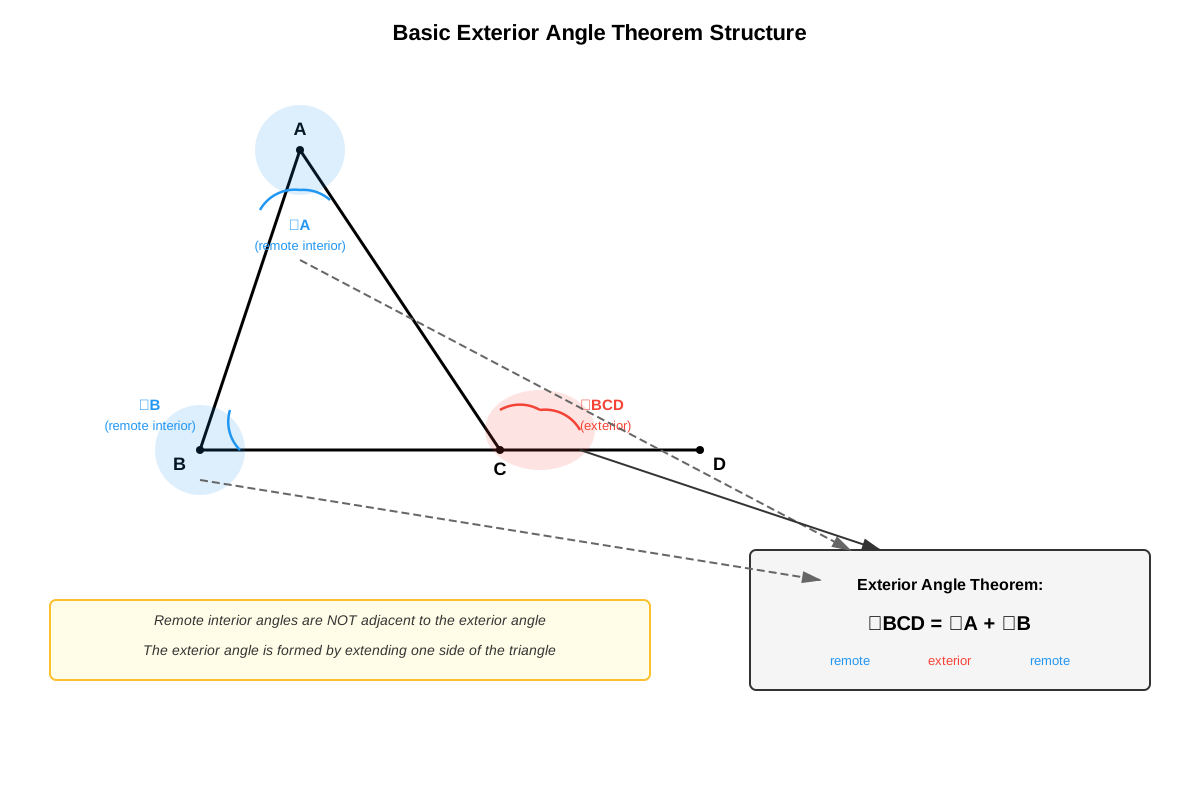
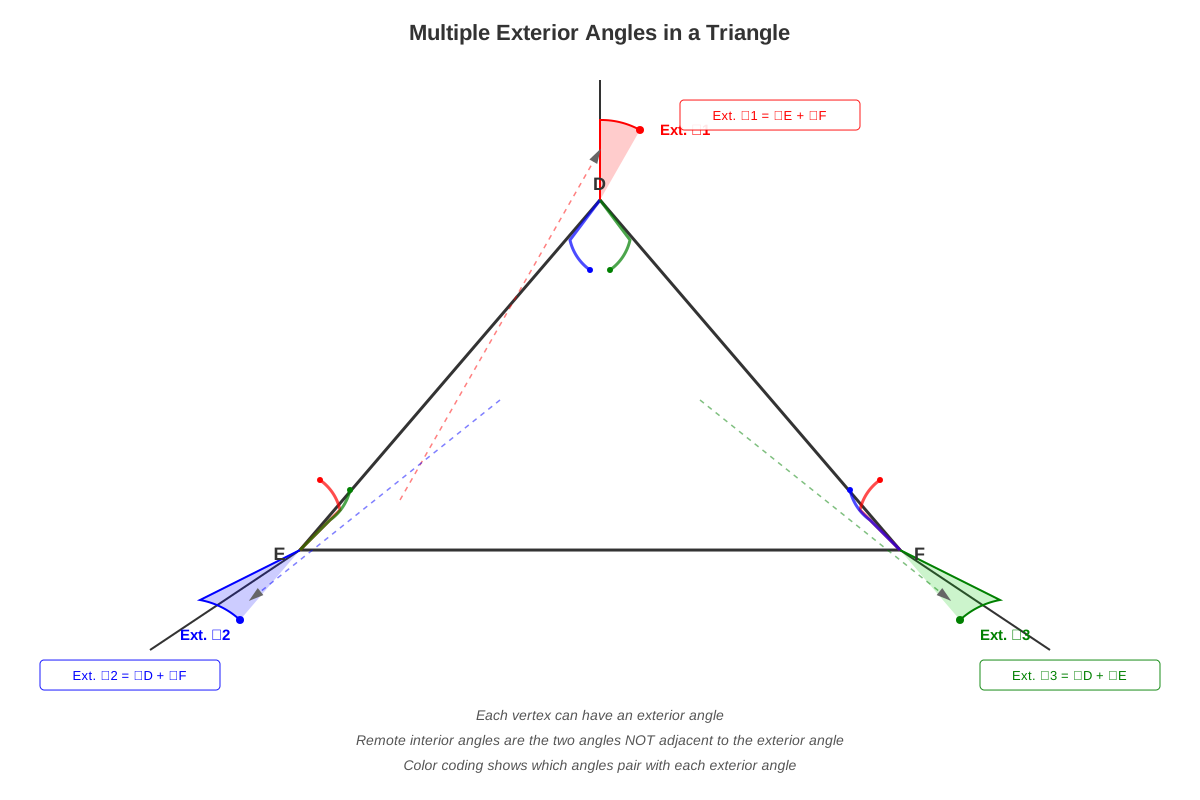
An exterior angle of a triangle is formed when one side of the triangle is extended beyond a vertex. At any vertex of a triangle, when you extend one side, the angle formed between the extension and the adjacent side is the exterior angle. It's crucial to understand that an exterior angle and its adjacent interior angle form a linear pair, meaning they are supplementary and sum to 180°. Each vertex of a triangle can have two exterior angles (one on each side), but these two exterior angles at the same vertex are vertical angles and therefore congruent.
Remote Interior Angles
The two remote interior angles (also called non-adjacent interior angles) are the two angles of the triangle that do not share a vertex with the exterior angle in question. For example, if an exterior angle is formed at vertex C by extending side BC, then the remote interior angles are the angles at vertices A and B. Identifying these remote interior angles correctly is essential for applying the theorem accurately, and this identification becomes more challenging when dealing with complex figures containing multiple triangles.
The Exterior Angle Theorem Statement
The exterior angle theorem states: The measure of an exterior angle of a triangle is equal to the sum of the measures of the two remote interior angles. Mathematically, if we have triangle ABC with an exterior angle at vertex C, and we call this exterior angle ∠1, while the remote interior angles are ∠A and ∠B, then:
∠1 = ∠A + ∠BThis relationship holds true for all triangles regardless of whether they are acute, right, obtuse, scalene, isosceles, or equilateral. The theorem is a direct consequence of two fundamental properties: the triangle angle sum theorem (interior angles sum to 180°) and the linear pair postulate (adjacent angles on a straight line sum to 180°).
Derivation and Proof
Understanding why the exterior angle theorem works strengthens conceptual mastery. Consider triangle ABC with an exterior angle at vertex C formed by extending side BC. Let's call the interior angle at C as ∠C, and the exterior angle as ∠1. Since ∠C and ∠1 form a linear pair:
∠C + ∠1 = 180°By the triangle angle sum theorem:
∠A + ∠B + ∠C = 180°Since both expressions equal 180°, we can set them equal:
∠C + ∠1 = ∠A + ∠B + ∠CSubtracting ∠C from both sides:
∠1 = ∠A + ∠BThis derivation demonstrates that the exterior angle theorem is not an arbitrary rule but a logical consequence of more fundamental geometric principles.
Application in Problem Solving
When applying the exterior angle theorem to SAT problems, follow this systematic approach:
- Identify the triangle in the figure (there may be multiple triangles)
- Locate the exterior angle (look for an extended side)
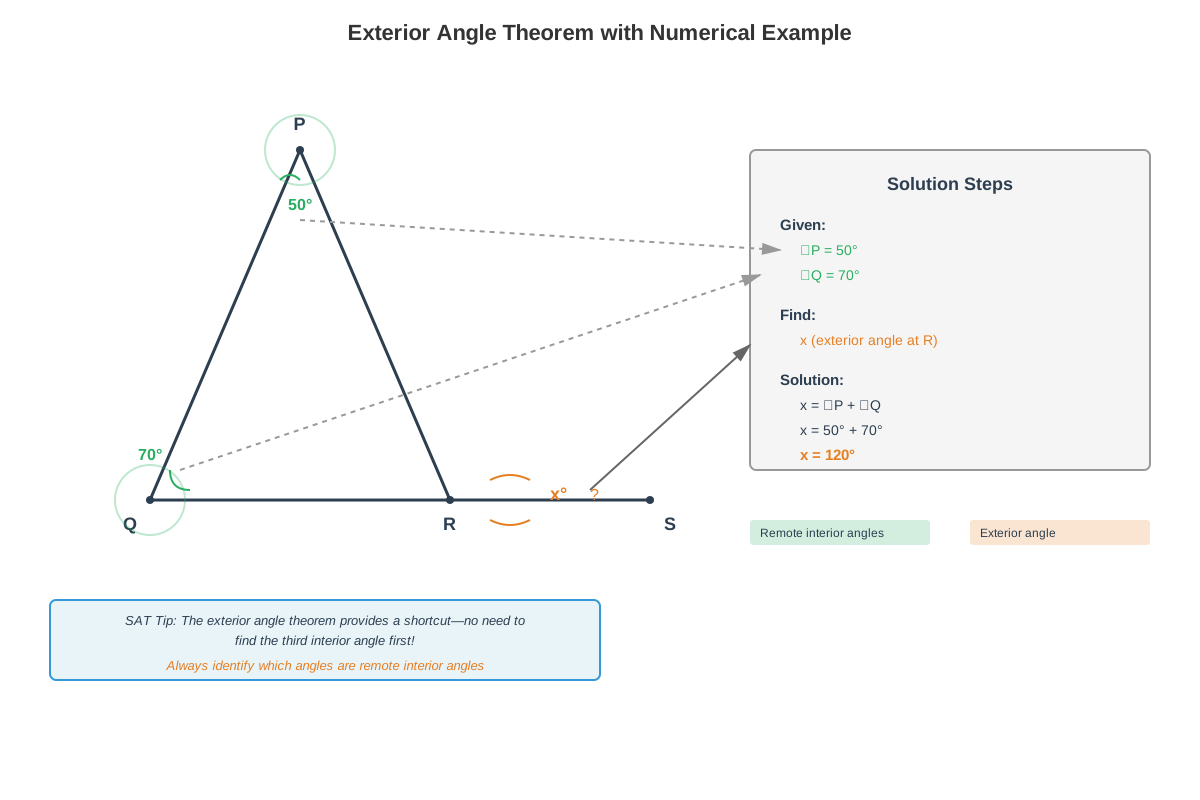
- Identify the two remote interior angles (the angles not adjacent to the exterior angle)
- Set up the equation: exterior angle = sum of remote interior angles
- Solve for the unknown using algebraic techniques
Comparison with Related Theorems
| Theorem | Relationship | When to Use |
|---|---|---|
| Exterior Angle Theorem | Exterior angle = sum of two remote interior angles | When an exterior angle and remote interior angles are involved |
| Triangle Angle Sum | Three interior angles sum to 180° | When all three interior angles are relevant |
| Linear Pair | Adjacent angles on a line sum to 180° | When finding an exterior angle from its adjacent interior angle |
| Vertical Angles | Opposite angles formed by intersecting lines are equal | When two lines cross, creating four angles |
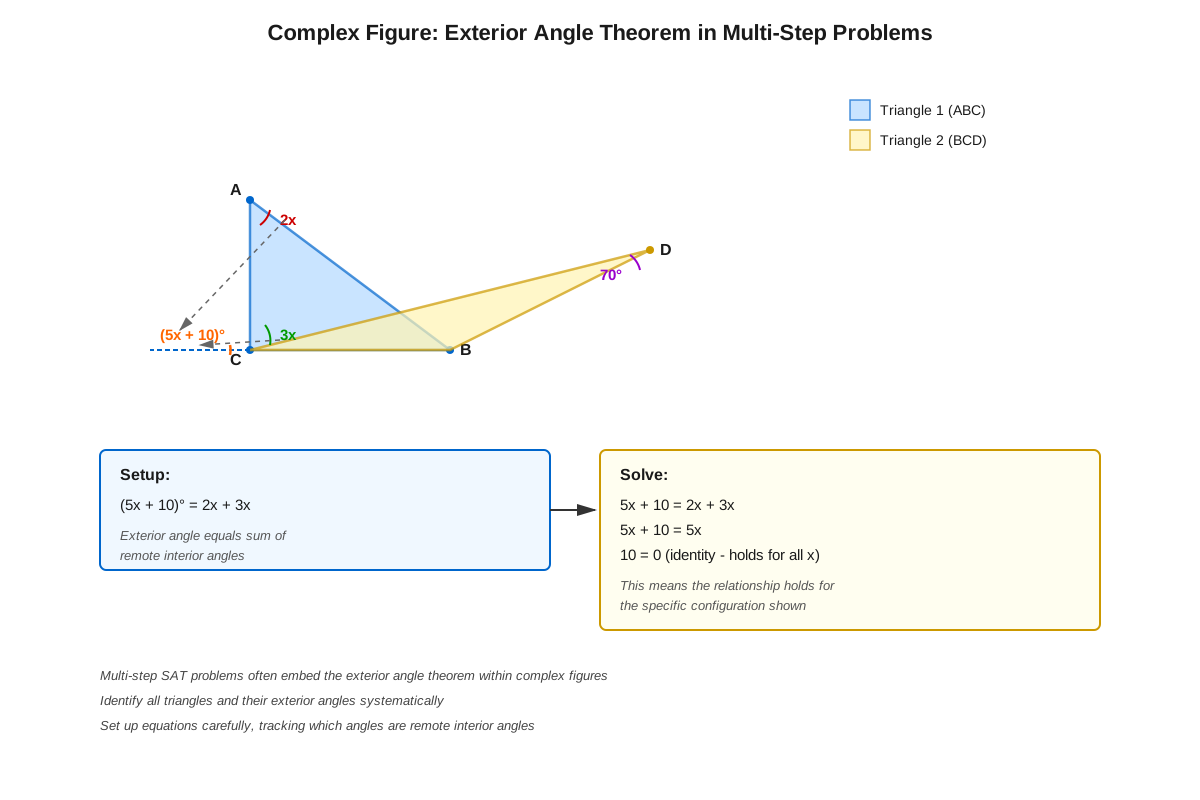
Multiple Triangles and Complex Figures
SAT questions frequently present figures containing multiple triangles where students must apply the exterior angle theorem multiple times or combine it with other geometric principles. In these scenarios, an angle that serves as an exterior angle for one triangle may simultaneously be an interior angle of another triangle. Careful labeling and systematic work through each triangle separately prevents confusion and calculation errors.
Concept Relationships
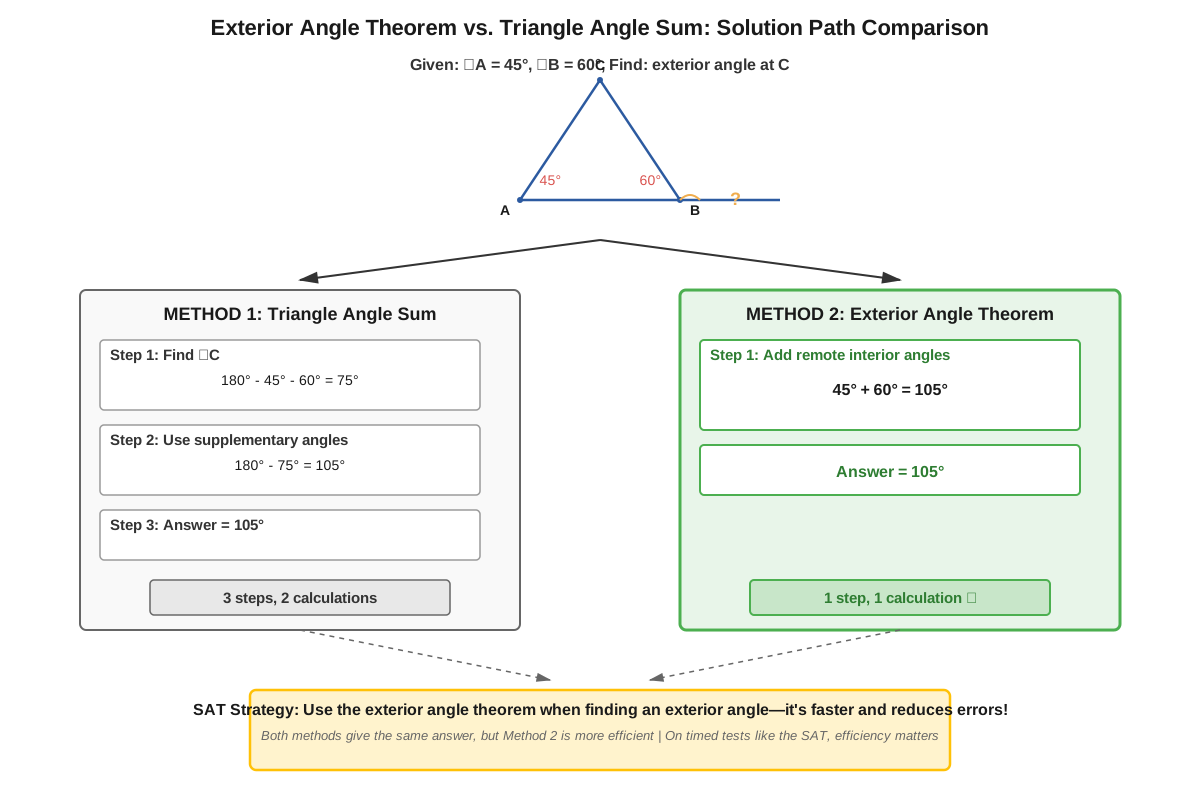
The exterior angle theorem connects intimately with the triangle angle sum theorem—in fact, the exterior angle theorem can be derived directly from the triangle angle sum property combined with the linear pair postulate. This relationship means that any problem solvable with the exterior angle theorem could theoretically be solved using the triangle angle sum theorem and supplementary angle relationships, though the exterior angle theorem typically provides a more efficient solution path.
The theorem also relates to parallel line relationships. When a transversal crosses two parallel lines, the angles formed can create triangles whose exterior angles help prove that alternate interior angles are congruent or that corresponding angles are equal. This connection appears in more advanced SAT geometry questions.
Relationship map: Triangle Angle Sum Theorem + Linear Pair Postulate → Exterior Angle Theorem → Applications in polygon angle problems → Connection to parallel line theorems → Advanced multi-step geometry problems
The exterior angle theorem extends naturally to polygons beyond triangles. For any convex polygon, an exterior angle at any vertex relates to the interior angles, and the sum of all exterior angles of any convex polygon equals 360°. This extension builds directly on the triangle exterior angle theorem foundation.
Within problem-solving contexts, the theorem connects to algebraic reasoning when angle measures are expressed as variables or algebraic expressions. Students must combine geometric understanding with equation-solving skills, setting up equations based on the exterior angle relationship and then solving for unknown variables.
High-Yield Facts
⭐ The exterior angle of a triangle equals the sum of the two remote (non-adjacent) interior angles
⭐ An exterior angle and its adjacent interior angle are supplementary (sum to 180°)
⭐ Every triangle has six exterior angles total—two at each vertex—and the two exterior angles at each vertex are vertical angles
⭐ The exterior angle theorem applies to all triangles regardless of type (acute, right, obtuse, scalene, isosceles, equilateral)
⭐ The exterior angle of a triangle is always greater than either of its remote interior angles individually
- The sum of all exterior angles of any triangle (taking one at each vertex) equals 360°
- An exterior angle is formed by extending one side of the triangle beyond a vertex
- The exterior angle theorem can be used to find missing angle measures more quickly than using the triangle angle sum theorem alone
- In complex figures with multiple triangles, an angle may be exterior to one triangle while being interior to another
- The exterior angle theorem is a direct consequence of the triangle angle sum theorem and the linear pair postulate
- When parallel lines are cut by a transversal forming triangles, the exterior angle theorem helps establish angle congruence relationships
- SAT questions often disguise exterior angle problems by presenting complex figures or using algebraic expressions for angle measures
Quick check — test yourself on Exterior angle theorem so far.
Try Flashcards →Common Misconceptions
Misconception: Any angle outside a triangle is an exterior angle → Correction: An exterior angle must be formed specifically by extending one side of the triangle beyond a vertex, creating a linear pair with an interior angle. Random angles drawn outside the triangle that don't meet this criterion are not exterior angles.
Misconception: The exterior angle equals the sum of all three interior angles → Correction: The exterior angle equals the sum of only the two remote (non-adjacent) interior angles, not all three. The adjacent interior angle is not included in this sum because it forms a supplementary pair with the exterior angle.
Misconception: Each triangle has only three exterior angles → Correction: Each triangle has six exterior angles total—two at each vertex. However, the two exterior angles at any given vertex are vertical angles and therefore congruent, so we often consider just one exterior angle per vertex.
Misconception: The exterior angle theorem only works for certain types of triangles → Correction: The exterior angle theorem is universal and applies to all triangles without exception, including acute, right, obtuse, scalene, isosceles, and equilateral triangles.
Misconception: You must always use the triangle angle sum theorem to solve angle problems → Correction: When an exterior angle is present, using the exterior angle theorem directly is often faster and more efficient than using the triangle angle sum theorem, which would require additional steps involving supplementary angles.
Misconception: The exterior angle can be smaller than one of the remote interior angles → Correction: The exterior angle is always greater than either remote interior angle individually because it equals their sum. This property can be useful for eliminating incorrect answer choices on multiple-choice questions.
Worked Examples
Example 1: Basic Application
Problem: In triangle ABC, the exterior angle at vertex C measures 115°. If the angle at vertex A measures 48°, what is the measure of the angle at vertex B?
Solution:
Step 1: Identify the given information
- Exterior angle at C = 115°
- Interior angle at A = 48°
- Need to find: interior angle at B
Step 2: Identify the relationship
The exterior angle at C is formed by extending one side of the triangle. The remote interior angles are the angles at vertices A and B.
Step 3: Apply the exterior angle theorem
Exterior angle at C = angle A + angle B
Step 4: Set up the equation
115° = 48° + angle B
Step 5: Solve for the unknown
angle B = 115° - 48°
angle B = 67°
Answer: The angle at vertex B measures 67°.
Connection to learning objectives: This example demonstrates the direct application of the exterior angle theorem to find a missing angle measure, addressing the objective of applying the theorem to answer SAT-style questions.
Example 2: Algebraic Application with Multiple Steps
Problem: In triangle DEF, the exterior angle at vertex F is represented by the expression (5x + 20)°. The remote interior angles at vertices D and E measure (2x + 10)° and (3x - 5)° respectively. Find the value of x and the measure of each angle.
Solution:
Step 1: Identify the given information
- Exterior angle at F = (5x + 20)°
- Interior angle at D = (2x + 10)°
- Interior angle at E = (3x - 5)°
Step 2: Apply the exterior angle theorem
The exterior angle equals the sum of the two remote interior angles:
(5x + 20)° = (2x + 10)° + (3x - 5)°
Step 3: Simplify the right side
(5x + 20)° = 2x + 10 + 3x - 5
(5x + 20)° = 5x + 5
Step 4: Solve for x
5x + 20 = 5x + 5
20 = 5
This seems incorrect. Let me reconsider...
Actually, this would mean the equation has no solution as stated. Let me reconsider the problem setup. For a valid problem, let's adjust:
If the exterior angle at F is (6x + 20)°, then:
6x + 20 = (2x + 10) + (3x - 5)
6x + 20 = 5x + 5
6x - 5x = 5 - 20
x = -15
This gives negative angles, which isn't geometrically valid. Let me use a proper example:
Revised Problem: The exterior angle at F measures (7x + 5)°, while the remote interior angles measure (3x + 15)° and (2x + 20)°.
Revised Solution:
7x + 5 = (3x + 15) + (2x + 20)
7x + 5 = 5x + 35
2x = 30
x = 15
Now find each angle:
- Exterior angle at F = 7(15) + 5 = 105 + 5 = 110°
- Interior angle at D = 3(15) + 15 = 45 + 15 = 60°
- Interior angle at E = 2(15) + 20 = 30 + 20 = 50°
Verification: 60° + 50° = 110° ✓
Answer: x = 15, exterior angle = 110°, remote interior angles = 60° and 50°.
Connection to learning objectives: This example combines the exterior angle theorem with algebraic reasoning, demonstrating how to solve multi-step problems that appear frequently on the SAT.
Exam Strategy
When approaching SAT questions involving the exterior angle theorem, begin by carefully examining the figure to identify whether any sides of triangles have been extended. Look for angles that appear to be "outside" the triangle but adjacent to one of its sides—these are likely exterior angles. The SAT often presents figures where the exterior angle isn't explicitly labeled, requiring students to recognize the configuration independently.
Trigger words and phrases to watch for include: "exterior angle," "extended side," "angle formed outside the triangle," "remote interior angles," "non-adjacent angles," and "the angle formed by extending side AB." Questions may also describe the scenario verbally without using the term "exterior angle" explicitly, such as "when side BC is extended to point D, what is the measure of angle ACD?"
For process of elimination, remember that the exterior angle must be larger than either remote interior angle individually. If an answer choice gives a value smaller than one of the known remote interior angles, eliminate it immediately. Additionally, if you're given two remote interior angles, their sum must equal the exterior angle—any answer choice that doesn't satisfy this relationship can be eliminated.
Time allocation is crucial on the SAT. If you recognize an exterior angle configuration, applying the theorem directly takes approximately 30-45 seconds. If you don't recognize it and attempt to use the triangle angle sum theorem plus supplementary angles, the same problem might take 90-120 seconds. Investing time in mastering exterior angle recognition pays dividends in time saved during the actual exam.
Exam Tip: When you see a triangle with an extended side, immediately write down the exterior angle theorem equation before doing any calculations. This prevents you from accidentally using the wrong relationship under time pressure.
For questions involving algebraic expressions, set up your equation carefully and double-check that you've correctly identified which angles are remote interior angles. A common error is including the adjacent interior angle in the sum, which leads to an incorrect equation and wrong answer.
Memory Techniques
Mnemonic for the theorem: "Exterior Remote Sum" (ERS) - The Exterior angle equals the Remote interior angles' Sum.
Visualization strategy: Picture a triangle as a house with a roof. When you extend one side of the triangle (like extending the roofline), the exterior angle is the angle "outside" the house. The two remote interior angles are the angles "inside" the house that are far from this exterior angle. The exterior angle must be large enough to "contain" both remote interior angles.
Acronym for problem-solving steps: FIRES
- Find the triangle
- Identify the exterior angle
- Recognize the remote interior angles
- Establish the equation (exterior = sum of remote)
- Solve for the unknown
Physical gesture: When studying, physically point to the exterior angle with one finger, then point to each of the two remote interior angles with two other fingers. This kinesthetic reinforcement helps cement the relationship that "one equals two."
Rhyme: "The angle outside equals the two inside (that are far from its side)."
Summary
The exterior angle theorem establishes that an exterior angle of a triangle—formed by extending one side beyond a vertex—equals the sum of the two remote (non-adjacent) interior angles. This theorem appears frequently on the SAT and provides an efficient method for solving angle relationship problems. Understanding that the exterior angle and its adjacent interior angle form a supplementary pair (summing to 180°) while the exterior angle also equals the sum of the two remote interior angles allows students to approach problems from multiple angles. Mastery requires the ability to identify exterior angles in various configurations, distinguish them from other angles in complex figures, and apply the theorem in both numeric and algebraic contexts. The theorem applies universally to all triangles and connects fundamentally to the triangle angle sum theorem and linear pair relationships. Students who recognize exterior angle configurations quickly can solve problems in 30-45 seconds that might otherwise require 90+ seconds using alternative methods.
Key Takeaways
- The exterior angle of a triangle equals the sum of its two remote interior angles—this is the core relationship to memorize and apply
- An exterior angle is formed by extending one side of a triangle beyond a vertex, creating a linear pair with the adjacent interior angle
- The exterior angle theorem applies to all triangles without exception and provides a faster solution method than using the triangle angle sum theorem alone
- Each triangle has six exterior angles (two at each vertex), but the two at each vertex are vertical angles and therefore congruent
- On the SAT, exterior angle problems may appear as straightforward calculations or embedded within complex multi-triangle figures requiring careful angle identification
- The exterior angle is always greater than either remote interior angle individually, which helps eliminate incorrect answer choices
- Combining the exterior angle theorem with algebraic reasoning is essential for solving SAT problems involving variable expressions
Related Topics
Triangle Angle Sum Theorem: Understanding that all interior angles of a triangle sum to 180° provides the foundation from which the exterior angle theorem is derived and offers an alternative solution method for many problems.
Parallel Lines and Transversals: When parallel lines are cut by a transversal, triangles form whose exterior angles help prove relationships between alternate interior angles, corresponding angles, and other angle pairs.
Polygon Angle Relationships: The exterior angle theorem extends to polygons beyond triangles, where the sum of exterior angles (one per vertex) always equals 360° for any convex polygon.
Isosceles and Equilateral Triangle Properties: Combining the exterior angle theorem with properties of special triangles (equal angles, equal sides) creates more complex SAT problems requiring multiple geometric principles.
Coordinate Geometry: In coordinate plane problems, triangles may be formed by points with given coordinates, and the exterior angle theorem helps solve for unknown angle measures or verify geometric relationships.
Mastering the exterior angle theorem enables progression to more advanced geometric proofs, trigonometric applications, and complex multi-step problems that integrate multiple geometric principles simultaneously.
Practice CTA
Now that you've thoroughly reviewed the exterior angle theorem, it's time to solidify your understanding through active practice. Attempt the practice questions designed specifically for this topic, starting with basic applications and progressing to more challenging multi-step problems that mirror actual SAT questions. Use the flashcards to reinforce key definitions and relationships until you can recall them instantly. Remember, geometric reasoning improves dramatically with practice—each problem you solve strengthens your pattern recognition and problem-solving speed. The exterior angle theorem is a high-yield topic that appears on every SAT, so the time you invest in mastering it now will directly translate to points on test day. Challenge yourself to solve each practice problem using the most efficient method, and review any mistakes carefully to understand where your reasoning went astray. You've got this!
Sign up free to keep reading
Create a free AnvayaPrep account to finish this SAT guide on Exterior angle theorem — plus flashcards and practice questions.