Overview
The triangle angle sum theorem is one of the most fundamental principles in geometry and a cornerstone concept for SAT Math success. This theorem states that the interior angles of any triangle always add up to exactly 180 degrees, regardless of the triangle's shape, size, or type. This seemingly simple rule unlocks the solution to countless geometry problems on the SAT and serves as the foundation for understanding more complex geometric relationships involving polygons, parallel lines, and angle relationships.
On the SAT, triangle angle sum questions appear with remarkable frequency, making this a high-yield topic that demands complete mastery. These questions rarely ask students to simply recite the theorem; instead, they embed the concept within multi-step problems involving algebraic expressions, systems of equations, or complex diagrams with multiple triangles. The College Board tests whether students can recognize when to apply the triangle angle sum theorem, combine it with other geometric principles, and execute calculations accurately under time pressure.
Understanding triangle angle sum connects directly to broader math concepts tested on the SAT, including linear equations, exterior angles, polygon angle sums, and properties of parallel lines cut by transversals. Mastering this topic provides the geometric reasoning skills necessary for tackling approximately 15-20% of SAT Math questions, making it an essential investment of study time with immediate returns on test day.
Learning Objectives
- [ ] Identify key features of triangle angle sum, including the fundamental theorem and its applications
- [ ] Explain how triangle angle sum appears on the SAT in various question formats and difficulty levels
- [ ] Apply triangle angle sum to answer SAT-style questions involving algebraic expressions and multi-step reasoning
- [ ] Calculate missing angle measures in triangles when given two angles or algebraic expressions
- [ ] Solve for variables in equations derived from the triangle angle sum theorem
- [ ] Recognize and apply the relationship between interior and exterior angles of triangles
- [ ] Combine triangle angle sum with other geometric principles to solve complex problems
Prerequisites
- Basic angle measurement: Understanding that angles are measured in degrees and recognizing angle notation is essential for interpreting triangle diagrams and applying the theorem correctly
- Algebraic equation solving: The ability to set up and solve linear equations is necessary because SAT questions frequently express angle measures as algebraic expressions
- Angle relationships: Knowledge of complementary angles (sum to 90°), supplementary angles (sum to 180°), and vertical angles (equal measures) helps solve problems involving triangles within larger geometric figures
- Triangle classification: Familiarity with equilateral, isosceles, and scalene triangles enables recognition of additional angle relationships that combine with the angle sum theorem
Why This Topic Matters
The triangle angle sum theorem appears in real-world applications across architecture, engineering, navigation, and design. Architects use this principle to ensure structural stability in triangular trusses and roof designs. Surveyors apply triangle angle relationships to measure distances and map terrain. Even smartphone GPS systems rely on triangulation methods that depend fundamentally on triangle angle properties.
On the SAT, triangle angle sum questions appear in approximately 3-5 questions per test, representing roughly 5-8% of the total Math section. These questions span both the calculator and no-calculator portions and range from straightforward single-triangle problems to complex scenarios involving multiple triangles, parallel lines, or polygon decomposition. The College Board particularly favors questions that combine the triangle angle sum with algebraic reasoning, requiring students to set up equations with variables representing unknown angles.
Common SAT question formats include: diagrams showing triangles with two known angles and one unknown; triangles with angles expressed as algebraic expressions (such as x, 2x, and 3x); overlapping or adjacent triangles sharing angles; triangles formed by parallel lines and transversals; and word problems describing angle relationships without diagrams. The versatility of this concept means it can appear in questions testing pure geometry, algebra, or problem-solving skills, making it one of the most integrated topics across the SAT Math curriculum.
Core Concepts
The Fundamental Triangle Angle Sum Theorem
The triangle angle sum theorem states that the sum of the three interior angles of any triangle equals exactly 180 degrees. Mathematically expressed:
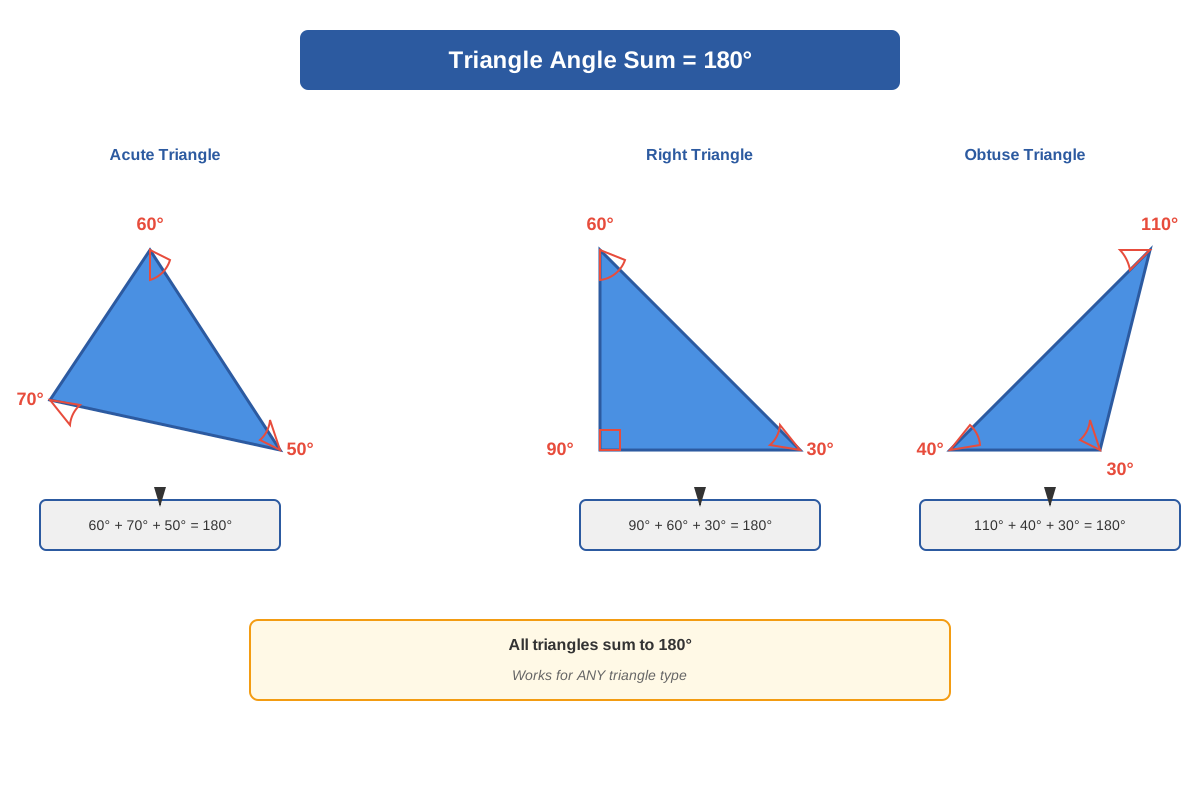
∠A + ∠B + ∠C = 180°This relationship holds true for every triangle without exception—whether the triangle is acute (all angles less than 90°), right (one 90° angle), obtuse (one angle greater than 90°), equilateral (all sides and angles equal), isosceles (two sides and angles equal), or scalene (all sides and angles different). The universality of this theorem makes it an incredibly powerful tool for solving geometric problems.
The proof of this theorem relies on the properties of parallel lines. When a line is drawn through one vertex parallel to the opposite side, alternate interior angles and corresponding angles create angle relationships that demonstrate the 180° sum. While the SAT doesn't require students to prove the theorem, understanding its logical foundation helps build confidence in applying it to complex problems.
Applying the Theorem to Find Missing Angles
When two angles of a triangle are known, the third angle can always be calculated by subtracting the sum of the known angles from 180°. For example, if a triangle has angles measuring 45° and 70°, the third angle must measure:
180° - (45° + 70°) = 180° - 115° = 65°This straightforward application appears frequently on the SAT, though often embedded within more complex scenarios. Students must carefully identify which angles belong to the same triangle, especially in diagrams showing multiple overlapping or adjacent triangles.
Algebraic Applications of Triangle Angle Sum
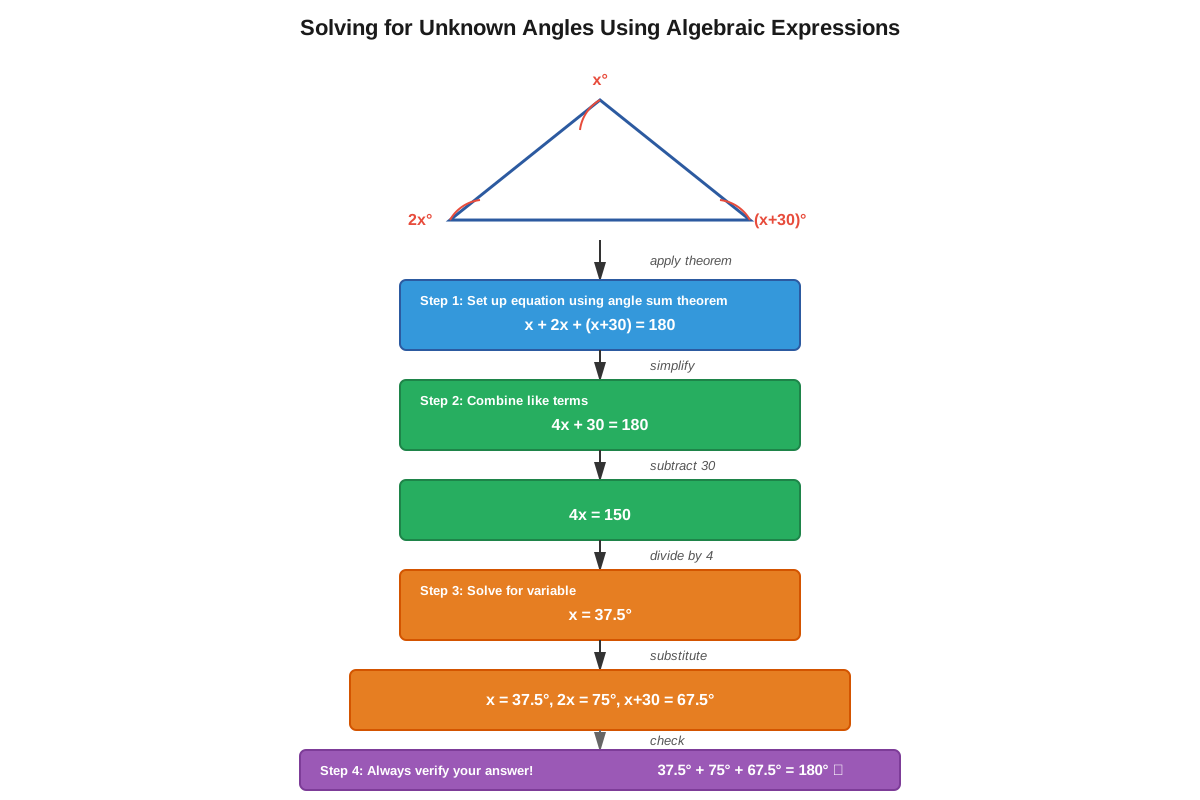
The SAT frequently presents triangle angles as algebraic expressions rather than numerical values. Consider a triangle with angles measuring x°, 2x°, and 3x°. Using the triangle angle sum theorem:
x + 2x + 3x = 180
6x = 180
x = 30
Therefore, the three angles measure 30°, 60°, and 90°, revealing this is a 30-60-90 right triangle. This type of problem tests both geometric understanding and algebraic manipulation skills simultaneously.
More complex variations might include expressions like (2x + 10)°, (3x - 5)°, and (x + 15)°, requiring students to combine like terms and solve multi-step equations. The key strategy involves setting up the equation correctly by ensuring all three angle expressions sum to 180°.
Exterior Angle Theorem Connection
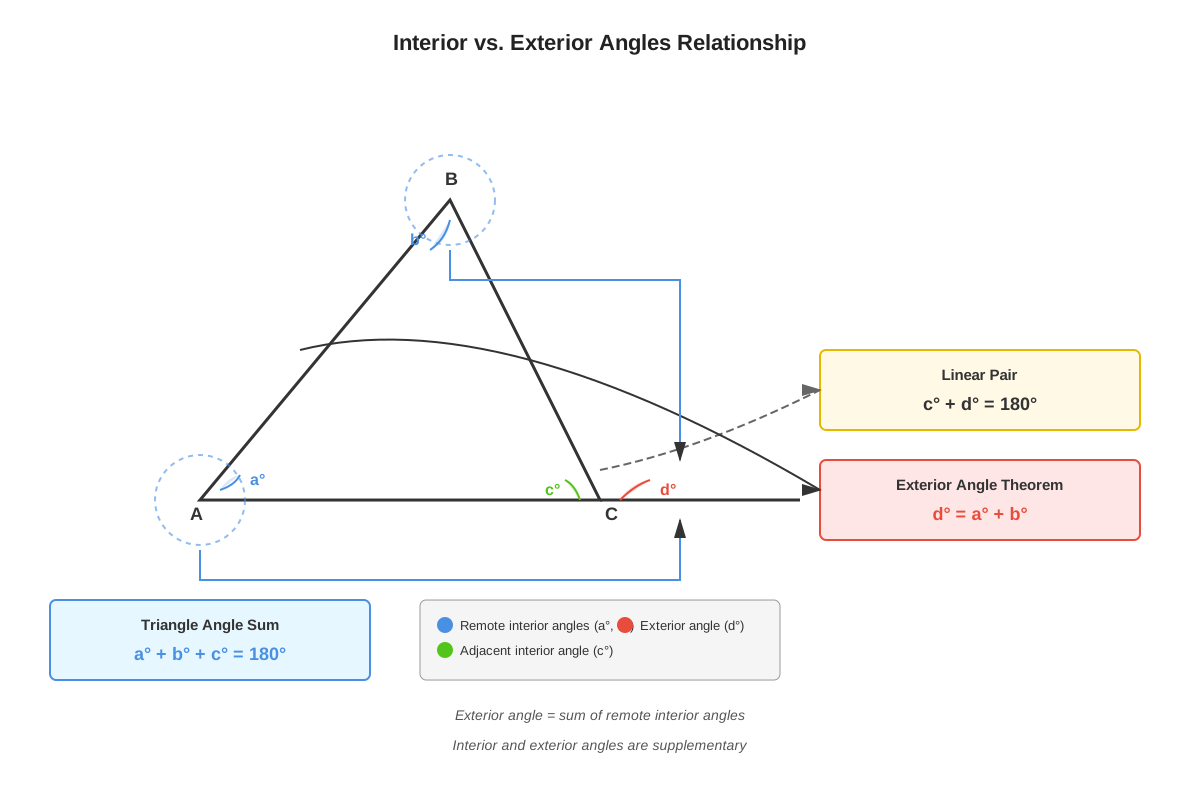
The exterior angle theorem states that an exterior angle of a triangle equals the sum of the two non-adjacent interior angles. This theorem is actually a direct consequence of the triangle angle sum theorem. If one interior angle measures a° and an exterior angle at another vertex measures e°, then:
a + e = 180° (linear pair)Combined with the triangle angle sum theorem, this creates powerful relationships for solving complex problems. The SAT often tests whether students can recognize when to apply the exterior angle theorem as a shortcut versus using the interior angle sum.
Special Triangle Angle Relationships
Certain triangle types have additional angle constraints that combine with the triangle angle sum theorem:
| Triangle Type | Angle Properties | Application to Angle Sum |
|---|---|---|
| Equilateral | All three angles equal | Each angle = 180° ÷ 3 = 60° |
| Isosceles | Two angles equal (base angles) | If base angles = x°, then 2x + (third angle) = 180° |
| Right | One angle = 90° | The two acute angles sum to 90° |
| Obtuse | One angle > 90° | The two acute angles sum to less than 90° |
Recognizing these special cases allows for faster problem-solving and provides built-in answer checking mechanisms.
Multiple Triangle Systems
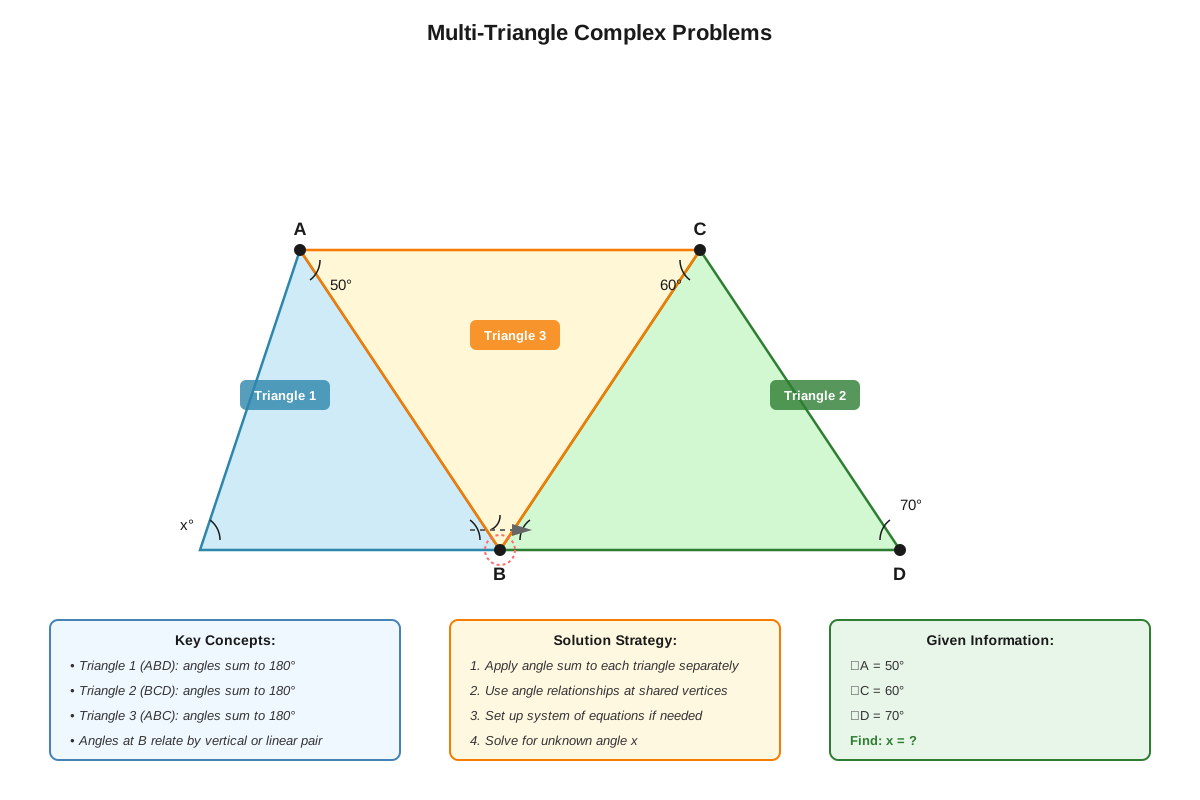
SAT problems frequently present diagrams containing multiple triangles that share sides or angles. In these scenarios, students must:
- Identify each distinct triangle in the figure
- Apply the triangle angle sum theorem to each triangle separately
- Use shared angles or sides to create systems of equations
- Solve systematically, often finding angles in one triangle before moving to adjacent triangles
For example, if two triangles share a common side and one angle of each triangle is known, students might need to find an angle in the first triangle, then use that result as a known angle in the second triangle.
Integration with Parallel Lines
When parallel lines are cut by a transversal, they create triangles with specific angle relationships. The combination of alternate interior angles (equal when lines are parallel), corresponding angles (equal when lines are parallel), and the triangle angle sum theorem creates a powerful problem-solving framework. These integrated problems represent some of the most challenging triangle angle sum questions on the SAT.
Concept Relationships
The triangle angle sum theorem serves as a central hub connecting multiple geometric concepts. At its foundation, the theorem relies on angle measurement and basic arithmetic (addition and subtraction). Moving outward, it connects directly to algebraic equation solving when angles are expressed as variables or expressions, creating a bridge between geometry and algebra that the SAT exploits frequently.
The relationship flows as follows: Basic angle properties → Triangle angle sum theorem → Exterior angle theorem → Polygon angle sum formulas. The triangle angle sum is the building block for understanding that a quadrilateral's angles sum to 360° (two triangles), a pentagon's to 540° (three triangles), and generally that an n-sided polygon's interior angles sum to (n-2) × 180°.
Laterally, triangle angle sum connects to parallel line properties through the alternate interior angle and corresponding angle theorems. When parallel lines create triangles, these angle relationships combine with the 180° sum to solve complex problems. Similarly, the theorem connects to triangle congruence and similarity, as angle measures help determine when triangles are congruent (same angles and sides) or similar (same angles, proportional sides).
The theorem also enables understanding of special right triangles (30-60-90 and 45-45-90), as the angle sum explains why these specific angle combinations create predictable side ratios. Finally, triangle angle sum connects forward to trigonometry, where angle measures determine sine, cosine, and tangent ratios—though trigonometry appears minimally on the SAT.
High-Yield Facts
⭐ The sum of the interior angles of any triangle always equals exactly 180 degrees, regardless of triangle type or size
⭐ If two angles of a triangle are known, the third angle equals 180° minus the sum of the two known angles
⭐ In an equilateral triangle, each angle measures exactly 60° (180° ÷ 3)
⭐ In an isosceles triangle, the two base angles (opposite the equal sides) are always equal in measure
⭐ In a right triangle, the two acute angles must sum to 90° (since one angle is already 90°)
- An exterior angle of a triangle equals the sum of the two non-adjacent interior angles
- When angles are expressed algebraically, set up an equation where the three expressions sum to 180°
- The largest angle in a triangle is always opposite the longest side; the smallest angle is opposite the shortest side
⭐ If a triangle has angles in the ratio a:b:c, multiply each ratio value by 180°/(a+b+c) to find actual angle measures
- In any triangle, at least two angles must be acute (less than 90°), since having two angles ≥90° would exceed 180°
- Vertical angles formed by intersecting lines are equal, which helps find angles in triangles formed by intersecting line segments
- When parallel lines are cut by a transversal forming triangles, alternate interior angles are equal
- The angle sum theorem applies to triangles in coordinate geometry, three-dimensional figures, and abstract diagrams equally
Quick check — test yourself on Triangle angle sum so far.
Try Flashcards →Common Misconceptions
Misconception: The triangle angle sum theorem only applies to right triangles or special triangles.
Correction: The theorem applies universally to every triangle without exception, including acute, obtuse, scalene, isosceles, and equilateral triangles. The 180° sum is a fundamental property of triangular geometry in Euclidean space.
Misconception: If a triangle has two equal angles, all three angles must be equal.
Correction: Two equal angles indicate an isosceles triangle, not necessarily an equilateral triangle. Only when all three angles are equal (each 60°) is the triangle equilateral. An isosceles triangle might have angles of 70°, 70°, and 40°, for example.
Misconception: Exterior angles are included in the 180° sum.
Correction: The triangle angle sum theorem refers only to the three interior angles. Exterior angles form linear pairs with interior angles (summing to 180° with their adjacent interior angle) but are not part of the interior angle sum calculation.
Misconception: In problems with algebraic expressions for angles, you can solve for x by setting any single expression equal to 180°.
Correction: You must set the sum of all three angle expressions equal to 180°, then solve for the variable. Each individual angle expression represents only one angle, not the total.
Misconception: Larger triangles have larger angle sums than smaller triangles.
Correction: The size or scale of a triangle has no effect on its angle sum. A tiny triangle and a huge triangle with the same angle measures are similar figures, and both have angles summing to exactly 180°. The angle sum is independent of the triangle's dimensions.
Misconception: If you know one angle of a triangle, you can determine the other two angles.
Correction: Knowing one angle only tells you that the other two angles must sum to (180° - known angle), but infinite combinations of two angles could satisfy this requirement. You need at least two angles, or additional information about the triangle's properties (like it being isosceles), to determine all angles.
Worked Examples
Example 1: Basic Algebraic Application
Problem: In triangle ABC, angle A measures (2x + 15)°, angle B measures (3x - 10)°, and angle C measures (x + 25)°. Find the measure of each angle.
Solution:
Step 1: Apply the triangle angle sum theorem by setting the sum of all three angles equal to 180°.
(2x + 15) + (3x - 10) + (x + 25) = 180Step 2: Combine like terms on the left side.
2x + 3x + x + 15 - 10 + 25 = 180
6x + 30 = 180
Step 3: Solve for x by isolating the variable.
6x = 180 - 30
6x = 150
x = 25
Step 4: Substitute x = 25 back into each angle expression to find the actual angle measures.
Angle A = 2(25) + 15 = 50 + 15 = 65°
Angle B = 3(25) - 10 = 75 - 10 = 65°
Angle C = 25 + 25 = 50°
Step 5: Verify the answer by checking that the angles sum to 180°.
65° + 65° + 50° = 180° ✓Connection to Learning Objectives: This example demonstrates applying the triangle angle sum to solve SAT-style questions involving algebraic expressions, addressing the core skill of setting up and solving equations derived from geometric principles.
Example 2: Multiple Triangle System
Problem: In the diagram, line segment BD divides triangle ABC into two smaller triangles, ABD and BCD. In triangle ABD, angle A = 40° and angle ABD = 70°. In triangle BCD, angle BCD = 55°. Line segments AB and CD are parallel. Find the measure of angle BDC.
Solution:
Step 1: Find angle ADB in triangle ABD using the triangle angle sum theorem.
∠A + ∠ABD + ∠ADB = 180°
40° + 70° + ∠ADB = 180°
∠ADB = 180° - 110° = 70°
Step 2: Recognize that angles ADB and BDC form a linear pair (they're supplementary angles on a straight line).
∠ADB + ∠BDC = 180°
70° + ∠BDC = 180°
∠BDC = 110°
Step 3: Verify this answer using triangle BCD and the given information.
∠DBC + ∠BCD + ∠BDC = 180°Step 4: Since AB and CD are parallel, and BD is a transversal, angle ABD and angle BDC are alternate interior angles... wait, that's not correct. Let me reconsider.
Actually, since AB || CD, angle ABD and angle BDC are NOT alternate interior angles because they're not on opposite sides of the transversal. Instead, use the triangle angle sum in triangle BCD:
∠DBC + 55° + 110° = 180°
∠DBC = 15°
This confirms our answer: angle BDC = 110°.
Connection to Learning Objectives: This example shows how triangle angle sum appears in complex SAT diagrams with multiple triangles and parallel lines, requiring students to apply the theorem systematically while tracking which angles belong to which triangle.
Exam Strategy
When approaching sat triangle angle sum questions on test day, begin by carefully examining the diagram and marking all known angle measures directly on the figure. This visual organization prevents confusion in multi-triangle problems and helps identify which angles belong to which triangle. If no diagram is provided, sketch one immediately—even a rough triangle with labeled angles dramatically reduces errors.
Trigger words and phrases that signal triangle angle sum problems include: "the angles of a triangle," "find the measure of angle," "the sum of two angles," "what is the value of x," and any mention of angle relationships within triangles. Questions asking about "the third angle" or "the remaining angle" almost always require straightforward application of the 180° sum.
For process-of-elimination strategies, remember that no angle in a triangle can be 180° or greater (eliminate any such answer choices immediately), and the sum of any two angles must be less than 180°. If answer choices are given as algebraic expressions, substitute them back into the triangle angle sum equation to verify—incorrect answers will not sum to 180°. When dealing with special triangles, eliminate answers inconsistent with known properties (for example, if the triangle is described as isosceles, eliminate answers where the base angles differ).
Time allocation for triangle angle sum questions should average 45-60 seconds for straightforward problems and up to 90 seconds for complex multi-triangle scenarios. If a problem requires more than two minutes, mark it for review and move on—these questions rarely justify extended time investment compared to other SAT Math topics. Practice recognizing the difference between simple one-step applications (quick points) and complex integrated problems (potentially time-consuming).
Always verify your answer when time permits by checking that angles sum to 180°. This five-second check catches calculation errors and provides confidence before moving to the next question. For algebraic problems, substitute your x-value back into all three angle expressions and confirm the sum—this catches both algebraic mistakes and conceptual errors.
Memory Techniques
The "Triangle = Half Circle" Mnemonic: Remember that a triangle's angles sum to 180° by visualizing that 180° is a straight line (half a circle). A triangle's angles, if placed adjacent to each other, would form a straight line. This visual connection reinforces why the sum is exactly half of a circle's 360°.
The "2-1-8-0" Finger Method: Hold up two fingers on one hand and one on the other, then make a circle with both hands. This physical reminder represents "2 hands, 1 concept, 8-0 degrees" and provides a kinesthetic memory aid during the test.
The Algebraic Setup Acronym "SAT": When solving algebraic triangle problems, remember Sum All Three expressions equal to 180. This reminds you to add all three angle expressions before setting the equation equal to 180°, preventing the common error of setting a single expression equal to 180°.
The Special Triangle Rhyme: "Sixty-sixty-sixty makes equilateral plenty; ninety plus two that sum to ninety makes a right triangle mighty; two the same means isosceles came." This rhyme encodes the angle properties of the three most common special triangles on the SAT.
Visualization Strategy: When encountering complex diagrams, mentally "color code" different triangles by tracing each triangle's outline with your pencil in different patterns (solid, dashed, dotted). This visual separation prevents mixing up which angles belong to which triangle, especially in overlapping triangle problems.
Summary
The triangle angle sum theorem—stating that the three interior angles of any triangle always sum to exactly 180 degrees—is a foundational geometric principle with high-yield applications throughout the SAT Math section. This universal property applies to all triangle types without exception and serves as the basis for solving both straightforward angle-finding problems and complex multi-step questions involving algebraic expressions, multiple triangles, and parallel line relationships. Success on SAT triangle angle sum questions requires the ability to set up equations correctly when angles are expressed algebraically, systematically apply the theorem to each triangle in complex diagrams, and integrate this principle with other geometric concepts like exterior angles, parallel line properties, and special triangle characteristics. Mastery involves not just memorizing the 180° sum but developing the problem-solving flexibility to recognize when and how to apply this theorem across diverse question formats, from simple numerical calculations to sophisticated algebraic reasoning challenges that combine geometry with equation-solving skills.
Key Takeaways
- The interior angles of any triangle always sum to exactly 180°, regardless of the triangle's type, size, or shape
- When two angles are known, calculate the third by subtracting their sum from 180°
- For algebraic angle expressions, set up an equation where all three expressions sum to 180°, then solve for the variable
- Special triangles have additional constraints: equilateral (all 60°), isosceles (two equal angles), right (acute angles sum to 90°)
- In multi-triangle diagrams, apply the theorem separately to each triangle while tracking shared angles
- The exterior angle of a triangle equals the sum of the two non-adjacent interior angles
- Always verify solutions by confirming that the three angles sum to 180°—this catches calculation errors and builds confidence
Related Topics
Exterior Angles of Triangles: Understanding how exterior angles relate to interior angles through both linear pairs (supplementary) and the exterior angle theorem (equals sum of non-adjacent interior angles) extends triangle angle sum mastery and appears frequently alongside interior angle problems on the SAT.
Polygon Angle Sums: The triangle angle sum theorem is the foundation for calculating interior angle sums of all polygons using the formula (n-2) × 180°, where n is the number of sides. Mastering triangles makes polygon problems significantly more accessible.
Parallel Lines and Transversals: When parallel lines are cut by transversals, they create triangles with specific angle relationships. Combining alternate interior angles, corresponding angles, and triangle angle sum creates powerful problem-solving strategies for complex SAT geometry questions.
Triangle Congruence and Similarity: Angle measures are critical for determining when triangles are congruent (SSS, SAS, ASA, AAS, HL) or similar (AA, SAS, SSS). Understanding angle relationships through the angle sum theorem enables recognition of these important triangle relationships.
Special Right Triangles (30-60-90 and 45-45-90): These triangles have specific angle measures that satisfy the triangle angle sum theorem while also creating predictable side ratios. Mastering basic triangle angle sum provides the foundation for understanding these high-yield SAT triangle types.
Practice CTA
Now that you've mastered the triangle angle sum theorem and its applications, it's time to cement your understanding through active practice. Attempt the practice questions to test your ability to apply these concepts under test-like conditions, and use the flashcards to reinforce the high-yield facts and formulas you'll need for automatic recall on test day. Remember, the difference between understanding a concept and scoring points on the SAT lies in practiced application—each problem you solve builds the pattern recognition and problem-solving speed that translates directly into higher scores. You've invested the time to learn this essential topic; now invest a few more minutes to ensure it becomes a reliable source of points on your SAT Math section!
Sign up free to keep reading
Create a free AnvayaPrep account to finish this SAT guide on Triangle angle sum — plus flashcards and practice questions.