Overview
Transversals are lines that intersect two or more other lines at distinct points, creating a rich system of angle relationships that form the foundation of many geometric proofs and problem-solving strategies. On the SAT math section, understanding transversals is absolutely critical because these concepts appear frequently in both multiple-choice and grid-in questions, often combined with other geometric principles like parallel lines, triangles, and polygons. When a transversal cuts through parallel lines, it creates eight angles with predictable relationships—mastering these patterns allows students to solve complex problems quickly and confidently.
The importance of transversals extends far beyond isolated geometry questions. These concepts integrate seamlessly with coordinate geometry, triangle properties, and even algebraic reasoning when variables represent unknown angle measures. SAT transversals questions typically test whether students can identify angle relationships, set up equations based on those relationships, and solve for unknown values under time pressure. The College Board consistently includes 2-4 questions per test that directly or indirectly assess transversal knowledge, making this a high-yield topic that deserves focused attention.
Understanding transversals provides the geometric reasoning skills necessary for more advanced topics like similar triangles, polygon angle sums, and coordinate plane geometry. The logical thinking required to navigate angle relationships—recognizing which angles are equal, which are supplementary, and how to chain multiple relationships together—develops mathematical maturity that benefits students across all SAT math domains. This topic represents a perfect intersection of visual-spatial reasoning and algebraic manipulation, skills that define success on standardized tests.
Learning Objectives
- [ ] Identify key features of transversals, including the eight angles formed when a transversal intersects two lines
- [ ] Explain how transversals appears on the SAT, including common question formats and integration with other geometry topics
- [ ] Apply transversals to answer SAT-style questions involving parallel lines, angle relationships, and algebraic reasoning
- [ ] Distinguish between corresponding angles, alternate interior angles, alternate exterior angles, and consecutive interior angles
- [ ] Determine whether two lines are parallel based on angle relationships created by a transversal
- [ ] Solve multi-step problems that combine transversal properties with equations and other geometric principles
Prerequisites
- Basic angle vocabulary: Understanding terms like acute, obtuse, right, straight, complementary, and supplementary angles is essential because transversal problems frequently require identifying these angle types and their numerical relationships.
- Linear pairs and vertical angles: These fundamental angle relationships appear constantly in transversal diagrams, as adjacent angles on a straight line and opposite angles at intersections form the building blocks of more complex relationships.
- Algebraic equation solving: Since many SAT transversal questions present angles as algebraic expressions (like 3x + 10), students must confidently solve linear equations and systems of equations.
- Properties of parallel lines: Recognizing parallel line notation (arrows or matching tick marks) and understanding that parallel lines never intersect provides the foundation for the special angle relationships transversals create.
Why This Topic Matters
In real-world applications, transversal concepts appear in architecture, engineering, urban planning, and design. When architects design buildings with parallel support beams crossed by diagonal braces, they rely on transversal angle relationships to ensure structural integrity. City planners use these principles when streets intersect at various angles, calculating optimal traffic flow patterns. Even in computer graphics and game design, programmers use transversal geometry to render realistic three-dimensional environments and calculate light reflection angles.
On the SAT, transversal questions appear with remarkable consistency—approximately 10-15% of geometry questions directly test this concept, and many additional questions incorporate transversal reasoning as part of multi-step problems. The College Board favors questions that combine transversals with algebraic expressions, requiring students to set up and solve equations based on angle relationships. These questions typically appear in both the calculator and no-calculator sections, with difficulty levels ranging from medium to hard. The most challenging versions involve multiple transversals, non-parallel lines, or integration with triangle properties.
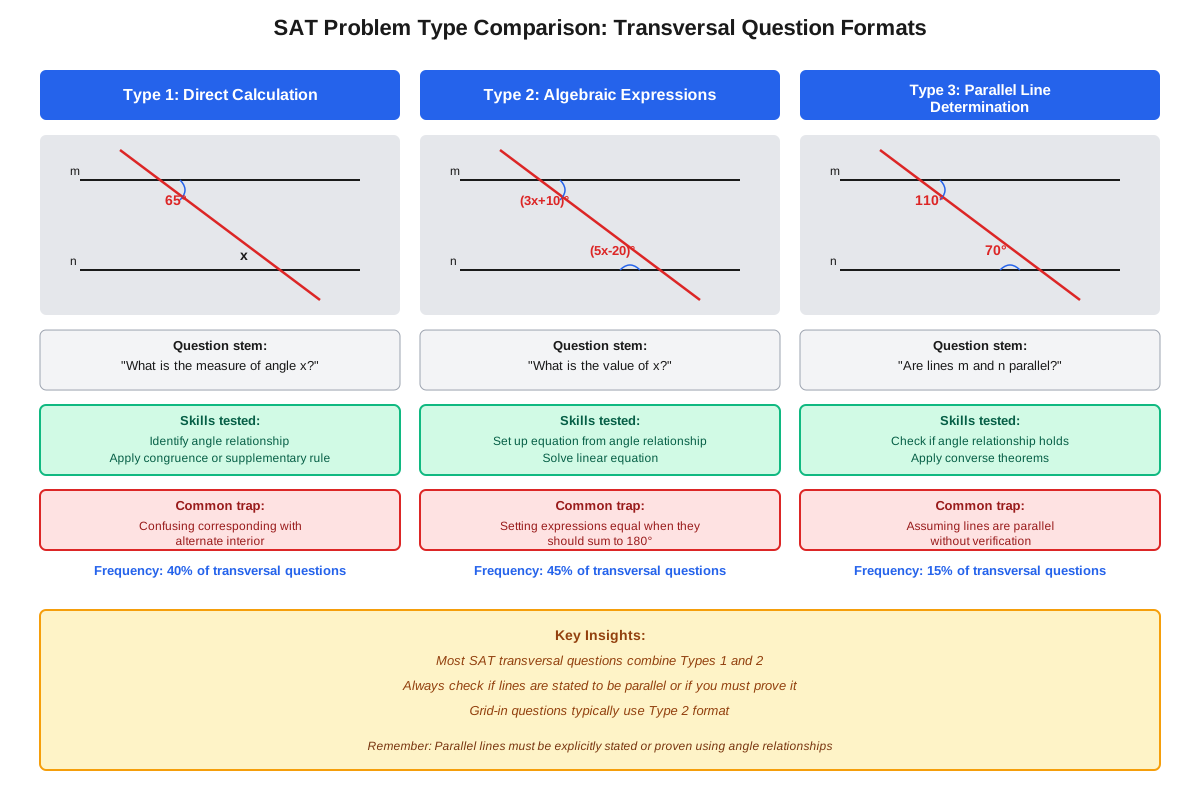
Common SAT question formats include: identifying angle measures when given one angle and parallel lines; determining whether lines are parallel based on angle information; solving for variables in algebraic expressions representing angles; and applying transversal properties within larger geometric figures like triangles or quadrilaterals. The test makers particularly favor scenarios where students must recognize that two different angle relationships lead to the same conclusion, testing both geometric intuition and algebraic flexibility.
Core Concepts
Definition and Basic Structure
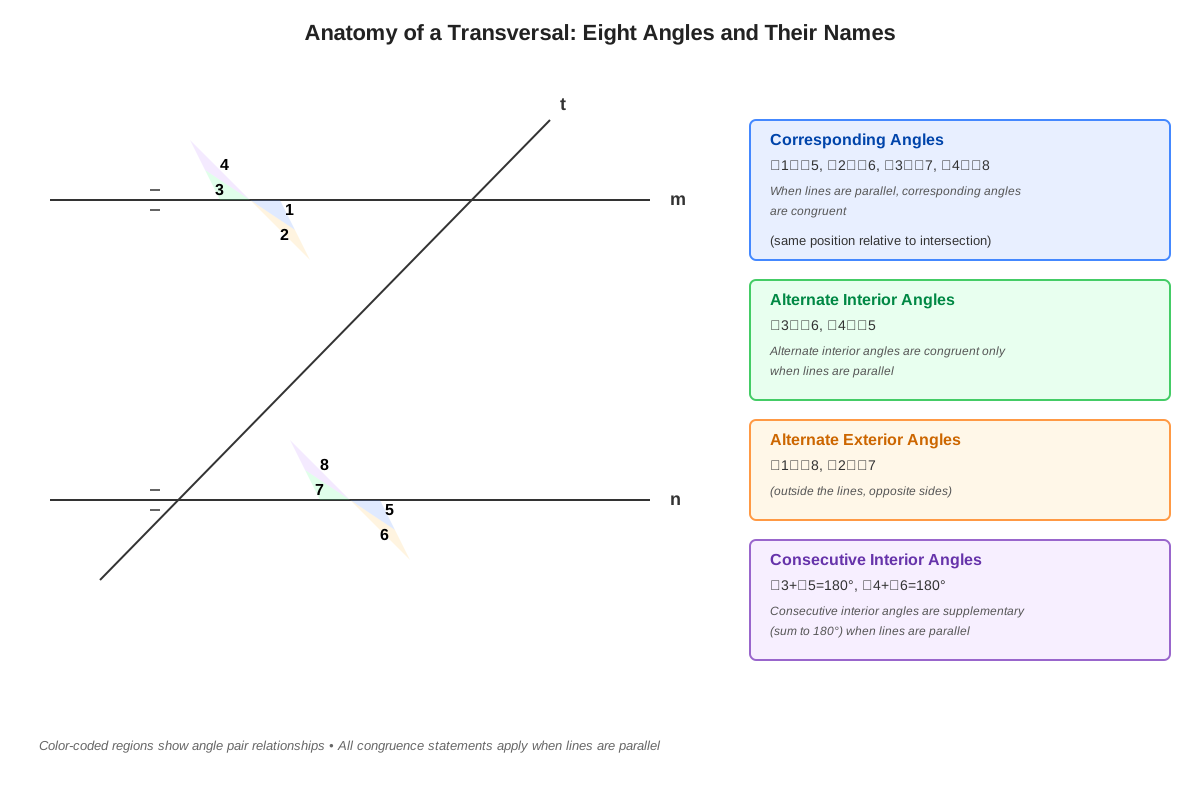
A transversal is a line that intersects two or more coplanar lines at distinct points. When a transversal crosses two lines, it creates eight angles (four at each intersection point). These eight angles have specific names and relationships that become especially powerful when the two lines being crossed are parallel. Understanding the anatomy of a transversal diagram is the first step toward mastery: label the transversal itself, identify the two lines it crosses, and number or name all eight angles systematically.
The two lines intersected by the transversal divide the plane into regions. Angles located between the two lines are called interior angles, while angles located outside the two lines are called exterior angles. Additionally, angles can be classified by their position relative to the transversal: angles on the same side of the transversal share a positional relationship, while angles on opposite sides have an alternate relationship. These positional classifications combine to create the four major angle pair types that dominate SAT questions.
Angle Pair Relationships with Parallel Lines
When a transversal intersects parallel lines, four critical angle relationships emerge that allow students to determine unknown angle measures:
Corresponding angles occupy the same relative position at each intersection point. Imagine the transversal creating an "F" shape (or backwards "F")—the angles at the same position in each intersection are corresponding. When lines are parallel, corresponding angles are congruent (equal in measure). For example, if the upper-right angle at the first intersection measures 65°, the upper-right angle at the second intersection also measures 65°.
Alternate interior angles lie between the parallel lines but on opposite sides of the transversal, forming a "Z" pattern (or backwards "Z"). When lines are parallel, alternate interior angles are congruent. This relationship is particularly useful because it connects angles that aren't adjacent, allowing students to "jump" across the diagram to find equal angles.
Alternate exterior angles lie outside the parallel lines on opposite sides of the transversal. Like alternate interior angles, they form a "Z" pattern but in the exterior regions. When lines are parallel, alternate exterior angles are congruent. Though tested less frequently than alternate interior angles, recognizing this pattern can provide elegant shortcuts in complex problems.
Consecutive interior angles (also called co-interior or same-side interior angles) lie between the parallel lines on the same side of the transversal, forming a "C" or "U" shape. When lines are parallel, consecutive interior angles are supplementary, meaning they sum to 180°. This relationship is unique among the four types because it involves addition rather than equality, making it essential for setting up equations in algebraic problems.
Angle Relationships Summary Table
| Angle Pair Type | Location | Relationship (Parallel Lines) | Visual Pattern |
|---|---|---|---|
| Corresponding | Same position at each intersection | Congruent (equal) | "F" shape |
| Alternate Interior | Between lines, opposite sides | Congruent (equal) | "Z" shape |
| Alternate Exterior | Outside lines, opposite sides | Congruent (equal) | "Z" shape (exterior) |
| Consecutive Interior | Between lines, same side | Supplementary (sum to 180°) | "C" or "U" shape |
Non-Parallel Lines and Transversals
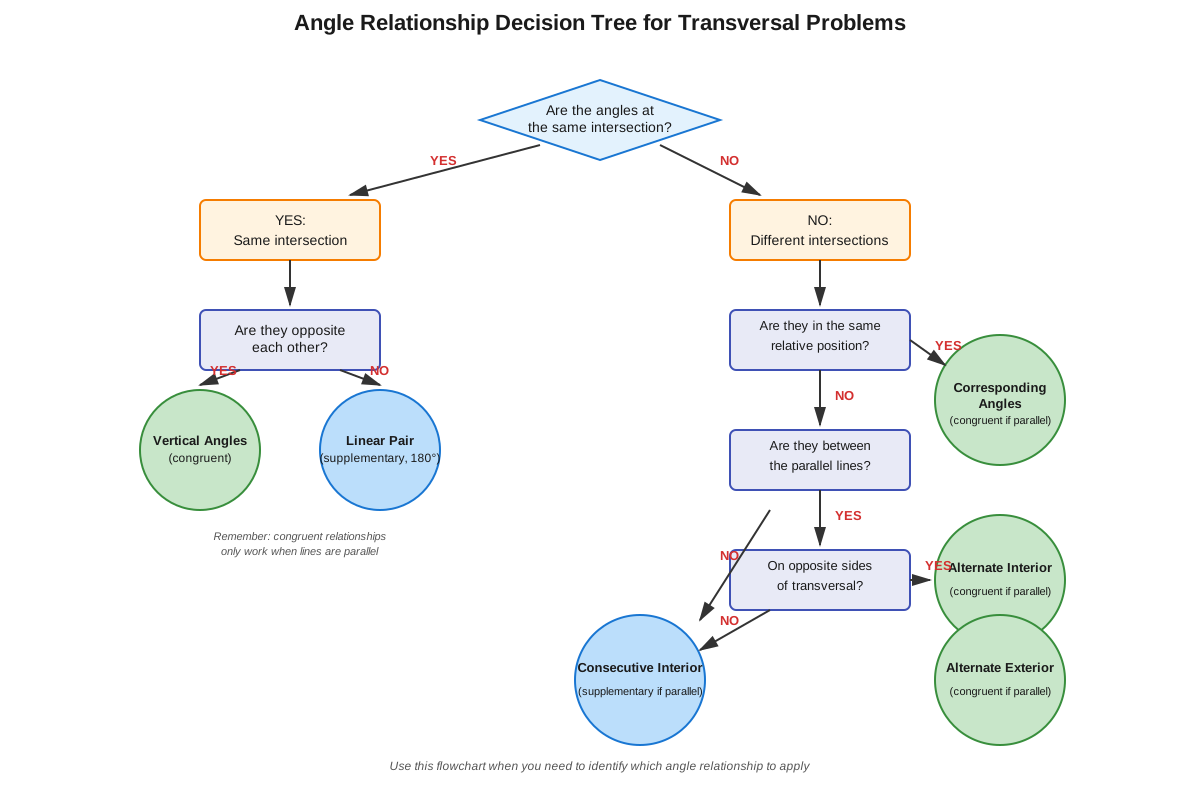
When a transversal crosses lines that are not parallel, the special angle relationships described above do not hold. Corresponding angles are not necessarily equal, alternate interior angles may have different measures, and consecutive interior angles may not sum to 180°. However, the fundamental properties of vertical angles (always equal) and linear pairs (always supplementary) remain true regardless of whether lines are parallel.
This distinction is crucial for SAT questions that ask students to determine whether lines are parallel. If you can demonstrate that corresponding angles are equal, or that alternate interior angles are equal, or that consecutive interior angles are supplementary, you have proven the lines are parallel. Conversely, if these relationships don't hold, the lines are not parallel. This logical reasoning—using angle relationships to prove or disprove parallelism—appears frequently in medium and hard SAT questions.
Multiple Transversals and Complex Diagrams
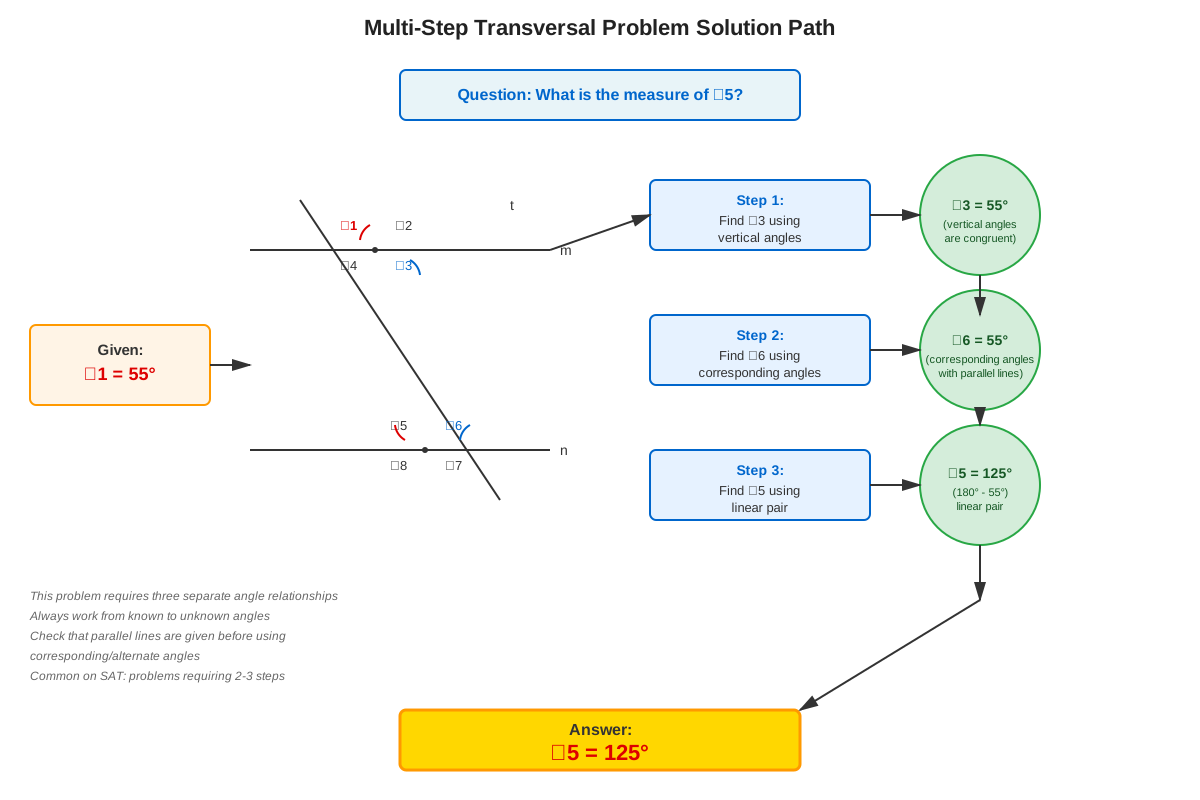
Advanced SAT questions may present diagrams with multiple transversals crossing the same pair of parallel lines, or a single transversal crossing more than two lines. In these scenarios, students must systematically apply angle relationships at each intersection point, often chaining multiple steps together. For example, if angle A equals angle B (corresponding angles), and angle B equals angle C (vertical angles), then angle A equals angle C (transitive property). Building these logical chains requires careful diagram analysis and organized work.
When working with complex diagrams, mark all known angle measures directly on the figure, use the fundamental relationships (vertical angles and linear pairs) to find additional angles, then apply parallel line relationships to extend knowledge across the diagram. This systematic approach prevents errors and ensures no relationships are overlooked.
Algebraic Applications
Many SAT transversal questions present angles as algebraic expressions rather than numerical values. For example, one angle might be represented as (2x + 15)° and another as (3x - 10)°. Students must recognize the geometric relationship between these angles (are they corresponding? alternate interior? supplementary?), set up an appropriate equation, and solve for the variable. These problems test both geometric reasoning and algebraic manipulation simultaneously.
The key strategy is to identify the relationship first, then translate it into an equation. If two angles are alternate interior angles with parallel lines, set them equal: 2x + 15 = 3x - 10. If they're consecutive interior angles, set their sum equal to 180: (2x + 15) + (3x - 10) = 180. After solving for the variable, always substitute back to find the actual angle measures, as SAT questions often ask for the measure of a specific angle rather than the variable value.
Concept Relationships
The core concepts within transversals build upon each other in a logical progression. Understanding the basic definition of a transversal → enables recognition of the eight angles formed → which leads to classification of angles as interior/exterior and same-side/alternate → allowing identification of the four major angle pair types → which reveals the special relationships that exist when lines are parallel → enabling both geometric proofs and algebraic problem-solving.
Transversals connect directly to prerequisite knowledge of vertical angles and linear pairs, as these relationships exist at every intersection point regardless of parallelism. The concept extends forward to triangle properties, since the angles in a triangle can be analyzed using an extended side as a transversal. Similarly, polygon angle sums rely on transversal reasoning when diagonals or extended sides create parallel line situations.
The relationship between transversals and coordinate geometry is particularly important for the SAT. When lines are graphed on a coordinate plane, their slopes determine whether they're parallel (equal slopes) or perpendicular (negative reciprocal slopes). Transversal angle relationships can then be applied to these graphed lines, creating problems that integrate multiple mathematical domains. This interconnection exemplifies the SAT's emphasis on mathematical reasoning across topics rather than isolated skill testing.
Quick check — test yourself on Transversals so far.
Try Flashcards →High-Yield Facts
⭐ When a transversal crosses parallel lines, corresponding angles are always congruent (equal in measure).
⭐ When a transversal crosses parallel lines, alternate interior angles are always congruent.
⭐ When a transversal crosses parallel lines, consecutive interior angles are always supplementary (sum to 180°).
⭐ Vertical angles are always congruent, regardless of whether lines are parallel.
⭐ Linear pairs (adjacent angles on a straight line) are always supplementary, regardless of whether lines are parallel.
- When a transversal crosses parallel lines, alternate exterior angles are congruent.
- If corresponding angles formed by a transversal are congruent, the lines must be parallel.
- If alternate interior angles formed by a transversal are congruent, the lines must be parallel.
- If consecutive interior angles formed by a transversal are supplementary, the lines must be parallel.
- A transversal creates exactly eight angles when crossing two lines (four at each intersection).
- The sum of all angles around a point equals 360°, useful when multiple transversals meet.
- In diagrams with parallel lines, you can often find all eight angle measures if given just one angle measure.
- Transversal problems frequently combine with triangle angle sum (180°) or exterior angle theorem.
Common Misconceptions
Misconception: All angles formed by a transversal are equal when lines are parallel. → Correction: Only specific angle pairs (corresponding, alternate interior, alternate exterior) are equal; consecutive interior angles are supplementary, not equal. Adjacent angles on a straight line always sum to 180° regardless of parallelism.
Misconception: Alternate interior angles are always equal, even when lines aren't parallel. → Correction: The special angle relationships (corresponding angles equal, alternate interior angles equal, etc.) only apply when the lines crossed by the transversal are parallel. Without parallel lines, these relationships don't hold.
Misconception: Consecutive interior angles are equal when lines are parallel. → Correction: Consecutive interior angles are supplementary (sum to 180°) when lines are parallel, not equal. This is the only major angle pair relationship that involves addition rather than equality.
Misconception: The transversal must be perpendicular to the parallel lines for angle relationships to work. → Correction: Transversal angle relationships hold regardless of the angle at which the transversal crosses the parallel lines. The transversal can intersect at any angle, and the relationships remain valid.
Misconception: When solving for x in an algebraic transversal problem, x is the final answer. → Correction: SAT questions typically ask for the measure of a specific angle, not the variable value. After solving for x, substitute it back into the expression to find the actual angle measure requested.
Misconception: Corresponding angles are always on the same side of both lines. → Correction: Corresponding angles are in the same relative position at each intersection, but they're on opposite sides of the transversal. They form an "F" pattern, not a pattern where both angles are on the same side of everything.
Worked Examples
Example 1: Finding Unknown Angles with Parallel Lines
Problem: In the diagram below, lines l and m are parallel, and line t is a transversal. If angle 1 measures 115°, find the measures of angles 2, 3, and 4, where angle 2 is adjacent to angle 1 on line l, angle 3 is the corresponding angle to angle 1 on line m, and angle 4 is the alternate interior angle to angle 2.
Solution:
Step 1: Identify what we know. Angle 1 = 115°, and lines l and m are parallel.
Step 2: Find angle 2. Angles 1 and 2 form a linear pair (adjacent angles on a straight line), so they're supplementary:
- Angle 1 + Angle 2 = 180°
- 115° + Angle 2 = 180°
- Angle 2 = 65°
Step 3: Find angle 3. Angle 3 is the corresponding angle to angle 1. Since lines l and m are parallel, corresponding angles are congruent:
- Angle 3 = Angle 1 = 115°
Step 4: Find angle 4. Angle 4 is the alternate interior angle to angle 2. Since lines l and m are parallel, alternate interior angles are congruent:
- Angle 4 = Angle 2 = 65°
Answer: Angle 2 = 65°, Angle 3 = 115°, Angle 4 = 65°
Connection to Learning Objectives: This problem demonstrates identification of key transversal features (corresponding and alternate interior angles) and application of parallel line properties to find unknown angle measures, directly addressing the core learning objectives.
Example 2: Algebraic Transversal Problem
Problem: Lines p and q are parallel, and line r is a transversal. One angle measures (4x - 20)° and its consecutive interior angle measures (2x + 40)°. Find the value of x and the measure of each angle.
Solution:
Step 1: Identify the relationship. Consecutive interior angles are supplementary when lines are parallel, so their sum equals 180°.
Step 2: Set up the equation:
- (4x - 20) + (2x + 40) = 180
Step 3: Solve for x:
- 4x - 20 + 2x + 40 = 180
- 6x + 20 = 180
- 6x = 160
- x = 160/6 = 80/3 ≈ 26.67°
Step 4: Find each angle measure by substituting x back:
- First angle: 4(80/3) - 20 = 320/3 - 60/3 = 260/3 ≈ 86.67°
- Second angle: 2(80/3) + 40 = 160/3 + 120/3 = 280/3 ≈ 93.33°
Step 5: Verify the answer:
- 260/3 + 280/3 = 540/3 = 180° ✓
Answer: x = 80/3 (or approximately 26.67), first angle ≈ 86.67°, second angle ≈ 93.33°
Connection to Learning Objectives: This problem integrates algebraic reasoning with transversal properties, demonstrating how SAT questions combine geometric relationships with equation-solving skills. It addresses the application objective and shows the importance of consecutive interior angle relationships.
Exam Strategy
When approaching SAT transversal questions, begin by identifying whether the lines are parallel—look for parallel line symbols (arrows or matching tick marks) or statements in the problem. If parallelism isn't explicitly stated, consider whether you need to prove or disprove it using angle relationships. Mark all given angle measures directly on the diagram, using different colors or symbols if possible to track your work.
Trigger words and phrases to watch for include: "parallel lines," "corresponding angles," "alternate interior," "consecutive interior," "same-side angles," "transversal," and "if lines l and m are parallel." Questions asking "what must be true" or "which statement is sufficient to prove" often test understanding of the converse relationships—using angle equality to prove parallelism rather than using parallelism to prove angle equality.
For process of elimination, remember that answer choices violating fundamental principles can be eliminated immediately. If a choice claims two angles are equal when they're actually supplementary (or vice versa), eliminate it. If a choice gives an angle measure greater than 180° for a single angle, eliminate it. When variables are involved, plug in the answer choices if algebraic solving seems complex—this often reveals the correct answer faster than formal equation solving.
Time allocation: Simple transversal questions identifying a single angle should take 30-45 seconds. Multi-step problems requiring several angle calculations should take 60-90 seconds. Complex algebraic problems may require up to 2 minutes, but if you're exceeding this time, mark the question and return to it later. The key is recognizing patterns quickly—with practice, identifying corresponding or alternate interior angles becomes automatic, dramatically reducing solution time.
Memory Techniques
"F for Friends": Corresponding angles form an "F" shape (or backwards "F"), and friends are equal—corresponding angles are equal when lines are parallel.
"Z for Zig-Zag": Alternate interior angles form a "Z" shape (or backwards "Z"), and the zig-zag connects equal angles when lines are parallel.
"C for Consecutive = Combine": Consecutive interior angles form a "C" or "U" shape, and you combine (add) them to get 180° when lines are parallel.
"CAIC" (pronounced "cake"): Corresponding, Alternate Interior, Alternate Exterior are all Congruent (equal) when lines are parallel. The one that's different (consecutive interior) is supplementary.
Visualization strategy: When looking at a transversal diagram, imagine the transversal as a sword cutting through two parallel boards. The angles on each board mirror each other in predictable ways—corresponding positions are equal, alternate positions are equal, and same-side interior positions combine to make a straight line (180°).
"VL-LP" for any intersection: Vertical angles are Like (equal), Linear Pairs are Plus 180 (supplementary). These relationships work at every intersection, parallel or not.
Summary
Transversals are lines that intersect two or more other lines, creating systematic angle relationships that become especially powerful when the intersected lines are parallel. The four major angle pair types—corresponding angles, alternate interior angles, alternate exterior angles, and consecutive interior angles—each have specific properties when parallel lines are involved: the first three types are congruent (equal), while consecutive interior angles are supplementary (sum to 180°). These relationships enable students to find unknown angle measures, prove lines are parallel, and solve algebraic equations involving angle expressions. Success on SAT transversal questions requires recognizing angle pair types quickly, applying the appropriate relationship, and combining geometric reasoning with algebraic manipulation. The topic integrates with vertical angles, linear pairs, triangle properties, and coordinate geometry, making it a foundational skill for the entire geometry domain. Mastering transversals means developing both visual pattern recognition (spotting "F," "Z," and "C" shapes) and logical reasoning (chaining multiple relationships together), skills that extend far beyond this single topic to benefit overall mathematical problem-solving ability.
Key Takeaways
- A transversal crossing two parallel lines creates four types of special angle pairs: corresponding (equal), alternate interior (equal), alternate exterior (equal), and consecutive interior (supplementary).
- Vertical angles and linear pairs work at every intersection regardless of whether lines are parallel, providing foundational relationships for solving complex problems.
- When lines are NOT parallel, the special transversal angle relationships do not apply, but you can use angle relationships to prove or disprove parallelism.
- SAT transversal questions frequently combine geometric angle relationships with algebraic expressions, requiring equation setup and solving.
- Visual pattern recognition—identifying "F" shapes for corresponding angles, "Z" shapes for alternate angles, and "C" shapes for consecutive interior angles—dramatically speeds up problem-solving.
- Always mark known angles directly on diagrams and systematically work through relationships rather than trying to solve everything mentally.
- The most common SAT error is confusing which angle pairs are equal versus supplementary—consecutive interior angles are the only major pair that sums to 180° rather than being equal.
Related Topics
Triangle Angle Relationships: Understanding that the sum of interior angles in a triangle equals 180° and that exterior angles equal the sum of remote interior angles builds directly on transversal concepts, as extended triangle sides act as transversals.
Polygon Angle Sums: The formulas for interior and exterior angle sums in polygons rely on dividing polygons into triangles using transversals (diagonals), making transversal mastery essential for polygon problems.
Coordinate Geometry and Slope: When lines are graphed on a coordinate plane, parallel lines have equal slopes, and transversal angle relationships can be applied to these graphed lines, integrating algebra and geometry.
Similar Triangles: Proving triangles similar often requires showing that corresponding angles are equal, which frequently involves transversal relationships when parallel lines cut through triangles.
Geometric Proofs: Formal two-column and paragraph proofs regularly use transversal properties as justification steps, making this topic essential for students pursuing advanced geometry.
Practice CTA
Now that you've mastered the core concepts of transversals, it's time to solidify your understanding through active practice. Attempt the practice questions to test your ability to identify angle relationships quickly and accurately under test-like conditions. Use the flashcards to drill the key angle pair types and their properties until recognition becomes automatic. Remember, the difference between knowing these concepts and scoring points on test day is practice—the more problems you solve, the faster you'll recognize patterns and the more confident you'll feel. You've built a strong foundation; now transform that knowledge into points through deliberate practice!
Sign up free to keep reading
Create a free AnvayaPrep account to finish this SAT guide on Transversals — plus flashcards and practice questions.