Overview
Vertical angles are one of the most fundamental and frequently tested concepts in SAT math, appearing in approximately 10-15% of geometry questions on the exam. When two straight lines intersect, they create two pairs of opposite angles called vertical angles, which possess a remarkable property: they are always equal in measure. This elegant geometric relationship forms the foundation for solving complex multi-step problems involving intersecting lines, parallel lines cut by transversals, and polygon angle calculations.
Understanding vertical angles is essential for SAT success because this concept rarely appears in isolation. Instead, sat vertical angles questions typically combine this principle with other geometric relationships such as supplementary angles, complementary angles, and properties of parallel lines. Students who master vertical angles gain a powerful tool for quickly identifying equal angle measures in diagrams, which often provides the key insight needed to solve challenging geometry problems efficiently. The ability to recognize vertical angles immediately can save precious time on test day, allowing students to allocate more minutes to complex problems.
The significance of vertical angles extends beyond standalone geometry questions. This concept integrates seamlessly with coordinate geometry, triangle properties, and even algebraic reasoning when variables represent unknown angle measures. Many SAT problems present diagrams with multiple intersecting lines, requiring students to chain together several geometric relationships—and vertical angles often serve as the critical first step in these solution chains. Mastering this topic builds the spatial reasoning skills and geometric intuition necessary for tackling the full range of geometry questions that appear on the SAT.
Learning Objectives
- [ ] Identify key features of vertical angles in geometric diagrams
- [ ] Explain how vertical angles appears on the SAT and in what contexts
- [ ] Apply vertical angles to answer SAT-style questions accurately and efficiently
- [ ] Calculate unknown angle measures using the vertical angles theorem in multi-step problems
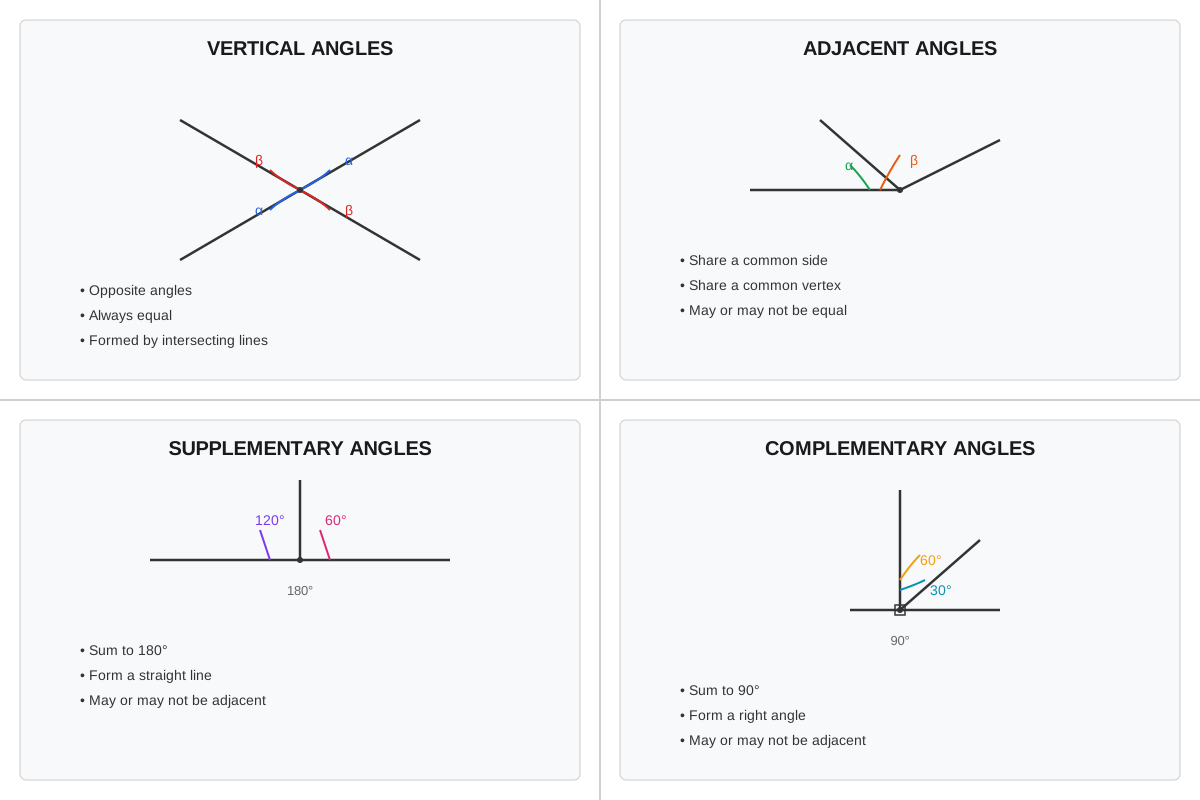
- [ ] Distinguish between vertical angles and other angle relationships (adjacent, supplementary, complementary)
- [ ] Combine vertical angles properties with other geometric principles to solve complex problems
- [ ] Recognize when vertical angles provide the optimal solution pathway in time-constrained situations
Prerequisites
- Basic angle measurement: Understanding that angles are measured in degrees and that a full rotation equals 360° is essential for calculating angle measures in intersection problems
- Linear pairs and supplementary angles: Recognizing that adjacent angles on a straight line sum to 180° enables students to find vertical angles when only one angle measure is given
- Algebraic equation solving: The ability to set up and solve simple equations is necessary when angle measures are expressed as algebraic expressions
- Geometric notation: Familiarity with angle notation (∠ABC) and how to interpret geometric diagrams ensures accurate problem comprehension
Why This Topic Matters
Vertical angles represent a cornerstone of geometric reasoning that extends far beyond the SAT. In real-world applications, engineers use vertical angle properties when designing intersecting structures like bridge supports, architects rely on these principles when creating floor plans with intersecting walls, and surveyors apply vertical angle relationships when measuring land boundaries. The concept also appears in physics when analyzing light reflection and in computer graphics when calculating intersection points.
On the SAT, vertical angles questions appear with remarkable consistency. Statistical analysis of recent SAT exams reveals that vertical angles concepts appear in 2-4 questions per test, either as the primary focus or as one step in a multi-concept problem. These questions typically fall into three categories: direct identification problems (15% of vertical angle questions), algebraic expression problems where angle measures contain variables (50%), and complex multi-step problems combining vertical angles with parallel lines or triangles (35%). The average point value for questions involving vertical angles ranges from 1-2 points, making this a high-yield topic for score improvement.
Common SAT presentations include diagrams showing two or more intersecting lines with some angles labeled with numerical values or algebraic expressions, word problems describing intersecting streets or paths, and coordinate geometry questions where students must identify angle relationships at intersection points. The test frequently embeds vertical angles within more complex scenarios, testing whether students can recognize this fundamental relationship amid visual complexity. Questions may also present incorrect statements about angle relationships, requiring students to identify which angles are actually vertical angles versus other angle pairs.
Core Concepts
Definition and Formation of Vertical Angles
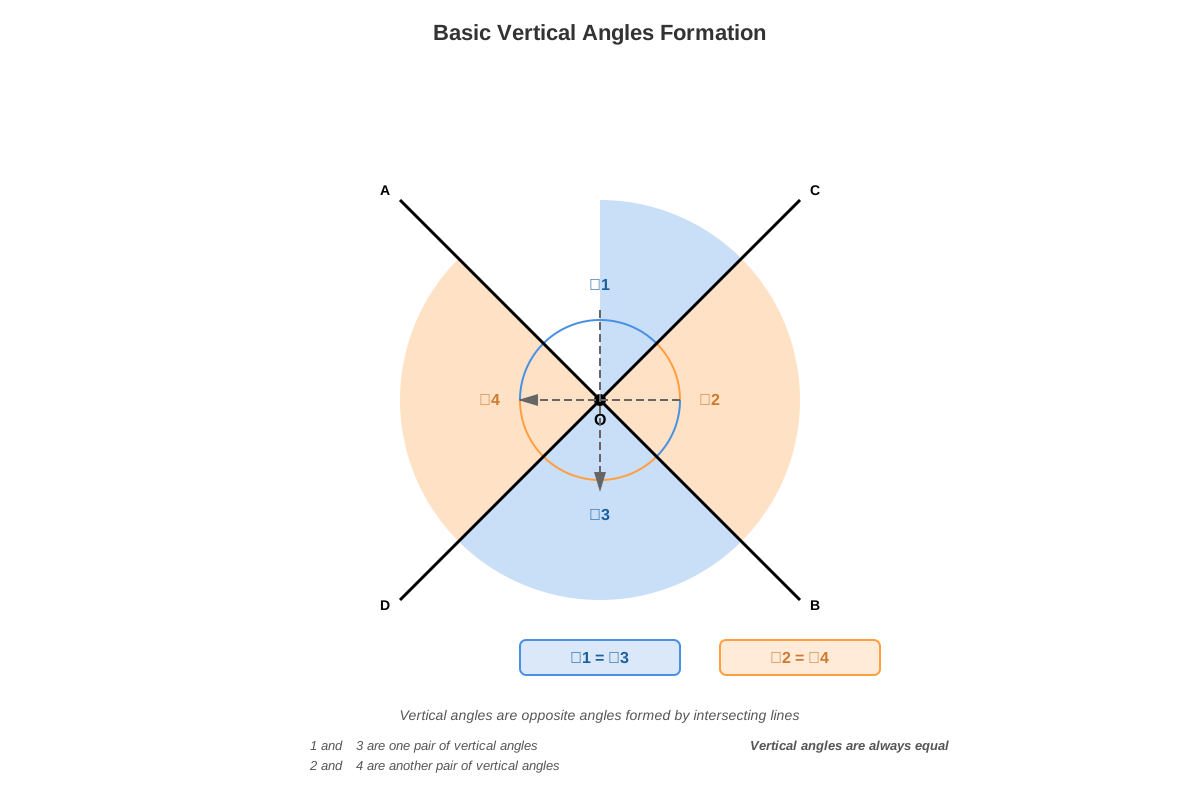
Vertical angles are pairs of opposite angles formed when two straight lines intersect at a single point. Despite the name, "vertical" does not refer to up-and-down orientation; rather, it derives from the Latin word "vertex," meaning the common point where the lines meet. When two lines cross, they create four angles around the intersection point. The angles that are directly across from each other—not sharing a common side—are vertical angles.
To visualize this clearly, imagine two lines intersecting to form an "X" shape. If we label the four angles created as ∠1, ∠2, ∠3, and ∠4 going clockwise around the intersection point, then ∠1 and ∠3 form one pair of vertical angles, while ∠2 and ∠4 form the other pair. Each pair of vertical angles shares only the vertex (intersection point) but no sides, distinguishing them from adjacent angles that share a common side.
The Vertical Angles Theorem
The fundamental property of vertical angles states: Vertical angles are always congruent (equal in measure). This theorem holds true regardless of the angle of intersection or the orientation of the lines. If one vertical angle measures 47°, its opposite vertical angle also measures exactly 47°. This relationship is not approximate or conditional—it is an absolute geometric truth that students can rely on in every problem.
The proof of this theorem relies on the properties of linear pairs. When two lines intersect, any two adjacent angles form a linear pair and are therefore supplementary (sum to 180°). Consider angles ∠1 and ∠2 as adjacent angles: ∠1 + ∠2 = 180°. Similarly, ∠2 and ∠3 are adjacent: ∠2 + ∠3 = 180°. Since both expressions equal 180°, we can set them equal: ∠1 + ∠2 = ∠2 + ∠3. Subtracting ∠2 from both sides yields ∠1 = ∠3, proving that vertical angles are congruent.
Identifying Vertical Angles in Complex Diagrams
SAT questions often present diagrams with multiple intersecting lines, creating numerous angles that can be overwhelming. The key to identifying vertical angles efficiently is to focus on one intersection point at a time. At each intersection, locate the two pairs of opposite angles—these are your vertical angle pairs. Angles that share a side are adjacent angles, not vertical angles, even if they appear to be across from each other in the overall diagram.
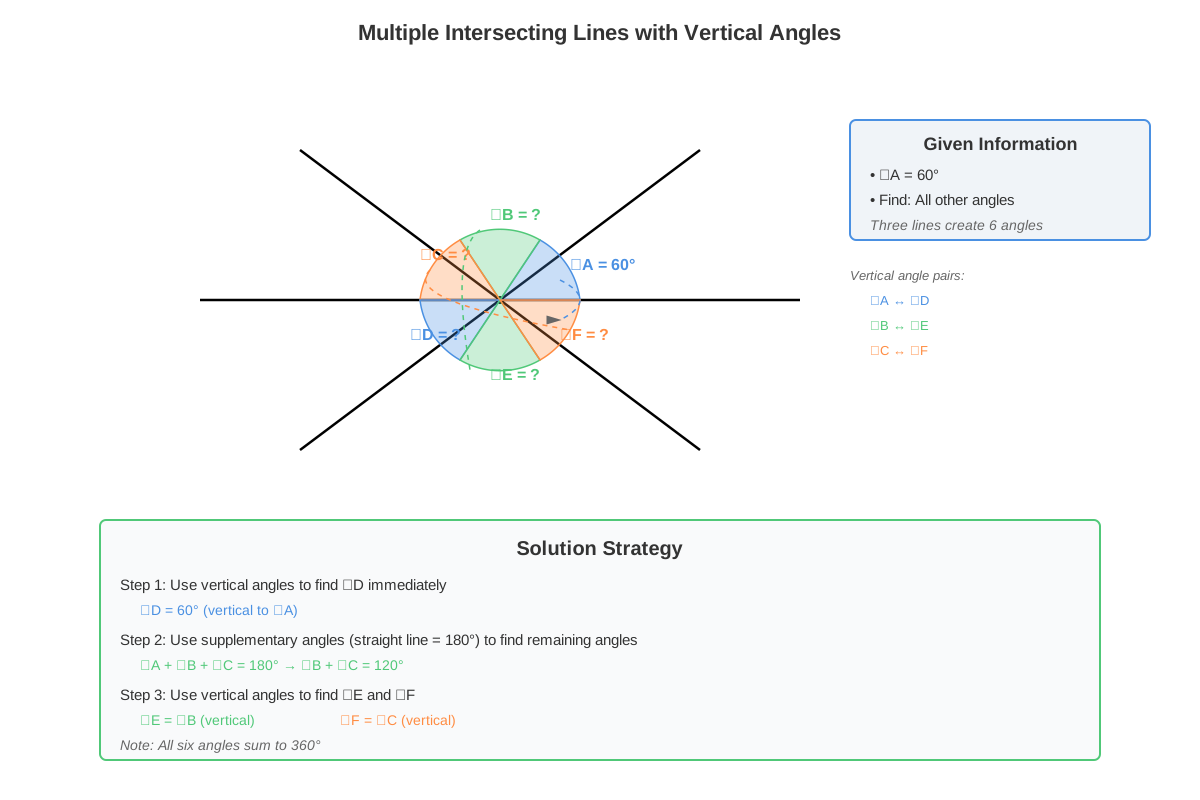
A common SAT trick involves presenting three or more lines intersecting at a single point. In such cases, students must carefully identify which specific pair of lines creates which angles. Each pair of lines generates its own set of four angles and two pairs of vertical angles. When multiple lines intersect at one point, the number of angles increases rapidly (n lines create 2n angles), but the vertical angle relationship still applies to each pair of opposite angles formed by any two specific lines.
Algebraic Applications with Vertical Angles
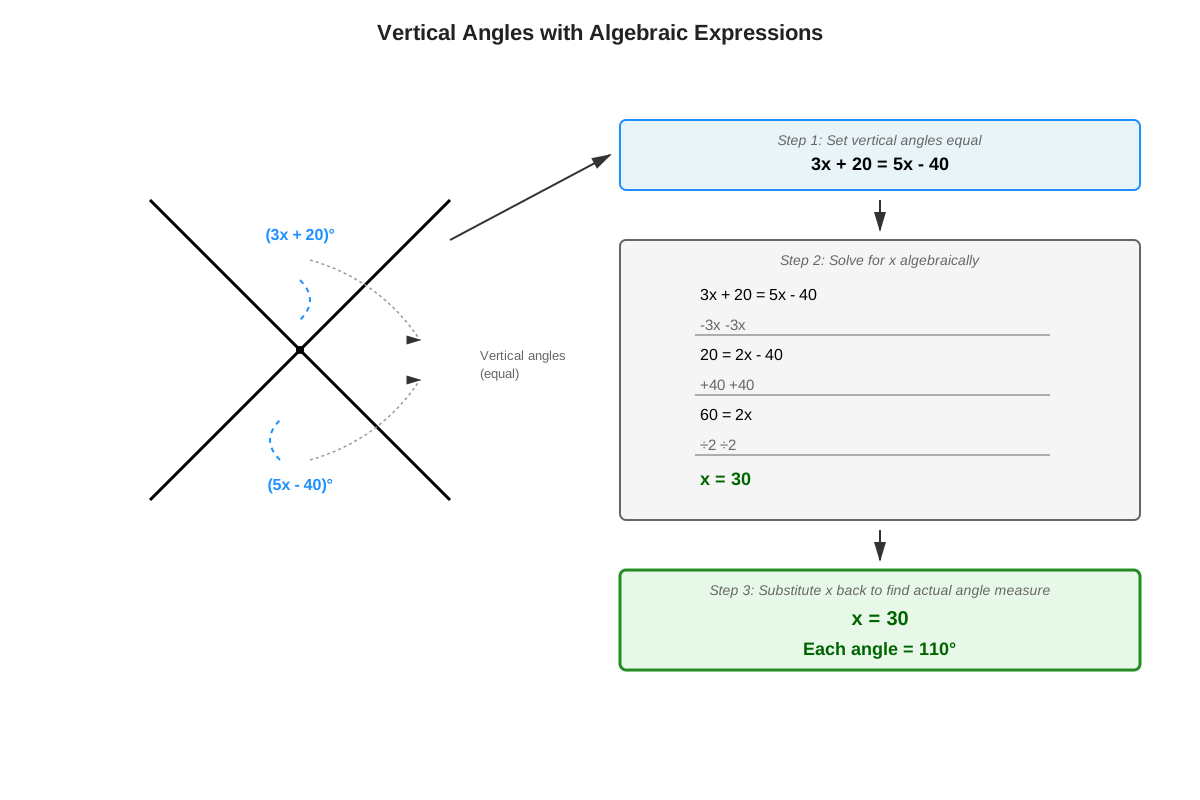
Many SAT problems express angle measures using algebraic expressions rather than numerical values. For example, one angle might be labeled (3x + 10)° while its vertical angle is labeled (5x - 20)°. Since vertical angles are equal, students can set these expressions equal to each other and solve for x:
3x + 10 = 5x - 20
10 + 20 = 5x - 3x
30 = 2x
x = 15
After finding x, students must often substitute back to find the actual angle measure: 3(15) + 10 = 55°. A critical verification step involves checking that both expressions yield the same result: 5(15) - 20 = 55°. This confirmation ensures no algebraic errors occurred.
Relationship Between Vertical Angles and Linear Pairs
Understanding the interplay between vertical angles and linear pairs unlocks efficient problem-solving strategies. At any intersection, four angles exist in two relationships simultaneously: vertical angles (opposite angles are equal) and linear pairs (adjacent angles sum to 180°). This dual relationship means that if you know just one angle measure at an intersection, you can determine all four angles.
For example, if one angle measures 65°, its vertical angle also measures 65°. The two angles adjacent to the 65° angle each measure 180° - 65° = 115° (since they form linear pairs with the 65° angle). These two 115° angles are vertical angles to each other. This pattern creates a powerful problem-solving shortcut: at any intersection, only two different angle measures exist, and they are supplementary to each other.
| Angle Position | Measure | Relationship |
|---|---|---|
| Angle 1 | 65° | Given |
| Angle 2 | 115° | Linear pair with Angle 1 |
| Angle 3 | 65° | Vertical to Angle 1 |
| Angle 4 | 115° | Vertical to Angle 2 |
Multiple Intersections and Angle Chains
Advanced SAT problems present scenarios with multiple intersection points, requiring students to chain together vertical angle relationships across several steps. For instance, a problem might show three parallel lines cut by two transversals, creating six intersection points. Solving such problems requires systematically working through each intersection, using vertical angles at one point to establish angle measures that then inform calculations at adjacent intersections.
The strategy for these complex problems involves: (1) identifying all intersection points, (2) marking known angle measures, (3) using vertical angles to find opposite angles at the same intersection, (4) applying linear pair relationships to find adjacent angles, and (5) using parallel line properties (corresponding angles, alternate interior angles) to transfer angle measures to other intersections. Vertical angles often provide the crucial first or intermediate step in these solution chains.
Concept Relationships
The vertical angles concept sits at the center of a web of interconnected geometric principles. Most directly, vertical angles connect to linear pairs through their shared formation at line intersections—every vertical angle pair exists alongside two linear pairs at the same vertex. This relationship flows in both directions: knowing one angle allows calculation of its vertical angle (equal measure) and its adjacent angles (supplementary measures).
Vertical angles serve as a prerequisite for understanding parallel lines cut by a transversal, where the transversal creates multiple intersection points. At each intersection, vertical angles help identify equal angle measures, which then combine with corresponding angles and alternate interior angles properties to solve for unknown measures. The relationship chain follows: Vertical Angles → Equal Opposite Angles → Parallel Line Properties → Complete Angle Determination.
Within triangle geometry, vertical angles frequently appear when a triangle's sides are extended beyond the vertices, creating exterior angles. The intersection of an extended side with another line creates vertical angles that relate to the triangle's interior angles. This connection extends to polygon angle problems where diagonals or extended sides create intersection points requiring vertical angle analysis.
The concept also bridges to coordinate geometry when lines are graphed on the coordinate plane. The intersection point of two lines creates vertical angles whose measures can be calculated using slope relationships and inverse tangent functions. This demonstrates how vertical angles connect pure geometry to algebraic and trigonometric concepts.
Relationship Map:
Line Intersections → Vertical Angles (equal) + Linear Pairs (supplementary) → Parallel Line Theorems → Triangle Angle Relationships → Polygon Angle Sums → Coordinate Geometry Applications
Quick check — test yourself on Vertical angles so far.
Try Flashcards →High-Yield Facts
⭐ Vertical angles are always congruent (equal in measure), regardless of the lines' orientation or intersection angle
⭐ Two intersecting lines create exactly two pairs of vertical angles at their intersection point
⭐ Vertical angles are non-adjacent angles—they do not share a common side, only a common vertex
⭐ At any intersection, only two distinct angle measures exist, and these two measures are supplementary (sum to 180°)
⭐ If one angle at an intersection measures x°, the four angles measure x°, (180-x)°, x°, and (180-x)° in order around the intersection
- The term "vertical" in vertical angles refers to the vertex (intersection point), not to up-and-down orientation
- Vertical angles can be acute, right, or obtuse, depending on how the lines intersect
- When three or more lines intersect at a single point, multiple pairs of vertical angles form, but each pair still involves only two specific lines
- Setting algebraic expressions for vertical angles equal to each other creates solvable equations for unknown variables
- Vertical angles maintain their equal relationship even when the intersecting lines are part of larger geometric figures like triangles or polygons
Common Misconceptions
Misconception: Vertical angles must be oriented vertically (up and down) in a diagram.
Correction: The term "vertical" refers to the vertex (intersection point) where the angles meet, not their orientation. Vertical angles can be positioned horizontally, diagonally, or in any orientation—what matters is that they are opposite angles at an intersection.
Misconception: Adjacent angles at an intersection are vertical angles.
Correction: Vertical angles are non-adjacent; they are the opposite angles at an intersection. Adjacent angles at an intersection form linear pairs and are supplementary (sum to 180°), not equal. If two angles share a common side, they cannot be vertical angles.
Misconception: Vertical angles are always 90°.
Correction: Vertical angles are equal to each other, but their measure depends on how the lines intersect. They equal 90° only when the lines intersect perpendicularly. In most cases, vertical angles have measures other than 90°, though they remain equal to their opposite angle.
Misconception: Three lines intersecting at a point create three pairs of vertical angles.
Correction: Three lines intersecting at one point create six angles total, but identifying vertical angle pairs requires considering each pair of lines separately. The number of vertical angle pairs depends on which specific lines you're examining, and angles may overlap in complex ways.
Misconception: Vertical angles only apply to straight lines, not to line segments or rays.
Correction: While the formal definition involves lines, the vertical angles property applies whenever two straight paths intersect, whether they are infinite lines, line segments, or rays. The key requirement is that they create an intersection point with opposite angles.
Misconception: If two angles look equal in a diagram, they must be vertical angles.
Correction: Many angle relationships create equal angles (corresponding angles with parallel lines, base angles of isosceles triangles, etc.). Vertical angles specifically require that the angles be opposite each other at a single intersection point. Equal angles that don't meet this criterion are equal for different geometric reasons.
Worked Examples
Example 1: Algebraic Expression Problem
Problem: Two lines intersect, creating four angles. One angle is labeled (4x - 15)° and its vertical angle is labeled (2x + 25)°. Find the value of x and the measure of all four angles.
Solution:
Step 1: Apply the vertical angles theorem. Since vertical angles are equal, set the expressions equal:
4x - 15 = 2x + 25Step 2: Solve for x by collecting like terms:
4x - 2x = 25 + 15
2x = 40
x = 20
Step 3: Substitute x = 20 into one expression to find the angle measure:
4(20) - 15 = 80 - 15 = 65°Step 4: Verify using the other expression:
2(20) + 25 = 40 + 25 = 65° ✓Step 5: Find the other pair of vertical angles using the linear pair relationship. Since adjacent angles are supplementary:
180° - 65° = 115°Answer: x = 20, and the four angles measure 65°, 115°, 65°, and 115° around the intersection.
Connection to Learning Objectives: This problem demonstrates applying vertical angles to solve SAT-style questions with algebraic expressions, combining geometric reasoning with equation-solving skills.
Example 2: Multi-Step Problem with Multiple Intersections
Problem: In the diagram below (described), line AB intersects line CD at point E, and line FG intersects line CD at point H. Angle AEC measures 38°. Angle FHC measures 127°. If line AB and line FG are extended until they intersect at point J, what is the measure of one of the acute angles at point J?
Solution:
Step 1: Find angle BEC using vertical angles. Since angle AEC and angle BEC are vertical angles:
∠BEC = ∠AEC = 38°Step 2: Find angle DHF using vertical angles. Since angle FHC and angle DHF are vertical angles:
∠DHF = ∠FHC = 127°Step 3: Find angle FHD using linear pairs. Since angle FHC and angle FHD are supplementary:
∠FHD = 180° - 127° = 53°Step 4: Recognize that we need to find angles at point J where lines AB and FG intersect. To find these angles, we need to determine the angles that lines AB and FG make with line CD, then use the fact that angles in a triangle sum to 180°.
Step 5: Consider triangle EHJ (formed by points E, H, and J). At point E, the angle in the triangle is supplementary to angle AEC:
∠HEJ = 180° - 38° = 142°Wait—this exceeds 90°, so we need the angle on the other side:
∠HEJ = 38° (using the vertical angle relationship)Step 6: At point H, the angle in the triangle is:
∠EHJ = 53° (the angle between the two lines)Step 7: Using the triangle angle sum property:
∠EJH = 180° - 38° - 53° = 89°Step 8: The acute angle at J is 89°, and its vertical angle is also 89°.
Answer: The acute angle at point J measures 89°.
Connection to Learning Objectives: This problem demonstrates how vertical angles combine with other geometric principles (linear pairs, triangle angle sums) to solve complex multi-step problems, illustrating the integrated nature of SAT geometry questions.
Exam Strategy
When approaching SAT questions involving vertical angles, begin by scanning the diagram for all intersection points and marking them clearly. This visual organization prevents confusion in complex diagrams with multiple intersections. Look for angles that are explicitly labeled with measures or algebraic expressions—these are your starting points.
Trigger words and phrases that signal vertical angles include: "opposite angles," "angles across from each other," "two lines intersect," "angles at the intersection," and "non-adjacent angles formed by intersecting lines." When a problem states that two lines "cross" or "intersect," immediately consider whether vertical angles will be part of the solution pathway.
For process-of-elimination strategies, remember that answer choices for angle measures at an intersection can only include two distinct values (since vertical angles create two pairs of equal angles). If answer choices include three or four different values for angles at a single intersection, some choices must be incorrect. Additionally, if one answer choice represents an angle measure, its supplement (180° minus that measure) should also appear among the angles at that intersection—if not, reconsider your approach.
Time allocation for vertical angles questions should follow this guideline: simple identification problems (15-30 seconds), algebraic expression problems (45-60 seconds), and multi-step problems combining vertical angles with other concepts (90-120 seconds). If a problem requires more than two minutes, mark it for review and move forward—you may gain insights from later problems that make returning to it more efficient.
Exam Tip: Always verify that angles you identify as vertical angles are truly opposite (non-adjacent) at an intersection. A quick visual check prevents costly errors: trace one angle's sides, then check if the other angle's sides are extensions of those same lines in the opposite direction.
When vertical angles involve algebraic expressions, set up your equation immediately and solve before attempting to visualize the angle measures. The algebra provides the definitive answer, while visual estimation can be misleading in SAT diagrams, which are not always drawn to scale.
Memory Techniques
Mnemonic for Vertical Angles: "Vertical angles are Very Equal" - The two V's remind you that vertical angles are equal, and the E emphasizes equality.
Visual Memory Strategy: Picture an "X" formed by two intersecting lines. The angles that touch the same parts of the X (top-left and bottom-right, or top-right and bottom-left) are vertical angles. This X-visualization works regardless of how the lines are oriented in a problem.
The "Opposite Twins" Technique: Think of vertical angles as identical twins standing on opposite sides of an intersection point. Just as identical twins look exactly the same, vertical angles measure exactly the same. This personification helps cement the equal-measure property.
Acronym for Intersection Properties: VELS - Vertical angles are Equal, Linear pairs are Supplementary. This acronym captures both key relationships at any intersection point.
Finger Method: Hold your index fingers in an X-shape. Your fingertips represent the four angles. The angles at opposite fingertips (top-left and bottom-right, or top-right and bottom-left) are vertical angles. This kinesthetic memory aid reinforces the spatial relationship.
Summary
Vertical angles represent a fundamental geometric relationship that appears consistently on the SAT, serving as both a standalone concept and an essential component of multi-step geometry problems. When two lines intersect, they create two pairs of opposite angles called vertical angles, which are always equal in measure—a property known as the vertical angles theorem. This equality holds regardless of the lines' orientation or the specific angle measures involved. At any intersection, only two distinct angle measures exist, and these measures are supplementary (sum to 180°), creating a predictable pattern that enables efficient problem-solving. SAT questions test vertical angles through direct identification, algebraic expression problems requiring equation-solving, and complex scenarios combining vertical angles with parallel lines, triangles, and other geometric concepts. Success requires recognizing vertical angles quickly in diagrams, distinguishing them from adjacent angles that form linear pairs, and applying the equal-measure property to calculate unknown angles or solve for variables. The concept connects deeply to supplementary angles, parallel line theorems, and polygon angle relationships, making it a cornerstone of geometric reasoning essential for achieving high scores on the SAT math section.
Key Takeaways
- Vertical angles are opposite angles formed when two lines intersect, and they are always equal in measure
- Two intersecting lines create exactly four angles: two pairs of vertical angles and two pairs of linear pairs (supplementary angles)
- Vertical angles are non-adjacent—they share only a vertex, not a common side
- At any intersection, knowing one angle measure allows you to determine all four angles using vertical angles (equal) and linear pairs (supplementary)
- SAT problems frequently express vertical angles as algebraic expressions that can be set equal to solve for unknown variables
- Vertical angles appear in approximately 10-15% of SAT geometry questions, often combined with other geometric principles
- The term "vertical" refers to the vertex (intersection point), not the orientation of the angles in the diagram
Related Topics
Linear Pairs and Supplementary Angles: Understanding that adjacent angles at an intersection sum to 180° complements vertical angles knowledge and enables complete angle determination at any intersection point. Mastering vertical angles provides the foundation for efficiently working with linear pairs.
Parallel Lines Cut by a Transversal: This topic extends vertical angles concepts to scenarios with multiple intersection points, where corresponding angles, alternate interior angles, and alternate exterior angles combine with vertical angles to solve complex problems.
Triangle Angle Relationships: Vertical angles frequently appear when triangle sides are extended, creating exterior angles. Understanding vertical angles enables efficient calculation of exterior angles and their relationships to remote interior angles.
Coordinate Geometry and Line Intersections: When lines are graphed on the coordinate plane, their intersection points create vertical angles whose measures relate to the lines' slopes, bridging geometric and algebraic reasoning.
Polygon Angle Sums: Vertical angles appear when polygon diagonals intersect or when sides are extended, making this foundational concept essential for advanced polygon problems involving multiple angle relationships.
Practice CTA
Now that you've mastered the core concepts of vertical angles, it's time to solidify your understanding through active practice. Attempt the practice questions designed specifically for this topic—they mirror actual SAT question formats and difficulty levels, giving you authentic test preparation. Use the flashcards to reinforce key definitions and properties until you can recall them instantly. Remember, geometry success on the SAT comes from recognizing patterns quickly and applying concepts confidently. Each practice problem you solve strengthens your geometric intuition and builds the speed necessary for test-day success. You've built a strong foundation—now transform that knowledge into points through deliberate practice!
Sign up free to keep reading
Create a free AnvayaPrep account to finish this SAT guide on Vertical angles — plus flashcards and practice questions.