Overview
Supplementary angles are pairs of angles whose measures add up to exactly 180 degrees. This fundamental geometric relationship appears frequently throughout the SAT Math section, making it one of the most important angle concepts students must master. Understanding supplementary angles is essential not only for direct angle measurement problems but also for solving complex geometry questions involving parallel lines, transversals, polygons, and coordinate geometry.
On the SAT, supplementary angles questions test both computational skills and spatial reasoning. Students encounter these angles in various contexts: adjacent angles forming straight lines, non-adjacent angles in geometric figures, angles formed by intersecting lines, and angles created when parallel lines are cut by transversals. The ability to quickly recognize supplementary angle relationships can dramatically reduce problem-solving time and unlock solutions to multi-step geometry problems that initially appear complex.
Mastering supplementary angles creates a foundation for understanding more advanced geometric concepts tested on the SAT. This topic connects directly to complementary angles (which sum to 90 degrees), vertical angles, linear pairs, and the angle relationships in triangles and polygons. Students who develop fluency with supplementary angles gain a powerful tool for approaching approximately 10-15% of SAT Math questions, making this a high-yield topic that deserves focused attention and practice.
Learning Objectives
- [ ] Identify key features of supplementary angles
- [ ] Explain how supplementary angles appears on the SAT
- [ ] Apply supplementary angles to answer SAT-style questions
- [ ] Calculate unknown angle measures using the supplementary angle relationship
- [ ] Recognize supplementary angles in both adjacent and non-adjacent configurations
- [ ] Solve multi-step problems involving supplementary angles combined with other geometric principles
- [ ] Distinguish between supplementary angles and other angle relationships (complementary, vertical, etc.)
Prerequisites
- Basic angle measurement: Understanding that angles are measured in degrees and that a full rotation equals 360 degrees is essential for comprehending why supplementary angles sum to 180 degrees
- Linear equations: The ability to set up and solve simple algebraic equations (e.g., x + 45 = 180) is necessary since most supplementary angle problems require algebraic manipulation
- Straight lines and rays: Recognizing that a straight line represents 180 degrees provides the visual foundation for understanding why adjacent supplementary angles form a straight line
- Basic arithmetic operations: Proficiency with addition and subtraction of whole numbers and decimals enables quick calculation of supplementary angle measures
Why This Topic Matters
Supplementary angles represent one of the most practical geometric concepts in both mathematics and real-world applications. Architects and engineers use supplementary angle relationships when designing structures, particularly in roof construction, bridge design, and mechanical linkages. The concept appears in navigation, where bearing calculations often involve supplementary relationships, and in physics when analyzing forces and vectors.
On the SAT, supplementary angles appear in approximately 8-12% of geometry questions, making them a high-frequency topic. The College Board includes supplementary angle problems in multiple formats: direct calculation questions, word problems requiring equation setup, diagram-based questions, and multi-step problems that combine supplementary angles with other geometric concepts. These questions typically appear in both the calculator and no-calculator sections, with difficulty levels ranging from straightforward one-step problems to complex multi-concept challenges.
The SAT commonly embeds supplementary angle relationships within larger problems involving parallel lines cut by transversals, polygon angle sums, coordinate geometry, and even trigonometry. Students who can quickly identify supplementary angle relationships gain a significant advantage, as this recognition often provides the key insight needed to unlock complex problems. Additionally, supplementary angles frequently appear in data sufficiency contexts where students must determine whether given information is sufficient to solve for unknown angles.
Core Concepts
Definition and Fundamental Properties
Supplementary angles are two angles whose measures sum to exactly 180 degrees. This relationship can be expressed algebraically as: if angles A and B are supplementary, then m∠A + m∠B = 180°. The term "supplementary" comes from the Latin word "supplere," meaning "to complete," which reflects how these angles complete a straight angle.
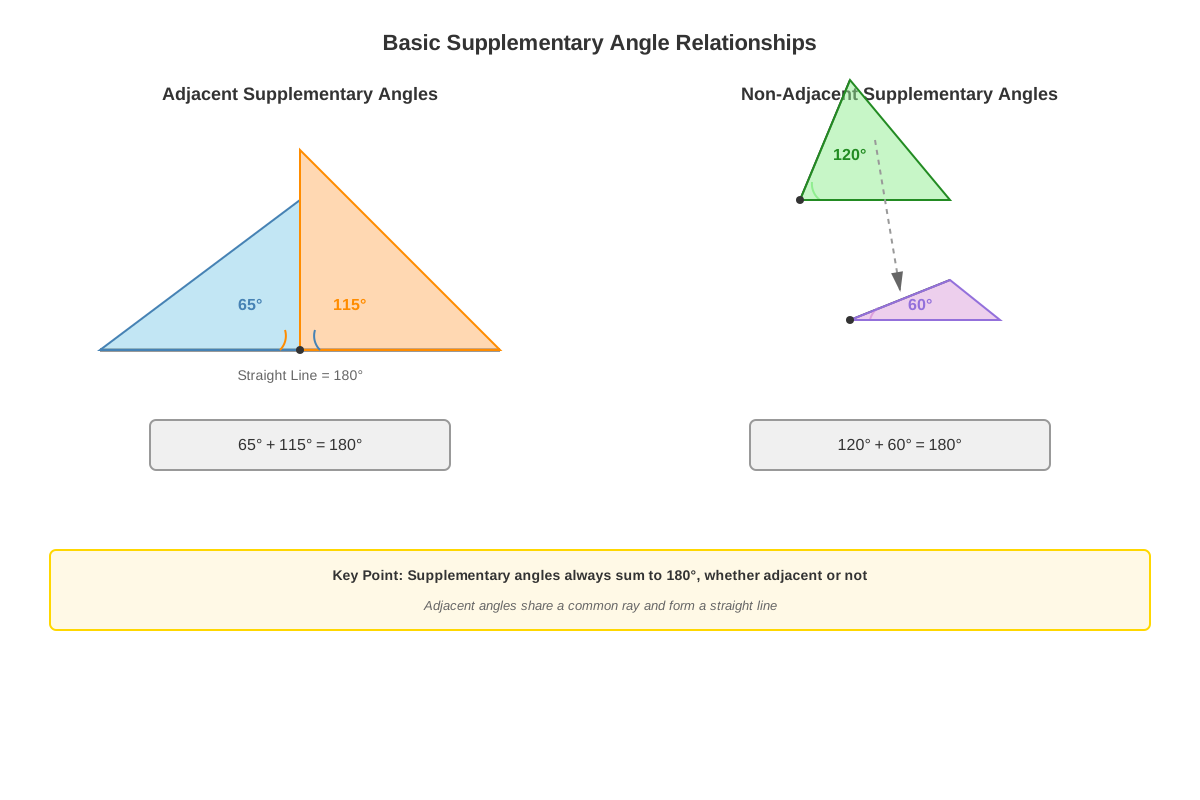
Supplementary angles can exist in two distinct configurations. Adjacent supplementary angles share a common vertex and a common side, with their non-common sides forming a straight line. These are also called linear pairs. Non-adjacent supplementary angles do not share a vertex or side but still maintain the 180-degree sum relationship. Both configurations appear regularly on the SAT, and recognizing each type is crucial for problem-solving efficiency.
An important property to remember: if two angles are supplementary to the same angle, they are congruent (equal in measure) to each other. For example, if angle A and angle B are both supplementary to angle C, then m∠A = m∠B. This transitive property frequently appears in proof-based SAT questions.
Supplementary Angles vs. Other Angle Relationships
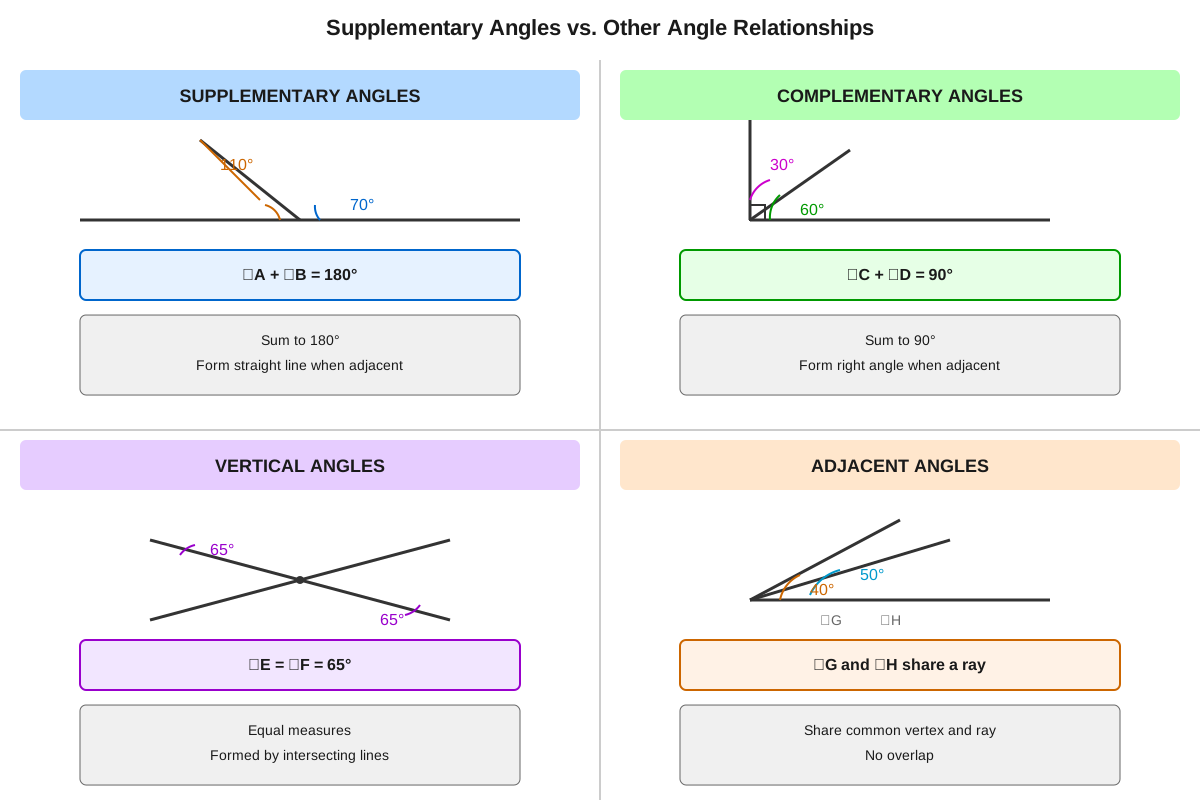
Understanding how supplementary angles differ from related concepts prevents common errors on the SAT:
| Angle Relationship | Sum of Measures | Visual Representation | SAT Frequency |
|---|---|---|---|
| Supplementary | 180° | Straight line (if adjacent) | Very High |
| Complementary | 90° | Right angle (if adjacent) | High |
| Vertical | Equal measures | Opposite angles at intersection | High |
| Linear Pair | 180° | Adjacent angles on straight line | Very High |
Note that all linear pairs are supplementary angles, but not all supplementary angles form linear pairs. This distinction matters on the SAT because questions may ask about supplementary angles that are not adjacent, requiring students to look beyond the obvious linear pair configurations.
Algebraic Applications
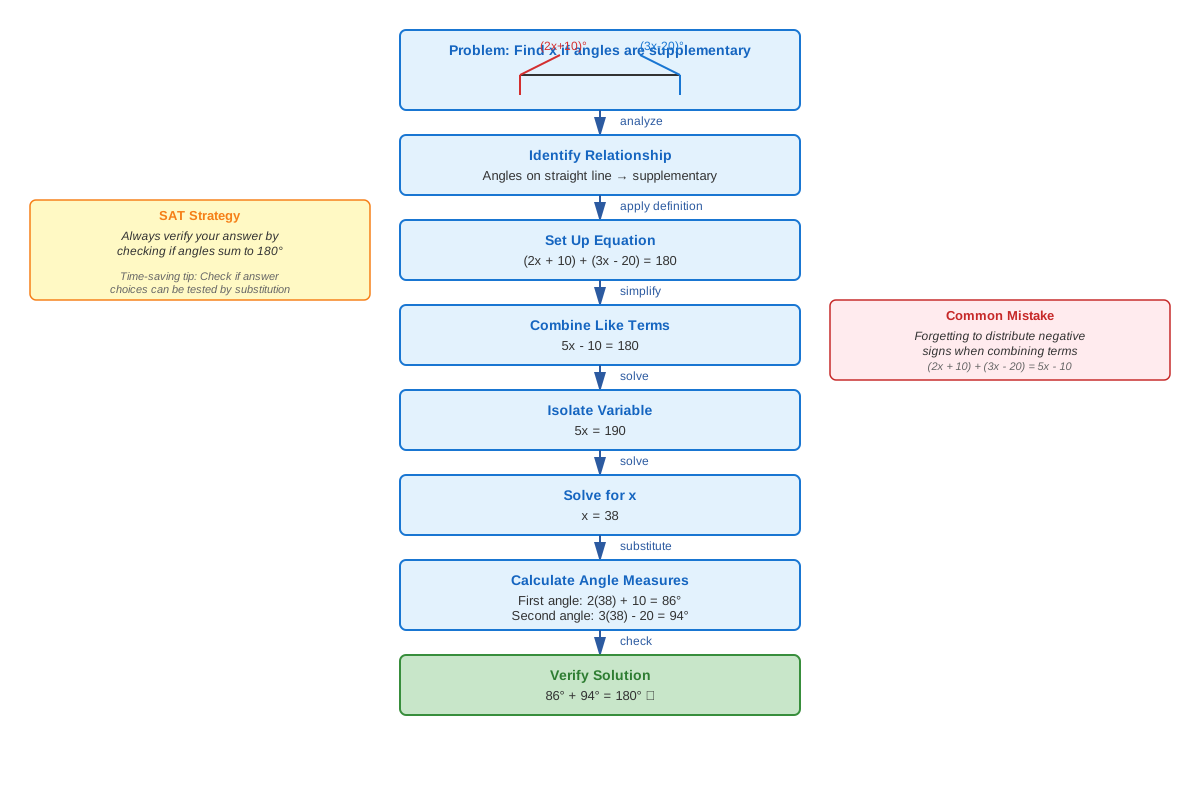
Most SAT questions involving supplementary angles require setting up and solving algebraic equations. The standard approach follows these steps:
- Identify the two angles that are supplementary
- Express each angle measure algebraically (using variables if unknown)
- Set up the equation: (first angle) + (second angle) = 180
- Solve for the unknown variable
- Calculate the specific angle measures requested
For example, if one angle measures (3x + 15)° and its supplement measures (2x - 5)°, the equation becomes:
(3x + 15) + (2x - 5) = 180
5x + 10 = 180
5x = 170
x = 34
The actual angle measures would then be calculated by substituting x = 34 back into the original expressions.
Supplementary Angles with Parallel Lines
When a transversal intersects two parallel lines, several pairs of supplementary angles are created. Consecutive interior angles (also called co-interior angles or same-side interior angles) are always supplementary when the lines are parallel. This relationship provides a powerful tool for solving complex geometry problems on the SAT.
Similarly, when a transversal cuts parallel lines, any pair of angles on the same side of the transversal that are not vertical angles will be supplementary. This includes combinations of corresponding angles with alternate interior angles, and other mixed pairs. Recognizing these relationships quickly can save valuable time on test day.
Applications in Polygons
Supplementary angles play a crucial role in polygon geometry. In any quadrilateral, opposite angles in a cyclic quadrilateral (one inscribed in a circle) are supplementary. Additionally, when finding exterior angles of polygons, each exterior angle and its adjacent interior angle form a supplementary pair, since they create a linear pair at each vertex.
The SAT frequently tests whether students can recognize that when a polygon's side is extended, the exterior angle formed is supplementary to the adjacent interior angle. This relationship becomes particularly important when calculating the sum of exterior angles or solving for unknown angles in irregular polygons.
Concept Relationships
Supplementary angles serve as a central hub connecting multiple geometric concepts tested on the SAT. The relationship map flows as follows:
Basic Angle Measurement → leads to → Supplementary Angles → enables understanding of → Linear Pairs → connects to → Parallel Lines and Transversals
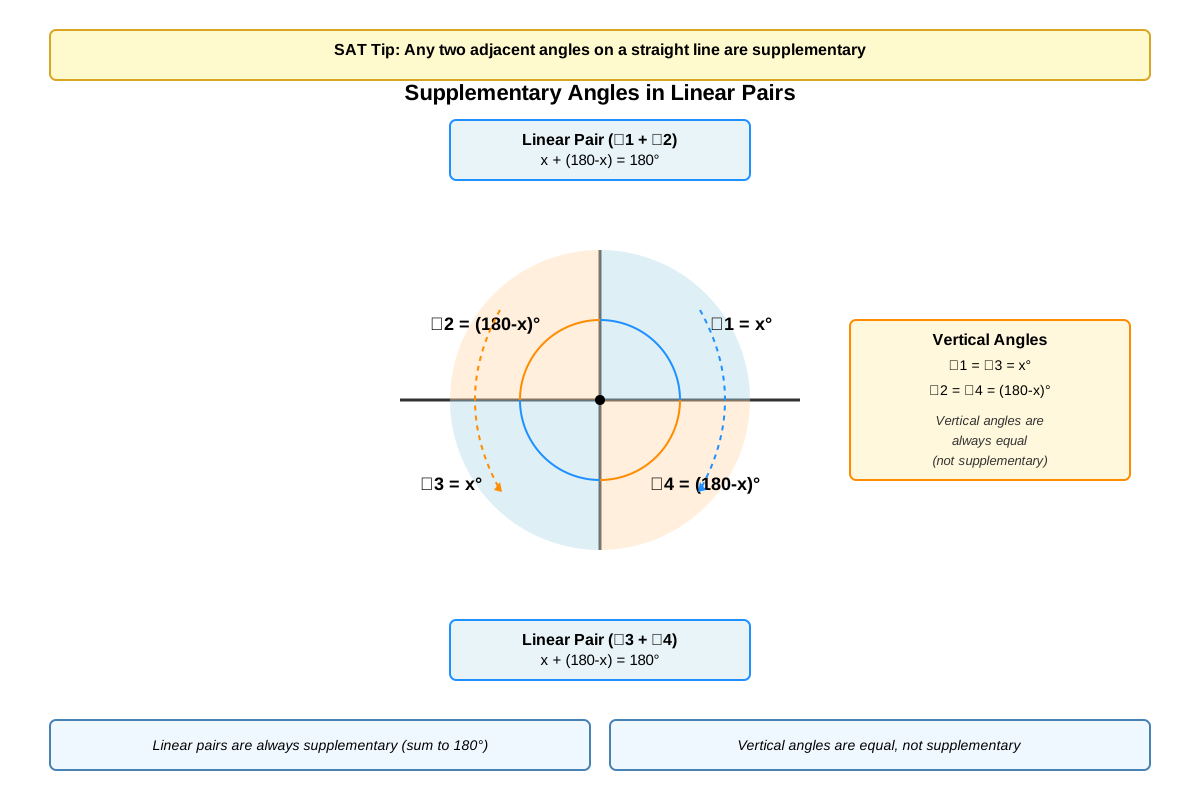
Additionally, supplementary angles connect horizontally to Complementary Angles (through comparison of angle sums) and to Vertical Angles (through intersection relationships). When students understand that vertical angles are equal and that adjacent angles at an intersection are supplementary, they can solve for all four angles at any intersection knowing just one angle measure.
The concept extends upward to more complex topics: Supplementary Angles → supports → Polygon Angle Sums → enables → Circle Theorems (particularly inscribed angle relationships). In coordinate geometry, supplementary angles relate to Slope concepts, since perpendicular lines create complementary angles with the x-axis, while supplementary relationships help determine angle measures in coordinate plane figures.
Understanding supplementary angles also prerequisite knowledge for Trigonometry on the SAT, particularly the supplementary angle identities: sin(180° - θ) = sin(θ) and cos(180° - θ) = -cos(θ). These relationships occasionally appear in advanced SAT Math problems.
High-Yield Facts
⭐ Two angles are supplementary if and only if their measures sum to exactly 180 degrees
⭐ All linear pairs are supplementary angles (adjacent angles that form a straight line)
⭐ Consecutive interior angles formed by a transversal cutting parallel lines are always supplementary
⭐ If two angles are supplementary to the same angle, they are congruent to each other
⭐ Each exterior angle of a polygon and its adjacent interior angle are supplementary
- Supplementary angles can be adjacent or non-adjacent; the spatial relationship doesn't affect the 180-degree sum
- If one angle in a supplementary pair is acute, the other must be obtuse (unless both are right angles)
- Two right angles (90° each) are supplementary to each other
- Supplementary angles cannot both be obtuse angles (since each would exceed 90°, making their sum exceed 180°)
- In a parallelogram, consecutive angles are supplementary
- When solving for x in supplementary angle problems, always verify that both resulting angle measures are positive and less than 180°
- The supplement of an angle measuring x° is (180 - x)°
- Supplementary angle relationships remain constant regardless of the orientation or rotation of the figure
Quick check — test yourself on Supplementary angles so far.
Try Flashcards →Common Misconceptions
Misconception: Supplementary angles must always be adjacent and form a straight line.
Correction: While adjacent supplementary angles do form a straight line (linear pairs), supplementary angles can also be non-adjacent. Any two angles whose measures sum to 180° are supplementary, regardless of their position relative to each other. The SAT frequently tests this by presenting supplementary angles in separate parts of a figure.
Misconception: Supplementary angles and complementary angles are interchangeable terms.
Correction: These are distinct concepts with different sum requirements. Supplementary angles sum to 180°, while complementary angles sum to 90°. Confusing these terms leads to incorrect equation setup and wrong answers. Always verify which relationship the question asks about before solving.
Misconception: Both angles in a supplementary pair must be acute or both must be obtuse.
Correction: If one angle in a supplementary pair is acute (less than 90°), the other must be obtuse (greater than 90°), except in the special case where both angles are exactly 90°. The only way for both angles to have the same classification is if they're both right angles.
Misconception: When a problem states "angle A is supplementary to angle B," this means angle A equals 180° minus angle B, so only one angle needs to be found.
Correction: While it's true that m∠A = 180° - m∠B, many SAT problems require finding both angle measures or using this relationship as one step in a multi-step problem. Don't stop solving after finding just one angle unless that's specifically what the question asks for.
Misconception: Vertical angles are supplementary.
Correction: Vertical angles are congruent (equal in measure), not supplementary. However, each vertical angle is supplementary to the adjacent angles at the intersection. At any intersection of two lines, vertical angles are equal, and adjacent angles are supplementary—these are two different relationships that students must distinguish.
Misconception: In a triangle, any two angles are supplementary.
Correction: In a triangle, all three angles sum to 180°, but no two individual angles are supplementary unless one of them is 0° (which would mean no triangle exists). However, an exterior angle of a triangle is supplementary to its adjacent interior angle, which is a relationship the SAT does test.
Worked Examples
Example 1: Basic Algebraic Application
Problem: Two angles are supplementary. The measure of the larger angle is 30° more than twice the measure of the smaller angle. Find the measure of each angle.
Solution:
Step 1: Define variables. Let x = measure of the smaller angle (in degrees).
Step 2: Express the larger angle in terms of x. The larger angle = 2x + 30.
Step 3: Set up the supplementary angle equation. Since the angles are supplementary:
x + (2x + 30) = 180
Step 4: Solve for x.
3x + 30 = 180
3x = 150
x = 50
Step 5: Find both angle measures.
Smaller angle = x = 50°
Larger angle = 2(50) + 30 = 100 + 30 = 130°
Step 6: Verify the solution.
50° + 130° = 180° ✓
130° is indeed 30° more than twice 50° (2 × 50 + 30 = 130) ✓
Answer: The angles measure 50° and 130°.
This problem demonstrates the standard approach for SAT supplementary angle problems: define variables, express relationships algebraically, set up the 180° equation, solve, and verify. This connects to Learning Objective 3 (applying supplementary angles to SAT-style questions) and Objective 4 (calculating unknown angle measures).
Example 2: Parallel Lines and Transversals
Problem: In the figure below, lines l and m are parallel, and line t is a transversal. If angle 1 measures (4x - 20)° and angle 5 measures (2x + 40)°, where angles 1 and 5 are consecutive interior angles, find the value of x and the measure of angle 1.
Solution:
Step 1: Identify the angle relationship. Consecutive interior angles (also called co-interior or same-side interior angles) formed by a transversal cutting parallel lines are supplementary.
Step 2: Set up the equation using the supplementary relationship.
(4x - 20) + (2x + 40) = 180
Step 3: Simplify and solve for x.
6x + 20 = 180
6x = 160
x = 160/6 = 80/3 or 26.67 (approximately)
Step 4: Calculate the measure of angle 1.
m∠1 = 4x - 20 = 4(80/3) - 20 = 320/3 - 60/3 = 260/3 ≈ 86.67°
Step 5: Verify by finding angle 5 and checking the sum.
m∠5 = 2(80/3) + 40 = 160/3 + 120/3 = 280/3 ≈ 93.33°
Sum: 260/3 + 280/3 = 540/3 = 180° ✓
Answer: x = 80/3 (or approximately 26.67), and angle 1 measures 260/3° (or approximately 86.67°).
This example illustrates how supplementary angles appear in the context of parallel lines, a common SAT scenario. It demonstrates Learning Objective 2 (explaining how supplementary angles appear on the SAT) and shows the integration of multiple geometric concepts, which is typical of medium-difficulty SAT problems.
Exam Strategy
When approaching supplementary angle questions on the SAT, follow this systematic process:
Step 1: Identify the relationship. Look for trigger words and visual cues that indicate supplementary angles: "straight line," "linear pair," "consecutive interior angles," "sum to 180°," or diagrams showing angles that appear to form a straight line. Mark these relationships on your test booklet.
Step 2: Set up your equation immediately. Don't try to solve the problem mentally. Write down the equation (angle 1) + (angle 2) = 180, substituting any given expressions or values. This prevents arithmetic errors and provides a clear path forward.
Step 3: Watch for multi-step problems. Many SAT questions use supplementary angles as one step in a larger problem. After finding angle measures using the supplementary relationship, check whether the question asks for something else: a different angle, a variable value, or a relationship to other geometric elements.
Exam Tip: If a diagram shows what appears to be a straight line but isn't explicitly labeled as such, do NOT assume the angles are supplementary unless the problem states the line is straight or provides enough information to prove it. The SAT occasionally includes misleading diagrams to test careful reasoning.
Trigger words and phrases to recognize:
- "Form a straight line" or "lie on a straight line"
- "Linear pair"
- "Consecutive interior angles" (with parallel lines)
- "Sum to 180 degrees"
- "Supplementary"
- "Adjacent angles on a line"
Process of elimination strategies:
- Eliminate any answer choice where two angles sum to 90° (those would be complementary, not supplementary)
- Eliminate choices where both angles are obtuse (both greater than 90°), as their sum would exceed 180°
- Eliminate choices where both angles are acute (both less than 90°), unless they're both exactly 90°
- If the problem involves algebra, eliminate choices that produce negative angle measures or angles greater than 180°
Time allocation: Basic supplementary angle problems should take 30-60 seconds. If you're spending more than 90 seconds, you may be overcomplicating the problem—step back and look for a simpler approach. Multi-step problems involving supplementary angles combined with other concepts may reasonably take 2-3 minutes.
Memory Techniques
Mnemonic for Supplementary vs. Complementary: "Supplementary = Straight line = 180" (both S's) and "Complementary = Corner (right angle) = 90" (both C's). The alphabetical order also helps: C comes before S, and 90 comes before 180.
Visual Memory Aid: Picture a straight line as a "supplement" that "completes" or "fills up" the space. When you see a straight line, immediately think "180 degrees" and "supplementary angles." This visual association helps on diagram-based questions.
Acronym for Linear Pair Properties: SANA - Supplementary, Adjacent, Non-overlapping, Add to 180. This reminds you of all the key features of linear pairs, which are the most common form of supplementary angles on the SAT.
Finger Trick: Hold your hands flat with palms down, fingers extended. Touch your index fingers together in a straight line. Your two hands represent supplementary angles forming a straight line (linear pair). Now separate your hands—they're still supplementary even though they're no longer adjacent. This kinesthetic memory aid helps remember that supplementary angles don't have to touch.
Number Pattern Memory: Remember these common supplementary pairs that appear frequently on the SAT:
- 90° and 90° (two right angles)
- 60° and 120° (common in hexagon problems)
- 45° and 135° (common in octagon problems)
- 30° and 150° (common in 12-sided polygon problems)
Recognizing these patterns allows for quick mental calculation without full algebraic setup.
Summary
Supplementary angles are pairs of angles whose measures sum to exactly 180 degrees, representing one of the most fundamental and frequently tested geometric relationships on the SAT Math section. These angles appear in two configurations: adjacent supplementary angles (linear pairs) that share a vertex and side while forming a straight line, and non-adjacent supplementary angles that maintain the 180-degree sum without touching. Mastery of supplementary angles requires both conceptual understanding and algebraic facility, as most SAT problems involve setting up and solving equations where angle measures are expressed in terms of variables. The concept extends beyond simple angle pairs to more complex applications involving parallel lines cut by transversals (where consecutive interior angles are supplementary), polygon geometry (where each exterior angle is supplementary to its adjacent interior angle), and multi-step problems that integrate supplementary angles with other geometric principles. Success on SAT supplementary angle questions depends on quickly recognizing the relationship, accurately setting up equations, and distinguishing supplementary angles from related concepts like complementary angles and vertical angles.
Key Takeaways
- Supplementary angles always sum to exactly 180 degrees, whether they're adjacent (forming a linear pair) or non-adjacent
- All linear pairs are supplementary, making straight lines a visual cue to look for supplementary angle relationships
- Consecutive interior angles formed by parallel lines and a transversal are supplementary, a high-yield relationship for SAT problems
- Set up the equation (angle 1) + (angle 2) = 180 immediately when you identify supplementary angles, then solve algebraically
- Don't confuse supplementary (180°) with complementary (90°)—use the S-for-Straight and C-for-Corner mnemonic
- Verify your solutions by checking that both angles are positive, less than 180°, and actually sum to 180°
- Supplementary angle problems often appear as one step in multi-step SAT questions, so always check whether the question asks for additional calculations beyond finding the angle measures
Related Topics
Complementary Angles: Understanding angles that sum to 90° provides important contrast to supplementary angles and appears in right triangle problems, perpendicular line relationships, and trigonometric applications. Mastering supplementary angles makes learning complementary angles straightforward through comparison.
Vertical Angles: These congruent angles formed by intersecting lines work together with supplementary angles at intersections, where vertical angles are equal and adjacent angles are supplementary. This combination allows students to find all four angles at any intersection.
Parallel Lines and Transversals: This topic extensively uses supplementary angle relationships, particularly with consecutive interior angles. Strong understanding of supplementary angles is essential before tackling the eight angle relationships created when a transversal cuts parallel lines.
Polygon Angle Sums: Interior and exterior angles of polygons rely on supplementary angle relationships, as each exterior angle is supplementary to its adjacent interior angle. This connection makes polygon problems more accessible once supplementary angles are mastered.
Triangle Angle Relationships: While triangle interior angles sum to 180° (not forming supplementary pairs), exterior angles of triangles are supplementary to their adjacent interior angles, making this concept relevant for triangle geometry.
Practice CTA
Now that you've mastered the core concepts of supplementary angles, it's time to solidify your understanding through active practice. Work through the practice questions to apply these principles to authentic SAT-style problems, and use the flashcards to reinforce the key definitions and relationships. Remember, geometry concepts like supplementary angles become automatic with repetition—the more problems you solve, the faster you'll recognize these relationships on test day. Each practice question you complete builds the pattern recognition and problem-solving speed that separates good scores from great scores. You've built a strong foundation; now strengthen it through deliberate practice!
Sign up free to keep reading
Create a free AnvayaPrep account to finish this SAT guide on Supplementary angles — plus flashcards and practice questions.