Overview
Checking solutions is a fundamental skill in algebra that involves verifying whether a proposed answer to an equation is correct by substituting it back into the original equation. This process is not merely a final step in problem-solving—it's a critical math strategy that can prevent careless errors and confirm accuracy on high-stakes exams. On the SAT, the ability to efficiently check solutions can mean the difference between a correct answer and a costly mistake, particularly when dealing with linear equations, systems of equations, or word problems that require algebraic modeling.
The SAT frequently tests this skill both directly and indirectly. Direct testing occurs when questions explicitly ask students to determine which value satisfies a given equation, while indirect testing happens when students must verify their own work under time pressure. Understanding sat checking solutions techniques enables students to catch algebraic errors, identify extraneous solutions introduced during equation manipulation, and confidently select answers even when multiple choices appear plausible. This skill is particularly valuable because it provides a self-correction mechanism that doesn't require reworking the entire problem from scratch.
Within the broader landscape of SAT Math, checking solutions serves as a bridge between computational algebra and critical reasoning. It connects to solving linear equations, understanding function notation, working with inequalities, and interpreting word problems. Mastery of this topic reinforces algebraic fluency while developing the metacognitive skills necessary for test-taking success. Students who systematically check their solutions demonstrate mathematical maturity and are better equipped to handle the SAT's adaptive difficulty and time constraints.
Learning Objectives
- [ ] Identify key features of checking solutions, including when and why verification is necessary
- [ ] Explain how checking solutions appears on the SAT in various question formats
- [ ] Apply checking solutions to answer SAT-style questions efficiently and accurately
- [ ] Distinguish between valid solutions and extraneous solutions introduced through algebraic manipulation
- [ ] Evaluate multiple answer choices by systematically testing each option in the original equation
- [ ] Recognize situations where checking solutions is the most efficient problem-solving strategy
- [ ] Demonstrate the ability to verify solutions in context-based word problems
Prerequisites
- Basic algebraic substitution: The ability to replace variables with numerical values is essential for plugging solutions back into equations
- Order of operations (PEMDAS): Correctly evaluating expressions after substitution requires following the proper sequence of mathematical operations
- Solving linear equations in one variable: Understanding how to isolate variables and manipulate equations provides the foundation for generating solutions to check
- Understanding equality: Recognizing that both sides of an equation must have the same value when a correct solution is substituted
- Simplifying algebraic expressions: The capacity to combine like terms and reduce expressions to determine if an equation balances
Why This Topic Matters
In real-world applications, checking solutions is analogous to quality control in any professional field. Engineers verify calculations before implementing designs, accountants reconcile figures to ensure accuracy, and scientists replicate experiments to confirm results. This mathematical habit of verification develops critical thinking skills that extend far beyond the classroom, fostering a mindset of thoroughness and precision that employers value across all industries.
On the SAT, checking solutions appears with remarkable frequency. Approximately 15-20% of SAT Math questions either directly test this skill or significantly benefit from its application. The College Board designs questions where checking solutions can be faster than solving from scratch, rewarding students who recognize these opportunities. Common question formats include: "Which of the following is a solution to the equation...?", "If x = 3 is a solution to the equation below, what is the value of k?", and word problems where verifying an answer against the problem's constraints is essential.
The strategic value of checking solutions on the SAT cannot be overstated. When facing multiple-choice questions, students can often work backward from answer choices, testing each option until finding the one that satisfies the equation. This approach is particularly effective when the algebraic solution path appears complex or time-consuming. Additionally, checking solutions serves as a safety net: even when solving equations traditionally, a quick verification step catches computational errors before submitting an answer, protecting against preventable point loss.
Core Concepts
The Fundamental Process of Checking Solutions
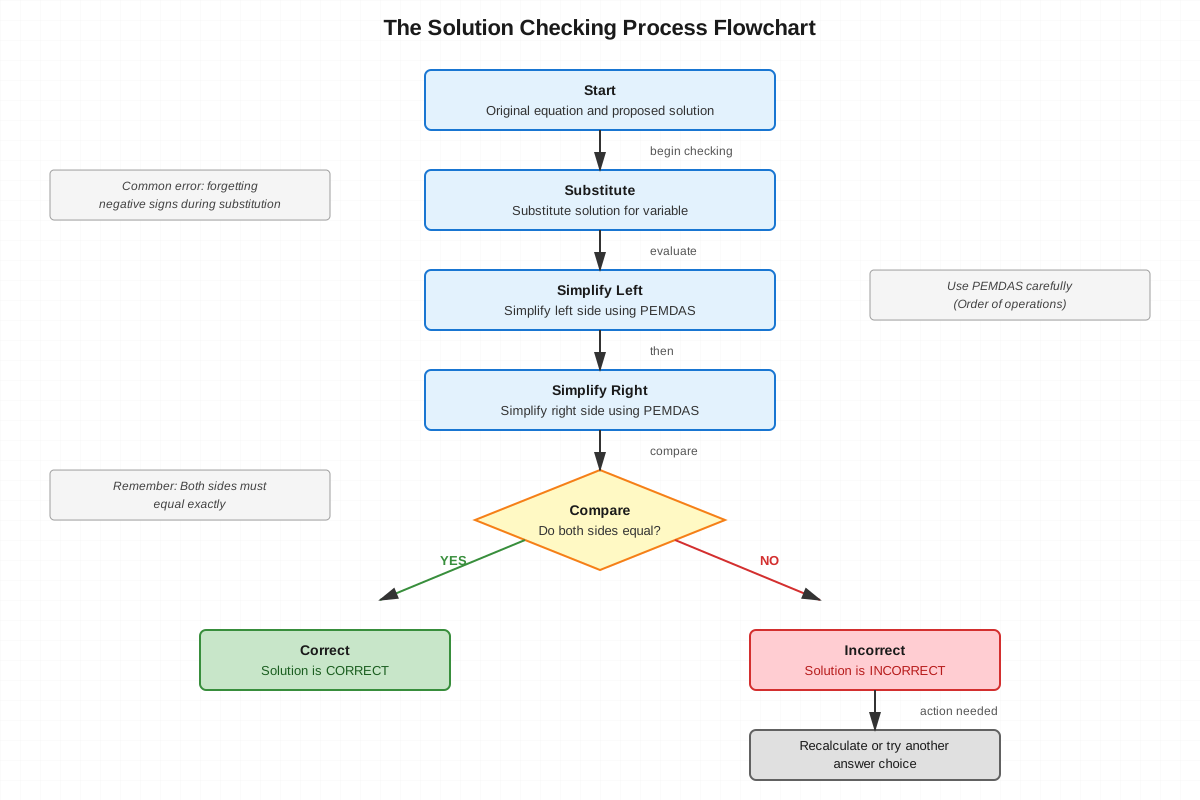
Checking solutions involves a systematic three-step process that validates whether a proposed value satisfies an equation. First, identify the variable and the proposed solution value. Second, substitute this value for every instance of the variable throughout the original equation. Third, simplify both sides of the equation independently and verify that they produce equal values. If both sides equal the same number, the solution is valid; if they differ, the proposed value is not a solution.
Consider the equation 3x + 7 = 22 with a proposed solution of x = 5. Substituting yields: 3(5) + 7 = 22, which simplifies to 15 + 7 = 22, and finally 22 = 22. Since both sides equal 22, x = 5 is confirmed as a valid solution. This verification process is mathematically rigorous because it directly tests the definition of a solution: a value that makes the equation true.
Direct Verification vs. Working Backward
There are two primary approaches to checking solutions on the SAT. Direct verification occurs after solving an equation algebraically—students substitute their calculated answer back into the original equation to confirm accuracy. This method catches algebraic errors, sign mistakes, and computational slip-ups that commonly occur under test pressure.
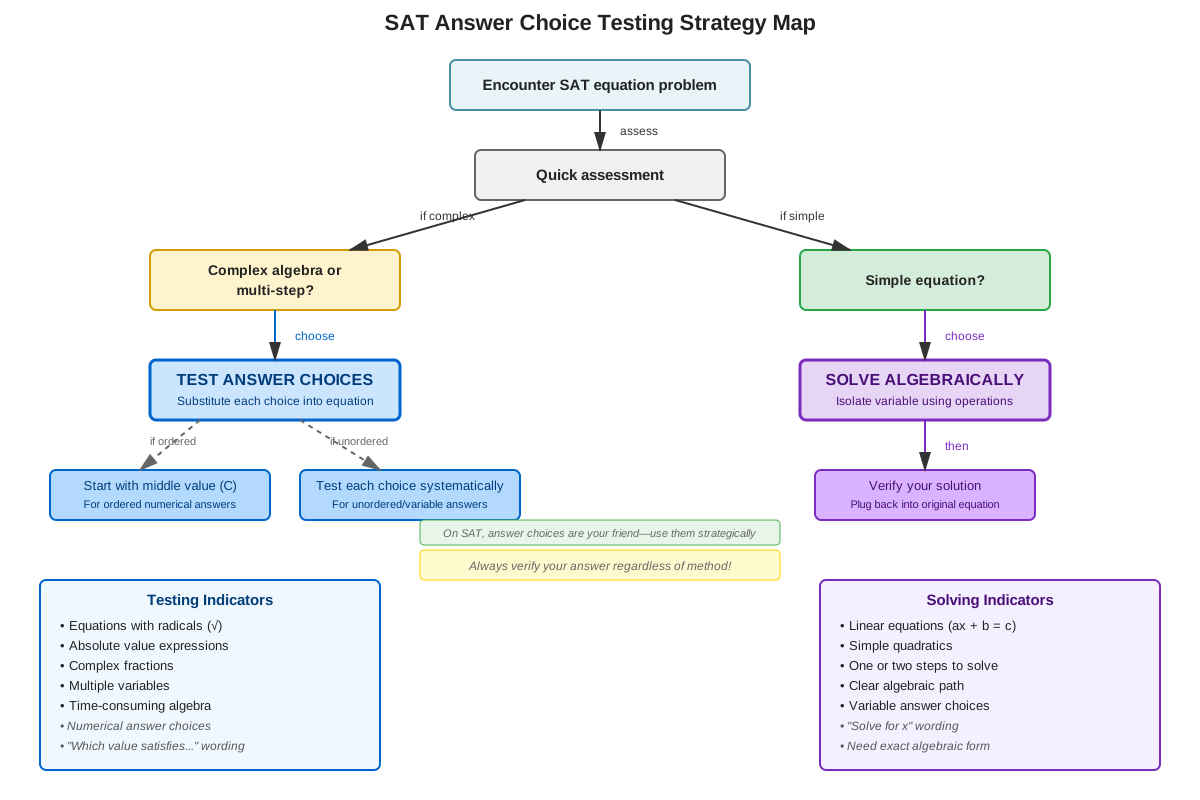
Working backward is a strategic approach where students begin with the answer choices and test each one in the original equation without solving algebraically first. This technique is particularly efficient when:
- The algebraic solution path involves multiple complex steps
- The equation contains fractions, radicals, or other challenging elements
- Time is limited and testing answers is faster than solving
- The question format explicitly asks "which of the following" is a solution
| Approach | Best Used When | Advantages | Disadvantages |
|---|---|---|---|
| Direct Verification | After solving algebraically | Confirms your work; builds confidence | Requires solving first; takes additional time |
| Working Backward | Multiple choice with numerical answers | Can be faster; no algebra needed | May test multiple wrong answers first |
Checking Solutions in Context Problems
Word problems and real-world context questions require an additional layer of verification beyond algebraic checking. After confirming that a value satisfies the equation mathematically, students must verify that the solution makes sense within the problem's context. For example, if a problem asks for the number of tickets sold and the algebraic solution yields x = -3, this answer is mathematically possible but contextually invalid since negative tickets cannot exist.
Context checking involves asking: Does this answer make sense given the units? Is it within reasonable bounds? Does it satisfy any stated constraints? On the SAT, the College Board frequently includes algebraically correct but contextually impossible answers as distractors, testing whether students think critically about their solutions rather than blindly accepting mathematical results.
Identifying Extraneous Solutions
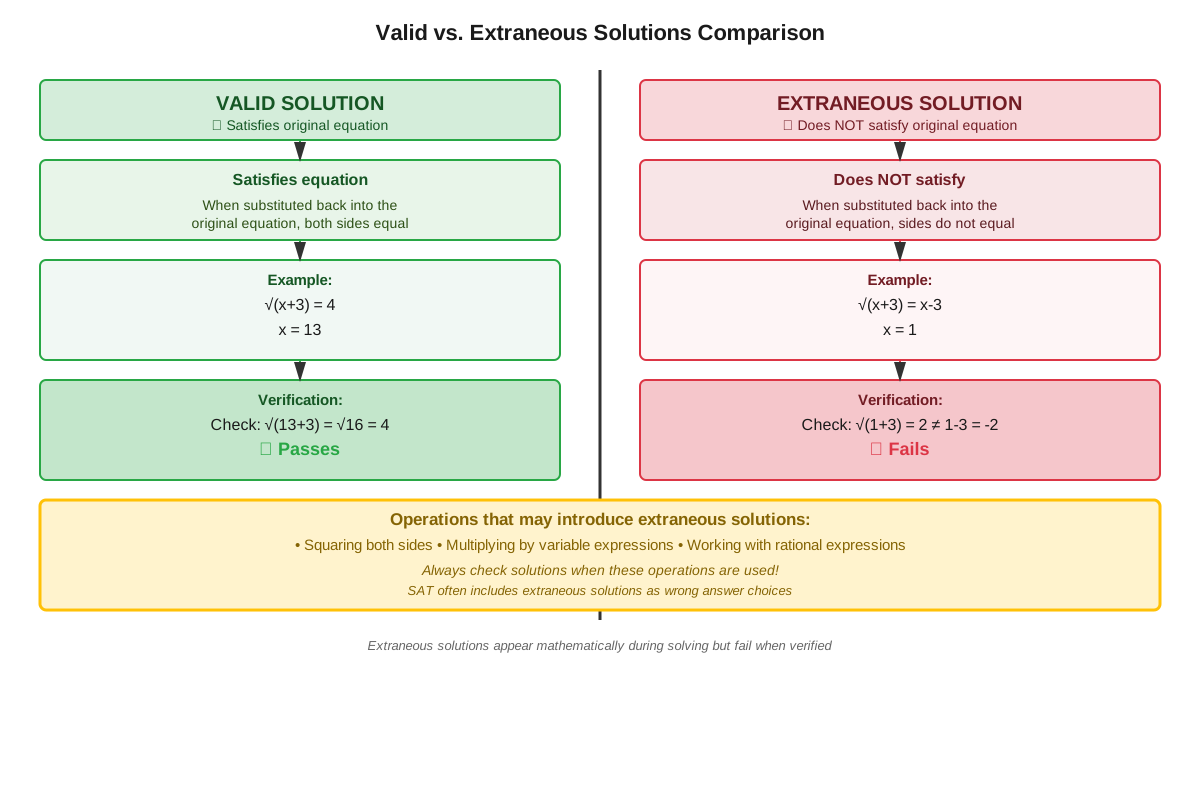
Certain algebraic operations can introduce extraneous solutions—values that emerge during the solving process but don't actually satisfy the original equation. This commonly occurs when:
- Squaring both sides of an equation (to eliminate square roots)
- Multiplying both sides by a variable expression
- Working with rational equations that require finding common denominators
For example, solving √(x + 3) = x - 3 by squaring both sides yields x + 3 = x² - 6x + 9, which simplifies to x² - 7x + 6 = 0, giving solutions x = 1 and x = 6. However, checking x = 1 in the original equation: √(1 + 3) = 1 - 3 becomes √4 = -2, or 2 = -2, which is false. Therefore, x = 1 is extraneous, and only x = 6 is valid. The SAT tests this concept by including extraneous solutions among answer choices, rewarding students who verify their work.
Systematic Testing of Multiple Choice Options
When SAT questions present four answer choices and ask which value satisfies an equation, an efficient strategy involves testing options strategically rather than randomly. Begin with option (B) or (C) rather than (A), because if the answers are arranged in numerical order and the tested value is too large or too small, this information can eliminate multiple choices simultaneously.
The systematic approach follows these steps:
- Identify the equation and the variable to solve for
- Select a middle answer choice to test first
- Substitute the value into the original equation
- Simplify both sides completely
- If the equation balances, select that answer; if not, determine whether you need a larger or smaller value
- Test the next logical choice based on your analysis
- Verify the correct answer once identified
This method transforms checking solutions from a verification tool into a primary problem-solving strategy, often saving significant time on the SAT.
Checking Solutions with Multiple Variables
Some SAT questions involve equations with multiple variables where one variable's value is given, and students must find another variable's value. For example: "If x = 4 is a solution to the equation 2x + 3y = 20, what is the value of y?" Here, checking solutions involves substituting the known value, then solving for the unknown: 2(4) + 3y = 20 becomes 8 + 3y = 20, yielding y = 4.
The verification process for these problems requires checking that both variable values simultaneously satisfy the equation. Substitute both x = 4 and y = 4 into the original equation: 2(4) + 3(4) = 8 + 12 = 20 ✓. This confirms the solution is correct.
Concept Relationships
The skill of checking solutions builds directly upon the prerequisite knowledge of solving linear equations in one variable. Students first learn to isolate variables through inverse operations, then apply checking solutions to verify their algebraic work. This creates a feedback loop: solving → checking → confirming, which reinforces both skills simultaneously.
Within the topic itself, the concepts connect in a logical progression: The fundamental process of checking solutions → serves as the foundation for → Direct verification and working backward strategies → which must account for → Context-based validation → while remaining alert to → Extraneous solutions → all of which inform → Systematic testing of multiple choice options.
Checking solutions also connects forward to more advanced topics. When students progress to systems of equations, they must check that solution pairs satisfy both equations simultaneously. In quadratic equations, checking becomes essential for identifying extraneous solutions introduced by squaring. For rational equations and radical equations, verification distinguishes between algebraically derived values and actual solutions. The skill even extends to functions, where students verify that input-output pairs satisfy function definitions.
The relationship map: Basic Substitution → Checking Solutions → Solving Linear Equations → Systems of Equations → Quadratic Equations → Rational/Radical Equations → Function Verification. Each level builds upon the previous, with checking solutions serving as the quality control mechanism throughout.
Quick check — test yourself on Checking solutions so far.
Try Flashcards →High-Yield Facts
⭐ Checking a solution means substituting the proposed value into the original equation and verifying both sides are equal
⭐ Working backward from answer choices is often faster than solving algebraically on multiple-choice questions
⭐ A solution must satisfy both the mathematical equation AND the real-world context in word problems
⭐ Extraneous solutions can be introduced when squaring both sides of an equation or multiplying by variable expressions
⭐ Always check solutions in the original equation, not in a transformed version of the equation
- If both sides of an equation equal the same value after substitution, the proposed solution is valid
- Testing middle answer choices first (B or C) can eliminate multiple options when answers are ordered numerically
- Negative solutions, fractional solutions, and zero are all mathematically valid unless the context prohibits them
- When checking solutions with fractions, find a common denominator before comparing both sides
- A solution that produces 0 = 0 after simplification is valid; a result like 5 = 7 indicates an invalid solution
- Checking solutions takes approximately 15-30 seconds per value, making it time-efficient on the SAT
- Calculator use can speed up checking solutions but isn't necessary for most SAT problems
- Some SAT questions give you the solution and ask you to find another parameter in the equation
- If an equation has no solution, no value will satisfy it when checked
- Checking solutions can reveal arithmetic errors made during the solving process
Common Misconceptions
Misconception: Checking solutions is only necessary when you're unsure of your answer → Correction: Checking solutions should be a standard practice for all problems, as it catches errors even when you feel confident. The SAT rewards thoroughness, and many students lose points on problems they "knew" they got right.
Misconception: If a value satisfies a transformed version of the equation, it's a valid solution → Correction: Solutions must be checked in the original equation, not in simplified or manipulated versions. Algebraic operations can introduce extraneous solutions that satisfy transformed equations but not the original.
Misconception: Working backward from answer choices is "cheating" or shows poor mathematical understanding → Correction: Strategic use of answer choices is a legitimate and efficient problem-solving technique on standardized tests. The SAT rewards correct answers regardless of method, and working backward demonstrates mathematical flexibility.
Misconception: If a solution produces a true statement like 0 = 0, something went wrong → Correction: The equation 0 = 0 (or any true statement like 5 = 5) confirms that the tested value is indeed a solution. This indicates the substitution and simplification were performed correctly.
Misconception: Checking solutions takes too much time on the SAT → Correction: Checking typically takes 15-30 seconds and can actually save time by preventing the need to rework problems. Additionally, working backward from answers can be faster than solving algebraically for complex equations.
Misconception: All algebraically derived solutions are valid → Correction: Certain operations (squaring, multiplying by variables) can introduce extraneous solutions. Always verify solutions in the original equation, especially after performing these operations.
Misconception: Context doesn't matter as long as the math works out → Correction: The SAT frequently includes mathematically correct but contextually impossible answers. A solution must make sense within the problem's real-world constraints (positive quantities, whole numbers where appropriate, etc.).
Worked Examples
Example 1: Direct Verification After Solving
Problem: Solve the equation 5x - 8 = 3x + 10 and verify your solution.
Solution Process:
First, solve algebraically:
- 5x - 8 = 3x + 10
- 5x - 3x = 10 + 8 (subtract 3x from both sides; add 8 to both sides)
- 2x = 18
- x = 9
Now, check the solution by substituting x = 9 into the original equation:
- Left side: 5(9) - 8 = 45 - 8 = 37
- Right side: 3(9) + 10 = 27 + 10 = 37
- Since 37 = 37, the solution x = 9 is verified ✓
Connection to Learning Objectives: This example demonstrates the fundamental process of checking solutions and shows how verification confirms algebraic work. The systematic substitution and simplification process ensures accuracy and builds confidence in the answer.
Example 2: Working Backward from Answer Choices
Problem: Which of the following is a solution to the equation 4(2x - 3) = 5x + 9?
A) x = 3
B) x = 5
C) x = 7
D) x = 9
Solution Process:
Rather than solving algebraically, test answer choices strategically. Start with (C) x = 7:
Left side: 4(2(7) - 3) = 4(14 - 3) = 4(11) = 44
Right side: 5(7) + 9 = 35 + 9 = 44
Since 44 = 44, x = 7 is the solution ✓
Answer: C
Alternative Approach: If we had tested (C) first and it didn't work, we could determine whether we needed a larger or smaller value based on which side was greater, then test accordingly. This strategic approach often requires testing only one or two choices.
Connection to Learning Objectives: This example illustrates how checking solutions can be the primary problem-solving strategy on SAT multiple-choice questions, demonstrating efficiency and strategic thinking. It shows that working backward is often faster than traditional algebraic solving.
Example 3: Context-Based Verification
Problem: Maria has $50 to spend on books. Each book costs $12, and she must pay a $2 shipping fee per order (not per book). If the equation 12b + 2 = 50 represents this situation, where b is the number of books, solve for b and verify the solution makes sense in context.
Solution Process:
Solve algebraically:
- 12b + 2 = 50
- 12b = 48
- b = 4
Check mathematically by substituting b = 4:
- 12(4) + 2 = 48 + 2 = 50 ✓
Check contextually:
- Can Maria buy 4 books? Yes, this is a positive whole number
- Does she have enough money? 4 books × $12 = $48, plus $2 shipping = $50 ✓
- Does this make sense? Yes, she spends exactly her budget
Connection to Learning Objectives: This example demonstrates that checking solutions requires both mathematical verification and contextual validation. It shows how SAT word problems require critical thinking beyond pure computation, addressing the learning objective of applying checking solutions to realistic scenarios.
Exam Strategy
When approaching SAT questions involving checking solutions, begin by reading the question carefully to determine whether you're asked to find a solution or verify a given one. Look for trigger phrases such as "which of the following," "if x = [value] is a solution," or "which value satisfies." These phrases signal that working backward may be more efficient than solving algebraically.
Process-of-elimination tips specific to checking solutions:
- Eliminate answers that produce obviously false statements (like 10 = 20) immediately
- When testing numerical answer choices arranged in order, start with middle values (B or C) to potentially eliminate multiple choices at once
- If a problem involves context (money, time, quantities), immediately eliminate negative numbers or values that don't make contextual sense
- For equations with fractions, eliminate answers that would create undefined expressions (like division by zero)
Time allocation advice: Allocate approximately 30-45 seconds for straightforward checking solutions questions. If working backward, budget 15-20 seconds per answer choice tested. If you find yourself testing more than three choices, consider whether solving algebraically might be faster. For context-based problems, add 10-15 seconds for contextual verification beyond mathematical checking.
Strategic decision-making: Before beginning any problem, ask yourself: "Is working backward faster here?" If the equation involves complex fractions, multiple steps, or difficult algebraic manipulation, and the answer choices are simple numbers, working backward is usually more efficient. Conversely, if the equation is simple but answer choices are complex expressions, solve algebraically first.
Exam Tip: Always perform checking in the original equation as written in the problem, not in any transformed version you created while solving. This ensures you catch all errors and identify extraneous solutions.
Memory Techniques
SOLVE Acronym for Checking Solutions:
- Substitute the proposed value for the variable
- Operate following PEMDAS on both sides independently
- Look at both sides after simplification
- Verify that both sides equal the same value
- Evaluate whether the solution makes contextual sense
Visualization Strategy: Picture an old-fashioned balance scale. When you substitute a correct solution into an equation, both sides of the scale should be perfectly balanced (equal). If the scale tips to one side, the proposed solution is incorrect. This mental image reinforces that equations represent equality.
The "Plug and Check" Rhyme: "When in doubt, plug it out—substitute and verify, that's the way to satisfy!" This simple rhyme helps students remember that checking solutions is about substitution and verification.
Backward vs. Forward Decision Tree: Remember "WHAM"—Work backward when you Have Answer choices with Multiple-choice format. This reminds students when the working backward strategy is most effective.
Extraneous Solutions Memory Aid: "Square with care, multiply with caution—these operations need solution verification!" This phrase reminds students which algebraic operations commonly introduce extraneous solutions.
Summary
Checking solutions is an essential SAT Math skill that serves both as a verification tool and a primary problem-solving strategy. The fundamental process involves substituting proposed values into original equations and confirming that both sides equal the same value. On the SAT, this skill appears in approximately 15-20% of questions, either directly (asking which value satisfies an equation) or indirectly (requiring verification of algebraic work). Students must master both direct verification after solving and the strategic approach of working backward from answer choices. Context-based problems require an additional layer of verification to ensure solutions make real-world sense beyond mathematical validity. Awareness of extraneous solutions—values introduced through operations like squaring or multiplying by variables—is crucial for avoiding common traps. Efficient checking typically takes 15-30 seconds per value and can actually save time by preventing errors and eliminating the need to rework problems. The skill connects foundational algebraic substitution to advanced topics like systems of equations and function verification, making it a cornerstone of mathematical problem-solving.
Key Takeaways
- Checking solutions involves substituting values into the original equation and verifying both sides are equal—this confirms mathematical validity
- Working backward from answer choices is often faster than solving algebraically on SAT multiple-choice questions, especially for complex equations
- Always verify solutions in the original equation, not transformed versions, to catch extraneous solutions introduced by algebraic operations
- Context-based problems require both mathematical and real-world verification—solutions must make sense within the problem's constraints
- Strategic testing of middle answer choices (B or C) can eliminate multiple options simultaneously when answers are numerically ordered
- Checking solutions takes minimal time (15-30 seconds) and serves as insurance against careless errors under test pressure
- Mastery of this skill provides a self-correction mechanism that improves accuracy and confidence across all SAT Math topics
Related Topics
Systems of Linear Equations: After mastering checking solutions for single equations, students progress to verifying solution pairs (x, y) that must satisfy multiple equations simultaneously. This extends the checking process to coordinate pairs and graphical interpretations.
Quadratic Equations: Checking solutions becomes more complex with quadratic equations that may have two solutions, no real solutions, or extraneous solutions introduced by taking square roots. Understanding verification in linear contexts prepares students for these advanced scenarios.
Rational Equations: These equations frequently produce extraneous solutions when both sides are multiplied by variable expressions to clear denominators. The checking solutions skill is essential for distinguishing valid solutions from algebraically derived but mathematically invalid values.
Inequalities: While the checking process differs slightly (verifying that substitution produces a true inequality rather than equality), the fundamental substitution and verification skills transfer directly to this related topic.
Functions and Function Notation: Checking whether specific input-output pairs satisfy function definitions applies the same substitution and verification process, extending the skill to functional relationships beyond simple equations.
Practice CTA
Now that you've mastered the concepts, strategies, and techniques for checking solutions, it's time to put your knowledge into action! The practice questions and flashcards are specifically designed to reinforce these skills and build the speed and accuracy you need for SAT success. Remember, checking solutions isn't just about finding right answers—it's about developing the mathematical confidence and strategic thinking that will serve you throughout the exam. Each practice problem you complete strengthens your ability to verify work efficiently and catch errors before they cost you points. Approach the practice with the same systematic mindset you've learned here, and watch your accuracy and confidence soar!
Sign up free to keep reading
Create a free AnvayaPrep account to finish this SAT guide on Checking solutions — plus flashcards and practice questions.