Overview
Algebra forms the backbone of SAT Math, appearing in roughly 35% of all questions across both calculator and no-calculator sections. While students often focus on learning new formulas and techniques, one of the most critical—and frequently overlooked—skills is recognizing and avoiding common algebra errors. These systematic mistakes cost students valuable points not because they lack knowledge, but because they fall into predictable traps during the pressure of test day.
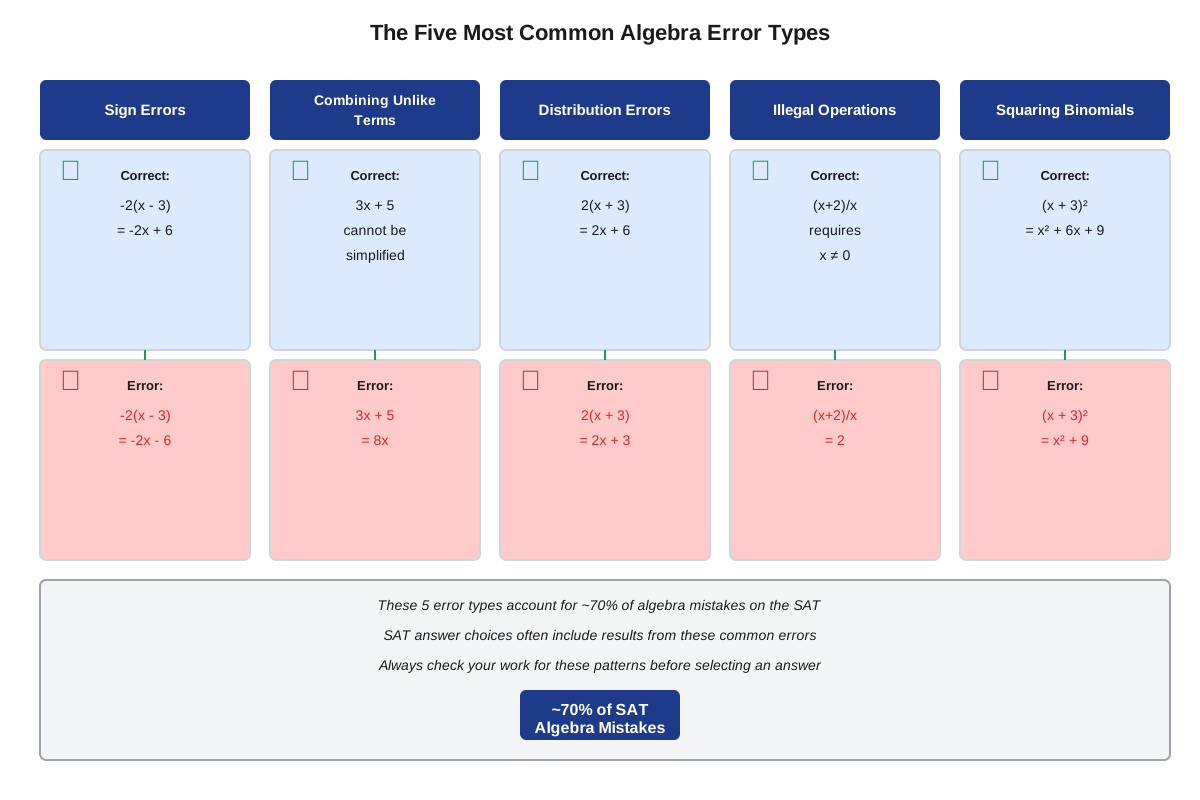
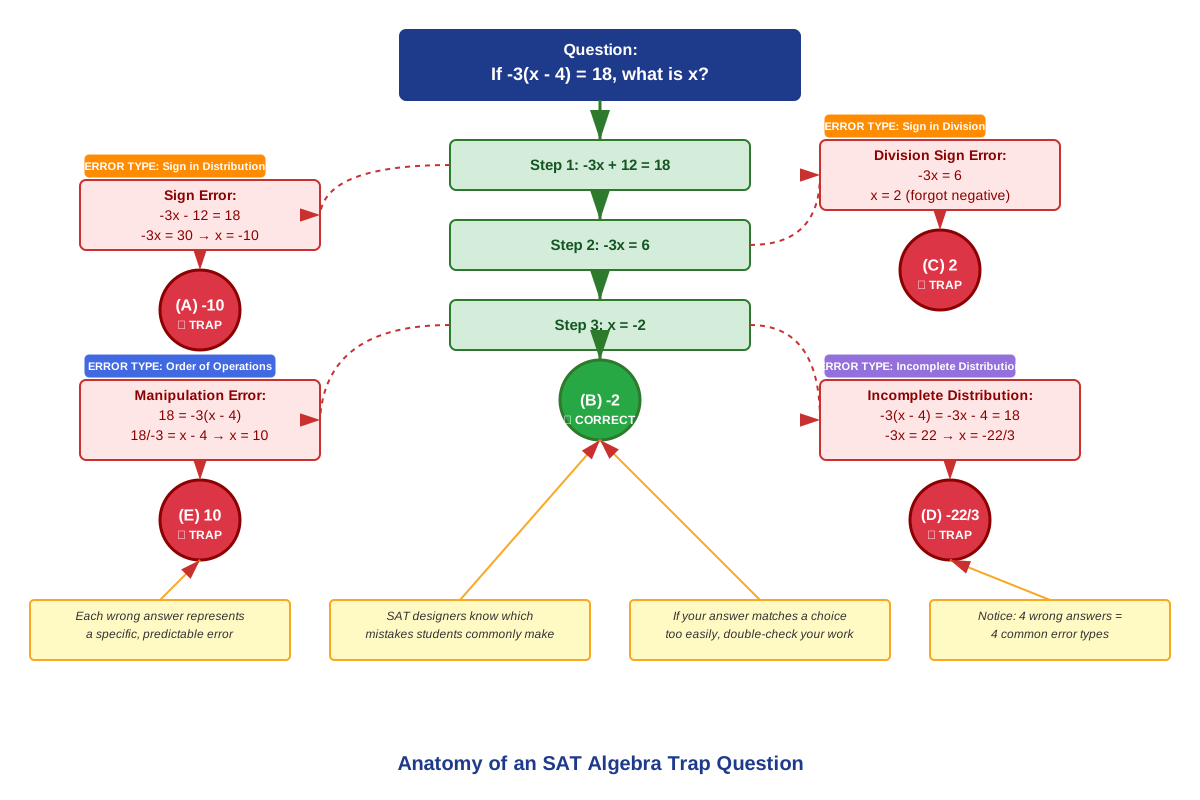
Common algebra errors represent recurring patterns of mistakes that students make when manipulating equations, simplifying expressions, and solving for variables. These errors include sign mistakes when distributing negative numbers, incorrectly combining unlike terms, misapplying the distributive property, dividing by variables that could equal zero, and making careless errors when squaring binomials. The SAT test writers deliberately design answer choices to match these common errors, meaning that if you make a typical mistake, you'll find your incorrect answer waiting for you among the options—making it feel deceptively "right."
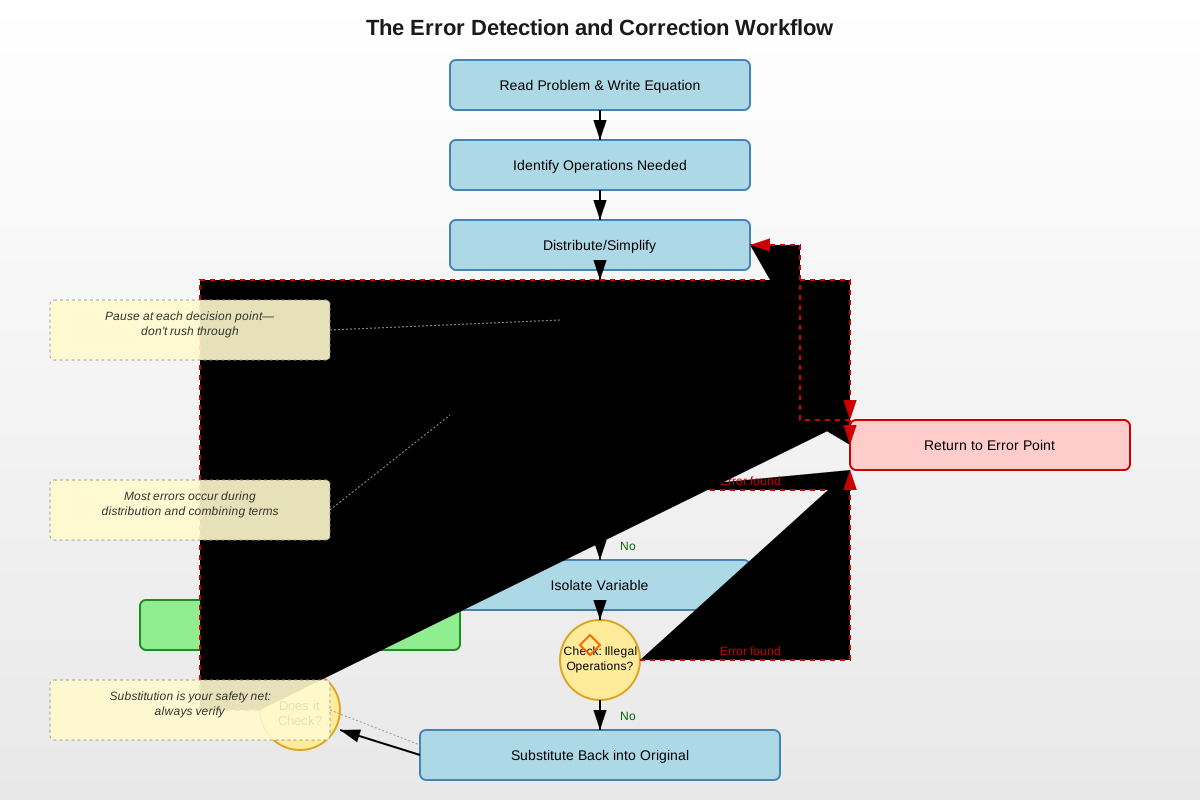
Understanding these error patterns is essential because it transforms how students approach math problems on the SAT. Rather than simply solving forward and selecting the first answer that matches, skilled test-takers develop a defensive mindset: they anticipate where errors might occur, double-check vulnerable steps, and verify their answers by substituting back into the original equation. This topic connects directly to linear equations in one variable, where most algebraic manipulation occurs, but the principles extend to quadratic equations, systems of equations, and even word problems where algebraic translation errors can derail an otherwise sound approach.
Learning Objectives
- [ ] Identify key features of common algebra errors
- [ ] Explain how common algebra errors appears on the SAT
- [ ] Apply common algebra errors to answer SAT-style questions
- [ ] Recognize error patterns in worked solutions and identify the specific mistake made
- [ ] Develop verification strategies to catch errors before selecting an answer
- [ ] Distinguish between conceptual misunderstandings and careless execution errors
- [ ] Predict which answer choices likely represent common errors for a given problem
Prerequisites
- Basic arithmetic operations with integers: Understanding positive and negative number operations is essential because sign errors represent the most frequent category of algebraic mistakes
- Order of operations (PEMDAS): Many algebra errors stem from incorrectly sequencing operations, particularly when distributing or combining terms
- Properties of equality: Recognizing that operations must be performed on both sides of an equation prevents one-sided manipulation errors
- Variable manipulation fundamentals: Basic comfort with isolating variables and performing inverse operations provides the foundation for recognizing when these processes go wrong
- Exponent rules: Errors involving powers and roots require understanding the correct rules to identify violations
Why This Topic Matters
In real-world applications, algebraic errors can have serious consequences—from engineering miscalculations that compromise structural integrity to financial modeling errors that lead to poor investment decisions. Scientists, economists, data analysts, and engineers all rely on accurate algebraic manipulation daily. Developing the habit of careful, systematic algebraic work and error-checking builds professional competencies that extend far beyond test-taking.
On the SAT specifically, sat common algebra errors appear with remarkable consistency. Research on SAT scoring patterns reveals that approximately 60-70% of students who miss algebra questions do so not because they don't know the relevant concept, but because they make execution errors. The College Board deliberately includes "distractor" answer choices that match common mistakes—if you incorrectly distribute a negative sign, there's likely an answer choice waiting for exactly that error. This means that mastering error recognition can improve scores even without learning new mathematical content.
Common algebra errors appear across multiple question types on the SAT. In standard multiple-choice questions, incorrect answer choices often represent specific error patterns. In grid-in questions where students supply their own answers, these errors lead to incorrect numerical responses. Word problems combine algebraic errors with translation mistakes, compounding the difficulty. Even data analysis questions involving linear models can be derailed by algebraic manipulation errors when solving for slope or intercepts. The topic appears in both calculator and no-calculator sections, with an estimated 8-12 questions per test directly testing careful algebraic manipulation where common errors are the primary trap.
Core Concepts
Sign Errors with Distribution
The most prevalent category of common algebra errors involves sign mistakes when distributing negative numbers or subtracting expressions. When a negative sign or negative coefficient appears before parentheses, students must distribute it to every term inside—yet this step is frequently executed incorrectly under time pressure.
Correct distribution: -3(x - 4) = -3x + 12 (the negative distributes to both terms)
Common error: -3(x - 4) = -3x - 12 (failing to change the sign of the second term)
The error becomes even more common with subtraction of grouped terms:
Correct: (5x + 2) - (3x - 7) = 5x + 2 - 3x + 7 = 2x + 9
Common error: (5x + 2) - (3x - 7) = 5x + 2 - 3x - 7 = 2x - 5 (not distributing the negative to both terms in the second group)
This error type accounts for approximately 25% of all algebraic mistakes on the SAT. The test writers know this and consistently include answer choices that match the incorrect distribution pattern.
Combining Unlike Terms
Another frequent error involves incorrectly combining terms that cannot be combined. Terms can only be combined when they have identical variable parts with identical exponents.
Correct combinations:
- 3x + 5x = 8x (like terms)
- 4x² - 2x² = 2x² (like terms)
Incorrect combinations (common errors):
- 3x + 5y ≠ 8xy (different variables cannot combine)
- 4x² + 2x ≠ 6x² or 6x³ (different exponents mean unlike terms)
- 7x + 3 ≠ 10x (variable terms and constants are unlike)
Students often make these errors when rushing or when expressions become complex. The SAT exploits this by presenting simplified expressions that would result from incorrectly combining unlike terms as answer choices.
Squaring Binomials Incorrectly
When squaring a binomial expression, students must apply the formula (a + b)² = a² + 2ab + b². The most common error is forgetting the middle term (2ab) and incorrectly calculating (a + b)² = a² + b².
Correct: (x + 3)² = x² + 6x + 9
Common error: (x + 3)² = x² + 9 (missing the middle term 6x)
Correct: (2x - 5)² = 4x² - 20x + 25
Common error: (2x - 5)² = 4x² + 25 (missing the middle term and/or getting the sign wrong)
This error appears frequently in questions involving quadratic expressions, area problems, and equation solving where both sides must be squared.
Division and Cancellation Errors
Errors involving division fall into several categories, all appearing regularly on the SAT:
Dividing only part of an expression:
- Correct: (6x + 9)/3 = 2x + 3 (divide each term by 3)
- Common error: (6x + 9)/3 = 2x + 9 (dividing only the first term)
Canceling terms instead of factors:
- Correct: (x + 5)/(x + 3) cannot be simplified by canceling x's (they're terms, not factors)
- Common error: (x + 5)/(x + 3) = 5/3 (incorrectly "canceling" the x's)
Dividing by a variable that could be zero:
- When solving x² = 3x, dividing both sides by x gives x = 3, but this loses the solution x = 0
- Correct approach: x² - 3x = 0, then x(x - 3) = 0, giving x = 0 or x = 3
Equation Solving Errors
When solving equations, several systematic errors occur:
Operating on only one side:
- Starting with 2x + 5 = 13
- Common error: 2x = 13 - 5 (correct) then x = 13 - 5/2 (incorrect—didn't divide 13 by 2)
- Correct: 2x = 8, then x = 4
Incorrect inverse operations:
- Starting with x/4 = 7
- Common error: x = 7/4 (dividing instead of multiplying)
- Correct: x = 28 (multiply both sides by 4)
Sign errors when moving terms:
- Starting with 5 - 2x = 11
- Common error: 2x = 11 - 5 (forgetting to change sign when moving -2x)
- Correct: -2x = 11 - 5 = 6, then x = -3
Exponent and Radical Errors
Errors with powers and roots include:
| Correct Rule | Common Error | Example |
|---|---|---|
| (xy)² = x²y² | (x + y)² = x² + y² | (3 + 4)² ≠ 9 + 16 |
| x^a · x^b = x^(a+b) | x^a · x^b = x^(ab) | x² · x³ = x⁵, not x⁶ |
| (x^a)^b = x^(ab) | (x^a)^b = x^(a+b) | (x²)³ = x⁶, not x⁵ |
| √(ab) = √a · √b | √(a + b) = √a + √b | √(9 + 16) ≠ 3 + 4 |
Fraction Operation Errors
Working with algebraic fractions introduces additional error opportunities:
Adding fractions without common denominators:
- Common error: x/3 + x/4 = x/7 or 2x/7
- Correct: x/3 + x/4 = 4x/12 + 3x/12 = 7x/12
Multiplying fractions incorrectly:
- Common error: (x/3) · (y/4) = xy/7
- Correct: (x/3) · (y/4) = xy/12
Complex fraction simplification:
- For (x/2)/(x/3), students often get confused about which operation to perform
- Correct: (x/2)/(x/3) = (x/2) · (3/x) = 3/2
Concept Relationships
The various common algebra errors interconnect through underlying causes. Sign errors with distribution → lead to → incorrect simplified expressions → which cause → wrong solutions when solving equations. Similarly, combining unlike terms → creates → false equivalences → that propagate → through multi-step problems.
These error patterns connect to prerequisite knowledge in specific ways: weak understanding of integer operations → manifests as → sign errors in algebra; incomplete mastery of order of operations → appears as → distribution and simplification errors; insufficient practice with fraction operations → results in → algebraic fraction mistakes.
The relationship to linear equations in one variable is direct: every step in solving a linear equation presents an opportunity for one of these common errors. A single equation like 3(2x - 5) - 4x = 7 requires distribution (sign error risk), combining like terms (unlike term error risk), and inverse operations (equation solving error risk). The errors compound—making one mistake early in a solution often leads to additional errors as the student works with an incorrect intermediate expression.
Looking forward, these same error patterns appear in more advanced topics: quadratic equations (squaring errors), systems of equations (sign and distribution errors), rational expressions (division and cancellation errors), and exponential functions (exponent rule errors). Mastering error recognition now builds a foundation for accuracy across all algebraic topics.
High-Yield Facts
⭐ The most common single error on SAT algebra questions is failing to distribute a negative sign to all terms in parentheses
⭐ When an answer choice matches your calculation exactly, verify your work—the SAT includes answers that match common errors
⭐ Terms can only be combined if they have identical variable parts with identical exponents; 3x² and 5x are unlike terms
⭐ (a + b)² always equals a² + 2ab + b², never just a² + b²; the middle term 2ab is essential
⭐ When dividing an expression by a number, every term must be divided, not just the first term
- Canceling only works with factors (multiplication), never with terms (addition/subtraction)
- When solving x² = kx, never divide by x; instead, factor to x(x - k) = 0 to avoid losing the x = 0 solution
- The square root of a sum is not the sum of square roots: √(a + b) ≠ √a + √b
- When moving a term across the equals sign, its sign must change: if 5 - 2x = 11, then -2x = 11 - 5, not 2x = 11 - 5
- Exponent rules: x^a · x^b = x^(a+b), but (x^a)^b = x^(ab); these are different operations
- Substituting your answer back into the original equation catches most algebraic errors
- Sign errors increase dramatically in no-calculator sections where mental math is required
- Complex fractions require multiplying by the reciprocal: (a/b)/(c/d) = (a/b) · (d/c)
Quick check — test yourself on Common algebra errors so far.
Try Flashcards →Common Misconceptions
Misconception: When distributing a negative sign, only the first term needs to change sign.
Correction: Every term inside the parentheses must have its sign changed. The expression -(3x - 5 + 2y) becomes -3x + 5 - 2y, with all three terms affected.
Misconception: You can cancel terms that appear in both the numerator and denominator of a fraction.
Correction: Only factors (things being multiplied) can cancel, never terms (things being added or subtracted). In (x + 3)/(x + 5), the x's cannot cancel because they're terms, not factors. However, in x(x + 3)/x(x + 5), the factor x can cancel, giving (x + 3)/(x + 5).
Misconception: Squaring a binomial means squaring each term: (a + b)² = a² + b².
Correction: Squaring a binomial requires the full expansion (a + b)² = a² + 2ab + b². The middle term 2ab is essential and represents the cross-products from FOIL. For example, (x + 4)² = x² + 8x + 16, not x² + 16.
Misconception: When solving an equation, you can perform different operations on each side as long as you "balance" them somehow.
Correction: The same operation must be performed on both sides of an equation. If you add 5 to the left side, you must add 5 to the right side. If you divide the left side by 3, you must divide the entire right side by 3, not just one term.
Misconception: If a variable appears in a problem, dividing by that variable is always safe.
Correction: Dividing by a variable is only valid when you know the variable cannot equal zero. When solving x² = 4x, dividing both sides by x gives x = 4 but loses the solution x = 0. Always factor instead: x² - 4x = 0 → x(x - 4) = 0 → x = 0 or x = 4.
Misconception: The order of operations doesn't matter much in algebra since you're just solving for x.
Correction: Order of operations is critical at every step. When simplifying 2 + 3x · 4, you must multiply before adding (2 + 12x), not add first. When solving equations, you must undo operations in reverse order of PEMDAS.
Misconception: If you make an error but get an answer that's among the choices, it's probably correct.
Correction: The SAT deliberately includes answer choices that match common errors. Finding your answer among the choices provides no validation—you must verify by substituting back into the original equation or checking your work step-by-step.
Worked Examples
Example 1: Multi-Step Equation with Distribution
Problem: Solve for x: 4(2x - 3) - 5(x + 2) = 7
Solution with error awareness:
Step 1: Distribute carefully, watching for sign errors
- 4(2x - 3) = 8x - 12 ✓ (positive coefficient, straightforward)
- -5(x + 2) = -5x - 10 ✓ (negative coefficient distributed to both terms)
Common error to avoid: Writing -5(x + 2) = -5x + 10 (forgetting to distribute the negative to the +2)
Step 2: Combine the distributed terms
- 8x - 12 - 5x - 10 = 7
- Combine like terms: 8x - 5x = 3x and -12 - 10 = -22
- Result: 3x - 22 = 7
Common error to avoid: Combining 8x and -12 or -5x and -10 (these are unlike terms)
Step 3: Isolate the variable term
- Add 22 to both sides: 3x - 22 + 22 = 7 + 22
- Result: 3x = 29
Common error to avoid: Adding 22 to only one side, or subtracting 22 from 7
Step 4: Solve for x
- Divide both sides by 3: x = 29/3
Common error to avoid: Dividing only the 29 by 3 while leaving something else behind
Step 5: Verify by substitution
- Substitute x = 29/3 back into the original equation
- Left side: 4(2(29/3) - 3) - 5(29/3 + 2) = 4(58/3 - 9/3) - 5(29/3 + 6/3)
- = 4(49/3) - 5(35/3) = 196/3 - 175/3 = 21/3 = 7 ✓
Learning objective connection: This example demonstrates identifying sign errors (distribution), combining unlike terms errors (simplification), and equation solving errors (isolation), while applying verification strategies.
Example 2: Equation with Squaring
Problem: If (x + 5)² = 64, what are all possible values of x?
Solution with error awareness:
Step 1: Take the square root of both sides
- √[(x + 5)²] = ±√64
- x + 5 = ±8
Common error to avoid: Expanding (x + 5)² = x² + 25 (forgetting the middle term 10x) and then trying to solve x² + 25 = 64. While this eventually works, it's unnecessarily complicated and introduces more error opportunities.
Another common error: Forgetting the ± when taking the square root, which loses one solution
Step 2: Solve both cases
- Case 1: x + 5 = 8 → x = 3
- Case 2: x + 5 = -8 → x = -13
Step 3: Verify both solutions
- For x = 3: (3 + 5)² = 8² = 64 ✓
- For x = -13: (-13 + 5)² = (-8)² = 64 ✓
Alternative approach showing the squaring error:
If a student incorrectly expands first:
- (x + 5)² = x² + 25 (ERROR: missing middle term)
- x² + 25 = 64
- x² = 39
- x = ±√39 ≈ ±6.24
These answers would be wrong and wouldn't verify in the original equation. This demonstrates why recognizing the squaring error is crucial.
Learning objective connection: This example shows how to identify squaring errors, explains how this error appears on the SAT (wrong answer choices would include √39 and -√39), and applies error recognition to reach the correct solution.
Exam Strategy
When approaching SAT algebra questions, adopt a defensive mindset focused on error prevention and detection:
Before solving: Scan the problem for error-prone elements. Look for negative signs before parentheses, expressions that need squaring, fractions requiring operations, and variables in denominators. These are red flags where extra care is needed.
Trigger words and phrases that signal high error-risk:
- "Simplify" or "Which expression is equivalent" → watch for combining unlike terms and distribution errors
- "Solve for x" with complex expressions → anticipate sign errors and equation-solving mistakes
- "If (expression)² = ..." → prepare for squaring errors
- Problems with subtraction of grouped terms → high risk for sign errors
During solving: Work deliberately through error-prone steps. When distributing a negative, physically mark each term as you change its sign. When combining terms, verify they're truly like terms before combining. When squaring binomials, write out the full formula (a + b)² = a² + 2ab + b² before substituting.
Process of elimination specific to algebra errors:
- If you get an answer quickly and easily, be suspicious—the SAT rarely gives away points
- Eliminate answer choices that would require combining unlike terms or other impossible operations
- If two answer choices differ only in sign, you likely have a sign error situation—double-check distribution
- If answer choices include both a² + b² and a² + 2ab + b² forms, the question is testing squaring errors
Time allocation: Don't rush through algebra problems to save time. A careful 90 seconds that yields the correct answer is far better than a rushed 45 seconds that leads to a preventable error. However, if you're stuck, make your best guess and move on—spending 3+ minutes on a single algebra problem is inefficient.
Verification strategy: On the SAT, you have limited time for checking, so prioritize verification for:
- Questions where you're uncertain about your answer
- Problems where you noticed yourself making and correcting an error
- Grid-in questions where there's no answer choice to guide you
The fastest verification method is substitution: plug your answer back into the original equation and confirm both sides equal. This catches virtually all algebraic errors.
Memory Techniques
SAND mnemonic for distribution: Sign Affects Numerator Distribution
- When distributing, the Sign outside affects All terms
- Never distribute to only one term
- Distribute to Numerator and denominator in fractions
"FOIL the SOIL" for squaring binomials:
- FOIL: First, Outer, Inner, Last (the standard method)
- SOIL: Squaring? Outer and Inner are Like terms (they combine to form the middle term 2ab)
- This reminds you that (a + b)² has three terms, not two
"Like likes like" for combining terms:
- Visualize terms as people who only interact with their "like" friends
- 3x² only combines with other x² terms
- 5x only combines with other x terms
- Constants only combine with constants
"Factor before you fracture" for division by variables:
- Before dividing by a variable (which might "fracture" your solution by losing roots), factor first
- x² = 5x → x² - 5x = 0 → x(x - 5) = 0 → x = 0 or x = 5
The "Both Sides" hand gesture:
- When solving equations, physically touch both sides of your paper/screen
- This kinesthetic reminder helps prevent operating on only one side
Visualization for (a + b)² ≠ a² + b²:
- Picture a square with side length (a + b)
- The area isn't just a² + b²; there are two rectangles of area ab in the corners
- Total area: a² + ab + ab + b² = a² + 2ab + b²
Summary
Common algebra errors represent systematic, predictable mistakes that students make when manipulating algebraic expressions and solving equations. These errors—including sign mistakes during distribution, incorrectly combining unlike terms, forgetting the middle term when squaring binomials, improper cancellation, and equation-solving mistakes—appear consistently across SAT Math sections. The test writers deliberately design incorrect answer choices to match these common errors, making error recognition and prevention essential skills. Success requires not just knowing how to solve algebra problems, but developing a defensive approach: anticipating where errors occur, working carefully through vulnerable steps, and verifying solutions through substitution. The most critical insight is that finding your answer among the choices provides no validation on the SAT—incorrect answers are designed to feel right. Students who master error recognition transform their approach from simply solving forward to strategically avoiding traps, often improving their scores significantly without learning new mathematical content. The key is deliberate practice: not just solving problems, but analyzing errors when they occur, understanding why they happened, and building habits that prevent their recurrence.
Key Takeaways
- The SAT includes answer choices specifically designed to match common algebraic errors, making error recognition as important as problem-solving ability
- Sign errors during distribution—especially with negative signs before parentheses—represent the single most common mistake on SAT algebra questions
- Terms can only be combined when they have identical variable parts with identical exponents; 3x² and 5x cannot be combined
- The formula (a + b)² = a² + 2ab + b² must include the middle term; (a + b)² ≠ a² + b²
- Verification through substitution catches most errors and should be used strategically when time permits
- Canceling only works with factors (multiplication), never with terms (addition/subtraction)
- When solving equations involving x² = kx, always factor rather than dividing by x to avoid losing the x = 0 solution
Related Topics
Quadratic Equations: Mastering common algebra errors in linear equations provides the foundation for avoiding similar mistakes in quadratic contexts, where squaring errors and factoring mistakes become even more consequential.
Systems of Linear Equations: Solving systems requires careful algebraic manipulation across multiple equations simultaneously, multiplying the opportunities for sign errors and combining term mistakes.
Rational Expressions and Equations: These advanced topics involve all the common errors discussed here plus additional complications with complex fractions and restrictions on variable values.
Functions and Function Notation: Evaluating and manipulating functions requires the same careful algebraic work, with errors in substitution and simplification leading to incorrect function values.
Word Problems and Mathematical Modeling: While these problems add the challenge of translating English to algebra, the algebraic manipulation once equations are set up remains vulnerable to all the common errors covered in this guide.
Practice CTA
Now that you understand the landscape of common algebra errors and how to avoid them, it's time to put this knowledge into practice. Attempt the practice questions designed for this topic—they'll present you with problems where common errors are tempting, helping you build the recognition skills that prevent mistakes on test day. Use the flashcards to reinforce the specific error patterns and their corrections until recognizing them becomes automatic. Remember: every error you catch in practice is a point you'll save on the actual SAT. Your goal isn't perfection in practice—it's building the habits and awareness that lead to accuracy when it counts. Start practicing now, and pay special attention to any mistakes you make; they're your most valuable learning opportunities.
Sign up free to keep reading
Create a free AnvayaPrep account to finish this SAT guide on Common algebra errors — plus flashcards and practice questions.