Overview
Distance rate time equations form one of the most frequently tested algebraic concepts on the SAT Math section. These equations express the fundamental relationship between how far something travels (distance), how fast it moves (rate), and how long it takes (time). The basic formula d = rt (distance equals rate times time) serves as the foundation for numerous problem types that appear across multiple SAT administrations. Students who master this topic gain a significant advantage, as these problems often appear in both the calculator and no-calculator sections.
Understanding sat distance rate time equations requires more than memorizing a single formula. Success demands the ability to manipulate the equation algebraically, set up systems of equations when multiple objects are moving, and translate complex word problems into mathematical expressions. These problems frequently involve scenarios such as two vehicles traveling toward or away from each other, objects moving at different speeds, or situations where speed changes during a journey. The SAT particularly favors problems that combine distance-rate-time relationships with other algebraic concepts like systems of equations or linear functions.
This topic connects directly to broader math concepts including linear equations in one variable, systems of equations, unit conversion, and proportional reasoning. Mastery of distance-rate-time problems strengthens algebraic manipulation skills and develops the critical ability to translate real-world scenarios into mathematical models—a skill that appears throughout the SAT Math section and forms the foundation for more advanced mathematical thinking.
Learning Objectives
- [ ] Identify key features of distance rate time equations
- [ ] Explain how distance rate time equations appears on the SAT
- [ ] Apply distance rate time equations to answer SAT-style questions
- [ ] Manipulate the distance formula to solve for any variable (distance, rate, or time)
- [ ] Set up and solve systems of equations involving multiple moving objects
- [ ] Convert between different units of measurement within distance-rate-time problems
- [ ] Analyze complex scenarios involving changing rates or multiple segments of travel
Prerequisites
- Basic algebraic manipulation: Students must solve for variables, distribute terms, and combine like terms—essential for rearranging the distance formula and solving resulting equations
- Unit awareness: Understanding units (miles per hour, feet per second, etc.) enables proper setup and prevents calculation errors
- Linear equations in one variable: The foundation for solving distance-rate-time equations, as most problems reduce to linear equations
- Fractions and decimals: Rate calculations often involve fractional or decimal values that require confident arithmetic
- Word problem translation: The ability to convert written scenarios into mathematical expressions determines success with these application problems
Why This Topic Matters
Distance-rate-time problems appear in everyday life constantly: calculating arrival times for trips, determining fuel efficiency, planning running pace for races, or estimating delivery times. These practical applications make the concept highly relevant beyond test preparation. In professional contexts, engineers, logistics coordinators, pilots, and project managers regularly use these relationships to optimize schedules and resources.
On the SAT, distance-rate-time questions appear with remarkable consistency. Approximately 2-4 questions per test directly involve these relationships, representing roughly 4-7% of the Math section. These problems appear in both multiple-choice and grid-in formats, and they frequently serve as medium-to-hard difficulty questions that separate high scorers from average performers. The College Board particularly favors problems that require setting up equations from word problems rather than straightforward plug-and-solve calculations.
Common SAT presentations include: two objects traveling toward each other until they meet (closing distance problems), objects traveling in the same direction with one catching up to another (pursuit problems), round-trip scenarios where different speeds apply to each direction, and problems involving average speed over multiple segments. The test also combines distance-rate-time concepts with other topics, such as using the relationship within a system of equations or asking students to interpret the meaning of variables in context.
Core Concepts
The Fundamental Distance Formula
The distance rate time equations foundation rests on a single relationship:
d = rtWhere:
- d represents distance (measured in units like miles, kilometers, feet, or meters)
- r represents rate or speed (measured in units like miles per hour, feet per second, or kilometers per hour)
- t represents time (measured in units like hours, minutes, or seconds)
This formula can be algebraically rearranged into three equivalent forms:
d = rt
r = d/t
t = d/r
Each form proves useful depending on which variable the problem asks to find. The SAT frequently requires students to recognize which form to use based on the given information.
Unit Consistency
A critical aspect of distance-rate-time problems involves maintaining unit consistency. All three variables must use compatible units. If rate is given in miles per hour, distance must be in miles and time in hours. Common SAT traps involve mixing units—for example, providing a rate in miles per hour but asking for time in minutes.
| Rate Unit | Distance Unit | Time Unit |
|---|---|---|
| miles per hour (mph) | miles | hours |
| kilometers per hour (km/h) | kilometers | hours |
| feet per second (ft/s) | feet | seconds |
| meters per minute (m/min) | meters | minutes |
Converting between units requires careful attention. To convert hours to minutes, multiply by 60. To convert minutes to hours, divide by 60. These conversions frequently appear as an additional step in SAT problems.
Single-Object Problems
The simplest distance-rate-time problems involve one object traveling at a constant rate. The solution process follows these steps:
- Identify the given information (which two of the three variables are known)
- Identify what the problem asks to find
- Select the appropriate form of the formula
- Substitute known values
- Solve for the unknown variable
- Check that units are consistent and the answer makes sense
For example, if a car travels at 60 miles per hour for 2.5 hours, the distance traveled equals d = (60)(2.5) = 150 miles.
Two-Object Problems: Opposite Directions
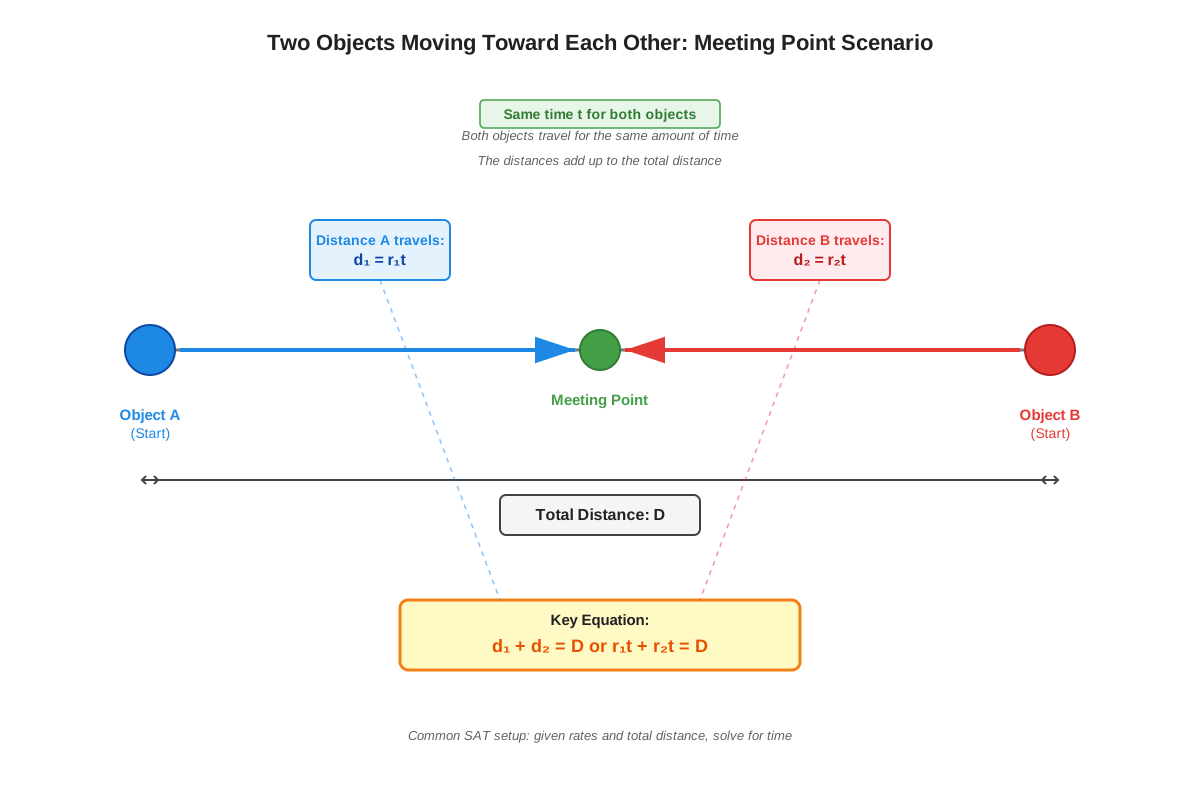
When two objects travel in opposite directions from the same starting point (or toward each other), their distances add together. If two cars leave the same location traveling in opposite directions, the total distance between them equals the sum of their individual distances.
The setup typically looks like:
d₁ + d₂ = total distance
r₁t₁ + r₂t₂ = total distance
Often, both objects travel for the same amount of time, simplifying to:
r₁t + r₂t = total distance
t(r₁ + r₂) = total distance
This reveals that when objects move in opposite directions, their rates effectively add together.
Two-Object Problems: Same Direction
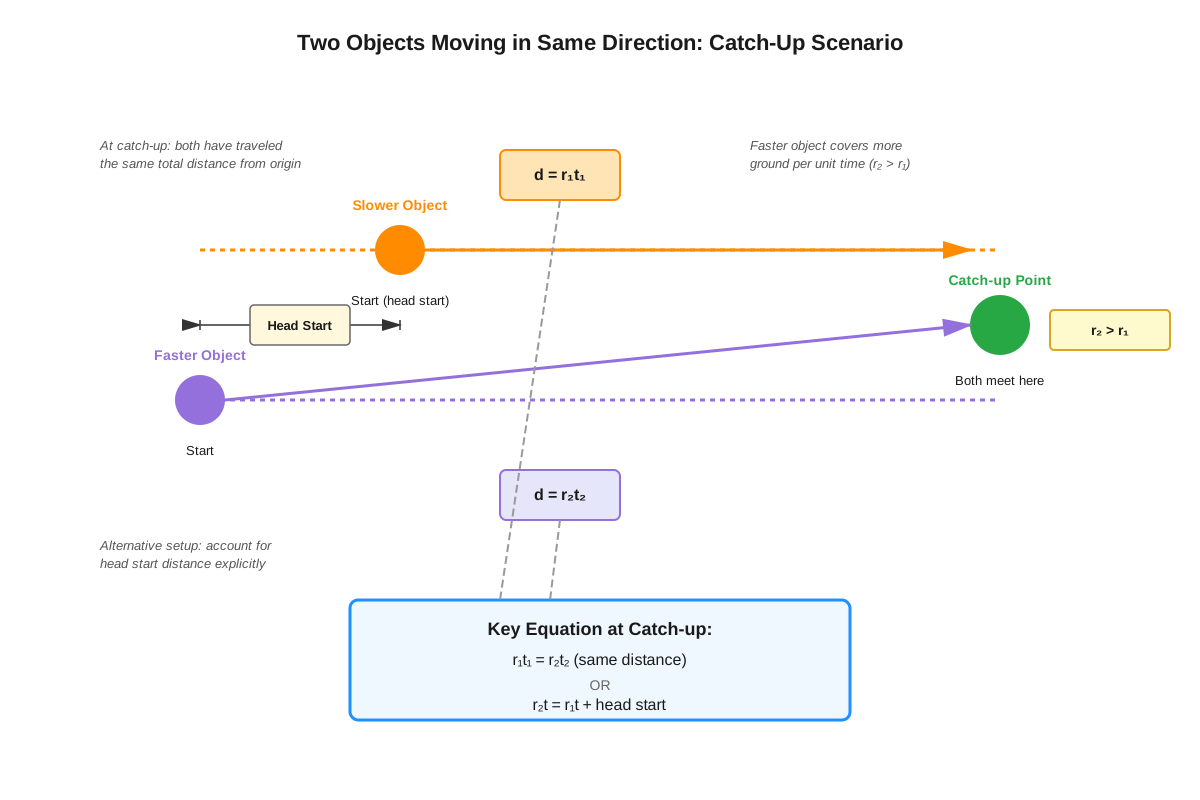
When two objects travel in the same direction, with one catching up to another, the faster object must cover the difference in their starting positions plus any distance the slower object travels. These pursuit problems require careful setup.
If both objects travel for the same time until the faster one catches the slower one:
d₁ = d₂
r₁t = r₂t + head start distance
Alternatively, if one object starts later but catches up:
r₁t₁ = r₂t₂Where t₁ and t₂ represent different time intervals.
Round-Trip Problems
Round-trip scenarios involve traveling to a destination and returning, often at different speeds. A common SAT question asks for average speed over the entire trip. A critical misconception involves simply averaging the two speeds—this is incorrect unless the time spent at each speed is equal.
The correct approach calculates total distance divided by total time:
Average speed = Total distance / Total timeFor a round trip where the distance to the destination is d, the outbound speed is r₁, and the return speed is r₂:
Average speed = 2d / (d/r₁ + d/r₂)Problems with Changing Conditions
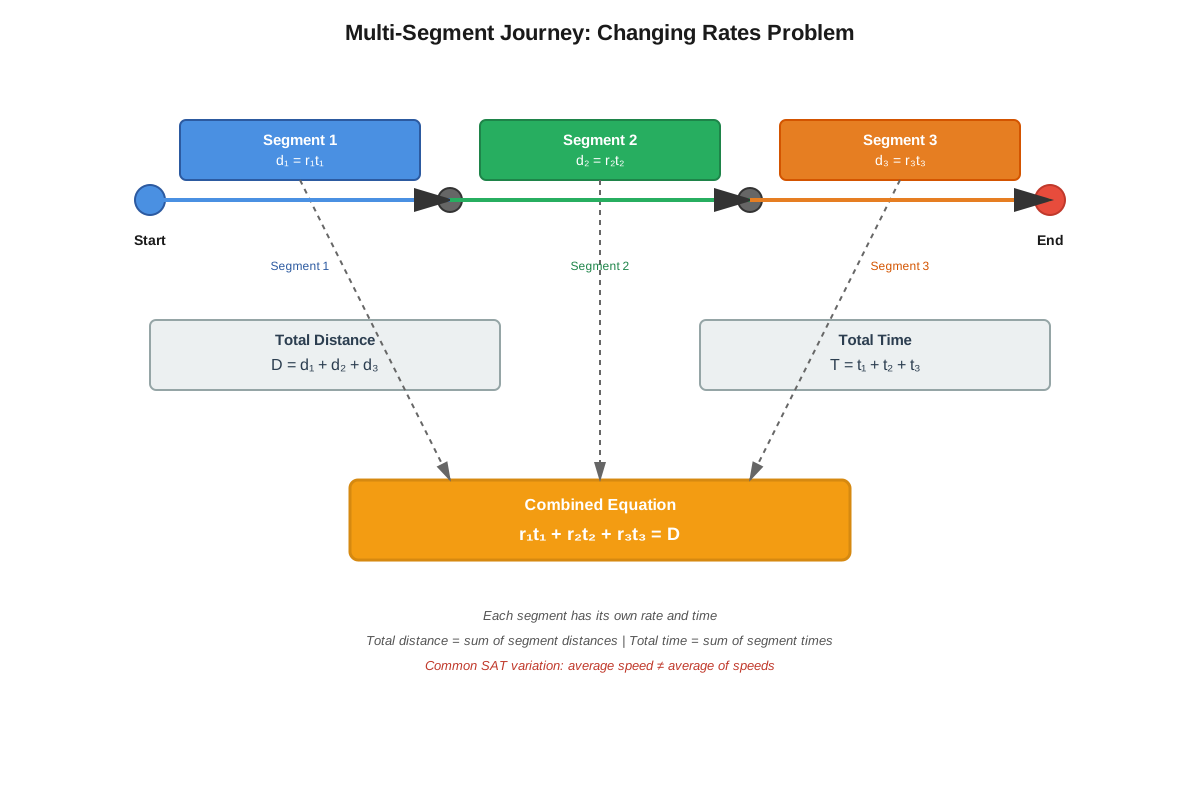
Some SAT problems involve multiple segments of travel at different rates. These require calculating distance (or time) for each segment separately, then combining the results. The approach:
- Break the problem into distinct segments
- Apply d = rt to each segment
- Sum the distances (or times) as appropriate
- Solve for the unknown
For example, if someone drives 2 hours at 50 mph, then 3 hours at 60 mph, the total distance equals (50)(2) + (60)(3) = 100 + 180 = 280 miles.
Concept Relationships
The distance formula d = rt serves as the central hub connecting all concepts within this topic. Single-object problems represent the direct application of this formula, requiring only algebraic manipulation to solve for the unknown variable. These foundational problems lead directly to unit conversion skills, as students must ensure consistency before applying the formula.
Two-object problems build upon single-object problems by requiring students to set up two separate distance equations and relate them through a common variable (usually time) or through their sum or difference. Opposite-direction problems → connect to addition of rates, while same-direction problems → connect to subtraction of rates or setting distances equal.
Round-trip problems → extend single-object concepts by requiring multiple applications of the formula and introducing the concept of average speed, which connects to weighted averages in statistics. Multi-segment problems → similarly require repeated application of the basic formula with careful attention to changing conditions.
All distance-rate-time concepts → connect to the prerequisite topic of linear equations in one variable, as solving for unknowns requires algebraic manipulation. They also → connect forward to systems of equations when two unknowns must be found simultaneously, and to function interpretation when problems ask about the meaning of variables or coefficients in context.
The relationship map: Basic formula → Single-object problems → Unit conversion → Two-object problems → (splits into) Opposite directions and Same direction → Round-trip problems → Multi-segment problems → Systems of equations and Advanced applications.
Quick check — test yourself on Distance rate time equations so far.
Try Flashcards →High-Yield Facts
⭐ The distance formula d = rt can be rearranged to solve for any of the three variables: r = d/t or t = d/r
⭐ When two objects travel in opposite directions, their rates add: combined rate = r₁ + r₂
⭐ Average speed for a round trip does NOT equal the average of the two speeds unless time at each speed is equal
⭐ All units must be consistent—if rate is in miles per hour, distance must be in miles and time in hours
⭐ When two objects travel the same distance in the same direction, set their distance expressions equal: r₁t₁ = r₂t₂
- In pursuit problems where one object catches another, the faster object's distance equals the slower object's distance plus any head start
- Converting hours to minutes requires multiplying by 60; converting minutes to hours requires dividing by 60
- Total distance for a round trip equals twice the one-way distance
- When rates change during a trip, calculate each segment separately and sum the results
- The SAT often provides extra information to test whether students can identify relevant variables
- Problems asking "how much longer" or "how much farther" require subtraction of two calculated values
- If time is the same for multiple objects, it can be factored out: r₁t + r₂t = t(r₁ + r₂)
Common Misconceptions
Misconception: Average speed equals the arithmetic mean of two speeds → Correction: Average speed equals total distance divided by total time. For a round trip at speeds r₁ and r₂, the average speed is 2/(1/r₁ + 1/r₂), which is the harmonic mean, not the arithmetic mean. Only when time spent at each speed is equal does the arithmetic mean work.
Misconception: In opposite-direction problems, subtract the rates → Correction: When objects move in opposite directions (away from each other or toward each other), their rates add together because they're increasing the distance between them (or closing the gap) at a combined rate.
Misconception: Units don't matter as long as the numbers are correct → Correction: Unit consistency is essential. If a rate is 60 mph and time is 30 minutes, you cannot simply multiply 60 × 30. First convert 30 minutes to 0.5 hours, then calculate 60 × 0.5 = 30 miles.
Misconception: In same-direction problems, the faster object's time equals the slower object's time → Correction: This is only true in specific scenarios. If one object has a head start, or if they start at different times, their travel times differ. Carefully read what the problem states about when each object begins moving.
Misconception: Distance problems always involve vehicles → Correction: The SAT uses diverse contexts including people walking, runners racing, planes flying, boats traveling with or against currents, and even abstract scenarios. The same mathematical principles apply regardless of context.
Worked Examples
Example 1: Two Objects Traveling in Opposite Directions
Problem: Two trains leave the same station at the same time, traveling in opposite directions. Train A travels at 80 miles per hour, and Train B travels at 65 miles per hour. How many hours will it take for the trains to be 435 miles apart?
Solution:
Step 1: Identify what we know and what we need to find.
- Train A rate: r₁ = 80 mph
- Train B rate: r₂ = 65 mph
- Total distance apart: 435 miles
- Unknown: time (t)
Step 2: Set up the equation. Since the trains travel in opposite directions, their distances add:
d₁ + d₂ = 435Step 3: Express each distance using d = rt:
r₁t + r₂t = 435
80t + 65t = 435
Step 4: Combine like terms:
145t = 435Step 5: Solve for t:
t = 435/145 = 3Answer: It will take 3 hours for the trains to be 435 miles apart.
Connection to learning objectives: This problem demonstrates identifying key features (opposite directions means rates add), applying the formula to an SAT-style question, and manipulating the equation to solve for time.
Example 2: Round Trip with Different Speeds
Problem: Maria drives from her home to the beach, a distance of 120 miles, at an average speed of 60 miles per hour. On the return trip, due to traffic, she averages only 40 miles per hour. What is her average speed for the entire round trip?
Solution:
Step 1: Calculate time for the trip to the beach.
t₁ = d/r₁ = 120/60 = 2 hoursStep 2: Calculate time for the return trip.
t₂ = d/r₂ = 120/40 = 3 hoursStep 3: Calculate total distance and total time.
Total distance = 120 + 120 = 240 miles
Total time = 2 + 3 = 5 hours
Step 4: Calculate average speed.
Average speed = Total distance / Total time = 240/5 = 48 mphAnswer: Maria's average speed for the entire round trip is 48 miles per hour.
Important note: If we had incorrectly averaged the two speeds (60 + 40)/2 = 50 mph, we would have gotten the wrong answer. This demonstrates the critical misconception about average speed.
Connection to learning objectives: This problem shows how distance-rate-time equations appear on the SAT (round-trip scenarios), requires applying the formula multiple times, and tests understanding of average speed calculation.
Exam Strategy
When approaching sat distance rate time equations on the SAT, follow this systematic process:
Step 1: Read carefully and identify the scenario type. Determine whether the problem involves one object, two objects moving in opposite directions, two objects moving in the same direction, a round trip, or multiple segments. This classification immediately suggests the appropriate setup.
Step 2: Create a visual representation. Draw a simple diagram showing the starting positions, directions of travel, and any given distances. This prevents confusion about whether objects move toward or away from each other.
Step 3: List known and unknown variables. Write out what's given for distance, rate, and time for each object. Identify what the question asks you to find. This organization prevents errors and helps you see which formula form to use.
Step 4: Check units immediately. Before setting up equations, verify that all units are consistent. If they're not, convert them before proceeding. This single step eliminates a major category of errors.
Trigger words to watch for:
- "Opposite directions" or "away from each other" → rates add
- "Same direction" or "catches up" → set distances equal or subtract rates
- "Average speed" → use total distance divided by total time, not arithmetic mean of speeds
- "How much longer" or "how much farther" → requires subtraction after calculating
- "Meets" or "together" → distances sum to total or equal each other
Process-of-elimination tips:
- Eliminate answers with incorrect units
- Check if the answer makes logical sense (e.g., average speed should be between the two given speeds for a round trip)
- For multiple-choice questions, you can sometimes work backward by testing answer choices
- Eliminate answers that would require traveling faster than the given rate or for longer than the given time
Time allocation: Budget 1.5-2 minutes for straightforward single-object problems, 2-3 minutes for two-object problems, and up to 3-4 minutes for complex multi-step problems. If a problem requires more than 4 minutes, mark it and return later.
Exam Tip: If a problem seems to have too much information, some of it may be irrelevant. The SAT occasionally includes extra details to test whether you can identify what's actually needed.
Memory Techniques
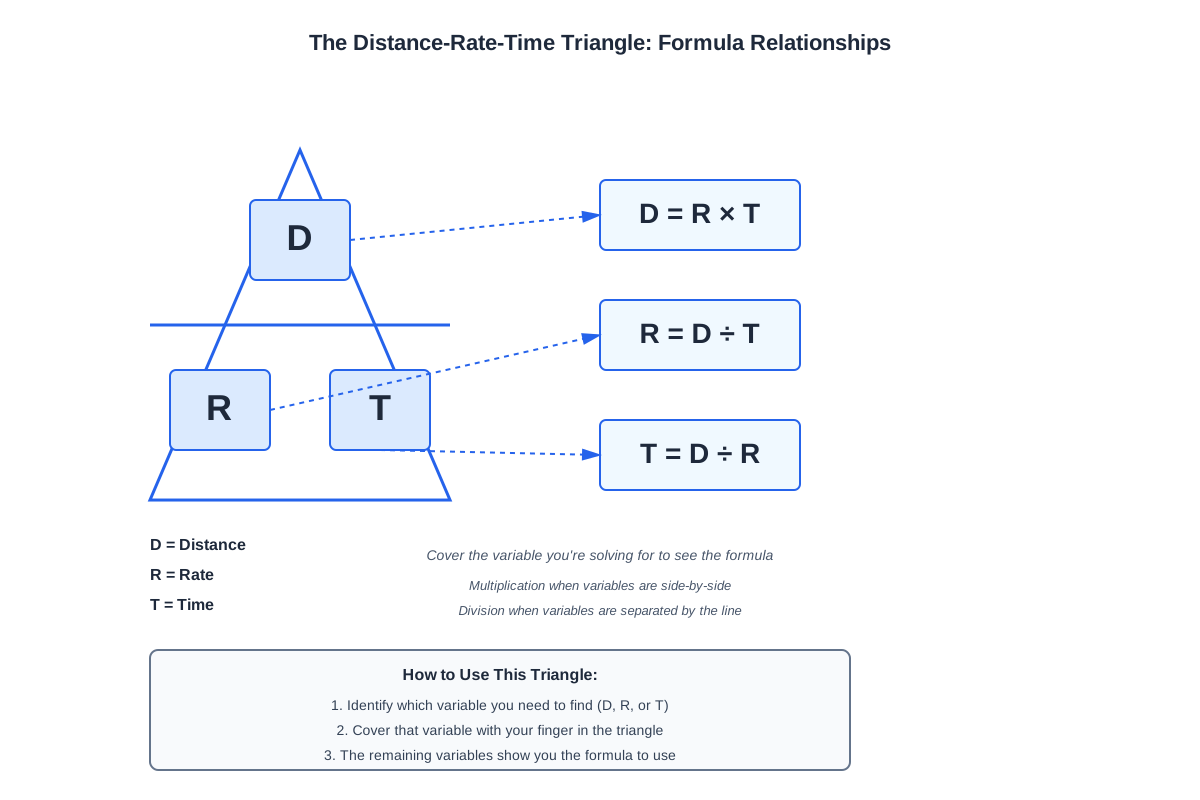
The "DRT Triangle" visualization: Picture a triangle with D at the top, R and T at the bottom corners. Cover the variable you're solving for, and the remaining two show the operation: cover D and you see R × T; cover R and you see D ÷ T; cover T and you see D ÷ R.
"OPPOSITE = ADD" mnemonic: When objects move in OPPOSITE directions, ADD their rates. The matching vowels (O in opposite, A in add) help cement this relationship.
"SAME = SUBTRACT or SET EQUAL" mnemonic: When objects move in the SAME direction, either SUBTRACT rates (if finding relative speed) or SET distances EQUAL (if finding when one catches the other). The alliteration helps recall both options.
"Average speed is HARMONIC, not ARITHMETIC" reminder: Think "HARM" in harmonic—using arithmetic mean will HARM your score. Always use total distance over total time.
Unit conversion memory aid: "Hours are BIGGER than minutes, so the number gets SMALLER." When converting 120 minutes to hours, the number decreases to 2. This prevents confusion about whether to multiply or divide by 60.
The "DUST" acronym for problem-solving steps:
- Draw a diagram
- Units check
- Set up equation
- Test your answer
Summary
Distance rate time equations represent a high-yield SAT Math topic that combines algebraic manipulation with real-world problem-solving. The fundamental relationship d = rt serves as the foundation, but success requires understanding how to apply this formula across various scenarios: single-object problems, two objects moving in opposite or same directions, round trips with different speeds, and multi-segment journeys. Critical skills include maintaining unit consistency, recognizing that average speed requires total distance divided by total time (not the arithmetic mean of speeds), understanding when to add versus subtract rates, and translating word problems into mathematical equations. The SAT favors problems that test conceptual understanding rather than straightforward calculation, often combining distance-rate-time relationships with other algebraic concepts or requiring interpretation of variables in context. Students who master the systematic approach—identifying scenario type, checking units, setting up appropriate equations, and verifying answers make logical sense—gain a significant advantage on these consistently appearing questions.
Key Takeaways
- The distance formula d = rt can be rearranged to solve for any variable: r = d/t or t = d/r
- Unit consistency is non-negotiable: ensure distance, rate, and time all use compatible units before calculating
- When objects move in opposite directions, add their rates; when moving in the same direction, set distances equal or subtract rates
- Average speed equals total distance divided by total time, NOT the arithmetic mean of two speeds
- Draw diagrams, list known and unknown variables, and check that answers make logical sense
- Distance-rate-time problems appear 2-4 times per SAT and often serve as medium-to-hard difficulty questions
- Master both single-object and two-object scenarios, as well as round-trip and multi-segment problems
Related Topics
Systems of Linear Equations: Many complex distance-rate-time problems require setting up and solving systems of two equations with two unknowns. Mastering this topic enables tackling advanced SAT problems that combine multiple constraints.
Linear Functions and Their Graphs: Distance-rate-time relationships can be represented as linear functions where distance is a function of time. Understanding slope as rate and y-intercept as initial position connects algebraic and graphical representations.
Ratios and Proportions: Rate itself is a ratio (distance per unit time), and many distance problems involve proportional reasoning. This connection strengthens understanding of both topics.
Unit Conversion and Dimensional Analysis: Beyond basic distance-rate-time problems, advanced questions may require converting between different measurement systems or working with compound units.
Word Problem Translation: Distance-rate-time problems exemplify the broader skill of translating verbal descriptions into mathematical expressions, a skill that appears throughout the SAT Math section.
Practice CTA
Now that you've mastered the core concepts of distance rate time equations, it's time to solidify your understanding through practice. Attempt the practice questions designed specifically for this topic, focusing on applying the systematic approach outlined in the exam strategy section. Use the flashcards to reinforce key formulas, common scenarios, and critical distinctions like when to add versus subtract rates. Remember that distance-rate-time problems reward careful setup and unit checking more than computational speed—take your time to organize information before diving into calculations. Each practice problem you complete builds the pattern recognition that makes these questions faster and easier on test day. You've got this!
Sign up free to keep reading
Create a free AnvayaPrep account to finish this SAT guide on Distance rate time equations — plus flashcards and practice questions.