Overview
Equivalent equations form a cornerstone of algebraic reasoning tested extensively on the SAT math section. These are equations that have identical solution sets—meaning any value that satisfies one equation will also satisfy the other. Understanding equivalent equations enables students to recognize when two different-looking algebraic expressions represent the same mathematical relationship, a skill that appears in approximately 15-20% of SAT math questions. Mastery of this concept allows test-takers to simplify complex problems, verify their answers, and identify correct responses even when they appear in unfamiliar forms.
The SAT frequently tests equivalent equations through various question formats: identifying which equation is equivalent to a given expression, determining what operations preserve equivalence, and recognizing when algebraic manipulations create or destroy equivalence. This topic bridges fundamental algebra with more advanced problem-solving strategies, serving as the foundation for solving systems of equations, working with functions, and manipulating formulas. Students who can quickly identify sat equivalent equations gain significant time advantages on the exam, as they can bypass lengthy calculations by recognizing structural similarities.
Beyond isolated equation problems, equivalent equations connect to nearly every algebraic concept on the SAT. They underpin the process of solving linear equations, enable substitution methods in systems, and facilitate the manipulation of literal equations. This topic also reinforces the fundamental principle that performing the same operation to both sides of an equation maintains equality—a concept that extends into inequalities, absolute value equations, and even quadratic relationships. Strong command of equivalent equations transforms students from mechanical equation-solvers into strategic mathematical thinkers who can navigate the SAT's most challenging algebra problems with confidence.
Learning Objectives
- [ ] Identify key features of equivalent equations
- [ ] Explain how equivalent equations appears on the SAT
- [ ] Apply equivalent equations to answer SAT-style questions
- [ ] Determine which algebraic operations preserve equation equivalence
- [ ] Recognize non-equivalent equations that appear similar but have different solution sets
- [ ] Transform equations into equivalent forms strategically to simplify problem-solving
- [ ] Verify equivalence by comparing solution sets or using substitution methods
Prerequisites
- Basic algebraic operations: Addition, subtraction, multiplication, and division with variables are essential for manipulating equations while maintaining equivalence
- Order of operations: Understanding PEMDAS ensures correct simplification when creating equivalent forms
- Properties of equality: Knowledge that performing identical operations on both sides preserves equality forms the theoretical foundation
- Combining like terms: This skill enables simplification of expressions to reveal equivalent forms
- Distributive property: Expanding and factoring expressions are fundamental techniques for generating equivalent equations
- Solving one-variable linear equations: Experience with basic equation-solving provides context for recognizing when equations share solutions
Why This Topic Matters
Equivalent equations represent one of the most practical algebraic concepts students encounter. In real-world applications, professionals regularly transform equations into more useful forms: engineers convert formulas to isolate specific variables, financial analysts rearrange compound interest equations to solve for different parameters, and scientists manipulate physical laws to match experimental conditions. The ability to recognize that different-looking equations represent the same relationship prevents redundant work and reveals hidden connections between seemingly unrelated problems.
On the SAT, equivalent equations appear in approximately 4-6 questions per test, making this a high-yield topic for score improvement. These questions typically manifest in three primary formats: direct identification questions asking which equation is equivalent to a given expression (appearing in both multiple-choice and grid-in formats), word problems requiring students to recognize equivalent representations of the same situation, and multi-step problems where recognizing equivalence provides a shortcut to the solution. The College Board specifically tests whether students understand that equivalent equations must have identical solution sets, not merely similar appearances.
The SAT also uses equivalent equations as a distractor strategy. Incorrect answer choices often contain equations that look similar to the correct answer but differ by a sign, coefficient, or operation—creating non-equivalent equations that trap students who work too quickly. Additionally, the exam frequently presents equivalent equations in different forms (standard form versus slope-intercept form, expanded versus factored, etc.) to test whether students recognize structural equivalence beyond surface-level appearance. Questions involving literal equations—where students must solve for one variable in terms of others—heavily rely on generating equivalent forms through systematic algebraic manipulation.
Core Concepts
Definition of Equivalent Equations
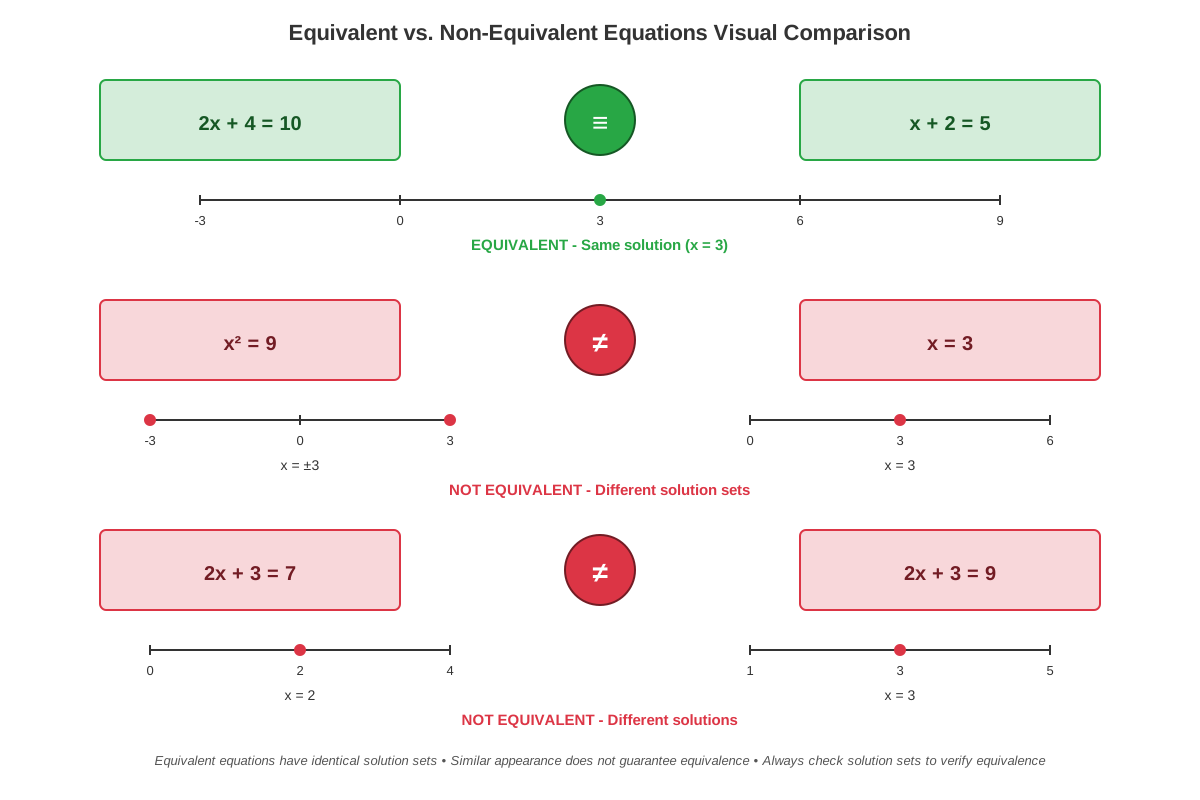
Two or more equations are equivalent equations when they have exactly the same solution set. This means every value that satisfies one equation must also satisfy all other equivalent equations, and no additional solutions exist in any of the equations. For example, the equations 2x + 4 = 10 and x + 2 = 5 are equivalent because both have the single solution x = 3. The critical distinction is that equivalent equations must share all solutions—not just some solutions, and not merely similar-looking expressions.
The solution set defines equivalence, not the appearance of the equation. The equations x = 5 and x² = 25 are NOT equivalent despite x = 5 being a solution to both, because x² = 25 also has the solution x = -5. This fundamental principle prevents a common error: assuming that if one equation's solutions satisfy another equation, they must be equivalent. True equivalence requires bidirectional satisfaction—all solutions of equation A satisfy equation B, AND all solutions of equation B satisfy equation A.
Operations That Preserve Equivalence
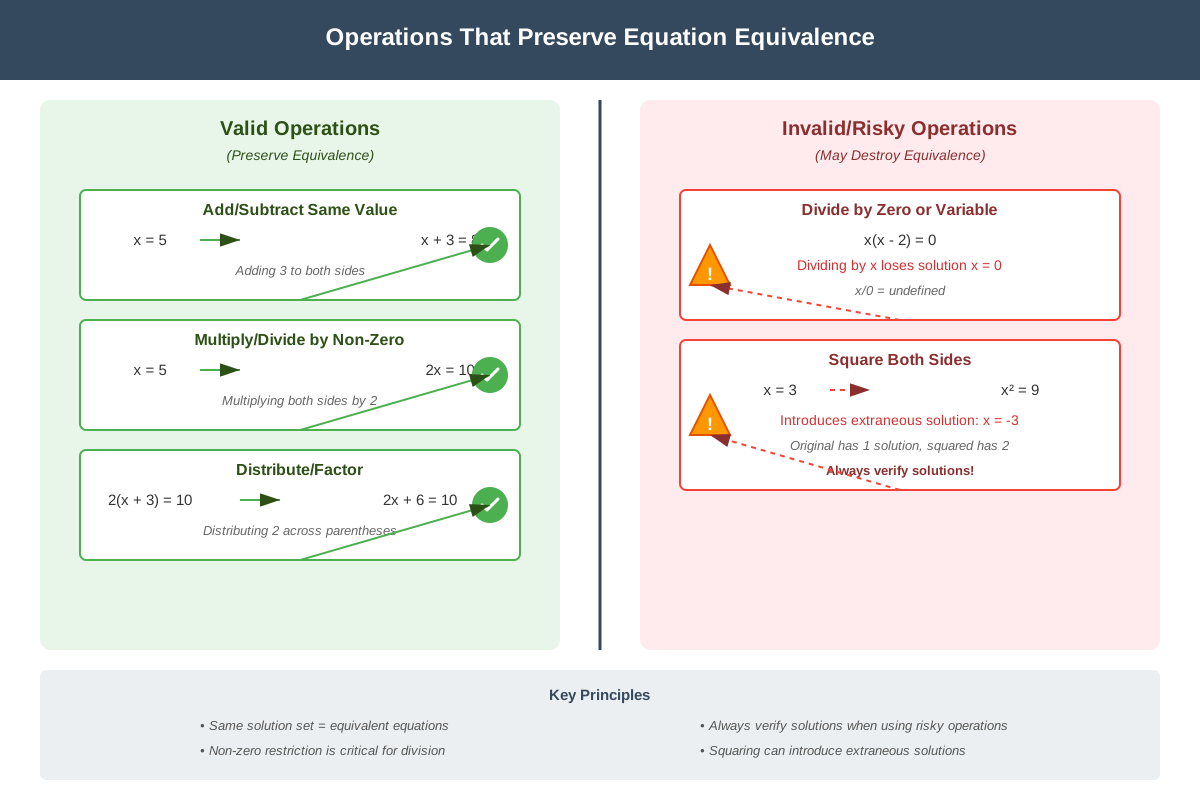
Understanding which operations maintain equivalence is essential for both creating equivalent equations and avoiding non-equivalent transformations. The following operations, when applied to both sides of an equation, always produce an equivalent equation:
Addition or Subtraction of the Same Value: Adding or subtracting any expression (number or variable expression) to both sides preserves equivalence. Starting with x - 7 = 12, adding 7 to both sides yields x = 19, an equivalent equation. This operation works because equality is maintained when identical quantities are added to equal expressions.
Multiplication or Division by the Same Non-Zero Value: Multiplying or dividing both sides by any non-zero constant or expression creates an equivalent equation. From 3x = 15, dividing both sides by 3 gives x = 5. The critical restriction is that the multiplier or divisor cannot be zero, as division by zero is undefined and multiplication by zero eliminates information about the variable.
Applying the Same Function to Both Sides: When a function is one-to-one (has an inverse), applying it to both sides preserves equivalence. For example, if x + 3 = 7, then (x + 3)² = 7² would be equivalent if we restrict to positive values. However, squaring both sides can introduce extraneous solutions, so this operation requires careful verification.
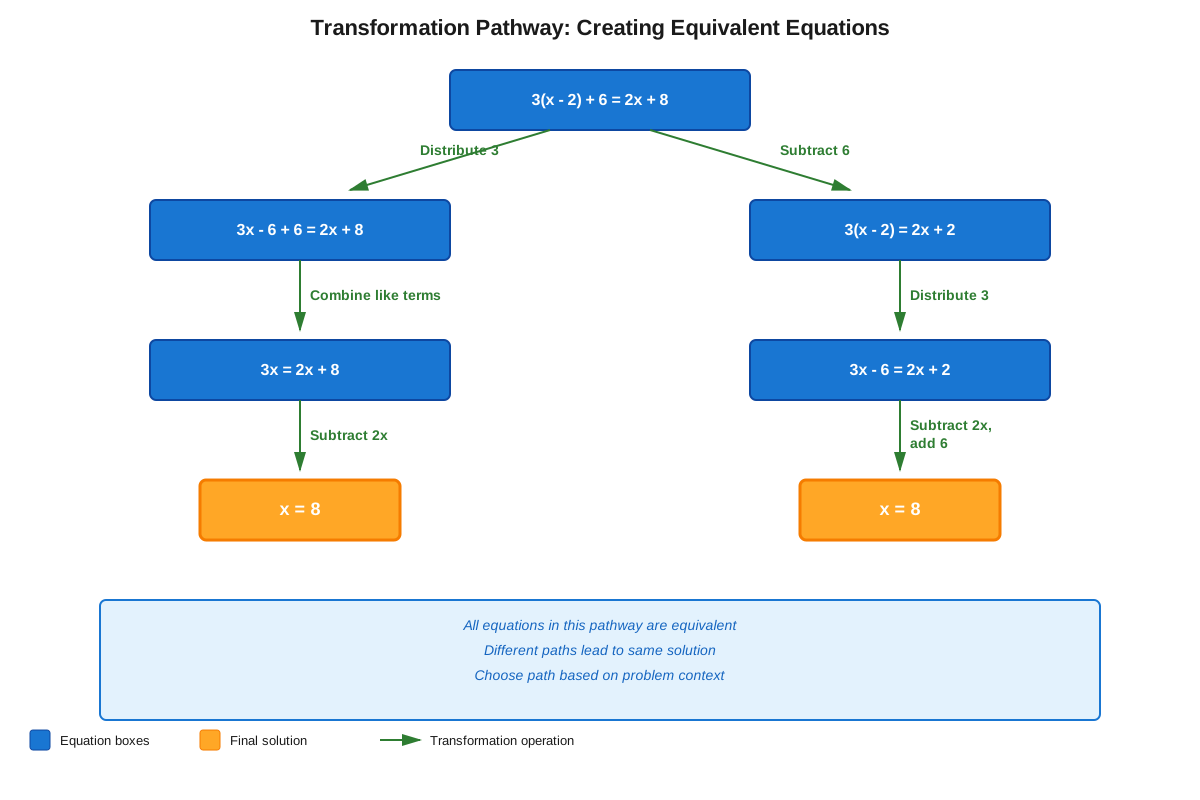
Simplifying Expressions: Combining like terms, applying the distributive property, or simplifying fractions on either side maintains equivalence. The equation 2(x + 3) - 4 = 10 is equivalent to 2x + 6 - 4 = 10, which simplifies to 2x + 2 = 10.
Operations That May Destroy Equivalence
Certain operations can create non-equivalent equations, typically by introducing additional solutions or eliminating existing ones:
Squaring Both Sides: This operation can introduce extraneous solutions. If x = 3, then x² = 9, but x² = 9 has solutions x = 3 and x = -3. The second equation has an additional solution, making them non-equivalent.
Multiplying by Zero: This eliminates all variable information. From x = 5, multiplying both sides by 0 gives 0 = 0, which is true for all x values, not just x = 5.
Multiplying by an Expression Containing the Variable: If the expression equals zero for some values, this can introduce extraneous solutions. Multiplying x = 2 by (x - 3) gives x(x - 3) = 2(x - 3), which simplifies to x² - 3x = 2x - 6. This new equation might have solutions beyond x = 2.
Taking Roots Without Considering All Cases: If x² = 16, then x = ±4, but writing only x = 4 creates a non-equivalent equation by excluding a valid solution.
Recognizing Equivalent Forms
The SAT frequently presents equivalent equations in different algebraic forms to test recognition skills:
| Original Form | Equivalent Form | Transformation Used |
|---|---|---|
| 2x + 6 = 14 | x + 3 = 7 | Divided both sides by 2 |
| 3(x - 4) = 15 | 3x - 12 = 15 | Distributed the 3 |
| x/5 = 3 | x = 15 | Multiplied both sides by 5 |
| 2x + 3x = 20 | 5x = 20 | Combined like terms |
| 4x - 8 = 12 | x - 2 = 3 | Divided both sides by 4 |
Students must develop the ability to see through surface differences to recognize structural equivalence. The equation 7 = 2x + 1 is equivalent to 2x + 1 = 7 (commutative property of equality), and both are equivalent to 2x = 6 and x = 3. Each form provides the same information but emphasizes different aspects of the relationship.
Strategic Transformation
Creating equivalent equations strategically can simplify problem-solving. When faced with a complex equation, students should ask: "What equivalent form would make this easier to work with?" For instance, the equation 0.25x + 0.5 = 2 becomes simpler when multiplied by 4 to eliminate decimals: x + 2 = 8. Both equations are equivalent, but the second is easier to solve mentally.
Similarly, when comparing equations to determine equivalence, transforming both to their simplest form often reveals whether they share the same solution set. To verify if 4x - 8 = 12 and 2x - 4 = 6 are equivalent, simplify both: the first becomes x = 5, and the second also becomes x = 5, confirming equivalence.
Testing for Equivalence
The SAT may require students to verify equivalence using multiple methods:
Method 1 - Solve Both Equations: If two equations have identical solution sets, they are equivalent. Solve each equation independently and compare results.
Method 2 - Transform One Into the Other: Apply valid operations to one equation to see if it can be transformed into the other. If successful using only equivalence-preserving operations, they are equivalent.
Method 3 - Substitution Test: Solve one equation, then substitute the solution into the other equation. If it satisfies the second equation, and both equations have the same number of solutions, they are likely equivalent (though this method should be combined with others for certainty).
Method 4 - Graphical Verification: For linear equations, equivalent equations represent the same line. If two equations have identical graphs, they are equivalent.
Concept Relationships
The concept of equivalent equations serves as a central hub connecting multiple algebraic ideas. At its foundation, equivalent equations rely on the properties of equality (reflexive, symmetric, transitive, addition, multiplication), which justify why certain operations preserve equivalence. These properties → enable → the systematic transformation of equations → which leads to → solving linear equations in one variable.
Equivalent equations directly connect to solving systems of equations, where the substitution and elimination methods both rely on creating equivalent systems that are easier to solve. When using elimination, adding two equations creates a new equation equivalent to the system's constraints. This relationship extends to literal equations, where solving for one variable in terms of others requires generating equivalent forms through algebraic manipulation.
The concept also bridges to functions and their representations. Two different function expressions that produce identical outputs for all inputs are equivalent, just as two equations with identical solution sets are equivalent. This connection → extends to → graphing linear equations, where equivalent equations produce identical graphs, reinforcing that different algebraic forms can represent the same geometric relationship.
Understanding equivalent equations → strengthens → work with inequalities, as many of the same operations that preserve equation equivalence also preserve inequality relationships (with the critical exception of multiplying or dividing by negative numbers). Additionally, the concept → prepares students for → quadratic equations, where recognizing equivalent forms (standard, factored, vertex) becomes essential for efficient problem-solving.
Finally, equivalent equations → connect forward to → more advanced topics like rational expressions and radical equations, where creating equivalent forms through multiplication by common denominators or squaring both sides requires careful attention to whether new equations remain equivalent or introduce extraneous solutions.
High-Yield Facts
⭐ Two equations are equivalent if and only if they have exactly the same solution set—all solutions must match, with no additional or missing solutions in either equation.
⭐ Adding or subtracting the same value to both sides of an equation always produces an equivalent equation.
⭐ Multiplying or dividing both sides by the same non-zero value always produces an equivalent equation.
⭐ Squaring both sides of an equation can introduce extraneous solutions, potentially creating a non-equivalent equation that must be verified.
⭐ The equation ax + b = c is equivalent to x = (c - b)/a when a ≠ 0, and this transformation is reversible.
- Combining like terms on either side of an equation maintains equivalence because it simplifies without changing the solution set.
- The distributive property can be applied to create equivalent equations: a(bx + c) = d is equivalent to abx + ac = d.
- Equivalent equations may look completely different but must satisfy the same x-values when solved.
- Multiplying both sides of an equation by zero destroys equivalence by creating 0 = 0, which is true for all values.
- The commutative property of equality means a = b is equivalent to b = a, allowing equations to be rewritten with sides swapped.
- Dividing by a variable expression can introduce restrictions or lose solutions, potentially destroying equivalence.
- Two linear equations in one variable are equivalent if they have the same slope and y-intercept when written in slope-intercept form.
Quick check — test yourself on Equivalent equations so far.
Try Flashcards →Common Misconceptions
Misconception: If one equation's solution satisfies another equation, the equations must be equivalent.
Correction: Equivalence requires that ALL solutions of each equation satisfy the other equation. The equation x = 3 has a solution that satisfies x² = 9, but x² = 9 also has the solution x = -3, making them non-equivalent. Both directions must hold: every solution of A satisfies B, AND every solution of B satisfies A.
Misconception: Equations that look similar are equivalent.
Correction: Appearance does not determine equivalence—only solution sets matter. The equations 2x + 4 = 10 and 2x + 4 = 12 look nearly identical but have different solutions (x = 3 versus x = 4), making them non-equivalent. Always solve or transform equations systematically rather than relying on visual similarity.
Misconception: Squaring both sides of an equation always produces an equivalent equation.
Correction: Squaring can introduce extraneous solutions. From x = 5, squaring gives x² = 25, which has solutions x = 5 and x = -5. The squared equation has an additional solution, making it non-equivalent to the original. Always check solutions in the original equation after squaring.
Misconception: Multiplying both sides by a variable expression preserves equivalence.
Correction: Multiplying by an expression containing the variable can introduce extraneous solutions if that expression equals zero for some values. If you multiply x = 2 by (x - 3), you get x(x - 3) = 2(x - 3), which might be satisfied by x = 3 (making the equation 0 = 0), even though x = 3 doesn't satisfy the original equation.
Misconception: Dividing both sides by a common factor always creates an equivalent equation.
Correction: Dividing by a factor that could equal zero can eliminate solutions. From 2x² = 2x, dividing both sides by 2x gives x = 1, but this loses the solution x = 0 (which satisfies the original equation). The correct approach is to factor: 2x² - 2x = 0 → 2x(x - 1) = 0, giving solutions x = 0 and x = 1.
Misconception: Equivalent equations must have the same coefficients and constants.
Correction: Equivalent equations can have completely different coefficients and constants as long as their solution sets match. The equations 6x + 12 = 30 and x + 2 = 5 have different coefficients but are equivalent because both have the solution x = 3. Focus on solution sets, not superficial appearance.
Misconception: Taking the square root of both sides preserves equivalence.
Correction: Taking square roots requires considering both positive and negative roots. From x² = 16, taking the square root gives x = ±4, not just x = 4. Writing only x = 4 creates a non-equivalent equation by excluding a valid solution.
Worked Examples
Example 1: Identifying Equivalent Equations
Problem: Which of the following equations is equivalent to 3(2x - 4) = 18?
A) 6x - 4 = 18
B) 6x - 12 = 18
C) 2x - 4 = 6
D) 3x - 6 = 9
Solution:
Step 1: Apply the distributive property to the left side of the original equation.
- 3(2x - 4) = 18
- 3 · 2x - 3 · 4 = 18
- 6x - 12 = 18
Step 2: Compare this result to the answer choices.
- Choice B matches exactly: 6x - 12 = 18
Step 3: Verify by checking if other choices could be equivalent through different transformations.
- Choice A (6x - 4 = 18): This would require distributing incorrectly (3 · 4 ≠ 4), so it's not equivalent.
- Choice C (2x - 4 = 6): This would result from dividing the original equation by 3, but let's verify: 3(2x - 4) = 18 → 2x - 4 = 6. Solving this gives 2x = 10, so x = 5. Checking in the original: 3(2·5 - 4) = 3(6) = 18 ✓. This IS equivalent!
- Choice D (3x - 6 = 9): This doesn't match any valid transformation of the original equation.
Step 4: Determine which answer the SAT expects.
- Both B and C are mathematically equivalent to the original equation. However, choice B is the direct result of distributing, which is the most straightforward transformation. Choice C requires an additional step (dividing by 3).
Answer: B (6x - 12 = 18) is the most direct equivalent form, though C is also technically equivalent.
Connection to Learning Objectives: This example demonstrates identifying equivalent equations through systematic transformation and verifying equivalence by solving.
Example 2: Determining Non-Equivalence
Problem: A student claims that the equation x² - 4 = 0 is equivalent to x - 2 = 0 because both are satisfied by x = 2. Is the student correct? Explain.
Solution:
Step 1: Solve the first equation completely.
- x² - 4 = 0
- x² = 4
- x = ±2
- Solutions: x = 2 and x = -2
Step 2: Solve the second equation.
- x - 2 = 0
- x = 2
- Solution: x = 2 only
Step 3: Compare solution sets.
- First equation has solutions: {2, -2}
- Second equation has solutions: {2}
- The solution sets are different.
Step 4: Determine equivalence.
- For equations to be equivalent, they must have identical solution sets.
- The first equation has an additional solution (x = -2) that doesn't satisfy the second equation.
- Therefore, these equations are NOT equivalent.
Step 5: Identify the student's error.
- The student only verified that x = 2 satisfies both equations (one-directional checking).
- The student failed to verify that ALL solutions of each equation satisfy the other equation.
- The student confused "having a common solution" with "being equivalent."
Answer: No, the student is incorrect. The equations are not equivalent because x² - 4 = 0 has two solutions (x = 2 and x = -2) while x - 2 = 0 has only one solution (x = 2). Equivalent equations must have identical solution sets, not just overlapping solutions.
Connection to Learning Objectives: This example illustrates the critical distinction between equations that share some solutions versus truly equivalent equations, and demonstrates how to verify equivalence by comparing complete solution sets.
Example 3: Creating Equivalent Equations Strategically
Problem: The equation 0.3x + 0.6 = 2.4 can be transformed into an equivalent equation with integer coefficients. What is this equivalent equation, and what is its solution?
Solution:
Step 1: Identify a strategy to eliminate decimals.
- All coefficients and constants are multiples of 0.3.
- Multiplying by 10 will eliminate all decimal points.
Step 2: Multiply both sides by 10.
- 10(0.3x + 0.6) = 10(2.4)
- 3x + 6 = 24
Step 3: Verify this is equivalent by checking that the operation preserves equivalence.
- Multiplying both sides by a non-zero constant (10) always produces an equivalent equation.
- Therefore, 3x + 6 = 24 is equivalent to 0.3x + 0.6 = 2.4.
Step 4: Solve the equivalent equation.
- 3x + 6 = 24
- 3x = 24 - 6
- 3x = 18
- x = 6
Step 5: Verify by substituting into the original equation.
- 0.3(6) + 0.6 = 2.4
- 1.8 + 0.6 = 2.4
- 2.4 = 2.4 ✓
Answer: The equivalent equation with integer coefficients is 3x + 6 = 24, and the solution is x = 6.
Connection to Learning Objectives: This example demonstrates strategic transformation to create equivalent equations that are easier to work with, and shows how to verify equivalence through substitution.
Exam Strategy
When approaching SAT questions involving equivalent equations, begin by identifying what the question asks: Are you determining which equation is equivalent, verifying equivalence, or using equivalence to solve a problem? This distinction guides your approach and prevents wasted time on unnecessary calculations.
Trigger words and phrases that signal equivalent equation questions include: "which equation is equivalent to," "which of the following has the same solution," "another way to write," "can be rewritten as," and "which equation represents the same relationship." When you see these phrases, immediately recognize that you're testing equivalence, not solving for a specific value.
Process-of-elimination strategy: For multiple-choice questions asking which equation is equivalent, use strategic substitution rather than full algebraic transformation. Solve the original equation first to find the solution(s), then substitute this value into each answer choice. Any choice that isn't satisfied by the solution can be eliminated immediately. This approach is often faster than transforming the original equation into each answer choice's form. However, be cautious: if an answer choice has additional solutions beyond those of the original equation, it's not equivalent even if it's satisfied by the original solution.
Time allocation: Equivalent equation questions typically require 30-60 seconds when approached efficiently. If you find yourself spending more than 90 seconds, you're likely overcomplicating the problem. Most SAT equivalent equation questions require only one or two algebraic steps—distributing, combining like terms, or multiplying/dividing by a constant. If your approach involves more than three steps, reconsider your strategy.
Common SAT patterns: The exam frequently presents the original equation in expanded form and asks you to identify the factored equivalent (or vice versa). Another common pattern involves equations with fractions or decimals in the original, with answer choices showing integer coefficients—signaling that you should multiply by an appropriate constant. Watch for answer choices that differ by a single sign or coefficient; these are deliberate distractors testing whether you can execute algebraic operations accurately.
Verification technique: When time permits, verify your answer by working backward. If you selected an answer choice as equivalent, transform it back to the original equation using inverse operations. If you can successfully return to the original form using only equivalence-preserving operations, your answer is correct.
Avoiding traps: The SAT includes non-equivalent equations as distractors that result from common errors—forgetting to distribute to all terms, dividing by a variable, or making sign errors. Before selecting an answer, ask yourself: "Did I perform the same operation to both sides?" and "Could this operation have introduced or eliminated solutions?" These two questions catch most equivalence errors.
Memory Techniques
SAME Mnemonic for verifying equivalent equations:
- Solution sets must match exactly
- All solutions of one satisfy the other
- Maintain operations on both sides
- Extraneous solutions indicate non-equivalence
The "Both Sides" Rule: Visualize a balance scale when performing operations. Whatever you do to one side must be done to the other to maintain balance (equivalence). This mental image reinforces that equivalence-preserving operations must be applied to both sides.
The "Zero Danger" Reminder: Create a mental red flag for operations involving zero. Remember: "Multiply by zero = lose all info" and "Divide by zero = undefined disaster." Whenever you see multiplication or division in a transformation, check whether zero could be involved.
PADS Acronym for equivalence-preserving operations:
- Plus (add the same value to both sides)
- Away (subtract the same value from both sides)
- Double (multiply both sides by the same non-zero value)
- Split (divide both sides by the same non-zero value)
Visualization Strategy: When comparing two equations for equivalence, write them vertically aligned:
Equation 1:  6x + 12 = 30
Equation 2:  x + 2 = 5
Then ask: "What single operation transforms the top into the bottom?" If you can identify one equivalence-preserving operation (here, dividing by 6), they're equivalent.
The "Solve and Check" Shortcut: For quick verification, remember this sequence: "Solve the first, plug into the second, if it works and both have the same number of solutions, they're equivalent." This provides a fast mental checklist for equivalence testing.
Summary
Equivalent equations are equations that share identical solution sets, meaning every value satisfying one equation must satisfy all equivalent equations. This concept forms the foundation of algebraic manipulation on the SAT, appearing in approximately 15-20% of math questions. The key to mastering equivalent equations lies in understanding which operations preserve equivalence—adding, subtracting, multiplying, or dividing both sides by the same non-zero value—and which operations can destroy equivalence, particularly squaring both sides or multiplying by variable expressions. Students must recognize that equivalent equations can appear dramatically different in form while maintaining the same solutions, and that visual similarity does not guarantee equivalence. The SAT tests this concept through direct identification questions, word problems requiring recognition of equivalent representations, and multi-step problems where recognizing equivalence provides solution shortcuts. Success requires systematic verification of solution sets, strategic transformation to simpler forms, and careful attention to operations that might introduce extraneous solutions or eliminate valid ones.
Key Takeaways
- Equivalent equations have exactly the same solution set—all solutions must match with no additions or omissions in either equation
- Adding, subtracting, multiplying by non-zero values, or dividing by non-zero values to both sides always preserves equivalence
- Squaring both sides can introduce extraneous solutions, creating non-equivalent equations that require verification
- Appearance does not determine equivalence; equations that look completely different can be equivalent if their solution sets match
- Strategic transformation to equivalent forms (eliminating fractions, combining like terms, factoring) simplifies problem-solving
- Verify equivalence by solving both equations and comparing solution sets, or by transforming one equation into the other using valid operations
- Watch for SAT distractors that result from common errors like incorrect distribution, sign mistakes, or operations that introduce extraneous solutions
Related Topics
Systems of Linear Equations: Mastering equivalent equations enables efficient use of substitution and elimination methods, where creating equivalent systems simplifies finding solutions to multiple equations simultaneously.
Literal Equations and Formulas: Solving for one variable in terms of others requires generating equivalent forms through systematic algebraic manipulation, extending the equivalence concept to multi-variable contexts.
Quadratic Equations: Understanding equivalent forms (standard, factored, vertex) becomes essential for efficient problem-solving, as different forms reveal different features of quadratic relationships.
Rational Equations: Creating equivalent equations by multiplying by common denominators requires careful attention to restrictions and potential extraneous solutions, building on equivalence principles.
Functions and Their Representations: Recognizing that different algebraic expressions can represent the same function parallels identifying equivalent equations, connecting algebraic and functional thinking.
Practice CTA
Now that you've mastered the core concepts of equivalent equations, it's time to solidify your understanding through practice! Attempt the practice questions to test your ability to identify, create, and verify equivalent equations under timed conditions. Use the flashcards to reinforce high-yield facts and common patterns that appear on the SAT. Remember: recognizing equivalent equations quickly is a skill that develops through deliberate practice—each problem you solve strengthens your pattern recognition and builds the confidence you need to excel on test day. You've built a strong foundation; now apply it!
Sign up free to keep reading
Create a free AnvayaPrep account to finish this SAT guide on Equivalent equations — plus flashcards and practice questions.