Overview
Linear modeling equations represent one of the most practical and frequently tested concepts in SAT math. These equations translate real-world situations into mathematical relationships where one variable changes at a constant rate with respect to another. On the SAT, linear modeling problems require students to interpret word problems, extract relevant information, construct appropriate equations, and use those equations to make predictions or solve for unknown values.
The ability to work with linear models is fundamental to success on the SAT Math section because these questions appear consistently across both the calculator and no-calculator portions. Linear modeling bridges the gap between abstract algebraic manipulation and practical problem-solving, testing whether students can recognize patterns in everyday scenarios—such as calculating costs, tracking distance over time, or predicting growth—and express them mathematically. These problems often involve interpreting the meaning of slope and y-intercept in context, which requires both computational skill and conceptual understanding.
Understanding linear modeling equations provides the foundation for more complex mathematical concepts tested on the SAT, including systems of equations, quadratic functions, and data analysis. The skills developed through mastering linear models—identifying variables, recognizing constant rates of change, and translating between verbal descriptions and mathematical notation—transfer directly to other problem types throughout the exam. Students who excel at linear modeling demonstrate the critical thinking and analytical reasoning that the SAT aims to measure.
Learning Objectives
- [ ] Identify key features of Linear modeling equations
- [ ] Explain how Linear modeling equations appears on the SAT
- [ ] Apply Linear modeling equations to answer SAT-style questions
- [ ] Construct linear equations from verbal descriptions and real-world scenarios
- [ ] Interpret the meaning of slope and y-intercept within the context of a problem
- [ ] Determine appropriate domain and range restrictions for linear models based on real-world constraints
Prerequisites
- Basic algebraic manipulation: Ability to solve for variables, combine like terms, and work with equations is essential for constructing and solving linear models
- Understanding of slope and y-intercept: Knowledge of how to calculate slope and identify y-intercept from equations or graphs enables interpretation of linear relationships
- Coordinate plane familiarity: Recognizing how points, lines, and equations relate on a graph helps visualize linear models
- Unit conversion and rate concepts: Understanding rates (such as miles per hour or dollars per item) is necessary for interpreting real-world linear relationships
Why This Topic Matters
Linear modeling equations appear in everyday life more frequently than almost any other mathematical concept. From calculating phone bills with monthly fees and per-minute charges, to determining how far a car travels at constant speed, to budgeting expenses with fixed and variable costs—linear relationships govern countless practical situations. Professionals in fields ranging from business and economics to engineering and science use linear models to make predictions, analyze trends, and inform decision-making.
On the SAT, linear modeling questions appear with remarkable consistency, comprising approximately 10-15% of all Math section questions. These problems typically appear as word problems that require students to translate verbal descriptions into mathematical equations. The College Board specifically tests whether students can move fluidly between different representations of linear relationships: verbal descriptions, equations, tables, and graphs. Questions may ask students to identify what a specific coefficient represents, predict a value using the model, or determine when two different linear models will yield equal results.
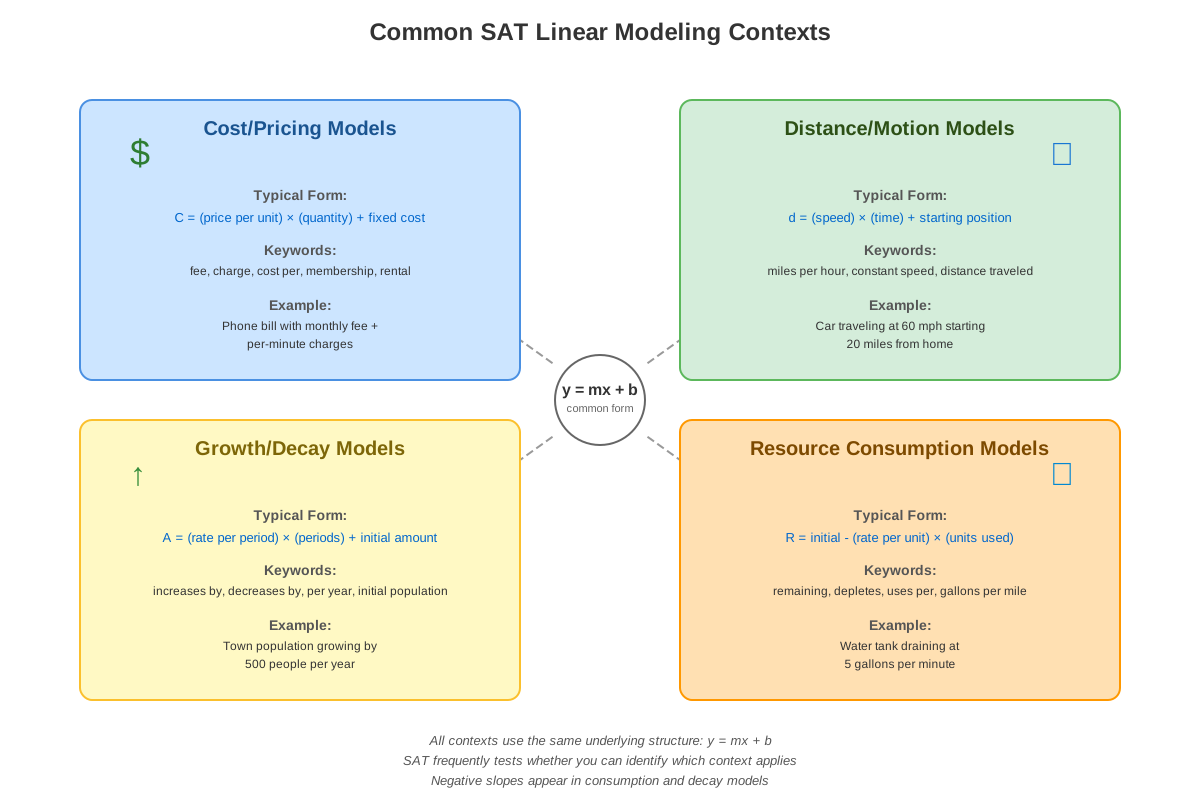
Linear modeling questions on the SAT commonly appear in several formats: cost analysis problems (fixed costs plus variable rates), distance-rate-time scenarios, population growth or decline at constant rates, and conversion between units or scales. These questions often include extraneous information to test whether students can identify relevant data, and they frequently require students to explain the meaning of mathematical components in real-world terms—a skill that distinguishes high-scoring students from those who merely compute without understanding.
Core Concepts
The Standard Form of Linear Equations
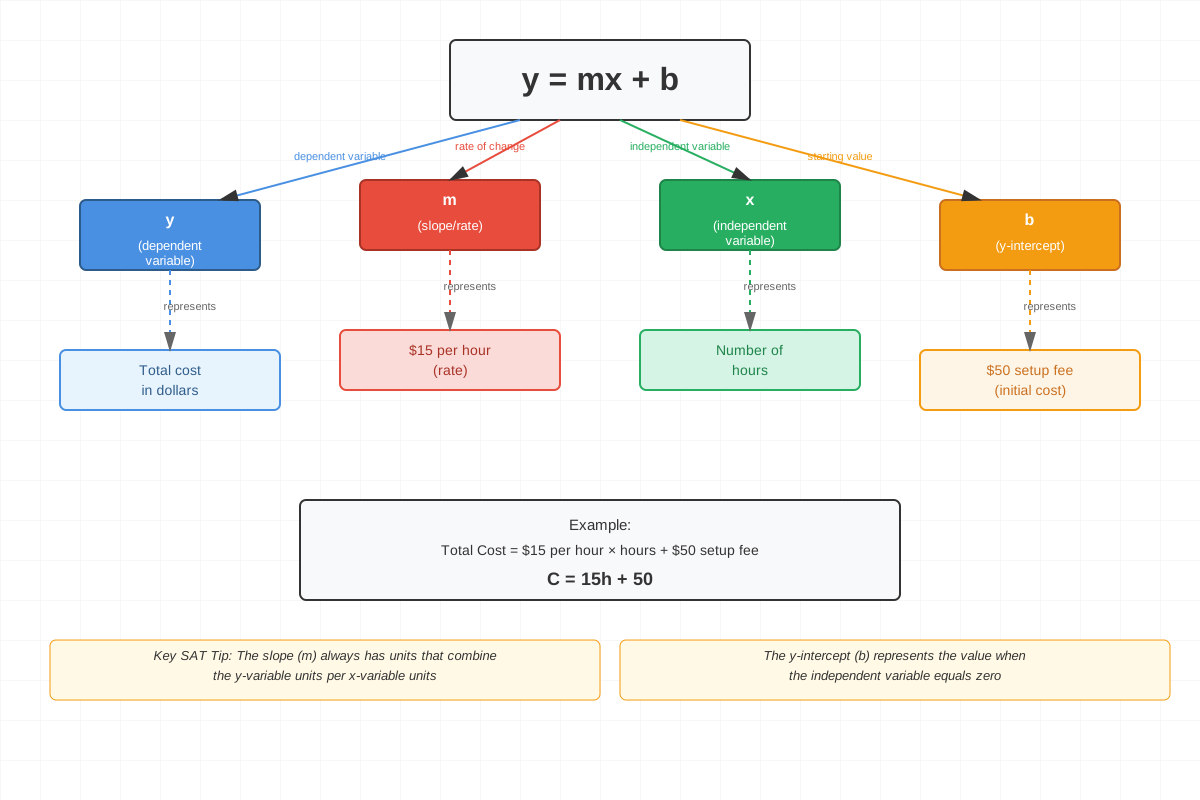
A linear modeling equation expresses a relationship between two variables where one variable changes at a constant rate with respect to the other. The most common form for linear models is the slope-intercept form: y = mx + b, where:
- y represents the dependent variable (the output or result)
- x represents the independent variable (the input or what we control)
- m represents the slope (the rate of change)
- b represents the y-intercept (the initial value or starting point)
In real-world contexts, these variables and coefficients take on specific meanings. For example, in a problem about taxi fares, y might represent total cost, x might represent miles traveled, m would be the cost per mile, and b would be the initial pickup fee. The power of linear modeling lies in recognizing these patterns across diverse situations.
Interpreting Slope in Context
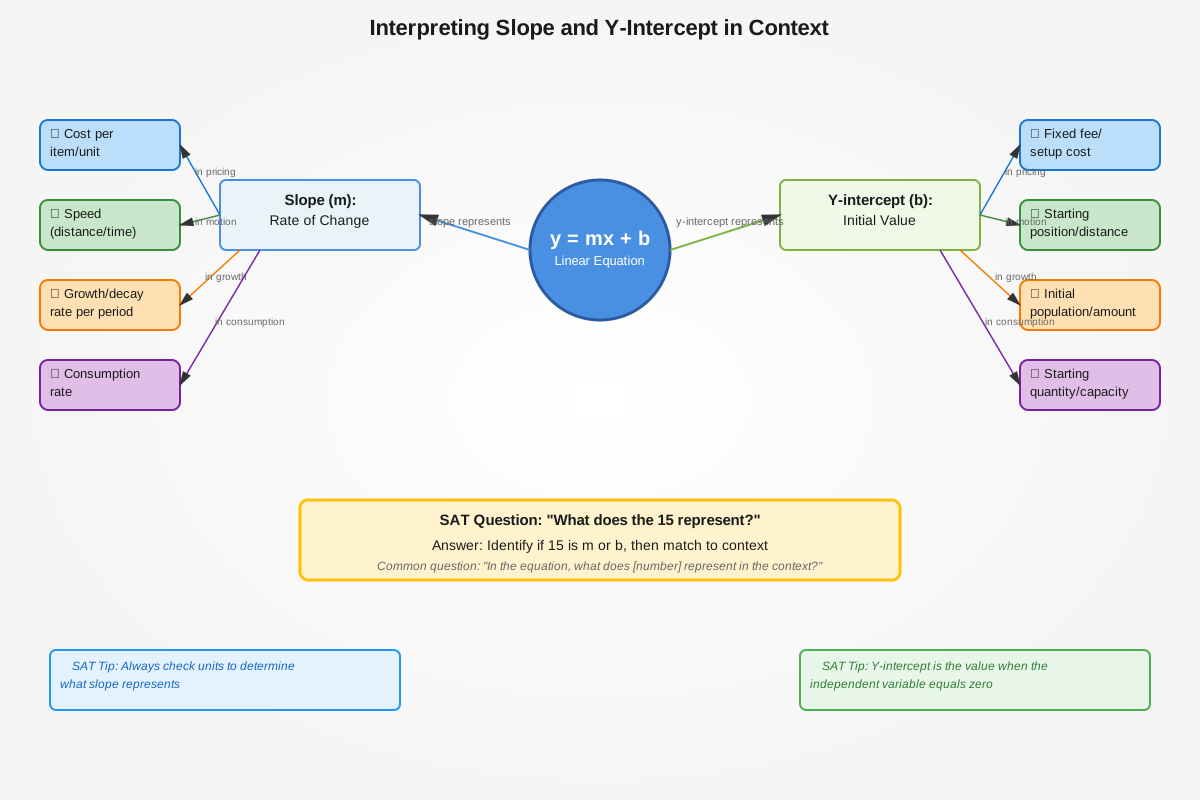
The slope (m) represents the rate of change—how much the dependent variable changes for each one-unit increase in the independent variable. On the SAT, questions frequently ask students to identify what the slope represents in a specific context.
For instance, in the equation C = 50 + 15h, where C represents total cost in dollars and h represents hours worked, the slope is 15, meaning the cost increases by $15 for each additional hour. The slope always carries units that combine the units of both variables: dollars per hour, miles per gallon, points per game, etc.
A positive slope indicates a direct relationship (as one variable increases, so does the other), while a negative slope indicates an inverse relationship (as one variable increases, the other decreases). The magnitude of the slope indicates how steep the relationship is—larger absolute values mean more dramatic changes.
Interpreting Y-Intercept in Context
The y-intercept (b) represents the value of the dependent variable when the independent variable equals zero. In practical terms, this often represents an initial value, starting amount, or fixed cost that exists regardless of the independent variable.
Using the previous example C = 50 + 15h, the y-intercept is 50, representing a $50 base fee that applies even if zero hours are worked. Not all y-intercepts have meaningful real-world interpretations—sometimes x = 0 falls outside the realistic domain of the problem—but when they do, the SAT often tests whether students can identify and explain this meaning.
Constructing Linear Models from Word Problems
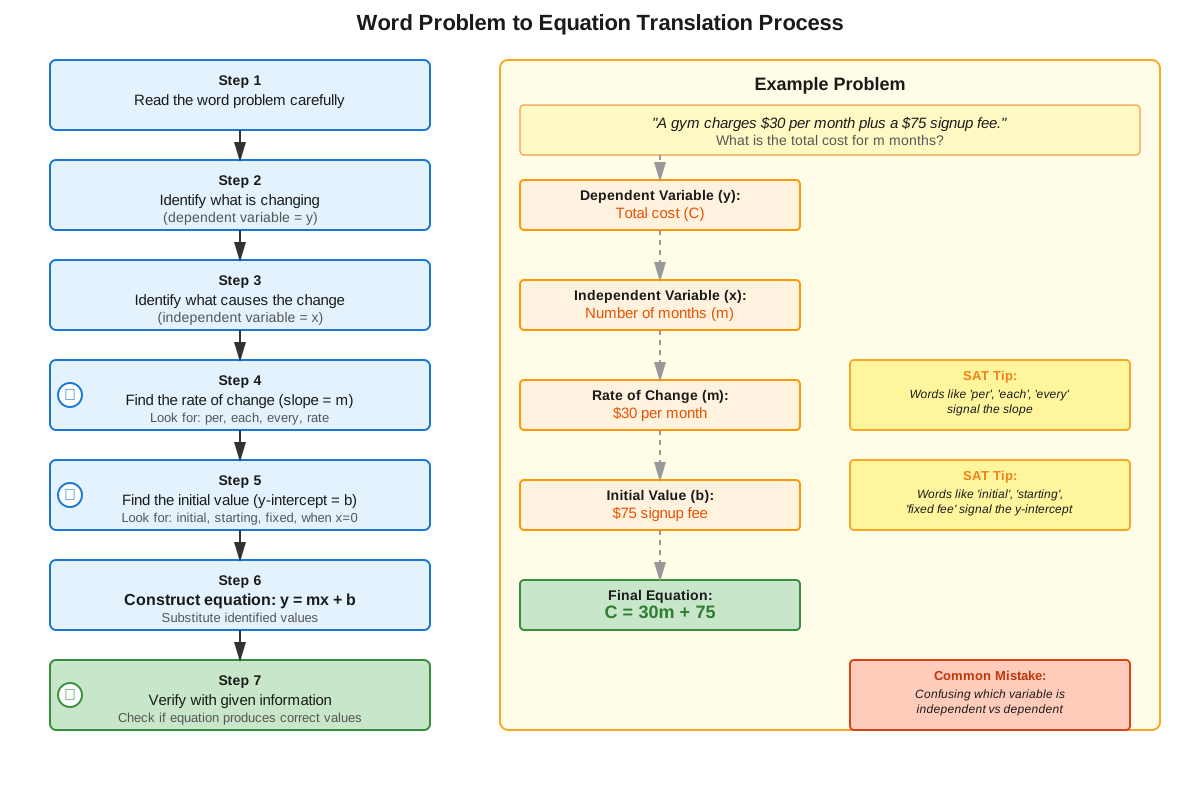
Building a linear equation from a verbal description requires a systematic approach:
- Identify the variables: Determine what quantities are changing and which one depends on the other
- Find the rate of change: Look for words like "per," "each," "every," or "rate" that indicate the slope
- Identify the initial value: Look for starting amounts, base fees, or values when the independent variable is zero
- Write the equation: Substitute the rate and initial value into y = mx + b
- Verify units: Ensure the equation makes sense dimensionally
For example: "A water tank contains 500 gallons and is being filled at a rate of 20 gallons per minute." Here, the amount of water (W) depends on time (t), the rate is 20 gallons/minute, and the initial amount is 500 gallons, yielding W = 20t + 500.
Domain and Range Restrictions
Real-world linear models often have domain restrictions (limitations on possible x-values) and range restrictions (limitations on possible y-values) based on practical constraints. While the mathematical equation might extend infinitely in both directions, the real-world situation may not.
For instance, in a problem about a candle burning at a constant rate, time cannot be negative (domain restriction: t ≥ 0), and the candle's height cannot exceed its original height or go below zero (range restrictions). The SAT tests whether students recognize these constraints and can determine when a model no longer applies.
Multiple Representations
Linear models can be represented in several equivalent ways:
| Representation | Example | When to Use |
|---|---|---|
| Slope-intercept form | y = 3x + 5 | When slope and y-intercept are known or needed |
| Point-slope form | y - 7 = 3(x - 2) | When a point and slope are known |
| Standard form | 3x - y = -5 | When working with systems or integer coefficients |
| Table of values | x: 0,1,2; y: 5,8,11 | When analyzing patterns in data |
| Graph | Visual line on coordinate plane | When interpreting trends visually |
The SAT expects students to move fluidly between these representations, extracting information from one form and applying it in another.
Concept Relationships
Linear modeling equations build directly on fundamental algebraic concepts. The ability to manipulate equations algebraically enables students to solve for unknown values within models, while understanding of slope and y-intercept provides the conceptual foundation for interpreting what these models mean.
Within the topic itself, the concepts form a logical progression: recognizing linear relationships → identifying rate of change (slope) and initial value (y-intercept) → constructing equations → interpreting equations in context → applying models to make predictions. Each step depends on the previous one, and mastery requires competence at all levels.
The relationship map flows as follows:
Real-world scenario → Identify variables and relationships → Determine slope (rate) and y-intercept (initial value) → Construct equation in appropriate form → Apply domain/range restrictions → Use model to solve problems or make predictions → Interpret results in original context
Linear modeling also connects forward to more advanced SAT topics. Systems of linear equations extend single models to situations with multiple constraints. Exponential models contrast with linear models by showing non-constant rates of change. Data analysis questions often require determining whether a linear model appropriately fits a dataset. Understanding linear models thoroughly makes these advanced topics more accessible.
High-Yield Facts
⭐ The slope in a linear model represents the rate of change and always includes units combining both variables (e.g., dollars per hour, miles per gallon)
⭐ The y-intercept represents the value of the dependent variable when the independent variable equals zero, often corresponding to an initial value or fixed cost
⭐ Linear models have the form y = mx + b, where m is constant—if the rate of change varies, the relationship is not linear
⭐ In word problems, phrases like "per," "each," "every," and "rate of" typically indicate the slope value
⭐ Real-world linear models often have domain and range restrictions that limit the valid input and output values
- A positive slope indicates both variables increase together; a negative slope indicates an inverse relationship
- When comparing two linear models, they intersect at the point where both equations yield the same output for the same input
- The steeper the line (larger absolute value of slope), the more rapidly the dependent variable changes
- Linear models assume constant rates of change—if a situation involves acceleration, compounding, or other non-constant changes, a linear model is inappropriate
- On the SAT, questions often provide more information than needed; identifying relevant values is part of the challenge
Quick check — test yourself on Linear modeling equations so far.
Try Flashcards →Common Misconceptions
Misconception: The y-intercept always represents a meaningful starting value in real-world problems → Correction: While the y-intercept is the value when x = 0, this point may fall outside the realistic domain of the problem. For example, in a model predicting height based on age for adults, the y-intercept (height at age 0) has no practical meaning within the model's valid range.
Misconception: Slope is always calculated as "rise over run" from a graph → Correction: While this geometric interpretation works, in word problems, slope is identified from the rate of change described verbally (dollars per item, miles per hour, etc.) without necessarily seeing a graph. Students must recognize slope from context, not just visual representations.
Misconception: All linear equations must be written in y = mx + b form → Correction: Linear equations can be expressed in multiple equivalent forms (point-slope, standard form, etc.). The SAT may present equations in any form, and students should recognize them all as representing linear relationships and be able to convert between forms as needed.
Misconception: If a problem involves two quantities, the relationship must be linear → Correction: Not all relationships between variables are linear. Only relationships with constant rates of change are linear. Exponential growth, quadratic relationships, and inverse variation are common non-linear relationships that appear on the SAT.
Misconception: The larger number in a word problem is always the y-intercept → Correction: Students must carefully analyze what each number represents in context. The y-intercept is specifically the initial value or the value when the independent variable is zero, regardless of its magnitude relative to other numbers in the problem.
Misconception: Linear models can be extended indefinitely to make predictions → Correction: Linear models are valid only within their appropriate domain and range. Extrapolating far beyond the data or context that generated the model often produces unrealistic predictions. The SAT tests whether students recognize when a model's predictions become invalid.
Worked Examples
Example 1: Constructing and Interpreting a Linear Model
Problem: A gym charges a one-time enrollment fee of $75 and a monthly membership fee of $40. Write an equation for the total cost C in dollars after m months of membership. What does the slope represent in this context? How much will a member pay after 8 months?
Solution:
Step 1: Identify the variables. The total cost C depends on the number of months m, so C is the dependent variable and m is the independent variable.
Step 2: Identify the rate of change (slope). The monthly fee is $40, meaning the cost increases by $40 for each additional month. Therefore, m = 40.
Step 3: Identify the initial value (y-intercept). The enrollment fee of $75 is paid regardless of how many months the membership lasts (it's the cost when m = 0). Therefore, b = 75.
Step 4: Write the equation. Substituting into y = mx + b (using our variables): C = 40m + 75
Step 5: Interpret the slope. The slope of 40 represents the monthly membership fee—the cost increases by $40 for each additional month of membership.
Step 6: Calculate the cost after 8 months. Substitute m = 8 into the equation:
C = 40(8) + 75
C = 320 + 75
C = 395Answer: The equation is C = 40m + 75. The slope represents the monthly membership fee of $40. After 8 months, a member will have paid $395 total.
This example demonstrates Learning Objectives 1, 2, and 3 by identifying key features (slope and y-intercept), showing how such problems appear on the SAT (word problem requiring equation construction), and applying the model to answer a specific question.
Example 2: Comparing Two Linear Models
Problem: Company A charges $30 plus $0.15 per minute for phone service. Company B charges $20 plus $0.20 per minute. Write equations for both companies' charges. After how many minutes of use will both companies charge the same amount? Which company is cheaper for someone who uses 150 minutes per month?
Solution:
Step 1: Write the equation for Company A. Let C represent cost and m represent minutes.
- Rate: $0.15 per minute (slope = 0.15)
- Initial fee: $30 (y-intercept = 30)
- Equation: C_A = 0.15m + 30
Step 2: Write the equation for Company B.
- Rate: $0.20 per minute (slope = 0.20)
- Initial fee: $20 (y-intercept = 20)
- Equation: C_B = 0.20m + 20
Step 3: Find when both companies charge the same amount by setting the equations equal:
0.15m + 30 = 0.20m + 20
30 - 20 = 0.20m - 0.15m
10 = 0.05m
m = 200
Step 4: Verify by substituting m = 200 into both equations:
- Company A: C = 0.15(200) + 30 = 30 + 30 = $60
- Company B: C = 0.20(200) + 20 = 40 + 20 = $60 ✓
Step 5: Determine which is cheaper for 150 minutes:
- Company A: C = 0.15(150) + 30 = 22.50 + 30 = $52.50
- Company B: C = 0.20(150) + 20 = 30 + 20 = $50.00
Answer: The equations are C_A = 0.15m + 30 and C_B = 0.20m + 20. Both companies charge the same amount ($60) at 200 minutes of use. For 150 minutes, Company B is cheaper at $50 compared to Company A's $52.50.
This example shows how linear models can be compared to make practical decisions, a common SAT question type that tests multiple skills simultaneously: constructing equations, solving systems, and interpreting results in context.
Exam Strategy
When approaching SAT linear modeling equations questions, begin by carefully reading the entire problem to understand the real-world scenario before attempting any calculations. Identify what the question is actually asking—many students lose points by solving for the wrong variable or answering a different question than what was asked.
Trigger words and phrases to watch for include:
- "Per," "each," "every," "rate of" → these indicate the slope
- "Initial," "starting," "base fee," "fixed cost" → these indicate the y-intercept
- "After," "when," "at what point" → these signal you need to substitute a value and solve
- "What does [coefficient] represent" → these test contextual interpretation, not just calculation
Use a systematic approach: (1) Define variables clearly, writing down what each letter represents; (2) Identify the rate and initial value from the problem; (3) Construct the equation; (4) Answer the specific question asked; (5) Check that your answer makes sense in context. This methodical process prevents careless errors and ensures you address all parts of the question.
For process-of-elimination on multiple-choice questions, check whether answer choices have the correct units and reasonable magnitudes. If a problem involves dollars and hours, an answer in miles makes no sense. If the problem describes a decreasing quantity, eliminate choices with positive slopes. When answer choices are equations, test them with simple values (like x = 0) to eliminate incorrect options quickly.
Time allocation: Most linear modeling questions should take 1.5-2 minutes. If you find yourself spending more than 2.5 minutes, mark the question and move on—you can return if time permits. These questions reward careful reading more than complex calculations, so rushing through the setup often leads to errors that cost more time to fix than reading carefully initially would have taken.
Memory Techniques
Slope Mnemonic: "S.P.E.E.D." - Slope Provides Each Equation's Direction (and rate of change)
Y-intercept Mnemonic: "Y-intercept = Your Initial" - The y-intercept represents your initial value when starting (when x = 0)
Equation Construction Mnemonic: "R.I.S.E." - Read carefully, Identify variables, Spot the rate and initial value, Equate using y = mx + b
Visualization Strategy: Picture linear models as ramps or slides. The slope determines how steep the ramp is (gentle slope = gradual change; steep slope = rapid change). The y-intercept is where the ramp starts on the vertical axis. This mental image helps distinguish between different linear relationships and their real-world meanings.
Unit Tracking: Always write units next to numbers when working through problems. This prevents mixing up which value represents slope versus y-intercept and helps catch errors when your final answer has incorrect units.
Context Connection: Create a mental library of common linear model scenarios: taxi fares (base fee + per-mile charge), phone bills (monthly fee + per-minute charge), rental costs (daily rate + initial fee), distance traveled (speed × time + starting position). Recognizing these patterns speeds up problem-solving.
Summary
Linear modeling equations represent real-world relationships where one quantity changes at a constant rate with respect to another, expressed mathematically as y = mx + b. The slope (m) represents the rate of change and carries units combining both variables, while the y-intercept (b) represents the initial value when the independent variable equals zero. On the SAT, linear modeling questions require students to translate verbal descriptions into equations, interpret the meaning of coefficients in context, and use models to make predictions or solve problems. Success requires identifying relevant information from word problems, constructing appropriate equations, recognizing domain and range restrictions based on real-world constraints, and moving fluidly between different representations (equations, tables, graphs, and verbal descriptions). These questions test both computational skill and conceptual understanding, rewarding students who can explain what mathematical components mean in practical terms rather than merely performing calculations mechanically.
Key Takeaways
- Linear models follow the form y = mx + b, where m (slope) represents the constant rate of change and b (y-intercept) represents the initial value
- The slope always includes units that combine both variables (dollars per hour, miles per gallon, etc.) and indicates how much the dependent variable changes per unit increase in the independent variable
- Constructing linear models from word problems requires identifying variables, extracting the rate of change and initial value, and writing the equation systematically
- Real-world linear models often have domain and range restrictions that limit valid input and output values based on practical constraints
- SAT questions frequently test whether students can interpret what coefficients represent in context, not just perform calculations
- Comparing two linear models involves setting equations equal to find intersection points where both models yield the same result
- Success on linear modeling questions requires careful reading, systematic problem-solving, and checking that answers make sense in the original context
Related Topics
Systems of Linear Equations: Building on single linear models, systems involve two or more linear equations that must be satisfied simultaneously. Mastering linear modeling provides the foundation for understanding how multiple constraints interact and finding solutions that satisfy all conditions.
Linear Inequalities: These extend linear equations by describing ranges of values rather than exact solutions, using inequality symbols instead of equal signs. Understanding linear models makes interpreting inequality solutions more intuitive.
Exponential Models: These contrast with linear models by representing situations where the rate of change itself changes (growth or decay by a constant percentage rather than constant amount). Recognizing when relationships are linear versus exponential is a key SAT skill.
Scatterplots and Line of Best Fit: These data analysis topics involve determining whether a linear model appropriately represents a dataset and using linear regression to make predictions. Strong understanding of linear models enables better interpretation of data trends.
Functions and Function Notation: Linear equations are specific examples of functions, and understanding linear models provides concrete examples for more abstract function concepts including domain, range, and function composition.
Practice CTA
Now that you've mastered the core concepts of linear modeling equations, it's time to solidify your understanding through practice. Work through the practice questions to apply these concepts to SAT-style problems, and use the flashcards to reinforce key definitions and relationships. Remember, linear modeling appears consistently on the SAT, so investing time in practice now will pay dividends on test day. Each problem you solve strengthens your pattern recognition and builds the confidence you need to tackle these questions quickly and accurately. You've got this!
Sign up free to keep reading
Create a free AnvayaPrep account to finish this SAT guide on Linear modeling equations — plus flashcards and practice questions.