Overview
The domain of a function is one of the most fundamental concepts in algebra and functions, representing all possible input values (x-values) for which a function is defined and produces a real output. On the SAT, understanding domain is critical because it appears in multiple question formats across both the calculator and no-calculator sections of the math test. Questions may ask students to identify restrictions on domain, determine the domain from a graph, or recognize when certain operations create domain limitations.
Mastering domain concepts is essential for SAT success because these questions test both computational skills and conceptual understanding. Students must recognize that domain restrictions arise from mathematical operations that are undefined in the real number system—such as division by zero, taking even roots of negative numbers, or evaluating logarithms of non-positive values. The College Board frequently embeds domain questions within function composition problems, rational expressions, and real-world modeling scenarios, making this topic a high-yield area for focused study.
Domain connects directly to other critical SAT math concepts including function notation, range, transformations, and equation solving. A solid grasp of domain enables students to work confidently with complex functions, interpret graphs accurately, and avoid common algebraic errors. Since approximately 5-8% of SAT math questions directly or indirectly test domain understanding, investing time in this topic yields significant score improvements.
Learning Objectives
- [ ] Identify key features of Domain
- [ ] Explain how Domain appears on the SAT
- [ ] Apply Domain to answer SAT-style questions
- [ ] Determine domain restrictions from algebraic expressions involving fractions, radicals, and other operations
- [ ] Interpret domain from function graphs and identify discontinuities or endpoints
- [ ] Solve inequality problems that arise from domain restrictions
- [ ] Recognize how function composition affects domain
Prerequisites
- Function notation and evaluation: Understanding f(x) notation is essential because domain describes all valid x-values for a function
- Solving linear and quadratic inequalities: Domain restrictions often require solving inequalities to determine which x-values are permissible
- Properties of real numbers: Recognizing which operations are undefined (division by zero, even roots of negatives) forms the foundation of domain analysis
- Basic graphing skills: Interpreting domain from visual representations requires reading graphs and identifying x-axis coverage
- Algebraic manipulation: Simplifying expressions and factoring helps identify potential domain restrictions
Why This Topic Matters
In real-world applications, domain represents the practical limitations of mathematical models. Engineers use domain restrictions to define safe operating ranges for equipment, economists model supply and demand functions within realistic price ranges, and scientists establish valid input ranges for experimental formulas. Understanding domain helps students recognize when mathematical models apply to real situations and when they break down.
On the SAT, domain questions appear in approximately 2-3 questions per test, representing 5-8% of the math section. These questions manifest in several formats: direct "what is the domain?" questions, problems requiring students to identify values that make expressions undefined, graph interpretation questions asking for the set of x-values covered, and word problems where context determines domain restrictions. The College Board particularly favors questions combining domain with function composition, rational expressions, and radical functions.
Domain questions commonly appear as multiple-choice problems asking students to identify which value is NOT in the domain, or as student-produced response questions requiring the boundary value of a domain restriction. The test also embeds domain concepts within more complex problems about function behavior, transformations, and modeling scenarios. Recognizing domain restrictions quickly allows students to eliminate impossible answer choices and avoid calculation errors.
Core Concepts
Definition of Domain
The domain of a function consists of all real numbers that can serve as valid inputs (x-values) for that function. Formally, the domain is the set of all x-values for which the function produces a defined real number output. When working with functions algebraically, the domain includes all real numbers except those that cause mathematical impossibilities or undefined operations.
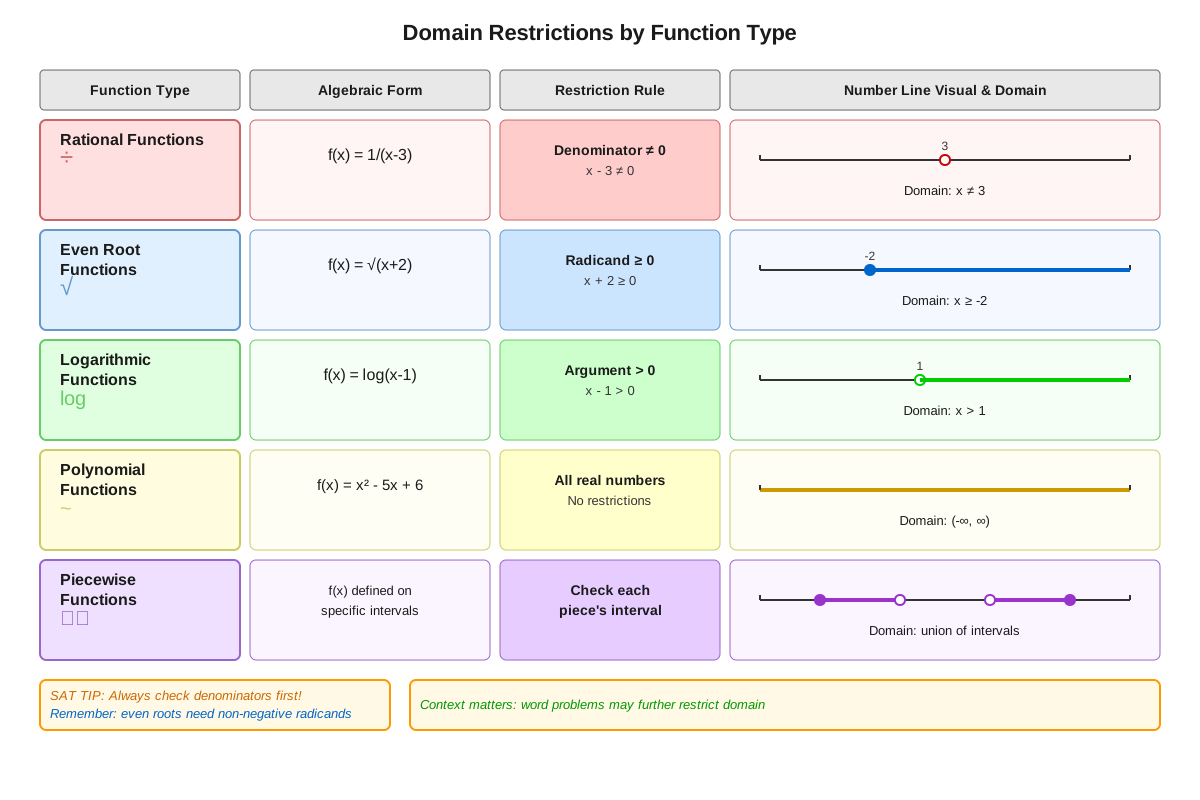
For most basic functions like linear functions (f(x) = mx + b) or simple polynomials (f(x) = x² + 3x - 5), the domain is all real numbers, often written as (-∞, ∞) or {x | x ∈ ℝ}. However, many functions have restricted domains due to mathematical constraints.
Common Domain Restrictions
Division by Zero
The most frequently tested domain restriction on the SAT involves rational functions where the denominator cannot equal zero. For a function like f(x) = 1/(x - 3), the value x = 3 must be excluded from the domain because it makes the denominator zero, creating an undefined expression.
To find domain restrictions from rational expressions:
- Identify the denominator
- Set the denominator equal to zero
- Solve for x
- Exclude these x-values from the domain
For example, with f(x) = (x + 2)/(x² - 4), factor the denominator: x² - 4 = (x + 2)(x - 2). Setting this equal to zero gives x = -2 or x = 2, so the domain is all real numbers except -2 and 2.
Even Roots of Negative Numbers
Square roots and other even-indexed radicals (fourth roots, sixth roots, etc.) require non-negative radicands in the real number system. For f(x) = √(x - 5), the expression under the radical must satisfy x - 5 ≥ 0, which means x ≥ 5. The domain is [5, ∞).
To determine domain for radical functions:
- Identify the expression under the radical
- Set up an inequality: radicand ≥ 0
- Solve the inequality
- Express the solution in interval notation
For f(x) = √(9 - x²), solve 9 - x² ≥ 0, which gives -3 ≤ x ≤ 3, so the domain is [-3, 3].
Logarithmic Functions
Logarithms require positive arguments. For f(x) = log(x - 4), the domain requires x - 4 > 0, so x > 4, giving domain (4, ∞). Note that logarithms use strict inequality (>) rather than (≥) because log(0) is undefined.
Domain from Graphs
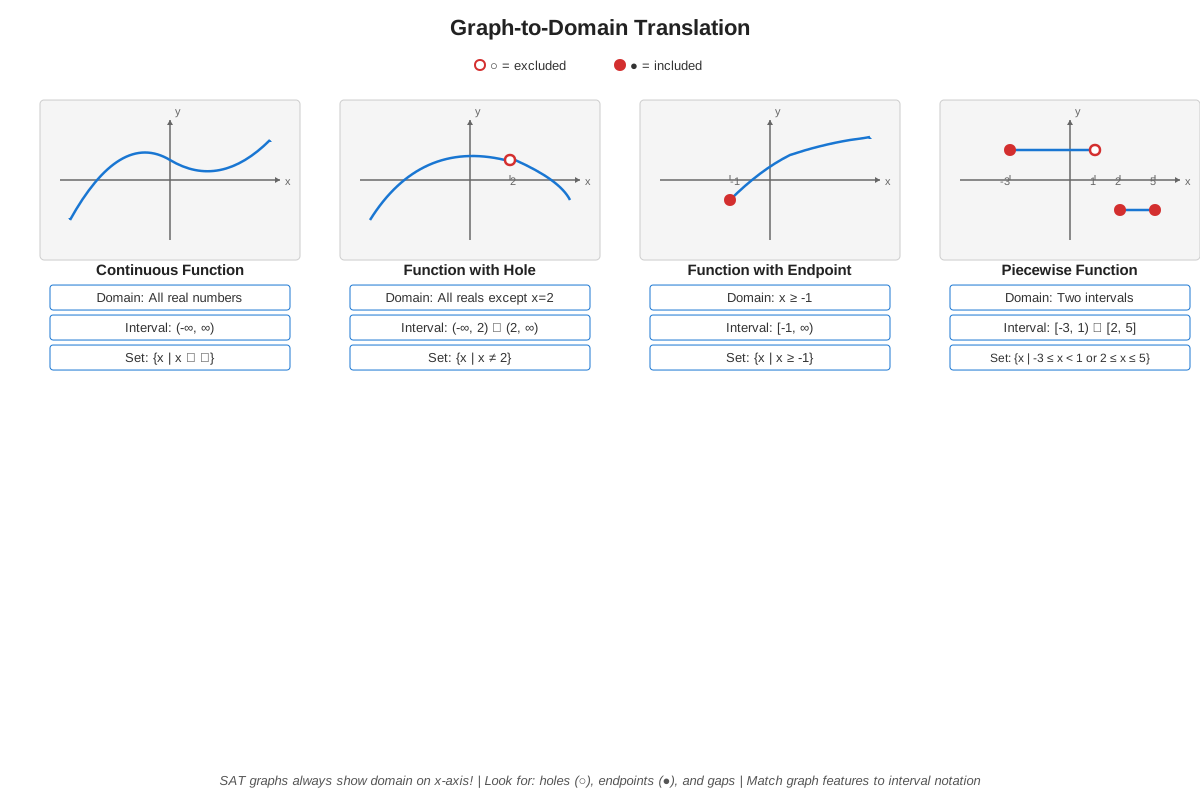
When a function is presented graphically, the domain consists of all x-values for which the graph exists. To read domain from a graph:
- Identify the leftmost point where the graph begins
- Identify the rightmost point where the graph ends
- Include all x-values between these points
- Use closed brackets [ ] for solid dots (included endpoints)
- Use open parentheses ( ) for open circles (excluded endpoints) or arrows (continuing infinitely)
A parabola opening upward or downward that extends infinitely left and right has domain (-∞, ∞). A semicircle with endpoints at x = -2 and x = 2 has domain [-2, 2].
Piecewise Functions and Domain
Piecewise functions define different expressions for different parts of the domain. The overall domain is the union of all individual piece domains. For example:
f(x) = { x² if x < 0
       { 2x + 1 if x ≥ 0
This function is defined for all real numbers because the two pieces together cover all x-values, giving domain (-∞, ∞).
Domain in Context
Word problems often impose domain restrictions based on real-world constraints. If a function models the area of a rectangle with side length x, then x > 0 because negative lengths are meaningless. If a function represents profit over t years where the study period is 10 years, then 0 ≤ t ≤ 10.
Interval Notation for Domain
| Inequality | Interval Notation | Meaning |
|---|---|---|
| x > 3 | (3, ∞) | All numbers greater than 3 |
| x ≥ 3 | [3, ∞) | All numbers greater than or equal to 3 |
| x < -2 | (-∞, -2) | All numbers less than -2 |
| -1 ≤ x < 5 | [-1, 5) | All numbers from -1 to 5, including -1 but not 5 |
| x ≠ 4 | (-∞, 4) ∪ (4, ∞) | All real numbers except 4 |
Function Composition and Domain
When composing functions (f ∘ g)(x) = f(g(x)), the domain is restricted by both functions. The input x must be in the domain of g, AND g(x) must be in the domain of f. This creates a compound restriction that students must carefully analyze on the SAT.
Concept Relationships
Domain serves as the foundation for understanding function behavior. The relationship flows as follows: Domain → determines valid inputs → which produce Range (valid outputs) → together defining the complete function behavior. Domain restrictions directly affect where functions can be graphed, creating discontinuities, holes, or asymptotes.
Domain connects to solving inequalities because finding domain often requires solving inequality expressions, particularly for radical and rational functions. The connection flows: identify restriction → set up inequality → solve inequality → express domain.
Function composition builds upon domain understanding: Domain of g → affects possible inputs to f → determines domain of f(g(x)). Similarly, transformations shift or stretch domains: horizontal shifts move domain left or right, while horizontal stretches/compressions multiply domain values.
Domain relates to graphing through a bidirectional relationship: algebraic domain restrictions predict graph behavior (asymptotes, endpoints), while graphs visually display domain through x-axis coverage. This connection helps students verify their algebraic work.
Quick check — test yourself on Domain so far.
Try Flashcards →High-Yield Facts
⭐ The domain of a function is the set of all permissible input (x) values
⭐ Division by zero is undefined; set denominators ≠ 0 to find restrictions
⭐ Even roots require non-negative radicands; set the expression under the radical ≥ 0
⭐ On graphs, domain is read from the x-axis, showing all x-values where the function exists
⭐ Logarithms require positive arguments; set the expression inside log > 0
- Polynomial functions (without denominators or radicals) have domain of all real numbers
- Absolute value functions typically have domain of all real numbers unless combined with restrictions
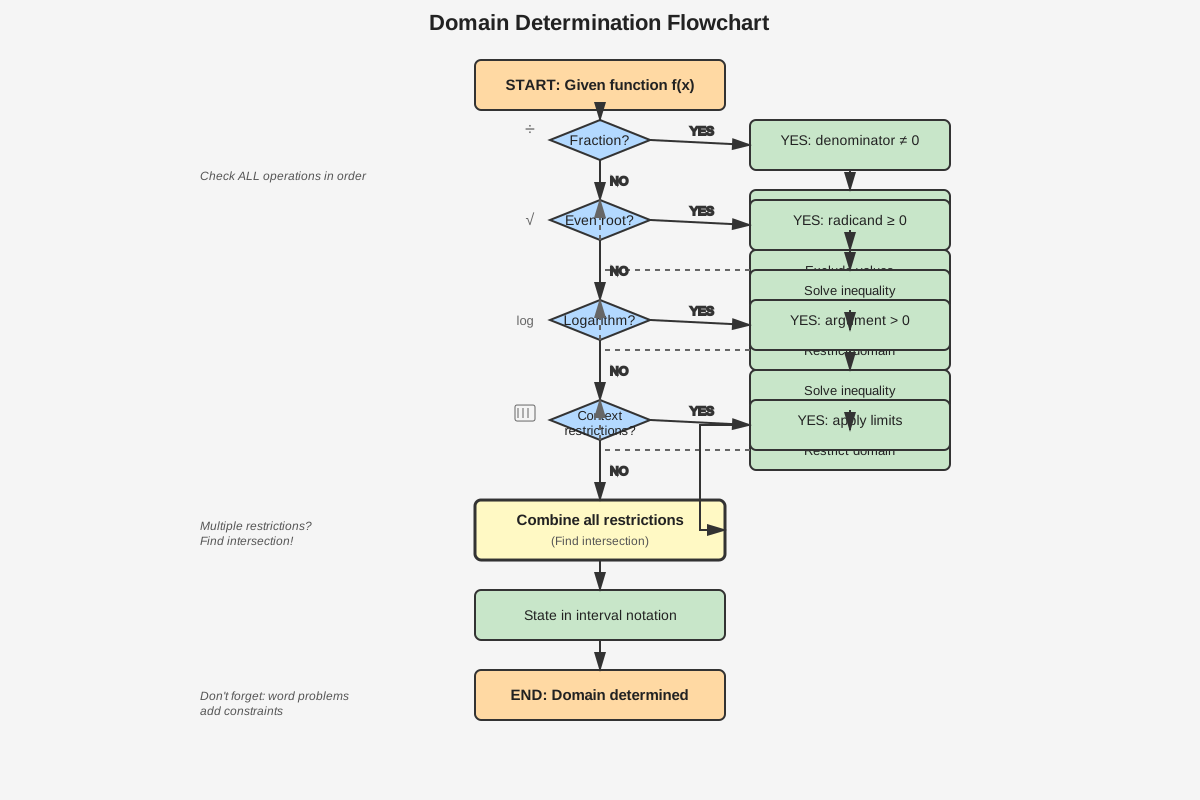
- When multiple restrictions exist, the domain is the intersection of all valid x-values
- Piecewise functions have domain equal to the union of all piece domains
- Context-based problems may impose additional domain restrictions beyond mathematical ones
Common Misconceptions
Misconception: The domain is the same as the range → Correction: Domain refers to input values (x-values), while range refers to output values (y-values). They are distinct concepts that describe different aspects of a function.
Misconception: For f(x) = √(x² - 9), the domain is x ≥ 3 → Correction: The domain requires x² - 9 ≥ 0, which factors as (x - 3)(x + 3) ≥ 0. This inequality is satisfied when x ≤ -3 OR x ≥ 3, so the domain is (-∞, -3] ∪ [3, ∞).
Misconception: If a function simplifies to remove a restriction, that value is in the domain → Correction: For f(x) = (x² - 4)/(x - 2), even though this simplifies to f(x) = x + 2 (after factoring and canceling), x = 2 is still NOT in the domain because the original function is undefined there. The graph has a hole at x = 2.
Misconception: Odd roots have the same restrictions as even roots → Correction: Odd roots (cube roots, fifth roots, etc.) can accept negative radicands because negative numbers have real odd roots. For f(x) = ∛(x - 5), the domain is all real numbers, not just x ≥ 5.
Misconception: When reading domain from a graph, arrows mean the endpoint is included → Correction: Arrows indicate the graph continues infinitely in that direction, represented by ∞ or -∞ in interval notation. These are always written with parentheses ( ), never brackets, because infinity is not a specific number that can be "included."
Misconception: The domain of f(x) + g(x) is the union of their individual domains → Correction: For combined functions (sum, difference, product), the domain is the intersection of individual domains—only x-values that work for BOTH functions are valid for the combination.
Worked Examples
Example 1: Rational Function with Quadratic Denominator
Problem: Find the domain of f(x) = (3x + 1)/(x² - 5x + 6).
Solution:
Step 1: Identify that this is a rational function, so we need to find where the denominator equals zero.
Step 2: Set the denominator equal to zero and solve:
x² - 5x + 6 = 0
Step 3: Factor the quadratic:
(x - 2)(x - 3) = 0
Step 4: Solve for x:
x = 2 or x = 3
Step 5: These values must be excluded from the domain. Express the answer:
Domain: All real numbers except x = 2 and x = 3
In interval notation: (-∞, 2) ∪ (2, 3) ∪ (3, ∞)
Connection to Learning Objectives: This example demonstrates identifying domain restrictions from algebraic expressions and applying domain concepts to answer SAT-style questions involving rational functions.
Example 2: Radical Function with Inequality
Problem: A function is defined as g(x) = √(2x - 8) + 3. What is the smallest value in the domain of g?
Solution:
Step 1: Recognize this involves a square root, requiring the radicand to be non-negative.
Step 2: Set up the inequality:
2x - 8 ≥ 0
Step 3: Solve for x:
2x ≥ 8
x ≥ 4
Step 4: The domain is [4, ∞), meaning all values greater than or equal to 4.
Step 5: The smallest value in the domain is x = 4.
Verification: Check that x = 4 works: g(4) = √(2(4) - 8) + 3 = √0 + 3 = 3 ✓
Connection to Learning Objectives: This problem requires determining domain restrictions from radical expressions and solving the resulting inequality, both key SAT skills. The question format (asking for a specific boundary value) is common on student-produced response questions.
Example 3: Domain from Graph Interpretation
Problem: A function h is graphed on the coordinate plane. The graph begins at a closed circle at (-3, 2), continues as a curve to an open circle at (1, 5), then jumps to a closed circle at (1, -1) and continues with an arrow to the right. What is the domain of h?
Solution:
Step 1: Identify the leftmost x-value: x = -3 (closed circle means included)
Step 2: Identify the rightmost extent: arrow to the right means continues to infinity
Step 3: Check for any gaps in x-values: The function has values at x = 1 from both pieces (open circle from left piece doesn't matter because closed circle from right piece includes x = 1)
Step 4: Express the domain: [-3, ∞)
Connection to Learning Objectives: This demonstrates interpreting domain from visual representations and understanding how piecewise functions affect domain, both important SAT skills.
Exam Strategy
When approaching SAT domain questions, first identify the type of function presented. Scan for denominators (rational functions), radicals (root functions), or logarithms, as these immediately signal potential restrictions. If the function appears to be a simple polynomial without these features, the domain is likely all real numbers.
Trigger words to watch for: "for which value is the function undefined," "what is the domain," "all possible values of x," "for what values of x does the function exist," and "which value is NOT in the domain."
Use the process of elimination strategically. If a question asks which value is NOT in the domain, test each answer choice by substituting it into the function. Any value that creates division by zero, a negative under an even radical, or a non-positive logarithm argument is the correct answer. This approach is often faster than solving algebraically, especially under time pressure.
For graph-based domain questions, use your pencil to trace along the x-axis beneath the graph, marking where the function exists. Pay careful attention to open versus closed circles—this distinction determines whether boundary values are included. If you're unsure, remember that solid dots mean "included" (use brackets [ ]) and open circles mean "excluded" (use parentheses ( )).
Allocate approximately 45-60 seconds for straightforward domain questions and up to 90 seconds for complex problems involving composition or multiple restrictions. If a problem requires extensive algebraic manipulation, consider whether testing answer choices might be more efficient.
When domain appears within a word problem, first extract the mathematical function, then apply standard domain-finding techniques, and finally check whether the context imposes additional restrictions (like time cannot be negative or quantity must be a whole number).
Memory Techniques
FRED - Fractions (denominators ≠ 0), Roots (even roots need ≥ 0), Everything else (usually all reals), Domain from graph (read x-axis)
"Don't Be Negative" - For square roots, the expression inside must NOT be negative (must be ≥ 0)
"Zero is a Hero Killer" - Zero in the denominator kills (makes undefined) the function at that point
Visual anchor: Picture domain as the "floor" of a function—it's the foundation (x-axis) on which the function stands. If there's no floor at a certain x-value, the function can't exist there.
Interval notation memory: Think of brackets [ ] as "closed doors" that include the endpoint, and parentheses ( ) as "open doors" that exclude the endpoint. Infinity always gets an open door because you can never reach it.
Summary
Domain represents the complete set of valid input values for a function, forming the foundation for understanding function behavior on the SAT. Students must recognize that domain restrictions arise from mathematical operations that are undefined in real numbers: division by zero (rational functions), even roots of negative numbers (radical functions), and logarithms of non-positive numbers. The domain can be determined algebraically by identifying and excluding problematic values, or graphically by reading all x-values where the function exists. SAT questions test domain through direct identification problems, graph interpretation, and embedded restrictions within complex functions or word problems. Mastering domain requires both computational skills (solving inequalities, factoring) and conceptual understanding (recognizing why certain operations create restrictions). Success on domain questions enables students to work confidently with function composition, transformations, and modeling scenarios throughout the math section.
Key Takeaways
- Domain consists of all permissible x-values (inputs) for a function; range consists of y-values (outputs)
- Set denominators ≠ 0, expressions under even radicals ≥ 0, and logarithm arguments > 0 to find restrictions
- Read domain from graphs by identifying all x-values where the function exists, using closed circles for included endpoints and open circles for excluded ones
- Express domain using interval notation with brackets [ ] for included values and parentheses ( ) for excluded values or infinity
- Context-based problems may impose additional domain restrictions beyond purely mathematical ones
- Function composition requires checking domain restrictions for both the inner and outer functions
- When multiple restrictions exist, the domain is the intersection of all valid x-value sets
Related Topics
Range of Functions: After mastering domain (input values), students naturally progress to range (output values), completing their understanding of function behavior and enabling them to fully describe any function.
Function Composition: Domain knowledge is essential for composition problems because (f ∘ g)(x) requires understanding how domain restrictions from both functions interact and compound.
Rational Functions and Asymptotes: Domain restrictions in rational functions create vertical asymptotes, connecting algebraic domain analysis to graphical behavior.
Inverse Functions: Finding inverse functions requires understanding that the domain of f becomes the range of f⁻¹ and vice versa, making domain mastery crucial for inverse problems.
Transformations: Horizontal shifts, stretches, and compressions directly affect domain, so understanding basic domain prepares students for transformation problems.
Practice CTA
Now that you've mastered the core concepts of domain, it's time to solidify your understanding through active practice. Work through the practice questions to apply these concepts to authentic SAT-style problems, and use the flashcards to reinforce key definitions and procedures. Remember, domain questions appear on every SAT, and the skills you've learned here will help you confidently tackle not just direct domain questions but also complex function problems throughout the math section. Your investment in understanding domain will pay dividends across multiple question types—so practice deliberately and review any mistakes carefully to identify gaps in your understanding. You've got this!
Sign up free to keep reading
Create a free AnvayaPrep account to finish this SAT guide on Domain — plus flashcards and practice questions.