Overview
Proportional equations form a critical foundation in SAT math, appearing consistently across multiple question types in both the calculator and no-calculator sections. These equations express relationships where two ratios are equal, taking the form a/b = c/d or equivalent representations. Understanding proportional relationships enables students to solve problems involving rates, scaling, unit conversions, and real-world scenarios that the SAT frequently tests.
Mastery of sat proportional equations is essential because they appear in approximately 10-15% of SAT math questions, either directly or embedded within word problems. These questions often combine proportional reasoning with other algebraic concepts, making them high-yield for score improvement. Students who can quickly recognize and solve proportional relationships gain significant advantages in time management and accuracy.
Within the broader context of linear equations, proportional equations represent a special case where relationships maintain constant ratios. This topic connects directly to concepts like direct variation, unit rates, and linear functions passing through the origin. Strong proportional reasoning skills also support success in geometry (similar figures), data analysis (scaling), and advanced algebra topics tested on the SAT.
Learning Objectives
- [ ] Identify key features of proportional equations
- [ ] Explain how proportional equations appears on the SAT
- [ ] Apply proportional equations to answer SAT-style questions
- [ ] Convert word problems into proportional equation setups efficiently
- [ ] Cross-multiply accurately to solve for unknown variables
- [ ] Recognize when proportional reasoning is the most efficient solution method
- [ ] Distinguish between proportional and non-proportional relationships in context
Prerequisites
- Basic algebraic manipulation: Solving one-variable equations is essential for isolating variables after cross-multiplication
- Fraction operations: Understanding equivalent fractions and simplification helps recognize proportional relationships
- Ratio and rate concepts: Proportions are built on ratio foundations, requiring comfort with comparing quantities
- Unit analysis: Converting between units and maintaining dimensional consistency appears in most proportion word problems
Why This Topic Matters
Proportional equations model countless real-world scenarios that appear on the SAT: recipe scaling, currency conversion, map distances, speed-distance-time relationships, population density, concentration problems, and similar figure calculations. These practical applications make proportional reasoning one of the most frequently tested mathematical skills in standardized testing.
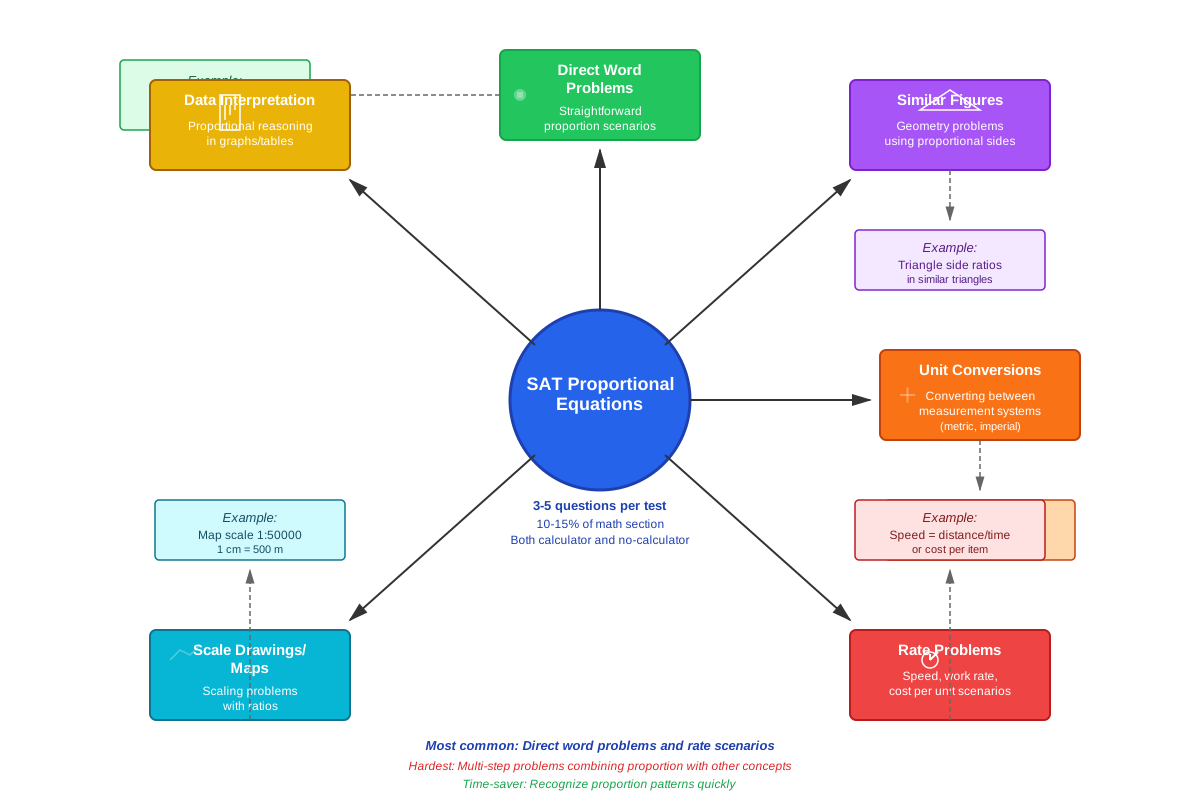
On the SAT specifically, proportional equations appear in 3-5 questions per test on average, distributed across both math sections. Questions may be presented as straightforward algebraic setups, embedded in word problems, integrated with geometry (similar triangles, scale factors), or disguised within data interpretation scenarios. The College Board particularly favors multi-step problems where students must first recognize that a proportional relationship exists, then set up and solve the equation.
Common SAT question formats include: direct proportion word problems ("If 3 pounds cost $12, how much do 7 pounds cost?"), inverse proportion scenarios, unit rate problems requiring proportion setup, geometry problems involving similar figures or scale drawings, and data analysis questions requiring proportional reasoning to interpret graphs or tables. The versatility of this topic makes it exceptionally high-yield for focused study.
Core Concepts
Definition and Structure of Proportional Equations
A proportional equation (or proportion) is an equation stating that two ratios are equal. The standard form is:
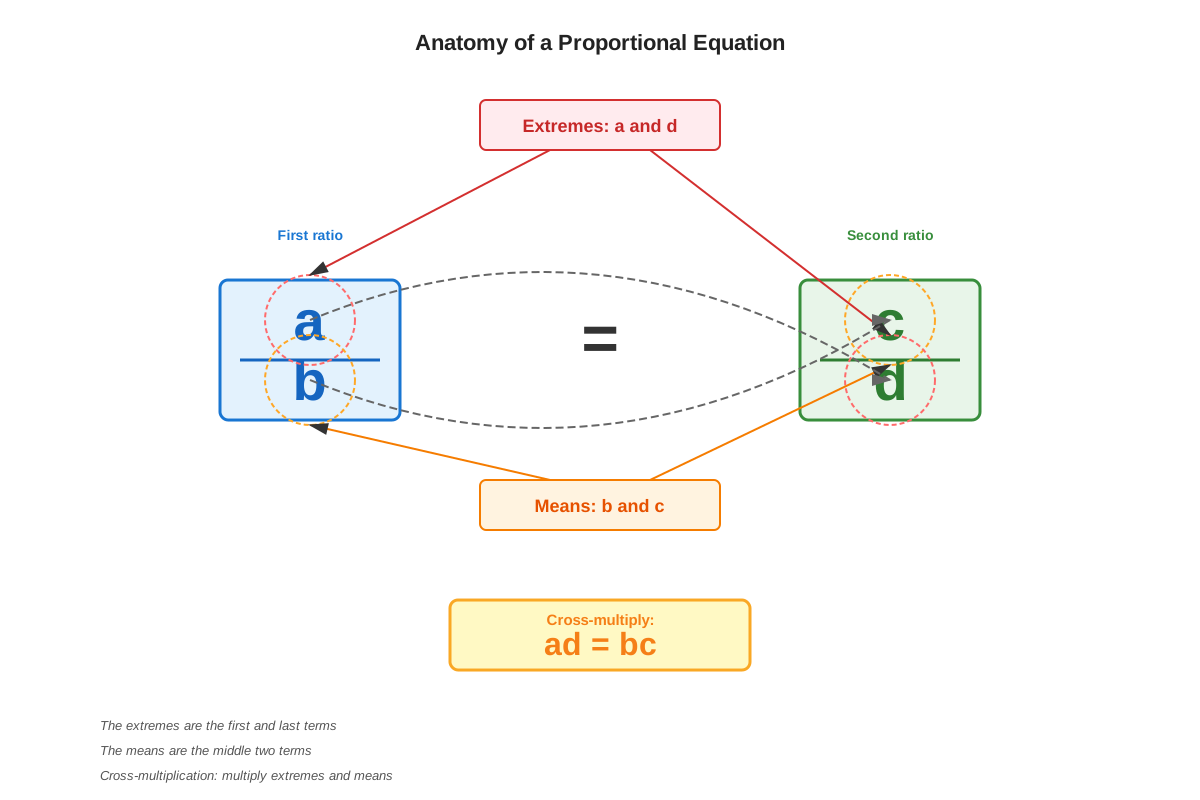
a/b = c/dwhere a, b, c, and d represent quantities, and b ≠ 0, d ≠ 0. The terms have specific names: 'a' and 'd' are called the extremes (outer terms), while 'b' and 'c' are called the means (inner terms). This terminology becomes relevant when applying the cross-multiplication property.
Proportional equations can also be written in alternative forms:
- Colon notation: a:b = c:d
- Fractional equation: a/b = c/d
- Decimal equation: a/b = c/d where ratios are expressed as decimals
- Verbal statement: "a is to b as c is to d"
The Cross-Multiplication Property
The fundamental solving technique for proportional equations is cross-multiplication. This property states that if a/b = c/d, then ad = bc. This works because multiplying both sides of the equation by bd (the common denominator) eliminates the fractions:
a/b = c/d
bd(a/b) = bd(c/d)
ad = bc
Cross-multiplication transforms a proportion into a linear equation that can be solved using standard algebraic techniques. This method is particularly efficient on the SAT where time management is crucial.
Direct Proportions
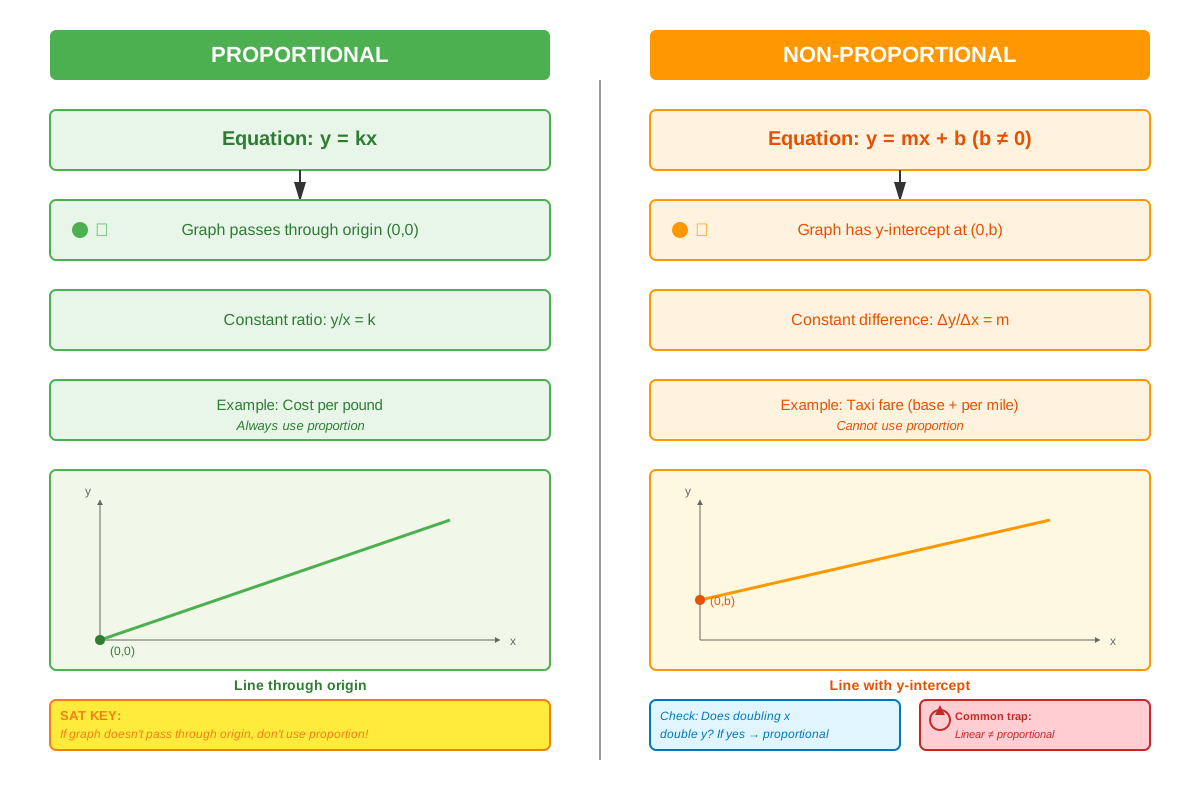
In a direct proportion, as one quantity increases, the other increases at a constant rate. The relationship takes the form y = kx, where k is the constant of proportionality. When two quantities are directly proportional, their ratio remains constant:
y₁/x₁ = y₂/x₂ = kSAT problems frequently present direct proportions in contexts like:
- Cost per item (total cost is proportional to number of items)
- Distance traveled at constant speed (distance is proportional to time)
- Recipe scaling (ingredient amounts are proportional to serving size)
Setting Up Proportions from Word Problems
The critical skill for SAT success is translating verbal descriptions into correct proportional setups. The key principle: keep corresponding quantities in the same positions.
For example, if the problem states "3 widgets cost $15, and you want to find the cost of 8 widgets," the setup must maintain consistency:
3 widgets/15 dollars = 8 widgets/x dollarsOR
3 widgets/8 widgets = 15 dollars/x dollarsBoth setups are valid because they maintain the correspondence between widgets and dollars. The most common error is mixing the positions, creating an incorrect proportion like 3/15 = x/8.
Unit Rates and Proportions
A unit rate expresses a ratio with a denominator of 1 (e.g., miles per hour, cost per item). Many SAT proportion problems can be solved by first finding the unit rate, then scaling up. This approach often provides a mental math shortcut:
If 5 items cost $35, the unit rate is $35 ÷ 5 = $7 per item. To find the cost of 12 items: 12 × $7 = $84.
This is equivalent to solving the proportion 5/35 = 12/x, but may be faster for students comfortable with mental arithmetic.
Inverse Proportions
While less common on the SAT, inverse proportions occur when one quantity increases as another decreases. The relationship is xy = k (constant). For example, if speed doubles, time to travel a fixed distance halves. These require different setup approaches and students should recognize when inverse relationships apply.
Proportion Tables
Organizing information in a table format helps prevent setup errors:
| Quantity | Situation 1 | Situation 2 |
|---|---|---|
| Items | 3 | 8 |
| Cost ($) | 15 | x |
This visual organization clarifies which values correspond, making the proportion setup more intuitive: 3/15 = 8/x or 3/8 = 15/x.
Concept Relationships
Proportional equations serve as a bridge between basic ratio concepts and more advanced algebraic thinking. The progression flows: Basic Ratios → Equivalent Ratios → Proportional Equations → Linear Functions → Direct Variation.
Within this topic, understanding the structure of proportions (identifying means and extremes) leads directly to the cross-multiplication technique. Cross-multiplication connects to solving linear equations in one variable, as the result of cross-multiplying is always a linear equation. The concept of constant of proportionality links proportional equations to linear functions of the form y = kx, which are linear equations passing through the origin.
Proportional reasoning also connects horizontally to geometry (similar figures maintain proportional side lengths), to unit conversion problems (using conversion factors as proportions), and to percent problems (which can be expressed as proportions with 100 as a denominator). Mastering proportional equations enables students to approach these diverse problem types with a unified strategy.
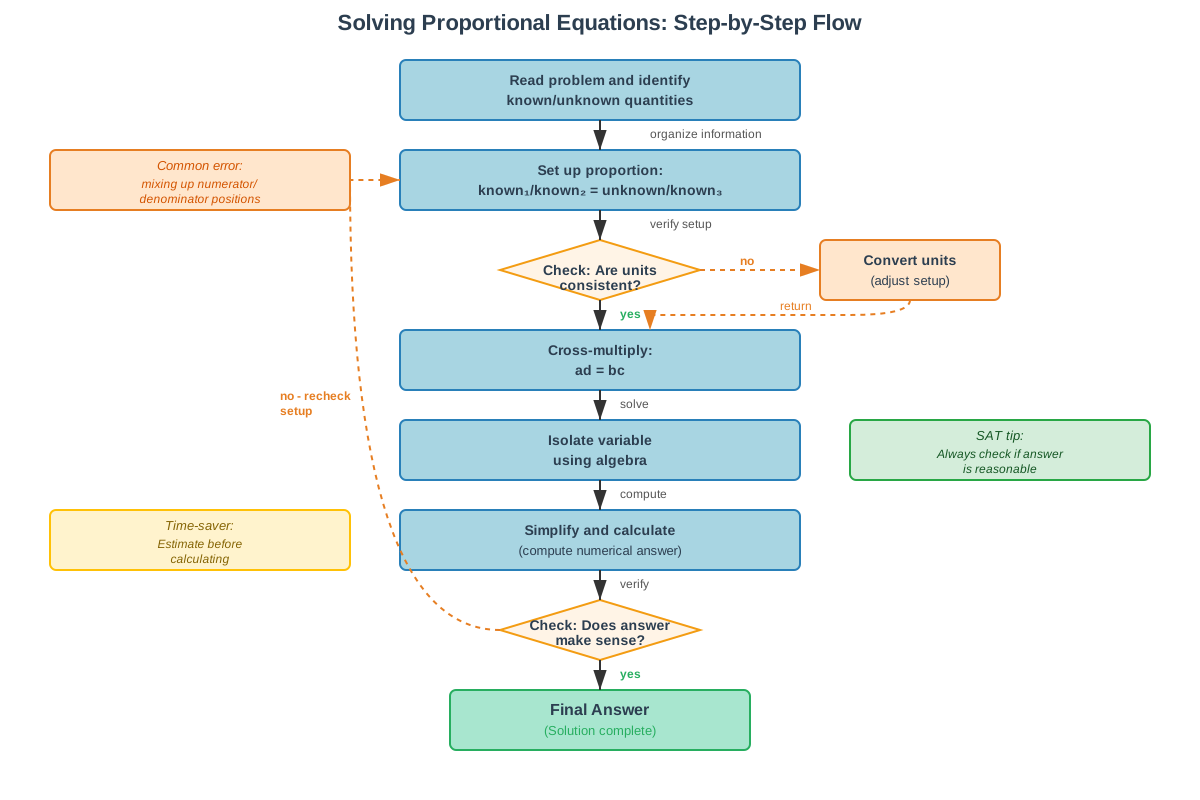
The relationship map: Word Problem → Identify Proportional Relationship → Set Up Proportion → Cross-Multiply → Solve Linear Equation → Verify Answer in Context
High-Yield Facts
⭐ Cross-multiplication is valid only when both sides of an equation are single fractions equal to each other; it cannot be applied to equations with multiple terms on either side.
⭐ In a valid proportion a/b = c/d, the product of the means equals the product of the extremes: bc = ad.
⭐ When setting up proportions from word problems, corresponding quantities must occupy the same positions in both ratios (e.g., if numerator is "items" on the left, it must be "items" on the right).
⭐ Direct proportions maintain a constant ratio: if y₁/x₁ = y₂/x₂, then y is directly proportional to x.
⭐ The constant of proportionality k in y = kx represents the unit rate and can be found by dividing any y-value by its corresponding x-value.
- Proportional equations always have exactly one solution when solving for a single unknown variable.
- If two quantities are proportional, doubling one quantity doubles the other; tripling one triples the other.
- Zero cannot appear in the denominator of any ratio within a proportion.
- Proportions can be inverted: if a/b = c/d, then b/a = d/c (flipping both fractions maintains equality).
- Unit analysis helps verify correct proportion setup: units should cancel appropriately when cross-multiplying.
- Similar geometric figures have proportional corresponding sides, making proportions essential for scale factor problems.
- Percent problems can be expressed as proportions: part/whole = percent/100.
- Speed-distance-time problems often require proportional reasoning: distance₁/time₁ = distance₂/time₂ when speed is constant.
Quick check — test yourself on Proportional equations so far.
Try Flashcards →Common Misconceptions
Misconception: Cross-multiplication can be used on any equation with fractions.
Correction: Cross-multiplication applies only when the equation has the form a/b = c/d (one fraction equals another fraction). For equations like x/3 + 2 = 5, standard algebraic techniques must be used instead.
Misconception: In a proportion, any numbers can go in any position as long as all four values are included.
Correction: Corresponding quantities must maintain consistent positions. If comparing "3 apples cost $6" to "5 apples cost $x," the setup must be 3/6 = 5/x or 3/5 = 6/x, not 3/5 = x/6.
Misconception: Proportional relationships always involve multiplication by the same number.
Correction: While scaling by a constant factor is one type of proportion, the defining feature is that the ratio remains constant, not that a specific multiplier is used. The proportion 2/3 = 4/6 is valid even though we don't multiply 2 by the same number to get both 4 and 6.
Misconception: If a problem involves two quantities, they must be proportional.
Correction: Not all relationships are proportional. For example, if a phone plan costs $20 plus $0.10 per minute, cost is not proportional to minutes because of the fixed $20 fee. Proportional relationships must pass through the origin (when one quantity is zero, the other is zero).
Misconception: The larger number must always be in the numerator when setting up a proportion.
Correction: The position of numbers depends on what quantities they represent and maintaining correspondence, not their magnitude. In 3 items/$15 = 8 items/$x, the 15 is larger than 3, but both are correctly positioned as costs in the denominators.
Misconception: Cross-multiplying always makes the problem easier to solve.
Correction: For simple proportions with friendly numbers, finding the unit rate and scaling may be faster. For example, if 4 items cost $20, finding the $5 unit rate and multiplying by the desired quantity is often quicker than formal cross-multiplication.
Worked Examples
Example 1: Classic Proportion Word Problem
Problem: A recipe for 6 servings requires 2.5 cups of flour. How many cups of flour are needed for 15 servings?
Solution:
Step 1: Identify the proportional relationship. The amount of flour is directly proportional to the number of servings (more servings require more flour at a constant rate).
Step 2: Set up the proportion with corresponding quantities in consistent positions. Let x = cups of flour needed for 15 servings.
6 servings / 2.5 cups = 15 servings / x cupsOR equivalently:
6 servings / 15 servings = 2.5 cups / x cupsStep 3: Cross-multiply using the second setup (which is slightly cleaner):
6x = 15(2.5)
6x = 37.5
Step 4: Solve for x:
x = 37.5 / 6
x = 6.25
Step 5: Verify the answer makes sense. Since 15 servings is 2.5 times the original 6 servings (15 ÷ 6 = 2.5), the flour should also be 2.5 times the original amount: 2.5 × 2.5 = 6.25 ✓
Answer: 6.25 cups of flour are needed.
This example demonstrates the learning objective of applying proportional equations to solve SAT-style questions and shows the importance of maintaining corresponding quantities in the correct positions.
Example 2: Multi-Step Proportion with Unit Conversion
Problem: A car travels 180 miles in 3 hours. At this same rate, how many minutes will it take to travel 45 miles?
Solution:
Step 1: Recognize this as a direct proportion problem (distance is proportional to time at constant speed).
Step 2: Note the unit inconsistency: the given time is in hours, but the answer requires minutes. We can either convert first or incorporate conversion into the proportion.
Step 3: Set up the proportion using hours, then convert:
180 miles / 3 hours = 45 miles / x hoursStep 4: Cross-multiply:
180x = 3(45)
180x = 135
x = 135/180
x = 0.75 hours
Step 5: Convert to minutes:
0.75 hours × 60 minutes/hour = 45 minutesStep 6: Verify using unit rate. Speed = 180 miles ÷ 3 hours = 60 mph. Time = 45 miles ÷ 60 mph = 0.75 hours = 45 minutes ✓
Answer: 45 minutes
This example illustrates how proportional equations integrate with unit conversion, a common SAT complexity. It also shows that verifying answers using an alternative method (unit rate) builds confidence and catches errors.
Exam Strategy
When approaching SAT questions involving proportional equations, follow this systematic process:
Step 1: Identify the relationship. Look for keywords indicating proportional relationships: "at this rate," "at the same speed," "per," "for every," "proportional to," or scenarios involving constant ratios (recipes, similar figures, unit prices).
Step 2: Organize the information. Create a simple table or list showing what corresponds to what. This prevents the most common error—mixing up which quantities correspond.
Step 3: Set up the proportion carefully. Write out the proportion with labels (units) to ensure correspondence. Double-check before cross-multiplying.
Step 4: Solve efficiently. For simple numbers, consider whether finding the unit rate is faster than formal cross-multiplication. For complex numbers or variables, cross-multiply.
Step 5: Check reasonableness. Does the answer make sense in context? If you're finding the cost of more items, the answer should be larger than the given cost. If you're finding time for a shorter distance, the time should be less.
Exam Tip: If a proportion problem seems too complex, try plugging in the answer choices. Since proportions have unique solutions, only one choice will satisfy the relationship.
Trigger phrases to watch for:
- "At this rate" → signals constant ratio/direct proportion
- "How many... would it take" → often requires proportion setup
- "If... then..." → comparing two scenarios, likely proportional
- "Per" or "for each" → indicates unit rate, foundation for proportion
- "Similar figures" or "scale factor" → geometric proportions
Process of elimination tips:
- Eliminate answers that violate the direction of change (if quantity increases, proportional quantity should increase)
- Eliminate answers with wrong units
- Eliminate answers that don't maintain the approximate ratio (if the ratio is about 2:1, the answer should reflect this)
Time allocation: Straightforward proportion problems should take 30-60 seconds. Multi-step problems with unit conversion or embedded in complex word problems may require 90-120 seconds. If you're spending more than 2 minutes, mark it and return later.
Memory Techniques
Cross-Multiplication Mnemonic: "X marks the spot" - visualize drawing an X through the proportion a/b = c/d, connecting a to d and b to c, giving you ad = bc.
Proportion Setup Mnemonic: "CUPS - Corresponding Units in Parallel Spots"
- Corresponding quantities
- Units must match
- Parallel positions (same type in same position)
- Solve after setup is verified
Visualization Strategy: Picture a proportion as a balanced scale. The left ratio and right ratio must balance (be equal). Cross-multiplication shows that the products of opposite corners must also balance.
Acronym for Problem-Solving Steps: "ISCV"
- Identify the proportional relationship
- Set up the proportion with labels
- Cross-multiply and solve
- Verify the answer makes sense
Memory aid for direct vs. inverse proportion:
- Direct: "Both go the same direction" (both increase or both decrease)
- Inverse: "Opposite directions" (one increases, other decreases)
Summary
Proportional equations express equality between two ratios and represent one of the most frequently tested concepts on the SAT math section. The standard form a/b = c/d can be solved efficiently using cross-multiplication (ad = bc), which transforms the proportion into a linear equation. Success on SAT proportion problems requires three key skills: recognizing when a proportional relationship exists in a word problem, setting up the proportion with corresponding quantities in consistent positions, and solving accurately while maintaining unit consistency. Direct proportions maintain constant ratios and are characterized by the relationship y = kx, where k is the constant of proportionality or unit rate. The most common errors involve incorrect proportion setup (mixing corresponding quantities) and misapplying cross-multiplication to equations that aren't true proportions. Students who master proportional reasoning gain advantages across multiple SAT math topics including unit conversion, rate problems, similar figures, and scaling scenarios. Verification through unit rate calculation or reasonableness checks helps ensure accuracy and builds confidence in test-taking situations.
Key Takeaways
- Proportional equations state that two ratios are equal (a/b = c/d) and appear in 10-15% of SAT math questions across diverse contexts
- Cross-multiplication (ad = bc) is the primary solving technique, but finding unit rates first may be faster for simple problems with friendly numbers
- Corresponding quantities must occupy the same positions in both ratios—this is the most critical setup rule and the most common source of errors
- Direct proportions maintain constant ratios (y₁/x₁ = y₂/x₂) and can be expressed as linear functions y = kx passing through the origin
- Organize information systematically using tables or labeled setups to prevent mixing up which quantities correspond
- Verify answers using reasonableness checks and alternative methods like unit rate calculations to catch setup or calculation errors
- Watch for trigger phrases like "at this rate," "per," and "proportional to" that signal when proportional reasoning applies
Related Topics
Linear Functions and Direct Variation: Proportional equations are special cases of linear functions where the y-intercept is zero. Understanding y = kx as both a proportion and a linear function deepens algebraic insight and connects to graphing skills.
Similar Figures in Geometry: Geometric similarity relies entirely on proportional relationships between corresponding sides. Mastering proportional equations enables efficient solution of scale factor, similar triangle, and indirect measurement problems.
Percent Problems: Many percent questions can be solved using the proportion part/whole = percent/100. This connection makes proportional reasoning a versatile tool across multiple SAT math domains.
Rate Problems: Distance-rate-time problems, work-rate problems, and other rate scenarios frequently require proportional setups. Strong proportion skills make these complex word problems more manageable.
Unit Conversion and Dimensional Analysis: Converting between units (inches to feet, hours to minutes) uses proportional relationships with conversion factors. This skill appears throughout SAT math and science reasoning.
Practice CTA
Now that you've mastered the core concepts of proportional equations, it's time to solidify your understanding through active practice. Attempt the practice questions to apply these strategies under test-like conditions, focusing on accurate setup and efficient solving. Use the flashcards to reinforce key facts and formulas until they become automatic. Remember, proportional reasoning is a high-yield skill that appears across multiple question types—your investment in mastering this topic will pay dividends throughout the SAT math section. Approach each practice problem systematically, verify your answers, and learn from any mistakes. You've got this!
Sign up free to keep reading
Create a free AnvayaPrep account to finish this SAT guide on Proportional equations — plus flashcards and practice questions.