Overview
Rate equation problems are among the most frequently tested question types in the SAT Math section, appearing in both the calculator and no-calculator portions of the exam. These problems involve relationships between distance, time, and speed (or other analogous quantities like work completed, cost per item, or flow rates). At their core, rate problems require students to set up and solve linear equations based on the fundamental relationship: Rate × Time = Distance (or Work, or Amount). Mastery of these problems is essential because they test not only algebraic manipulation skills but also logical reasoning and the ability to translate real-world scenarios into mathematical expressions.
The SAT consistently includes 2-4 rate problems per test, making them high-yield content that directly impacts scores. These questions often appear as word problems that require careful reading and interpretation before any mathematical work begins. Students must identify the given information, determine what the question asks for, and construct an appropriate equation or system of equations. Rate problems frequently combine multiple concepts: setting up proportions, working with fractions, manipulating formulas, and solving for variables in various positions within equations.
Understanding rate equation problems strengthens broader mathematical reasoning skills essential throughout the SAT Math section. These problems connect directly to linear equations in one variable, systems of equations, ratios and proportions, and unit conversion—all fundamental topics in the SAT curriculum. The problem-solving framework developed through rate problems transfers to other question types, making this topic a cornerstone of SAT Math preparation.
Learning Objectives
- [ ] Identify key features of rate equation problems, including the rate, time, and distance (or work/amount) components
- [ ] Explain how rate equation problems appear on the SAT, including common scenarios and question formats
- [ ] Apply rate equation problems to answer SAT-style questions with accuracy and efficiency
- [ ] Construct appropriate equations from word problems involving rates, including multi-step scenarios
- [ ] Solve rate problems involving opposite directions, same direction, and meeting/catching scenarios
- [ ] Convert between different units of measurement within rate problems
- [ ] Recognize and solve combined work rate problems involving multiple entities working together
Prerequisites
- Basic algebraic manipulation: Solving linear equations in one variable is fundamental to isolating the unknown quantity in rate problems
- Understanding of ratios and proportions: Rate problems are essentially ratio relationships expressed as equations
- Fraction operations: Many rate problems involve fractional rates or require adding/subtracting fractions when combining rates
- Unit awareness: Recognizing and working with different units (miles per hour, feet per second, etc.) is essential for setting up correct equations
- Word problem translation skills: Converting written scenarios into mathematical expressions forms the foundation of rate problem solving
Why This Topic Matters
Rate equation problems reflect real-world situations that students encounter daily: calculating travel time for trips, determining how long tasks will take, comparing speeds, and optimizing efficiency. These practical applications make rate problems relevant beyond the exam context, developing quantitative reasoning skills applicable to everyday decision-making, career planning, and scientific thinking.
On the SAT, rate problems appear with remarkable consistency. Statistical analysis of released SAT exams shows that approximately 8-12% of Math section questions involve rate relationships, either directly or as part of multi-concept problems. These questions typically appear in both multiple-choice and grid-in formats, with difficulty levels ranging from straightforward single-step calculations to complex multi-part scenarios requiring systems of equations.
Common SAT manifestations include: two travelers moving toward or away from each other, vehicles traveling at different speeds, work completion problems (one person working alone versus multiple people working together), filling/draining tank problems, and cost-per-unit scenarios. The College Board favors realistic contexts like commuting, running races, and completing projects, making these problems accessible while still testing rigorous mathematical thinking. Questions often include distractors that represent common calculation errors, making precision and systematic problem-solving essential.
Core Concepts
The Fundamental Rate Equation
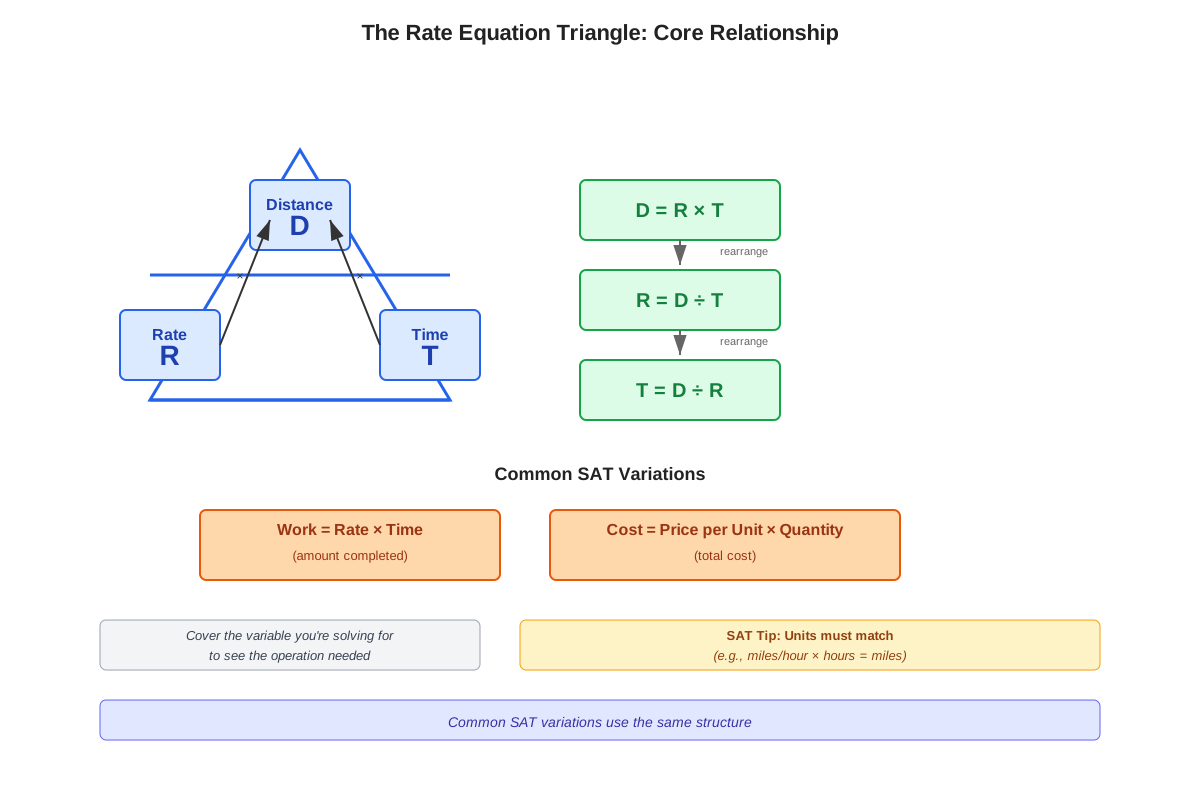
The foundation of all rate equation problems is the relationship between three quantities: rate (speed or pace), time (duration), and distance (or amount of work completed). This relationship is expressed as:
Distance = Rate × TimeThis equation can be rearranged into three equivalent forms:
- Distance = Rate × Time (D = RT)
- Rate = Distance ÷ Time (R = D/T)
- Time = Distance ÷ Rate (T = D/R)
Understanding which form to use depends on what the problem provides and what it asks you to find. The rate represents how much distance is covered (or work completed) per unit of time. Common rate units include miles per hour (mph), kilometers per hour (km/h), feet per second (ft/s), or problems completed per hour.
Types of Rate Problems on the SAT
Single-Entity Rate Problems
The simplest rate problems involve one person, vehicle, or entity moving at a constant rate. These problems provide two of the three variables (rate, time, distance) and ask for the third.
Example structure: "A car travels at 60 miles per hour for 2.5 hours. How far does it travel?"
Solution approach: D = RT = 60 × 2.5 = 150 miles
Two-Entity Problems: Opposite Directions
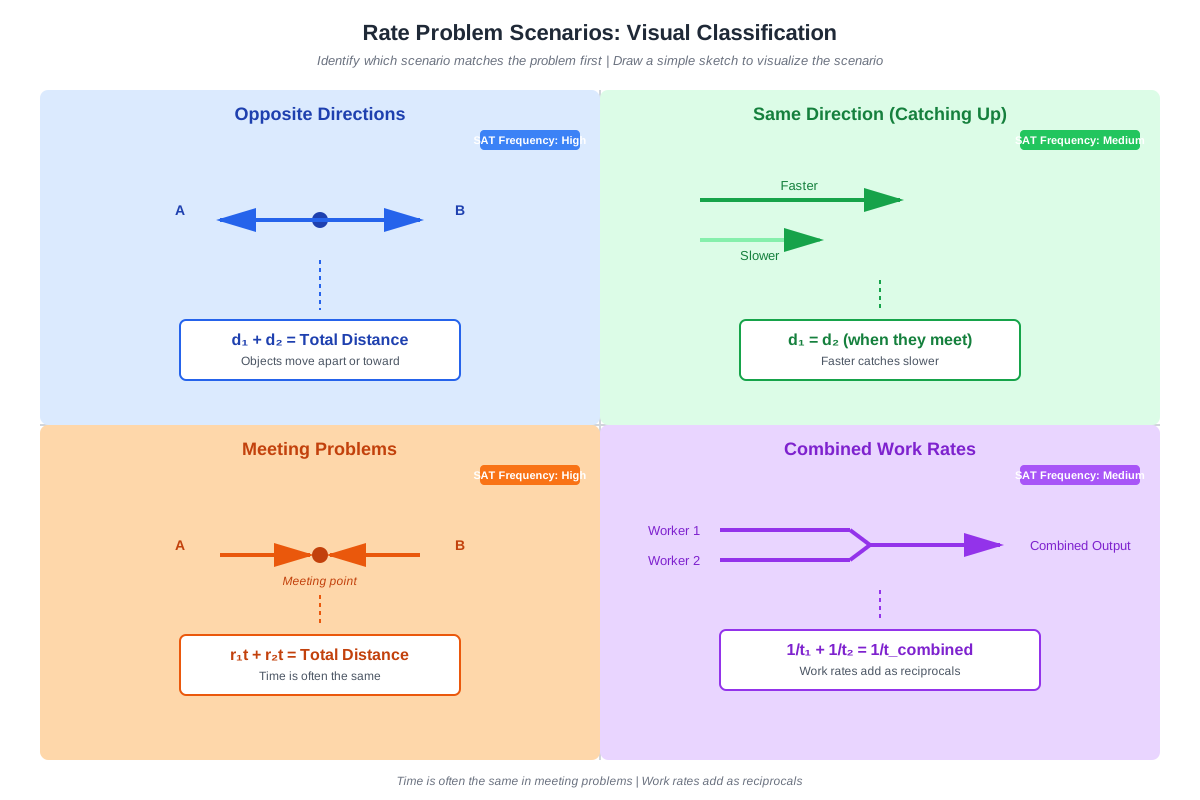
When two objects move in opposite directions from the same starting point, their distances add together. If they start at the same time, the combined distance equals the sum of individual distances.
Setup: If Object A travels at rate r₁ and Object B travels at rate r₂ for time t, and they move in opposite directions:
Total Distance = r₁t + r₂t = (r₁ + r₂)tTwo-Entity Problems: Same Direction
When two objects move in the same direction, one typically starts ahead or travels faster. The key is determining when the faster object catches up or how far apart they are after a given time.
Setup: If Object A (faster) travels at rate r₁ and Object B (slower) travels at rate r₂:
- Distance between them after time t: (r₁ - r₂)t
- Time for A to catch B if B has a head start of distance d: t = d/(r₁ - r₂)
Meeting Problems
Meeting problems involve two entities starting from different locations and traveling toward each other. They meet when the sum of their distances equals the total distance between starting points.
Setup: If the total distance between starting points is D, and they travel at rates r₁ and r₂:
r₁t + r₂t = D
t = D/(r₁ + r₂)
Work Rate Problems
Work rate problems apply the same D = RT framework, but "distance" becomes "work completed." The rate represents work per unit time (like "houses painted per day" or "fraction of job per hour").
Key principle: If a person completes a job in n hours, their rate is 1/n of the job per hour.
Combined work formula: When multiple entities work together, their rates add:
Combined Rate = Rate₁ + Rate₂ + Rate₃ + ...Example: If Person A completes a job in 4 hours (rate = 1/4 per hour) and Person B completes it in 6 hours (rate = 1/6 per hour), working together their combined rate is 1/4 + 1/6 = 5/12 of the job per hour.
Unit Conversion in Rate Problems
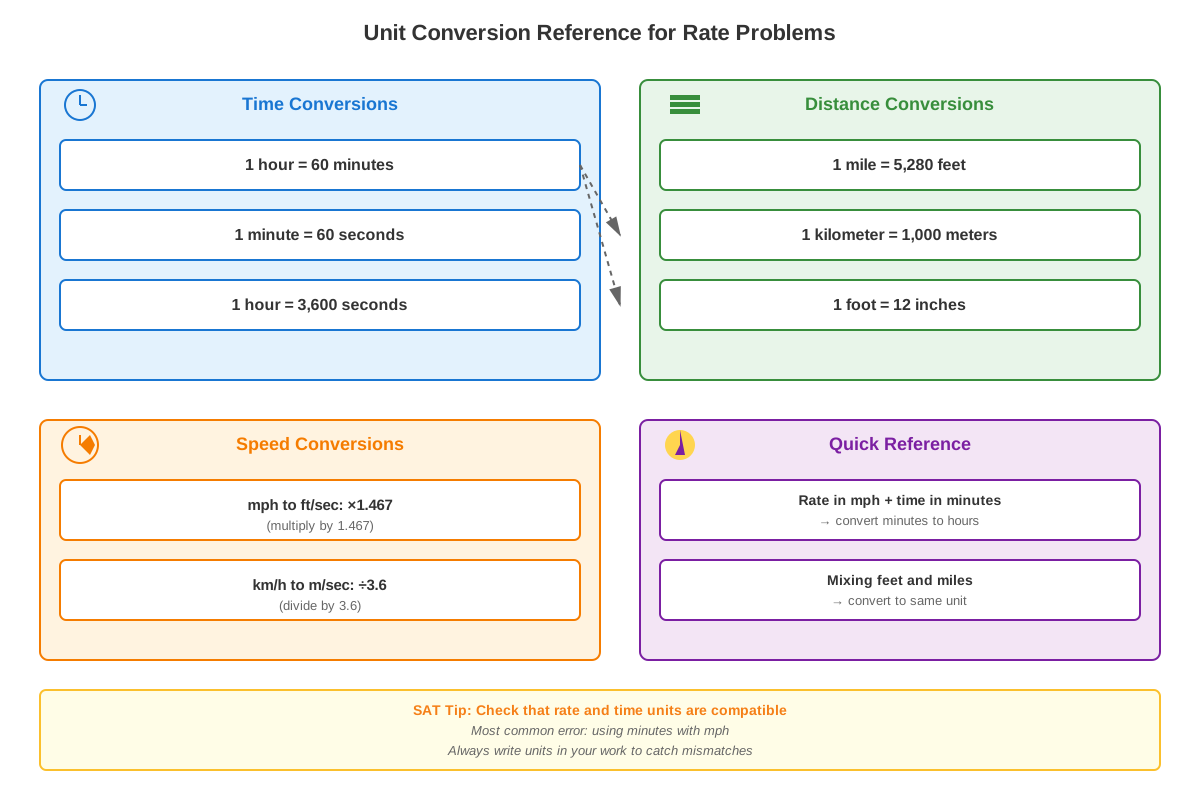
SAT rate problems frequently require converting between units. Common conversions include:
| From | To | Conversion Factor |
|---|---|---|
| Hours | Minutes | Multiply by 60 |
| Minutes | Hours | Divide by 60 |
| Miles | Feet | Multiply by 5,280 |
| Kilometers | Meters | Multiply by 1,000 |
| Hours | Seconds | Multiply by 3,600 |
Critical strategy: Ensure all quantities use consistent units before setting up equations. If rate is in miles per hour and time is in minutes, convert one to match the other.
Average Rate vs. Average Speed
A common SAT trap involves calculating average rate for a round trip. The average rate is NOT the arithmetic mean of two speeds.
Correct formula for average rate:
Average Rate = Total Distance / Total TimeExample: If you drive 60 mph for the first half of a trip and 40 mph for the return, your average speed is NOT 50 mph. You must calculate total distance and total time separately, then divide.
Concept Relationships
Rate equation problems form a hierarchical structure of concepts. At the foundation lies the basic rate formula (D = RT), which serves as the building block for all other rate problem types. This fundamental relationship → extends to → single-entity problems, where students practice isolating variables and performing basic algebraic manipulation.
Single-entity mastery → enables → two-entity problems, which introduce the concept of relative rates and combined distances. Within two-entity problems, the distinction between opposite direction and same direction scenarios represents parallel branches that require different equation setups but rely on the same underlying principles.
The meeting problem concept → synthesizes → both opposite-direction movement and equation-solving skills, requiring students to set the sum of two distances equal to a total distance. This same synthesis skill → transfers to → work rate problems, where the "distance" metaphor shifts to "work completed," but the mathematical structure remains identical.
Unit conversion acts as a supporting skill that intersects with all problem types, requiring dimensional analysis and proportional reasoning. Similarly, average rate calculations connect back to the fundamental formula but require multi-step thinking about total distance and total time.
These concepts collectively connect to broader SAT Math topics: rate problems reinforce linear equations in one variable (the unit focus), extend to systems of linear equations when multiple unknowns exist, and apply ratio and proportion reasoning throughout. The problem-solving framework developed here → transfers to → other word problem contexts like mixture problems, percent problems, and geometric rate-of-change scenarios.
Quick check — test yourself on Rate equation problems so far.
Try Flashcards →High-Yield Facts
⭐ The fundamental rate equation D = RT can be rearranged to solve for any of the three variables: R = D/T or T = D/R
⭐ When two objects move in opposite directions from the same point, add their rates to find the combined rate of separation
⭐ When two objects move in the same direction, subtract the slower rate from the faster rate to find the relative rate
⭐ In work rate problems, if a person completes a job in n hours, their rate is 1/n of the job per hour
⭐ When multiple people work together, add their individual rates to find the combined work rate
- Average rate for a trip equals total distance divided by total time, NOT the arithmetic mean of different speeds
- Meeting time when two objects travel toward each other: t = (total distance)/(sum of rates)
- Time for a faster object to catch a slower object with a head start: t = (head start distance)/(difference in rates)
- Always check that units are consistent before setting up rate equations (e.g., if rate is mph, time must be in hours)
- SAT rate problems often provide information in mixed units specifically to test unit conversion skills
- The distance traveled at a constant rate is directly proportional to time—doubling time doubles distance
- In round-trip problems, if different rates apply to each direction, you must calculate each leg separately before finding averages
Common Misconceptions
Misconception: Average speed for a round trip is the arithmetic mean of the two speeds.
Correction: Average speed equals total distance divided by total time. If you travel 60 mph one way and 40 mph back over the same distance, the average speed is NOT 50 mph. You must calculate: if distance is d each way, time₁ = d/60, time₂ = d/40, so average = 2d/(d/60 + d/40) = 48 mph.
Misconception: When two people work together, the time required is the average of their individual times.
Correction: You must add their rates (not average their times). If Person A takes 4 hours alone (rate = 1/4) and Person B takes 6 hours alone (rate = 1/6), together their rate is 1/4 + 1/6 = 5/12, so time = 1 ÷ (5/12) = 2.4 hours, not (4+6)/2 = 5 hours.
Misconception: In same-direction problems, the faster object always catches the slower one.
Correction: The faster object only catches up if it starts at the same time or after the slower object. If the slower object has too much of a head start, or if there's a time limit, catching up may not occur within the problem's constraints.
Misconception: Rate must always be expressed as distance per time.
Correction: Rate can represent any quantity per unit time: work per hour, cost per item, gallons per minute, pages per day. The D = RT structure applies to all these contexts with appropriate variable substitutions.
Misconception: When objects move in opposite directions, you subtract their rates.
Correction: When moving in opposite directions from the same starting point, you ADD their rates because they're increasing the distance between them. You subtract rates only when they move in the same direction and you're finding relative speed.
Misconception: If a problem gives rate in mph and time in minutes, you can multiply them directly.
Correction: Units must match. Convert minutes to hours (divide by 60) or convert mph to miles per minute (divide by 60) before applying D = RT.
Worked Examples
Example 1: Two-Entity Meeting Problem
Problem: Two cyclists start from towns 90 miles apart and ride toward each other. Cyclist A rides at 15 mph and Cyclist B rides at 12 mph. How long will it take them to meet?
Solution:
Step 1: Identify what we know and what we need
- Total distance between them: 90 miles
- Rate of Cyclist A: 15 mph
- Rate of Cyclist B: 12 mph
- Unknown: time until they meet
Step 2: Set up the equation
When they meet, the sum of distances they've traveled equals 90 miles. Since they travel for the same time t:
- Distance A travels: 15t
- Distance B travels: 12t
- Combined: 15t + 12t = 90
Step 3: Solve for t
27t = 90
t = 90/27 = 10/3 hours = 3⅓ hours = 3 hours 20 minutes
Step 4: Verify
In 10/3 hours, Cyclist A travels: 15 × 10/3 = 50 miles
In 10/3 hours, Cyclist B travels: 12 × 10/3 = 40 miles
Total: 50 + 40 = 90 miles ✓
Connection to learning objectives: This problem demonstrates identifying key features (two rates, one time, total distance), applying the rate equation to an SAT-style scenario, and constructing an equation from a word problem.
Example 2: Combined Work Rate Problem
Problem: Machine A can complete a printing job in 6 hours. Machine B can complete the same job in 4 hours. If both machines work together, how long will it take to complete the job?
Solution:
Step 1: Determine individual rates
- Machine A completes the job in 6 hours → Rate A = 1/6 of the job per hour
- Machine B completes the job in 4 hours → Rate B = 1/4 of the job per hour
Step 2: Find combined rate
When working together, rates add:
Combined Rate = 1/6 + 1/4Finding common denominator (12):
Combined Rate = 2/12 + 3/12 = 5/12 of the job per hourStep 3: Calculate time to complete one full job
If they complete 5/12 of the job per hour, time for the full job:
Time = 1 job ÷ (5/12 job per hour) = 1 × 12/5 = 12/5 = 2.4 hoursConverting to hours and minutes: 2.4 hours = 2 hours 24 minutes
Step 4: Verify reasonableness
Working together should take less time than either machine alone (less than 4 hours) but more than half the faster machine's time (more than 2 hours). 2.4 hours fits this range ✓
Connection to learning objectives: This example shows how rate equation problems appear in work contexts on the SAT, requires applying the rate formula with fractional rates, and demonstrates the multi-step reasoning tested in medium-difficulty questions.
Exam Strategy
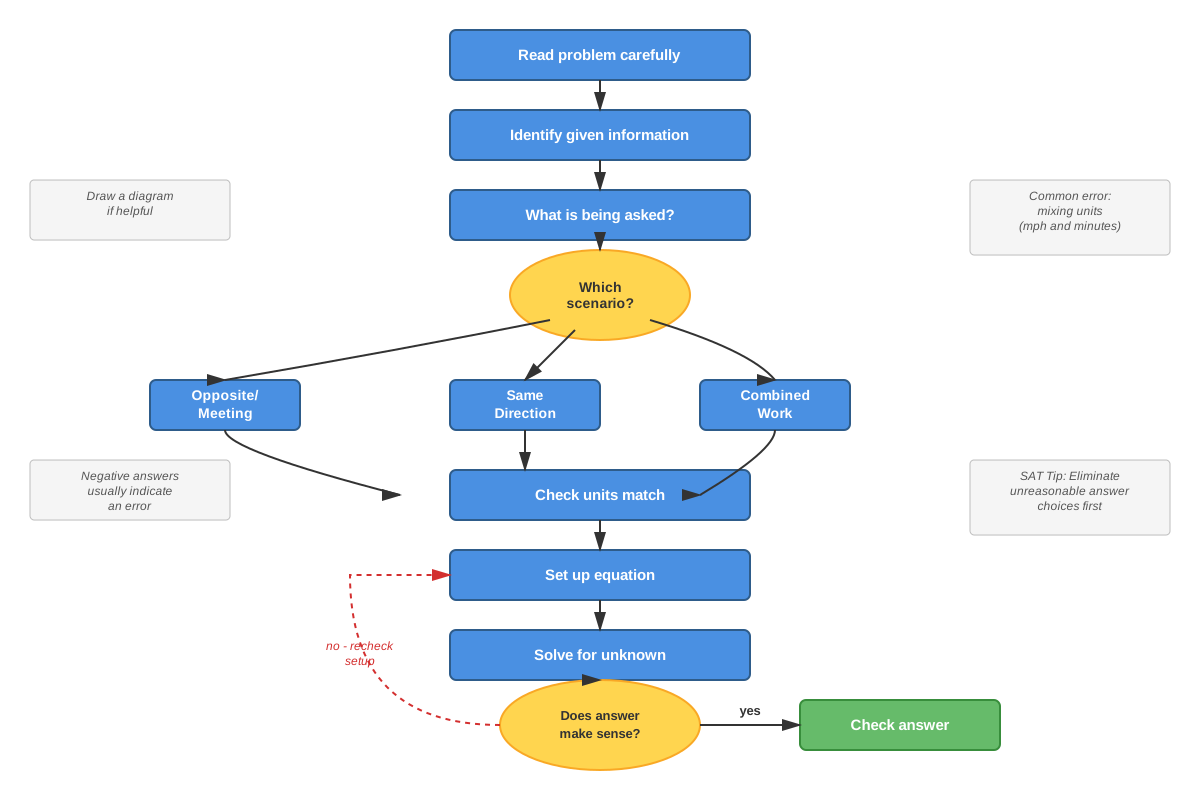
Systematic Approach to SAT Rate Problems
Step 1: Read carefully and identify the scenario type
Determine whether the problem involves: single entity, two entities (same/opposite direction), meeting, catching up, or work rate. This classification immediately suggests which equation setup to use.
Step 2: Create a variable table
Organize given information in a table with columns for Rate, Time, and Distance (or Work). This visual organization prevents confusion and helps identify what's missing.
Step 3: Check units immediately
Before any calculation, verify that all rates, times, and distances use consistent units. If not, convert first. SAT problems frequently mix units intentionally.
Step 4: Set up the equation based on the relationship
- Opposite directions: r₁t + r₂t = total distance
- Same direction: (r₁ - r₂)t = distance difference
- Work together: (1/t₁ + 1/t₂) × t = 1 job
Trigger Words and Phrases
"Toward each other" or "approaching" → Add rates (opposite direction)
"In the same direction" or "catches up" → Subtract rates
"Working together" or "combined" → Add work rates
"How long until they meet" → Meeting problem; sum of distances equals total
"Average speed for the entire trip" → Calculate total distance ÷ total time (not arithmetic mean)
"Head start" or "leaves 30 minutes earlier" → Account for different starting times
Process of Elimination Tips
When answer choices are given:
- Eliminate answers with wrong units if the question asks for hours but an answer is in minutes without conversion
- Check reasonableness: If two people work together, time should be less than either person alone
- Test extreme cases: If rates are very different, the answer should be closer to the faster rate's time
- Verify with dimensional analysis: Ensure your calculation produces the correct unit for what's asked
Time Allocation
For straightforward single-entity problems: 30-45 seconds
For two-entity or meeting problems: 60-90 seconds
For complex work rate or multi-step problems: 90-120 seconds
If a problem takes longer than 2 minutes, mark it and return later. The SAT rewards efficient problem selection.
Memory Techniques
The "DRT Triangle" Visualization
Visualize a triangle with D at the top, R and T at the bottom corners. Cover the variable you're solving for:
- Cover D → multiply R × T
- Cover R → divide D ÷ T
- Cover T → divide D ÷ R
Mnemonic for Direction Problems
"OPPOSITE = ADD, SAME = SUBTRACT"
- Opposite directions → Add rates
- Same direction → Subtract rates
Work Rate Memory Device
"The JOB is ONE"
Remember that in work problems, the complete job = 1. If someone does a job in n hours, their rate is 1/n. This prevents the common error of using n as the rate.
Unit Conversion Anchor
"60-60-24" for time conversions:
- 60 seconds in a minute
- 60 minutes in an hour
- 24 hours in a day
Average Rate Reminder
"Total over Total, NOT Average of Averages"
Average rate = Total Distance / Total Time
This phrase prevents the arithmetic mean error.
Summary
Rate equation problems represent a high-yield SAT Math topic that tests algebraic reasoning, unit awareness, and problem-solving strategy. The fundamental relationship D = RT (Distance = Rate × Time) serves as the foundation for all rate problems, whether involving travel, work completion, or other rate-based scenarios. Success requires recognizing problem types—single entity, opposite directions, same direction, meeting, and combined work—and applying the appropriate equation setup for each. Critical skills include maintaining unit consistency, understanding that rates add when entities work together or move apart, and recognizing that average rate requires total distance divided by total time, not the arithmetic mean of speeds. The SAT tests these concepts through realistic word problems that require careful reading, systematic organization of information, and multi-step algebraic manipulation. Mastery comes from practicing the identification of problem types, setting up equations methodically, and verifying answers for reasonableness.
Key Takeaways
- The fundamental rate equation D = RT can be rearranged to solve for any variable and applies to distance, work, and other rate contexts
- When two entities move in opposite directions, add their rates; when moving in the same direction, subtract rates to find relative speed
- In work rate problems, if a task takes n hours to complete, the rate is 1/n of the task per hour; combined rates add when working together
- Always verify unit consistency before setting up equations—SAT problems intentionally mix units to test conversion skills
- Average rate equals total distance divided by total time, never the arithmetic mean of different speeds
- Systematic problem-solving (identify type → organize information → check units → set up equation → solve → verify) maximizes accuracy and efficiency
- Meeting problems require setting the sum of distances equal to the total distance between starting points
Related Topics
Systems of Linear Equations: Many complex rate problems involve two unknowns (like two different rates) and require setting up systems of equations. Mastering rate problems provides excellent practice for systems.
Ratios and Proportions: Rate problems are fundamentally ratio relationships. Understanding proportional reasoning deepens rate problem skills and vice versa.
Functions and Their Graphs: Distance as a function of time at constant rate produces linear functions. Graphical representations of rate problems connect algebraic and visual reasoning.
Unit Conversion and Dimensional Analysis: Essential for all rate problems, this skill extends to chemistry, physics, and other scientific contexts on the SAT.
Percent Problems: Work rate problems share structural similarities with percent problems (part/whole relationships), making the problem-solving strategies transferable.
Practice CTA
Now that you've mastered the core concepts of rate equation problems, it's time to solidify your understanding through active practice. Attempt the practice questions designed specifically for this topic—they mirror actual SAT question formats and difficulty levels. Use the flashcards to reinforce key formulas, problem types, and common traps. Remember, the difference between understanding rate problems and mastering them lies in repeated, deliberate practice. Each problem you solve strengthens your pattern recognition and builds the confidence needed to tackle any rate question the SAT presents. You've built the foundation—now construct expertise through practice!
Sign up free to keep reading
Create a free AnvayaPrep account to finish this SAT guide on Rate equation problems — plus flashcards and practice questions.