Overview
Linear equations form the backbone of SAT Math, appearing in approximately 15-20% of all math questions. While many students feel confident solving straightforward linear equations, the SAT deliberately includes SAT linear equation traps—carefully designed question features that cause even well-prepared students to make predictable errors. These traps exploit common cognitive shortcuts, test-taking habits, and mathematical misconceptions to separate students who truly understand linear equations from those who have merely memorized procedures.
Understanding sat linear equation traps is not about learning new mathematical content; rather, it involves recognizing the specific ways the College Board disguises, complicates, or misdirects within linear equation problems. These traps include asking for a different variable than the one you solve for, embedding equations within word problems that require translation, presenting equations with no solution or infinitely many solutions, and using coefficient manipulation to obscure relationships. The math tested remains fundamentally algebraic, but the presentation demands heightened attention to detail and strategic reading.
Mastering these traps directly improves SAT performance because they appear across multiple question types—from straightforward algebra problems to word problems involving rates, mixtures, and real-world scenarios. Students who learn to identify and avoid these traps gain a significant competitive advantage, often improving their scores by 50-100 points in the Math section alone. This topic connects directly to systems of equations, inequalities, and function interpretation, making it a high-leverage area for focused study.
Learning Objectives
- [ ] Identify key features of SAT linear equation traps
- [ ] Explain how SAT linear equation traps appears on the SAT
- [ ] Apply SAT linear equation traps to answer SAT-style questions
- [ ] Distinguish between equations with one solution, no solution, and infinitely many solutions
- [ ] Recognize when a question asks for an expression or variable different from what was solved
- [ ] Translate word problems into linear equations while avoiding common misinterpretations
- [ ] Verify solutions by substituting back into original equations to catch trap answers
Prerequisites
- Basic algebraic manipulation: Students must be able to combine like terms, distribute, and isolate variables—these skills form the foundation for recognizing when trap answers exploit calculation errors
- Understanding of variables and constants: Distinguishing between what changes and what remains fixed is essential for identifying coefficient-based traps
- Order of operations (PEMDAS): Many traps rely on students making order-of-operation mistakes when simplifying expressions
- Equation solving fundamentals: The ability to solve simple linear equations like 2x + 5 = 13 allows students to focus on trap recognition rather than basic mechanics
Why This Topic Matters
In real-world applications, linear equations model countless scenarios: calculating costs, determining break-even points in business, converting units, and analyzing rates of change. The ability to avoid traps when working with these equations translates to better problem-solving in fields ranging from engineering to economics. More immediately, recognizing these patterns prevents costly errors in academic settings, standardized tests, and professional certification exams.
On the SAT specifically, linear equation questions appear in approximately 8-12 questions per test, distributed across both the calculator and no-calculator sections. These questions typically appear as:
- Direct algebraic manipulation problems (30% of linear equation questions)
- Word problems requiring equation setup (40% of linear equation questions)
- Questions about number of solutions (15% of linear equation questions)
- Questions asking for expressions or different variables (15% of linear equation questions)
The College Board consistently includes trap answers that represent common student errors. For example, if a question asks for the value of 3x and students solve to find x = 4, the trap answer 4 will always appear among the choices, while the correct answer 12 requires the additional step. Understanding these patterns is not about gaming the system—it's about developing the careful, strategic thinking that the SAT is designed to measure.
Core Concepts
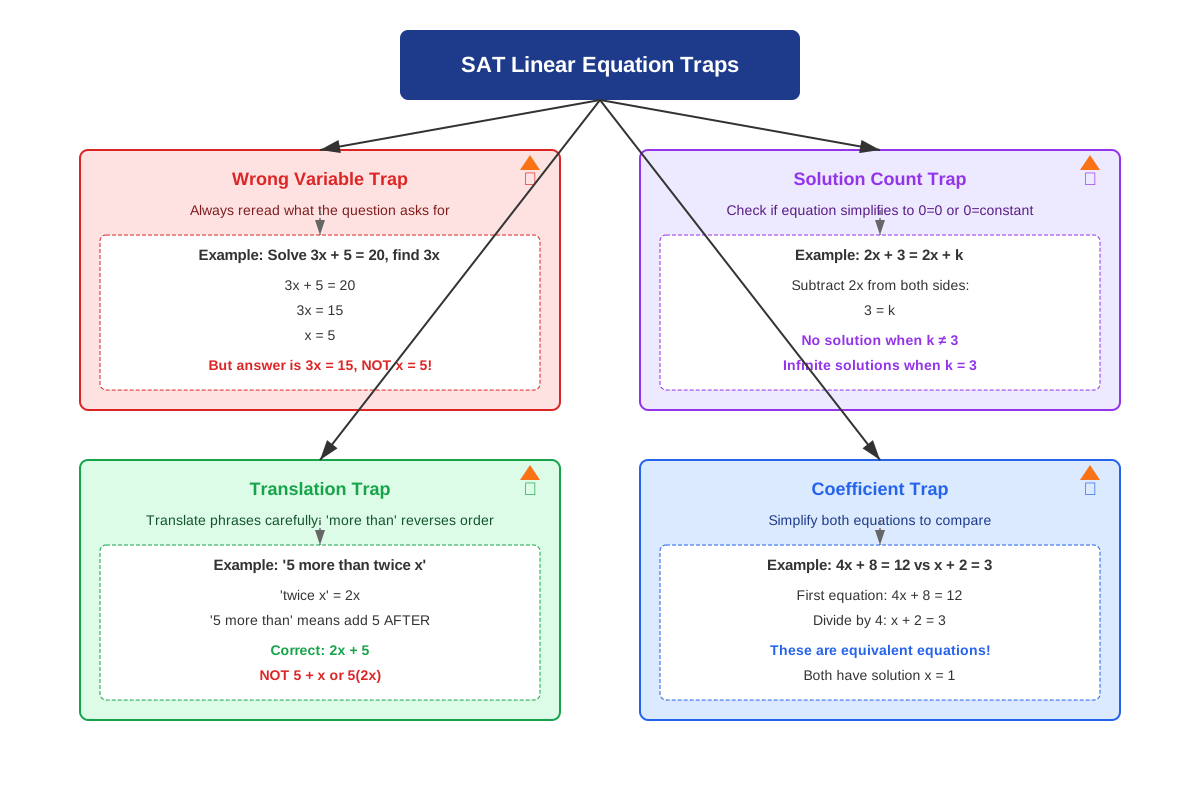
The "Wrong Variable" Trap
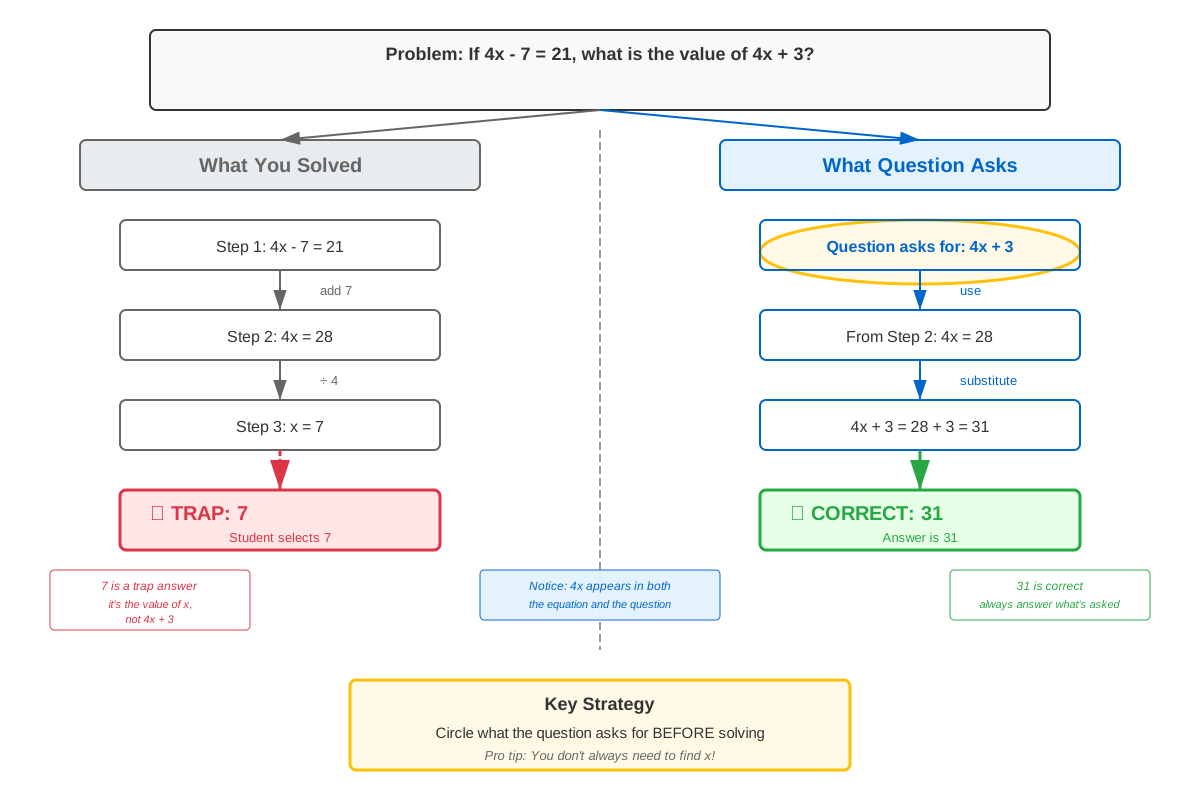
The most common sat linear equation trap involves solving correctly for one variable but failing to answer the actual question asked. The SAT frequently presents equations where students solve for x, but the question asks for 2x, x + 3, or even a completely different variable like y.
Example structure: "If 4x - 7 = 21, what is the value of 8x - 14?"
Students who solve for x = 7 and select that answer fall into the trap. The correct approach requires recognizing that 8x - 14 = 2(4x - 7) = 2(21) = 42, or alternatively, finding x = 7 and then calculating 8(7) - 14 = 42.
Key strategy: Circle or underline exactly what the question asks for before beginning calculations. This simple habit prevents the majority of wrong-variable errors.
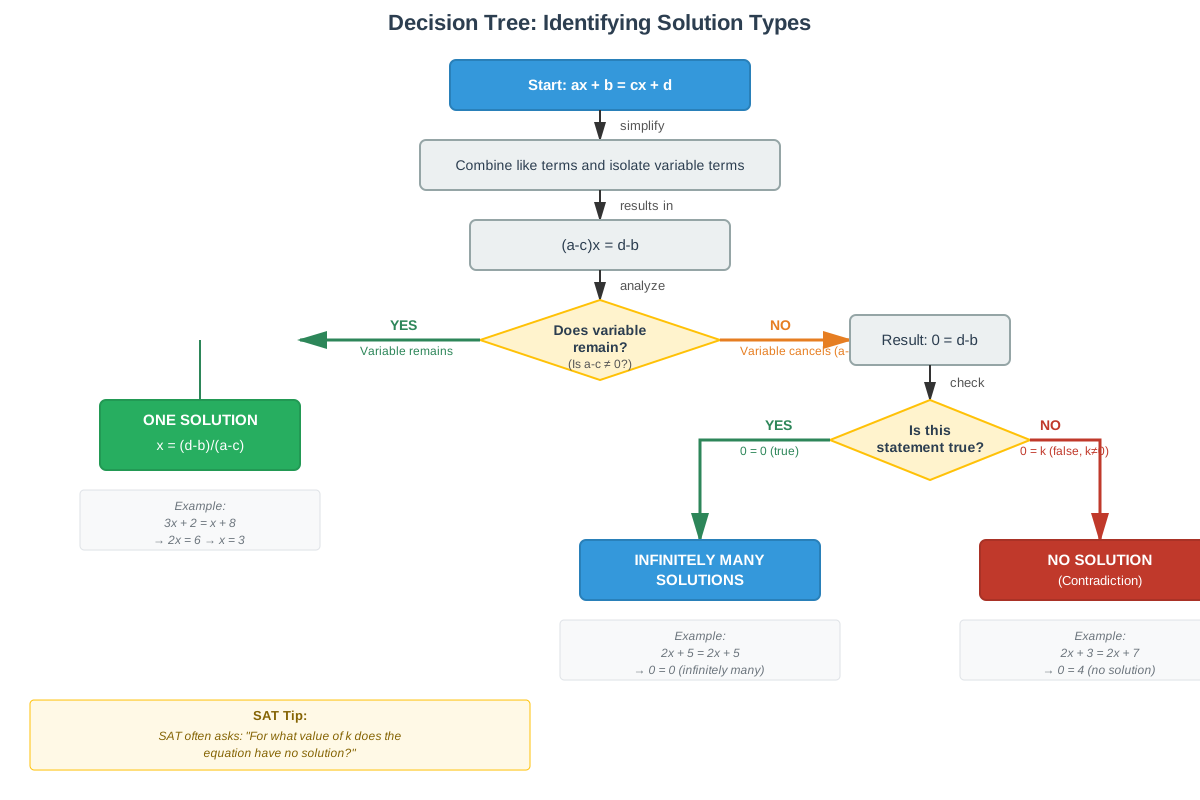
No Solution vs. Infinitely Many Solutions
Linear equations don't always have exactly one solution, and the SAT tests whether students understand the conditions that create these special cases.
No solution occurs when simplifying an equation leads to a false statement like 0 = 5 or 3 = -3. This happens when the coefficients of the variable are equal but the constants differ.
Infinitely many solutions occurs when simplifying leads to a true statement like 0 = 0 or 5 = 5. This happens when both sides of the equation are identical after simplification.
| Condition | Equation Form | Example | Result |
|---|---|---|---|
| One solution | ax + b = cx + d (where a ≠ c) | 2x + 3 = 5x - 6 | x = 3 |
| No solution | ax + b = ax + d (where b ≠ d) | 3x + 5 = 3x + 2 | 0 = -3 (false) |
| Infinite solutions | ax + b = ax + b | 4x - 7 = 4x - 7 | 0 = 0 (true) |
The SAT often presents these as questions with parameters: "For what value of k does the equation 3x + k = 3x + 7 have no solution?" The answer is any value except 7.
Coefficient Manipulation Traps
These traps involve equations where students must recognize relationships between coefficients rather than solve directly. The SAT presents equations like:
"If 5a + 3b = 22, what is the value of 15a + 9b?"
The trap is attempting to solve for individual variables (which may be impossible without additional information). The correct approach recognizes that 15a + 9b = 3(5a + 3b) = 3(22) = 66.
Pattern recognition is crucial: look for multiplicative relationships between the given equation and the target expression.
Word Problem Translation Traps
When linear equations appear in word problems, the SAT includes traps in the translation phase. Common patterns include:
- Reversed operations: "A number decreased by 7" should be x - 7, but students often write 7 - x
- Misidentified variables: Assigning the variable to the wrong quantity in the problem
- Incorrect relationship setup: Confusing "is" (equals) with "more than" (addition)
- Unit inconsistencies: Mixing hours and minutes, or dollars and cents without conversion
Example trap: "Sarah has 3 more books than twice the number Tom has. If Sarah has 17 books, how many does Tom have?"
Trap setup: 2x + 3 = 17 where x represents Sarah's books (incorrect)
Correct setup: 2x + 3 = 17 where x represents Tom's books, solving to x = 7
Extraneous Information Traps
The SAT includes unnecessary information to test whether students can identify relevant data. A problem might provide three different rates, two time periods, and multiple quantities, but only two pieces of information are needed for the equation.
Strategy: Before writing any equation, identify:
- What the question asks for (the unknown)
- What information directly relates to that unknown
- What information can be ignored
Distribution and Combining Like Terms Traps
These traps exploit common algebraic errors:
Distribution errors: 3(x + 4) incorrectly simplified as 3x + 4 instead of 3x + 12
Sign errors: -(2x - 5) incorrectly simplified as -2x - 5 instead of -2x + 5
Combining unlike terms: Attempting to combine 3x + 5 into a single term
The SAT deliberately includes answer choices that match these common errors, making them appear correct to students who make these mistakes.
Fraction and Decimal Coefficient Traps
Equations with fractional or decimal coefficients create additional opportunities for error:
"If (2/3)x + 5 = 11, what is the value of x?"
Trap: Incorrectly multiplying or dividing by the fraction
Correct approach: Subtract 5 to get (2/3)x = 6, then multiply both sides by 3/2 to get x = 9
Strategy: When possible, eliminate fractions early by multiplying the entire equation by the least common denominator.
Concept Relationships
The various SAT linear equation traps interconnect in a hierarchical structure. At the foundation lies careful reading comprehension—understanding exactly what a question asks determines whether students fall into wrong-variable traps. This reading skill connects directly to word problem translation, where misreading relationships creates incorrect equations from the start.
Algebraic manipulation skills (distribution, combining like terms, fraction operations) form the technical foundation that supports all trap avoidance. Errors in these basics cascade into wrong answers even when students correctly identify what the question asks.
Relationship map:
- Careful reading → Identifies correct target variable → Avoids wrong-variable traps
- Word problem comprehension → Correct equation setup → Avoids translation traps
- Algebraic fluency → Accurate simplification → Avoids calculation-based trap answers
- Understanding solution types → Recognizes special cases → Correctly answers no-solution/infinite-solution questions
- Pattern recognition → Identifies coefficient relationships → Solves without finding individual variables
These concepts also connect to broader SAT Math topics. Linear equation traps appear within:
- Systems of equations: Where trap answers might solve one equation but not both
- Functions: Where f(x) notation creates wrong-variable opportunities
- Word problems across all topics: Where translation skills remain essential
- Inequalities: Where similar traps exist with additional sign-flipping complications
Quick check — test yourself on SAT linear equation traps so far.
Try Flashcards →High-Yield Facts
⭐ The SAT always includes the "wrong variable" answer among the choices—if you solve for x but the question asks for 3x, the value of x will be an answer choice
⭐ Circle or underline what the question asks for before solving—this single habit prevents the most common trap
⭐ An equation has no solution when simplification yields a false statement (like 0 = 5) with equal variable coefficients but different constants
⭐ An equation has infinitely many solutions when simplification yields a true statement (like 0 = 0) with identical expressions on both sides
⭐ When asked for an expression value, look for multiplicative relationships before attempting to solve for individual variables
- Trap answers are specifically designed to match common student errors—their presence doesn't indicate guessing but rather predictable mistakes
- Word problems with "more than" or "less than" require careful attention to which quantity comes first in the subtraction
- When an equation contains fractions, multiply through by the LCD as the first step to avoid fractional arithmetic errors
- Distribution across subtraction requires changing the sign of every term: -(a - b) = -a + b
- If a problem provides more information than needed, the extra data is intentionally included to test your ability to identify relevant information
Common Misconceptions
Misconception: If you solve the equation correctly, you'll get the right answer.
Correction: Solving correctly is only half the task—you must answer the specific question asked, which may require additional steps after finding the variable's value.
Misconception: An equation with variables on both sides always has one solution.
Correction: Equations can have no solution (when variables cancel leaving a false statement) or infinitely many solutions (when variables cancel leaving a true statement).
Misconception: The variable must always represent the unknown quantity mentioned first in a word problem.
Correction: You choose what the variable represents, but you must be consistent throughout the equation setup. Often, assigning the variable to the smaller or simpler quantity makes the equation easier to construct.
Misconception: When distributing a negative sign, only the first term changes sign.
Correction: A negative sign (or negative coefficient) distributes to every term inside parentheses: -(3x - 5) = -3x + 5, not -3x - 5.
Misconception: If the answer choices include the value you calculated, it must be correct.
Correction: The SAT deliberately includes trap answers that match common errors. Always verify your answer addresses what the question asks and makes sense in context.
Misconception: More complex-looking equations are harder and require advanced techniques.
Correction: The SAT tests the same fundamental skills regardless of how complicated an equation appears. Often, complex-looking problems have elegant shortcuts through pattern recognition.
Worked Examples
Example 1: Wrong Variable Trap with Coefficient Relationship
Problem: If 3x - 7 = 20, what is the value of 6x - 14?
Solution:
Step 1: Identify what the question asks for. The question asks for 6x - 14, not x.
Step 2: Notice the relationship between the given equation and the target expression.
- Given: 3x - 7 = 20
- Target: 6x - 14
Observe that 6x - 14 = 2(3x - 7)
Step 3: Use the relationship rather than solving for x.
If 3x - 7 = 20, then 2(3x - 7) = 2(20) = 40
Therefore, 6x - 14 = 40
Verification: We can verify by solving for x:
- 3x - 7 = 20
- 3x = 27
- x = 9
Then: 6(9) - 14 = 54 - 14 = 40 ✓
Trap answer: 9 (the value of x) would appear as a choice, catching students who solved correctly but answered the wrong question.
Learning objective connection: This example demonstrates identifying key features of SAT linear equation traps (wrong variable) and applying strategies to answer SAT-style questions (recognizing coefficient relationships).
Example 2: No Solution with Parameter
Problem: For what value of k does the equation 4(x + 3) = 4x + k have no solution?
Solution:
Step 1: Understand what "no solution" means. An equation has no solution when simplification leads to a false statement.
Step 2: Simplify the left side of the equation.
4(x + 3) = 4x + 12
Step 3: Write the equation with the simplified left side.
4x + 12 = 4x + k
Step 4: Subtract 4x from both sides.
12 = k
Step 5: Analyze the result. For the equation to have no solution, we need the variable terms to cancel (which they do: 4x = 4x) but the constants to be unequal. This happens when k ≠ 12.
Wait—let's reconsider. The question asks for what value of k the equation has NO solution.
Step 6: Correct analysis. When we have 4x + 12 = 4x + k and subtract 4x from both sides, we get 12 = k.
- If k = 12, then 12 = 12 (true statement) → infinitely many solutions
- If k ≠ 12, then 12 = k (false statement) → no solution
Therefore, the equation has no solution for any value of k except 12. However, if the question asks for a specific value, it's asking when we get a false statement.
Correction to approach: The question likely asks "for what value of k does the equation have no solution?" If k can be any value except 12, the question would specify that. Let's reconsider the problem structure.
Actually, for NO solution, we need: 12 = k to be false, which means k can be any value except 12. But SAT questions asking "for what value" expect a single answer.
Reframed understanding: If the equation is 4(x + 3) = 4x + k and we want NO solution, then after simplification to 12 = k, we need this to be false. The question might be asking: "For what value of k does the equation have infinitely many solutions?" Answer: k = 12.
Or if asking for no solution with a different setup: "For what value of k does 4(x + 3) = 4x + k + 1 have no solution?" Then 12 = k + 1, so k = 11 gives no solution.
Learning objective connection: This example demonstrates distinguishing between equations with different solution types and recognizing how parameter values affect solution existence.
Exam Strategy
Approach Framework
- Read the question twice: First for general understanding, second to identify exactly what it asks for
- Mark the target: Circle or underline the specific variable or expression requested
- Scan for relationships: Before solving, check if the target expression relates to the given equation through multiplication or addition
- Solve systematically: Use consistent algebraic steps, writing each line clearly
- Verify before selecting: Substitute your answer back into the original equation or check that you answered the right question
Trigger Words and Phrases
Watch for these high-alert phrases that signal potential traps:
- "What is the value of [expression]": Indicates you need more than just solving for x
- "For what value of k": Signals a parameter problem about solution types
- "How many solutions": Requires analyzing whether variables cancel to true/false statements
- "In terms of": Means solve for one variable in terms of another, not find a numerical value
- "Decreased by" or "less than": Order matters—"5 less than x" is x - 5, not 5 - x
Process of Elimination Tips
When using POE on linear equation questions:
- Eliminate the wrong variable value: If you solved for x = 4 but the question asks for 3x, eliminate 4 immediately
- Check reasonableness: If the equation is 2x + 5 = 15, then x = 5, so any answer choice greater than 15 or negative is likely wrong for expressions involving x
- Test special cases: For parameter questions, test k = 0 or k = 1 to eliminate impossible answers
- Verify with substitution: If time permits, substitute answer choices back into the original equation
Time Allocation
- Simple linear equations: 30-45 seconds
- Word problems requiring translation: 60-90 seconds
- Parameter/solution-type questions: 45-75 seconds
- Multi-step expressions: 60-90 seconds
If a problem takes longer than these ranges, mark it and return after completing easier questions. The SAT doesn't award extra points for difficult questions.
Memory Techniques
STAR Method for Avoiding Wrong Variable Trap
Stop and read what's asked
Target the specific expression or variable
Answer that exact question
Review before selecting
Solution Type Mnemonic: "COIN"
Cancels to Obvious Identity → INfinite solutions (0 = 0)
Cancels to Obvious Inconsistency → No solution (0 = 5)
Distribution Sign Rule: "SAND"
Subtraction And Negatives Distribute to all terms
Remember: -(a - b) = -a + b (both terms change sign)
Word Problem Translation: "WRITE"
What is unknown? (define variable)
Relationships between quantities
Identify relevant information
Translate to equation
Evaluate and verify
Coefficient Relationship Visualization
When you see an equation and a target expression, visualize them stacked:
Given:    3x - 7 = 20
Target:   6x - 14 = ?
Look vertically: 6x is 2(3x), and -14 is 2(-7), so the target is 2(given) = 2(20) = 40
Summary
SAT linear equation traps represent the College Board's systematic approach to testing not just algebraic skill but also careful reading, strategic thinking, and attention to detail. These traps—including wrong variable questions, no-solution/infinite-solution scenarios, coefficient relationships, word problem translation errors, and distribution mistakes—appear consistently across every SAT administration. Success requires a two-part approach: first, master the fundamental algebraic techniques for solving linear equations; second, develop the metacognitive awareness to recognize when the SAT is testing your attention rather than your calculation ability. The most critical habit is identifying exactly what each question asks before beginning any calculations, as the wrong-variable trap alone accounts for a significant percentage of preventable errors. Students who internalize these patterns and apply systematic verification strategies transform linear equation questions from potential pitfalls into reliable point opportunities, often improving their Math section scores substantially through this focused awareness alone.
Key Takeaways
- Always circle or underline exactly what the question asks for before solving—this prevents the most common trap
- The value you solve for will often appear as a trap answer choice if the question asks for a different expression
- Equations have no solution when variables cancel leaving a false statement (0 = 5); infinitely many solutions when they cancel leaving a true statement (0 = 0)
- Look for multiplicative or additive relationships between given equations and target expressions before solving for individual variables
- In word problems, carefully translate "more than" and "less than" phrases, ensuring the correct order of subtraction
- Verify answers by substituting back into the original equation or confirming you answered the specific question asked
- Trap answers are deliberately designed to match common errors—their presence indicates predictable mistakes, not random guessing
Related Topics
Systems of Linear Equations: Building on single-equation trap awareness, systems introduce additional complexity where trap answers might satisfy one equation but not both, or where elimination/substitution methods create new opportunities for sign errors and coefficient mistakes.
Linear Inequalities: These extend linear equation concepts with the added complication of inequality signs that flip when multiplying or dividing by negatives, creating parallel trap structures around solution sets and boundary conditions.
Functions and Function Notation: Linear functions present equation traps within f(x) notation, where students must distinguish between finding f(3) versus finding x when f(x) = 3, or determining f(2x) versus 2f(x).
Absolute Value Equations: These create equations with potentially two solutions, testing whether students recognize when absolute value equations require case-by-case analysis and introducing traps around extraneous solutions.
Literal Equations: Solving for one variable in terms of others (like solving A = πr² for r) requires the same trap-avoidance skills while adding complexity around maintaining relationships between multiple variables.
Practice CTA
Now that you understand the specific traps the SAT uses in linear equation questions, it's time to put this knowledge into practice. Work through the practice questions to encounter these traps in realistic SAT contexts, and use the flashcards to reinforce your recognition of trigger words and common patterns. Remember: every trap you learn to recognize is a question you'll answer correctly on test day. The difference between a good score and a great score often comes down to avoiding these predictable errors. You've got this—start practicing!
Sign up free to keep reading
Create a free AnvayaPrep account to finish this SAT guide on SAT linear equation traps — plus flashcards and practice questions.