Overview
Sign errors in equations represent one of the most common yet preventable mistakes students make when solving linear equations on the SAT math section. These errors occur when students incorrectly handle positive and negative signs during algebraic manipulation—whether distributing a negative sign, moving terms across the equals sign, or simplifying expressions with multiple operations. The SAT deliberately designs questions to exploit these vulnerabilities, making sign error recognition and prevention a critical skill for achieving a competitive score.
Understanding and avoiding sign errors is essential because they cascade through multi-step problems, turning correct reasoning into wrong answers. On the SAT, approximately 15-20% of algebra questions specifically test whether students can maintain sign accuracy through complex manipulations. These questions appear in both multiple-choice and student-produced response formats, often embedded within word problems, systems of equations, or function notation contexts where the algebraic manipulation itself becomes the primary challenge.
This topic connects fundamentally to all algebraic reasoning on the SAT. Mastery of sign handling underpins success with linear equations, inequalities, systems of equations, quadratic expressions, and even rational expressions. Students who develop systematic approaches to tracking signs gain accuracy advantages across the entire math section, as virtually every equation-solving scenario requires careful attention to positive and negative values. The relationship between sign errors and broader mathematical competency makes this a high-leverage topic worthy of focused study and deliberate practice.
Learning Objectives
- [ ] Identify key features of sign errors in equations
- [ ] Explain how sign errors in equations appears on the SAT
- [ ] Apply sign errors in equations to answer SAT-style questions
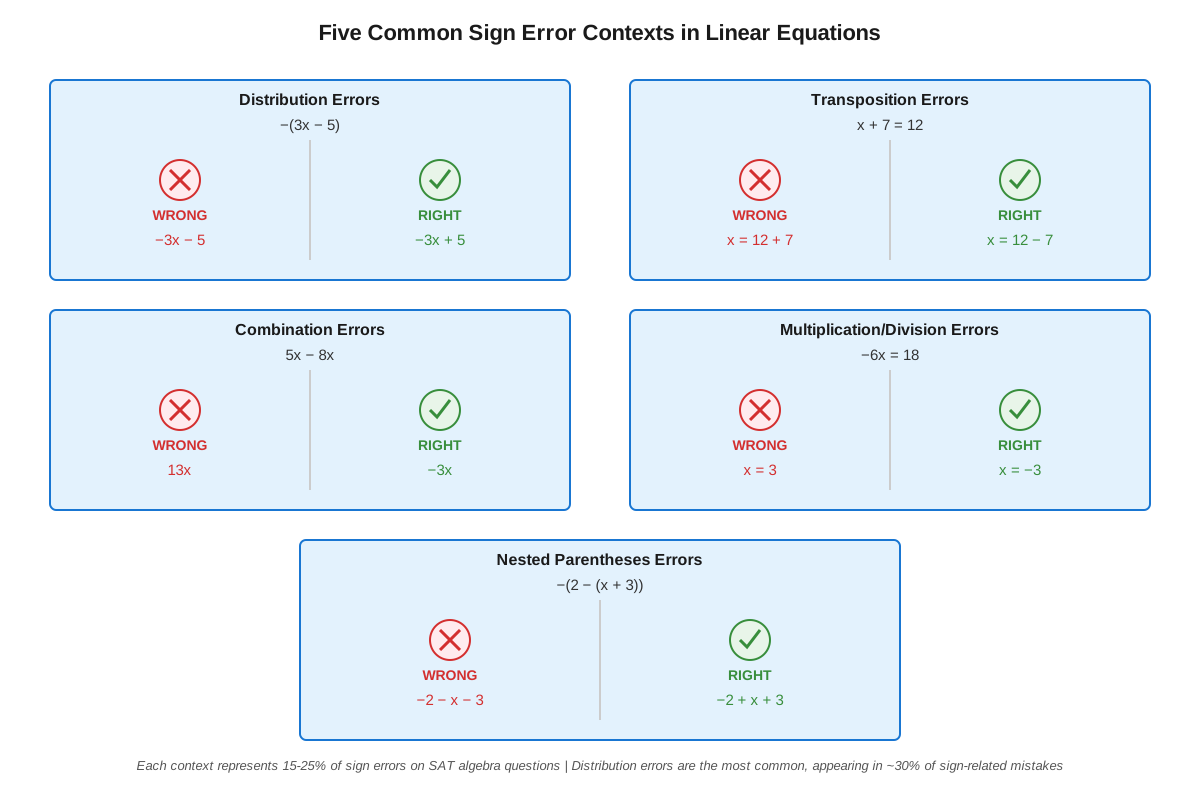
- [ ] Recognize the five most common contexts where sign errors occur in linear equations
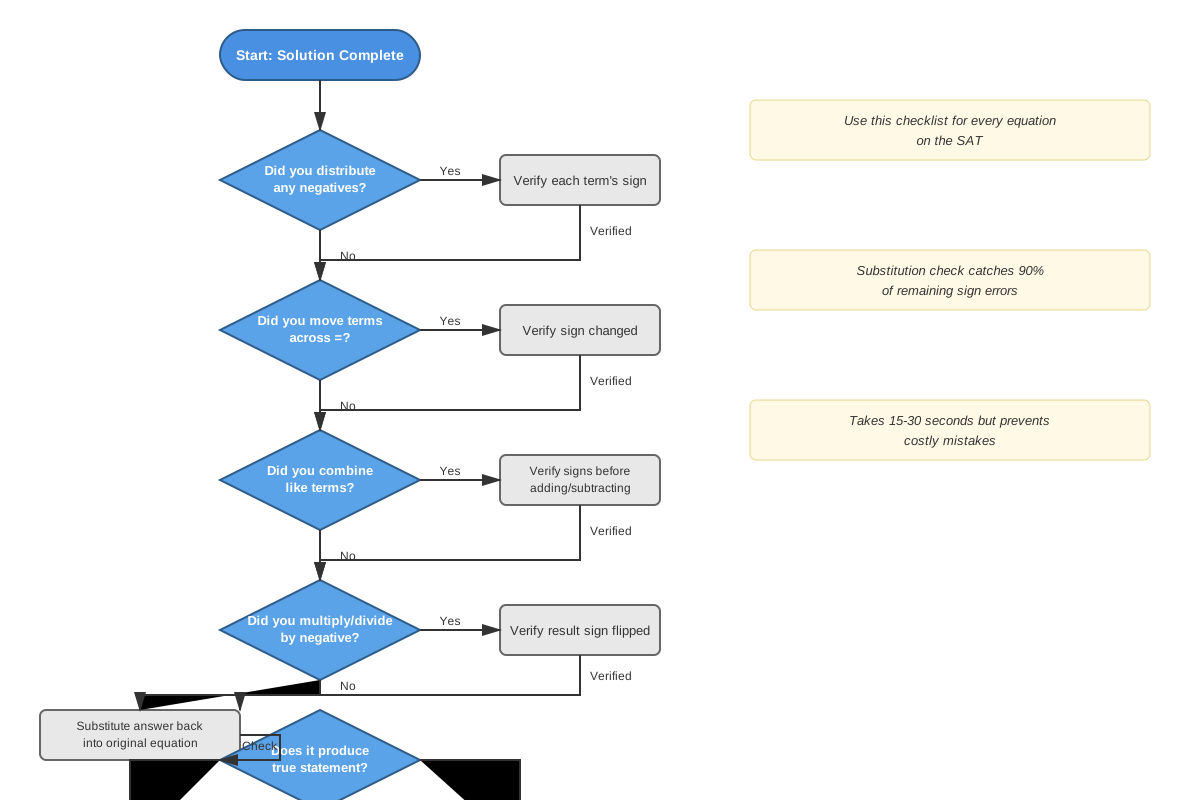
- [ ] Demonstrate systematic checking procedures to catch sign errors before submitting answers
- [ ] Distinguish between conceptual sign errors and computational mistakes to target remediation effectively
Prerequisites
- Basic integer operations: Understanding how to add, subtract, multiply, and divide positive and negative numbers is fundamental, as sign errors stem from misapplying these operations in algebraic contexts.
- Order of operations (PEMDAS): Knowing the correct sequence for evaluating expressions prevents sign errors that arise from performing operations in the wrong order.
- Properties of equality: Understanding that operations performed on one side of an equation must be performed on the other side helps prevent sign errors when isolating variables.
- Distributive property: Familiarity with distributing multiplication over addition/subtraction is essential, as distributing negative signs represents a primary source of sign errors.
- Combining like terms: Ability to simplify expressions by adding or subtracting similar terms correctly, maintaining proper signs throughout the process.
Why This Topic Matters
Sign errors in equations affect real-world problem-solving across numerous fields. Engineers calculating structural loads must maintain sign accuracy to distinguish between compressive and tensile forces. Financial analysts tracking debits and credits rely on correct sign handling to produce accurate balance sheets. Physicists describing motion use positive and negative values to indicate direction, where sign errors could lead to catastrophic misinterpretations of velocity or acceleration data.
On the SAT, sign errors appear with remarkable frequency and strategic importance. College Board data suggests that sign-related mistakes account for approximately 25-30% of all errors students make on algebra questions. The exam includes 13-15 questions per test that directly assess equation-solving skills, and virtually all of these create opportunities for sign errors. Questions appear in multiple formats: straightforward "solve for x" problems, word problems requiring equation setup and solution, questions asking students to identify equivalent expressions, and problems testing whether students can verify solutions by substitution.
The SAT strategically places sign error traps in several predictable ways. Answer choices often include the result a student would obtain by making a specific sign error, making these "distractor" answers appear plausible. Questions frequently involve subtracting negative numbers, distributing negative coefficients, or moving negative terms across the equals sign—all high-risk operations. The test also embeds sign challenges within time-pressure scenarios, knowing that rushed students are more likely to make careless errors. Understanding these patterns allows students to anticipate where sign errors lurk and implement preventive strategies.
Core Concepts
Understanding Sign Errors
A sign error occurs when a student incorrectly changes or maintains the sign (positive or negative) of a number or variable during algebraic manipulation. These errors differ from computational mistakes (like calculating 7 + 5 = 11) because they specifically involve the positive or negative quality of values rather than the magnitude. Sign errors are particularly insidious because the algebraic process may appear correct at first glance, and the resulting answer often seems reasonable, especially when it appears among the multiple-choice options.
The Five Critical Sign Error Contexts
1. Distributing Negative Signs
When multiplying a negative number or negative sign through parentheses, students must change the sign of every term inside. The most common error involves distributing the negative to only the first term or forgetting to change signs on subsequent terms.
Correct: −(3x − 5) = −3x + 5
Common Error: −(3x − 5) = −3x − 5
This error stems from treating the negative sign as affecting only the first term rather than as a multiplication factor affecting the entire expression. The distributive property requires multiplying −1 by each term: (−1)(3x) + (−1)(−5) = −3x + 5.
2. Moving Terms Across the Equals Sign
When isolating a variable, students move terms from one side of an equation to the other by performing the inverse operation on both sides. A sign error occurs when students move a term without changing its sign appropriately.
Correct Process:
5x + 7 = 22
5x + 7 − 7 = 22 − 7
5x = 15
Common Error: Moving +7 to the right side as +7 instead of subtracting 7 from both sides, or incorrectly thinking "the sign changes when crossing the equals sign" without understanding the underlying operation.
The conceptually correct approach recognizes that we're adding −7 to both sides (the inverse of +7), which effectively moves the term while maintaining equation balance.
3. Subtracting Negative Numbers
Subtracting a negative number is equivalent to adding its positive counterpart, but students frequently subtract instead of add, or add when they should subtract.
Correct: x − (−8) = x + 8
Common Error: x − (−8) = x − 8
This error reflects incomplete understanding of the rule "subtracting a negative equals adding a positive." The conceptual foundation involves recognizing that subtraction means "adding the opposite," so subtracting −8 means adding the opposite of −8, which is +8.
4. Multiplying or Dividing by Negative Numbers
When both sides of an equation are multiplied or divided by a negative number, the signs of all terms must change appropriately. In inequalities, this operation also requires flipping the inequality sign, but in equations, students must ensure consistent sign handling.
Correct:
−3x = 12
−3x ÷ (−3) = 12 ÷ (−3)
x = −4
Common Error: Obtaining x = 4 by forgetting that dividing a positive number by a negative number yields a negative result.
5. Combining Like Terms with Different Signs
When simplifying expressions containing like terms with different signs, students must carefully track which terms are positive and which are negative before combining.
Correct: 5x − 3x + 2x = (5 − 3 + 2)x = 4x
Common Error: 5x − 3x + 2x = (5 + 3 + 2)x = 10x (treating all terms as positive)
This error often occurs when students focus on the coefficients without maintaining awareness of the signs attached to each term.
Systematic Sign Tracking Methods
| Method | Description | Best Used When |
|---|---|---|
| Rewrite subtraction as addition | Convert all subtraction to adding negatives: a − b becomes a + (−b) | Working with complex expressions with multiple operations |
| Circle all signs | Physically mark every positive and negative sign before manipulating | Prone to rushing or working with many terms |
| Verbalize operations | State aloud "I'm adding negative 5 to both sides" | Learning the skill or checking difficult problems |
| Use parentheses liberally | Write (−3x) instead of −3x to keep signs attached to terms | Distributing or moving multiple terms |
| Check by substitution | Plug the solution back into the original equation | Final verification step |
The Sign Error Prevention Protocol
- Identify all operations involving signs before beginning manipulation
- Plan the solution path by determining which operations will be performed in which order
- Execute one operation at a time, writing out each step completely
- Verify each step by checking that the equation remains balanced
- Substitute the final answer back into the original equation to confirm correctness
This protocol transforms sign handling from an intuitive process (where errors creep in) to a systematic procedure that catches mistakes before they propagate through the problem.
Concept Relationships
The concepts within sign error prevention form an interconnected system. Understanding sign errors provides the foundation for recognizing when and why they occur. This awareness leads directly to identifying the five critical contexts, which represent the specific situations where vigilance is required. Each context demands application of systematic sign tracking methods, which are the tactical tools for maintaining accuracy. Finally, the sign error prevention protocol integrates all previous concepts into a comprehensive approach that students can apply to any equation-solving scenario.
These concepts connect to prerequisite knowledge in essential ways. Basic integer operations provide the computational foundation for understanding why signs behave as they do during algebraic manipulation. The distributive property directly underlies the first critical context (distributing negative signs), while properties of equality explain why moving terms across the equals sign requires inverse operations. Order of operations determines the sequence in which sign-sensitive operations should be performed.
Looking forward, mastery of sign errors enables progression to more advanced topics. Systems of equations require sign accuracy when using elimination or substitution methods. Quadratic equations demand careful sign handling when factoring, completing the square, or applying the quadratic formula. Rational expressions multiply the opportunities for sign errors through complex numerators and denominators. The relationship map flows: Basic Integer Operations → Sign Error Awareness → Critical Context Recognition → Systematic Tracking Methods → Prevention Protocol → Advanced Algebraic Topics.
High-Yield Facts
⭐ The most common sign error on the SAT involves distributing a negative sign through parentheses and forgetting to change the sign of the second (or subsequent) terms.
⭐ When moving a term across the equals sign, students must perform the inverse operation on both sides; the sign doesn't "automatically change" just by crossing the equals sign.
⭐ Subtracting a negative number is equivalent to adding the positive version of that number: a − (−b) = a + b.
⭐ When dividing or multiplying both sides of an equation by a negative number, the sign of the result must reflect the rules of integer operations (negative × positive = negative, negative × negative = positive).
⭐ The SAT deliberately includes answer choices that represent common sign errors, making these wrong answers appear plausible and tempting.
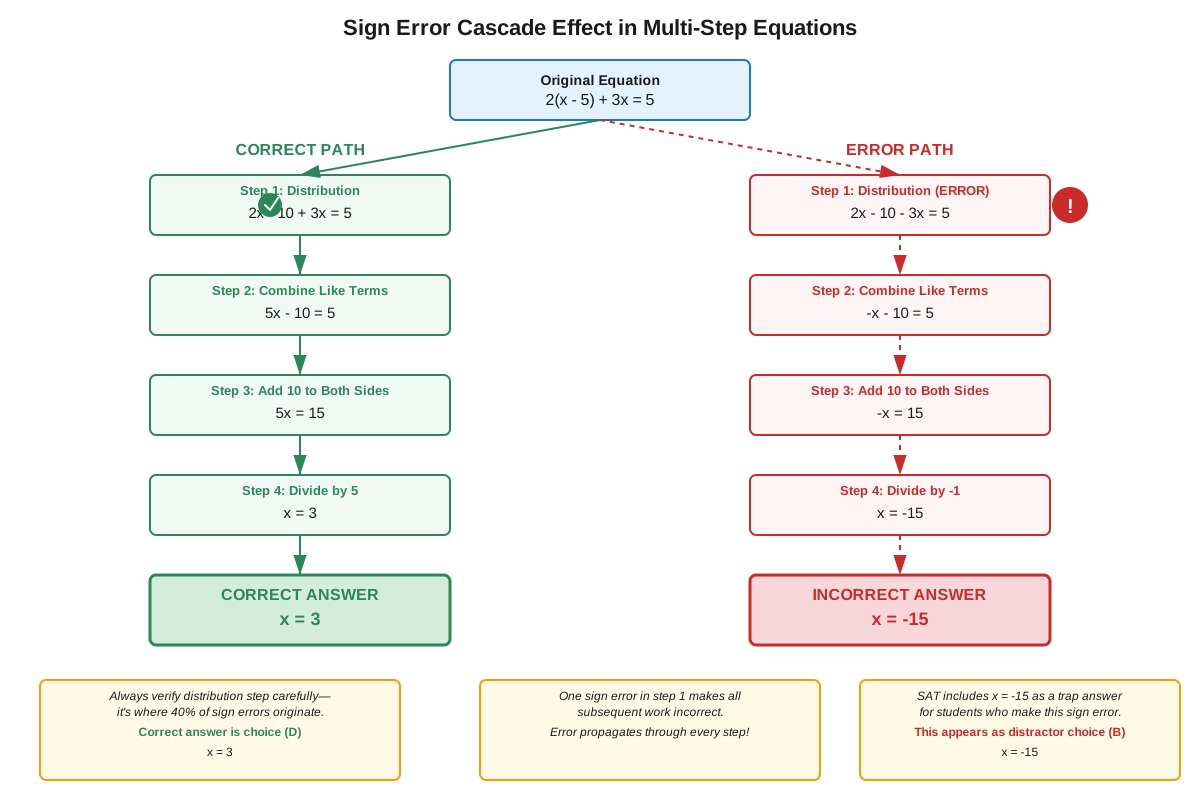
- Sign errors cascade through multi-step problems, so an error in step 2 of a 5-step problem will produce a wrong final answer even if all subsequent steps are executed correctly.
- Rewriting subtraction as "adding the opposite" reduces sign errors by making all operations explicit: 5x − 3 becomes 5x + (−3).
- When checking work, substituting the solution back into the original equation catches sign errors that might otherwise go unnoticed.
- Negative coefficients in front of parentheses require distributing −1 to every term inside: −(a + b − c) = −a − b + c.
- The expression −x does not necessarily represent a negative number; if x = −5, then −x = −(−5) = 5, which is positive.
- On the SAT, approximately 60% of sign error questions involve distributing negatives or moving terms across the equals sign.
- Writing each step of equation-solving on a separate line (rather than doing multiple operations in one line) significantly reduces sign errors.
Quick check — test yourself on Sign errors in equations so far.
Try Flashcards →Common Misconceptions
Misconception: When moving a term across the equals sign, the sign automatically changes.
Correction: The sign appears to change because we're performing the inverse operation on both sides. For example, to move +7 from the left side, we subtract 7 from both sides, which makes the +7 become 0 on the left and creates −7 on the right. Understanding the underlying operation prevents errors.
Misconception: Distributing a negative sign only affects the first term in parentheses.
Correction: A negative sign in front of parentheses means multiplying every term inside by −1. The distributive property requires applying the multiplication to each term: −(3x − 5 + 2y) = (−1)(3x) + (−1)(−5) + (−1)(2y) = −3x + 5 − 2y.
Misconception: Two negatives always make a positive.
Correction: This rule applies specifically to multiplication and division: (−3)(−4) = 12. However, when adding two negative numbers, the result is more negative: −3 + (−4) = −7. The context of the operation determines the outcome.
Misconception: The expression −x always represents a negative number.
Correction: The expression −x represents the opposite of x. If x is negative, then −x is positive. For example, if x = −8, then −x = −(−8) = 8. The sign of −x depends on the value of x.
Misconception: Sign errors are just careless mistakes that don't require systematic prevention.
Correction: While some sign errors result from rushing, many stem from incomplete conceptual understanding of how operations affect signs. Systematic approaches like rewriting subtraction as addition, using parentheses to keep signs attached to terms, and verifying each step prevent both conceptual and careless errors.
Misconception: If the final answer is positive, all the algebra must be correct.
Correction: Sign errors can produce positive answers that are nonetheless wrong. The only reliable verification method is substituting the answer back into the original equation to confirm it satisfies the equation. A positive answer that seems reasonable may still be incorrect.
Worked Examples
Example 1: Multi-Step Equation with Distribution
Problem: Solve for x: −2(3x − 5) + 4x = 18
Solution:
Step 1: Distribute −2 through the parentheses.
Remember that −2 must multiply both terms inside: (−2)(3x) + (−2)(−5)
−2(3x − 5) = −6x + 10
The equation becomes: −6x + 10 + 4x = 18
Step 2: Combine like terms on the left side.
−6x + 4x = (−6 + 4)x = −2x
The equation becomes: −2x + 10 = 18
Step 3: Isolate the variable term by subtracting 10 from both sides.
−2x + 10 − 10 = 18 − 10
−2x = 8
Step 4: Divide both sides by −2.
−2x ÷ (−2) = 8 ÷ (−2)
x = −4
Step 5: Verify by substitution into the original equation.
−2(3(−4) − 5) + 4(−4) = −2(−12 − 5) + (−16) = −2(−17) − 16 = 34 − 16 = 18 ✓
Key Sign Moments: This problem tests distributing a negative coefficient (Step 1), combining terms with different signs (Step 2), and dividing by a negative number (Step 4). The most common error occurs in Step 1, where students might write −6x − 10 instead of −6x + 10.
Example 2: Equation with Subtraction of Negative Terms
Problem: Solve for y: 5y − (−3y + 7) = 12
Solution:
Step 1: Rewrite the subtraction as adding the opposite.
Subtracting (−3y + 7) means adding the opposite of the entire expression.
The opposite of (−3y + 7) is (+3y − 7).
The equation becomes: 5y + 3y − 7 = 12
Alternative Step 1: Distribute the negative sign.
5y − (−3y + 7) = 5y + (−1)(−3y) + (−1)(7) = 5y + 3y − 7
Step 2: Combine like terms.
5y + 3y = 8y
The equation becomes: 8y − 7 = 12
Step 3: Add 7 to both sides.
8y − 7 + 7 = 12 + 7
8y = 19
Step 4: Divide both sides by 8.
y = 19/8 or 2.375
Step 5: Verify by substitution.
5(19/8) − (−3(19/8) + 7) = 95/8 − (−57/8 + 56/8) = 95/8 − (−1/8) = 95/8 + 1/8 = 96/8 = 12 ✓
Key Sign Moments: This problem tests subtracting a negative term (Step 1), which is the second most common source of sign errors on the SAT. Students who incorrectly handle this step might write 5y − 3y − 7 = 12, leading to 2y = 19 and y = 19/2, which would appear as a distractor answer choice.
Exam Strategy
When approaching SAT sign errors in equations questions, implement a three-phase strategy: recognition, execution, and verification.
Recognition Phase: Scan the equation for sign error danger zones before beginning to solve. Look for:
- Negative signs or negative coefficients in front of parentheses
- Subtraction operations, especially those involving negative numbers
- Multiple terms that need to be moved across the equals sign
- Negative coefficients on the variable being isolated
Exam Tip: If you spot two or more danger zones in a single equation, slow down and write out every step. The SAT places these complex sign situations in questions worth the same points as simpler ones, so investing extra time prevents costly errors.
Trigger Words and Phrases:
- "Solve for x" or "What is the value of..." signals that sign accuracy during isolation is critical
- "Which of the following is equivalent to..." often tests whether students can correctly distribute or simplify while maintaining signs
- "If the equation above is true, what is..." may require rearranging with multiple sign-sensitive operations
Execution Phase: Use the systematic approach of writing one operation per line. When time pressure mounts, resist the temptation to do multiple steps mentally. The 10 seconds saved by skipping written steps costs far more when it leads to a wrong answer.
Process of Elimination Tips:
- If your answer doesn't appear in the choices, check sign handling first before recalculating everything
- Eliminate answer choices by testing extreme cases: if x = 0 or x = −1 produces an obvious contradiction, that choice is wrong
- The SAT often includes both the correct answer and the answer obtained by making the most common sign error; if you see two answers that differ only in sign, double-check your distribution and term-moving steps
Time Allocation: Allocate 60-90 seconds for straightforward linear equations and up to 2 minutes for complex multi-step problems. If a problem requires more than 2 minutes, mark it for review and move on—sign errors often occur when students rush through the end of a problem they've spent too long on.
Verification Strategy: On the SAT, time constraints make it impractical to verify every answer by substitution. Prioritize verification for:
- Questions where you identified multiple sign danger zones
- Problems where your answer differs from what you initially expected
- Questions where you had to erase and redo work
Memory Techniques
DIPS Mnemonic for the four most common sign error contexts:
- Distribute negatives to all terms
- Inverse operations when moving terms
- Positive results from subtracting negatives
- Sign changes when dividing by negatives
Visualization Strategy: Picture a negative sign as a "flip operator" that reverses the sign of whatever it touches. When distributing −(3x − 5), visualize the negative sign flipping each term: 3x flips to −3x, and −5 flips to +5.
The "Opposite Day" Technique: When subtracting an expression in parentheses, imagine it's "opposite day" for everything inside. Every positive becomes negative, every negative becomes positive: 7 − (4x − 3) becomes 7 + (−4x + 3) = 7 − 4x + 3.
Acronym for Verification: SUBS = Substitute your answer, Use the original equation, Both sides should equal, Sign errors revealed.
Kinesthetic Memory: When distributing a negative, physically point to each term as you change its sign. This physical action reinforces the mental process and reduces the likelihood of forgetting a term.
The "Parentheses Protection" Rule: Whenever you see a negative sign before a term, put that term in parentheses: −3x becomes (−3x). This visual cue reminds you that the negative is attached to the term and must stay with it during all operations.
Summary
Sign errors in equations represent a high-frequency, high-impact challenge on the SAT math section, accounting for approximately 25-30% of algebra mistakes. These errors occur in five critical contexts: distributing negative signs through parentheses, moving terms across the equals sign, subtracting negative numbers, multiplying or dividing by negative numbers, and combining like terms with different signs. The SAT strategically exploits these vulnerabilities by including answer choices that represent common sign errors, making wrong answers appear plausible. Mastery requires understanding that sign errors stem from both conceptual gaps (not fully understanding why operations affect signs as they do) and procedural lapses (rushing through steps without careful tracking). Systematic prevention strategies—including rewriting subtraction as addition, using parentheses to keep signs attached to terms, writing one operation per line, and verifying solutions by substitution—transform sign handling from an error-prone intuitive process into a reliable systematic procedure. Students who develop these habits gain accuracy advantages across all equation-solving scenarios on the SAT.
Key Takeaways
- Sign errors cascade: A single sign mistake in an early step produces a wrong final answer even if all subsequent work is correct, making prevention more efficient than correction.
- Distribution demands completeness: When distributing a negative sign or negative coefficient through parentheses, every term inside must have its sign changed, not just the first term.
- Subtraction equals adding the opposite: Rewriting a − b as a + (−b) and a − (−b) as a + b makes sign handling explicit and reduces errors.
- The SAT weaponizes sign errors: Wrong answer choices frequently represent the result of common sign mistakes, making these distractors tempting and requiring systematic verification.
- Systematic approaches outperform intuition: Writing each step separately, using parentheses liberally, and verifying by substitution prevent both conceptual and careless sign errors.
- Context recognition enables prevention: Identifying the five critical sign error contexts (distribution, moving terms, subtracting negatives, dividing by negatives, combining like terms) before solving allows targeted vigilance.
- Verification catches what prevention misses: Substituting the final answer back into the original equation provides definitive confirmation and catches sign errors that slipped through earlier checks.
Related Topics
Linear Inequalities: Mastering sign errors in equations provides the foundation for solving inequalities, where sign handling becomes even more critical because multiplying or dividing by negative numbers requires flipping the inequality sign. Students who struggle with equation sign errors will face compounded difficulties with inequalities.
Systems of Equations: Both elimination and substitution methods for solving systems require careful sign tracking through multiple equations simultaneously. Sign errors in systems problems often occur when multiplying equations by constants to enable elimination or when substituting expressions containing negative terms.
Quadratic Equations: Factoring, completing the square, and applying the quadratic formula all demand precise sign handling. The quadratic formula, in particular, contains multiple opportunities for sign errors with its ±√ notation and negative b term.
Rational Expressions: Simplifying, adding, subtracting, multiplying, and dividing rational expressions multiplies the opportunities for sign errors through complex numerators and denominators. Mastery of basic sign handling in linear equations is prerequisite to success with rational expressions.
Function Notation and Transformations: Understanding how negative signs affect functions—such as f(−x) versus −f(x)—requires the same sign awareness developed through equation-solving practice.
Practice CTA
Now that you understand the critical concepts behind sign errors in equations, it's time to cement your mastery through deliberate practice. Attempt the practice questions designed specifically to target the five critical sign error contexts, paying special attention to problems that combine multiple danger zones. Use the flashcards to reinforce the systematic prevention strategies and verification techniques. Remember: every sign error you catch in practice is one you won't make on test day. The difference between a good SAT math score and a great one often comes down to eliminating these preventable mistakes. Approach each practice problem as an opportunity to strengthen your sign-tracking habits until they become automatic. Your future self—sitting in the testing center with confidence—will thank you for the focused effort you invest today.
Sign up free to keep reading
Create a free AnvayaPrep account to finish this SAT guide on Sign errors in equations — plus flashcards and practice questions.