Overview
Solving for a variable is one of the most fundamental and frequently tested skills in SAT math. This topic involves manipulating algebraic equations to isolate a specific variable on one side of the equation, allowing you to determine its value or express it in terms of other variables. Mastery of this skill is absolutely essential because it appears not only in dedicated algebra questions but also serves as the foundation for solving word problems, systems of equations, quadratic equations, and even some geometry problems on the SAT.
The SAT tests solving for a variable in multiple contexts: straightforward one-step equations, multi-step equations requiring the distributive property and combining like terms, equations with variables on both sides, and literal equations where you solve for one variable in terms of others (such as solving for radius in the area formula). Questions may appear in both multiple-choice and student-produced response (grid-in) formats, and they can range from simple computational problems to complex word problems that require setting up an equation before solving it.
Understanding how to solve for a variable connects directly to nearly every other topic in SAT algebra. It's the gateway skill that enables you to work with linear functions, solve systems of equations, manipulate formulas in geometry and data analysis, and tackle real-world application problems. Without fluency in this fundamental skill, students will struggle with approximately 30-40% of the math section, making it one of the highest-yield topics to master for score improvement.
Learning Objectives
- [ ] Identify key features of solving for a variable
- [ ] Explain how solving for a variable appears on the SAT
- [ ] Apply solving for a variable to answer SAT-style questions
- [ ] Execute multi-step algebraic manipulations to isolate variables in complex equations
- [ ] Solve literal equations for a specified variable in terms of other variables
- [ ] Recognize and avoid common algebraic errors when performing inverse operations
- [ ] Translate word problems into algebraic equations and solve for unknown quantities
Prerequisites
- Basic arithmetic operations: Addition, subtraction, multiplication, and division are the building blocks for all algebraic manipulations when solving equations.
- Order of operations (PEMDAS): Understanding the correct sequence of operations is essential for both simplifying expressions and determining which inverse operations to apply when isolating variables.
- Properties of equality: The fundamental principle that performing the same operation on both sides of an equation maintains equality is the foundation of all equation-solving techniques.
- Combining like terms: Simplifying expressions by adding or subtracting terms with the same variable is necessary before isolating the variable.
- Distributive property: The ability to expand expressions like 3(x + 4) or factor expressions is frequently required in multi-step equations.
Why This Topic Matters
In real-world applications, solving for a variable is the mathematical skill that enables professionals across all fields to work with formulas and relationships. Engineers solve for unknown dimensions, scientists isolate variables in experimental formulas, financial analysts calculate interest rates and investment returns, and medical professionals determine dosages based on patient weight. The ability to manipulate equations to find unknown values is fundamental to quantitative reasoning in virtually every career path.
On the SAT, solving for a variable appears with remarkable frequency. Approximately 8-12 questions per test (roughly 15-20% of the entire math section) directly test this skill, and many additional questions require it as an intermediate step. Questions appear in both the calculator and no-calculator sections, across all difficulty levels. The College Board consistently includes straightforward one-step equations, multi-step equations with variables on both sides, literal equations (solving for one variable in a formula), and word problems requiring equation setup and solution.
Common question formats include: solving linear equations with integer or fractional coefficients, isolating a variable in a scientific or geometric formula (like solving for h in V = πr²h), determining the value of a constant in an equation given a solution, and translating verbal descriptions into algebraic equations. The SAT particularly favors questions that combine solving for a variable with other skills, such as systems of equations or function notation, making this topic a critical foundation for success across the entire math section.
Core Concepts
Basic Equation-Solving Principles
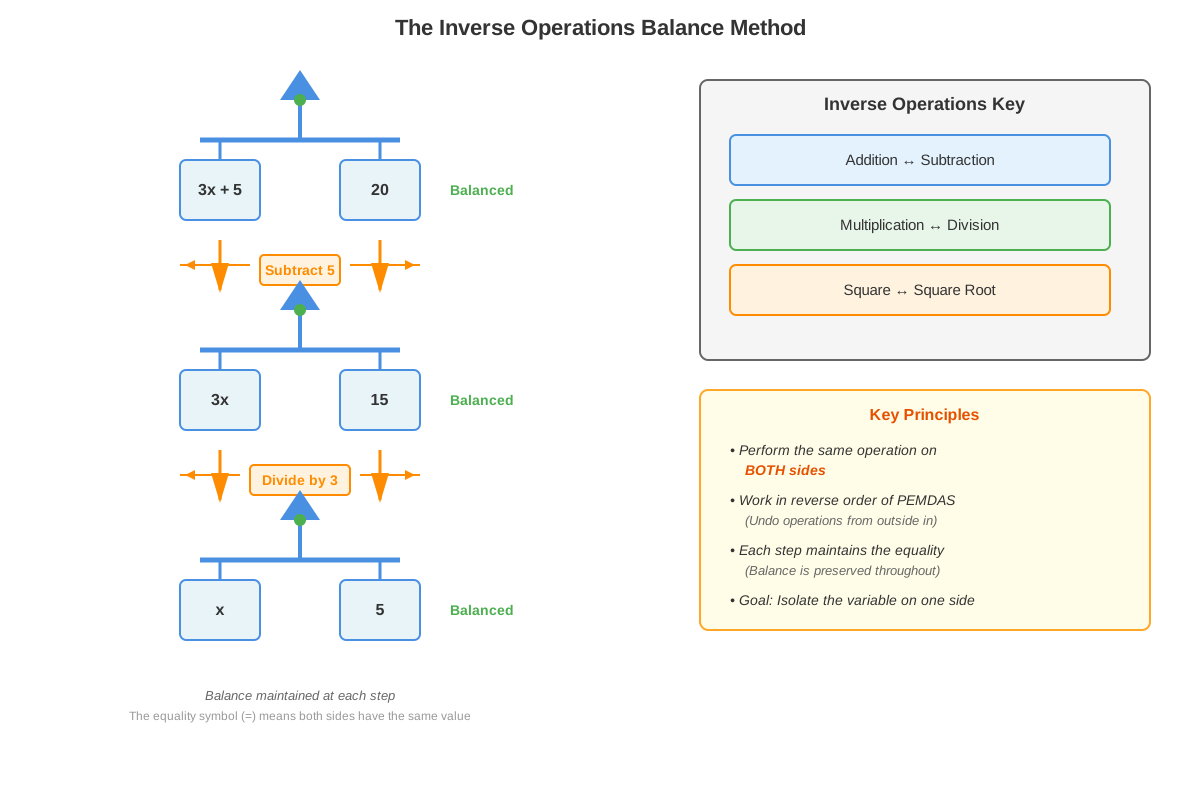
The fundamental principle underlying all equation solving is the property of equality: whatever operation you perform on one side of an equation, you must perform on the other side to maintain the equality. When solving for a variable, the goal is to isolate that variable on one side of the equation (typically the left side) while moving all other terms to the opposite side.
The process involves applying inverse operations in the reverse order of operations. If a variable is being multiplied by a coefficient, you divide both sides by that coefficient. If a number is added to the variable, you subtract that number from both sides. The key is to systematically "undo" each operation that has been applied to the variable, working from the outside in.
One-Step and Two-Step Equations
The simplest equations require only one or two operations to solve:
One-step equations involve a single operation:
- x + 7 = 15 (subtract 7 from both sides: x = 8)
- 3x = 21 (divide both sides by 3: x = 7)
- x/4 = 5 (multiply both sides by 4: x = 20)
Two-step equations require two operations, typically addressing addition/subtraction first, then multiplication/division:
- 2x + 5 = 13 (subtract 5: 2x = 8, then divide by 2: x = 4)
- (x - 3)/2 = 7 (multiply by 2: x - 3 = 14, then add 3: x = 17)
Multi-Step Equations
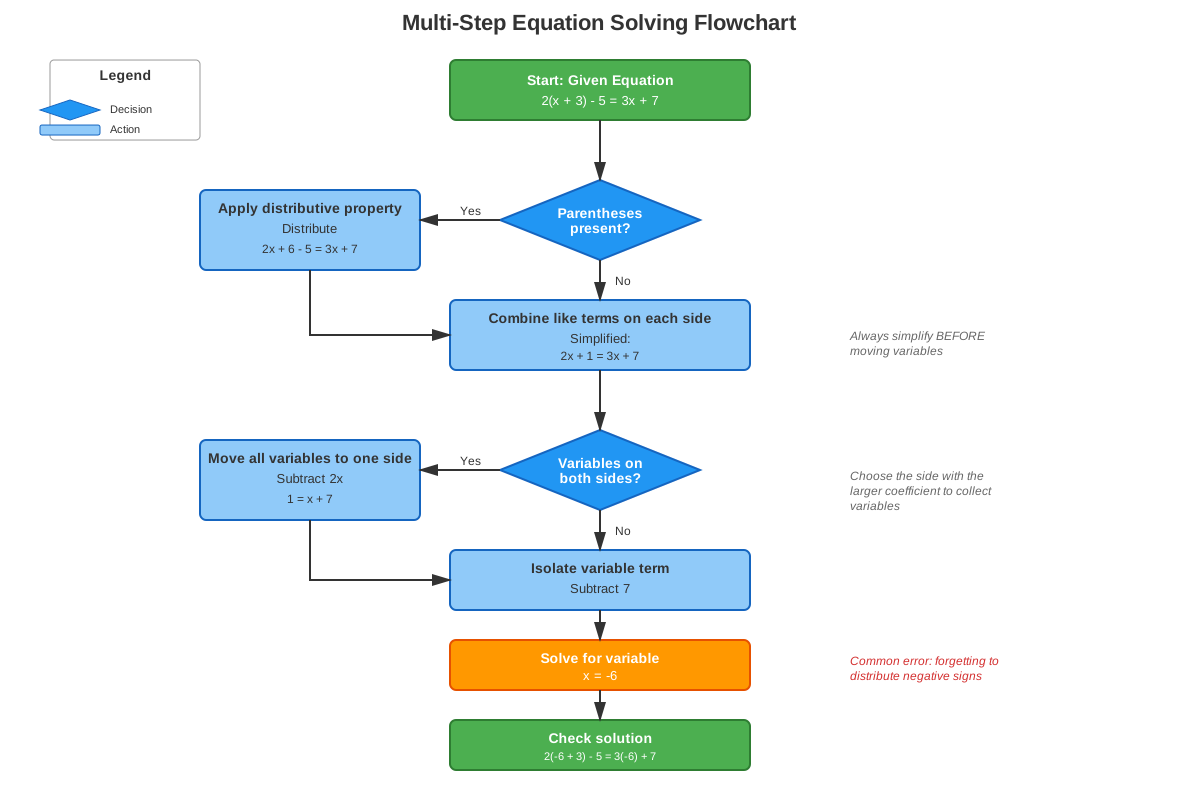
More complex equations require multiple steps and often involve the distributive property and combining like terms:
- Simplify both sides by distributing and combining like terms
- Move variable terms to one side using addition or subtraction
- Move constant terms to the opposite side
- Isolate the variable by dividing or multiplying
Example: 3(x + 4) - 2x = 18
- Distribute: 3x + 12 - 2x = 18
- Combine like terms: x + 12 = 18
- Subtract 12: x = 6
Variables on Both Sides
When variables appear on both sides of an equation, collect all variable terms on one side and all constants on the other:
Example: 5x - 7 = 2x + 8
- Subtract 2x from both sides: 3x - 7 = 8
- Add 7 to both sides: 3x = 15
- Divide by 3: x = 5
The choice of which side to collect variables on is arbitrary, but choosing the side with the larger coefficient often reduces the chance of working with negative coefficients.
Equations with Fractions
Equations containing fractions can be solved in two ways:
Method 1: Work with fractions throughout
- (2x + 3)/4 = 5
- Multiply both sides by 4: 2x + 3 = 20
- Subtract 3: 2x = 17
- Divide by 2: x = 17/2 or 8.5
Method 2: Clear fractions by multiplying by the least common denominator (LCD)
- x/3 + x/4 = 14
- LCD is 12, multiply all terms by 12: 4x + 3x = 168
- Combine: 7x = 168
- Divide by 7: x = 24
Literal Equations and Formula Manipulation
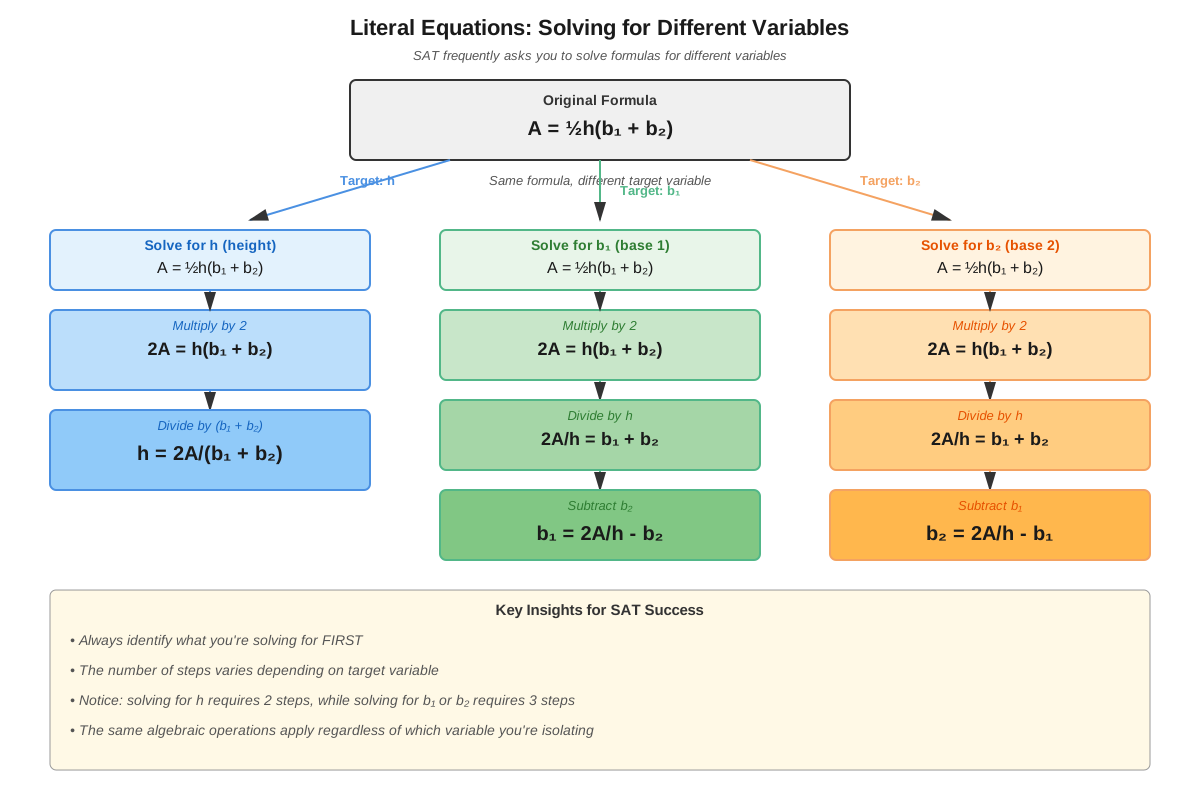
Literal equations contain multiple variables, and the task is to solve for one variable in terms of the others. This skill is essential for working with formulas in geometry, physics, and other applications.
The process is identical to solving numerical equations, but the result is an expression rather than a number:
Example: Solve for w in the formula P = 2l + 2w
- Subtract 2l from both sides: P - 2l = 2w
- Divide both sides by 2: (P - 2l)/2 = w
- Simplified: w = (P - 2l)/2 or w = P/2 - l
| Formula Type | Example | Solving For | Result |
|---|---|---|---|
| Geometric | A = πr² | r | r = √(A/π) |
| Physics | d = rt | t | t = d/r |
| Financial | I = Prt | P | P = I/(rt) |
| Temperature | F = (9/5)C + 32 | C | C = (5/9)(F - 32) |
Special Cases and No Solution/Infinite Solutions
Some equations have special characteristics:
No solution: When simplification leads to a false statement (like 5 = 3), the equation has no solution. This occurs when the variable terms cancel out, leaving an impossible equality.
Example: 2x + 5 = 2x + 8 → 5 = 8 (false, no solution)
Infinite solutions: When simplification leads to a true statement (like 7 = 7), every value of the variable is a solution. This occurs when both sides of the equation are identical.
Example: 3x + 6 = 3(x + 2) → 3x + 6 = 3x + 6 (true for all x, infinite solutions)
Concept Relationships
The concepts within solving for a variable build upon each other in a clear progression: basic one-step equations → two-step equations → multi-step equations with distribution and combining like terms → equations with variables on both sides → literal equations and formula manipulation. Each level incorporates all previous skills while adding new complexity.
Solving for a variable connects directly to prerequisite topics: the distributive property enables simplification of expressions before solving, combining like terms reduces equations to simpler forms, and properties of equality justify every manipulation performed. The order of operations determines which inverse operations to apply and in what sequence.
This topic serves as the foundation for numerous advanced SAT math concepts. Systems of equations require solving for variables in multiple equations simultaneously. Quadratic equations extend solving techniques to equations with squared terms. Function notation often requires solving equations like f(x) = k for x. Word problems across all categories require translating situations into equations and then solving for unknown quantities. Geometric formulas frequently require isolating specific variables to find dimensions or measurements.
The relationship map: Basic arithmetic operations → Properties of equality → One-step equations → Multi-step equations → Literal equations → Systems of equations, Quadratic equations, Word problems
Quick check — test yourself on Solving for a variable so far.
Try Flashcards →High-Yield Facts
⭐ The property of equality states that performing the same operation on both sides of an equation maintains the equality, which is the fundamental principle for all equation solving.
⭐ Inverse operations undo each other: addition and subtraction are inverses, as are multiplication and division.
⭐ When solving multi-step equations, simplify each side first by distributing and combining like terms before moving terms across the equals sign.
⭐ To solve equations with variables on both sides, collect all variable terms on one side and all constants on the other side before isolating the variable.
⭐ When solving literal equations, treat all other variables as constants and apply the same inverse operations used for numerical equations.
- Multiplying or dividing both sides by a negative number reverses inequality signs (though this applies to inequalities, not equations).
- Fractions in equations can be eliminated by multiplying every term by the least common denominator.
- The coefficient of a variable is the number multiplied by that variable; to isolate the variable, divide by this coefficient.
- When a variable appears in a denominator, multiply both sides by that denominator to clear it, but check that your solution doesn't make any denominator zero.
- Checking your solution by substituting it back into the original equation verifies correctness and catches calculation errors.
- Equations that simplify to a false statement (like 3 = 7) have no solution; equations that simplify to a true statement (like 5 = 5) have infinite solutions.
- The SAT frequently tests literal equations using formulas from geometry (area, volume, perimeter) and science (distance, density, temperature conversion).
Common Misconceptions
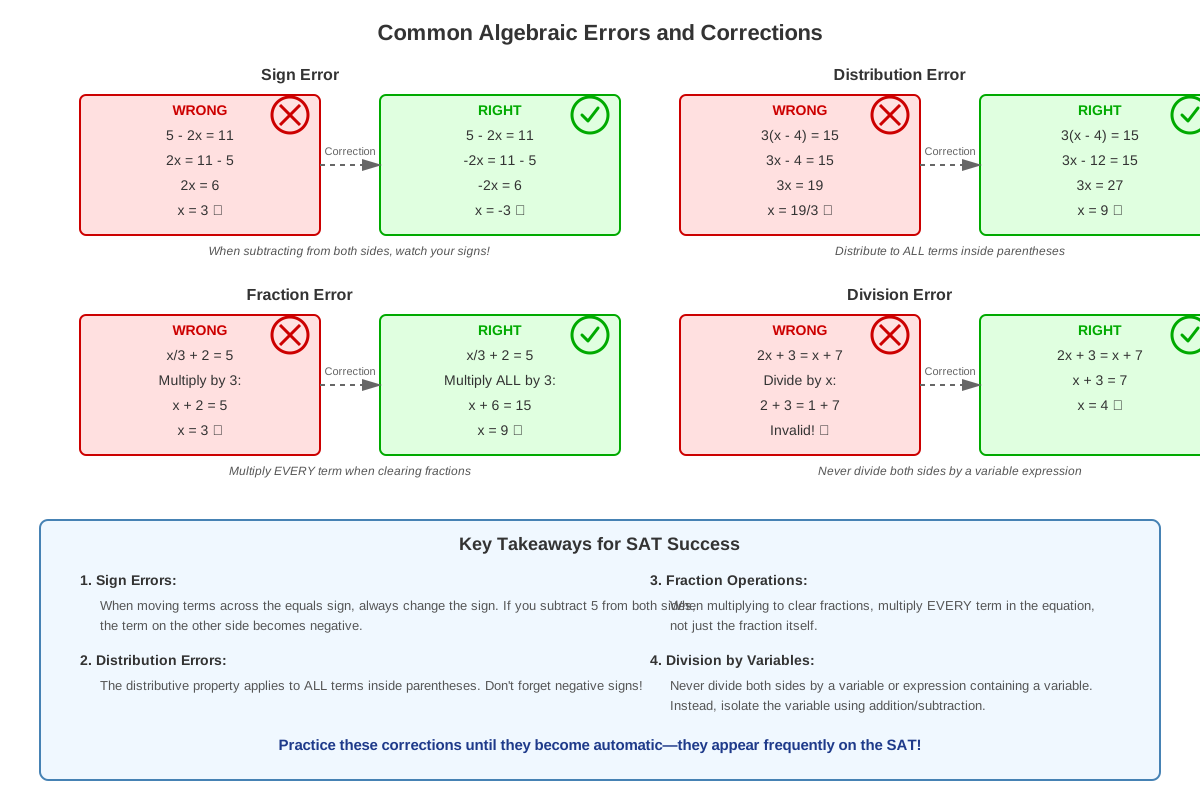
Misconception: When solving 2x = 10, students can subtract 2 from both sides to get x = 8.
Correction: Subtraction is not the inverse of multiplication. To undo multiplication by 2, divide both sides by 2, yielding x = 5. Inverse operations must match the operation being undone.
Misconception: In the equation x/3 = 5, multiplying only the left side by 3 gives x = 5.
Correction: The property of equality requires performing the same operation on both sides. Multiply both sides by 3: (x/3) × 3 = 5 × 3, so x = 15.
Misconception: When solving 3x + 5 = 20, students first divide everything by 3, getting x + 5/3 = 20/3.
Correction: Operations should be applied to entire sides, not individual terms, and should follow the reverse order of operations. First subtract 5 from both sides (3x = 15), then divide both sides by 3 (x = 5).
Misconception: In equations with variables on both sides like 5x = 3x + 10, students think they should add the x terms together to get 8x = 10.
Correction: Variables on opposite sides of the equals sign cannot be combined. Instead, subtract 3x from both sides to collect variables on one side: 5x - 3x = 10, so 2x = 10, and x = 5.
Misconception: When solving for r in A = πr², students divide both sides by π to get r² = A/π, then conclude r = A/π.
Correction: After obtaining r² = A/π, one more step is required. Take the square root of both sides: r = √(A/π). The squared variable requires a square root to isolate it.
Misconception: In literal equations like P = 2l + 2w, students think solving for w means just isolating the 2w term: P - 2l = 2w, and stop there.
Correction: Solving for a variable means isolating that variable completely, with a coefficient of 1. After P - 2l = 2w, divide both sides by 2 to get w = (P - 2l)/2.
Misconception: When an equation simplifies to 0 = 0, students think the answer is x = 0.
Correction: When an equation simplifies to a true statement like 0 = 0 or 5 = 5, it means the equation is an identity—true for all values of x. The solution is "all real numbers" or "infinite solutions," not x = 0.
Worked Examples
Example 1: Multi-Step Equation with Distribution
Problem: Solve for x: 4(2x - 3) + 5 = 3x + 18
Solution:
Step 1: Distribute the 4 on the left side
- 4(2x) - 4(3) + 5 = 3x + 18
- 8x - 12 + 5 = 3x + 18
Step 2: Combine like terms on the left side
- 8x - 7 = 3x + 18
Step 3: Collect variable terms on one side by subtracting 3x from both sides
- 8x - 3x - 7 = 3x - 3x + 18
- 5x - 7 = 18
Step 4: Isolate the variable term by adding 7 to both sides
- 5x - 7 + 7 = 18 + 7
- 5x = 25
Step 5: Solve for x by dividing both sides by 5
- 5x/5 = 25/5
- x = 5
Step 6: Check the solution by substituting x = 5 into the original equation
- Left side: 4(2(5) - 3) + 5 = 4(10 - 3) + 5 = 4(7) + 5 = 28 + 5 = 33
- Right side: 3(5) + 18 = 15 + 18 = 33
- Both sides equal 33, confirming x = 5 is correct ✓
Connection to Learning Objectives: This example demonstrates applying solving for a variable to answer SAT-style questions by executing multi-step algebraic manipulations including distribution, combining like terms, and collecting variables on one side.
Example 2: Literal Equation (Formula Manipulation)
Problem: The formula for the surface area of a cylinder is S = 2πr² + 2πrh, where r is the radius and h is the height. Solve for h in terms of S and r.
Solution:
Step 1: Write the original equation
- S = 2πr² + 2πrh
Step 2: Isolate the term containing h by subtracting 2πr² from both sides
- S - 2πr² = 2πr² - 2πr² + 2πrh
- S - 2πr² = 2πrh
Step 3: Solve for h by dividing both sides by 2πr (the coefficient of h)
- (S - 2πr²)/(2πr) = (2πrh)/(2πr)
- (S - 2πr²)/(2πr) = h
Step 4: Write the final answer with h on the left side
- h = (S - 2πr²)/(2πr)
Alternative simplified form (optional):
- h = S/(2πr) - 2πr²/(2πr)
- h = S/(2πr) - r
Connection to Learning Objectives: This example shows how solving for a variable appears on the SAT in the context of literal equations, requiring students to treat other variables as constants and apply the same inverse operations used in numerical equations. This skill is essential for geometry and science formula questions.
Exam Strategy
When approaching SAT questions involving solving for a variable, begin by identifying what the question asks for—this determines which variable to isolate. Read carefully to distinguish between "solve for x" (find a numerical value) and "which expression represents x" (create a literal equation).
Trigger words and phrases that indicate solving for a variable questions include: "solve for," "find the value of," "what is x," "isolate," "express in terms of," "if the equation is true, what is," and "which of the following is equivalent to." Formula manipulation questions often use phrases like "solve for [variable] in the formula" or "which equation shows [variable] in terms of."
For multiple-choice questions, consider working backwards by substituting answer choices into the original equation. This strategy, called "backsolving," can be faster than algebraic manipulation, especially for complex equations. Start with choice (B) or (C) since SAT answers are typically ordered numerically.
Process-of-elimination tips specific to this topic:
- Eliminate answers with incorrect signs (positive vs. negative)
- Check if the answer has the correct variable isolated
- Verify that the answer has reasonable magnitude (not absurdly large or small)
- For literal equations, eliminate answers that don't have the correct variable in the numerator/denominator
Time allocation: Simple one- or two-step equations should take 30-45 seconds. Multi-step equations with distribution typically require 60-90 seconds. Literal equations and formula manipulation questions may take 90-120 seconds. If an equation seems overly complex, check whether the question asks for something other than the variable's value (like the value of an expression containing the variable, which might simplify the work).
Always perform a quick check when time permits: substitute your answer back into the original equation to verify it works. This catches calculation errors and ensures you haven't made a sign mistake or algebraic error. For grid-in questions, this verification is especially important since there's no answer choice to guide you.
Memory Techniques
SADMEP - The reverse of PEMDAS for solving equations: Subtraction/Addition, Division/Multiplication, Exponents, Parentheses. When solving, undo operations in reverse order of how they were applied.
"Change sides, change signs" - When moving a term from one side of an equation to the other, change its sign. This is a shortcut for remembering that adding/subtracting the same value from both sides effectively moves the term and changes its sign.
"Do unto one side as you do unto the other" - A memorable way to remember the property of equality: whatever operation you perform on one side must be performed on the other.
MOVE for multi-step equations:
- Multiply to clear fractions (if needed)
- Open parentheses (distribute)
- Variables to one side
- Everything else to the other side
Literal equation visualization: Picture the variable you're solving for as being "trapped" inside a box with other operations around it. Your job is to "free" the variable by removing each layer (operation) one at a time, working from the outside in.
The "opposite operation" pairs: Create a mental image of these pairs as mirror images:
- Addition ↔ Subtraction
- Multiplication ↔ Division
- Squaring ↔ Square root
- Cubing ↔ Cube root
Summary
Solving for a variable is the cornerstone skill of SAT algebra, requiring systematic application of inverse operations to isolate a variable on one side of an equation. The process involves simplifying both sides through distribution and combining like terms, collecting all variable terms on one side and constants on the other, then dividing or multiplying to achieve a coefficient of 1 for the variable. This skill extends from simple one-step equations to complex multi-step equations with variables on both sides, and further to literal equations where one variable is expressed in terms of others. Success requires understanding the property of equality (performing identical operations on both sides), recognizing inverse operations, and working in reverse order of operations. The SAT tests this skill extensively across 15-20% of math questions, both as standalone problems and as essential steps within word problems, systems of equations, and formula manipulation questions. Mastery requires fluency with algebraic manipulation, attention to detail with signs and coefficients, and the ability to check solutions by substitution.
Key Takeaways
- The property of equality—performing the same operation on both sides—is the fundamental principle enabling all equation solving
- Inverse operations (addition/subtraction, multiplication/division) undo each other and must be applied in reverse order of operations
- Multi-step equations require systematic simplification: distribute, combine like terms, collect variables on one side, isolate the variable
- Literal equations are solved using identical techniques to numerical equations, treating other variables as constants
- Variables on both sides require collecting all variable terms on one side before isolating the variable
- Checking solutions by substituting back into the original equation catches errors and verifies correctness
- The SAT frequently tests formula manipulation, requiring students to solve geometric and scientific formulas for specified variables
Related Topics
Systems of Linear Equations: Building on solving single equations, systems require finding values that satisfy multiple equations simultaneously, using substitution or elimination methods that rely heavily on solving for variables.
Quadratic Equations: Extends equation-solving to expressions with squared terms, requiring factoring, completing the square, or the quadratic formula—all of which build on the foundational skills of isolating variables.
Linear Inequalities: Applies identical solving techniques to inequalities, with the additional rule that multiplying or dividing by negative numbers reverses the inequality sign.
Functions and Function Notation: Solving equations like f(x) = k for x requires the same algebraic manipulation skills, connecting equation-solving to the broader concept of functions.
Word Problems and Applications: Translating real-world situations into algebraic equations is only the first step; solving for the unknown variable completes the problem-solving process.
Rational Equations: Equations containing variables in denominators require clearing fractions and solving, extending the techniques learned here to more complex scenarios.
Practice CTA
Now that you've mastered the core concepts of solving for a variable, it's time to solidify your understanding through practice. Work through the practice questions to apply these techniques to authentic SAT-style problems, and use the flashcards to reinforce key facts and procedures. Remember, fluency in solving for a variable is one of the highest-yield skills for SAT math success—every minute spent practicing this topic will pay dividends across multiple question types on test day. You've built a strong foundation; now strengthen it through deliberate practice!
Sign up free to keep reading
Create a free AnvayaPrep account to finish this SAT guide on Solving for a variable — plus flashcards and practice questions.