Overview
Solving multi-step equations represents one of the most fundamental and frequently tested skills in the math section of the SAT. These equations require students to perform multiple operations in a logical sequence to isolate the variable and determine its value. Unlike simple one-step equations, multi-step equations demand strategic thinking about the order of operations, proper application of inverse operations, and careful attention to algebraic manipulation rules. Mastery of this topic is non-negotiable for SAT success, as these problems appear throughout both the calculator and no-calculator portions of the exam.
The SAT tests multi-step equation solving in various contexts, from straightforward algebraic expressions to word problems that require translation from English to mathematical notation. Questions may involve combining like terms, using the distributive property, working with fractions and decimals, and handling variables on both sides of the equation. The College Board consistently includes 3-5 questions directly testing this skill, with many additional questions requiring multi-step equation solving as an intermediate step toward the final answer.
Understanding multi-step equations serves as the foundation for virtually all algebraic reasoning on the SAT. This topic connects directly to systems of equations, linear functions, inequalities, and even quadratic equations. Students who struggle with multi-step equations will find themselves unable to progress through more complex mathematical concepts. Conversely, those who develop fluency in this area gain confidence and speed that translates into higher scores across the entire math section.
Learning Objectives
- [ ] Identify key features of solving multi-step equations
- [ ] Explain how solving multi-step equations appears on the SAT
- [ ] Apply solving multi-step equations to answer SAT-style questions
- [ ] Execute the correct sequence of inverse operations to isolate variables
- [ ] Recognize and correct common algebraic errors in multi-step solutions
- [ ] Translate word problems into multi-step equations and solve them efficiently
- [ ] Verify solutions by substitution and identify extraneous solutions when applicable
Prerequisites
- Basic arithmetic operations: Addition, subtraction, multiplication, and division form the foundation for all algebraic manipulation
- Order of operations (PEMDAS): Understanding the hierarchy of operations is essential for both setting up and solving equations correctly
- Properties of equality: Knowledge that performing the same operation on both sides maintains equality is fundamental to equation solving
- Combining like terms: The ability to simplify expressions by adding or subtracting similar terms streamlines the solving process
- Distributive property: Expanding expressions like 3(x + 4) is frequently required before solving can begin
- Working with negative numbers: Confidence with signed numbers prevents calculation errors throughout the solving process
- Fraction operations: Many SAT equations involve fractional coefficients that must be handled correctly
Why This Topic Matters
Multi-step equation solving represents a critical life skill that extends far beyond standardized testing. In real-world applications, professionals use these techniques in financial planning (calculating loan payments, investment returns, and budget allocations), engineering (determining unknown measurements and specifications), science (solving for variables in formulas), and business (analyzing break-even points and profit margins). The logical thinking required to solve multi-step equations develops problem-solving abilities applicable to countless situations.
On the SAT specifically, multi-step equations appear with remarkable frequency and predictability. Research of recent SAT administrations reveals that approximately 15-20% of all math questions either directly test or require multi-step equation solving as a component of the solution. These questions appear in both multiple-choice and student-produced response formats, with point values ranging from 1 to 2 points each. The College Board particularly favors questions that combine multiple algebraic skills, such as distributing, combining like terms, and working with variables on both sides within a single problem.
Common SAT question formats include: pure algebraic equations presented symbolically; word problems requiring equation setup and solution; questions asking for the value of an expression rather than the variable itself; problems involving literal equations where students solve for one variable in terms of others; and multi-part questions where solving an equation is step one of a larger problem. The predictability of these formats makes this topic exceptionally high-yield for focused study.
Core Concepts
The Fundamental Principle of Equation Solving
The core principle underlying all equation solving is maintaining balance. An equation states that two expressions are equal, and any operation performed must preserve this equality. The goal when solving multi-step equations is to isolate the variable on one side of the equation through a series of inverse operations. Each step should simplify the equation, bringing the variable closer to isolation while maintaining the equality relationship.
The inverse operations are the key tools:
- Addition and subtraction are inverses
- Multiplication and division are inverses
- Squaring and taking square roots are inverses (though less common in linear equations)
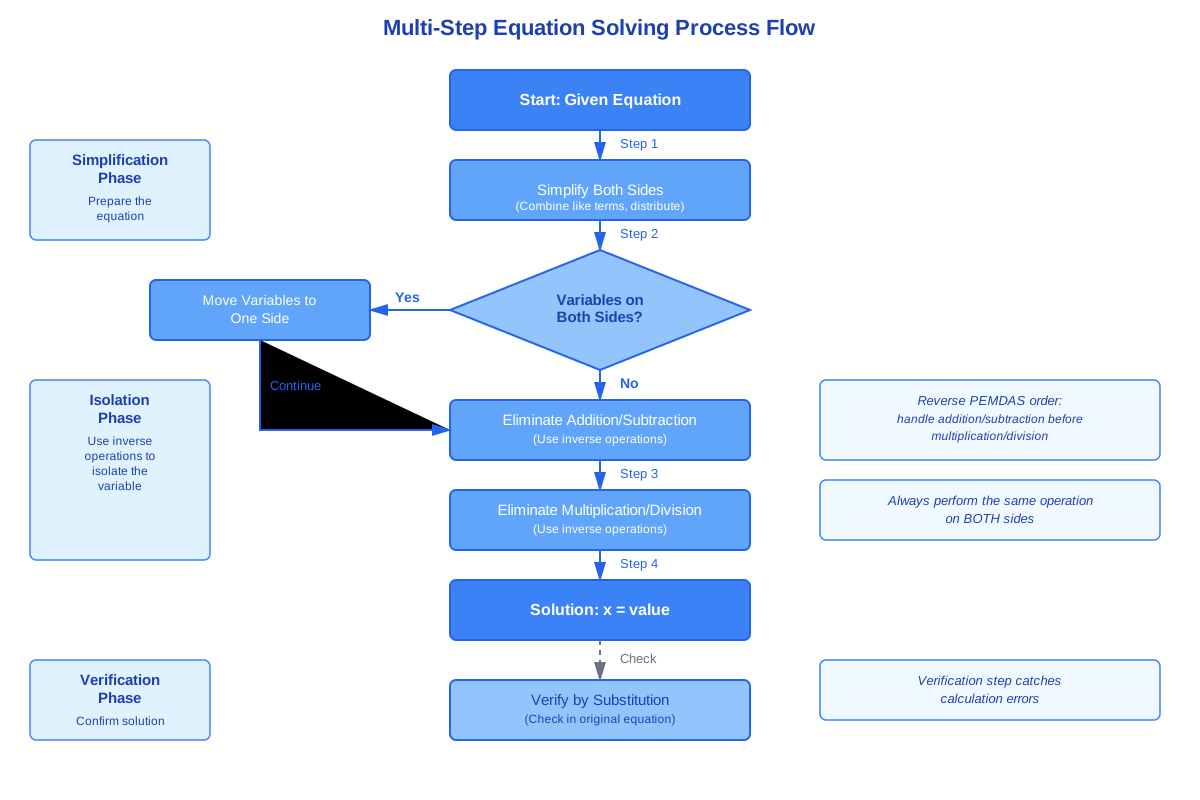
The Standard Solution Process
When approaching multi-step equations, following a systematic process ensures accuracy and efficiency:
- Simplify both sides independently: Remove parentheses using the distributive property and combine all like terms on each side
- Collect variable terms: Move all terms containing the variable to one side of the equation (typically the left)
- Collect constant terms: Move all constant terms to the opposite side
- Isolate the variable: Use multiplication or division to make the coefficient of the variable equal to 1
- Verify the solution: Substitute the answer back into the original equation to confirm it works
Equations with Variables on Both Sides
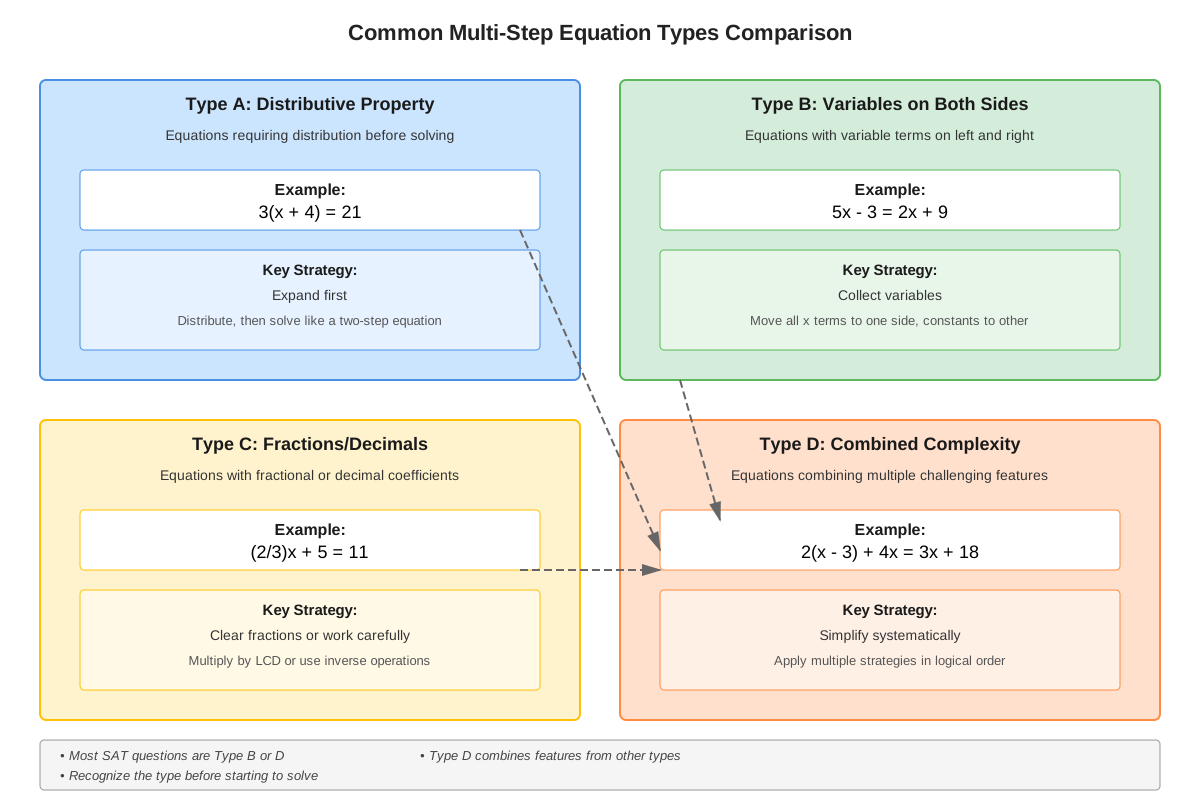
A particularly common SAT format involves equations where the variable appears on both sides, such as 5x - 7 = 2x + 11. The strategy involves:
- Deciding which side should contain the variable (choose the side with the larger coefficient to avoid negative coefficients when possible)
- Subtracting the smaller variable term from both sides
- Proceeding with standard isolation steps
Example: For 5x - 7 = 2x + 11
- Subtract 2x from both sides: 3x - 7 = 11
- Add 7 to both sides: 3x = 18
- Divide both sides by 3: x = 6
The Distributive Property in Multi-Step Equations
Many SAT solving multi-step equations problems require distributing before solving. The distributive property states that a(b + c) = ab + ac. This must be applied correctly to remove parentheses:
Example: 3(2x - 5) = 4x + 7
- Distribute: 6x - 15 = 4x + 7
- Subtract 4x: 2x - 15 = 7
- Add 15: 2x = 22
- Divide by 2: x = 11
Equations with Fractions
Fractional coefficients appear frequently on the SAT. Two approaches work well:
Method 1 - Clear fractions first: Multiply every term by the least common denominator (LCD)
Method 2 - Work with fractions: Use fraction operations throughout
| Approach | Advantages | Disadvantages |
|---|---|---|
| Clear fractions | Simpler arithmetic with whole numbers | Requires finding LCD; more steps initially |
| Keep fractions | Fewer initial steps | More complex arithmetic; higher error risk |
Example: (x/3) + 5 = (2x/5) - 1
- LCD is 15; multiply all terms by 15
- 5x + 75 = 6x - 15
- Subtract 5x: 75 = x - 15
- Add 15: x = 90
Equations Requiring Multiple Distributions
Some SAT problems nest multiple layers of complexity:
Example: 2(3x - 4) - 5(x + 2) = 18
- Distribute both: 6x - 8 - 5x - 10 = 18
- Combine like terms: x - 18 = 18
- Add 18: x = 36
Special Cases and No Solution/Infinite Solutions
Occasionally, the SAT tests understanding of equations that don't have exactly one solution:
- No solution: Variables cancel and leave a false statement (e.g., 5 = 3)
- Infinite solutions: Variables cancel and leave a true statement (e.g., 7 = 7)
- One solution: Standard case where a specific value satisfies the equation
Solving for Expressions Rather Than Variables
A sophisticated SAT twist asks for the value of an expression rather than the variable itself. Sometimes solving for the variable is unnecessary:
Example: If 4x + 7 = 23, what is the value of 4x - 3?
- Rather than solving for x, recognize that 4x = 16
- Therefore, 4x - 3 = 16 - 3 = 13
Concept Relationships
The concepts within multi-step equation solving build upon each other in a clear hierarchy. Simplification (combining like terms and distributing) must occur before variable collection (moving variable terms to one side), which must precede isolation (dividing or multiplying to get the variable alone). Each step depends on the previous step being executed correctly.
Multi-step equation solving connects directly to prerequisite knowledge of basic operations and the order of operations. The distributive property, a prerequisite concept, becomes a tool within the larger solving process. Similarly, fraction operations transform from standalone skills into components of more complex equation solving.
Looking forward, multi-step equation solving enables progression to systems of equations (where multiple equations are solved simultaneously), inequalities (where the same solving process applies with modified rules for multiplication/division by negatives), and literal equations (solving for one variable in terms of others). The relationship map flows:
Basic Operations → Order of Operations → One-Step Equations → Multi-Step Equations → Systems of Equations → Quadratic Equations → Functions
Additionally, multi-step equations connect horizontally to word problems, as translating verbal descriptions into equations often yields multi-step problems requiring these exact solving techniques.
High-Yield Facts
⭐ Always perform the same operation to both sides of an equation to maintain equality
⭐ The standard solving sequence is: simplify, collect variables, collect constants, isolate, verify
⭐ When variables appear on both sides, subtract the smaller variable term from both sides first
⭐ The distributive property must be applied before combining like terms: a(b + c) = ab + ac
⭐ Multiplying or dividing both sides by the LCD eliminates fractions efficiently
- Combining like terms means adding or subtracting terms with identical variable parts
- When distributing a negative sign or negative number, the sign of every term inside parentheses changes
- Equations can have one solution, no solution, or infinitely many solutions
- Verification by substitution catches calculation errors and confirms the answer
- Sometimes solving for an expression is faster than solving for the variable itself
- The coefficient of the variable must equal 1 for the variable to be fully isolated
- Order matters: attempting to isolate before simplifying leads to unnecessary complexity
- Division by zero is undefined; if solving leads to division by zero, reconsider the approach
- Parentheses must be completely removed before collecting variable terms
- The SAT never requires solutions involving imaginary numbers for linear equations
Quick check — test yourself on Solving multi-step equations so far.
Try Flashcards →Common Misconceptions
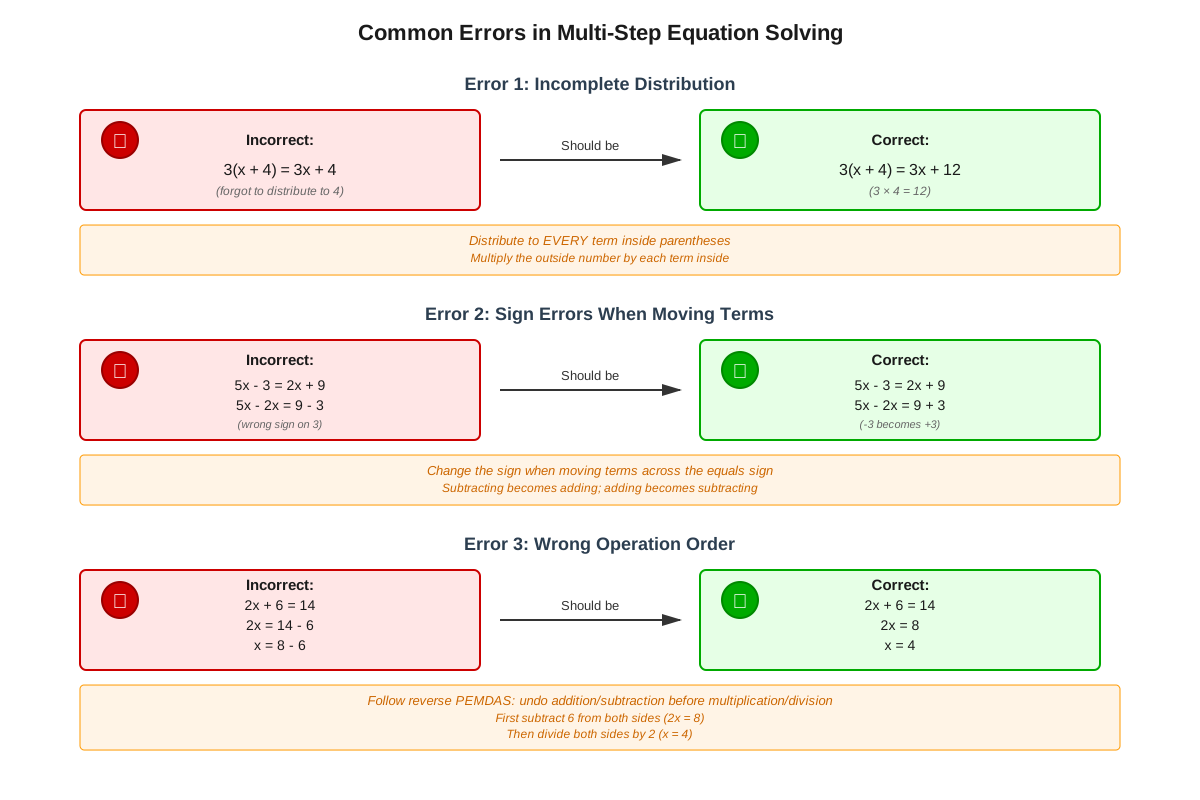
Misconception: When distributing a negative sign, only the first term inside parentheses becomes negative → Correction: Every term inside the parentheses must have its sign changed. For -(3x - 5), the result is -3x + 5, not -3x - 5.
Misconception: Combining like terms means adding all numbers and all variables separately → Correction: Only terms with identical variable parts can be combined. In 3x + 5 + 2x - 7, the result is 5x - 2, but 3x + 5y cannot be simplified further because x and y are different variables.
Misconception: The equation is solved when the variable appears on one side, even if it has a coefficient → Correction: The variable is only isolated when its coefficient equals 1. The equation 3x = 12 requires one more step (dividing both sides by 3) to reach x = 4.
Misconception: When an equation simplifies to 0 = 0, there is no solution → Correction: The statement 0 = 0 is always true, indicating infinitely many solutions (the equation is an identity). No solution occurs when simplification yields a false statement like 5 = 3.
Misconception: Fractions can be eliminated by multiplying only the fraction terms by the LCD → Correction: Every term in the equation must be multiplied by the LCD to maintain equality. Selectively multiplying only some terms destroys the balance of the equation.
Misconception: The order of operations doesn't matter when solving equations → Correction: While solving uses inverse operations in reverse order, the simplification steps must respect PEMDAS. Parentheses must be addressed before other operations, and multiplication/division before addition/subtraction when simplifying each side.
Misconception: If the variable cancels out, the problem was done incorrectly → Correction: Variables canceling is legitimate and indicates either no solution (false statement remains) or infinite solutions (true statement remains). This is a valid outcome that the SAT occasionally tests.
Worked Examples
Example 1: Standard Multi-Step Equation with Distribution
Problem: Solve for x: 3(2x - 5) + 4 = 5x - 7
Solution:
Step 1 - Distribute the 3:
- 3(2x) - 3(5) + 4 = 5x - 7
- 6x - 15 + 4 = 5x - 7
Step 2 - Combine like terms on the left side:
- 6x - 11 = 5x - 7
Step 3 - Collect variable terms (subtract 5x from both sides):
- 6x - 5x - 11 = 5x - 5x - 7
- x - 11 = -7
Step 4 - Isolate x (add 11 to both sides):
- x - 11 + 11 = -7 + 11
- x = 4
Step 5 - Verify by substituting x = 4 into the original equation:
- Left side: 3(2(4) - 5) + 4 = 3(8 - 5) + 4 = 3(3) + 4 = 9 + 4 = 13
- Right side: 5(4) - 7 = 20 - 7 = 13
- Both sides equal 13 ✓
Connection to Learning Objectives: This example demonstrates the complete solving process, including distribution, combining like terms, variable collection, isolation, and verification—addressing the objective of executing the correct sequence of operations.
Example 2: Equation with Fractions and Variables on Both Sides
Problem: Solve for y: (2y/3) - 5 = (y/4) + 2
Solution:
Step 1 - Identify the LCD of 3 and 4, which is 12
Step 2 - Multiply every term by 12 to clear fractions:
- 12(2y/3) - 12(5) = 12(y/4) + 12(2)
- 8y - 60 = 3y + 24
Step 3 - Collect variable terms (subtract 3y from both sides):
- 8y - 3y - 60 = 3y - 3y + 24
- 5y - 60 = 24
Step 4 - Collect constants (add 60 to both sides):
- 5y - 60 + 60 = 24 + 60
- 5y = 84
Step 5 - Isolate y (divide both sides by 5):
- y = 84/5 or 16.8
Step 6 - Verify by substituting y = 84/5:
- Left side: (2(84/5)/3) - 5 = (168/15) - 5 = (56/5) - (25/5) = 31/5
- Right side: ((84/5)/4) + 2 = (84/20) + 2 = (21/5) + (10/5) = 31/5
- Both sides equal 31/5 ✓
Connection to Learning Objectives: This example addresses applying multi-step equation solving to SAT-style questions, as fractional coefficients with variables on both sides represent a common SAT format. It also demonstrates the strategic choice to clear fractions first.
Example 3: Solving for an Expression
Problem: If 6x - 9 = 27, what is the value of 2x - 3?
Solution:
Method 1 (Solve for x first):
- 6x - 9 = 27
- 6x = 36
- x = 6
- Therefore, 2x - 3 = 2(6) - 3 = 12 - 3 = 9
Method 2 (Recognize the relationship):
- Notice that 2x - 3 is exactly one-third of 6x - 9
- Factor: 6x - 9 = 3(2x - 3)
- If 3(2x - 3) = 27, then 2x - 3 = 9
Connection to Learning Objectives: This example demonstrates a sophisticated SAT strategy where recognizing relationships between expressions saves time. It addresses the objective of applying solving techniques efficiently to SAT-style questions, which often test whether students can find shortcuts rather than always using the standard algorithm.
Exam Strategy
When approaching multi-step equation problems on the SAT, begin by quickly scanning the equation to identify its complexity level. Look for the presence of parentheses (requiring distribution), fractions (potentially requiring LCD multiplication), and variables on both sides. This 5-second assessment determines the appropriate strategy.
Trigger words and phrases in word problems that signal multi-step equations include: "more than," "less than," "combined," "total," "difference," "times as much," "increased by," "decreased by," and "the sum of." These phrases indicate relationships that translate into algebraic operations requiring multiple steps to solve.
For process of elimination on multiple-choice questions, substitute answer choices back into the original equation when the algebra becomes complex. This "backsolving" technique is particularly effective when answer choices are simple numbers. Start with choice (C) since SAT answers are typically ordered numerically; if (C) makes the left side too large, try (A) or (B); if too small, try (D) or (E).
Time allocation for multi-step equation problems should average 45-90 seconds per question. If a problem exceeds 2 minutes, mark it for review and move forward. The SAT rewards efficient problem-solving, and spending excessive time on one question sacrifices opportunities elsewhere. Practice builds the pattern recognition that enables faster solving.
Exam Tip: Always write down each step, even on the no-calculator section. Mental math increases error risk, and showing work allows you to catch mistakes during verification. The few seconds spent writing are recovered by avoiding careless errors.
Strategic verification: On the SAT, time constraints make verifying every answer impractical. Prioritize verification for: (1) questions where you felt uncertain during solving, (2) problems with multiple steps where errors compound, and (3) any question where your answer doesn't match the available choices (suggesting an error occurred).
Memory Techniques
DISC - Remember the solving sequence:
- Distribute and simplify
- Isolate variables on one side
- Separate constants to the other side
- Complete by dividing/multiplying to get the variable alone
"Keep the Balance" - Visualize an old-fashioned balance scale. Whatever you do to one side, you must do to the other. This mental image prevents the most common error: performing operations on only one side of the equation.
"PEMDAS Reversed" - When isolating a variable, think of undoing operations in reverse order of operations:
- Undo Addition/Subtraction first (reverse of last in PEMDAS)
- Then undo Multiplication/Division
- Finally undo Exponents (rare in linear equations)
- Parentheses are removed during simplification
The Fraction Eliminator - When you see fractions, immediately think "LCD attack!" Multiply everything by the LCD to transform the problem into whole numbers, reducing calculation errors.
"Same Variable, Combine Time" - Only terms with identical variable parts can be combined. Create a mental checklist: same variable? same exponent? If yes to both, combine; if no to either, keep separate.
Summary
Solving multi-step equations represents a cornerstone skill for SAT math success, appearing directly in 15-20% of questions and serving as a prerequisite for countless others. The systematic approach—simplify both sides, collect variable terms, collect constants, isolate the variable, and verify—provides a reliable framework for tackling any linear equation. Mastery requires fluency with the distributive property, combining like terms, working with fractions, and handling variables on both sides of equations. The SAT tests this topic through pure algebraic problems, word problems requiring translation, and sophisticated questions asking for expression values rather than variable values. Students who develop automatic pattern recognition for equation types and internalize the standard solving sequence gain both speed and accuracy. The key to success lies in consistent practice with verification, as catching errors through substitution prevents lost points. Understanding special cases (no solution and infinite solutions) and recognizing when shortcuts exist (solving for expressions directly) distinguishes high-scoring students from average performers. This topic's high yield and predictable format make it an excellent investment of study time.
Key Takeaways
- Multi-step equation solving follows a consistent sequence: simplify, collect variables, collect constants, isolate, verify
- Always perform identical operations on both sides of the equation to maintain equality
- The distributive property must be applied correctly before combining like terms, with special attention to negative signs
- Clearing fractions by multiplying all terms by the LCD transforms complex problems into simpler whole-number equations
- When variables appear on both sides, subtract the smaller variable term from both sides before proceeding
- Verification by substitution catches errors and confirms solutions, particularly important for complex multi-step problems
- The SAT frequently asks for expression values rather than variable values, sometimes allowing shortcuts that bypass full solving
Related Topics
Systems of Linear Equations: Building on single-equation solving, systems require finding values that satisfy multiple equations simultaneously. Mastery of multi-step equations is essential, as each equation in a system may require individual solving before combining results.
Linear Inequalities: The solving process for inequalities mirrors multi-step equations with one critical difference—multiplying or dividing by negative numbers reverses the inequality symbol. Comfort with equation solving makes the transition to inequalities straightforward.
Literal Equations and Formulas: These problems require solving for one variable in terms of others (e.g., solving A = πr² for r). The same multi-step techniques apply, but the "answer" contains variables rather than numbers.
Word Problems and Applications: Real-world scenarios translate into multi-step equations. Mastering the algebraic solving process allows focus on the translation step, where many students struggle.
Functions and Function Notation: Understanding how to solve equations like f(x) = 7 for x requires the same multi-step solving skills, now applied within function contexts.
Practice CTA
Now that you've mastered the concepts and strategies for solving multi-step equations, it's time to cement your understanding through active practice. The practice questions and flashcards designed for this topic will challenge you with SAT-style problems that mirror actual test conditions. Each practice problem provides an opportunity to apply the DISC sequence, recognize patterns, and build the automaticity that leads to test-day confidence. Remember, the difference between understanding a concept and mastering it lies in deliberate practice. Approach each problem methodically, verify your solutions, and learn from any mistakes. Your investment in practice now will pay dividends in points on test day. You've got this!
Sign up free to keep reading
Create a free AnvayaPrep account to finish this SAT guide on Solving multi-step equations — plus flashcards and practice questions.