Overview
Solving two-step equations represents one of the most fundamental and frequently tested algebraic skills on the SAT. These equations require exactly two inverse operations to isolate the variable, making them a cornerstone of the Linear Equations in One Variable unit. Mastery of this topic is non-negotiable for SAT success, as two-step equations appear directly in approximately 8-12% of math questions and serve as building blocks for more complex algebraic manipulations throughout the exam.
The SAT tests two-step equations in multiple contexts: as straightforward algebraic problems, embedded within word problems, and as components of more complex multi-step scenarios. Students who can quickly and accurately solve these equations gain a significant advantage, as the skill transfers to solving inequalities, systems of equations, and even quadratic equations. The College Board specifically designs questions to test whether students understand the logical sequence of operations and can apply inverse operations correctly.
Understanding two-step equations creates a foundation for virtually all algebraic reasoning on the SAT. These equations bridge the gap between basic arithmetic operations and advanced problem-solving, teaching students to think systematically about mathematical relationships. The ability to manipulate equations efficiently directly impacts performance on questions involving formulas, literal equations, and real-world modeling scenarios that comprise a substantial portion of the Heart of Algebra domain.
Learning Objectives
- [ ] Identify key features of solving two-step equations
- [ ] Explain how solving two-step equations appears on the SAT
- [ ] Apply solving two-step equations to answer SAT-style questions
- [ ] Execute the correct sequence of inverse operations to isolate variables
- [ ] Verify solutions by substituting values back into original equations
- [ ] Translate word problems into two-step equations and solve them accurately
- [ ] Recognize and avoid common algebraic manipulation errors under timed conditions
Prerequisites
- Basic arithmetic operations: Addition, subtraction, multiplication, and division form the foundation for applying inverse operations
- Order of operations (PEMDAS): Understanding operation hierarchy is essential for recognizing which operations to undo first
- Properties of equality: The concept that performing the same operation on both sides maintains equality is fundamental to equation solving
- Negative number operations: Two-step equations frequently involve negative coefficients and constants requiring confident manipulation
- Fraction and decimal operations: Many SAT equations include rational numbers that must be handled accurately
Why This Topic Matters
Two-step equations appear in everyday situations far beyond the classroom. Calculating discounts with tax, determining hourly wages after deductions, converting temperature scales, and budgeting with fixed and variable costs all involve two-step equation logic. Financial literacy, scientific calculations, and business decisions regularly require this fundamental algebraic skill.
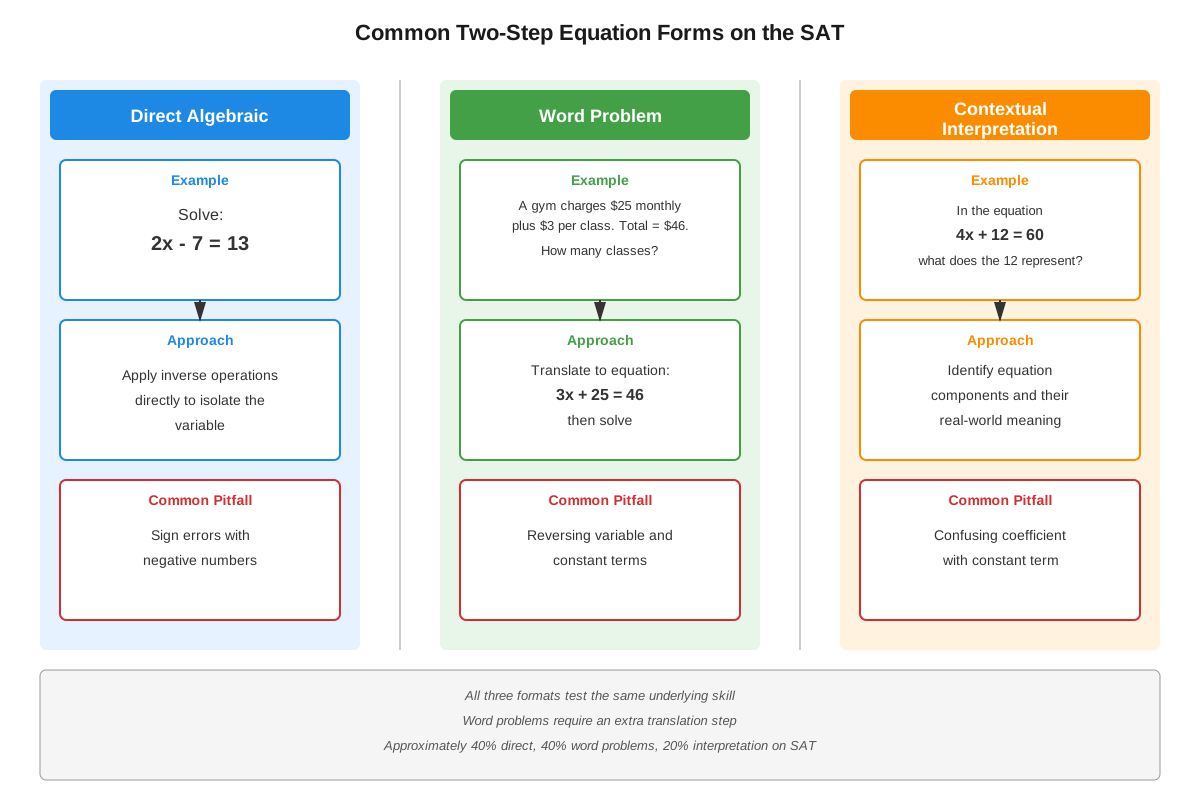
On the SAT, two-step equations appear in approximately 3-5 questions per test, representing roughly 5-8% of the total math score. These questions appear in both the calculator and no-calculator sections, testing both computational accuracy and conceptual understanding. The College Board presents these equations in three primary formats: direct algebraic equations requiring solution, word problems requiring equation setup and solution, and questions asking students to identify equivalent forms or interpret solution meanings.
Common SAT question types include: solving for a variable and selecting the correct answer from multiple choices, determining the value of an expression containing the variable, identifying which equation represents a described situation, and finding the value of constants that make equations have specific solutions. Two-step equations also appear as components within more complex problems, making fluency essential for efficient test-taking.
Core Concepts
Definition and Structure of Two-Step Equations
A two-step equation is a linear equation in one variable that requires exactly two inverse operations to isolate the variable. The standard form follows the pattern: ax + b = c or b + ax = c, where a, b, and c are constants and x is the variable. The "two steps" refer to the two operations needed: first eliminating the constant term through addition or subtraction, then eliminating the coefficient through multiplication or division.
The structure always involves two different operations acting on the variable. For example, in the equation 3x + 7 = 22, the variable x is first multiplied by 3, then 7 is added. To solve, these operations must be reversed in the opposite order: first subtract 7, then divide by 3. This reversal follows directly from the order of operations—we undo operations in reverse order of how they were applied.
The Inverse Operations Principle
Inverse operations are mathematical operations that undo each other. The four pairs of inverse operations are:
| Operation | Inverse Operation |
|---|---|
| Addition (+) | Subtraction (−) |
| Subtraction (−) | Addition (+) |
| Multiplication (×) | Division (÷) |
| Division (÷) | Multiplication (×) |
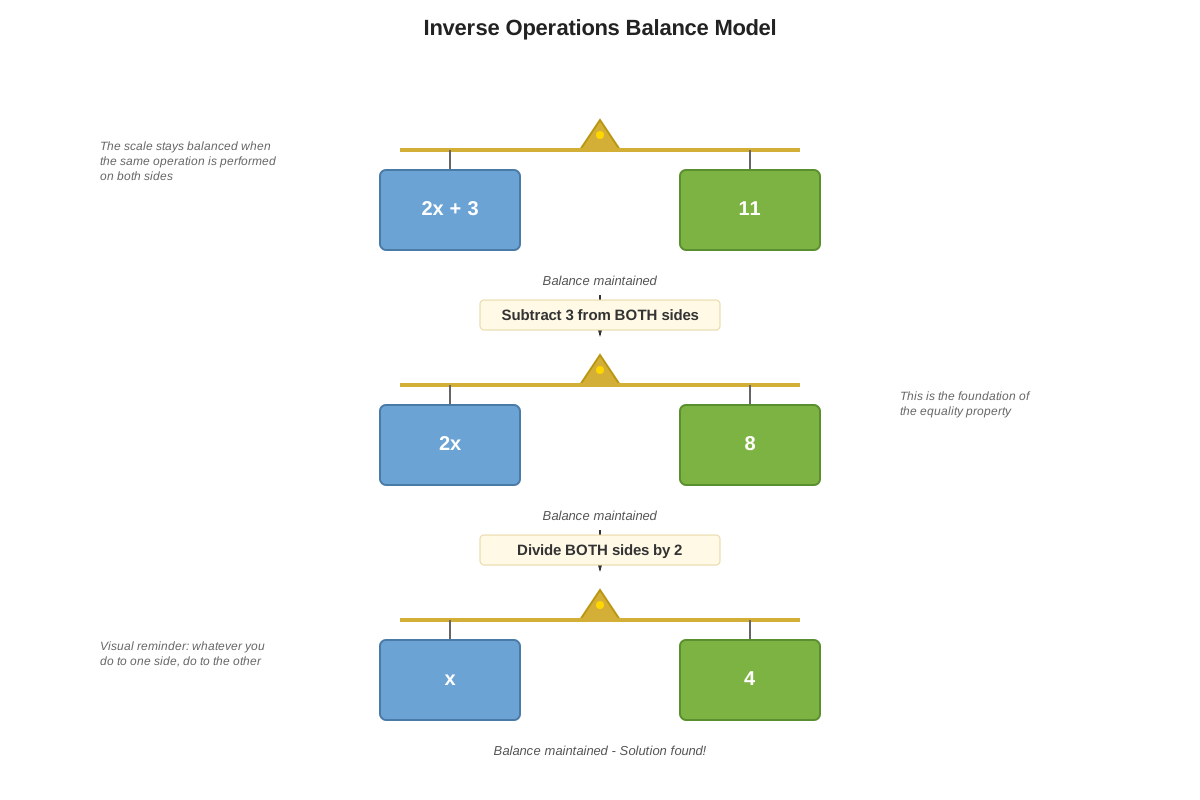
When solving equations, applying an inverse operation to both sides maintains the equality while simplifying the equation. This principle, known as the properties of equality, ensures that whatever value satisfies the original equation will also satisfy each transformed version. The key insight is that equations remain balanced when identical operations are performed on both sides.
Step-by-Step Solution Process
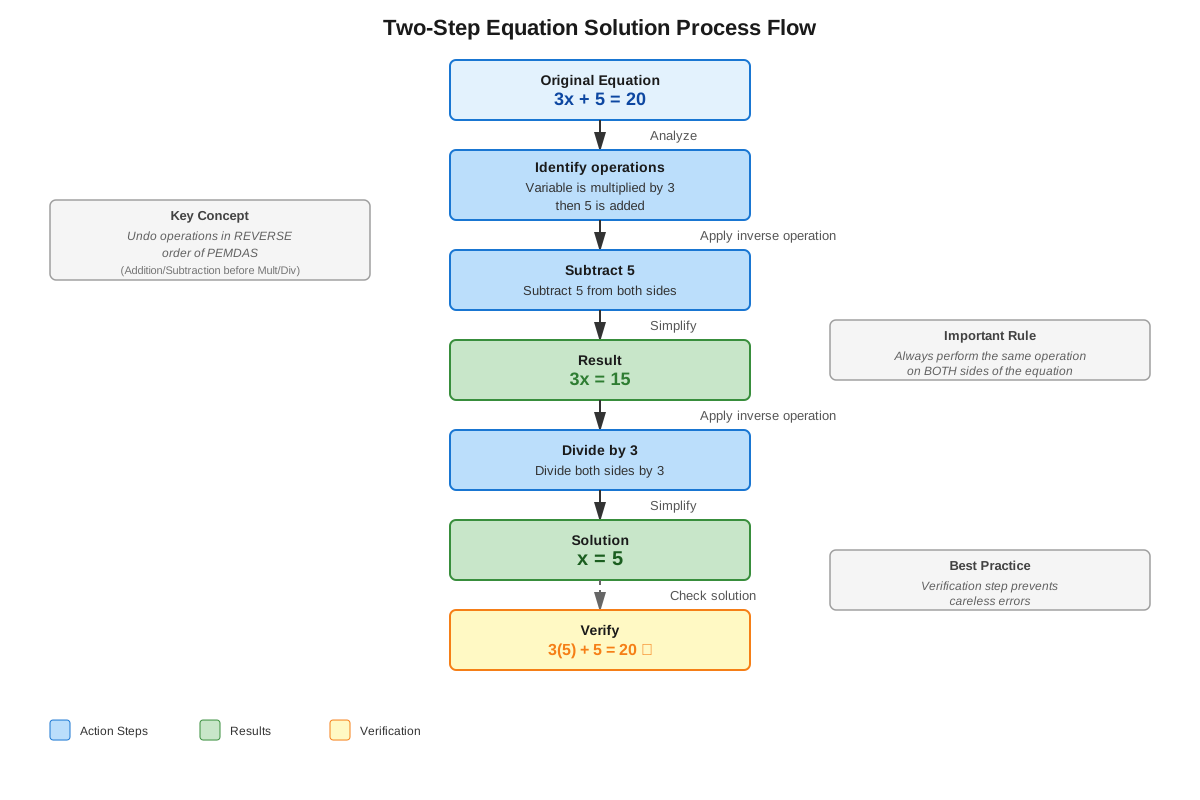
The systematic approach to solving two-step equations follows this sequence:
- Identify the operations: Determine which two operations are being performed on the variable and in what order
- Eliminate the constant term: Use addition or subtraction to remove the constant that is added to or subtracted from the variable term
- Simplify both sides: Combine like terms after the first operation
- Eliminate the coefficient: Use multiplication or division to remove the number multiplying the variable
- Simplify to find the solution: Perform the final calculation to determine the variable's value
- Verify the solution: Substitute the answer back into the original equation to confirm accuracy
Consider the equation 5x − 8 = 17. The variable x is multiplied by 5, then 8 is subtracted. To solve:
- Add 8 to both sides: 5x − 8 + 8 = 17 + 8, which simplifies to 5x = 25
- Divide both sides by 5: 5x ÷ 5 = 25 ÷ 5, which gives x = 5
- Verify: 5(5) − 8 = 25 − 8 = 17 ✓
Equations with Negative Coefficients
When the coefficient is negative, special attention to sign conventions prevents errors. In the equation −4x + 9 = 1, the variable is multiplied by −4, then 9 is added. The solution process:
- Subtract 9 from both sides: −4x + 9 − 9 = 1 − 9, giving −4x = −8
- Divide both sides by −4: −4x ÷ (−4) = −8 ÷ (−4), yielding x = 2
Remember that dividing two negative numbers produces a positive result. Many students incorrectly obtain x = −2 by forgetting this rule.
Equations with Fractions and Decimals
Two-step equations frequently involve rational coefficients on the SAT. For the equation x/3 + 5 = 11:
- Subtract 5 from both sides: x/3 = 6
- Multiply both sides by 3: x = 18
Alternatively, when dealing with fractional coefficients like (2/3)x − 4 = 10:
- Add 4 to both sides: (2/3)x = 14
- Multiply both sides by the reciprocal 3/2: x = 14 × (3/2) = 21
For decimal equations such as 0.5x + 3.2 = 8.7:
- Subtract 3.2 from both sides: 0.5x = 5.5
- Divide both sides by 0.5: x = 11
Variable on the Right Side
When the variable appears on the right side of the equation, the same principles apply. For 15 = 2x + 7:
- Subtract 7 from both sides: 8 = 2x
- Divide both sides by 2: 4 = x, or equivalently, x = 4
The equation remains balanced regardless of which side contains the variable, though many students find it more intuitive to rewrite with the variable on the left.
Word Problems and Two-Step Equations
The SAT frequently embeds two-step equations within real-world contexts. Translating word problems requires identifying:
- The unknown quantity (variable)
- The operations performed on that quantity
- The final result or condition
For example: "A taxi charges a $3 base fare plus $2 per mile. If a ride costs $17, how many miles was the trip?" This translates to: 2x + 3 = 17, where x represents miles traveled.
Concept Relationships
The concepts within two-step equations form a logical hierarchy. Inverse operations serve as the fundamental principle → enabling the step-by-step solution process → which applies differently depending on whether equations contain negative coefficients, fractions/decimals, or have variables on different sides. All these variations ultimately rely on the same core principle: performing inverse operations in reverse order to isolate the variable.
Two-step equations build directly on prerequisite knowledge of basic arithmetic operations and order of operations. The PEMDAS sequence explains why we undo addition/subtraction before multiplication/division—we reverse the order in which operations were originally applied. Understanding properties of equality from earlier math courses provides the theoretical justification for why applying operations to both sides maintains valid equations.
This topic connects forward to numerous advanced concepts. Mastering two-step equations enables progression to multi-step equations (which simply add more operations), solving inequalities (which uses identical techniques with one additional rule about reversing inequality signs), literal equations (solving for one variable in terms of others), and systems of equations (which often require solving two-step equations as intermediate steps). The logical thinking developed here transfers to virtually all algebraic manipulation throughout high school mathematics.
High-Yield Facts
⭐ Two-step equations require exactly two inverse operations performed in reverse order of the original operations
⭐ Always eliminate the constant term (addition/subtraction) before eliminating the coefficient (multiplication/division)
⭐ Whatever operation is performed on one side of an equation must be performed on the other side to maintain equality
⭐ Dividing or multiplying both sides by a negative number does not change the equality, but requires careful attention to signs
⭐ The solution can and should be verified by substituting the value back into the original equation
- When a variable has a fractional coefficient, multiply both sides by the reciprocal to isolate the variable efficiently
- Equations with decimals can be solved directly or by first multiplying both sides by a power of 10 to eliminate decimals
- The variable can appear on either side of the equation without changing the solution method
- Two-step equations in word problems typically involve one fixed cost and one variable cost
- Combining like terms before applying inverse operations can sometimes simplify the solution process
- The coefficient of the variable can never be zero in a valid two-step equation (this would make it a one-step equation or create a contradiction)
Quick check — test yourself on Solving two-step equations so far.
Try Flashcards →Common Misconceptions
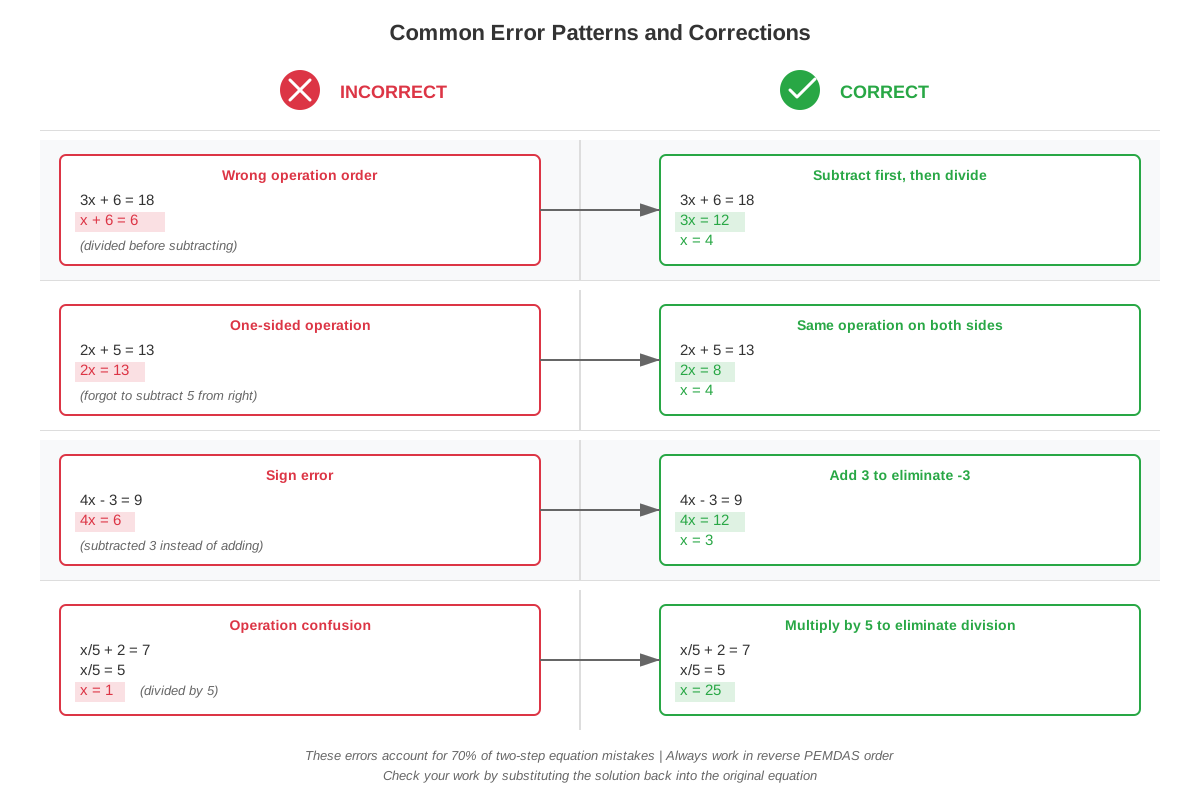
Misconception: Students should always divide before subtracting when solving equations. → Correction: The order of operations must be reversed, meaning addition/subtraction operations are undone first, then multiplication/division operations. The equation 3x + 5 = 20 requires subtracting 5 before dividing by 3.
Misconception: When dividing both sides by a negative number, the answer becomes negative. → Correction: The sign of the answer depends on the sign of the numerator after division. In −2x = 10, dividing both sides by −2 gives x = −5 (negative divided by negative equals positive), but in −2x = −10, the result is x = 5.
Misconception: Operations only need to be performed on the side of the equation containing the variable. → Correction: The properties of equality require performing identical operations on both sides. If you subtract 7 from the left side of 2x + 7 = 15, you must also subtract 7 from the right side to maintain the equality.
Misconception: The equation 5 + 2x = 17 is different from 2x + 5 = 17 and requires a different solution method. → Correction: By the commutative property of addition, these equations are identical and solve the same way. The order of terms being added doesn't affect the solution process.
Misconception: Checking the answer is optional and wastes time on the SAT. → Correction: Verification takes only seconds and catches calculation errors that would otherwise cost points. Substituting x = 4 into 3x − 5 = 7 to confirm that 3(4) − 5 = 7 is true provides certainty and is worth the minimal time investment.
Misconception: Equations with fractions are fundamentally different from equations with whole numbers. → Correction: The same inverse operations principle applies; only the arithmetic becomes slightly more complex. The equation x/4 + 3 = 7 solves by subtracting 3, then multiplying by 4, following the identical logical structure as equations with integer coefficients.
Worked Examples
Example 1: Standard Two-Step Equation
Problem: Solve for x: 7x − 12 = 30
Solution:
Step 1: Identify the operations. The variable x is multiplied by 7, then 12 is subtracted from the result.
Step 2: Eliminate the constant term by performing the inverse of subtraction (addition). Add 12 to both sides:
7x − 12 + 12 = 30 + 12
7x = 42
Step 3: Eliminate the coefficient by performing the inverse of multiplication (division). Divide both sides by 7:
7x ÷ 7 = 42 ÷ 7
x = 6
Step 4: Verify the solution by substituting x = 6 into the original equation:
7(6) − 12 = 42 − 12 = 30 ✓The solution x = 6 satisfies the original equation, confirming our answer.
Connection to Learning Objectives: This example demonstrates the systematic application of inverse operations in the correct sequence, directly addressing the objective to execute the correct sequence and verify solutions.
Example 2: Word Problem Application
Problem: A gym membership costs $25 per month plus a one-time enrollment fee. If the total cost for 6 months is $185, what is the enrollment fee?
Solution:
Step 1: Translate the word problem into an equation. Let f represent the enrollment fee. The total cost equals the monthly cost times the number of months plus the enrollment fee:
6(25) + f = 185
150 + f = 185
Step 2: This is now a two-step equation (though simplified from the word problem). Identify that f has 150 added to it.
Step 3: Eliminate the constant by subtracting 150 from both sides:
150 + f − 150 = 185 − 150
f = 35
Step 4: Verify by checking if 6 months at $25 per month plus a $35 enrollment fee equals $185:
6(25) + 35 = 150 + 35 = 185 ✓The enrollment fee is $35.
Connection to Learning Objectives: This example addresses the objective to translate word problems into two-step equations and demonstrates how SAT questions embed algebraic concepts in real-world contexts.
Example 3: Equation with Negative Coefficient and Fraction
Problem: Solve for x: −(2/5)x + 7 = 3
Solution:
Step 1: Identify operations. The variable x is multiplied by −2/5, then 7 is added.
Step 2: Eliminate the constant term by subtracting 7 from both sides:
−(2/5)x + 7 − 7 = 3 − 7
−(2/5)x = −4
Step 3: Eliminate the coefficient by multiplying both sides by the reciprocal of −2/5, which is −5/2:
−(2/5)x × (−5/2) = −4 × (−5/2)
x = 20/2
x = 10
Note: Multiplying two negative numbers produces a positive result.
Step 4: Verify by substituting x = 10:
−(2/5)(10) + 7 = −4 + 7 = 3 ✓The solution is x = 10.
Connection to Learning Objectives: This example demonstrates handling negative coefficients and fractions, addressing the objective to recognize and avoid common algebraic manipulation errors.
Exam Strategy
When approaching two-step equation questions on the SAT, begin by quickly scanning the equation to identify its structure. Look for the two operations being performed on the variable and mentally note the order in which you'll undo them. This pre-planning prevents the common error of performing operations in the wrong sequence.
Trigger words and phrases in word problems that signal two-step equations include: "plus a fee," "in addition to," "after a discount," "base rate plus," "flat fee and," and "initial amount plus." These phrases indicate a constant term separate from the variable term. Questions asking "solve for x" or "what is the value of x" directly signal equation-solving tasks.
For process of elimination, incorrect answer choices often result from predictable errors:
- Performing operations in the wrong order (undoing multiplication before addition)
- Sign errors when working with negative coefficients
- Arithmetic mistakes in the final calculation
- Forgetting to perform an operation on both sides
If time is limited, you can sometimes work backward by substituting each answer choice into the original equation, though this is less efficient than solving directly.
Time allocation for two-step equation questions should be approximately 30-45 seconds for straightforward algebraic equations and 60-90 seconds for word problems requiring translation. If a question takes longer, mark it for review and move on—these are considered medium-difficulty questions, and spending excessive time indicates a conceptual gap that won't resolve under pressure.
Exam Tip: Always perform a quick mental check after solving. Ask: "Does this answer make sense given the context?" If a word problem asks for a number of items and your answer is negative or a fraction, you've likely made an error.
Memory Techniques
DADC Mnemonic for the solution sequence:
- Determine the operations
- Add or subtract to eliminate the constant
- Divide or multiply to eliminate the coefficient
- Check your answer
"Undo in Reverse" Visualization: Picture the equation as a wrapped package. The variable is the gift inside, the coefficient is the inner wrapping paper, and the constant is the outer box. To reach the gift, you must remove the outer box first (constant), then unwrap the paper (coefficient).
"Both Sides Balance" Mantra: Whenever performing an operation, mentally say "both sides" to reinforce that the operation must be applied to both sides of the equation. This prevents the common error of only operating on one side.
Reciprocal Reminder: For fractional coefficients, remember "flip and multiply." The reciprocal of a/b is b/a, and multiplying by the reciprocal is the inverse of multiplying by the original fraction.
Sign Check Acronym - NNN = P: "Negative times Negative times Negative equals Positive" helps remember that an even number of negative signs produces a positive result, while an odd number produces a negative result.
Summary
Solving two-step equations is a fundamental algebraic skill that appears frequently on the SAT and serves as the foundation for more advanced mathematical concepts. These equations require exactly two inverse operations—typically eliminating a constant term through addition or subtraction, followed by eliminating a coefficient through multiplication or division. The key to success lies in performing operations in the correct sequence (reverse order of the original operations), applying operations to both sides of the equation to maintain equality, and carefully managing signs when working with negative numbers. Students must be able to solve equations presented in standard algebraic form, translate word problems into equations, and work confidently with whole numbers, fractions, and decimals. Verification through substitution provides a reliable check against calculation errors. Mastery of two-step equations directly impacts performance on 5-8% of SAT math questions and enables progression to more complex algebraic topics including multi-step equations, inequalities, and systems of equations.
Key Takeaways
- Two-step equations require exactly two inverse operations performed in reverse order: eliminate the constant first, then eliminate the coefficient
- The properties of equality require performing identical operations on both sides of the equation to maintain balance
- Negative coefficients demand careful attention to sign rules, particularly remembering that dividing two negatives produces a positive result
- Word problems on the SAT frequently embed two-step equations in real-world contexts involving fixed costs plus variable costs
- Always verify solutions by substituting the answer back into the original equation—this catches errors and takes minimal time
- Fractional coefficients are eliminated by multiplying both sides by the reciprocal, not by dividing
- The systematic DADC approach (Determine, Add/subtract, Divide/multiply, Check) provides a reliable framework for solving any two-step equation
Related Topics
Multi-Step Equations: Building on two-step equations, these problems require three or more operations and often involve combining like terms or using the distributive property. Mastering two-step equations makes multi-step equations a natural progression.
Solving Linear Inequalities: Uses identical solution techniques as two-step equations with one additional rule about reversing inequality signs when multiplying or dividing by negative numbers.
Literal Equations and Formulas: Applies two-step equation techniques to solve for one variable in terms of others, such as solving d = rt for t or converting temperature formulas.
Systems of Linear Equations: Often requires solving two-step equations as intermediate steps when using substitution or elimination methods.
Linear Functions and Slope: Understanding how to manipulate linear equations connects directly to working with function notation and finding slopes from equations.
Practice CTA
Now that you've mastered the core concepts of solving two-step equations, it's time to solidify your understanding through practice. Attempt the practice questions to apply these techniques under test-like conditions, and use the flashcards to reinforce key concepts and common patterns. Remember, fluency with two-step equations isn't just about getting the right answer—it's about developing the systematic thinking that will serve you throughout the SAT math section. Each practice problem you solve builds the confidence and speed you need for test day success. You've got this!
Sign up free to keep reading
Create a free AnvayaPrep account to finish this SAT guide on Solving two-step equations — plus flashcards and practice questions.