Overview
Comparing linear functions is a fundamental skill tested extensively on the SAT math section, appearing in multiple question formats across both calculator and no-calculator portions. This topic requires students to analyze linear relationships presented in various representations—equations, graphs, tables, and verbal descriptions—and determine which function has specific characteristics such as a greater slope, higher y-intercept, or faster rate of change. Mastery of this concept is essential because it forms the foundation for understanding more complex mathematical relationships and appears in approximately 10-15% of SAT math questions.
The ability to compare linear functions demonstrates mathematical fluency that extends beyond simple computation. Students must synthesize information from different formats, translate between representations, and make quantitative comparisons—skills that the College Board considers critical for college readiness. Questions on sat comparing linear functions often integrate multiple concepts simultaneously, requiring students to identify slopes from graphs, extract rates of change from tables, and interpret y-intercepts from equations all within a single problem.
Understanding how to compare linear functions connects directly to broader mathematical concepts including systems of equations, inequalities, and data analysis. This topic serves as a bridge between basic algebraic manipulation and more sophisticated problem-solving involving real-world scenarios such as comparing costs, analyzing trends, and making predictions based on linear models. The comparative nature of these problems also develops critical thinking skills that appear throughout the SAT, making this one of the highest-yield topics for focused study.
Learning Objectives
- [ ] Identify key features of comparing linear functions including slope, y-intercept, and rate of change
- [ ] Explain how comparing linear functions appears on the SAT in various question formats
- [ ] Apply comparing linear functions to answer SAT-style questions across multiple representations
- [ ] Convert between different representations of linear functions (equations, graphs, tables, descriptions) to facilitate comparison
- [ ] Determine which linear function has a greater rate of change when presented in mixed formats
- [ ] Analyze real-world scenarios involving linear relationships and make quantitative comparisons
- [ ] Identify intersection points and interpret their meaning when comparing two linear functions
Prerequisites
- Slope-intercept form (y = mx + b): Essential for quickly identifying and comparing slopes and y-intercepts from equations
- Calculating slope from two points: Necessary when comparing functions presented as tables or coordinate pairs
- Reading and interpreting graphs: Required to extract slope and y-intercept information from visual representations
- Understanding rate of change: Fundamental to recognizing that slope represents how quickly one variable changes relative to another
- Basic algebraic manipulation: Needed to convert between different forms of linear equations for comparison purposes
Why This Topic Matters
In real-world applications, comparing linear functions appears constantly in decision-making scenarios. Consumers compare phone plans with different monthly fees and per-minute charges, businesses analyze competing pricing structures, and scientists compare rates of change in experimental data. The ability to determine which option is better under specific conditions—a core skill in comparing linear functions—translates directly to practical financial literacy and analytical reasoning.
On the SAT, comparing linear functions appears in approximately 3-5 questions per test, making it one of the most frequently tested concepts in the Linear Functions unit. These questions typically appear as multiple-choice problems worth 1 point each, but they also surface in student-produced response (grid-in) questions. The College Board particularly favors questions that present functions in different formats—for example, one function as a graph and another as an equation—testing whether students can flexibly work across representations.
Common SAT question formats include: comparing slopes when one function is graphed and another is given as a table; determining which function has a greater y-intercept when presented in different forms; identifying which linear model grows faster over a specific interval; finding the point where two functions have equal values; and analyzing real-world scenarios where two linear relationships must be compared to make a decision. The topic frequently appears in context-based questions involving distance-time relationships, cost comparisons, and population growth models.
Core Concepts
Understanding Linear Function Components
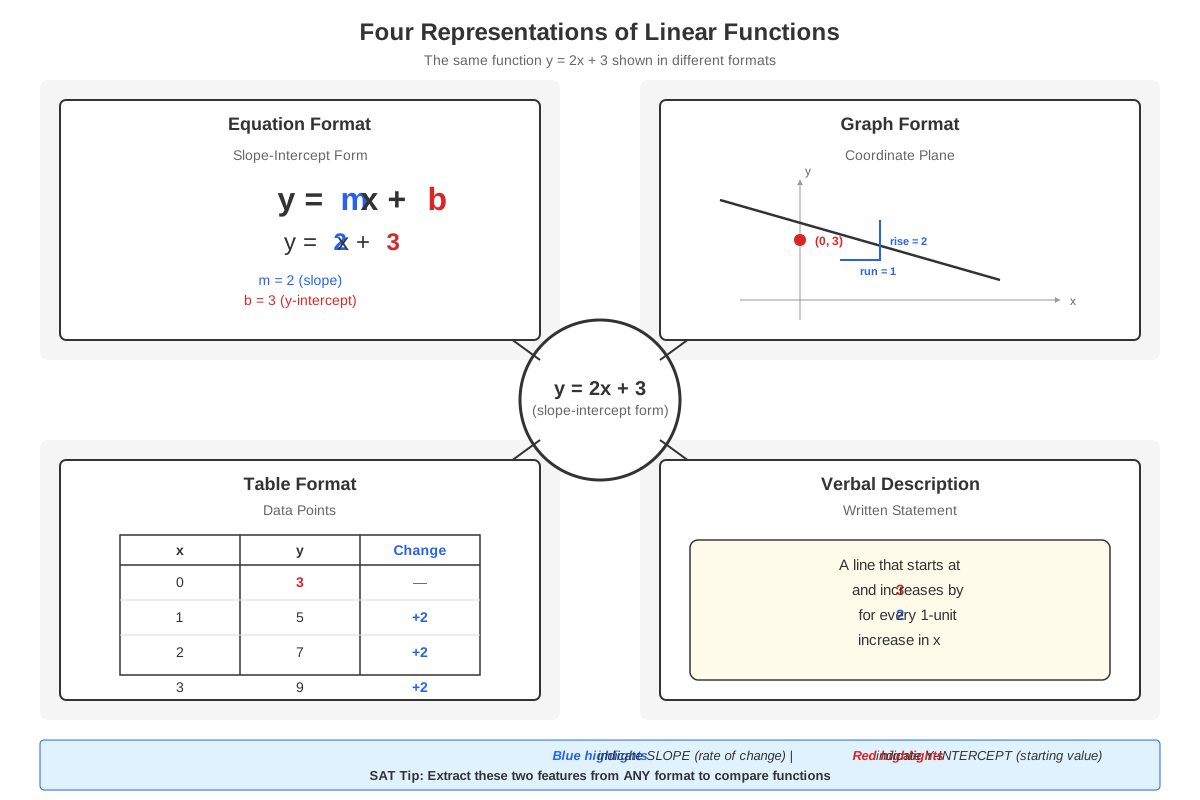
A linear function can be expressed in the form y = mx + b, where m represents the slope (rate of change) and b represents the y-intercept (initial value). When comparing linear functions, these two components serve as the primary basis for comparison. The slope indicates how steep the line is and whether it increases or decreases, while the y-intercept shows where the line crosses the y-axis, representing the starting value when the independent variable equals zero.
The slope can be calculated using the formula m = (y₂ - y₁)/(x₂ - x₁) when given two points, or it can be identified directly from an equation in slope-intercept form. A positive slope indicates an increasing function, a negative slope indicates a decreasing function, and a slope of zero indicates a horizontal line. When comparing two linear functions, the function with the greater absolute value of slope changes more rapidly, though the direction of change (positive or negative) must also be considered.
Comparing Functions in Different Representations
The SAT deliberately presents linear functions in various formats to test conceptual understanding rather than rote memorization. Students must develop fluency in extracting key features from each representation:
| Representation | How to Find Slope | How to Find Y-Intercept |
|---|---|---|
| Equation (y = mx + b) | Coefficient of x | Constant term |
| Graph | Rise over run between two points | Where line crosses y-axis |
| Table | Change in y ÷ change in x | Value of y when x = 0 |
| Verbal Description | Rate of change stated in problem | Initial value or starting amount |
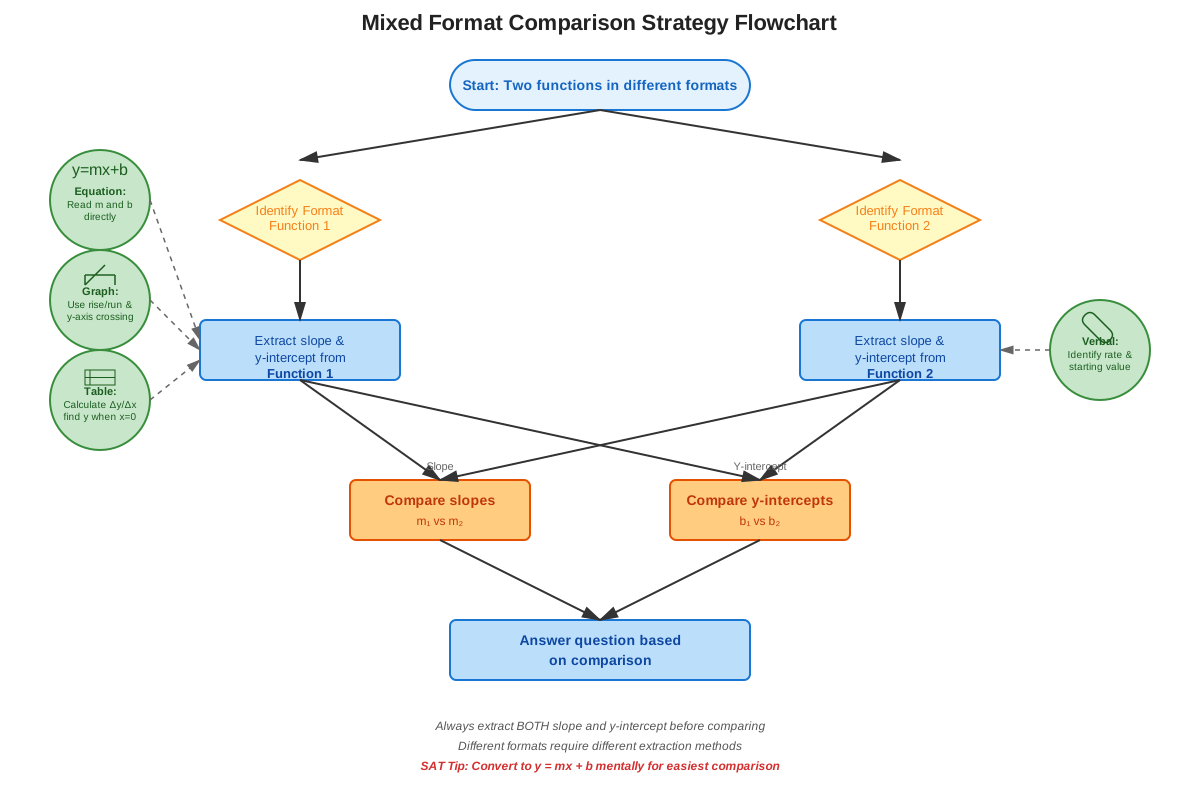
When comparing functions presented in different formats, the key strategy involves converting all functions to a common representation or extracting the same features from each. For example, if Function A is given as a graph and Function B as an equation, calculate the slope from the graph and compare it to the coefficient of x in the equation.
Rate of Change Analysis
The rate of change is synonymous with slope in linear functions and represents how much the dependent variable changes for each unit increase in the independent variable. When comparing rates of change, consider both magnitude and direction. A function with a slope of 5 has a greater rate of increase than a function with a slope of 3, but a function with a slope of -2 has a greater rate of decrease than a function with a slope of -1.
In real-world contexts, rate of change often appears with units: dollars per hour, miles per gallon, or degrees per minute. When comparing such functions, the one with the greater rate of change will reach higher values more quickly (for positive slopes) or decrease more rapidly (for negative slopes). SAT questions frequently ask which function will have a greater value after a specific time period, requiring students to consider both the initial value and the rate of change.
Intersection Points and Crossover Analysis
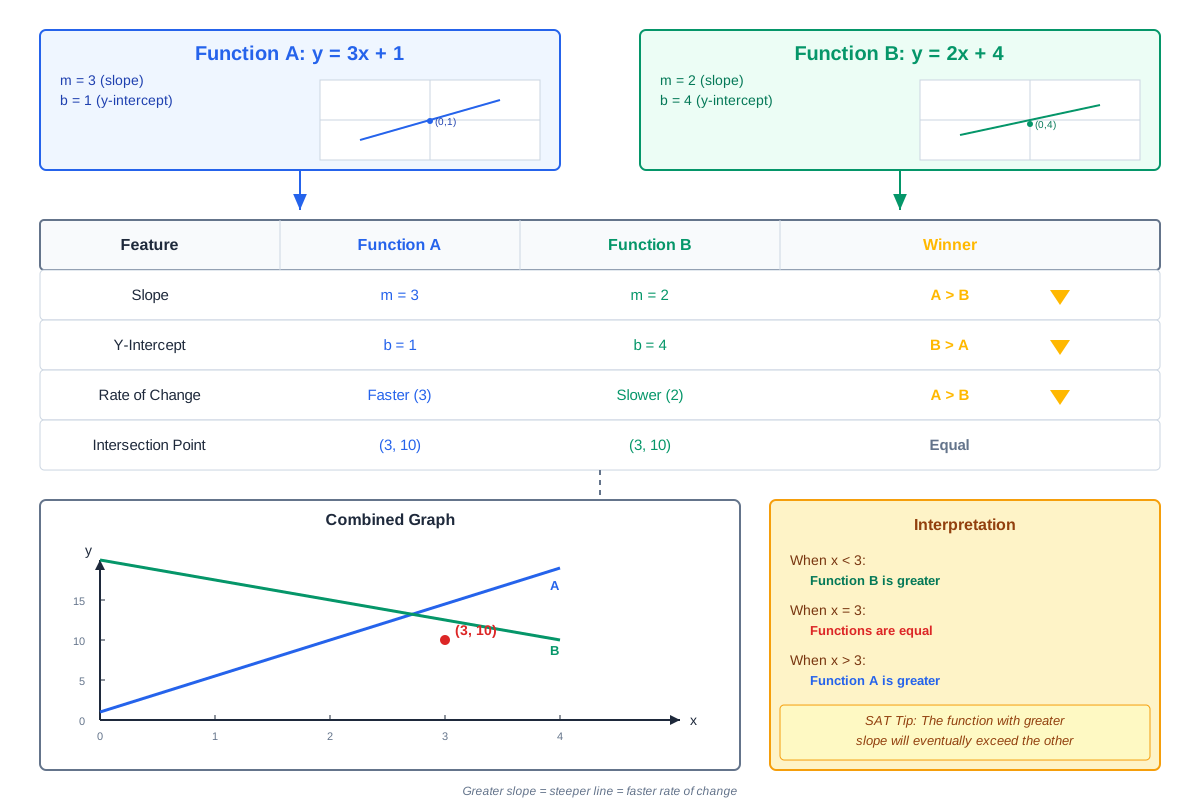
When comparing two linear functions, the intersection point represents the input value where both functions produce the same output. This concept is crucial for SAT questions asking "when will the two quantities be equal?" or "at what point does Function A exceed Function B?" To find an intersection point algebraically, set the two functions equal to each other and solve for x, then substitute back to find y.
The intersection point divides the domain into regions where one function is greater than the other. If Function A has a smaller y-intercept but a greater slope than Function B, there will be an intersection point after which Function A exceeds Function B. Understanding this relationship allows students to answer comparison questions for specific input values without calculating exact outputs.
Comparing Initial Values and Long-Term Behavior
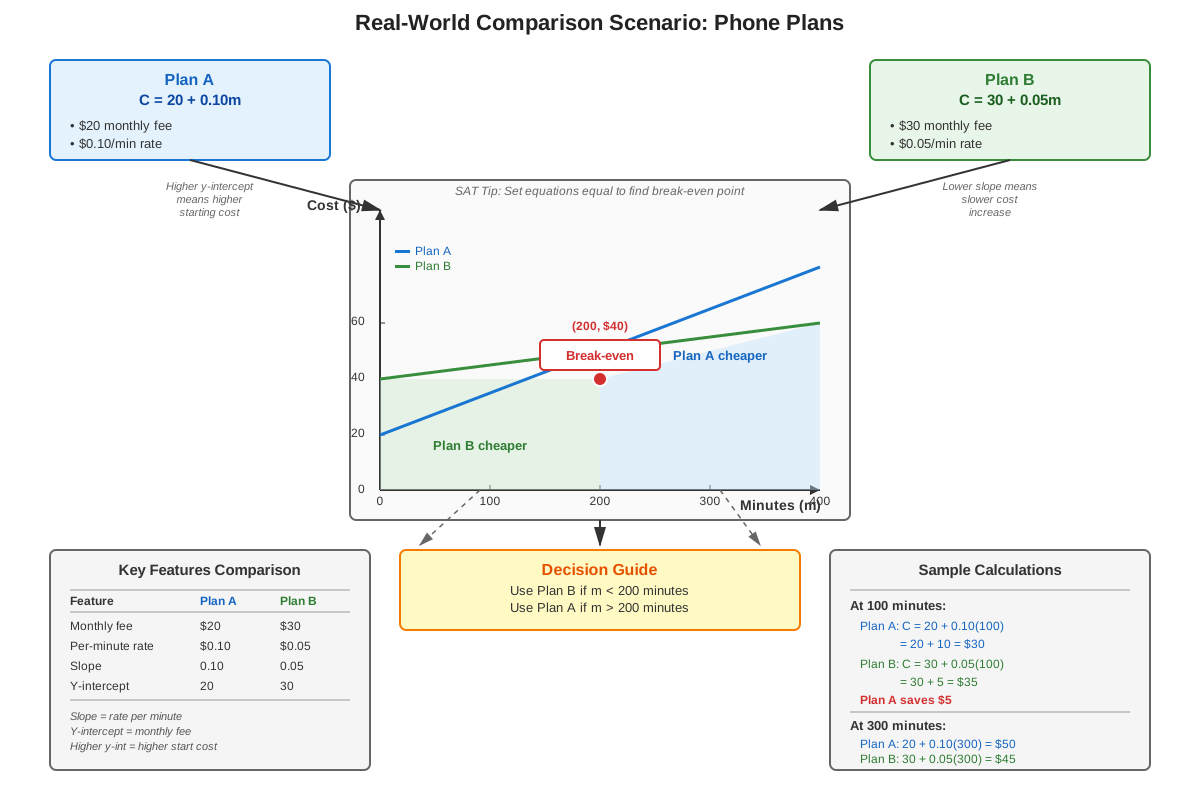
When comparing linear functions, distinguish between initial value (y-intercept) and long-term behavior (determined by slope). A function may start with a higher value but grow more slowly, eventually being overtaken by a function with a lower initial value but steeper slope. This scenario appears frequently in SAT word problems involving competing plans or options.
For example, consider two phone plans: Plan A costs $30 per month plus $0.10 per minute, while Plan B costs $20 per month plus $0.15 per minute. Plan A has a higher initial cost (y-intercept) but lower rate of change (slope). For low usage, Plan B is cheaper, but there exists a crossover point where Plan A becomes more economical. SAT questions often ask students to determine which option is better under specific conditions or to find the crossover point.
Parallel and Perpendicular Comparisons
While less common in comparison questions, understanding parallel and perpendicular relationships provides additional comparison tools. Parallel lines have identical slopes but different y-intercepts, meaning they never intersect and maintain a constant vertical distance. Perpendicular lines have slopes that are negative reciprocals (m₁ × m₂ = -1), creating a 90-degree angle at their intersection.
When comparing functions to determine if they're parallel, simply compare slopes—if equal, the lines are parallel. For perpendicular lines, multiply the slopes; if the product equals -1, the lines are perpendicular. These relationships occasionally appear in SAT geometry problems that integrate coordinate geometry with linear functions.
Concept Relationships
The core concepts within comparing linear functions build upon each other in a logical progression. Understanding linear function components (slope and y-intercept) → enables extraction of these features from different representations → which facilitates rate of change analysis → leading to the ability to determine intersection points → ultimately allowing for comprehensive comparison of initial values and long-term behavior.
This topic connects directly to prerequisite knowledge of slope-intercept form, as this representation provides the most efficient framework for comparison. The ability to calculate slope from two points enables students to work with functions presented as tables or graphs. Understanding rate of change extends to more advanced topics including exponential functions (where rate of change is not constant) and calculus concepts (derivatives as instantaneous rates of change).
Comparing linear functions also serves as foundational knowledge for systems of linear equations, where finding intersection points becomes the primary objective. The skills developed here transfer to analyzing inequalities, where students must determine regions where one function exceeds another. Additionally, this topic connects to data analysis and statistics, where linear regression models must be compared to determine which better fits a dataset.
Quick check — test yourself on Comparing linear functions so far.
Try Flashcards →High-Yield Facts
⭐ The slope (m) represents the rate of change and determines how quickly a function increases or decreases
⭐ The y-intercept (b) represents the initial value when the independent variable equals zero
⭐ When comparing functions in different formats, extract slope and y-intercept from each representation first
⭐ A function with a greater slope will eventually exceed a function with a smaller slope, regardless of initial values
⭐ The intersection point of two linear functions occurs where their outputs are equal for the same input
- To find slope from a table, calculate (change in y)/(change in x) between any two points
- To find slope from a graph, identify two clear points and use rise over run
- Parallel lines have equal slopes but different y-intercepts
- A steeper line (greater absolute value of slope) changes more rapidly
- When comparing word problems, identify which quantity represents the slope and which represents the y-intercept
- Negative slopes indicate decreasing functions; positive slopes indicate increasing functions
- The function with the greater y-intercept starts higher but may not remain higher
- To compare function values at a specific input, substitute that value into both functions
- Functions with the same slope never intersect (parallel lines)
- The crossover point is where one function changes from being less than to greater than another function
Common Misconceptions
Misconception: The function with the greater y-intercept is always greater for all input values → Correction: The y-intercept only determines the starting value. A function with a smaller y-intercept but greater slope will eventually exceed the function with the larger y-intercept after their intersection point.
Misconception: A steeper-looking line always has a greater slope → Correction: Visual steepness depends on the scale of the axes. Always calculate slope numerically rather than relying on visual appearance, especially when comparing a graph to an equation or table.
Misconception: Slope is calculated as (x₂ - x₁)/(y₂ - y₁) → Correction: Slope is the change in y divided by the change in x: (y₂ - y₁)/(x₂ - x₁). Reversing this formula is one of the most common errors in comparing functions from tables or graphs.
Misconception: When comparing rates of change, -5 is greater than -2 → Correction: While -5 is less than -2 as a number, a slope of -5 represents a greater rate of decrease (steeper downward slope) than -2. Context determines whether "greater" refers to numerical value or magnitude of change.
Misconception: The intersection point is where the lines cross the y-axis → Correction: The intersection point is where two functions have the same output for the same input, which can occur anywhere in the coordinate plane. The y-intercept is specifically where a single function crosses the y-axis (when x = 0).
Misconception: Functions presented in different formats cannot be compared directly → Correction: Functions in any format can be compared by extracting the same features (slope and y-intercept) from each representation, then comparing these features numerically.
Misconception: A function with a greater rate of change is always better or more desirable → Correction: Whether a greater rate of change is preferable depends on context. In cost scenarios, a lower rate of increase is typically better; in profit scenarios, a higher rate of increase is better.
Worked Examples
Example 1: Comparing Functions in Mixed Formats
Problem: Function f is defined by f(x) = 3x + 5. Function g is represented by the table below. Which function has the greater rate of change?
| x | g(x) |
|---|---|
| 0 | 2 |
| 2 | 10 |
| 4 | 18 |
Solution:
Step 1: Identify the rate of change (slope) for function f.
From the equation f(x) = 3x + 5, the coefficient of x is 3, so the slope is 3.
Step 2: Calculate the rate of change for function g from the table.
Using any two points, calculate: slope = (change in y)/(change in x)
Using (0, 2) and (2, 10): slope = (10 - 2)/(2 - 0) = 8/2 = 4
Step 3: Compare the rates of change.
Function f has a rate of change of 3.
Function g has a rate of change of 4.
Therefore, function g has the greater rate of change.
Connection to Learning Objectives: This example demonstrates the ability to extract slope from different representations (equation and table) and make a direct comparison, addressing the core skill of comparing linear functions across formats.
Example 2: Real-World Comparison with Crossover Point
Problem: Company A charges a $50 setup fee plus $20 per month for internet service. Company B charges no setup fee but $30 per month. After how many months will the total cost be the same for both companies? Which company is cheaper for 8 months of service?
Solution:
Step 1: Write equations for both companies.
Let x = number of months and y = total cost
Company A: y = 20x + 50 (slope = 20, y-intercept = 50)
Company B: y = 30x + 0 (slope = 30, y-intercept = 0)
Step 2: Find when costs are equal by setting equations equal.
20x + 50 = 30x
50 = 30x - 20x
50 = 10x
x = 5 months
Step 3: Determine which is cheaper for 8 months.
Company A at 8 months: y = 20(8) + 50 = 160 + 50 = $210
Company B at 8 months: y = 30(8) = $240
Company A is cheaper for 8 months of service.
Analysis: Company B starts cheaper (lower y-intercept) but has a higher monthly rate (greater slope). The crossover occurs at 5 months. For usage less than 5 months, Company B is cheaper; for usage greater than 5 months, Company A is cheaper. This demonstrates how initial value and rate of change interact in real-world comparisons.
Connection to Learning Objectives: This example applies comparing linear functions to a real-world scenario, requires finding an intersection point, and demonstrates how to determine which function is greater for a specific input value.
Exam Strategy
When approaching SAT questions on comparing linear functions, begin by identifying the format of each function presented. If functions appear in different representations, immediately extract the slope and y-intercept from each before attempting to answer the question. This systematic approach prevents errors caused by comparing incompatible information.
Trigger words and phrases to watch for include: "greater rate of change" (comparing slopes), "initial value" or "starting amount" (comparing y-intercepts), "after x units" (substitute specific value), "when will they be equal" (find intersection point), "which is greater when x = ..." (evaluate both functions), and "eventually exceeds" (compare slopes to determine long-term behavior).
For process of elimination, recognize that answer choices often include common calculation errors. If you calculate a slope of 3 but see answer choices of 3, -3, 1/3, and -1/3, the incorrect options likely represent sign errors or reciprocal mistakes. When comparing functions, eliminate answers that contradict the basic relationship between slope and rate of change—for example, if Function A has a slope of 5 and Function B has a slope of 3, eliminate any answer stating that Function B increases faster.
Time allocation for comparing linear functions questions should be approximately 1-1.5 minutes per question. If a question requires multiple steps (extracting features from different formats, then comparing, then evaluating at a specific point), budget up to 2 minutes. If you cannot identify the slope or y-intercept within 30 seconds, move to a different approach such as testing answer choices or evaluating both functions at a specific value.
Exam Tip: When one function is graphed and another is given as an equation, don't waste time writing the equation of the graphed line unless necessary. Instead, visually identify the y-intercept and calculate slope from two clear points on the graph, then compare directly to the equation's coefficients.
For questions asking which function is greater at a specific value, consider whether you need to calculate exact values or can determine the answer through comparison of slopes and intercepts. If the question asks about a value far from the origin, the function with the greater slope will dominate regardless of y-intercept differences.
Memory Techniques
Slope Comparison Mnemonic: "Slope Shows Speed" - Remember that slope represents how fast a function changes, making it the primary factor in long-term comparisons.
Y-Intercept Visualization: Picture the y-intercept as the "starting line" in a race. The function that starts ahead (higher y-intercept) leads initially, but the function with greater slope (faster runner) may overtake it.
Format Extraction Acronym - "GET":
- Graph: Get slope from rise/run, y-intercept from y-axis crossing
- Equation: Extract m and b directly from y = mx + b
- Table: Take any two points and calculate (Δy)/(Δx)
Intersection Point Memory: "Equal Inputs, Equal Outputs" - At the intersection point, both functions have Equal Inputs (same x) producing Equal Outputs (same y).
Comparison Decision Tree: Visualize this sequence:
- Same slope? → Parallel lines, compare y-intercepts only
- Different slopes? → Lines intersect, determine which is greater before/after intersection
- Need specific value? → Substitute and calculate both
Slope Sign Reminder: "Positive = Progress upward, Negative = Nosedive downward" - helps remember that positive slopes increase and negative slopes decrease.
Summary
Comparing linear functions is a high-yield SAT topic requiring students to analyze and contrast linear relationships presented in multiple formats including equations, graphs, tables, and verbal descriptions. The fundamental skill involves extracting key features—primarily slope (rate of change) and y-intercept (initial value)—from each representation and making quantitative comparisons. Success on these questions depends on understanding that slope determines long-term behavior while y-intercept determines starting position, and that a function with a smaller initial value but greater slope will eventually exceed a function with a larger initial value but smaller slope. Students must develop fluency in converting between representations, calculating slopes from various formats, identifying intersection points where functions are equal, and determining which function is greater for specific input values. The ability to analyze real-world scenarios involving competing linear models—such as comparing costs, rates, or growth patterns—represents the practical application of this mathematical concept and appears frequently in context-based SAT questions.
Key Takeaways
- Slope (m) represents rate of change and determines which function grows faster; y-intercept (b) represents initial value and determines starting position
- Functions can be compared across different representations by extracting slope and y-intercept from each format systematically
- The function with greater slope will eventually exceed the other function regardless of initial values, with the crossover occurring at their intersection point
- When comparing functions at a specific input value, substitute that value into both functions unless slope comparison alone can determine the answer
- Real-world SAT problems often present one function as an equation and another as a graph or table, requiring format conversion skills
- Intersection points occur where functions are equal and can be found by setting equations equal and solving for x
- Understanding both magnitude and direction of slope is essential—a slope of -5 represents a greater rate of decrease than a slope of -2
Related Topics
Systems of Linear Equations: Building on comparing linear functions, systems problems require finding exact intersection points and determining solution sets. Mastering comparison skills provides the foundation for understanding when systems have one solution, no solution, or infinitely many solutions.
Linear Inequalities: Extends comparison concepts to determine regions where one function is greater than or less than another, rather than finding specific equality points. The skills developed in comparing functions transfer directly to graphing and solving inequality systems.
Linear Modeling and Data Analysis: Applies comparison skills to real-world datasets, requiring students to determine which linear model best fits data or to compare predictions from different models. This topic integrates statistical reasoning with linear function comparison.
Absolute Value Functions: Introduces piecewise linear functions that require comparison techniques within different domains. Understanding basic linear comparison provides the foundation for analyzing more complex piecewise scenarios.
Exponential Functions: Contrasts with linear functions by presenting non-constant rates of change. Mastering linear comparison helps students recognize when exponential models are more appropriate and understand how exponential growth eventually exceeds any linear growth.
Practice CTA
Now that you've mastered the core concepts of comparing linear functions, it's time to solidify your understanding through active practice. The practice questions and flashcards designed for this topic will challenge you to apply these concepts in various SAT-style formats, helping you build the speed and accuracy needed for test day. Remember, comparing linear functions appears in multiple questions on every SAT, making this practice time a high-yield investment in your score improvement. Approach each practice problem systematically, extract key features from each representation, and trust the strategies you've learned. Your ability to confidently compare functions across different formats will serve as a foundation for success throughout the entire math section!
Sign up free to keep reading
Create a free AnvayaPrep account to finish this SAT guide on Comparing linear functions — plus flashcards and practice questions.