Overview
Linear equations are fundamental to algebra and appear in multiple forms on the SAT Math section. Converting linear forms refers to the essential skill of transforming a linear equation from one representation to another—such as changing from standard form to slope-intercept form, or from point-slope form to standard form. This skill is not merely an algebraic exercise; it represents a deeper understanding of how different representations of the same mathematical relationship reveal different features of a line. On the SAT, questions testing this concept appear regularly, often requiring students to recognize which form best reveals specific information about a line's behavior, intercepts, or slope.
Mastering SAT converting linear forms enables students to approach linear equation problems strategically rather than mechanically. When a question asks about the y-intercept, recognizing that slope-intercept form immediately reveals this value can save precious seconds. Similarly, understanding when standard form makes identifying intercepts easier, or when point-slope form simplifies writing an equation given specific conditions, transforms a potentially time-consuming algebraic manipulation into a straightforward task. This topic bridges conceptual understanding with procedural fluency, requiring both recognition of form characteristics and technical skill in algebraic manipulation.
Within the broader landscape of math on the SAT, converting linear forms connects directly to graphing linear equations, solving systems of equations, and interpreting linear models in real-world contexts. The ability to fluidly move between forms underpins success in questions involving linear functions, coordinate geometry, and even some data analysis problems. This topic typically accounts for 3-5 questions per SAT administration, making it a high-yield area for focused study. Students who develop automaticity in form conversion gain both accuracy and speed advantages on test day.
Learning Objectives
- [ ] Identify key features of converting linear forms
- [ ] Explain how converting linear forms appears on the SAT
- [ ] Apply converting linear forms to answer SAT-style questions
- [ ] Convert fluently between slope-intercept, standard, and point-slope forms within 60 seconds
- [ ] Determine the most efficient form for extracting specific information (slope, intercepts, or specific points)
- [ ] Recognize equivalent linear equations written in different forms without full conversion
Prerequisites
- Algebraic manipulation skills: Ability to isolate variables, distribute terms, and combine like terms—essential for performing the mechanical steps of conversion
- Understanding of slope and y-intercept: Recognition of what these values represent geometrically—necessary to interpret the meaning of different forms
- Solving linear equations: Proficiency in solving for one variable in terms of another—the fundamental operation in most conversions
- Coordinate plane familiarity: Understanding of x and y coordinates and how points relate to lines—required to verify conversions and understand geometric implications
Why This Topic Matters
In real-world applications, different linear forms serve distinct purposes. Engineers use standard form when working with constraints in optimization problems. Economists prefer slope-intercept form when modeling relationships where the y-intercept represents an initial value and slope represents a rate of change. Computer graphics programmers often work with point-slope form when calculating lines through specific pixels. Understanding form conversion allows professionals to choose the representation that makes their specific task most efficient.
On the SAT, converting linear forms appears in approximately 8-12% of algebra questions, translating to roughly 3-5 questions per test administration. These questions manifest in several ways: direct conversion problems ("Which of the following is equivalent to..."), questions requiring identification of specific features ("What is the y-intercept of the line..."), and application problems where choosing the right form simplifies the solution path. The College Board frequently embeds form conversion within multi-step problems, making it a gateway skill rather than an isolated topic.
Common SAT question patterns include: presenting a linear equation in standard form and asking for the slope; providing two points and asking which equation represents the line; giving a word problem that describes a linear relationship and asking students to identify the correct equation; and presenting multiple equivalent equations and asking students to identify which form most easily reveals a specific feature. Questions may also involve negative coefficients, fractional slopes, or equations requiring simplification before conversion, testing both conceptual understanding and technical precision.
Core Concepts
The Three Primary Linear Forms
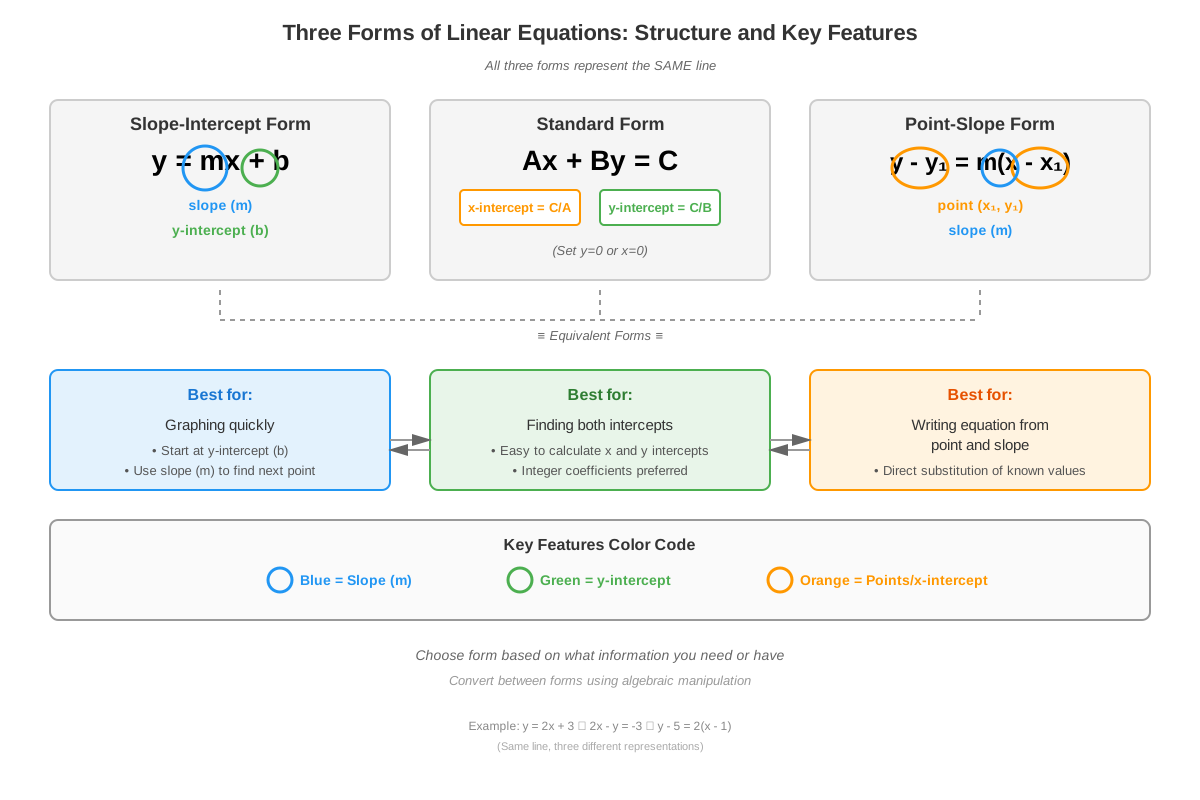
Linear equations can be expressed in three standard forms, each highlighting different characteristics of the line:
| Form | General Equation | Key Features Revealed | Best Used When |
|---|---|---|---|
| Slope-Intercept | y = mx + b | Slope (m) and y-intercept (b) | Graphing quickly or comparing slopes |
| Standard Form | Ax + By = C | x-intercept and y-intercept (via substitution) | Finding intercepts or working with integer coefficients |
| Point-Slope | y - y₁ = m(x - x₁) | Slope (m) and a specific point (x₁, y₁) | Writing equations from given information |
Slope-intercept form (y = mx + b) is the most commonly used form on the SAT because it immediately reveals the slope (m) and y-intercept (b). The coefficient of x gives the rate of change, while the constant term shows where the line crosses the y-axis. This form is isolated for y, making it ideal for graphing and for understanding the line as a function.
Standard form (Ax + By = C) presents both variables on the same side of the equation, with integer coefficients when possible. By convention, A should be positive, and A, B, and C should be integers with no common factors. This form excels at revealing both intercepts: setting x = 0 gives the y-intercept (C/B), and setting y = 0 gives the x-intercept (C/A). Standard form also appears frequently in systems of equations.
Point-slope form (y - y₁ = m(x - x₁)) explicitly shows a point (x₁, y₁) that the line passes through and the slope m. This form is particularly useful when constructing an equation from given information, though it appears less frequently as a final answer format on the SAT.
Converting from Standard Form to Slope-Intercept Form
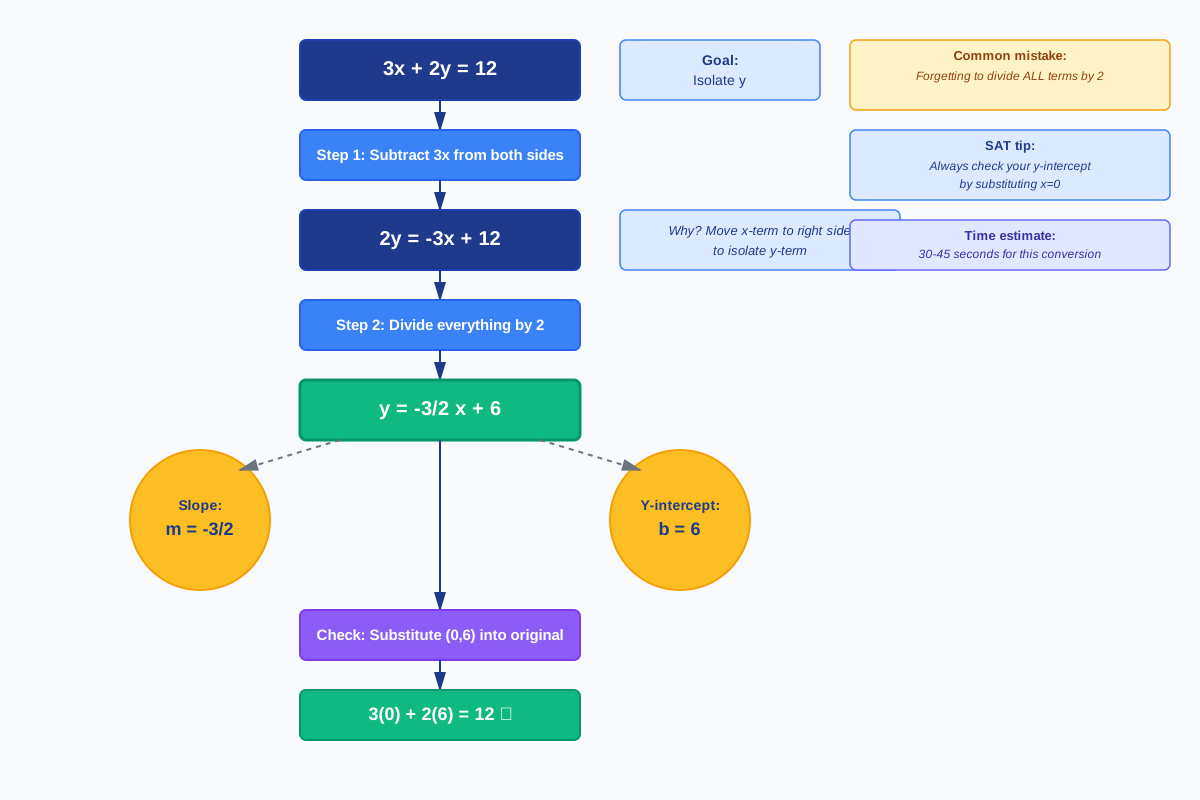
To convert from standard form (Ax + By = C) to slope-intercept form (y = mx + b), solve for y:
- Isolate the term containing y by subtracting Ax from both sides: By = -Ax + C
- Divide every term by B: y = (-A/B)x + (C/B)
- Identify the slope as m = -A/B and the y-intercept as b = C/B
Example: Convert 3x + 4y = 12 to slope-intercept form.
- Subtract 3x: 4y = -3x + 12
- Divide by 4: y = (-3/4)x + 3
- The slope is -3/4 and the y-intercept is 3
This conversion is among the most frequently tested on the SAT because it requires students to recognize that the slope in standard form is not immediately visible—it must be calculated as the negative ratio of the x-coefficient to the y-coefficient.
Converting from Slope-Intercept Form to Standard Form
To convert from slope-intercept form (y = mx + b) to standard form (Ax + By = C):
- Eliminate fractions by multiplying all terms by the denominator (if slope is fractional)
- Move the x-term to the left side by subtracting mx from both sides: -mx + y = b
- Multiply by -1 if necessary to make A positive: mx - y = -b or Ax + By = C
- Ensure A, B, and C are integers with no common factors
Example: Convert y = (2/3)x - 5 to standard form.
- Multiply by 3 to eliminate fractions: 3y = 2x - 15
- Subtract 2x from both sides: -2x + 3y = -15
- Multiply by -1 to make A positive: 2x - 3y = 15
The SAT often includes answer choices with different forms or with common factors not reduced, testing whether students understand the conventions of standard form.
Converting Involving Point-Slope Form
When given a point (x₁, y₁) and slope m, point-slope form y - y₁ = m(x - x₁) is the most direct way to write the equation. To convert to slope-intercept form:
- Distribute m through (x - x₁): y - y₁ = mx - mx₁
- Add y₁ to both sides: y = mx - mx₁ + y₁
- Simplify the constant term: y = mx + b, where b = y₁ - mx₁
Example: A line passes through (2, 5) with slope 3. Write the equation in slope-intercept form.
- Point-slope form: y - 5 = 3(x - 2)
- Distribute: y - 5 = 3x - 6
- Add 5: y = 3x - 1
Converting from point-slope to standard form follows similar steps but concludes with moving all variables to one side and ensuring proper formatting.
Recognizing Equivalent Forms Without Full Conversion
On the SAT, time efficiency matters. Sometimes recognizing equivalent equations without complete conversion saves valuable seconds. Key strategies include:
- Coefficient relationships: In standard form Ax + By = C, the slope is -A/B. If two equations have the same -A/B ratio, they have the same slope.
- Intercept checking: Quickly verify the y-intercept by setting x = 0 in any form.
- Point substitution: Test if a known point satisfies the equation by substituting coordinates.
- Proportional coefficients: If all coefficients in one equation are multiples of another's, the equations represent the same line (e.g., 2x + 4y = 6 and x + 2y = 3).
Special Cases and Edge Cases
Certain linear equations require special attention during conversion:
- Horizontal lines (y = k): In standard form, this becomes 0x + 1y = k or simply y = k. The slope is 0.
- Vertical lines (x = k): Cannot be written in slope-intercept form because the slope is undefined. Standard form is 1x + 0y = k or x = k.
- Lines through the origin: The y-intercept is 0, so slope-intercept form is y = mx. Standard form is mx - y = 0 or -mx + y = 0.
- Negative slopes with fractions: Require careful attention to signs during conversion, particularly when clearing denominators.
Concept Relationships
Converting linear forms serves as a central hub connecting multiple algebraic concepts. The relationship flows as follows:
Algebraic manipulation skills → enable → Converting linear forms → enables → Graphing linear equations and Solving systems of equations
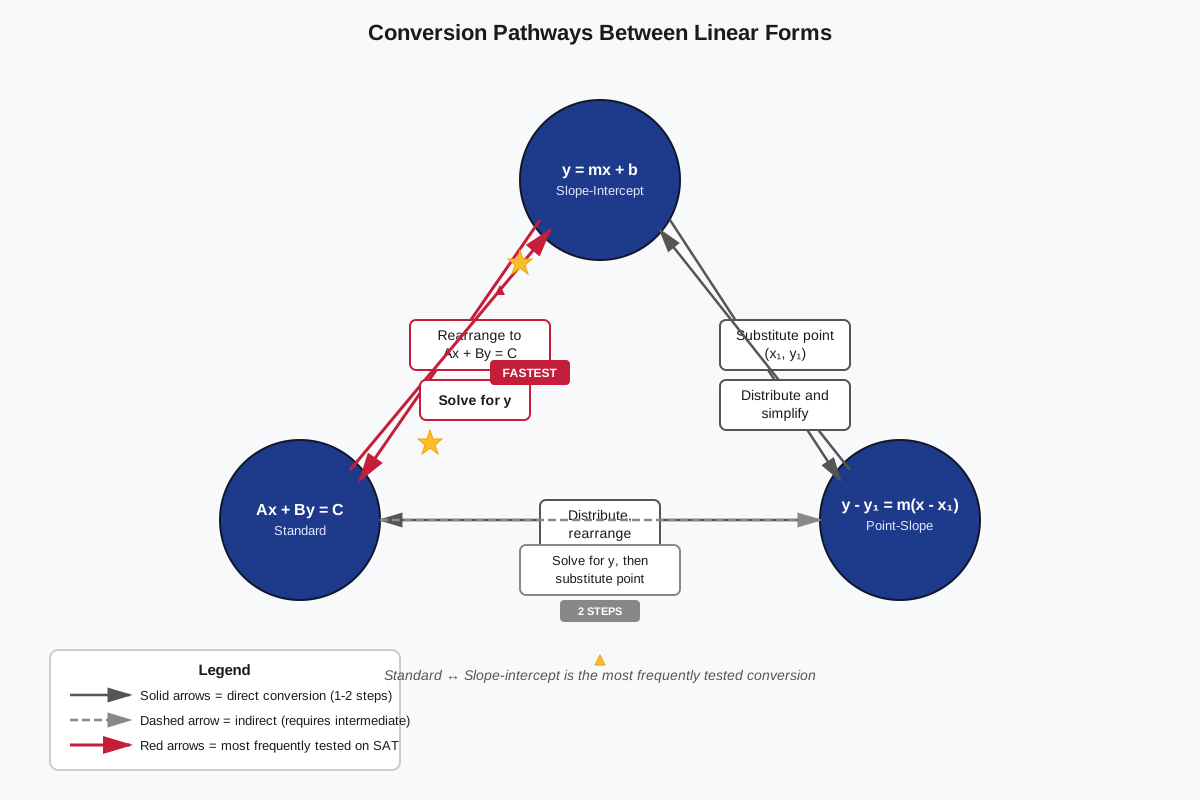
Within the topic itself, understanding the three primary forms creates a triangular relationship where any form can be converted to either of the other two. The conversion process relies heavily on solving for variables, which connects back to prerequisite equation-solving skills.
Standard form ↔ Slope-intercept form represents the most commonly tested conversion pathway, requiring division and fraction manipulation. Point-slope form → Slope-intercept form involves distribution and combining like terms. Slope-intercept form → Standard form requires moving terms and eliminating fractions.
The concept also connects forward to more advanced topics: Converting linear forms → supports → Writing equations of parallel and perpendicular lines (which requires identifying slopes from various forms) → supports → Linear systems (where standard form is often preferred) → supports → Linear programming (an advanced topic using standard form constraints).
Understanding form conversion also enhances function notation comprehension, as recognizing y = f(x) = mx + b connects algebraic and functional representations. This relationship extends to transformations of functions, where changes in m and b correspond to geometric transformations of the line.
Quick check — test yourself on Converting linear forms so far.
Try Flashcards →High-Yield Facts
⭐ The slope in standard form Ax + By = C is always -A/B, not A/B or B/A—this is the most commonly tested relationship.
⭐ The y-intercept in standard form Ax + By = C is C/B, found by setting x = 0 and solving for y.
⭐ Standard form convention requires A to be positive and A, B, C to be integers with no common factors.
⭐ Slope-intercept form y = mx + b immediately reveals both slope (m) and y-intercept (b) without calculation.
⭐ To convert from standard to slope-intercept form, isolate y by moving the x-term and dividing by the y-coefficient.
- Point-slope form y - y₁ = m(x - x₁) is most efficient when writing an equation from a point and slope.
- Horizontal lines have slope 0 and can be written as y = k in any form.
- Vertical lines have undefined slope and cannot be written in slope-intercept form.
- Two equations represent the same line if their coefficients are proportional (one is a multiple of the other).
- When converting to standard form from slope-intercept form with fractional slope, multiply through by the denominator first.
- The x-intercept in standard form Ax + By = C is C/A, found by setting y = 0.
- Distributing correctly in point-slope form is essential: y - y₁ = m(x - x₁) becomes y - y₁ = mx - mx₁.
Common Misconceptions
Misconception: The slope in standard form Ax + By = C is A/B.
Correction: The slope is -A/B (negative A divided by B). The negative sign is crucial and frequently forgotten, leading to incorrect slope identification.
Misconception: Standard form can have any coefficients, including fractions and decimals.
Correction: By convention, standard form should have integer coefficients with no common factors, and A should be positive. While equations with fractions are mathematically valid, they don't follow SAT standard form conventions.
Misconception: Point-slope form y - y₁ = m(x - x₁) can use any point, so the equation isn't unique.
Correction: While different points on the same line yield different-looking point-slope equations, they all represent the same line and convert to the same slope-intercept or standard form. The form isn't unique, but the line is.
Misconception: Converting from y = (2/3)x + 4 to standard form gives 2x + 3y = 4.
Correction: This misses the step of properly moving terms. The correct conversion: multiply by 3 to get 3y = 2x + 12, then rearrange to -2x + 3y = 12, and finally multiply by -1 to get 2x - 3y = -12.
Misconception: All linear equations can be written in slope-intercept form.
Correction: Vertical lines (x = k) cannot be written in slope-intercept form because they have undefined slope. Slope-intercept form requires the equation to be solvable for y, which is impossible when x is constant.
Misconception: When converting 4x + 2y = 8 to standard form, the answer is already in standard form.
Correction: While technically in standard form structure, the coefficients share a common factor of 2. Proper standard form requires dividing through by 2 to get 2x + y = 4.
Misconception: The y-intercept is always the constant term in any form.
Correction: The y-intercept is the constant term only in slope-intercept form (y = mx + b). In standard form Ax + By = C, the y-intercept is C/B, not C.
Worked Examples
Example 1: Multi-Step Conversion with Application
Problem: A line passes through points (3, 7) and (6, 13). Which of the following equations represents this line in standard form?
A) y = 2x + 1
B) 2x - y = -1
C) x - 2y = -11
D) 2x + y = 1
Solution:
Step 1: Find the slope using the two points.
- m = (y₂ - y₁)/(x₂ - x₁) = (13 - 7)/(6 - 3) = 6/3 = 2
Step 2: Use point-slope form with either point. Using (3, 7):
- y - 7 = 2(x - 3)
Step 3: Convert to slope-intercept form to verify.
- y - 7 = 2x - 6
- y = 2x + 1
Step 4: Convert to standard form.
- Subtract 2x from both sides: -2x + y = 1
- Multiply by -1 to make A positive: 2x - y = -1
Step 5: Verify by testing a point. Using (3, 7) in 2x - y = -1:
- 2(3) - 7 = 6 - 7 = -1 ✓
Answer: B) 2x - y = -1
Connection to learning objectives: This problem requires applying form conversion to answer an SAT-style question, demonstrating the complete process from finding slope through multiple conversions to reach the required form.
Example 2: Identifying Features Without Full Conversion
Problem: The equation 6x - 3y = 12 represents a line in the xy-plane. What is the slope of this line?
A) -2
B) -1/2
C) 1/2
D) 2
Solution:
Method 1 (Direct formula): In standard form Ax + By = C, the slope is -A/B.
- Here, A = 6 and B = -3
- Slope = -A/B = -6/(-3) = 6/3 = 2
Method 2 (Conversion to slope-intercept form):
- Start with 6x - 3y = 12
- Subtract 6x: -3y = -6x + 12
- Divide by -3: y = 2x - 4
- The slope is the coefficient of x: m = 2
Method 3 (Verification): Find two points and calculate slope.
- When x = 0: 6(0) - 3y = 12 → y = -4, giving point (0, -4)
- When x = 2: 6(2) - 3y = 12 → 12 - 3y = 12 → y = 0, giving point (2, 0)
- Slope = (0 - (-4))/(2 - 0) = 4/2 = 2
Answer: D) 2
Key insight: Method 1 is fastest for SAT purposes. Recognizing that slope = -A/B in standard form eliminates the need for full conversion, saving 30-45 seconds on test day.
Connection to learning objectives: This demonstrates identifying key features of converting linear forms and applying the most efficient strategy for SAT questions.
Exam Strategy
When approaching SAT questions on converting linear forms, follow this strategic framework:
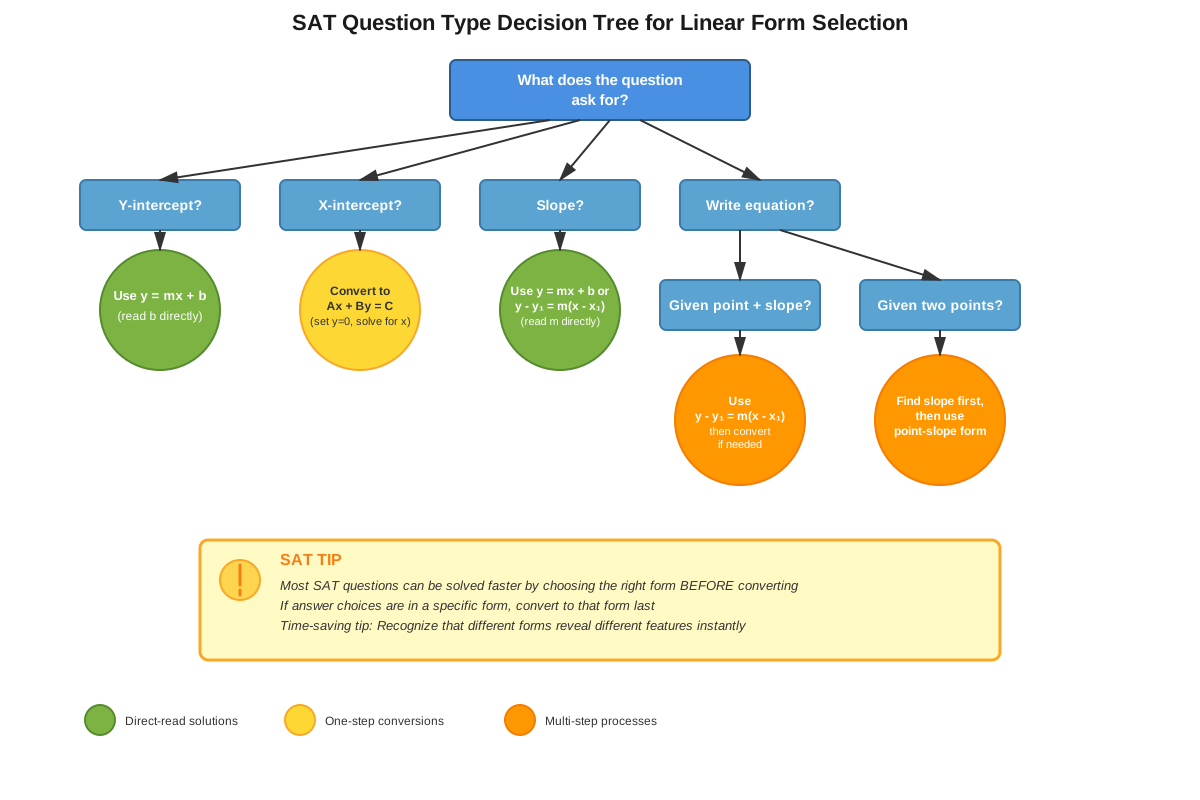
1. Identify what the question asks for: Before converting, determine whether you need slope, y-intercept, x-intercept, or a specific form. Often, you can extract the needed information without full conversion.
2. Recognize trigger words and phrases:
- "What is the slope..." → Look for or convert to slope-intercept form, or use -A/B from standard form
- "Where does the line cross the y-axis..." → Find the y-intercept (b in y = mx + b, or C/B in Ax + By = C)
- "Which equation is equivalent..." → Convert to the same form as answer choices
- "Write an equation for the line..." → Determine which form is most efficient given the information
3. Use process of elimination strategically:
- Check slopes first: If the original equation has positive slope, eliminate choices with negative slopes
- Verify y-intercepts: Substitute x = 0 into both the original and answer choices
- Test a point: If you know a point on the line, substitute it into answer choices to eliminate incorrect options
- Look for coefficient relationships: Equations with proportional coefficients represent the same line
4. Time allocation guidance:
- Simple conversions (standard to slope-intercept with integer coefficients): 30-45 seconds
- Complex conversions (fractional slopes, multiple steps): 60-90 seconds
- If a conversion is taking longer than 90 seconds, mark it and return later
5. Common SAT traps to avoid:
- Answer choices in different forms than requested (always check what form is asked for)
- Coefficients that aren't fully simplified in standard form
- Sign errors when moving terms between sides
- Forgetting to make A positive in standard form
6. When stuck, work backwards: If answer choices are given, substitute a point from the original equation into each choice to eliminate wrong answers.
Memory Techniques
Mnemonic for Standard Form Slope: "Negative Always Before" → The slope is Negative A divided By B, or -A/B.
Visualization for Form Purposes:
- Slope-Intercept = See It (SI) → You can immediately see the slope and intercept
- Standard = Same Side (SS) → Both variables on the same side
- Point-Slope = Point Perfect (PP) → Perfect for when you have a point and slope
Acronym for Conversion Steps (Standard to Slope-Intercept): MID
- Move the x-term to the other side
- Isolate y by dividing
- Determine slope (coefficient of x) and y-intercept (constant)
Memory palace technique: Imagine three rooms in a house:
- Living room (Slope-Intercept): Everything is visible and comfortable—you can see the slope and y-intercept immediately
- Storage room (Standard Form): Things are organized but packed away—you need to do some work to find what you need
- Workshop (Point-Slope): You're building something new from specific materials (a point and slope)
Rhyme for Standard Form Convention: "A is positive, that's the key, and all three numbers factor-free!"
Summary
Converting linear forms is a foundational skill that enables students to move fluidly between different representations of linear equations, each revealing distinct features of a line. The three primary forms—slope-intercept (y = mx + b), standard (Ax + By = C), and point-slope (y - y₁ = m(x - x₁))—serve different purposes, with slope-intercept immediately showing slope and y-intercept, standard form facilitating intercept calculations and integer coefficient work, and point-slope form being ideal for constructing equations from given information. Successful conversion requires both conceptual understanding of what each form reveals and procedural fluency in algebraic manipulation. On the SAT, this topic appears in 3-5 questions per test, often embedded within larger problems or requiring strategic recognition of which form best answers the question. The most critical relationship to remember is that slope in standard form equals -A/B, not A/B. Mastery involves not just mechanical conversion ability but also strategic thinking about when full conversion is necessary versus when direct feature extraction suffices, enabling both accuracy and time efficiency on test day.
Key Takeaways
- Slope-intercept form (y = mx + b) immediately reveals slope and y-intercept, making it ideal for graphing and quick feature identification
- In standard form (Ax + By = C), the slope is -A/B and the y-intercept is C/B—the negative sign in the slope formula is critical
- Converting between forms requires isolating y for slope-intercept form and moving all variables to one side for standard form, with attention to maintaining proper conventions
- Standard form convention requires A positive and all coefficients as integers with no common factors—answer choices violating this are incorrect
- Strategic feature extraction without full conversion saves time—use -A/B for slope in standard form rather than converting completely
- Point-slope form is most efficient when writing equations from a point and slope, though it rarely appears as a final answer format
- Vertical lines cannot be written in slope-intercept form because they have undefined slope, while horizontal lines have slope zero
Related Topics
Parallel and Perpendicular Lines: Building on form conversion, this topic requires identifying slopes from various forms to determine relationships between lines. Parallel lines have equal slopes, while perpendicular lines have negative reciprocal slopes.
Systems of Linear Equations: Converting to standard form often simplifies elimination methods, while slope-intercept form facilitates graphical solutions. Mastering form conversion enables flexible problem-solving approaches.
Linear Inequalities: The same forms apply to inequalities, with conversion skills transferring directly. Understanding how to manipulate linear equations prepares students for the additional consideration of inequality direction.
Functions and Function Notation: Recognizing y = f(x) = mx + b connects algebraic form to functional representation, deepening understanding of linear relationships as functions.
Graphing Linear Equations: Form conversion directly supports graphing by revealing key features—intercepts, slope, and specific points—that enable accurate graph construction.
Practice CTA
Now that you've mastered the concepts of converting linear forms, it's time to solidify your understanding through practice. Attempt the practice questions to test your ability to convert between forms under timed conditions, and use the flashcards to build automaticity in recognizing key relationships like the -A/B slope formula. Remember, the difference between knowing these concepts and scoring points on test day lies in repeated, deliberate practice. Each problem you solve strengthens your pattern recognition and speeds up your conversion process. You've built the foundation—now make it unshakeable through application!
Sign up free to keep reading
Create a free AnvayaPrep account to finish this SAT guide on Converting linear forms — plus flashcards and practice questions.