Overview
Interpreting slope is one of the most fundamental and frequently tested concepts in the SAT math section, appearing in multiple questions across both the calculator and no-calculator portions. Slope represents the rate of change between two variables in a linear relationship, and understanding how to interpret this rate in context is essential for success on the exam. While calculating slope mechanically is straightforward, the SAT emphasizes the ability to understand what slope means in real-world scenarios—whether it represents speed, cost per item, population growth rate, or any other rate of change.
The ability to interpret slope connects directly to data analysis, modeling, and problem-solving skills that extend far beyond simple algebraic manipulation. On the SAT, students encounter slope interpretation in word problems, graph analysis questions, and data modeling scenarios. Questions may present a linear equation and ask what the slope represents in context, or they may provide a real-world scenario and require students to identify which value corresponds to the slope. This topic bridges pure algebra with applied mathematics, making it a critical skill for achieving a competitive score.
Mastery of slope interpretation forms the foundation for understanding more complex mathematical relationships, including systems of equations, linear inequalities, and even the basics of calculus concepts that appear in advanced coursework. Within the Linear Functions unit, interpreting slope works hand-in-hand with understanding y-intercepts, writing linear equations, and analyzing the relationship between algebraic and graphical representations of functions.
Learning Objectives
- [ ] Identify key features of interpreting slope in linear equations and graphs
- [ ] Explain how interpreting slope appears on the SAT in various question formats
- [ ] Apply interpreting slope to answer SAT-style questions accurately and efficiently
- [ ] Distinguish between positive, negative, zero, and undefined slopes in context
- [ ] Translate between verbal descriptions, equations, tables, and graphs to identify slope meaning
- [ ] Evaluate which real-world quantity corresponds to slope in multi-variable scenarios
- [ ] Compare slopes of different linear relationships to determine relative rates of change
Prerequisites
- Basic algebraic manipulation: Understanding variables, coefficients, and solving simple equations is necessary to work with linear functions in slope-intercept form
- Coordinate plane familiarity: Recognizing x and y axes, plotting points, and understanding ordered pairs enables interpretation of slope from graphs
- Ratio and rate concepts: Slope is fundamentally a ratio, so comfort with rates (miles per hour, dollars per item) provides the conceptual foundation
- Linear equation forms: Knowledge of slope-intercept form (y = mx + b) and point-slope form helps identify where slope appears in equations
- Unit analysis: Understanding how units combine (miles/hour, dollars/pound) is crucial for interpreting what slope represents
Why This Topic Matters
In real-world applications, slope interpretation appears constantly in fields ranging from economics to physics to social sciences. When a business analyzes profit margins, they're interpreting slope. When scientists study population growth or decay, they're working with slope. When engineers design roads with specific grades, they're applying slope concepts. The ability to translate between mathematical representations and real-world meaning is a critical thinking skill that extends far beyond the SAT.
On the SAT specifically, slope interpretation questions appear with remarkable frequency—typically 2-4 questions per test directly assess this skill, with additional questions incorporating it as part of more complex problems. These questions appear in both multiple-choice and student-produced response formats. The College Board consistently includes slope interpretation in the "Heart of Algebra" category, which comprises approximately 33% of the math section (19 out of 58 questions). Questions testing this concept often appear in the medium-to-hard difficulty range, making them crucial for students aiming for scores above 600.
Common question formats include: presenting a linear equation modeling a real-world scenario and asking what the slope represents; providing a graph with context and asking students to interpret the meaning of the line's steepness; giving a table of values from a real situation and requiring identification of the rate of change; or presenting two linear relationships and asking students to compare their slopes in context. The SAT particularly favors questions that combine multiple representations, such as providing an equation and asking students to match it to a verbal description of the slope's meaning.
Core Concepts
Definition and Mathematical Representation
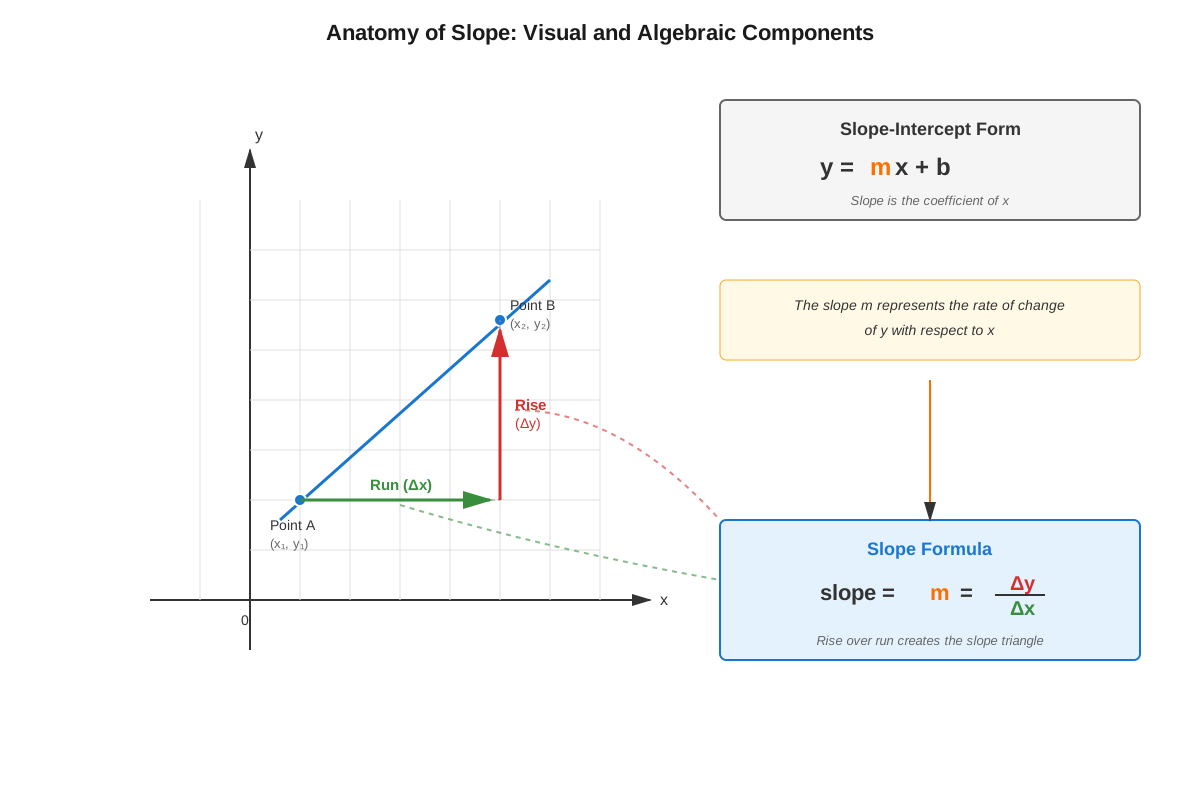
Slope is the ratio of vertical change to horizontal change between any two points on a line, commonly expressed as "rise over run." Mathematically, for two points (x₁, y₁) and (x₂, y₂), slope m is calculated as:
m = (y₂ - y₁)/(x₂ - x₁)In the slope-intercept form y = mx + b, the coefficient m represents the slope, while b represents the y-intercept. The slope tells us how much y changes for every one-unit increase in x. This rate of change remains constant throughout the entire line, which is the defining characteristic of linear relationships.
Interpreting Slope in Context
The critical SAT skill involves translating the mathematical value of slope into meaningful real-world language. When interpreting slope, students must identify:
- The dependent variable (typically y): What quantity is being measured or predicted?
- The independent variable (typically x): What quantity is changing or being controlled?
- The rate relationship: How does the dependent variable change as the independent variable increases by one unit?
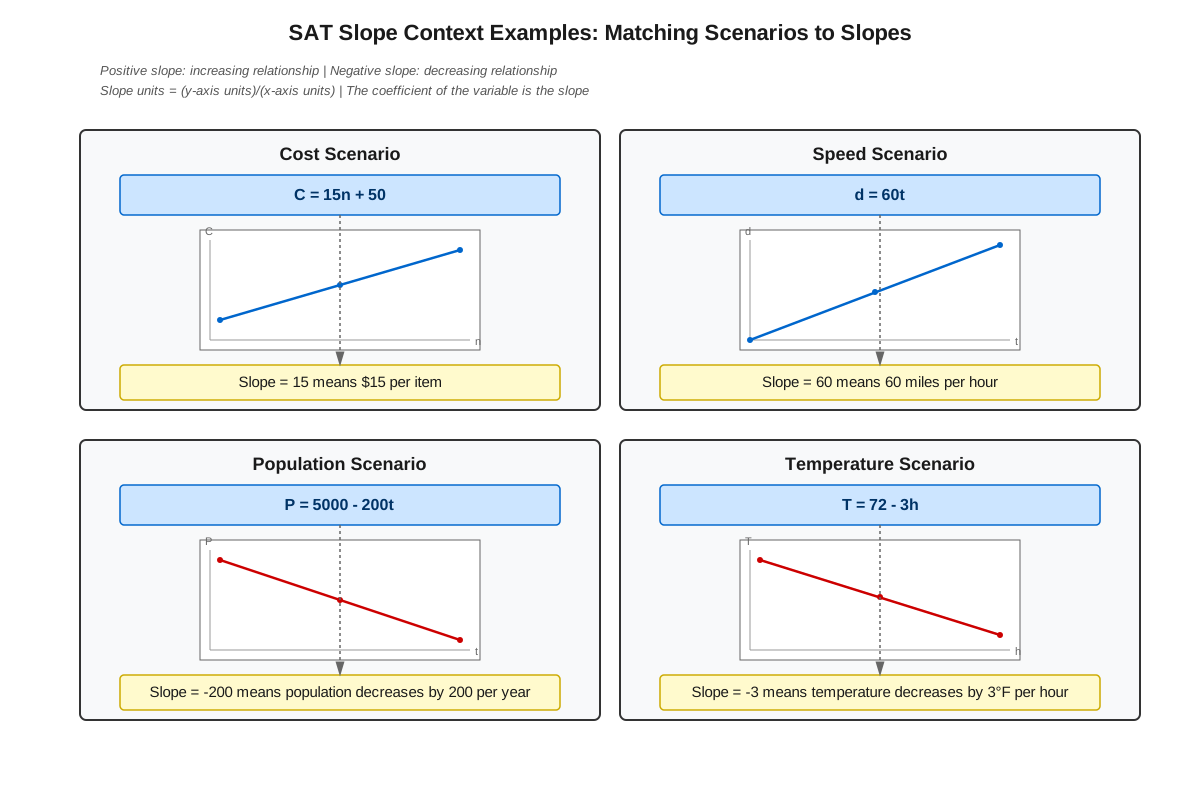
For example, in the equation C = 25h + 50, where C represents total cost in dollars and h represents hours worked, the slope is 25. The interpretation is: "The cost increases by $25 for each additional hour worked" or "The hourly rate is $25 per hour."
Units of Slope
Understanding units is essential for correct interpretation. The units of slope are always the units of the y-variable divided by the units of the x-variable. This creates a rate unit:
| Scenario | y-variable (units) | x-variable (units) | Slope units | Interpretation |
|---|---|---|---|---|
| Distance vs. Time | miles | hours | miles/hour | speed |
| Cost vs. Quantity | dollars | items | dollars/item | unit price |
| Population vs. Year | people | years | people/year | growth rate |
| Temperature vs. Altitude | degrees | feet | degrees/foot | temperature change per foot |
Sign of Slope and Its Meaning
The sign (positive or negative) of slope carries important contextual meaning:
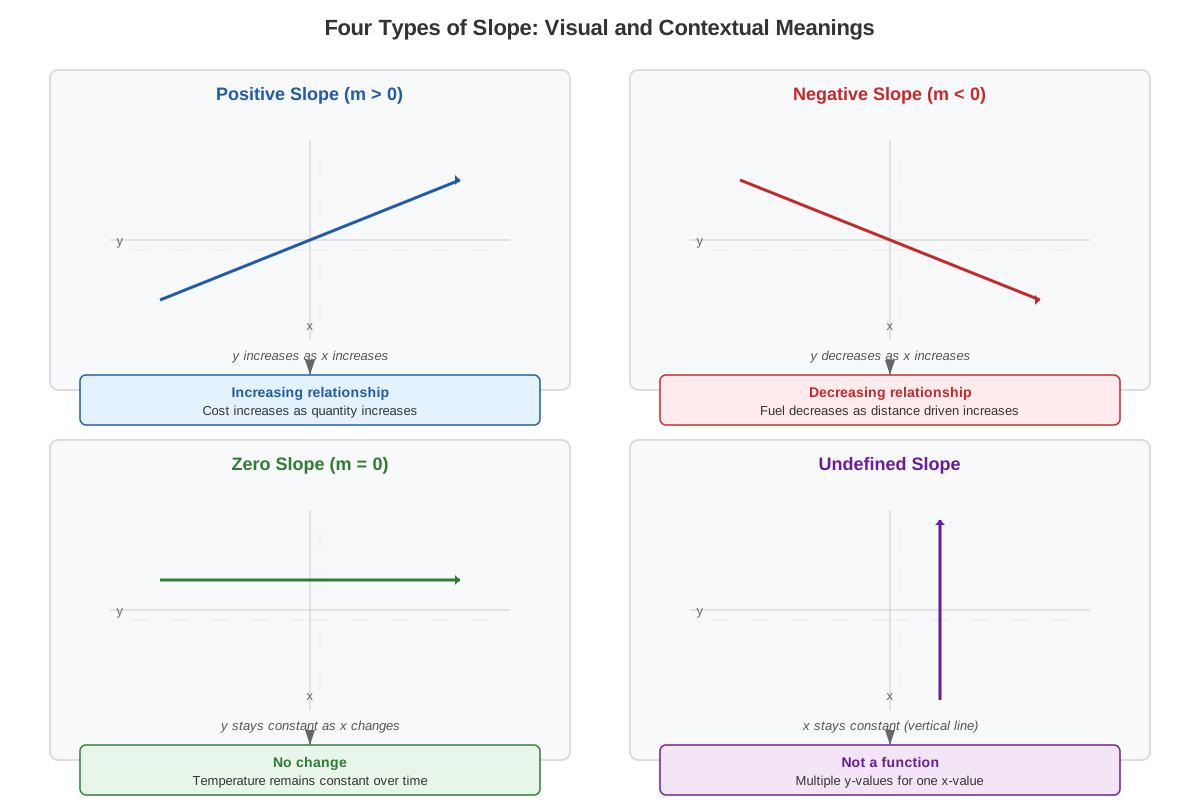
- Positive slope: As x increases, y increases. This represents growth, accumulation, or direct relationships. Example: "For each additional mile driven, the total cost increases by $0.50."
- Negative slope: As x increases, y decreases. This represents decay, depletion, or inverse relationships. Example: "For each hour that passes, the battery charge decreases by 5%."
- Zero slope: y remains constant regardless of x changes. This represents no relationship or a constant value. Example: "The membership fee remains $50 regardless of how many months you've been a member."
- Undefined slope: The line is vertical (x remains constant while y changes). This rarely appears in real-world SAT contexts but may appear in pure geometry questions.
Comparing Slopes
SAT questions frequently ask students to compare two or more slopes to determine which represents a faster rate, steeper increase, or more efficient option. When comparing slopes:
- Larger absolute value = steeper line = faster rate of change
- For positive slopes: larger number means faster increase
- For negative slopes: more negative number (larger absolute value) means faster decrease
- Comparing slopes only makes sense when the variables have the same units
For example, if Company A charges C = 40h + 20 and Company B charges C = 35h + 50 (where C is cost in dollars and h is hours), Company A has the steeper slope (40 vs. 35), meaning they charge $40 per hour compared to Company B's $35 per hour.
Slope from Different Representations
Students must extract slope from various formats:
From an equation: Identify the coefficient of x when the equation is in slope-intercept form (y = mx + b) or convert to this form.
From a graph: Select two clear points on the line, calculate rise/run, and pay attention to whether the line goes up (positive) or down (negative) from left to right.
From a table: Calculate the change in y-values divided by the change in x-values between any two rows. For linear relationships, this ratio remains constant.
From a verbal description: Identify phrases like "per," "for each," "every time," or "rate of" which signal the slope value and its interpretation.
Fractional and Decimal Slopes
Slopes need not be whole numbers. A slope of 0.5 or 1/2 means that y increases by 0.5 units for every 1-unit increase in x. Alternatively, this can be interpreted as y increasing by 1 unit for every 2-unit increase in x. The SAT may present slopes as fractions, decimals, or require students to convert between these forms. For example, a slope of 2/3 in a cost-versus-quantity scenario means "$2 for every 3 items" or approximately "$0.67 per item."
Concept Relationships
The concept of interpreting slope sits at the intersection of multiple mathematical ideas. Slope calculation (the mechanical process of finding rise/run) → leads to → slope interpretation (understanding what that number means in context) → enables → equation writing (creating linear models from real situations) → supports → prediction and extrapolation (using the model to find unknown values).
Within the topic itself, understanding units of slope directly connects to contextual interpretation, as the units tell you what the slope measures. The sign of slope relates to graphical representation, since positive slopes rise from left to right while negative slopes fall. Comparing slopes requires both calculating slope values and interpreting their contextual meaning to determine which represents a faster or slower rate.
Slope interpretation connects backward to prerequisite knowledge of rates and ratios, as slope is fundamentally a rate. It connects forward to systems of linear equations, where comparing slopes helps determine if lines are parallel (equal slopes) or if they intersect (different slopes). It also relates to linear inequalities, where the slope maintains the same interpretation but the relationship becomes "at least" or "at most" rather than exact equality.
The relationship map: Rate concepts → Slope calculation → Slope interpretation → Linear modeling → Systems of equations → Real-world problem solving
Quick check — test yourself on Interpreting slope so far.
Try Flashcards →High-Yield Facts
⭐ Slope represents the rate of change of the dependent variable (y) with respect to the independent variable (x)
⭐ The units of slope are always y-units divided by x-units, creating a rate unit
⭐ In y = mx + b form, m is the slope and represents how much y changes when x increases by 1
⭐ Positive slope means both variables increase together; negative slope means as one increases, the other decreases
⭐ A steeper line (larger absolute value of slope) represents a faster rate of change
- Slope remains constant throughout an entire linear relationship—it's the same between any two points on the line
- Zero slope means the y-value doesn't change regardless of x (horizontal line)
- When comparing two linear relationships, the one with the larger slope coefficient has the faster rate
- Slope can be expressed as a fraction, decimal, or whole number—all forms are equivalent
- The phrase "per" in a word problem almost always indicates the slope (dollars per hour, miles per gallon, etc.)
⭐ To interpret slope, always state: "[y-variable] changes by [slope value] [y-units] for each [x-unit] increase in [x-variable]"
- Slope interpretation questions often require identifying which quantity in a scenario corresponds to the rate of change
- A slope of 1/2 can be interpreted as "1 unit of y for every 2 units of x" or "0.5 units of y per unit of x"
- In real-world contexts, slope often represents speed, price per unit, growth rate, or efficiency
- The SAT frequently tests whether students can match a verbal description of slope to its numerical value in an equation
Common Misconceptions
Misconception: Slope is always the larger number in an equation → Correction: Slope is specifically the coefficient of the x-variable in slope-intercept form (y = mx + b). The constant term b is the y-intercept, not the slope, even if b is larger than m.
Misconception: A steeper-looking line always has a larger slope value → Correction: Visual steepness depends on the scale of the axes. A line that looks steep might have a small slope if the y-axis is compressed. Always calculate slope numerically rather than relying on visual appearance alone.
Misconception: Slope interpretation is just stating the slope value → Correction: Proper interpretation requires identifying what both variables represent and explaining the relationship with correct units. Saying "the slope is 5" is incomplete; saying "the cost increases by $5 for each additional item purchased" is a complete interpretation.
Misconception: Negative slope means the relationship is decreasing → Correction: Negative slope means that as x increases, y decreases. The relationship itself is still linear and predictable. For example, "the tank loses 2 gallons per minute" is a negative slope (-2) but describes a consistent, understandable relationship.
Misconception: You can only find slope from two points on a graph → Correction: Slope can be determined from an equation (coefficient of x), a table (change in y / change in x), a graph (rise/run), or a verbal description (rate stated in the problem). The SAT tests all these representations.
Misconception: Slope and rate of change are different concepts → Correction: For linear functions, slope and rate of change are identical. The slope is the constant rate at which y changes with respect to x throughout the entire function.
Misconception: The slope tells you the y-value when x = 0 → Correction: The y-intercept (b in y = mx + b) tells you the y-value when x = 0. The slope tells you how much y changes for each unit increase in x.
Worked Examples
Example 1: Interpreting Slope from an Equation
Problem: A water tank is being drained according to the equation V = 500 - 12t, where V represents the volume of water in gallons and t represents time in minutes. What does the slope of this equation represent in this context?
Solution:
Step 1: Identify the form of the equation. This is in slope-intercept form where y = V and x = t.
Step 2: Rewrite to clearly see slope-intercept form: V = -12t + 500
Step 3: Identify the slope. The coefficient of t is -12, so m = -12.
Step 4: Identify the variables and their units:
- Dependent variable (V): volume in gallons
- Independent variable (t): time in minutes
- Slope units: gallons per minute
Step 5: Interpret the sign. The slope is negative, meaning as time increases, volume decreases.
Step 6: Write the complete interpretation: "The volume of water in the tank decreases by 12 gallons for each minute that passes" or "The tank is draining at a rate of 12 gallons per minute."
Connection to learning objectives: This example demonstrates identifying slope from an equation (Objective 1), applying interpretation to an SAT-style context (Objective 3), and distinguishing the meaning of negative slope (Objective 4).
Example 2: Comparing Slopes in Context
Problem: Two phone plans are modeled by the equations below, where C represents total monthly cost in dollars and m represents minutes used:
Plan A: C = 0.10m + 25
Plan B: C = 0.15m + 15
A customer typically uses 200 minutes per month. Which statement correctly interprets the slopes of these plans?
A) Plan A charges $0.10 per month, while Plan B charges $0.15 per month
B) Plan A charges $0.10 per minute, while Plan B charges $0.15 per minute
C) Plan A has a lower total cost for any number of minutes
D) Plan B is always the better deal because it has a lower base fee
Solution:
Step 1: Identify the slopes. Plan A has slope 0.10; Plan B has slope 0.15.
Step 2: Determine the units. Since C is in dollars and m is in minutes, the slope units are dollars per minute.
Step 3: Interpret each slope:
- Plan A: $0.10 per minute
- Plan B: $0.15 per minute
Step 4: Evaluate the answer choices:
- Choice A: Incorrect—the slope represents cost per minute, not per month
- Choice B: Correct—this accurately interprets both slopes with proper units
- Choice C: Incorrect—we'd need to calculate total costs to determine this, and it depends on minutes used
- Choice D: Incorrect—the lower base fee (15 vs. 25) doesn't make it always better; the higher per-minute rate might make it more expensive for heavy users
Step 5: Verify with the given usage. At 200 minutes:
- Plan A: C = 0.10(200) + 25 = $45
- Plan B: C = 0.15(200) + 15 = $45
They're equal at 200 minutes, confirming that neither is always better.
Answer: B
Connection to learning objectives: This example demonstrates comparing slopes (Objective 7), interpreting slope in a real-world scenario (Objective 2), and applying interpretation to eliminate incorrect answers (Objective 3).
Exam Strategy
When approaching SAT questions on interpreting slope, follow this systematic process:
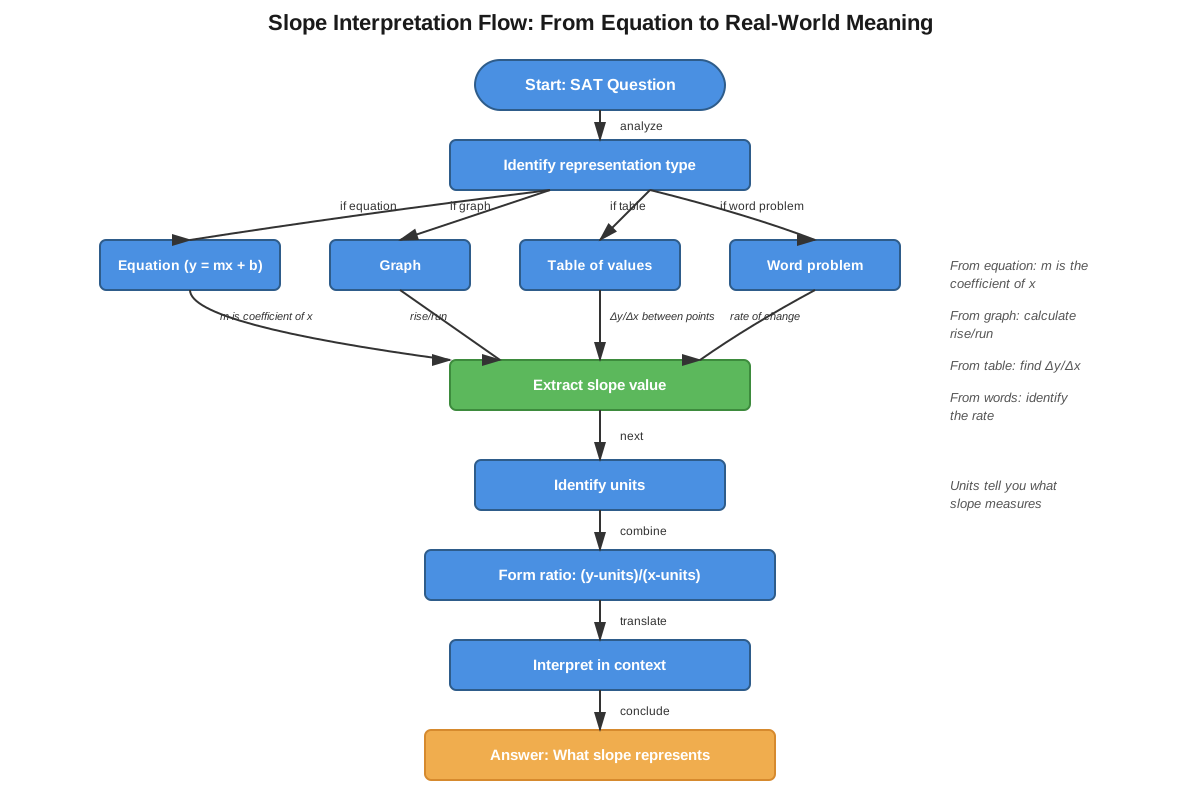
Step 1: Identify the representation. Determine whether slope is given in an equation, graph, table, or verbal description. This tells you how to extract the slope value.
Step 2: Find the slope value. Calculate or identify the numerical value of the slope before attempting interpretation.
Step 3: Identify variables and units. Clearly determine what the x and y variables represent and their units. Write them down if necessary.
Step 4: Construct the interpretation. Use the template: "[y-variable] changes by [slope value] [y-units] for each [x-unit] increase in [x-variable]."
Step 5: Check the sign. Ensure your interpretation matches whether the slope is positive (both increase) or negative (one increases, other decreases).
Exam Tip: Watch for trigger phrases that signal slope interpretation questions: "What does the [number] represent?", "Which statement best interprets...", "The rate of change...", "For each additional...", or "Per unit increase..."
Process of elimination strategies:
- Eliminate any answer choice that confuses slope with y-intercept (the constant term)
- Eliminate choices that have incorrect units (check that units match y-units/x-units)
- Eliminate choices that get the direction wrong (increase vs. decrease)
- Eliminate choices that describe a one-time change rather than a rate
Time allocation: Slope interpretation questions typically require 45-60 seconds. If you find yourself spending more than 90 seconds, you may be overcomplicating the problem. Return to the basic definition: slope is the rate of change of y with respect to x.
Common trap answers: The SAT often includes distractors that state the y-intercept value, reverse the variables, use incorrect units, or describe the total change rather than the rate. Always verify that your answer describes a rate (per unit) rather than a total amount.
Memory Techniques
Slope Interpretation Template Mnemonic - "YUCK":
- Y-variable changes by
- Units (include them!)
- Coefficient (the slope value)
- Keyed to each x-unit increase
This reminds you to include all essential components of a complete interpretation.
Sign Memory - "PUNS":
- Positive = Up together (both variables increase)
- Negative = Separate directions (one up, one down)
Units Formula Visualization: Picture a fraction with y on top and x on bottom. The units of slope are literally "y-units over x-units" or "y-units per x-unit." Visualize this fraction whenever you need to determine slope units.
"Per" = Slope: Whenever you see the word "per" in a problem (per hour, per item, per mile), that quantity is almost always the slope. Circle or underline "per" phrases when reading SAT questions.
Steepness = Speed: A steeper line means a faster rate of change. Visualize a steep hill requiring more effort to climb—that's a larger slope value representing a faster change.
Summary
Interpreting slope is a high-yield SAT math skill that requires students to translate between mathematical representations and real-world meaning. Slope represents the constant rate of change in a linear relationship, specifically how much the dependent variable (y) changes for each one-unit increase in the independent variable (x). The units of slope are always y-units divided by x-units, creating a rate unit like dollars per hour or miles per gallon. Students must be able to extract slope from equations (the coefficient of x in y = mx + b form), graphs (rise over run), tables (change in y over change in x), and verbal descriptions (rate statements). The sign of slope indicates whether variables increase together (positive) or move in opposite directions (negative), while the magnitude indicates how quickly the change occurs. SAT questions test whether students can identify what slope represents in context, compare slopes of different relationships, and match verbal interpretations to mathematical models. Mastery requires understanding that slope is fundamentally a rate and that proper interpretation always includes both variables, their units, and the direction of change.
Key Takeaways
- Slope is the rate of change of y with respect to x, representing how much y changes per unit increase in x
- Complete slope interpretation requires stating both variables, the slope value, and the correct units (y-units per x-unit)
- In y = mx + b, the coefficient m is the slope; don't confuse it with the y-intercept b
- Positive slope means both variables increase together; negative slope means they move in opposite directions
- The word "per" in a problem almost always indicates the slope value
- Slope can be extracted from equations, graphs, tables, or verbal descriptions—practice all formats
- Larger absolute value of slope means steeper line and faster rate of change
Related Topics
Y-Intercept Interpretation: Understanding what the constant term in y = mx + b represents in context complements slope interpretation and together allows complete analysis of linear models. The y-intercept represents the starting value or initial condition when x = 0.
Writing Linear Equations from Context: Once you can interpret slope, the reverse skill—creating equations from verbal descriptions—becomes accessible. This involves identifying the rate (slope) and initial value (y-intercept) from word problems.
Systems of Linear Equations: Comparing slopes helps determine whether lines are parallel (same slope), perpendicular (negative reciprocal slopes), or intersecting (different slopes), which is essential for solving systems.
Linear Regression and Data Analysis: Interpreting slope extends to understanding lines of best fit in scatter plots, where slope represents the average rate of change in real data sets.
Piecewise Functions: Understanding slope in different intervals helps analyze functions that have different rates of change in different domains.
Practice CTA
Now that you've mastered the fundamentals of interpreting slope, it's time to solidify your understanding through practice. Attempt the practice questions to test your ability to identify, interpret, and apply slope concepts in various SAT-style scenarios. Use the flashcards to reinforce the key definitions and interpretation templates until they become second nature. Remember, slope interpretation appears on virtually every SAT, making this one of the highest-yield topics you can master. Each practice problem you complete builds the pattern recognition and confidence you need to quickly and accurately handle these questions on test day. You've got this!
Sign up free to keep reading
Create a free AnvayaPrep account to finish this SAT guide on Interpreting slope — plus flashcards and practice questions.