Overview
The y-intercept is one of the most fundamental concepts in linear functions and appears consistently across multiple question types on the SAT. Understanding the y-intercept means grasping where a line crosses the y-axis—the point at which the input value (x) equals zero. This seemingly simple concept serves as a gateway to interpreting graphs, writing equations, and solving real-world problems involving linear relationships. On the SAT, questions involving the y-intercept test not only computational skills but also conceptual understanding of how linear functions behave and what their components represent in context.
The y-intercept appears in various forms throughout the SAT Math section: as a coordinate point on a graph, as the constant term in slope-intercept form, or as a meaningful value in word problems describing starting conditions or initial values. Mastering this topic enables students to quickly extract information from equations, translate between different representations of linear functions, and interpret the practical meaning of mathematical models. The y-intercept frequently appears alongside slope in questions worth 2-4 points, making it a high-yield topic that directly impacts overall scores.
Beyond its standalone importance, the y-intercept connects to broader mathematical concepts including systems of equations, function transformations, and data interpretation. It serves as the foundation for understanding how changes in equations affect graphs and vice versa. Students who thoroughly understand y-intercepts can approach complex multi-step problems with confidence, recognizing patterns and relationships that lead to efficient problem-solving strategies.
Learning Objectives
- [ ] Identify key features of Y-intercept
- [ ] Explain how Y-intercept appears on the SAT
- [ ] Apply Y-intercept to answer SAT-style questions
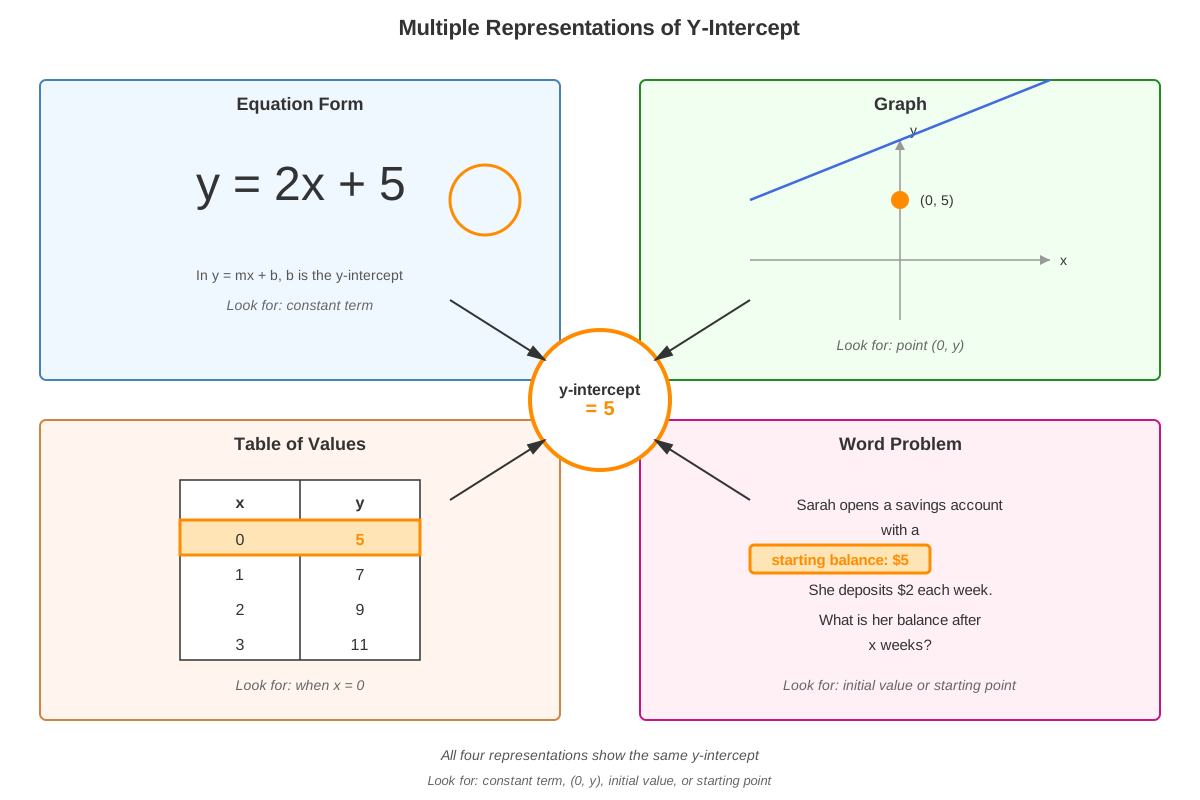
- [ ] Determine the y-intercept from multiple representations (equations, graphs, tables, and word problems)
- [ ] Interpret the real-world meaning of y-intercepts in context-based problems
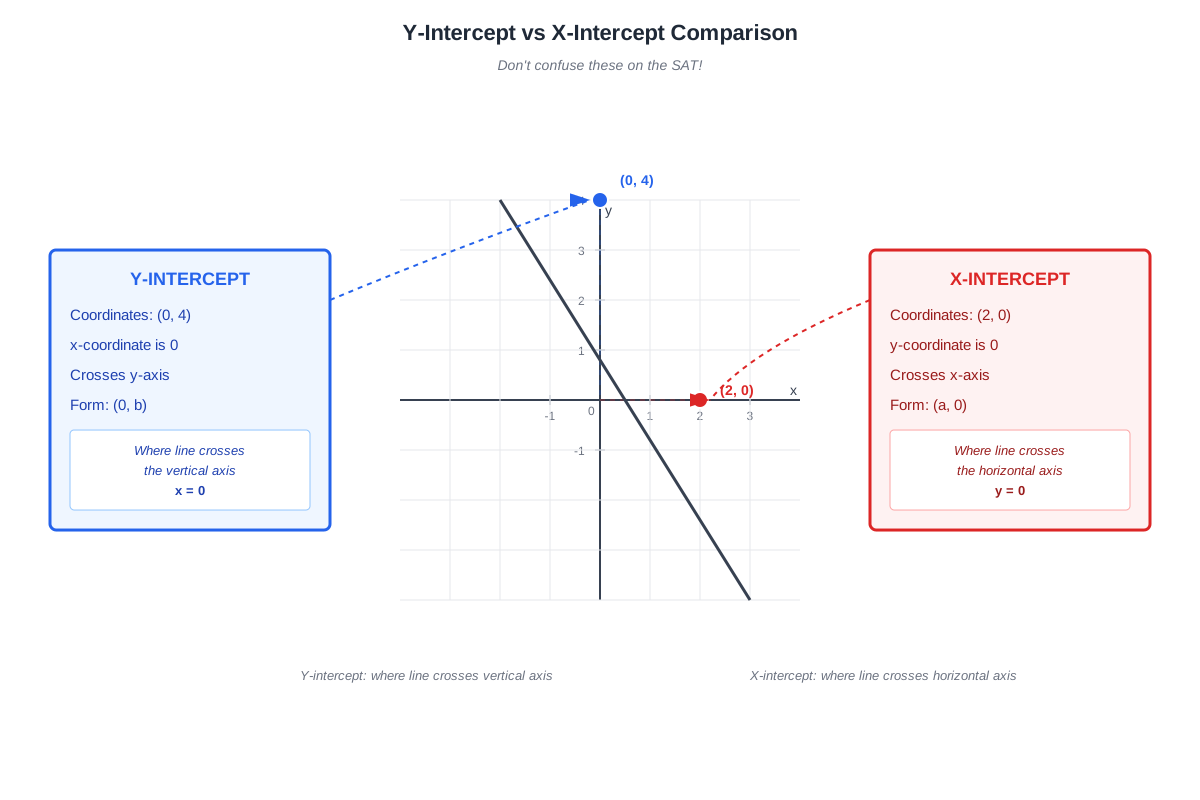
- [ ] Distinguish between y-intercepts and x-intercepts in various problem formats
- [ ] Use y-intercepts to write and manipulate linear equations efficiently
Prerequisites
- Basic coordinate plane understanding: Recognizing x and y axes, plotting points, and reading coordinates is essential for locating where lines intersect the y-axis
- Linear equation familiarity: Understanding that linear equations represent straight lines helps contextualize the y-intercept as one defining feature of these functions
- Substitution skills: The ability to substitute values into equations is necessary for calculating y-intercepts algebraically
- Function notation basics: Recognizing f(x) and y as interchangeable helps when working with function-based problems involving intercepts
Why This Topic Matters
The y-intercept appears in approximately 8-12% of SAT Math questions, making it one of the most frequently tested concepts in the Linear Functions domain. Questions involving y-intercepts span both the calculator and no-calculator sections, appearing as multiple-choice problems, grid-ins, and as components of multi-step questions worth multiple points. The College Board consistently includes y-intercept questions because they assess fundamental algebraic reasoning that underpins success in college-level mathematics.
In real-world applications, the y-intercept represents initial conditions or starting values in countless scenarios: the starting balance in a bank account before deposits or withdrawals, the initial temperature before heating or cooling begins, the base fee before variable charges apply, or the starting position before movement occurs. This practical significance makes y-intercept problems particularly common in word problems and data interpretation questions on the SAT, where students must translate between mathematical representations and real-world contexts.
On the exam, y-intercepts commonly appear in questions asking students to: interpret graphs of linear functions, write equations from verbal descriptions, identify which equation matches a given scenario, determine where two lines intersect the y-axis, or explain what a constant term represents in context. The ability to quickly identify and work with y-intercepts often determines whether students can complete these questions within the time constraints, making this a critical skill for achieving competitive scores.
Core Concepts
Definition and Graphical Representation
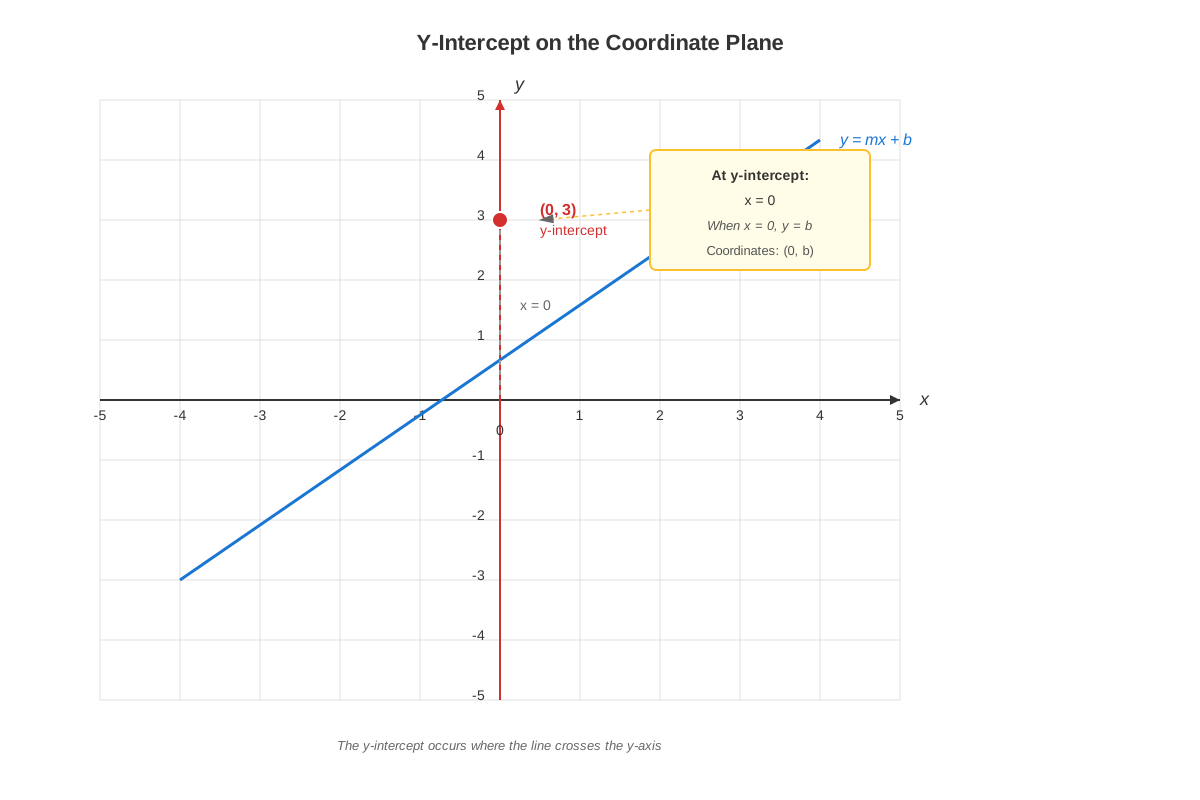
The y-intercept is the point where a line or curve crosses the y-axis on a coordinate plane. At this point, the x-coordinate always equals zero, making the y-intercept expressible as the ordered pair (0, b), where b represents the y-coordinate. Graphically, finding the y-intercept means locating where the line touches or passes through the vertical axis. This point provides crucial information about the function's behavior and serves as one of two key features (along with slope) that completely determine a linear function.
When examining a graph, the y-intercept can be read directly by identifying the y-coordinate where the line crosses the y-axis. If a line passes through the point (0, 3), the y-intercept is 3. If it crosses at (0, -5), the y-intercept is -5. Some students mistakenly report the y-intercept as a coordinate pair, but on the SAT, questions typically ask for the y-intercept value itself (just the number) rather than the full coordinate, though both representations are technically correct.
Algebraic Forms and Identification
In the slope-intercept form of a linear equation, y = mx + b, the y-intercept is represented by the constant term b. This form makes the y-intercept immediately visible and is the most efficient representation for quickly identifying this feature. For example, in the equation y = 2x + 7, the y-intercept is 7. In y = -3x - 4, the y-intercept is -4. The sign of the constant term matters significantly—positive values indicate the line crosses above the origin, while negative values indicate crossing below.
When equations appear in standard form (Ax + By = C), the y-intercept requires calculation. To find it, substitute x = 0 into the equation and solve for y. For example, given 3x + 2y = 12, substitute x = 0 to get 2y = 12, yielding y = 6, so the y-intercept is 6. This process works because the y-intercept occurs precisely where x equals zero.
For equations in point-slope form, y - y₁ = m(x - x₁), finding the y-intercept requires algebraic manipulation. Substitute x = 0 and solve for y, or convert the equation to slope-intercept form by distributing and isolating y. Given y - 4 = 2(x - 3), distributing yields y - 4 = 2x - 6, then y = 2x - 2, revealing a y-intercept of -2.
Y-Intercept from Tables and Data
When linear functions are presented in table format, the y-intercept can be identified directly if the table includes the point where x = 0. Simply locate the row with x = 0 and read the corresponding y-value. However, SAT questions often provide tables that don't include x = 0, requiring students to use the pattern of change to determine the y-intercept.
To find the y-intercept from a table without x = 0, first calculate the slope using any two points, then use the slope and one point to work backward or forward to x = 0. For example, if a table shows (2, 8) and (5, 17), the slope is (17-8)/(5-2) = 9/3 = 3. Using the point (2, 8) and slope 3, the equation is y = 3x + b. Substituting: 8 = 3(2) + b, so 8 = 6 + b, yielding b = 2. The y-intercept is 2.
Contextual Interpretation
In word problems and real-world scenarios, the y-intercept represents the initial value or starting condition before any changes occur. When time is the independent variable (x-axis), the y-intercept shows the value at time zero—the beginning of the observation period. When quantity is the independent variable, the y-intercept might represent a base fee, fixed cost, or starting amount.
Consider this scenario: "A phone plan costs $30 per month plus a one-time activation fee of $50." If y represents total cost and x represents months of service, the equation is y = 30x + 50. The y-intercept of 50 represents the cost when x = 0 (zero months), which is the activation fee—the amount paid before any monthly charges apply. Recognizing this interpretation is crucial for SAT questions that ask "What does the constant term represent?" or "What is the meaning of the y-intercept in this context?"
Comparison Table: Forms and Y-Intercept Identification
| Equation Form | Example | Y-Intercept | Method |
|---|---|---|---|
| Slope-Intercept | y = 4x - 3 | -3 | Read constant term directly |
| Standard Form | 2x + 5y = 20 | 4 | Substitute x = 0, solve for y |
| Point-Slope | y - 6 = 3(x - 2) | 0 | Convert to slope-intercept or substitute x = 0 |
| Function Notation | f(x) = -2x + 7 | 7 | Evaluate f(0) or read constant term |
Concept Relationships
The y-intercept connects intimately with slope to completely define a linear function. While slope describes the rate of change (how steep the line is), the y-intercept establishes the starting position. Together, these two features allow us to write unique equations and draw precise graphs. Understanding this relationship enables students to move fluidly between different representations: given a graph, extract both slope and y-intercept to write an equation; given an equation, identify both features to sketch a graph.
The relationship flows as follows: Coordinate Plane Understanding → enables → Point Identification → leads to → Y-Intercept Recognition → combines with → Slope → produces → Complete Linear Equation → enables → Graphing and Problem Solving. Each step builds on the previous, creating a comprehensive understanding of linear functions.
Y-intercepts also connect to systems of equations. When solving systems graphically, the y-intercepts of two lines help determine whether the lines might intersect, and if so, provide reference points for sketching. When two lines have the same y-intercept but different slopes, they intersect at that y-intercept point. This connection appears in SAT questions asking about the number of solutions to systems or the meaning of intersection points.
The concept extends to function transformations: vertical shifts of linear functions change only the y-intercept while preserving the slope. Adding a constant to a function (f(x) + k) shifts the graph vertically, changing the y-intercept by that constant amount. This relationship helps students predict how equation changes affect graphs and vice versa.
Quick check — test yourself on Y-intercept so far.
Try Flashcards →High-Yield Facts
⭐ The y-intercept occurs where x = 0, making it the point (0, b) on any graph
⭐ In slope-intercept form (y = mx + b), the y-intercept is the constant term b
⭐ To find the y-intercept from any equation, substitute x = 0 and solve for y
⭐ In word problems, the y-intercept typically represents the initial value or starting condition
⭐ The y-intercept can be positive, negative, or zero; a y-intercept of zero means the line passes through the origin
- Two different lines can share the same y-intercept if they have different slopes
- Horizontal lines (y = k) have a y-intercept of k and never change regardless of x
- Vertical lines (x = k) have no y-intercept unless k = 0, in which case every point on the y-axis is an intercept
- The y-intercept is also written as f(0) in function notation
- Parallel lines have the same slope but different y-intercepts (unless they're the same line)
- When a linear equation is written as y = mx + b, changing only b shifts the line vertically without changing its steepness
- In standard form Ax + By = C, the y-intercept equals C/B (when B ≠ 0)
Common Misconceptions
Misconception: The y-intercept is always positive.
Correction: The y-intercept can be any real number—positive, negative, or zero. A negative y-intercept simply means the line crosses the y-axis below the origin. For example, y = 2x - 5 has a y-intercept of -5.
Misconception: The y-intercept and the slope are the same thing.
Correction: These are distinct features of linear functions. The slope (m) describes the rate of change or steepness, while the y-intercept (b) describes where the line crosses the y-axis. In y = 3x + 2, the slope is 3 and the y-intercept is 2—completely different values with different meanings.
Misconception: To find the y-intercept, set y = 0.
Correction: This finds the x-intercept, not the y-intercept. To find the y-intercept, set x = 0 and solve for y. This confusion stems from mixing up which variable to zero out for which intercept.
Misconception: The y-intercept must be written as a coordinate pair (0, b).
Correction: While (0, b) is correct, SAT questions typically ask for just the y-intercept value (b) itself. Both representations are valid, but understanding what the question asks for prevents unnecessary errors.
Misconception: All lines have a y-intercept.
Correction: Vertical lines (except x = 0) have no y-intercept because they never cross the y-axis. The line x = 3, for example, is parallel to the y-axis and never intersects it, so it has no y-intercept.
Misconception: In the equation 2y = 4x + 6, the y-intercept is 6.
Correction: The equation must be in slope-intercept form (y = mx + b) to read the y-intercept directly. Dividing both sides by 2 gives y = 2x + 3, so the y-intercept is 3, not 6. Always isolate y before identifying the y-intercept from the equation.
Worked Examples
Example 1: Finding Y-Intercept from Standard Form
Problem: What is the y-intercept of the line represented by the equation 4x - 3y = 12?
Solution:
To find the y-intercept, we need to determine the y-value when x = 0.
Step 1: Substitute x = 0 into the equation
4(0) - 3y = 12
Step 2: Simplify
0 - 3y = 12
-3y = 12
Step 3: Solve for y
y = 12 ÷ (-3)
y = -4
Therefore, the y-intercept is -4, which corresponds to the point (0, -4) on the graph.
Alternative Method: Convert to slope-intercept form
4x - 3y = 12
-3y = -4x + 12
y = (4/3)x - 4
Reading directly from slope-intercept form, the y-intercept is -4.
Connection to Learning Objectives: This example demonstrates identifying the y-intercept from an equation not in slope-intercept form, a common SAT question type that tests algebraic manipulation skills.
Example 2: Contextual Interpretation
Problem: A water tank contains 500 gallons of water. Water is being drained at a constant rate of 25 gallons per hour. Which equation represents the amount of water W, in gallons, remaining in the tank after t hours, and what does the y-intercept represent?
Solution:
Step 1: Identify the components
- Initial amount (starting value): 500 gallons
- Rate of change: -25 gallons per hour (negative because water is being drained)
- Independent variable: t (time in hours)
- Dependent variable: W (water remaining)
Step 2: Write the equation in slope-intercept form
W = mt + b, where m is the rate and b is the initial value
W = -25t + 500
Step 3: Identify and interpret the y-intercept
The y-intercept is 500.
Interpretation: The y-intercept represents the amount of water in the tank at time t = 0, which is the initial amount before any draining occurs. In context, this means the tank started with 500 gallons of water.
SAT Connection: This type of question frequently appears on the SAT, asking students to both write an equation from a verbal description and explain what the constant term (y-intercept) means in the real-world context. The y-intercept always represents the starting condition or initial value when time or another independent variable equals zero.
Exam Strategy
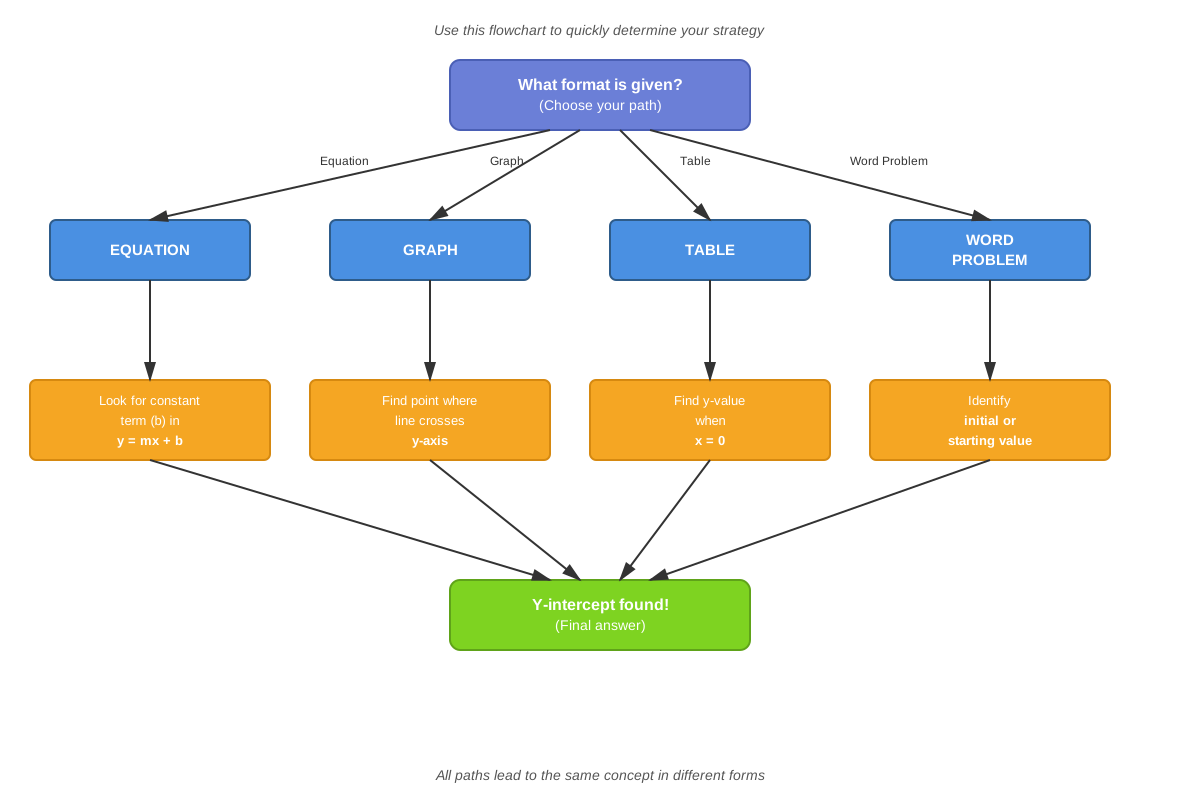
When approaching SAT questions involving y-intercepts, first identify how the information is presented: as a graph, equation, table, or word problem. Each format requires a specific strategy. For graphs, locate where the line crosses the y-axis and read the y-coordinate directly. For equations, check if they're in slope-intercept form (y = mx + b) for immediate identification, or convert/substitute as needed for other forms.
Trigger words and phrases that signal y-intercept questions include: "initial value," "starting amount," "when x = 0," "constant term," "where the line crosses the y-axis," "y-coordinate of the y-intercept," and "what does the constant represent?" When you see these phrases, immediately think about the y-intercept and how to extract or interpret it from the given information.
For process-of-elimination strategies, remember that the y-intercept must be a single number (or coordinate pair), not an expression with variables. If answer choices include variables, they likely represent something other than the y-intercept. Also, check the sign carefully—if a graph shows a line crossing below the x-axis on the y-axis, the y-intercept must be negative, allowing you to eliminate positive answer choices immediately.
Time allocation: Most y-intercept questions should take 30-60 seconds once you've mastered the concept. If you find yourself spending more than 90 seconds, you may be overcomplicating the problem. Step back and ask: "What is this question really asking?" Often, SAT questions test whether you can identify the y-intercept quickly rather than perform complex calculations.
Exam Tip: When a question asks "What does the constant term represent?" in a word problem, the answer is almost always describing the y-intercept's real-world meaning—the initial or starting value before any changes occur.
Memory Techniques
Mnemonic for Y-Intercept: "Y is where You start" — The y-intercept represents the starting value or initial condition in most contexts, and it's found on the y-axis.
Visual Memory Aid: Picture the y-axis as a "starting line" in a race. The y-intercept is where the runner (the line) begins before moving forward (increasing x). This visualization helps remember that y-intercepts represent initial conditions.
Acronym for Finding Y-Intercept: ZERO
- Zero out x
- Evaluate the equation
- Read the result
- Or look at the constant in y = mx + b
Slope-Intercept Memory Device: In y = mx + b, think "b is for beginning" — the b term shows where the line begins on the y-axis.
Sign Memory Trick: If the y-intercept is positive, the line "starts high" (crosses above the origin). If negative, it "starts low" (crosses below the origin). If zero, it "starts at home" (passes through the origin).
Summary
The y-intercept is the point where a line crosses the y-axis, occurring when x = 0 and represented as (0, b) or simply as the value b. In slope-intercept form (y = mx + b), the y-intercept is the constant term b, making it immediately identifiable. For other equation forms, substituting x = 0 and solving for y reveals the y-intercept. On the SAT, y-intercept questions appear frequently across multiple question types, testing both computational skills and conceptual understanding. In real-world contexts, the y-intercept represents initial values or starting conditions—the amount before any changes occur. Mastering y-intercepts requires recognizing them in various representations (graphs, equations, tables, word problems), calculating them efficiently, and interpreting their meaning in context. This foundational concept connects to broader topics including slope, linear equations, systems, and function transformations, making it essential for success on the SAT Math section.
Key Takeaways
- The y-intercept is where a line crosses the y-axis, always occurring at x = 0
- In y = mx + b form, the y-intercept is b (the constant term)
- To find the y-intercept from any equation, substitute x = 0 and solve for y
- In word problems, the y-intercept represents the initial value or starting condition
- Y-intercepts can be positive, negative, or zero, and this sign indicates whether the line crosses above, below, or through the origin
- SAT questions test y-intercept identification, calculation, and contextual interpretation
- Combining y-intercept with slope completely determines a unique linear function
Related Topics
Slope: Understanding how to calculate and interpret the rate of change in linear functions complements y-intercept knowledge, as both features together define a line completely. Mastering y-intercepts makes learning about slope relationships more intuitive.
X-Intercepts: The counterpart to y-intercepts, x-intercepts occur where lines cross the x-axis (when y = 0). Understanding both types of intercepts enables complete analysis of linear functions and their graphs.
Systems of Linear Equations: Y-intercepts play a crucial role in solving systems graphically and algebraically, particularly when determining whether lines intersect and where those intersections occur.
Linear Inequalities: The concepts learned for y-intercepts transfer directly to graphing and interpreting linear inequalities, where the boundary line's y-intercept remains a key feature.
Function Transformations: Understanding how changes to equations affect y-intercepts (vertical shifts) builds on this foundational knowledge and extends to more complex function families beyond linear functions.
Practice CTA
Now that you've mastered the core concepts of y-intercepts, it's time to solidify your understanding through practice! Work through the practice questions to apply these strategies to SAT-style problems, and use the flashcards to reinforce key definitions and formulas. Remember, the y-intercept appears on nearly every SAT exam—mastering this topic now will pay dividends on test day. Each practice problem you complete builds the pattern recognition and speed you need to excel. You've got this!
Sign up free to keep reading
Create a free AnvayaPrep account to finish this SAT guide on Y-intercept — plus flashcards and practice questions.