Overview
Piecewise functions are mathematical functions defined by multiple sub-functions, each applying to a specific interval or condition within the domain. Rather than having a single rule that applies to all input values, piecewise functions use different formulas depending on which part of the domain the input falls into. These functions appear frequently on the SAT and test a student's ability to interpret mathematical notation, evaluate functions at specific points, and understand how different rules apply to different intervals.
Understanding piecewise functions is essential for SAT success because they combine multiple mathematical skills: reading complex notation, working with inequalities, evaluating expressions, and interpreting graphs. The College Board regularly includes sat piecewise functions questions in both the calculator and no-calculator sections, often embedding them within word problems or asking students to analyze their graphical representations. These questions typically assess whether students can correctly identify which piece of the function to use for a given input value and accurately perform the required calculations.
Within the broader context of math on the SAT, piecewise functions connect to several fundamental concepts including function notation, domain and range, graphing, and the interpretation of mathematical models. They serve as a bridge between basic function evaluation and more complex real-world applications where different rules apply under different conditions—such as tax brackets, shipping costs, or parking fees. Mastering piecewise functions strengthens overall function literacy and prepares students for questions involving conditional logic and multi-step problem solving.
Learning Objectives
- [ ] Identify key features of piecewise functions
- [ ] Explain how piecewise functions appear on the SAT
- [ ] Apply piecewise functions to answer SAT-style questions
- [ ] Evaluate piecewise functions at specific input values by selecting the correct sub-function
- [ ] Interpret and sketch graphs of piecewise functions, identifying discontinuities and endpoints
- [ ] Solve equations involving piecewise functions by considering multiple cases
- [ ] Translate real-world scenarios into piecewise function notation
Prerequisites
- Function notation and evaluation: Understanding f(x) notation is essential because piecewise functions require evaluating different expressions based on input values
- Solving linear and quadratic equations: Each piece of a piecewise function often involves algebraic expressions that students must manipulate and evaluate
- Understanding inequalities: Piecewise functions use inequality notation to define the domain intervals where each sub-function applies
- Coordinate plane and graphing basics: Visualizing piecewise functions requires plotting points and understanding how different function pieces connect or disconnect on a graph
- Absolute value functions: Many piecewise functions can be rewritten using absolute value, and vice versa, making this connection valuable
Why This Topic Matters
Piecewise functions model countless real-world situations where rules change based on conditions. Tax systems use piecewise functions where different income brackets are taxed at different rates. Utility companies charge different rates based on usage tiers. Shipping companies calculate costs differently based on package weight ranges. Understanding piecewise functions enables students to translate these practical scenarios into mathematical models and solve problems involving conditional logic.
On the SAT, piecewise functions appear in approximately 2-4 questions per test, making them a high-yield topic for focused study. These questions typically appear in the Heart of Algebra and Passport to Advanced Math content domains. The College Board tests piecewise functions through multiple question formats: direct evaluation problems where students must find f(a) for a specific value a, graphical interpretation questions requiring students to match functions to graphs, and word problems where students must construct or analyze piecewise models. Questions may also combine piecewise functions with other topics such as systems of equations, domain and range, or function composition.
The SAT particularly favors questions that test whether students can correctly identify which piece of the function applies to a given input. Common question types include: evaluating the function at boundary points where the pieces meet, finding values of x that make f(x) equal to a specific output, determining the range of the function over a specified interval, and interpreting the meaning of different pieces in context. Students who master piecewise functions gain a significant advantage because these questions often appear in the medium-to-hard difficulty range where correct answers most impact scaled scores.
Core Concepts
Definition and Notation
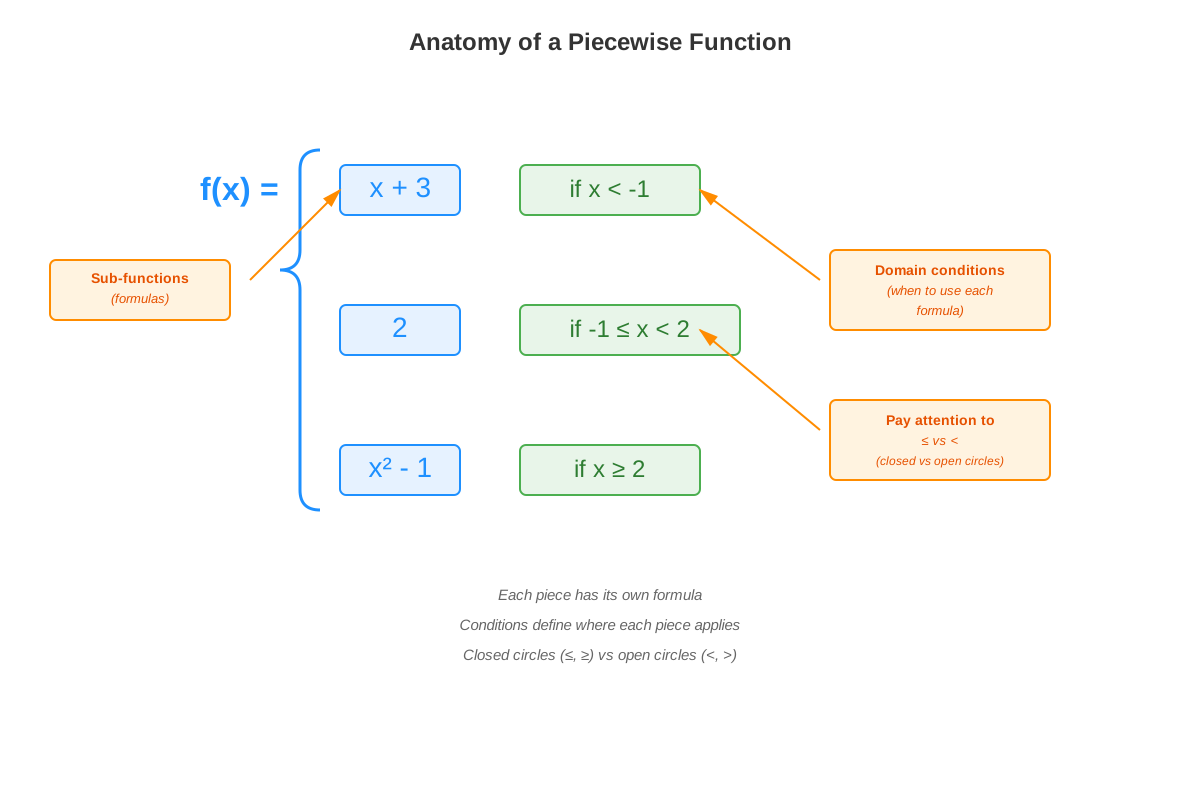
A piecewise function is a function defined by two or more sub-functions, each applying to a specific part of the domain. The standard notation uses a large brace to group the different pieces together:
f(x) = {
  expression₁,  if condition₁
  expression₂,  if condition₂
  expression₃,  if condition₃
}
Each piece consists of two parts: an expression (the formula to use) and a condition (when to use that formula). The conditions are typically written as inequalities that partition the domain into non-overlapping intervals. For example:
f(x) = {
  2x + 1,     if x < 0
  x²,         if 0 ≤ x < 3
  10,         if x ≥ 3
}
This function has three pieces: for negative inputs, use 2x + 1; for inputs from 0 to just below 3, use x²; for inputs of 3 or greater, use the constant 10.
Evaluating Piecewise Functions
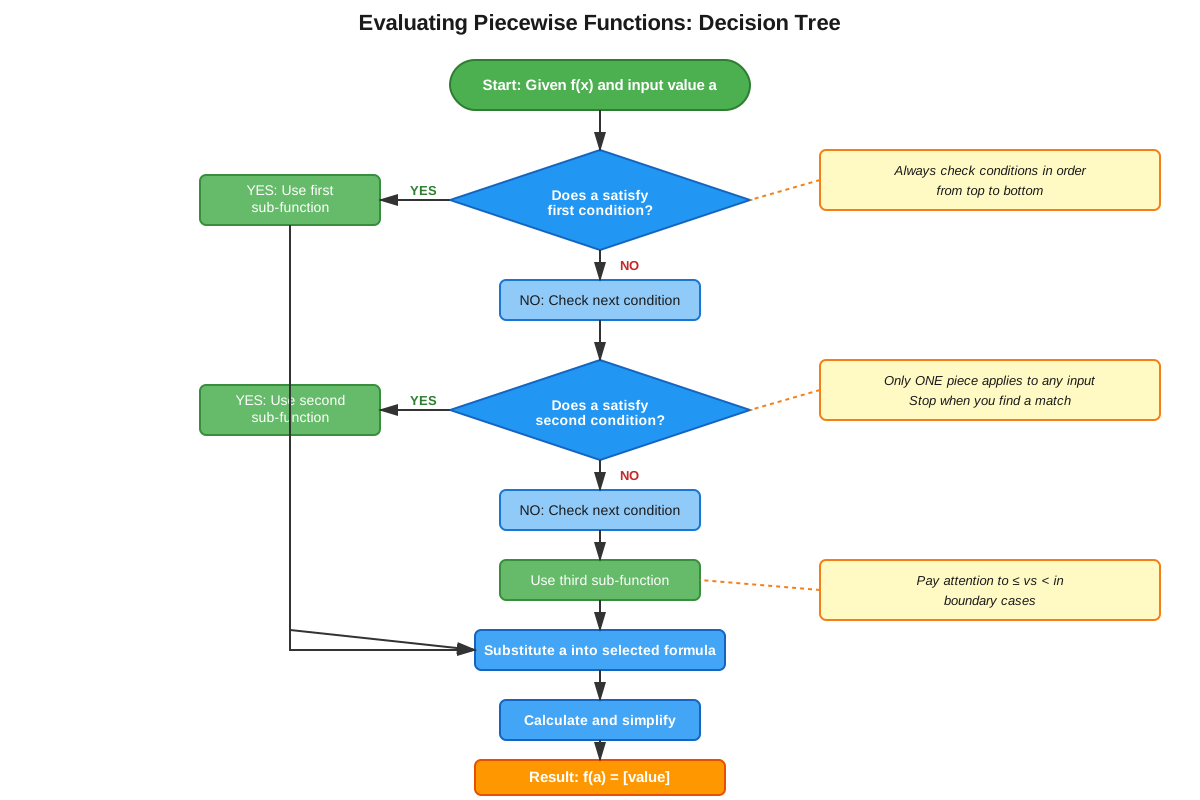
To evaluate a piecewise function at a specific input value, follow this systematic process:
- Identify the input value you need to evaluate
- Check each condition to determine which piece applies
- Select the correct expression based on which condition is satisfied
- Substitute the input value into that expression
- Calculate the result using standard algebraic operations
Consider the function above. To find f(-2):
- Check: Is -2 < 0? Yes, so use the first piece: 2x + 1
- Substitute: f(-2) = 2(-2) + 1 = -4 + 1 = -3
To find f(2):
- Check: Is 2 < 0? No. Is 0 ≤ 2 < 3? Yes, so use the second piece: x²
- Substitute: f(2) = (2)² = 4
To find f(5):
- Check: Is 5 < 0? No. Is 0 ≤ 5 < 3? No. Is 5 ≥ 3? Yes, so use the third piece: 10
- Substitute: f(5) = 10
Boundary Points and Continuity
Boundary points are the x-values where the function transitions from one piece to another. These points require special attention because they determine whether the function is continuous (connected) or has discontinuities (breaks or jumps).
For the function above, the boundary points are x = 0 and x = 3. To determine if the function is continuous at a boundary:
- Evaluate the function at the boundary point using the piece that includes it
- Find the limit approaching from the left (using the piece just before)
- Find the limit approaching from the right (using the piece just after)
- If all three values match, the function is continuous at that point
At x = 0:
- From the left (using 2x + 1): approaches 2(0) + 1 = 1
- At the point (using x²): f(0) = 0² = 0
- The function has a jump discontinuity at x = 0
At x = 3:
- From the left (using x²): approaches (3)² = 9
- At the point (using 10): f(3) = 10
- The function has a jump discontinuity at x = 3
Graphing Piecewise Functions
Graphing piecewise functions requires plotting each piece separately over its specified domain interval:
- Graph each piece as if it were the entire function
- Restrict each graph to only the interval specified by its condition
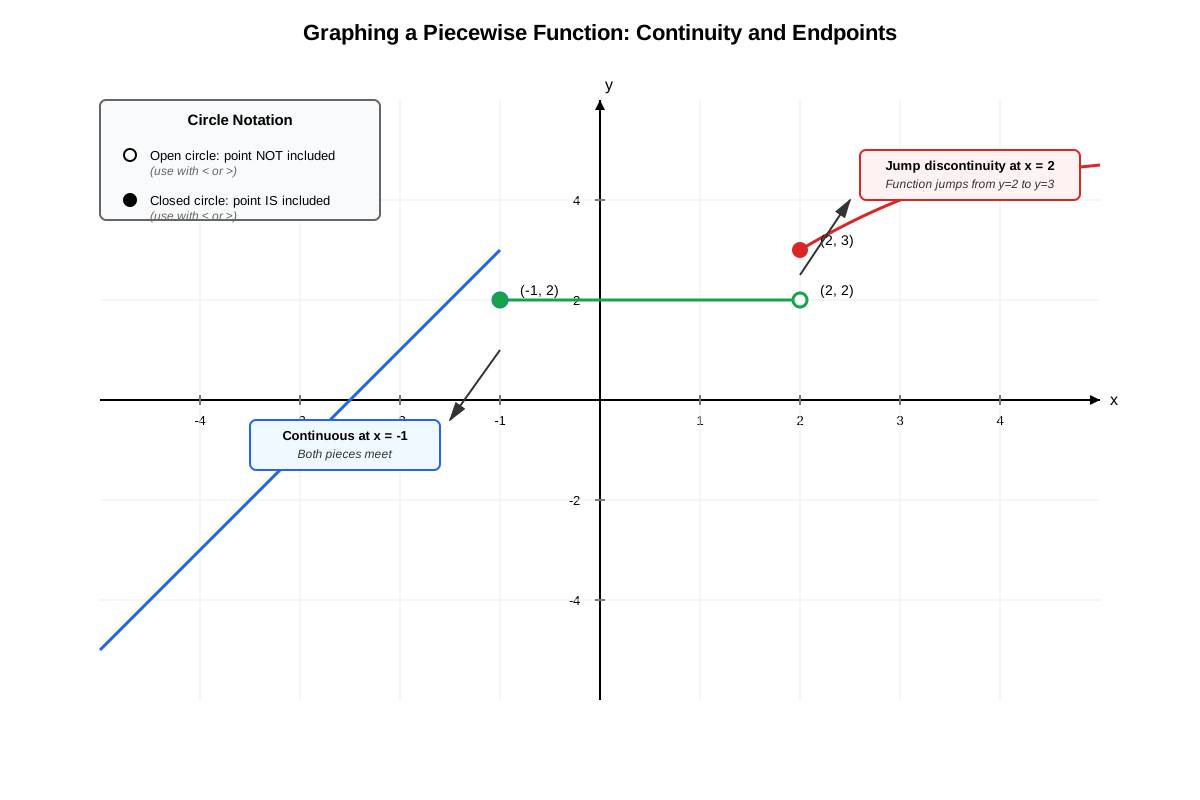
- Mark endpoints with open circles (○) for excluded values and closed circles (●) for included values
- Connect or leave gaps based on continuity
For the example function:
- First piece (2x + 1 for x < 0): Draw a line with slope 2 and y-intercept 1, but only for x < 0. Use an open circle at (0, 1)
- Second piece (x² for 0 ≤ x < 3): Draw a parabola, but only from x = 0 to x = 3. Use a closed circle at (0, 0) and an open circle at (3, 9)
- Third piece (10 for x ≥ 3): Draw a horizontal line at y = 10, starting from x = 3. Use a closed circle at (3, 10)
The resulting graph shows two visible jumps at x = 0 and x = 3.
Domain and Range
The domain of a piecewise function is the union of all intervals specified in the conditions. If the conditions cover all real numbers without gaps, the domain is all real numbers. If there are gaps or restrictions, the domain excludes those values.
The range is determined by examining the output values produced by each piece over its respective interval. This often requires:
- Finding the minimum and maximum values of each piece on its interval
- Considering endpoint behavior (included or excluded)
- Taking the union of all possible output values
Solving Equations with Piecewise Functions
To solve an equation like f(x) = k where f is a piecewise function, consider each piece separately:
- Set up separate equations for each piece: expression₁ = k, expression₂ = k, etc.
- Solve each equation algebraically
- Check each solution against the condition for that piece
- Keep only valid solutions where the x-value satisfies the piece's condition
- Combine all valid solutions as the final answer
This case-by-case approach ensures that solutions are only accepted if they fall within the appropriate domain interval for each piece.
Concept Relationships
Piecewise functions integrate multiple foundational concepts into a unified framework. Function notation serves as the starting point, providing the language needed to express and evaluate piecewise definitions. The ability to work with inequalities directly enables students to interpret the conditions that define each piece's domain, while graphing skills allow visualization of how different pieces connect or disconnect on the coordinate plane.
Within piecewise functions themselves, the concepts build hierarchically: Definition and notation → Evaluation at specific points → Analysis of boundary points → Graphing complete functions → Solving equations involving multiple cases. Each level requires mastery of the previous concepts.
Piecewise functions connect forward to more advanced topics including absolute value functions (which can be rewritten as piecewise functions), function transformations (where each piece may be shifted or scaled), and systems of equations (where piecewise functions may serve as one equation in the system). They also relate to domain and range analysis, as determining the range of a piecewise function requires examining each piece's behavior over its specific interval.
The relationship between algebraic and graphical representations is particularly important: algebraic conditions (x < 2, x ≥ 2) translate directly to graphical features (open vs. closed circles, connected vs. disconnected pieces). Understanding this bidirectional relationship—moving from equation to graph and from graph to equation—is essential for SAT success.
Quick check — test yourself on Piecewise functions so far.
Try Flashcards →High-Yield Facts
⭐ To evaluate a piecewise function, first determine which condition the input satisfies, then use only that piece's expression
⭐ Boundary points are where pieces meet; check whether the point is included (≤ or ≥) or excluded (< or >) to determine if you use a closed or open circle
⭐ A piecewise function is continuous at a boundary point only if the output values from both adjacent pieces match at that point
⭐ When solving f(x) = k for a piecewise function, you must solve separate equations for each piece and verify that solutions fall within the correct domain intervals
⭐ The range of a piecewise function requires analyzing each piece separately over its specific interval, then combining all possible output values
- Open circles (○) on a graph indicate the endpoint is NOT included; closed circles (●) indicate the endpoint IS included
- If conditions use < or >, the boundary value belongs to the adjacent piece; if they use ≤ or ≥, the boundary belongs to that piece
- Horizontal line segments in piecewise graphs represent constant functions over specific intervals
- Jump discontinuities occur when the left-hand and right-hand limits at a boundary point don't match
- The domain of a piecewise function is the union of all intervals specified in the conditions
- When graphing, always check the inequality symbols carefully to determine which endpoints to include
- Piecewise functions can model real-world situations where different rules apply in different scenarios (tax brackets, shipping rates, parking fees)
Common Misconceptions
Misconception: When evaluating a piecewise function, students use all pieces and add the results together.
Correction: Only one piece applies to any given input value. Identify which condition the input satisfies, then use only that single piece's expression to calculate the output.
Misconception: The boundary point always belongs to the piece written first or on top.
Correction: The boundary point belongs to whichever piece includes it in its condition using ≤ or ≥. If one piece uses x < 2 and another uses x ≥ 2, the point x = 2 belongs to the second piece.
Misconception: All piecewise functions have discontinuities at their boundary points.
Correction: A piecewise function is continuous at a boundary if the output values from both adjacent pieces match at that point. Many piecewise functions are designed to be continuous by carefully choosing expressions that connect smoothly.
Misconception: When solving f(x) = k, students find one solution and stop.
Correction: Each piece of the function might yield a solution. You must solve the equation for each piece separately, then verify which solutions are valid by checking if they satisfy that piece's domain condition. Multiple valid solutions are possible.
Misconception: The graph of a piecewise function is always made up of straight line segments.
Correction: Each piece can be any type of function—linear, quadratic, exponential, constant, or others. The graph might include curves, parabolas, or other non-linear shapes depending on the expressions used in each piece.
Worked Examples
Example 1: Evaluation and Equation Solving
Given the piecewise function:
g(x) = {
  x² - 4,      if x ≤ 1
  3x + 2,      if 1 < x < 5
  -2x + 17,    if x ≥ 5
}
Part A: Find g(-2), g(3), and g(5).
Solution:
For g(-2):
- Check conditions: Is -2 ≤ 1? Yes, so use the first piece: x² - 4
- Calculate: g(-2) = (-2)² - 4 = 4 - 4 = 0
For g(3):
- Check conditions: Is 3 ≤ 1? No. Is 1 < 3 < 5? Yes, so use the second piece: 3x + 2
- Calculate: g(3) = 3(3) + 2 = 9 + 2 = 11
For g(5):
- Check conditions: Is 5 ≤ 1? No. Is 1 < 5 < 5? No. Is 5 ≥ 5? Yes, so use the third piece: -2x + 17
- Calculate: g(5) = -2(5) + 17 = -10 + 17 = 7
Part B: Solve g(x) = 5.
Solution:
We must consider each piece separately:
Case 1 (x ≤ 1): x² - 4 = 5
- x² = 9
- x = ±3
- Check: Is 3 ≤ 1? No, invalid. Is -3 ≤ 1? Yes, valid.
- Solution from Case 1: x = -3
Case 2 (1 < x < 5): 3x + 2 = 5
- 3x = 3
- x = 1
- Check: Is 1 < 1 < 5? No, 1 is not strictly greater than 1, invalid.
- No solution from Case 2
Case 3 (x ≥ 5): -2x + 17 = 5
- -2x = -12
- x = 6
- Check: Is 6 ≥ 5? Yes, valid.
- Solution from Case 3: x = 6
Final answer: x = -3 or x = 6
This example demonstrates the critical learning objectives of evaluating piecewise functions at specific points and solving equations by considering multiple cases.
Example 2: Real-World Application
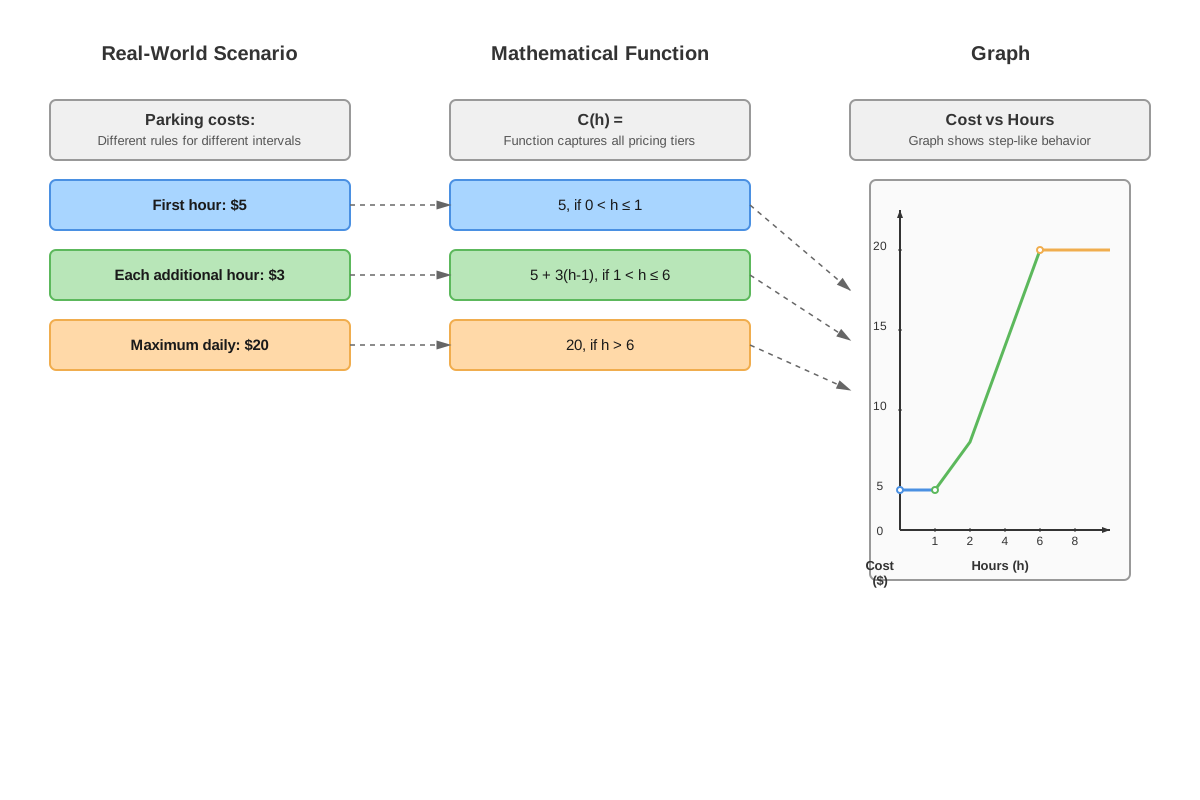
A parking garage charges based on the following rate structure:
- $5 for the first hour or any part thereof
- $3 per hour for hours 2 through 4
- $2 per hour for hour 5 and beyond
Part A: Write a piecewise function C(t) that gives the cost for parking t hours, where t is a positive number.
Solution:
We need to think about cumulative costs:
- For 0 < t ≤ 1: Cost is $5
- For 1 < t ≤ 2: Cost is $5 + $3 = $8
- For 2 < t ≤ 3: Cost is $5 + $3 + $3 = $11
- For 3 < t ≤ 4: Cost is $5 + $3 + $3 + $3 = $14
- For t > 4: Cost is $14 + $2(t - 4) = $14 + $2t - $8 = $2t + 6
C(t) = {
  5,           if 0 < t ≤ 1
  8,           if 1 < t ≤ 2
  11,          if 2 < t ≤ 3
  14,          if 3 < t ≤ 4
  2t + 6,      if t > 4
}
Part B: How much does it cost to park for 3.5 hours? For 6 hours?
Solution:
For t = 3.5:
- Check: Is 3 < 3.5 ≤ 4? Yes, so use the fourth piece: 14
- C(3.5) = $14
For t = 6:
- Check: Is 6 > 4? Yes, so use the fifth piece: 2t + 6
- C(6) = 2(6) + 6 = 12 + 6 = $18
This example shows how piecewise functions model real-world scenarios where different rules apply in different situations, connecting directly to the learning objective of applying piecewise functions to practical problems.
Exam Strategy
When approaching SAT questions involving piecewise functions, follow this systematic strategy:
Step 1: Identify the question type. Determine whether you need to evaluate the function at a specific point, solve an equation, analyze a graph, or interpret a real-world scenario. This dictates your approach.
Step 2: For evaluation questions, carefully identify which condition applies to the given input. Circle or underline the relevant piece before substituting. This prevents the common error of using the wrong expression.
Step 3: Pay special attention to boundary points. When the input value equals a boundary, check the inequality symbols carefully. The symbols ≤ and ≥ include the boundary; < and > exclude it. This distinction often determines the correct answer.
Step 4: For equation-solving questions, set up separate cases for each piece. Write out each case explicitly, solve it, then verify the solution satisfies that piece's domain condition. Don't stop after finding one solution—check all pieces.
Step 5: For graphing questions, look for these trigger features:
- Open vs. closed circles at boundaries
- Jumps or breaks in the graph (discontinuities)
- Different slopes or curvatures in different regions
- Horizontal segments (constant pieces)
Trigger words and phrases that signal piecewise function questions:
- "For values of x less than..."
- "When x is between..."
- "Different rates apply..."
- "The function is defined by..."
- "For the first [amount], then..."
- Questions showing functions with large braces
Process of elimination tips:
- If evaluating at a boundary point, eliminate answers that don't respect the inequality symbols
- For graphs, eliminate any option with incorrect open/closed circles at boundaries
- For word problems, eliminate answers that don't account for all specified conditions
- If solving an equation, eliminate answers that fall outside the valid domain for their piece
Time allocation: Piecewise function questions typically require 60-90 seconds. If a question involves multiple evaluations or solving for multiple cases, allocate up to 2 minutes. Don't spend excessive time on graphing questions—use process of elimination to narrow choices quickly, then verify your selection.
Exam Tip: Always write down which piece you're using before calculating. This simple step prevents the most common error—using the wrong expression—and makes it easy to check your work if time permits.
Memory Techniques
PIECE mnemonic for evaluating piecewise functions:
- Pick the input value
- Identify which condition applies
- Extract the correct expression
- Calculate by substituting
- Evaluate your answer for reasonableness
Boundary Circle Rule: "Less than is Open, Equal is Closed" (LOC)
- < or > → Open circle (○)
- ≤ or ≥ → Closed circle (●)
Visual anchor: Think of piecewise functions as a "mathematical menu" where different items (expressions) are available during different times (domain intervals). Just as you can't order breakfast items during lunch hours, you can't use one piece's expression outside its specified domain.
The Three-Check System for solving equations:
- Solve it (find x algebraically)
- Check it (verify x satisfies the domain condition)
- Keep it (include only valid solutions)
Continuity test: "Meet and Match"—a piecewise function is continuous at a boundary if the pieces meet (connect) and match (have the same y-value) at that point.
Summary
Piecewise functions are multi-part functions where different expressions apply to different portions of the domain, defined by specific conditions using inequalities. Success with piecewise functions on the SAT requires three core competencies: correctly identifying which piece applies to a given input by checking conditions, accurately evaluating expressions by substituting values, and understanding boundary behavior including open versus closed endpoints and continuity. When evaluating, always determine which condition is satisfied before using that piece's expression. When solving equations, consider each piece separately, solve algebraically, then verify solutions fall within the correct domain intervals. Graphically, piecewise functions may show discontinuities at boundaries, represented by jumps between pieces, with open circles indicating excluded endpoints and closed circles indicating included endpoints. The domain is the union of all specified intervals, while the range requires analyzing each piece's output over its specific interval. These functions frequently model real-world scenarios where different rules apply under different conditions, making them both practically relevant and commonly tested on the SAT.
Key Takeaways
- Piecewise functions use different expressions for different parts of the domain, with conditions specifying when each piece applies
- To evaluate a piecewise function, identify which condition the input satisfies, then use only that piece's expression
- Boundary points require careful attention to inequality symbols: ≤ and ≥ include the point, while < and > exclude it
- When solving equations with piecewise functions, solve for each piece separately and verify solutions satisfy the appropriate domain conditions
- Graphically, open circles indicate excluded endpoints, closed circles indicate included endpoints, and jumps represent discontinuities
- The range of a piecewise function requires analyzing each piece over its specific interval and combining all possible outputs
- Piecewise functions model real-world situations where different rules apply in different scenarios, making them highly practical and frequently tested on the SAT
Related Topics
Absolute Value Functions: Absolute value functions can be rewritten as piecewise functions with two pieces (one for positive inputs, one for negative). Mastering piecewise functions provides the foundation for understanding why absolute value graphs have their characteristic V-shape.
Function Transformations: Understanding how to shift, stretch, and reflect piecewise functions requires applying transformation rules to each piece separately, building on the piecewise foundation established here.
Systems of Equations: Piecewise functions can appear as one equation in a system, requiring students to consider multiple cases when finding intersection points or solving simultaneously.
Domain and Range Analysis: Advanced domain and range problems often involve piecewise functions where determining the range requires careful analysis of each piece's behavior over its restricted interval.
Continuity and Limits (for advanced students): The formal definition of continuity builds directly on the boundary point analysis learned with piecewise functions, making this topic essential preparation for calculus.
Practice CTA
Now that you've mastered the core concepts of piecewise functions, it's time to solidify your understanding through active practice. Work through the practice questions to apply these strategies to SAT-style problems, and use the flashcards to reinforce key definitions and procedures. Remember, piecewise functions appear on nearly every SAT, and the skills you've developed here—careful attention to conditions, systematic evaluation, and case-by-case analysis—will serve you across multiple question types. You've built a strong foundation; now practice will transform that knowledge into test-day confidence and points!
Sign up free to keep reading
Create a free AnvayaPrep account to finish this SAT guide on Piecewise functions — plus flashcards and practice questions.