Overview
A linear function is one of the most fundamental concepts in algebra and serves as a cornerstone for success on the SAT Math section. At its core, a linear function definition describes a relationship between two variables where the rate of change remains constant, producing a straight line when graphed on a coordinate plane. Understanding this concept is not merely about memorizing a formula—it requires recognizing how linear relationships manifest in equations, tables, graphs, and real-world contexts that frequently appear on standardized tests.
The SAT consistently tests linear functions across multiple question types, from straightforward equation manipulation to complex word problems involving rate of change, slope-intercept form, and systems of equations. Approximately 20-25% of SAT Math questions directly or indirectly involve linear functions, making this topic one of the highest-yield areas for focused study. Students who master the sat linear function definition gain a significant advantage, as these concepts appear in both the calculator and no-calculator sections, often serving as building blocks for more complex algebraic reasoning.
Linear functions connect to virtually every other algebraic concept tested on the SAT, including quadratic functions (by contrast), systems of equations (where linear functions intersect), inequalities (linear boundaries), and data analysis (trend lines). The ability to quickly identify, manipulate, and interpret linear functions enables students to approach a wide range of math problems with confidence and efficiency, making this topic essential for achieving competitive scores.
Learning Objectives
- [ ] Identify key features of linear function definition, including slope, y-intercept, and constant rate of change
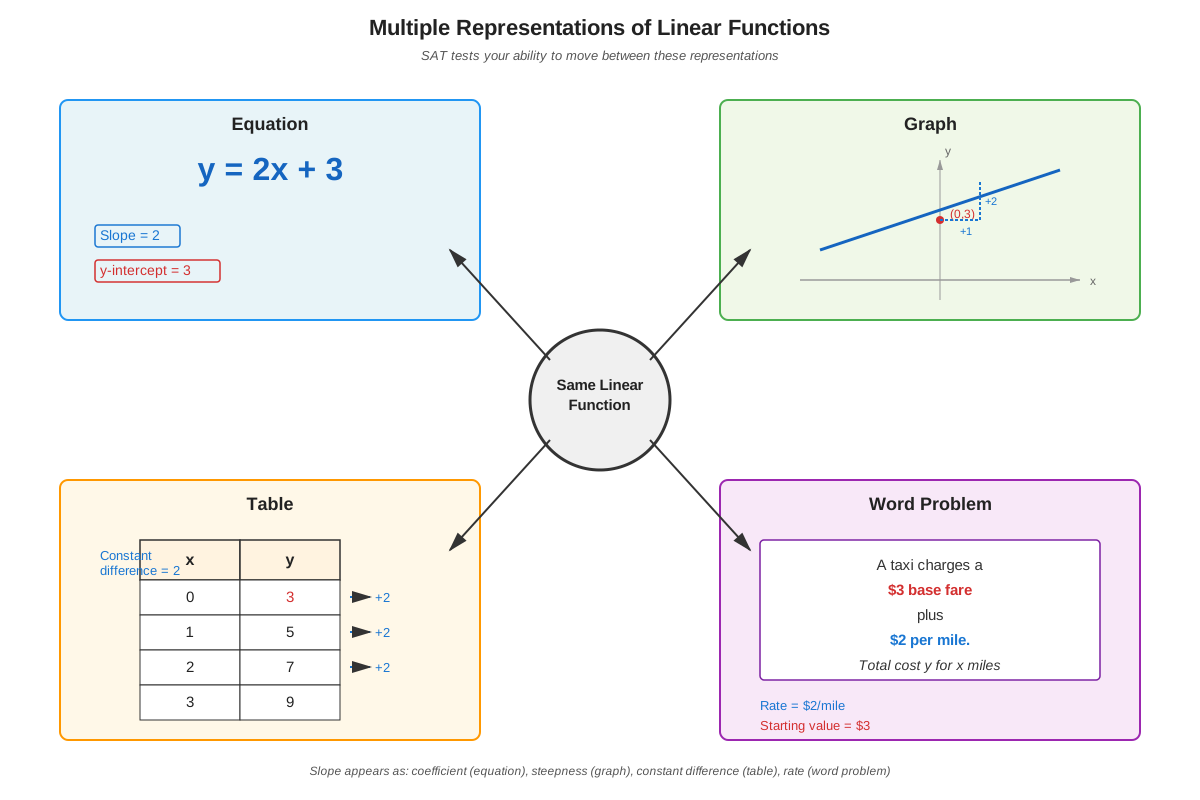
- [ ] Explain how linear function definition appears on the SAT across multiple representations (equations, graphs, tables, word problems)
- [ ] Apply linear function definition to answer SAT-style questions involving function notation, graphing, and real-world scenarios
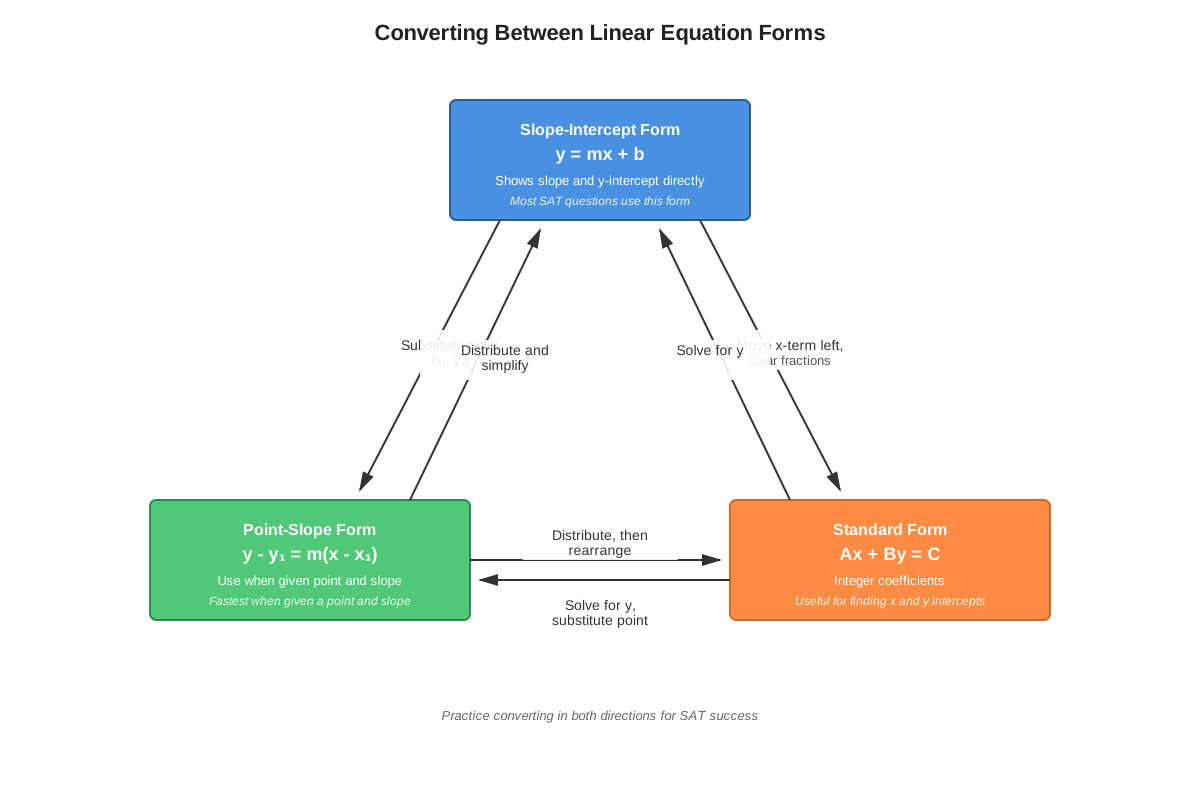
- [ ] Convert between different forms of linear equations (slope-intercept, point-slope, standard form) fluently
- [ ] Determine whether a given relationship represents a linear function by analyzing its properties
- [ ] Calculate and interpret the meaning of slope and intercepts in context-based problems
- [ ] Recognize non-linear functions by identifying violations of linear function properties
Prerequisites
- Basic algebraic manipulation: Solving for variables, combining like terms, and distributing are essential for working with linear equations
- Coordinate plane understanding: Plotting points and reading coordinates enables visualization of linear functions
- Function notation basics: Recognizing f(x) notation and evaluating functions at specific values is necessary for SAT questions
- Ratio and proportion concepts: Understanding constant rates of change builds directly on proportional reasoning
- Negative number operations: Linear functions frequently involve negative slopes and intercepts requiring confident arithmetic
Why This Topic Matters
Linear functions model countless real-world phenomena, from calculating costs based on quantity to predicting distances based on constant speeds. In everyday applications, linear relationships appear in budgeting (fixed costs plus variable rates), physics (constant velocity motion), economics (supply and demand at equilibrium), and data analysis (trend lines). Understanding linear functions empowers students to make predictions, analyze trends, and solve practical problems across disciplines.
On the SAT, linear functions appear in approximately 6-8 questions per test, representing one of the most frequently tested algebraic concepts. These questions manifest in multiple formats: direct equation manipulation (solving for slope or intercept), graph interpretation (identifying functions from visual representations), table analysis (recognizing constant differences), word problems (translating verbal descriptions into equations), and systems of equations (finding intersection points). The College Board particularly favors questions that require students to interpret the meaning of slope and intercepts in real-world contexts, such as understanding that slope represents rate of change per unit or that the y-intercept represents an initial value.
Linear function questions typically appear in both the calculator and no-calculator sections, with difficulty ranging from straightforward identification to multi-step reasoning problems. The SAT often embeds linear function concepts within more complex scenarios, such as combining them with data interpretation, requiring students to extract linear models from scatter plots, or asking them to compare multiple linear relationships simultaneously. Mastery of this topic directly impacts performance on 15-20% of the entire Math section, making it one of the highest-return investments of study time.
Core Concepts
Formal Definition of a Linear Function
A linear function is a function that can be written in the form f(x) = mx + b, where m and b are constants, x is the independent variable, and f(x) (or y) is the dependent variable. The defining characteristic is that the function produces a straight line when graphed and exhibits a constant rate of change. This means that for any equal change in x, there is always the same corresponding change in y.
More formally, a function f is linear if and only if f(x₁ + x₂) = f(x₁) + f(x₂) for all values in the domain, and f(cx) = c·f(x) for any constant c. However, for SAT purposes, the practical definition focuses on the standard form and its properties rather than these abstract algebraic properties.
Components of Linear Functions
The standard slope-intercept form y = mx + b contains two critical parameters:
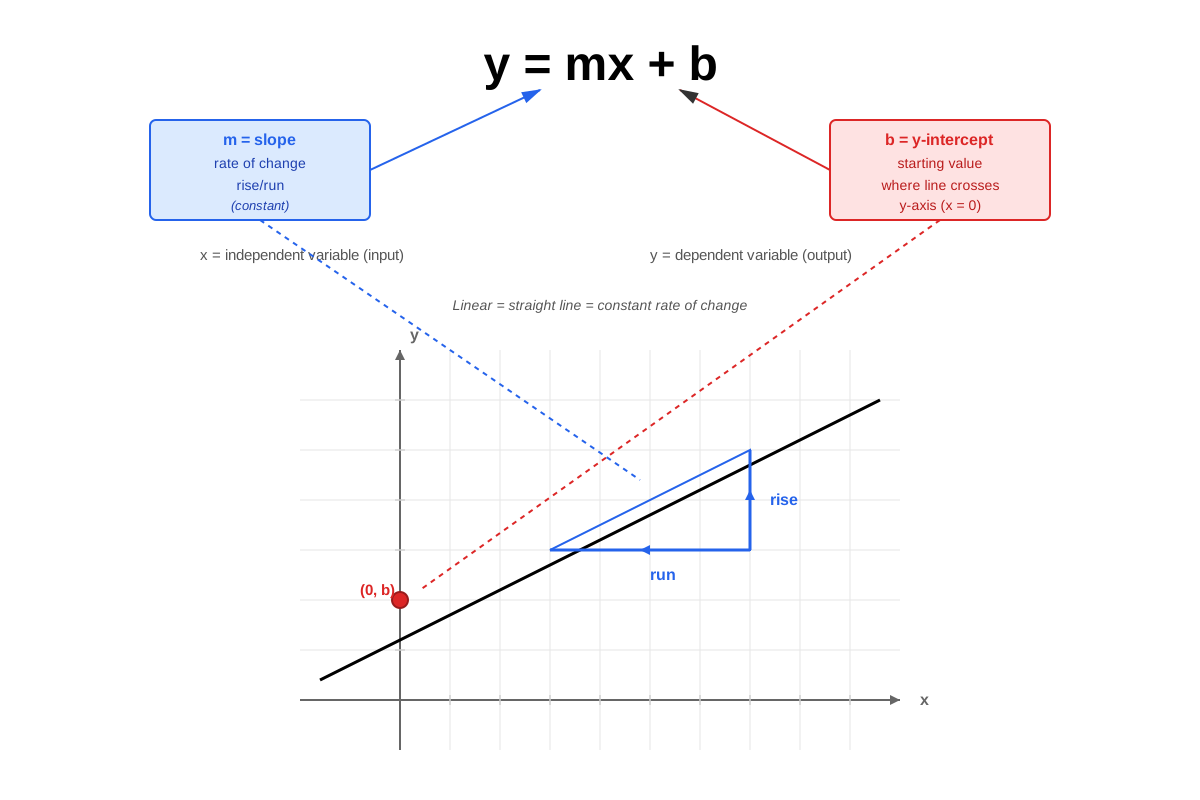
Slope (m): The coefficient of x represents the rate of change of y with respect to x. Mathematically, slope is calculated as:
m = (y₂ - y₁)/(x₂ - x₁) = rise/run = change in y/change in xThe slope indicates both the steepness and direction of the line. Positive slopes rise from left to right, negative slopes fall from left to right, zero slope indicates a horizontal line, and undefined slope (division by zero) indicates a vertical line (which is not a function).
Y-intercept (b): The constant term represents the y-coordinate where the line crosses the y-axis, which occurs when x = 0. In applied problems, the y-intercept often represents an initial value, starting amount, or fixed cost.
Alternative Forms of Linear Equations
While y = mx + b is the most common form, linear equations appear in several equivalent representations on the SAT:
| Form | Equation | When to Use | Key Features |
|---|---|---|---|
| Slope-Intercept | y = mx + b | Graphing, identifying slope/intercept quickly | Slope and y-intercept immediately visible |
| Point-Slope | y - y₁ = m(x - x₁) | Given a point and slope | Useful for writing equations from given information |
| Standard Form | Ax + By = C | Systems of equations, integer coefficients | A, B, C are integers; A is typically positive |
| Horizontal Line | y = k | Constant function, zero slope | Slope is 0; all points have same y-value |
| Vertical Line | x = k | Not a function | Undefined slope; fails vertical line test |
Identifying Linear Functions from Tables
A table of values represents a linear function if and only if the differences in consecutive y-values are constant when the x-values increase by a constant amount. This constant difference equals the slope.
Example analysis:
- If x increases by 1 each time and y increases by 3 each time, the slope is 3
- If x increases by 2 each time and y increases by 6 each time, the slope is 6/2 = 3
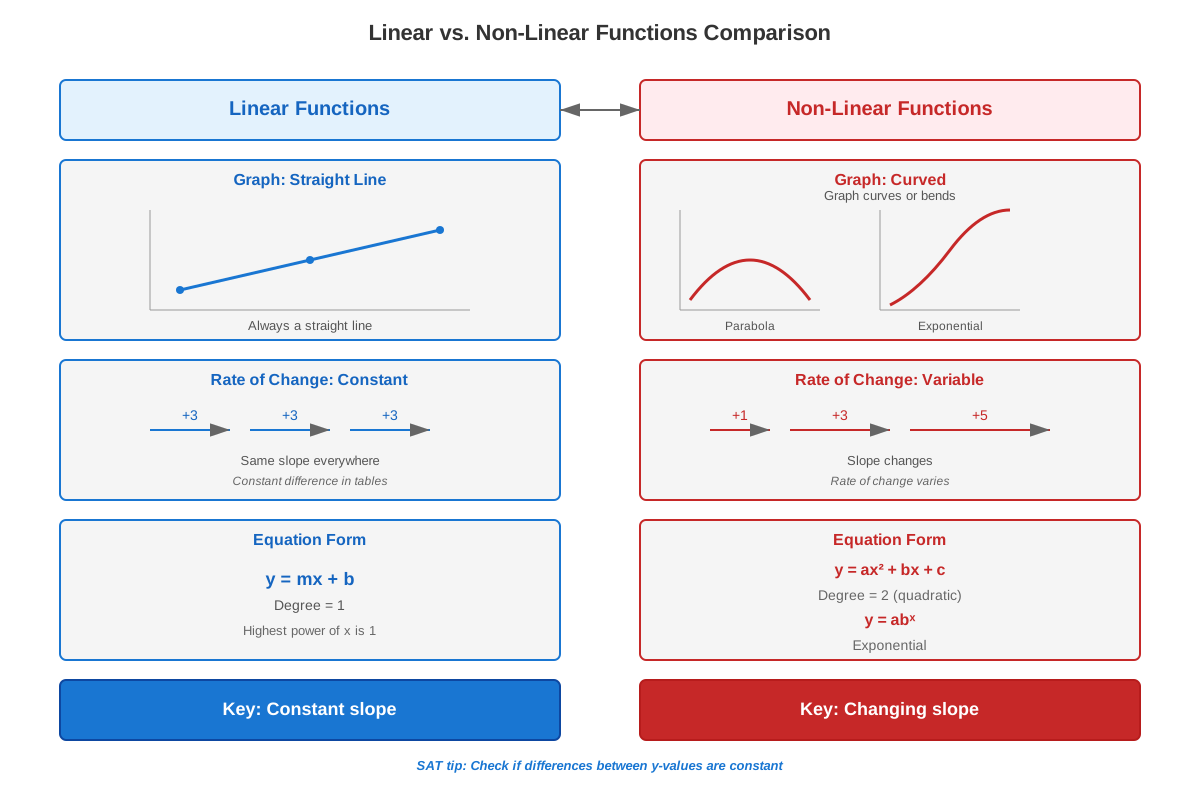
- If the differences in y-values are not constant, the function is not linear
Identifying Linear Functions from Graphs
A graph represents a linear function if it forms a perfectly straight line that passes the vertical line test (any vertical line intersects the graph at most once). Key visual indicators include:
- Constant steepness throughout (no curves or bends)
- Extends infinitely in both directions unless domain is restricted
- Crosses the y-axis at exactly one point (the y-intercept)
- May or may not cross the x-axis (x-intercept exists unless line is horizontal with b ≠ 0)
Domain and Range of Linear Functions
For unrestricted linear functions (not horizontal or vertical):
- Domain: All real numbers (-∞, ∞)
- Range: All real numbers (-∞, ∞)
For horizontal lines (y = k):
- Domain: All real numbers (-∞, ∞)
- Range: Single value {k}
The SAT may present linear functions with restricted domains based on context (e.g., time cannot be negative, quantity must be a whole number), requiring students to identify appropriate domain restrictions.
Parallel and Perpendicular Lines
Two linear functions have special relationships based on their slopes:
Parallel lines: Have identical slopes (m₁ = m₂) but different y-intercepts. Parallel lines never intersect and maintain constant distance apart.
Perpendicular lines: Have slopes that are negative reciprocals (m₁ · m₂ = -1, or m₂ = -1/m₁). Perpendicular lines intersect at right angles (90 degrees).
These relationships frequently appear in SAT geometry problems involving coordinate plane figures.
Concept Relationships
The linear function definition serves as the foundation for understanding how slope and y-intercept work together to determine a line's position and orientation. The slope (rate of change) → determines the steepness and direction → which combines with the y-intercept (starting value) → to uniquely define any non-vertical line.
Different forms of linear equations (slope-intercept, point-slope, standard form) → are algebraically equivalent representations → that emphasize different features → making certain calculations or interpretations more efficient depending on the given information and required task.
The concept of constant rate of change → connects directly to proportional relationships → which are special cases of linear functions where b = 0 → meaning the line passes through the origin and represents direct variation.
Linear functions → contrast with non-linear functions (quadratic, exponential, absolute value) → by maintaining constant slope → while non-linear functions have variable rates of change → making the identification of linearity a critical skill for function classification.
Understanding linear functions from tables → requires recognizing constant differences → which connects to arithmetic sequences → where each term differs from the previous by a constant amount (the common difference equals the slope).
The graphical representation of linear functions → connects to the algebraic representation → through the geometric interpretation of slope as rise over run → and the y-intercept as the point (0, b) → enabling translation between visual and symbolic representations.
Quick check — test yourself on Linear function definition so far.
Try Flashcards →High-Yield Facts
⭐ A linear function has the form f(x) = mx + b where m is the slope and b is the y-intercept
⭐ The slope represents the constant rate of change: for every 1-unit increase in x, y changes by m units
⭐ In a table with constant x-intervals, a linear function shows constant differences in consecutive y-values
⭐ Parallel lines have equal slopes; perpendicular lines have slopes that are negative reciprocals
⭐ The y-intercept is the value of the function when x = 0, often representing an initial or starting value in word problems
- A horizontal line (y = k) has slope 0 and represents a constant function
- A vertical line (x = k) has undefined slope and is not a function
- The x-intercept occurs where y = 0 and can be found by solving mx + b = 0
- Linear functions have unrestricted domains and ranges (all real numbers) unless context limits them
- The point-slope form y - y₁ = m(x - x₁) is most efficient when given a point and slope
- Standard form Ax + By = C is useful for systems of equations and ensuring integer coefficients
- Two points uniquely determine a line; the slope between them is (y₂ - y₁)/(x₂ - x₁)
- A function is linear if and only if its graph is a straight line that passes the vertical line test
Common Misconceptions
Misconception: All straight lines are functions → Correction: Vertical lines are straight but fail the vertical line test because one x-value corresponds to infinitely many y-values, violating the definition of a function
Misconception: The slope is always positive → Correction: Slope can be positive (rising left to right), negative (falling left to right), zero (horizontal line), or undefined (vertical line, not a function)
Misconception: The y-intercept is always positive → Correction: The y-intercept b can be any real number—positive, negative, or zero—depending on where the line crosses the y-axis
Misconception: A larger slope value always means a steeper line → Correction: Slope steepness depends on absolute value; a slope of -5 is steeper than a slope of 2, even though -5 < 2. Additionally, comparing slopes only makes sense when considering their absolute values for steepness
Misconception: Linear functions must pass through the origin → Correction: Only proportional relationships (linear functions with b = 0) pass through the origin; most linear functions have non-zero y-intercepts
Misconception: If a table shows a pattern, it must be linear → Correction: Many non-linear functions show patterns; only constant differences in y-values (for constant x-intervals) indicate linearity
Misconception: The equation y = 3 is not a linear function → Correction: This is a linear function with slope 0 (horizontal line); it can be written as y = 0x + 3, fitting the form y = mx + b
Misconception: Slope is calculated as (x₂ - x₁)/(y₂ - y₁) → Correction: Slope is rise over run: (y₂ - y₁)/(x₂ - x₁), with the change in y in the numerator and change in x in the denominator
Worked Examples
Example 1: Identifying and Interpreting a Linear Function from a Word Problem
Problem: A phone plan charges a monthly fee of $25 plus $0.10 per minute of calls. Write a linear function C(m) that represents the total monthly cost based on m minutes of calls. What does the slope represent? What is the cost for 200 minutes?
Solution:
Step 1: Identify the components of the linear function.
- The fixed monthly fee ($25) is the y-intercept (b) because it's charged regardless of usage
- The per-minute charge ($0.10) is the slope (m) because it represents the rate of change in cost per minute
Step 2: Write the function in slope-intercept form.
C(m) = 0.10m + 25Step 3: Interpret the slope.
The slope of 0.10 means that for each additional minute of calls, the total cost increases by $0.10. This is the constant rate of change.
Step 4: Calculate the cost for 200 minutes.
C(200) = 0.10(200) + 25
C(200) = 20 + 25
C(200) = 45
The cost for 200 minutes is $45.
Connection to Learning Objectives: This example demonstrates how to identify key features (slope and y-intercept) in a real-world context and apply the linear function definition to answer a practical question, which is exactly how the SAT tests this concept.
Example 2: Determining if a Table Represents a Linear Function
Problem: Determine whether the following table represents a linear function. If it does, find the equation.
| x | -2 | 0 | 2 | 4 | 6 |
|---|---|---|---|---|---|
| y | 11 | 7 | 3 | -1 | -5 |
Solution:
Step 1: Check if x-values increase by a constant amount.
The x-values increase by 2 each time: 0-(-2)=2, 2-0=2, 4-2=2, 6-4=2 ✓
Step 2: Calculate the differences in consecutive y-values.
- 7 - 11 = -4
- 3 - 7 = -4
- -1 - 3 = -4
- -5 - (-1) = -4
The differences are constant (-4), so this represents a linear function.
Step 3: Calculate the slope.
Since x increases by 2 and y decreases by 4 each time:
m = -4/2 = -2Step 4: Find the y-intercept.
From the table, when x = 0, y = 7, so b = 7.
Step 5: Write the equation.
y = -2x + 7Step 6: Verify with another point.
Check with (4, -1):
y = -2(4) + 7 = -8 + 7 = -1 ✓Connection to Learning Objectives: This example shows how to identify a linear function from a table by recognizing constant differences and demonstrates the process of finding the equation, addressing multiple learning objectives about identification and application.
Exam Strategy
When approaching SAT questions involving linear functions, begin by identifying what form the information is presented in: equation, graph, table, or word problem. Each format requires a slightly different initial approach, but all connect back to the fundamental components of slope and y-intercept.
Trigger words and phrases that signal linear function questions include:
- "Constant rate," "per unit," "each," "every" (indicating slope)
- "Initial," "starting," "when x = 0," "fixed cost" (indicating y-intercept)
- "Increases by," "decreases by" (indicating constant change)
- "Directly proportional" (linear through origin, b = 0)
- "Parallel," "perpendicular" (relationship between slopes)
For graph-based questions, immediately identify the y-intercept (where the line crosses the y-axis) and calculate slope using two clear points on the line. Count rise and run carefully, paying attention to negative directions. If the graph shows a decreasing line, the slope must be negative.
For table-based questions, check differences in consecutive y-values first. If they're constant (for constant x-intervals), you have a linear function. Calculate slope as (change in y)/(change in x), then use any point to find the y-intercept by substituting into y = mx + b.
For word problems, systematically identify what changes (the variable) and what stays constant (the y-intercept). The rate of change per unit is always the slope. Draw a quick table or write down the pattern if needed: "starts at 50, increases by 3 each time" immediately translates to y = 3x + 50.
Process-of-elimination tips:
- If answer choices give equations, test the y-intercept first by checking what happens when x = 0
- Eliminate any equation with the wrong slope sign (positive vs. negative)
- For graph matching, eliminate options where the line doesn't pass through the given y-intercept
- If a table shows non-constant differences, eliminate all linear function options
Time allocation: Most linear function questions should take 45-90 seconds. If you're spending more than 2 minutes, you may be overcomplicating the problem. Look for the most direct path: often, the SAT rewards recognizing patterns rather than extensive calculation. Practice identifying whether you need to find slope, y-intercept, or both, and use the most efficient method for the given information.
Memory Techniques
Slope Formula Mnemonic: "You Rise before you Run" helps remember that y-values go in the numerator (rise) and x-values go in the denominator (run): (y₂ - y₁)/(x₂ - x₁)
Slope-Intercept Form: Remember "y = mx + b" as "You Make Xcellent Bread" where M is the multiplier (slope) of X, and B is the base (y-intercept)
Parallel vs. Perpendicular:
- Parallel = Perfectly Paired slopes (same slope)
- Perpendicular = Product equals Negative one (m₁ · m₂ = -1)
Visualization Strategy: When seeing a word problem, immediately sketch a rough graph with labeled axes. Mark the y-intercept as a dot on the y-axis, then use the slope to plot a second point (rise over run from the first point). This visual representation often makes the relationship clearer than abstract equations.
Forms Acronym: Remember the three main forms as SPS:
- Slope-intercept (y = mx + b)
- Point-slope (y - y₁ = m(x - x₁))
- Standard (Ax + By = C)
Intercept Memory Device:
- Y-intercept: "Y is where You start" (x = 0, initial value)
- X-intercept: "X marks the spot" where the line crosses the x-axis (y = 0)
Summary
Linear functions represent relationships with constant rates of change and form the foundation of algebraic reasoning on the SAT. Defined by the equation f(x) = mx + b, every linear function is characterized by two parameters: slope (m), which measures the rate of change, and y-intercept (b), which represents the starting value. These functions appear as straight lines on graphs, show constant differences in tables with regular intervals, and model countless real-world scenarios involving fixed costs plus variable rates. Success on SAT linear function questions requires fluency in converting between multiple representations (equations, graphs, tables, verbal descriptions), recognizing the meaning of slope and intercepts in context, and efficiently manipulating different equation forms. Students must distinguish linear from non-linear relationships, understand that parallel lines share identical slopes while perpendicular lines have negative reciprocal slopes, and apply these concepts to solve multi-step problems. Mastering linear functions unlocks approximately 20% of SAT Math questions and provides essential groundwork for systems of equations, inequalities, and function analysis.
Key Takeaways
- A linear function has the form y = mx + b, where m (slope) represents constant rate of change and b (y-intercept) represents the initial value
- Linear functions produce straight lines on graphs and show constant differences in y-values for tables with constant x-intervals
- Slope is calculated as (change in y)/(change in x) and can be positive, negative, zero, or undefined
- The SAT frequently tests interpretation of slope and y-intercept in real-world contexts, not just equation manipulation
- Parallel lines have equal slopes; perpendicular lines have slopes that multiply to -1
- Multiple equation forms (slope-intercept, point-slope, standard) are equivalent but emphasize different features
- Recognizing trigger words like "constant rate," "initial," and "per unit" helps translate word problems into equations efficiently
Related Topics
Systems of Linear Equations: Building on single linear functions, systems involve finding where two or more linear functions intersect, requiring solution methods like substitution, elimination, or graphing. Mastering individual linear functions is essential before tackling systems.
Linear Inequalities: These extend linear functions by replacing the equals sign with inequality symbols (<, >, ≤, ≥), creating regions rather than lines. Understanding linear function graphs makes visualizing solution regions straightforward.
Quadratic Functions: These non-linear functions (y = ax² + bx + c) contrast with linear functions by having variable rates of change. Comparing linear and quadratic models helps develop function classification skills.
Absolute Value Functions: Functions like y = |x| create V-shaped graphs that are piecewise linear, connecting linear function concepts to more complex function families.
Data Analysis and Scatter Plots: Linear functions serve as models for trends in data, with lines of best fit representing approximate linear relationships in real-world datasets.
Practice CTA
Now that you've mastered the core concepts of linear functions, it's time to solidify your understanding through active practice. Work through the practice questions to test your ability to identify, interpret, and apply linear function concepts in various SAT-style scenarios. Use the flashcards to reinforce key definitions and formulas until they become automatic. Remember, linear functions appear in roughly one out of every five SAT Math questions—your investment in mastering this topic will pay dividends across the entire test. Approach each practice problem strategically, identifying what form the information is presented in and what the question is really asking before diving into calculations. You've got this!
Sign up free to keep reading
Create a free AnvayaPrep account to finish this SAT guide on Linear function definition — plus flashcards and practice questions.