Overview
Writing equations from graphs is a fundamental skill in algebra that requires students to translate visual information into algebraic expressions. On the SAT math section, this skill appears frequently in both multiple-choice and grid-in questions, testing whether students can extract key features from a linear graph and construct the corresponding equation. This process involves identifying the slope and y-intercept from a coordinate plane, then applying the appropriate form of a linear equation—typically slope-intercept form (y = mx + b) or point-slope form.
The ability to write equations from graphs represents a critical bridge between visual and symbolic mathematical reasoning. Students must demonstrate fluency in moving between different representations of linear relationships, a skill that the College Board considers essential for college readiness. This topic integrates coordinate geometry, algebraic manipulation, and analytical reasoning, making it one of the most practical applications of linear functions on the exam.
Mastery of sat writing equations from graphs connects directly to broader mathematical concepts including systems of equations, function notation, and modeling real-world scenarios. Questions on this topic often appear in contexts involving rate of change, cost analysis, or scientific relationships, requiring students to not only write equations but also interpret their meaning. Success with this skill demonstrates mathematical maturity and prepares students for more advanced topics in both the SAT Math section and college-level mathematics.
Learning Objectives
- [ ] Identify key features of writing equations from graphs, including slope, y-intercept, and points on the line
- [ ] Explain how writing equations from graphs appears on the SAT in various question formats and contexts
- [ ] Apply writing equations from graphs to answer SAT-style questions accurately and efficiently
- [ ] Determine the appropriate form of linear equation (slope-intercept, point-slope, or standard form) based on given information
- [ ] Calculate slope from two points on a graph with precision, including negative and fractional slopes
- [ ] Verify written equations by substituting points from the graph to confirm accuracy
- [ ] Interpret the real-world meaning of slope and y-intercept in context-based problems
Prerequisites
- Coordinate plane fundamentals: Understanding ordered pairs (x, y) and how to plot points is essential for reading information from graphs
- Slope concept: Knowledge of slope as "rise over run" or rate of change enables calculation from visual information
- Linear equation forms: Familiarity with y = mx + b and other forms provides the framework for writing equations
- Basic algebraic manipulation: Ability to solve for variables and rearrange equations allows conversion between different forms
- Fraction operations: Competence with simplifying and calculating with fractions is necessary for accurate slope determination
Why This Topic Matters
In real-world applications, writing equations from graphs enables professionals to model relationships in fields ranging from economics to engineering. Scientists use this skill to derive formulas from experimental data, business analysts create cost functions from trend lines, and engineers determine specifications from performance curves. The ability to extract mathematical relationships from visual data represents a fundamental analytical skill valued across disciplines.
On the SAT, writing equations from graphs appears in approximately 3-5 questions per test, accounting for roughly 8-12% of the total math score. These questions appear in both the calculator and no-calculator sections, with varying difficulty levels. The College Board frequently embeds this skill within word problems, requiring students to first interpret a context, then write an equation, and finally use that equation to make predictions or solve for specific values.
Common SAT question formats include: providing a graph and asking for the equation in a specific form; presenting a real-world scenario with a graph and requesting interpretation of slope or y-intercept; offering multiple graphs and asking which matches a given equation; and reverse-engineering problems where students must identify which equation could NOT represent the graphed line. The topic also appears in multi-step problems where writing the equation is an intermediate step toward finding a final answer.
Core Concepts
Understanding Slope from Graphs
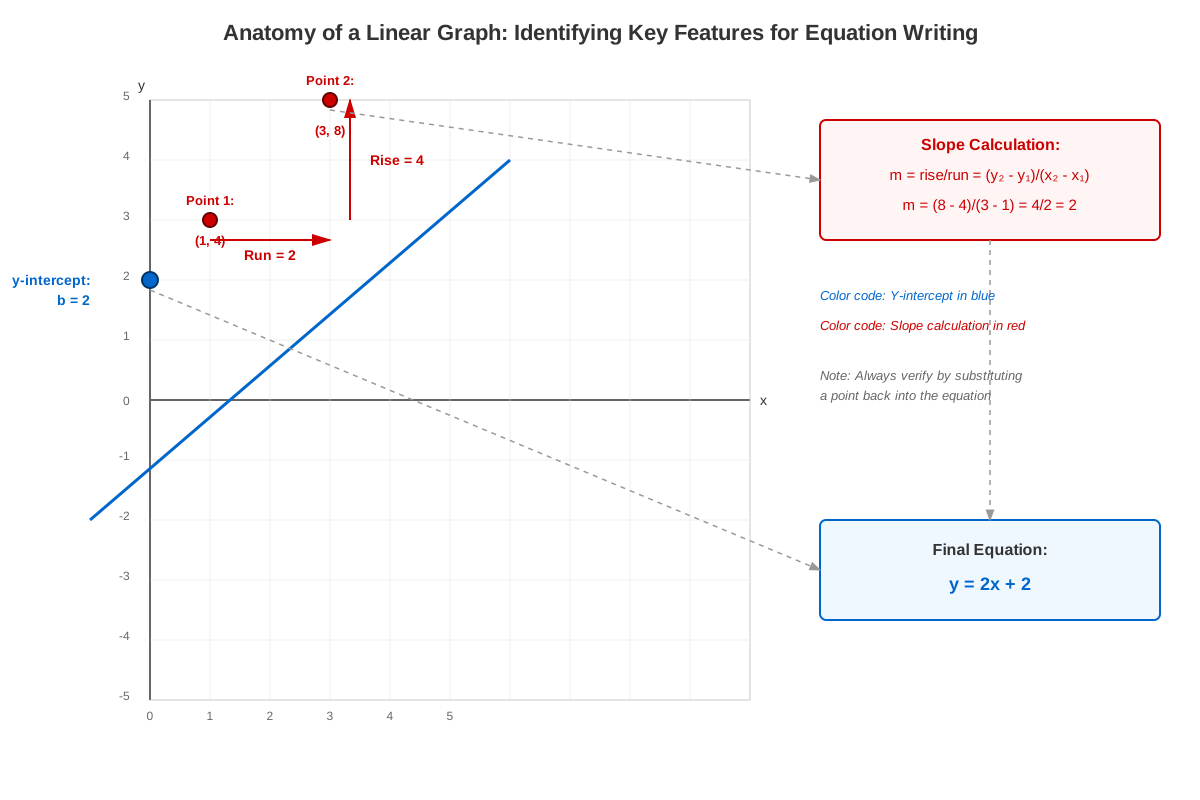
Slope represents the rate of change in a linear relationship and is calculated as the ratio of vertical change (rise) to horizontal change (run) between any two points on a line. When reading a graph, identify two clear points where the line intersects grid intersections to minimize calculation errors. The formula for slope is:
m = (y₂ - y₁)/(x₂ - x₁)Positive slopes indicate lines rising from left to right, while negative slopes show lines falling from left to right. A slope of zero represents a horizontal line, and an undefined slope indicates a vertical line. On the SAT, slopes frequently appear as integers, simple fractions like 1/2 or -3/4, or occasionally as decimals in context problems.
When calculating slope from a graph, always subtract coordinates in the same order (second point minus first point) for both numerator and denominator. Pay careful attention to negative coordinates, as sign errors represent the most common mistake in slope calculation. For example, if a line passes through (-2, 3) and (4, -1), the slope is (-1 - 3)/(4 - (-2)) = -4/6 = -2/3.
Identifying the Y-Intercept
The y-intercept is the point where a line crosses the y-axis, occurring when x = 0. This value, typically denoted as "b" in slope-intercept form, can be read directly from a graph by locating where the line intersects the vertical axis. If the y-intercept falls between grid lines, students must estimate or use another point with the slope to calculate it algebraically.
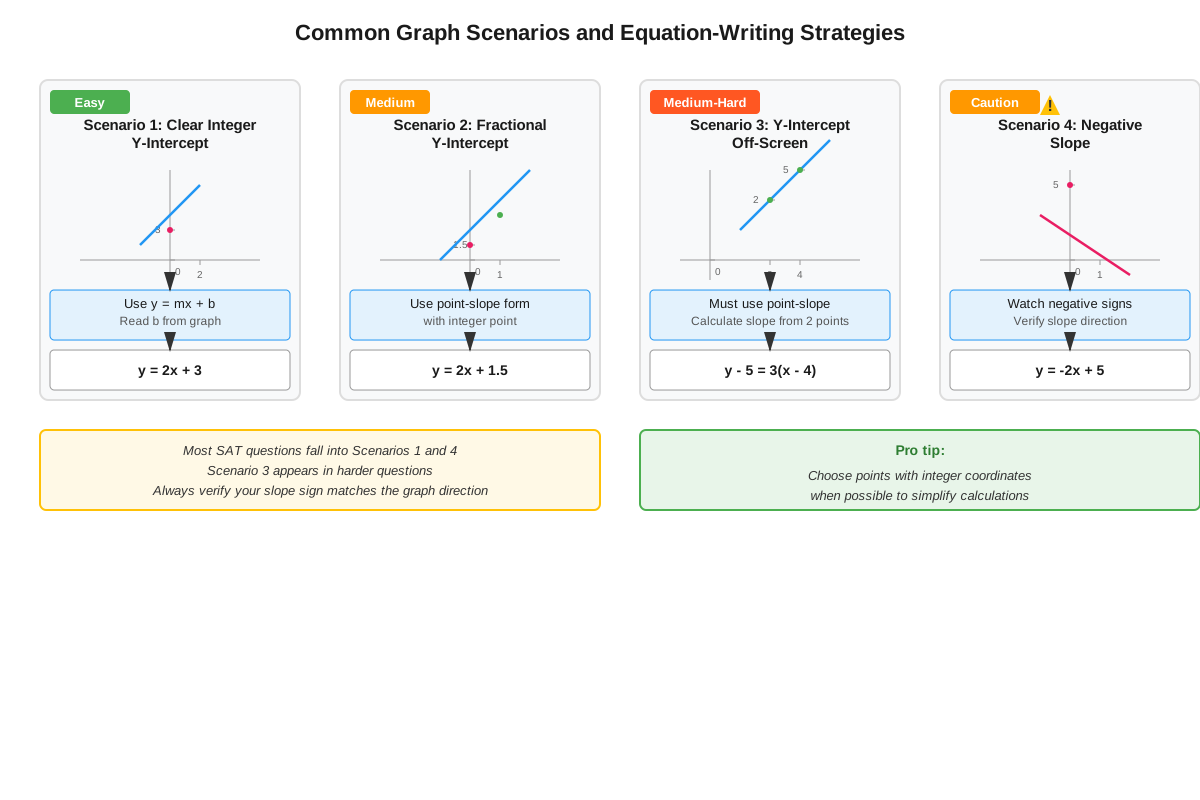
When the y-intercept is not clearly visible on the provided graph (because the graph doesn't show x = 0), students must use the point-slope relationship. After determining the slope and identifying any point (x₁, y₁) on the line, substitute into y = mx + b and solve for b. This technique is essential for SAT questions that deliberately crop graphs or use non-standard viewing windows.
Slope-Intercept Form
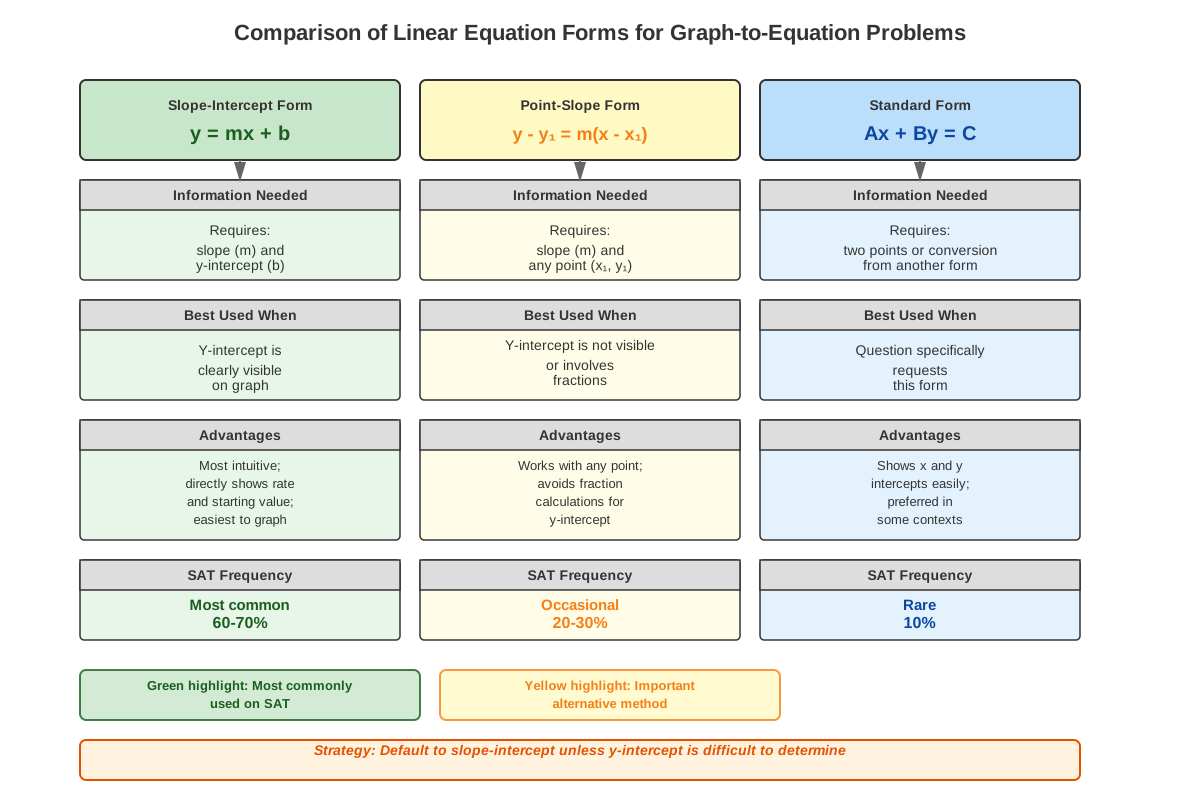
Slope-intercept form, written as y = mx + b, is the most commonly requested format on the SAT. In this form, m represents the slope and b represents the y-intercept. This form immediately reveals the rate of change and starting value, making it ideal for interpretation questions.
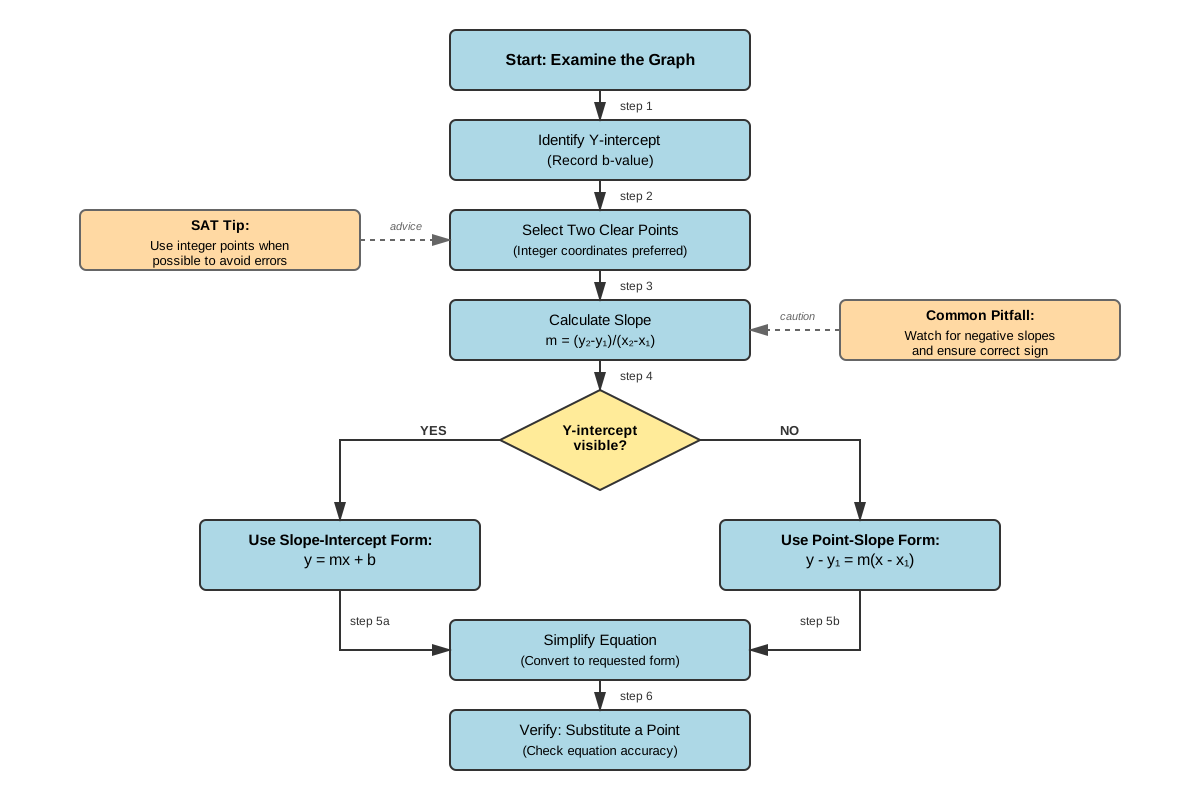
To write an equation in slope-intercept form from a graph:
- Identify two clear points on the line
- Calculate the slope using the slope formula
- Identify or calculate the y-intercept
- Substitute m and b into y = mx + b
- Verify by checking that at least one point from the graph satisfies the equation
Point-Slope Form
Point-slope form, expressed as y - y₁ = m(x - x₁), proves useful when the y-intercept is difficult to determine but clear points are visible. This form uses the slope m and any point (x₁, y₁) on the line. While less commonly requested directly on the SAT, understanding this form enables efficient equation writing and can be converted to slope-intercept form through algebraic manipulation.
Standard Form Considerations
Standard form (Ax + By = C, where A, B, and C are integers and A is positive) occasionally appears on the SAT. Converting from slope-intercept to standard form requires moving all variables to one side and eliminating fractions by multiplying through by the least common denominator. For example, y = (2/3)x + 4 becomes 2x - 3y = -12 in standard form.
Special Cases
Horizontal lines have equations of the form y = k (where k is a constant), representing zero slope. Vertical lines have equations of the form x = k, representing undefined slope. These special cases appear less frequently on the SAT but are tested to ensure comprehensive understanding of linear relationships.
Reading Graphs with Different Scales
SAT graphs may use non-uniform scales where each grid square represents values other than 1. Always check axis labels and scale indicators before calculating slope. If the x-axis shows increments of 2 and the y-axis shows increments of 5, a visual "rise" of one square actually represents a change of 5 units, while a "run" of one square represents a change of 2 units.
Concept Relationships
The process of writing equations from graphs begins with coordinate plane reading → which enables point identification → leading to slope calculation → combined with y-intercept determination → resulting in equation construction in the appropriate form.
Slope calculation connects directly to the prerequisite understanding of rate of change and fraction operations. The y-intercept identification links to function evaluation at x = 0. Both concepts merge in slope-intercept form, which serves as the foundation for more complex topics like systems of equations and linear inequalities.
Writing equations from graphs represents the inverse operation of graphing equations from algebraic expressions. This bidirectional relationship reinforces understanding of linear functions as having multiple equivalent representations: graphical, algebraic, tabular, and verbal. Mastery of this topic enables progression to parallel and perpendicular lines (which share slope relationships), linear modeling (which applies equation writing to real scenarios), and systems of linear equations (which require writing multiple equations from multiple graphs or contexts).
The connection between this topic and function notation is particularly important for SAT success. Questions may ask students to write f(x) = mx + b instead of y = mx + b, testing whether students recognize these as equivalent representations. Additionally, the skill of writing equations from graphs extends to piecewise functions, where students must write different equations for different portions of a graph.
Quick check — test yourself on Writing equations from graphs so far.
Try Flashcards →High-Yield Facts
- ⭐ Slope-intercept form (y = mx + b) is the most frequently requested equation format on the SAT
- ⭐ Slope is calculated as (y₂ - y₁)/(x₂ - x₁) using any two points on the line
- ⭐ The y-intercept can be read directly from a graph where the line crosses the y-axis (when x = 0)
- ⭐ Negative slopes indicate lines falling from left to right; positive slopes indicate lines rising from left to right
- ⭐ Always verify your equation by substituting at least one point from the graph to check accuracy
- Horizontal lines have slope = 0 and equations of the form y = k
- Vertical lines have undefined slope and equations of the form x = k
- When the y-intercept isn't visible, use point-slope form or substitute a known point into y = mx + b to solve for b
- Parallel lines have identical slopes but different y-intercepts
- The slope represents the rate of change: how much y changes for each unit increase in x
- In real-world contexts, the y-intercept often represents an initial value or starting amount
- Grid scales may vary; always check axis labels before calculating slope from visual rise and run
- Fractional slopes should be simplified to lowest terms for final answers
- Point-slope form y - y₁ = m(x - x₁) can be converted to slope-intercept form by solving for y
Common Misconceptions
Misconception: The slope is always positive when a line goes upward on the page.
Correction: Slope direction depends on movement from left to right. A line rising as you move left to right has positive slope; a line falling as you move left to right has negative slope, regardless of the line's absolute position on the graph.
Misconception: The y-intercept is always visible on every graph.
Correction: SAT graphs may be cropped or scaled such that x = 0 is not shown. In these cases, calculate the y-intercept algebraically using y = mx + b with a known point and the calculated slope.
Misconception: Slope can be calculated as (x₂ - x₁)/(y₂ - y₁).
Correction: Slope is always vertical change over horizontal change: (y₂ - y₁)/(x₂ - x₁). Reversing this formula produces the reciprocal of the actual slope, leading to incorrect equations.
Misconception: When calculating slope, it doesn't matter which point is first and which is second.
Correction: While the order doesn't matter, consistency does. If you use (y₂ - y₁) in the numerator, you must use (x₂ - x₁) in the denominator. Mixing orders produces incorrect signs.
Misconception: A steep line always has a larger slope than a gradual line.
Correction: While this is true for positive slopes, a line with slope -5 is steeper than a line with slope -1, even though -5 < -1. Steepness relates to the absolute value of slope.
Misconception: The equation y = 3 represents a line with slope 3.
Correction: The equation y = 3 represents a horizontal line with slope 0 that passes through all points where y = 3. The equation y = 3x represents a line with slope 3.
Misconception: Grid squares always represent one unit.
Correction: SAT graphs frequently use different scales on each axis. Always read axis labels to determine what each grid square represents before calculating slope visually.
Worked Examples
Example 1: Standard Slope-Intercept Form
Problem: A line passes through the points (-3, 7) and (2, -3) on a coordinate plane. Write the equation of this line in slope-intercept form.
Solution:
Step 1: Calculate the slope using the two given points.
m = (y₂ - y₁)/(x₂ - x₁) = (-3 - 7)/(2 - (-3)) = -10/5 = -2Step 2: Use one point and the slope to find the y-intercept. Using point (2, -3):
y = mx + b
-3 = -2(2) + b
-3 = -4 + b
b = 1
Step 3: Write the equation in slope-intercept form:
y = -2x + 1Step 4: Verify using the other point (-3, 7):
y = -2(-3) + 1 = 6 + 1 = 7 ✓Connection to Learning Objectives: This example demonstrates the complete process of identifying key features (slope and y-intercept) from given points and applying the standard method to construct an equation, directly addressing the core SAT skill of writing equations from graphical information.
Example 2: Real-World Context with Non-Standard Scale
Problem: A graph shows the relationship between hours worked (x-axis) and total earnings in dollars (y-axis). The line passes through points (0, 50) and (4, 130). Write an equation that models this relationship and interpret the meaning of the slope and y-intercept.
Solution:
Step 1: Identify the y-intercept directly from the graph. Since the line passes through (0, 50), the y-intercept b = 50.
Step 2: Calculate the slope:
m = (130 - 50)/(4 - 0) = 80/4 = 20Step 3: Write the equation:
y = 20x + 50Step 4: Interpret in context:
- The slope of 20 means the person earns $20 per hour worked
- The y-intercept of 50 means the person receives a $50 base payment (perhaps a signing bonus or daily stipend) before any hours are worked
Connection to Learning Objectives: This example shows how writing equations from graphs appears in SAT context problems, requiring not just mechanical calculation but also interpretation of mathematical features in real-world terms, a high-yield SAT skill.
Exam Strategy
When approaching SAT questions on writing equations from graphs, follow this systematic process:
Step 1: Identify what form is requested. The question will specify slope-intercept form, standard form, or occasionally point-slope form. Write this at the top of your work area to maintain focus.
Step 2: Locate two clear points. Choose points where the line clearly intersects grid intersections to avoid estimation errors. Prefer points with integer coordinates when possible, but don't avoid negative numbers—they're often included deliberately.
Step 3: Calculate slope carefully. Write out the slope formula, substitute values, and simplify completely. This is where most errors occur, so double-check signs and arithmetic.
Step 4: Determine the y-intercept. If visible, read it directly. If not visible, use algebra with your calculated slope and any known point.
Step 5: Verify your equation. Substitute at least one point (preferably one you didn't use in calculations) to confirm your equation is correct. This 10-second check can save you from careless errors.
Exam Tip: If the answer choices are in slope-intercept form and you're unsure of your calculation, substitute the x-coordinate of a visible point into each answer choice to see which produces the correct y-coordinate.
Trigger words and phrases to watch for:
- "Write an equation" or "which equation represents" signals direct equation writing
- "Rate of change" refers to slope
- "Initial value" or "starting amount" refers to y-intercept
- "For each unit increase" describes slope in context
- "When x = 0" asks about the y-intercept
Process of elimination strategies:
- Eliminate answer choices with incorrect slope signs (positive vs. negative) immediately
- If you can determine the y-intercept is positive, eliminate choices with negative y-intercepts
- For steep lines, eliminate choices with slopes close to zero
- Check whether the line passes through the origin; if not, eliminate y = mx (which has no y-intercept term)
Time allocation: Spend 45-60 seconds on straightforward equation-writing questions. For multi-step problems involving interpretation or additional calculations, allocate up to 90 seconds. If you're stuck after one minute, mark the question and return to it after completing easier problems.
Memory Techniques
Slope Formula Mnemonic: "You Yell Xtra Xtra" reminds you that slope is (Y - Y)/(X - X), with y-values in the numerator and x-values in the denominator.
Slope-Intercept Form Memory: "Y = Mountain X + Base" helps recall y = mx + b, where the mountain represents the slope (steepness) and the base represents where you start (y-intercept).
Positive vs. Negative Slope Visualization: Imagine skiing. A positive slope means you're going uphill as you move forward (left to right). A negative slope means you're going downhill as you move forward. This physical metaphor prevents sign errors.
Y-Intercept Quick Check: "Y-intercept happens when X is Zero" (Y-X-Z) reminds you that the y-intercept occurs at x = 0.
Verification Acronym - SPIV:
- Slope calculated correctly
- Point substituted to find b
- Intercept identified or calculated
- Verify with a point from the graph
Order Matters for Slope: Remember "Same Order" (SO) - whatever order you subtract y-values, use the same order for x-values to avoid sign errors.
Summary
Writing equations from graphs is a high-yield SAT skill that requires students to extract algebraic information from visual representations of linear relationships. The process centers on identifying two key features: slope (calculated as rise over run between two points) and y-intercept (where the line crosses the y-axis). These values are then substituted into slope-intercept form (y = mx + b), the most commonly requested format on the exam. Success requires careful attention to signs when calculating slope, proper reading of graph scales, and verification of the final equation by substituting known points. SAT questions on this topic range from straightforward equation writing to complex contextual problems requiring interpretation of slope and y-intercept meanings. Students must be fluent in moving between graphical and algebraic representations, recognizing that the same linear relationship can be expressed in multiple equivalent forms. Mastery involves not just mechanical calculation but also strategic thinking about which points to use, how to handle non-standard scales, and when to apply alternative forms like point-slope. The ability to write equations from graphs connects to broader mathematical reasoning skills and appears in approximately 8-12% of SAT math questions, making it essential for achieving competitive scores.
Key Takeaways
- Slope-intercept form (y = mx + b) is the most important equation format for SAT success, with m representing slope and b representing y-intercept
- Calculate slope as (y₂ - y₁)/(x₂ - x₁) using any two clear points on the line, maintaining consistent order in numerator and denominator
- The y-intercept can be read directly when x = 0 is visible, or calculated algebraically using a known point and the slope
- Always verify your equation by substituting a point from the graph to catch calculation errors before selecting your answer
- Negative slopes indicate lines falling from left to right; positive slopes indicate lines rising from left to right
- Pay careful attention to graph scales, as each grid square may represent values other than 1 unit
- In context problems, interpret slope as rate of change and y-intercept as initial value or starting amount
Related Topics
Systems of Linear Equations: After mastering writing single equations from graphs, students progress to writing multiple equations from multiple lines and finding their intersection points, a skill that builds directly on this foundation.
Linear Inequalities: Understanding how to write equations from graphs extends naturally to writing inequalities, where students must also determine whether to use ≤, ≥, <, or > based on shading and line style (solid vs. dashed).
Parallel and Perpendicular Lines: These topics require identifying slope relationships (parallel lines have equal slopes; perpendicular lines have negative reciprocal slopes), making equation-writing skills essential.
Linear Modeling and Regression: Advanced applications involve writing equations that best fit data sets, requiring interpretation of slope and intercept in real-world contexts.
Function Notation and Transformations: Writing equations in the form f(x) = mx + b connects to broader function concepts and prepares students for transformations of parent functions.
Practice CTA
Now that you've mastered the core concepts of writing equations from graphs, it's time to solidify your understanding through active practice. The practice questions and flashcards have been specifically designed to mirror actual SAT question formats and difficulty levels. Work through each problem systematically, applying the strategies and verification techniques you've learned. Remember, proficiency comes from deliberate practice—each question you solve strengthens your pattern recognition and builds the confidence you need for test day. Challenge yourself to complete the practice set, and don't hesitate to review the worked examples if you encounter difficulty. You're building a critical skill that will serve you throughout the SAT Math section and beyond!
Sign up free to keep reading
Create a free AnvayaPrep account to finish this SAT guide on Writing equations from graphs — plus flashcards and practice questions.