Overview
Writing equations from two points is a foundational skill in algebra that appears frequently on the SAT Math section. This topic requires students to construct linear equations when given only two coordinate pairs, without being provided the slope or y-intercept directly. Mastery of this skill demonstrates understanding of how linear relationships work and how algebraic representations connect to geometric interpretations on the coordinate plane. The SAT tests this concept both as standalone questions and as part of more complex multi-step problems involving real-world scenarios, data interpretation, and systems of equations.
The ability to write equations from two points is essential because it bridges multiple mathematical concepts that the SAT emphasizes heavily. Students must understand slope calculation, the relationship between slope and rate of change, various forms of linear equations (slope-intercept, point-slope, and standard form), and how to manipulate algebraic expressions efficiently. This topic typically appears 2-4 times per SAT exam, either directly or embedded within word problems involving linear modeling, making it a high-yield area for focused study.
Beyond isolated calculation questions, SAT writing equations from two points connects to broader mathematical reasoning skills tested throughout the exam. Linear functions form the backbone of modeling real-world relationships—from business profit calculations to scientific data trends—and the SAT frequently presents these scenarios in context-rich problems. Understanding how to derive equations from coordinate pairs enables students to tackle questions about parallel and perpendicular lines, systems of equations, and function transformations, all of which are core components of the SAT math curriculum.
Learning Objectives
- [ ] Identify key features of writing equations from two points, including slope calculation and equation forms
- [ ] Explain how writing equations from two points appears on the SAT in various question formats
- [ ] Apply writing equations from two points to answer SAT-style questions efficiently and accurately
- [ ] Calculate slope from two coordinate pairs using the slope formula without computational errors
- [ ] Convert between different forms of linear equations (slope-intercept, point-slope, standard form) fluently
- [ ] Recognize when to use each equation form based on the question requirements and answer choices
- [ ] Solve multi-step problems that require writing equations from points within real-world contexts
Prerequisites
- Coordinate plane basics: Understanding ordered pairs (x, y) and how to plot points is essential for visualizing the relationship between two points
- Slope concept: Familiarity with slope as "rise over run" or rate of change provides the foundation for calculating slope from coordinates
- Basic algebraic manipulation: Skills in solving for variables, distributing, and simplifying expressions are necessary for converting between equation forms
- Linear equation forms: Knowledge of y = mx + b (slope-intercept form) helps students recognize the target format for many SAT questions
- Substitution: The ability to substitute values into equations is required when using point-slope form or verifying solutions
Why This Topic Matters
In real-world applications, writing equations from two data points enables modeling of countless phenomena: calculating depreciation rates from two asset values, determining speed from two position-time measurements, projecting costs from two price points, or analyzing scientific data trends. Businesses use this skill to forecast revenue, scientists use it to analyze experimental results, and engineers apply it to design specifications. The mathematical thinking required—identifying patterns, quantifying relationships, and creating predictive models—represents fundamental problem-solving abilities valued across disciplines.
On the SAT, this topic appears with remarkable consistency. Approximately 10-15% of SAT Math questions involve linear functions, and writing equations from two points constitutes a significant portion of these questions. The College Board presents this concept in multiple formats: direct calculation questions asking for the equation of a line through two points, word problems requiring students to identify two points from a scenario and then write the equation, data interpretation questions with tables or graphs, and multi-step problems where writing the equation is an intermediate step toward finding a specific value or making a prediction.
Common SAT question formats include: tables showing x and y values where students must identify the linear relationship; word problems describing two situations with different quantities (like cost at two different times); graphs with two clearly marked points requiring an equation; and comparison questions asking which equation passes through given coordinates. The SAT particularly favors questions that combine this skill with real-world contexts—such as "A phone plan charges $30 for 100 minutes and $45 for 200 minutes; which equation represents the total cost C for m minutes?"—requiring students to extract coordinate pairs from verbal descriptions before writing equations.
Core Concepts
The Slope Formula
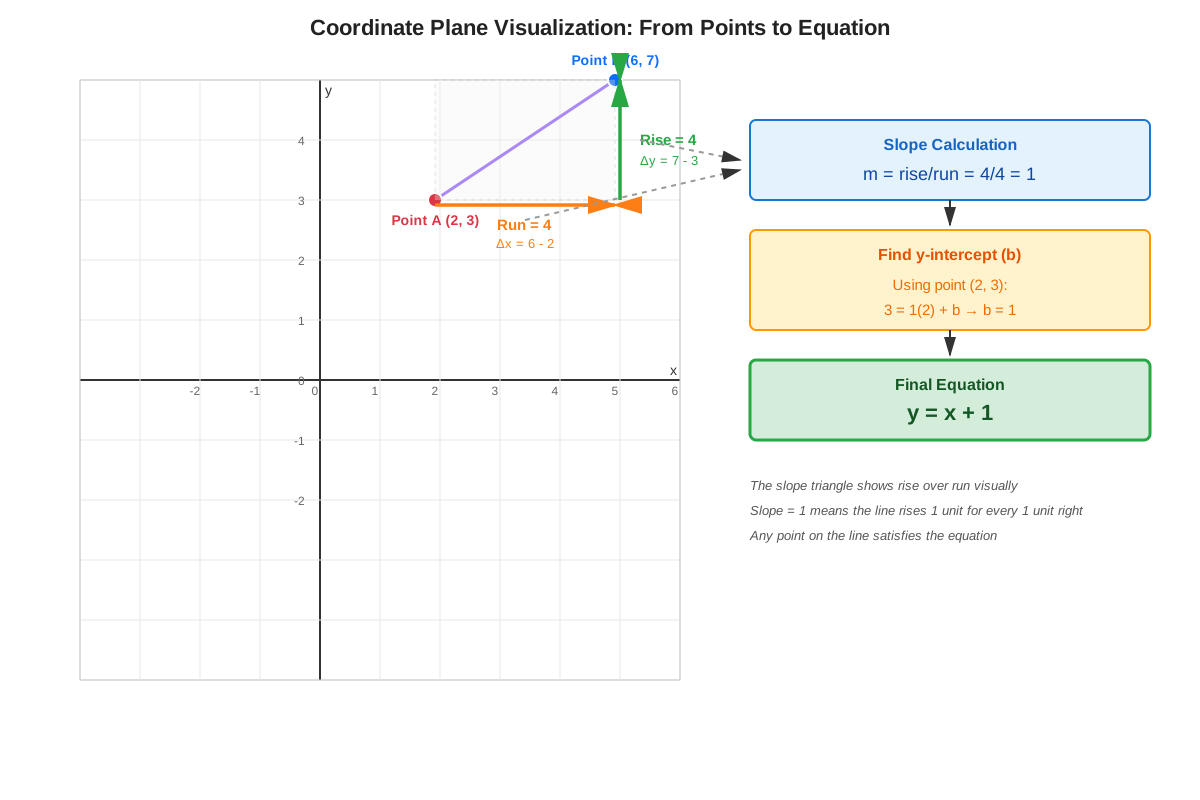
The foundation of writing equations from two points begins with calculating slope. Given two points (x₁, y₁) and (x₂, y₂), the slope (m) represents the rate of change between them:
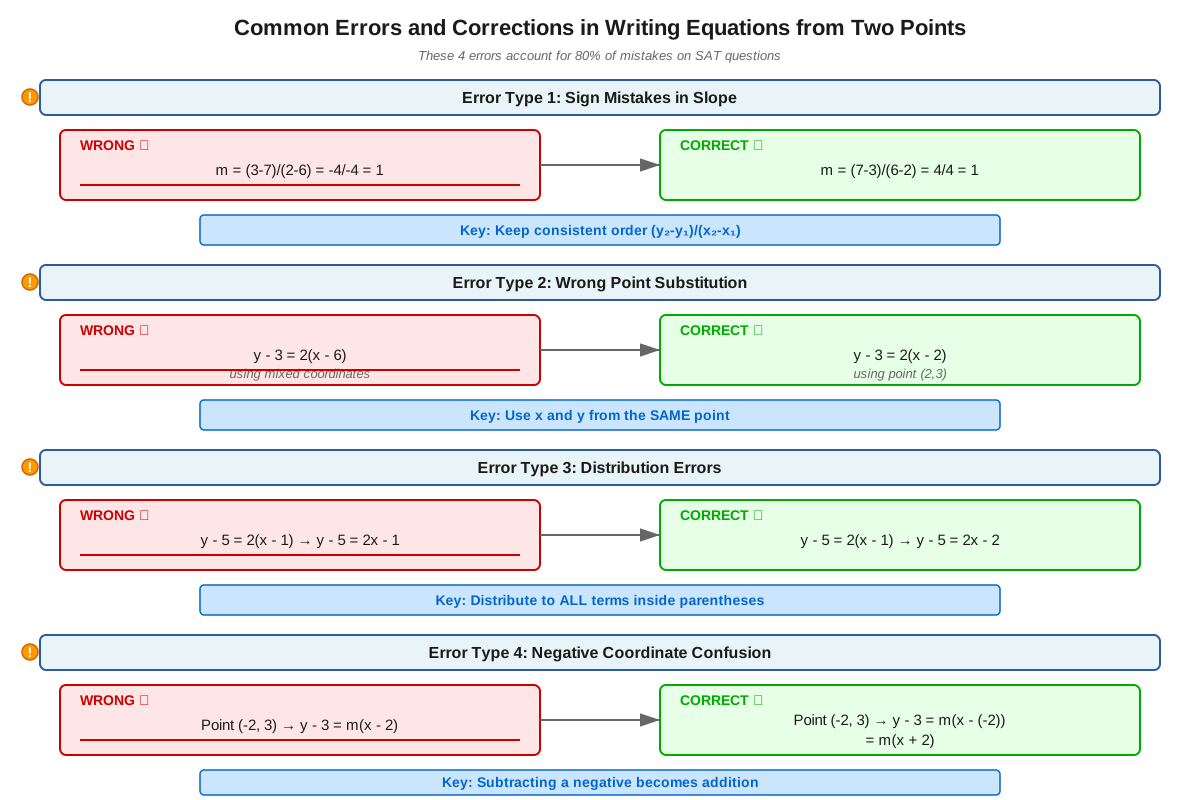
m = (y₂ - y₁)/(x₂ - x₁)This formula calculates the vertical change (rise) divided by the horizontal change (run). The order of subtraction must remain consistent: if you subtract y₁ from y₂ in the numerator, you must subtract x₁ from x₂ in the denominator. Reversing both gives the same result, but mixing the order produces an incorrect slope with the wrong sign.
Key considerations for slope calculation:
- Positive slope: line rises from left to right (y increases as x increases)
- Negative slope: line falls from left to right (y decreases as x increases)
- Zero slope: horizontal line (y-values are identical)
- Undefined slope: vertical line (x-values are identical, creating division by zero)
Slope-Intercept Form
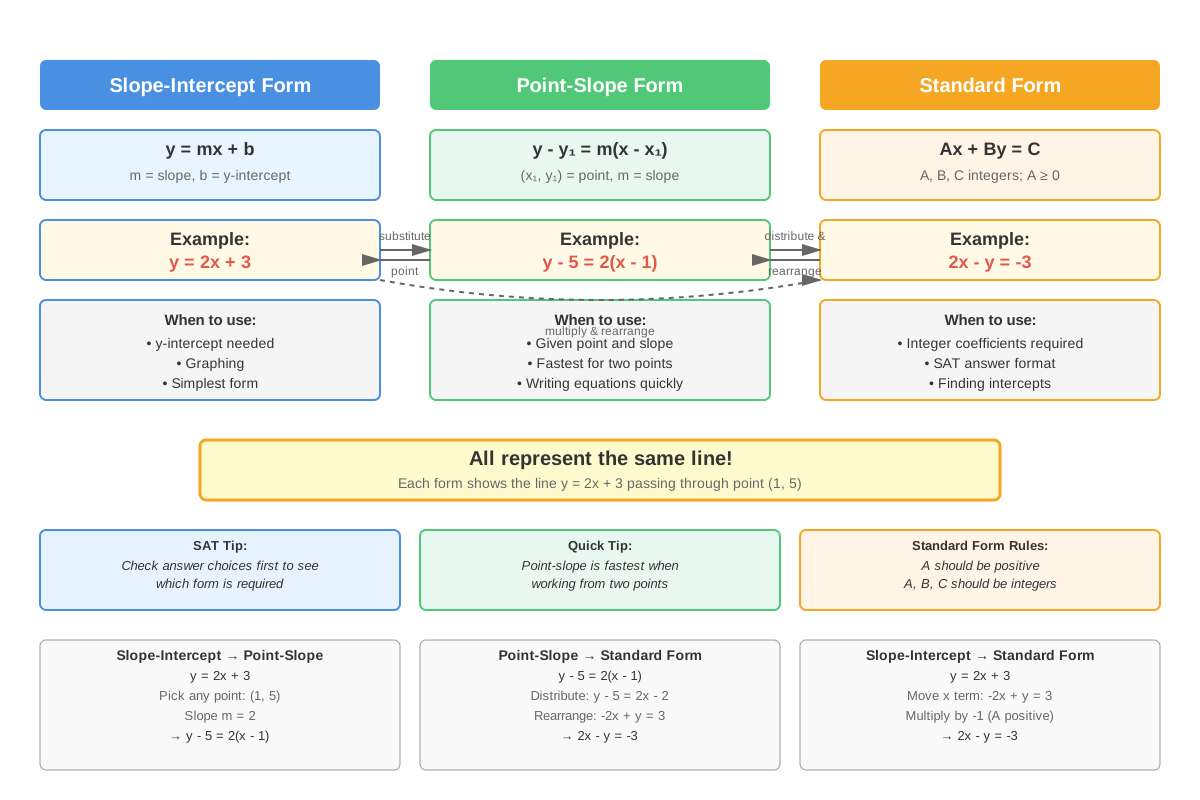
Slope-intercept form (y = mx + b) is the most commonly requested format on the SAT because it clearly displays both the slope (m) and y-intercept (b). After calculating slope from two points, students must determine the y-intercept by substituting one point's coordinates into the equation and solving for b.
Process for slope-intercept form:
- Calculate slope m using the slope formula
- Choose either given point (x₁, y₁) or (x₂, y₂)
- Substitute the slope and chosen point into y = mx + b
- Solve the resulting equation for b
- Write the final equation with both m and b values
For example, given points (2, 5) and (6, 13):
- Slope: m = (13 - 5)/(6 - 2) = 8/4 = 2
- Using point (2, 5): 5 = 2(2) + b → 5 = 4 + b → b = 1
- Final equation: y = 2x + 1
Point-Slope Form
Point-slope form provides an efficient alternative that requires fewer steps: y - y₁ = m(x - x₁). This form uses the slope and one point directly without requiring calculation of the y-intercept. While less commonly requested as a final answer on the SAT, point-slope form serves as an excellent intermediate step that can be converted to slope-intercept form through algebraic manipulation.
Advantages of point-slope form:
- Faster initial setup (no need to solve for b separately)
- Reduces arithmetic errors in multi-step problems
- Useful when the y-intercept is not a clean integer
- Can be converted to any other form as needed
Using the same example with points (2, 5) and (6, 13) and slope m = 2:
- Point-slope form: y - 5 = 2(x - 2)
- Expanding: y - 5 = 2x - 4
- Converting to slope-intercept: y = 2x + 1
Standard Form
Standard form (Ax + By = C, where A, B, and C are integers and A is positive) occasionally appears in SAT answer choices. Converting from slope-intercept or point-slope form to standard form requires moving all variable terms to one side and ensuring integer coefficients.
Conversion process:
- Start with slope-intercept or point-slope form
- Move all x and y terms to the left side
- Eliminate fractions by multiplying through by the denominator
- Ensure A is positive (multiply entire equation by -1 if necessary)
- Verify that A, B, and C have no common factors (reduce if possible)
For y = 2x + 1:
- Move x term: -2x + y = 1
- Make A positive: 2x - y = -1
Choosing the Right Approach
| Situation | Best Form | Reason |
|---|---|---|
| Answer choices in y = mx + b format | Slope-intercept | Matches required format directly |
| Need to identify y-intercept quickly | Slope-intercept | b value is explicit |
| Working with fractional slopes | Point-slope | Avoids premature fraction arithmetic |
| Answer choices in Ax + By = C format | Standard form | Matches required format |
| Multi-step problem requiring further manipulation | Point-slope | Provides flexibility for conversion |
Special Cases
Horizontal lines occur when both points have identical y-coordinates. The slope is zero, and the equation takes the form y = k (where k is the constant y-value). For points (3, 7) and (8, 7), the equation is simply y = 7.
Vertical lines occur when both points have identical x-coordinates. The slope is undefined, and the equation takes the form x = k (where k is the constant x-value). For points (4, 2) and (4, 9), the equation is x = 4. Note that vertical lines cannot be written in slope-intercept form since they don't represent functions.
Concept Relationships
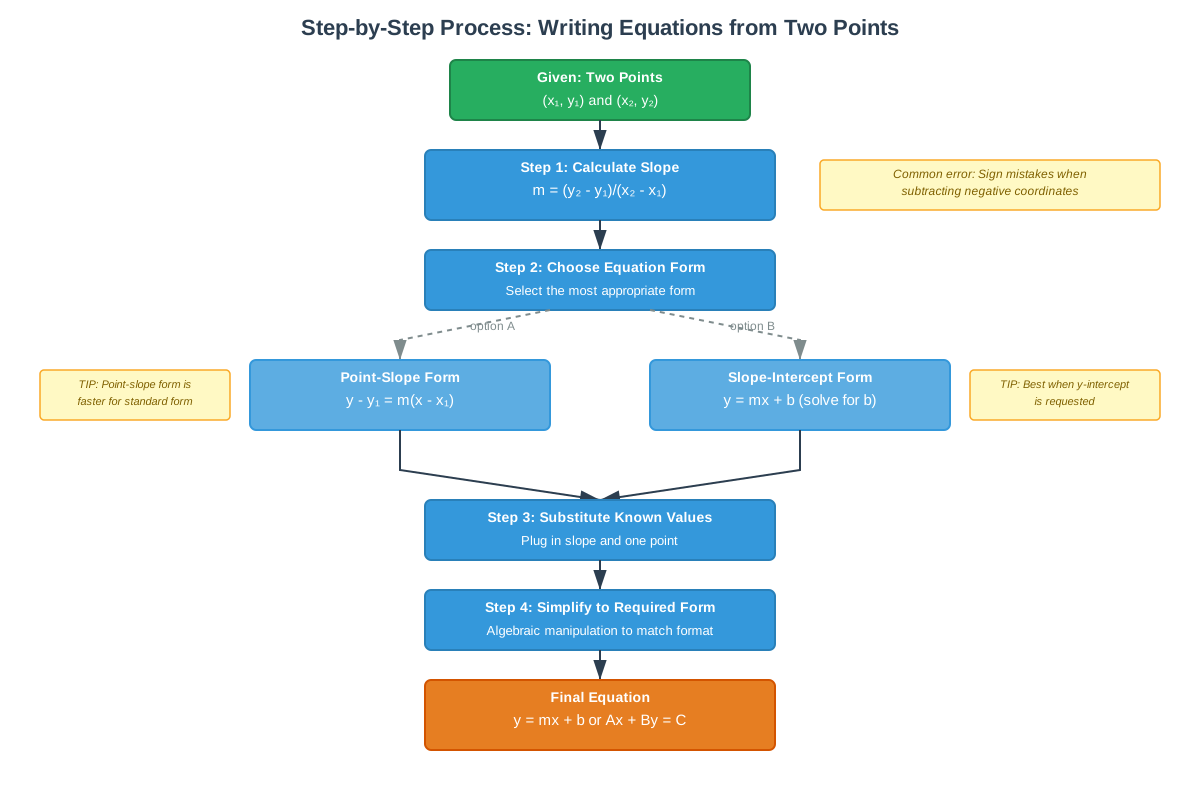
The process of writing equations from two points creates a logical sequence: coordinate pairs → slope calculation → equation form selection → algebraic manipulation → final equation. Each step depends on the previous one, making this a hierarchical skill where errors early in the process cascade through subsequent steps.
Slope calculation connects directly to the prerequisite understanding of rate of change and the coordinate plane. The slope formula itself derives from the definition of slope as rise over run, linking geometric visualization to algebraic computation. Once slope is determined, the choice between point-slope and slope-intercept form represents a strategic decision based on the problem requirements and personal computational preferences.
This topic serves as a gateway to more advanced concepts tested on the SAT. Writing equations from two points enables solving systems of equations (where two lines intersect), understanding parallel lines (equal slopes) and perpendicular lines (negative reciprocal slopes), and modeling real-world linear relationships. The skill also connects to function notation, as linear equations represent functions that can be evaluated at specific x-values or used to solve for x given a y-value.
The relationship to data interpretation is particularly important for SAT success. Tables of values, scatter plots with trend lines, and word problems describing two scenarios all require extracting coordinate pairs before applying equation-writing techniques. This connection between verbal/visual information and algebraic representation represents higher-order thinking that the SAT emphasizes heavily.
Quick check — test yourself on Writing equations from two points so far.
Try Flashcards →High-Yield Facts
⭐ The slope formula m = (y₂ - y₁)/(x₂ - x₁) requires consistent order of subtraction in numerator and denominator
⭐ Slope-intercept form (y = mx + b) is the most commonly requested format in SAT answer choices
⭐ After calculating slope, substitute ONE point (not both) into y = mx + b to solve for b
⭐ Point-slope form y - y₁ = m(x - x₁) provides the fastest path to an equation and can be converted to any other form
⭐ When both points have the same y-coordinate, the line is horizontal with equation y = k and slope = 0
- When both points have the same x-coordinate, the line is vertical with equation x = k and undefined slope
- The y-intercept b represents the y-value when x = 0, which may not be one of the given points
- Either given point can be used to find b; both will yield the same result if calculations are correct
- Standard form Ax + By = C requires integer coefficients with A positive and no common factors
- Negative slopes indicate inverse relationships where y decreases as x increases
- The slope represents the rate of change: for every 1-unit increase in x, y changes by m units
- Converting from point-slope to slope-intercept requires distributing m and isolating y
- SAT questions often disguise points within word problems or tables rather than stating them explicitly
- Parallel lines have identical slopes; perpendicular lines have slopes that are negative reciprocals
Common Misconceptions
Misconception: The order of subtraction in the slope formula doesn't matter, so (y₁ - y₂)/(x₂ - x₁) gives the same result as (y₂ - y₁)/(x₂ - x₁).
Correction: Reversing only the numerator or only the denominator changes the sign of the slope. Both must be reversed together to maintain the correct slope value. Consistency is essential: if you subtract the first point from the second in the numerator, you must do the same in the denominator.
Misconception: After finding the slope, both points should be substituted into y = mx + b to find b.
Correction: Only one point needs to be substituted to solve for b. Using both points is redundant and doesn't provide additional information. Choose whichever point has simpler numbers to minimize arithmetic errors.
Misconception: The y-intercept b must be one of the y-coordinates from the given points.
Correction: The y-intercept is the y-value when x = 0, which is typically not one of the given points. The value of b must be calculated by substituting a point into the equation after determining the slope.
Misconception: Point-slope form is only useful when the problem specifically asks for that format.
Correction: Point-slope form is an efficient intermediate step even when the final answer requires slope-intercept form. It reduces the number of calculations and potential errors, especially when dealing with fractional slopes or large numbers.
Misconception: A vertical line through points like (3, 2) and (3, 7) has a slope of zero.
Correction: Vertical lines have undefined slope (not zero) because the denominator of the slope formula becomes zero. The equation is x = 3, not y = something. Horizontal lines have zero slope.
Misconception: When converting to standard form, any arrangement of terms is acceptable as long as everything is on one side.
Correction: Standard form has specific requirements: A must be positive, all coefficients must be integers, and there should be no common factors among A, B, and C. Simply moving terms around without ensuring these conditions doesn't produce proper standard form.
Worked Examples
Example 1: Direct Calculation with Integer Coordinates
Problem: Write the equation of the line passing through points (1, 4) and (5, 12) in slope-intercept form.
Solution:
Step 1: Calculate the slope using the slope formula.
- m = (y₂ - y₁)/(x₂ - x₁)
- m = (12 - 4)/(5 - 1)
- m = 8/4
- m = 2
Step 2: Substitute the slope and one point into y = mx + b to find b.
- Using point (1, 4): 4 = 2(1) + b
- 4 = 2 + b
- b = 2
Step 3: Write the final equation.
- y = 2x + 2
Verification: Check that the second point satisfies the equation.
- For (5, 12): 12 = 2(5) + 2 = 10 + 2 = 12 ✓
This example demonstrates the standard process and connects to the learning objective of applying the technique to answer SAT-style questions. The verification step, while not always necessary under time pressure, confirms accuracy and builds confidence.
Example 2: Real-World Context with Fractional Slope
Problem: A car rental company charges $80 for 2 days and $170 for 6 days. Write an equation for the total cost C in terms of the number of days d.
Solution:
Step 1: Identify the two points from the context.
- Point 1: (2, 80) representing 2 days and $80
- Point 2: (6, 170) representing 6 days and $170
- Note: d is the independent variable (like x) and C is the dependent variable (like y)
Step 2: Calculate the slope (rate of change in cost per day).
- m = (170 - 80)/(6 - 2)
- m = 90/4
- m = 22.5
Step 3: Use point-slope form to avoid premature decimal arithmetic.
- C - 80 = 22.5(d - 2)
- C - 80 = 22.5d - 45
- C = 22.5d + 35
Step 4: Interpret the equation.
- The slope 22.5 means the cost increases by $22.50 per day
- The C-intercept 35 represents a base fee of $35 (the cost when d = 0)
Verification: Check both points.
- For d = 2: C = 22.5(2) + 35 = 45 + 35 = 80 ✓
- For d = 6: C = 22.5(6) + 35 = 135 + 35 = 170 ✓
This example illustrates how SAT questions embed coordinate pairs within word problems, requiring students to extract the relevant information before applying mathematical procedures. The interpretation step connects the abstract equation back to the real-world context, demonstrating complete understanding.
Exam Strategy
When approaching SAT questions on writing equations from two points, begin by identifying whether the points are explicitly stated or embedded within a word problem, table, or graph. Trigger phrases include "passes through," "contains the points," "when x is [value], y is [value]," or tables showing corresponding x and y values. Circle or underline these coordinate pairs immediately to avoid losing track of them during calculations.
Time management is crucial: allocate approximately 1-2 minutes for straightforward equation-writing questions. If a problem requires more than 2 minutes, consider whether you've missed a shortcut or should flag it for review. Many students waste time by recalculating slope multiple times or second-guessing correct work—trust your process and move forward once you've verified your answer with one point.
Process-of-elimination strategies work particularly well for this topic. If answer choices are in slope-intercept form, calculate the slope first and eliminate any choices with incorrect m values before finding b. This immediately narrows options, often to just one or two possibilities. For questions with numerical answer choices, you can substitute both given points into each answer choice—the correct equation must satisfy both points. This substitution method, while sometimes slower than direct calculation, provides a reliable backup strategy when under pressure or uncertain about algebraic steps.
Common SAT tricks to watch for include: giving points in reverse order (larger x-value first) to test careful application of the slope formula; providing three or four points where only two are needed, requiring identification of which points actually lie on the line; mixing up independent and dependent variables in word problems; and offering answer choices that represent common calculation errors (like using the wrong sign for slope or forgetting to solve for b).
Exam Tip: When answer choices are in different forms (some slope-intercept, some standard form), calculate in slope-intercept form first, then convert only if your answer doesn't match any choice. Don't waste time converting to multiple forms speculatively.
Memory Techniques
Slope Formula Mnemonic: "You Yell X-tra X-cited" reminds you of the order: Y₂ - Y₁ over X₂ - X₁. The matching letters (both Y's, both X's) emphasize that the same subscript order must be maintained.
Point-Slope Form Visualization: Remember "Point-Slope = Pick a Spot" to recall that you pick one specific point (x₁, y₁) and use it with the slope in the form y - y₁ = m(x - x₁).
Slope-Intercept Form Memory Aid: "Mountains have Slopes, Bases are at the Bottom" connects m to slope and b to the y-intercept (where the line crosses the y-axis, the "base" of the coordinate plane).
Special Cases Acronym: "Horizontal Zero, Vertical Undefined" (HZVU) helps remember that horizontal lines have zero slope and vertical lines have undefined slope.
Verification Technique: Use the acronym "Substitute Both Points" (SBP) as a reminder to check your final equation by plugging in both original points to ensure they satisfy the equation.
Summary
Writing equations from two points is a high-yield SAT Math skill that requires calculating slope from coordinate pairs and then constructing linear equations in various forms. The process begins with the slope formula m = (y₂ - y₁)/(x₂ - x₁), maintaining consistent subtraction order to avoid sign errors. Once slope is determined, students can use either slope-intercept form (y = mx + b) by substituting one point to solve for b, or point-slope form (y - y₁ = m(x - x₁)) for faster initial setup. The SAT frequently embeds this skill within real-world contexts, requiring extraction of coordinate pairs from word problems, tables, or graphs before applying mathematical procedures. Special cases include horizontal lines (slope = 0, equation y = k) and vertical lines (undefined slope, equation x = k). Success on SAT questions demands not only computational accuracy but also strategic thinking about which equation form to use, efficient time management, and the ability to verify answers by substitution. This topic connects to broader concepts including systems of equations, parallel and perpendicular lines, and linear modeling, making it foundational for multiple question types throughout the SAT Math section.
Key Takeaways
- The slope formula requires consistent subtraction order: (y₂ - y₁)/(x₂ - x₁), never mixing subscripts
- Slope-intercept form (y = mx + b) is the most common SAT answer format; find b by substituting one point after calculating slope
- Point-slope form (y - y₁ = m(x - x₁)) provides an efficient intermediate step that reduces arithmetic errors
- SAT questions often disguise coordinate pairs within word problems, tables, or graphs—extract these carefully before calculating
- Horizontal lines have zero slope and equation y = k; vertical lines have undefined slope and equation x = k
- Verify your equation by substituting both original points to catch calculation errors before selecting an answer
- Strategic use of process of elimination (checking answer choices against calculated slope) saves time and increases accuracy
Related Topics
Systems of Linear Equations: Writing equations from two points becomes essential when solving systems, as you may need to construct one or both equations from given information before finding intersection points. Mastery of this topic enables efficient setup of system problems.
Parallel and Perpendicular Lines: Understanding how to write equations from points extends to finding equations of lines parallel (same slope) or perpendicular (negative reciprocal slopes) to a given line through a specific point, a common SAT question type.
Linear Modeling and Data Interpretation: Real-world SAT problems require writing equations from data points to make predictions, calculate rates of change, or compare different scenarios—all applications of the fundamental skill covered in this guide.
Function Notation and Evaluation: Linear equations written from points can be expressed using function notation f(x) = mx + b, connecting this algebraic skill to the broader concept of functions and their properties.
Practice CTA
Now that you've mastered the core concepts of writing equations from two points, it's time to solidify your understanding through active practice. Work through the practice questions to apply these techniques under test-like conditions, and use the flashcards to reinforce key formulas and procedures until they become automatic. Remember: the SAT rewards both accuracy and speed, and both improve dramatically with focused practice. Each problem you solve builds the pattern recognition and computational fluency that will serve you on test day. You've got this—start practicing now to transform this knowledge into points on your SAT score!
Sign up free to keep reading
Create a free AnvayaPrep account to finish this SAT guide on Writing equations from two points — plus flashcards and practice questions.