Overview
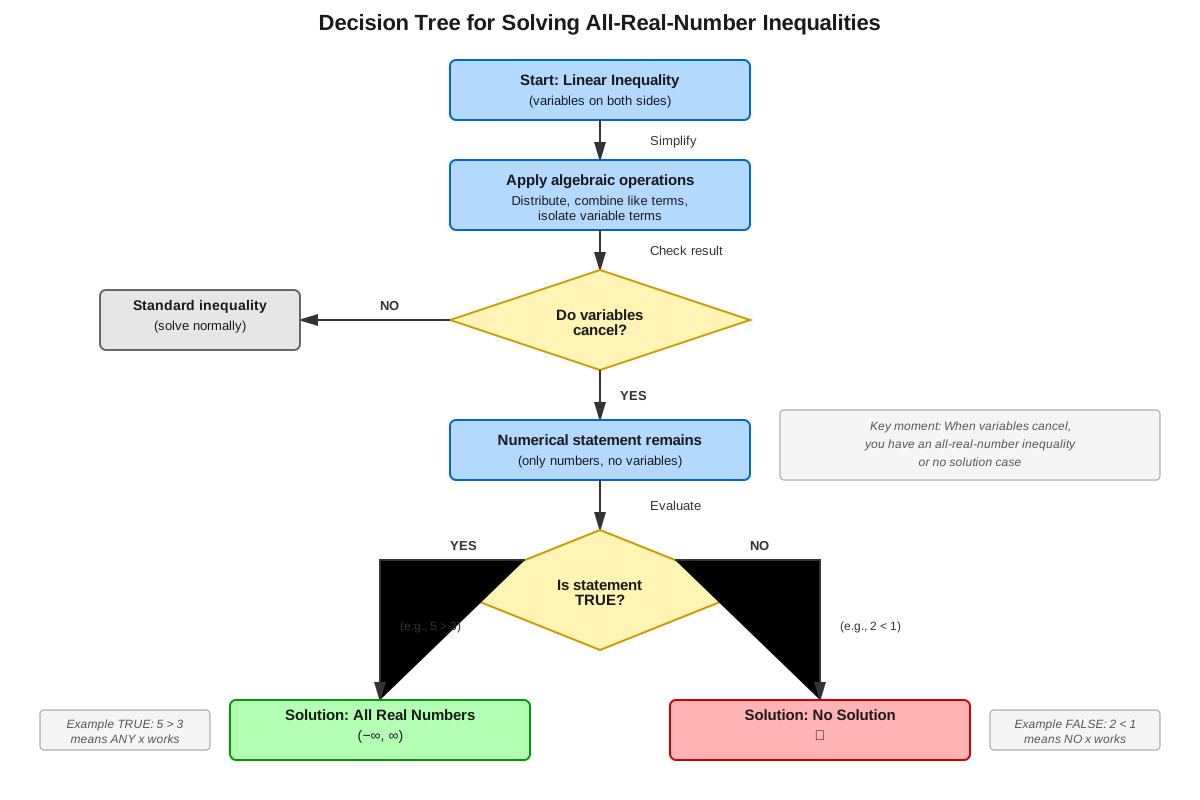
All-real-number inequalities represent a special category of linear inequalities that are either true for every real number or false for every real number. These inequalities arise when simplifying algebraic expressions leads to statements like "5 > 3" (always true) or "2 < 1" (always false), rather than expressions containing variables. Understanding this concept is crucial for SAT all-real-number inequalities questions, which test students' ability to recognize when an inequality has infinitely many solutions (all real numbers) or no solutions at all.
On the SAT, these problems typically appear as multi-step inequality questions where students must manipulate expressions algebraically and determine the solution set. The exam frequently presents scenarios where variables cancel out during the solving process, leaving students with a pure numerical comparison. Recognizing this situation and correctly interpreting what it means for the solution set distinguishes high-scoring students from those who struggle with algebraic reasoning.
This topic connects fundamentally to broader math concepts including linear equations, inequality properties, and solution set analysis. Mastery of all-real-number inequalities strengthens understanding of algebraic manipulation, logical reasoning, and the relationship between equations and their graphical representations. These skills transfer directly to more advanced topics like systems of inequalities, absolute value inequalities, and even quadratic inequalities that students encounter in higher-level mathematics.
Learning Objectives
- [ ] Identify key features of all-real-number inequalities
- [ ] Explain how all-real-number inequalities appears on the SAT
- [ ] Apply all-real-number inequalities to answer SAT-style questions
- [ ] Distinguish between inequalities with all real numbers as solutions versus no solutions
- [ ] Recognize when algebraic manipulation will result in an all-real-number inequality
- [ ] Analyze compound inequalities to determine if they represent all real numbers or empty sets
Prerequisites
- Basic inequality properties: Understanding how to add, subtract, multiply, and divide inequalities is essential for manipulating expressions that lead to all-real-number scenarios
- Combining like terms: Students must confidently simplify algebraic expressions to recognize when variables will cancel
- Distributive property: Expanding expressions correctly is necessary before identifying whether an inequality simplifies to a true or false statement
- Solution set notation: Familiarity with interval notation and set-builder notation helps express when solutions include all real numbers
Why This Topic Matters
All-real-number inequalities appear regularly on the SAT Math section, typically in 1-2 questions per test administration. These questions assess deeper algebraic reasoning rather than simple computational skills, making them high-value problems that separate score ranges. Students who master this concept gain points that many test-takers miss due to confusion about what happens when variables disappear during solving.
In real-world applications, all-real-number inequalities model situations where constraints are either universally satisfied or impossible to satisfy. For example, a business constraint that simplifies to "10 > 5" indicates the constraint is always met regardless of production levels, while "3 < 1" reveals an impossible condition in the model. Engineers and economists regularly encounter such scenarios when analyzing systems of constraints.
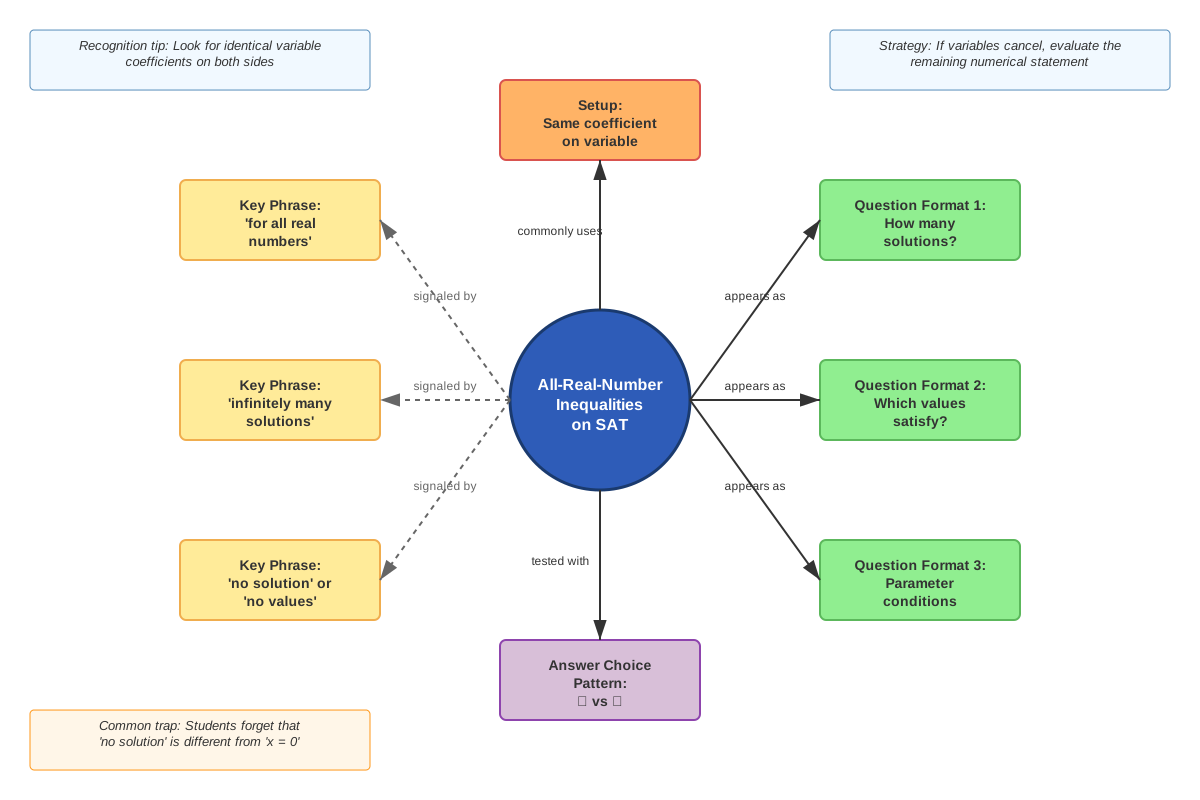
On the SAT, these problems commonly appear as:
- Multiple-choice questions asking "For which values of x is the inequality true?"
- Questions requiring students to identify the number of solutions
- Problems embedded within word problems where students must set up and solve inequalities
- Questions asking students to determine conditions on parameters that make inequalities true for all real numbers
Core Concepts
Definition of All-Real-Number Inequalities
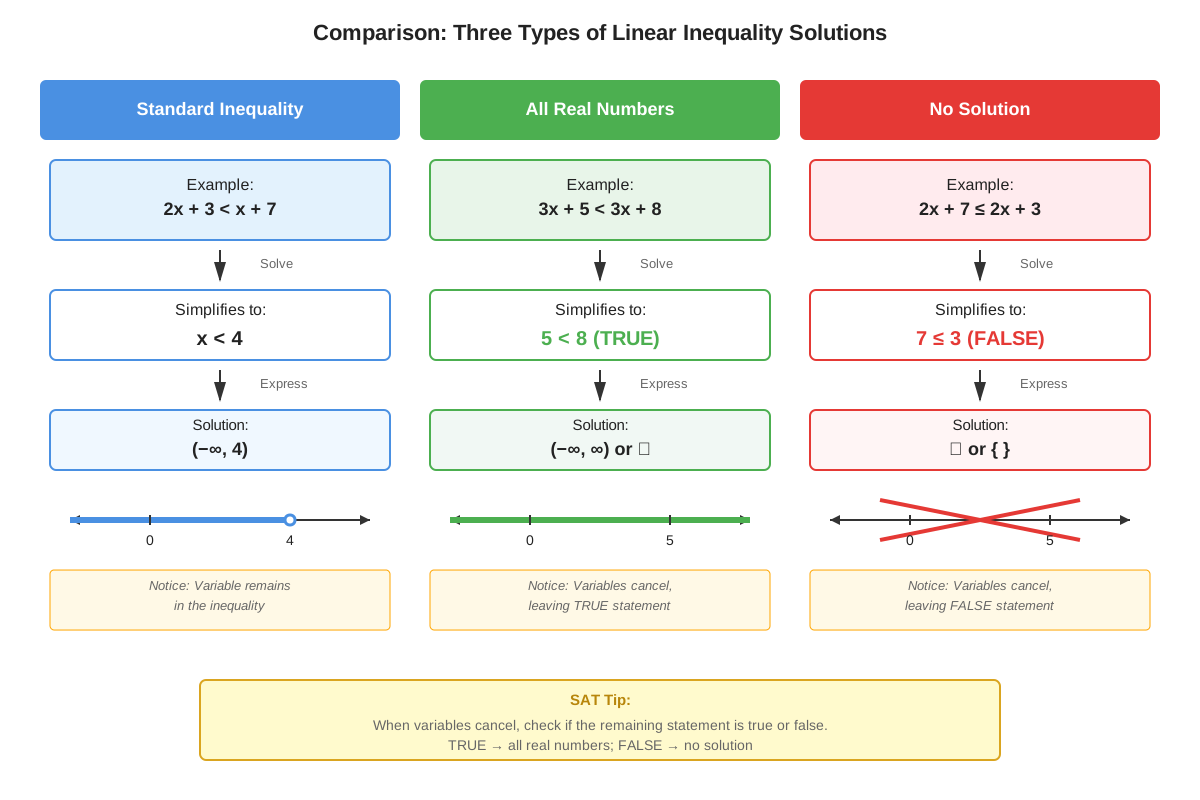
An all-real-number inequality is an inequality whose solution set is either all real numbers (ℝ) or the empty set (∅). These inequalities emerge when algebraic simplification eliminates all variables, leaving only a numerical comparison. If the resulting statement is true (such as 7 > 2), then every real number satisfies the original inequality. If the resulting statement is false (such as 4 < 1), then no real number satisfies the original inequality.
The key distinguishing feature is the absence of variables in the final simplified form. Traditional inequalities like "x > 5" have solution sets that include some but not all real numbers. All-real-number inequalities, by contrast, have solution sets at the extremes: everything or nothing.
How All-Real-Number Inequalities Arise
These inequalities typically arise through one of three mechanisms:
- Variable cancellation through subtraction: When identical variable terms appear on both sides of an inequality and cancel during simplification
- Coefficient reduction to zero: When combining like terms results in a zero coefficient for the variable
- Identical expressions: When both sides of an inequality contain equivalent expressions that simplify to the same form
Consider the inequality: 3x + 7 < 3x + 10
Subtracting 3x from both sides yields: 7 < 10
Since this statement is always true regardless of x's value, the solution set is all real numbers.
Identifying True vs. False Statements
After simplifying an inequality to a pure numerical comparison, students must evaluate whether the statement is mathematically true or false:
| Statement Type | Example | Solution Set | Interpretation |
|---|---|---|---|
| True inequality | 5 > 2 | All real numbers (ℝ) | Original inequality satisfied by every x |
| False inequality | 3 < -1 | Empty set (∅) | Original inequality has no solutions |
| True equality | 4 = 4 | Not applicable | This is an equation, not an inequality |
| False equality | 6 = 9 | Not applicable | This is an equation, not an inequality |
The distinction between true and false statements determines the answer to SAT questions. Students must carefully evaluate the numerical comparison after all algebraic steps are complete.
Solution Set Notation
When expressing solutions to all-real-number inequalities, several notations are acceptable:
- Interval notation: (-∞, ∞) for all real numbers; no standard notation for empty set, though ∅ or { } may be used
- Set-builder notation: {x | x ∈ ℝ} for all real numbers; {x | } or ∅ for empty set
- Verbal description: "all real numbers" or "no solution"
On the SAT, answer choices typically use verbal descriptions or ask students to identify the number of solutions (infinitely many vs. zero).
Step-by-Step Solution Process
To solve potential all-real-number inequalities:
- Distribute and expand all expressions to eliminate parentheses
- Combine like terms on each side of the inequality
- Move variable terms to one side using addition or subtraction
- Move constant terms to the other side
- Observe whether variables cancel completely
- Evaluate the resulting numerical statement as true or false
- State the solution set based on the evaluation
Special Cases and Variations
Some SAT questions present all-real-number inequalities in disguised forms:
Compound inequalities: An expression like "a < x < b" where a ≥ b represents an empty set because no number can simultaneously be greater than a and less than b when a is already greater than or equal to b.
Absolute value inequalities: Expressions like |x| < -3 have no solutions because absolute values are never negative.
Parameter-dependent inequalities: Questions may ask "For what value of k is the inequality true for all real numbers?" requiring students to find conditions that force variable cancellation.
Concept Relationships
All-real-number inequalities build directly on foundational inequality properties, particularly the rules for maintaining or reversing inequality signs during algebraic operations. The concept of variable cancellation connects to solving linear equations, where cancellation leads to statements like "5 = 5" (infinitely many solutions) or "2 = 7" (no solutions).
The relationship flow follows this pattern:
Basic inequality properties → Algebraic manipulation skills → Recognition of variable cancellation → Evaluation of numerical statements → Determination of solution sets → All-real-number inequalities
This topic also connects forward to systems of inequalities, where understanding when individual inequalities have all real numbers as solutions helps determine the solution region for the system. Additionally, the logical reasoning required for all-real-number inequalities transfers to absolute value inequalities and quadratic inequalities, where solution sets may also be all real numbers or empty sets under certain conditions.
The concept bridges algebraic manipulation and logical analysis, requiring students to shift from computational thinking to interpretive thinking once variables disappear from the inequality.
High-Yield Facts
⭐ An inequality that simplifies to a true numerical statement (like 8 > 3) has all real numbers as solutions
⭐ An inequality that simplifies to a false numerical statement (like 2 > 5) has no solutions (empty set)
⭐ When identical variable expressions appear on both sides of an inequality and cancel, check the remaining numerical comparison
⭐ The solution set is either all real numbers or the empty set—there is no middle ground for all-real-number inequalities
⭐ On the SAT, answer choices for these problems often include "all real numbers," "no solution," or ask for the count of solutions
- All-real-number inequalities always result from complete variable cancellation during simplification
- The inequality sign direction (< vs. >) does not change unless multiplying or dividing by a negative number
- Compound inequalities like "x > 5 and x < 3" represent the empty set because they're contradictory
- If an inequality contains no variables initially (like 7 < 10), it's already an all-real-number inequality
- Graphically, all-real-number inequalities represent either the entire number line or no points on the number line
- These problems test logical reasoning more than computational skill
Quick check — test yourself on All-real-number inequalities so far.
Try Flashcards →Common Misconceptions
Misconception: When variables cancel, the inequality has no solution → Correction: Variable cancellation doesn't automatically mean no solution; evaluate the remaining numerical statement. If it's true, all real numbers are solutions; if false, there's no solution.
Misconception: An inequality like "5 > 2" means x = 5 or x = 2 → Correction: When an inequality simplifies to a pure numerical comparison, the numbers represent constants, not values of x. The statement's truth value determines whether all x-values or no x-values satisfy the original inequality.
Misconception: All-real-number inequalities are the same as identities → Correction: While both involve statements true for all values, identities are equations (using =), while all-real-number inequalities use inequality symbols (<, >, ≤, ≥). The solution interpretation differs slightly.
Misconception: If both sides of an inequality are identical, the solution is all real numbers → Correction: Identical sides create an equation, not an inequality. For example, "3x + 2 < 3x + 2" simplifies to "0 < 0," which is false, yielding no solutions. However, "3x + 2 < 3x + 5" simplifies to "0 < 3," which is true, yielding all real numbers.
Misconception: You can't have infinitely many solutions to an inequality → Correction: Most inequalities have infinitely many solutions. What makes all-real-number inequalities special is that every real number is a solution, not just infinitely many within a restricted range.
Misconception: The empty set and zero are the same thing → Correction: The empty set (∅) means no solutions exist, while zero is a number. An inequality with no solutions is fundamentally different from an inequality whose only solution is x = 0.
Worked Examples
Example 1: Basic All-Real-Number Inequality
Problem: Solve the inequality: 2(x + 3) - 5 ≤ 2x + 1
Solution:
Step 1: Distribute the 2 on the left side
2x + 6 - 5 ≤ 2x + 1Step 2: Combine like terms on the left side
2x + 1 ≤ 2x + 1Step 3: Subtract 2x from both sides
1 ≤ 1Step 4: Evaluate the statement
The statement "1 ≤ 1" is true because 1 equals 1, satisfying the "less than or equal to" condition.
Step 5: State the solution
Since the simplified statement is true, the solution set is all real numbers.
Connection to learning objectives: This example demonstrates how to identify when an inequality becomes an all-real-number inequality (variables cancel completely) and how to apply the solution process to determine that the answer is all real numbers rather than no solution.
Example 2: Empty Set Solution
Problem: For what values of x is the following inequality true: 4(x - 2) + 3 > 4x - 5?
Solution:
Step 1: Distribute the 4 on the left side
4x - 8 + 3 > 4x - 5Step 2: Combine like terms on the left side
4x - 5 > 4x - 5Step 3: Subtract 4x from both sides
-5 > -5Step 4: Evaluate the statement
The statement "-5 > -5" is false because -5 equals -5; it is not greater than itself.
Step 5: State the solution
Since the simplified statement is false, there are no solutions (empty set).
Answer: No values of x satisfy this inequality.
Connection to learning objectives: This example shows how to distinguish between true and false numerical statements after variable cancellation, demonstrating that false statements result in empty solution sets. This directly addresses the SAT-style question format asking "for what values" an inequality holds.
Example 3: SAT-Style Parameter Problem
Problem: For what value of k is the inequality 3x + k < 3x + 7 true for all real numbers?
Solution:
Step 1: Recognize that for the inequality to be true for all real numbers, it must simplify to a true statement after variable cancellation
Step 2: Subtract 3x from both sides
k < 7Step 3: Analyze the condition
For this to be true for all x (meaning the original inequality doesn't depend on x), we need k < 7 to be a true statement.
Step 4: Determine the answer
Any value k < 7 makes the inequality true for all real numbers. If the question asks for a specific value, any number less than 7 works (e.g., k = 6, k = 0, k = -100).
Connection to learning objectives: This example demonstrates how all-real-number inequalities appear in parameter-based SAT questions, requiring students to understand the conditions that create universally true inequalities.
Exam Strategy
When approaching all-real-number inequality questions on the SAT, follow this strategic process:
Trigger words to watch for:
- "For all real numbers"
- "For what values of x"
- "How many solutions"
- "True for every value"
- "No solution" or "infinitely many solutions" in answer choices
Step-by-step approach:
- Simplify aggressively: Don't hesitate to combine like terms and cancel variables—this is exactly what the question wants you to do
- Watch for cancellation: If variables disappear completely, you're dealing with an all-real-number inequality
- Evaluate carefully: Take an extra second to verify whether the numerical statement is true or false
- Match to answer choices: SAT answers typically say "all real numbers," "no solution," or give numerical counts
Process of elimination tips:
- Eliminate answer choices that give specific x-values or ranges when you've achieved complete variable cancellation
- If the simplified statement is clearly true (like 10 > 3), eliminate "no solution" options immediately
- If the simplified statement is clearly false (like 2 > 8), eliminate "all real numbers" options immediately
- Be suspicious of answer choices that include x in the final answer when your work shows all variables canceled
Time allocation:
These problems typically take 45-60 seconds once recognized. Don't spend excessive time trying to "solve for x" when variables have already canceled—recognize the situation quickly and evaluate the numerical statement.
Exam Tip: If you simplify an inequality and get something like "5 < 5" or "3 ≤ 3," pay attention to whether the inequality allows equality (≤ or ≥). The statement "5 ≤ 5" is true, but "5 < 5" is false.
Memory Techniques
Mnemonic for solution determination: "TRUE = ALL, FALSE = FALL"
- If the numerical statement is TRUE, the solution is ALL real numbers
- If the numerical statement is FALSE, the solution FALLs away (empty set)
Visualization strategy: Picture a number line. When an inequality simplifies to a true statement like "7 > 2," imagine coloring the entire number line because every point satisfies the inequality. When it simplifies to a false statement like "1 > 4," imagine the number line remaining blank because no points satisfy it.
Acronym for the solution process: "DECO-VEN"
- Distribute
- Expand
- Combine like terms
- Organize (move variables to one side)
- Verify if variables canceled
- Evaluate the numerical statement
- Name the solution set
Pattern recognition: Remember that these problems always follow the pattern: "complicated expression" → "simple numerical comparison" → "all or nothing solution"
Summary
All-real-number inequalities represent a special category of linear inequalities where algebraic simplification eliminates all variables, leaving only a numerical comparison to evaluate. When this numerical statement is true, the solution set includes all real numbers; when false, the solution set is empty. These problems appear regularly on the SAT Math section, testing students' ability to recognize variable cancellation and correctly interpret the resulting numerical statements. The key to mastering this topic lies in systematic algebraic simplification, careful evaluation of true versus false statements, and understanding that solution sets exist at extremes—either everything or nothing. Success requires both computational accuracy during simplification and logical reasoning when interpreting results. Students must distinguish these problems from standard inequalities that have bounded solution sets and recognize the trigger phrases that indicate an all-real-number inequality question. By following a structured approach and avoiding common misconceptions about variable cancellation, students can confidently tackle these high-value SAT problems.
Key Takeaways
- All-real-number inequalities simplify to pure numerical comparisons after complete variable cancellation
- True numerical statements (like 8 > 3) yield all real numbers as solutions; false statements (like 2 > 7) yield no solutions
- These inequalities test logical reasoning and interpretation skills, not just algebraic manipulation
- Solution sets are always at extremes: all real numbers (ℝ) or the empty set (∅)
- Systematic simplification through distribution, combining like terms, and organizing variables reveals whether an inequality is all-real-number type
- SAT questions often ask "for what values" or "how many solutions," with answers being "all real numbers" or "no solution"
- Recognition of variable cancellation is the critical skill that distinguishes these problems from standard inequalities
Related Topics
Systems of Linear Inequalities: Understanding all-real-number inequalities provides foundation for analyzing systems where one or more inequalities might be universally true or false, affecting the solution region.
Absolute Value Inequalities: Similar logical reasoning applies when absolute value inequalities simplify to statements like |x| < -2 (no solution) or |x| > -1 (all real numbers).
Quadratic Inequalities: Advanced inequality problems may also result in all-real-number solutions when the quadratic expression maintains consistent sign for all x-values.
Linear Equations with Infinite or No Solutions: The parallel concept in equations helps reinforce understanding of when algebraic systems have extreme solution sets.
Mastering all-real-number inequalities builds the analytical skills necessary for these more advanced topics and strengthens overall algebraic reasoning.
Practice CTA
Now that you've mastered the core concepts of all-real-number inequalities, it's time to cement your understanding through practice. Attempt the practice questions to apply these strategies under test-like conditions, and use the flashcards to reinforce the key distinctions between true and false numerical statements. Remember: recognizing these problems quickly on test day and executing the systematic solution process will earn you valuable points that many students miss. You've got the knowledge—now build the confidence through practice!
Sign up free to keep reading
Create a free AnvayaPrep account to finish this SAT guide on All-real-number inequalities — plus flashcards and practice questions.