Overview
Boundary lines form the foundation for understanding and solving linear inequalities on the SAT math section. When graphing an inequality on a coordinate plane, the boundary line represents the equation that results when the inequality symbol is replaced with an equals sign. This line divides the coordinate plane into two distinct regions: one that contains all solutions to the inequality and one that does not. Mastering boundary lines is essential because they provide a visual representation of abstract algebraic relationships and help students quickly identify solution sets.
On the SAT, boundary lines appear frequently in both multiple-choice and grid-in questions, often integrated with other algebraic concepts such as systems of inequalities, linear functions, and coordinate geometry. Questions may ask students to identify which inequality corresponds to a given graph, determine whether a boundary line should be solid or dashed, or find points that satisfy a system of inequalities. The ability to quickly recognize and interpret boundary lines can save valuable time during the exam and unlock points in questions that combine multiple mathematical concepts.
Understanding boundary lines connects directly to broader mathematical concepts including linear equations, slope-intercept form, coordinate geometry, and solution sets. This topic serves as a bridge between purely algebraic manipulation and geometric visualization, a skill that the SAT tests extensively. Students who master boundary lines develop stronger spatial reasoning abilities and can more effectively tackle complex problems involving multiple constraints, optimization scenarios, and real-world modeling situations that appear throughout the SAT math section.
Learning Objectives
- [ ] Identify key features of boundary lines including slope, y-intercept, and whether the line is solid or dashed
- [ ] Explain how boundary lines appears on the SAT in various question formats and contexts
- [ ] Apply boundary lines to answer SAT-style questions involving graphing and interpreting inequalities
- [ ] Determine the correct inequality symbol based on the appearance and shading of a boundary line graph
- [ ] Convert between algebraic inequality notation and graphical representations using boundary lines
- [ ] Evaluate whether specific coordinate points satisfy inequalities by analyzing their position relative to boundary lines
Prerequisites
- Linear equations in slope-intercept form (y = mx + b): Understanding how to identify slope and y-intercept is essential for drawing and interpreting boundary lines
- Graphing points on the coordinate plane: Students must be able to plot points and understand the x-y coordinate system to work with boundary line graphs
- Inequality symbols (<, >, ≤, ≥): Familiarity with inequality notation and what each symbol represents is necessary for translating between algebraic and graphical forms
- Basic algebraic manipulation: Solving for y and rearranging equations is required to convert inequalities into graphable form
Why This Topic Matters
Boundary lines represent a critical intersection of algebra and geometry that appears throughout real-world applications. Engineers use boundary lines to define feasible regions in optimization problems, economists use them to model budget constraints, and scientists employ them to represent experimental limitations. Understanding boundary lines develops visual-spatial reasoning skills that extend far beyond mathematics into fields requiring data interpretation and constraint analysis.
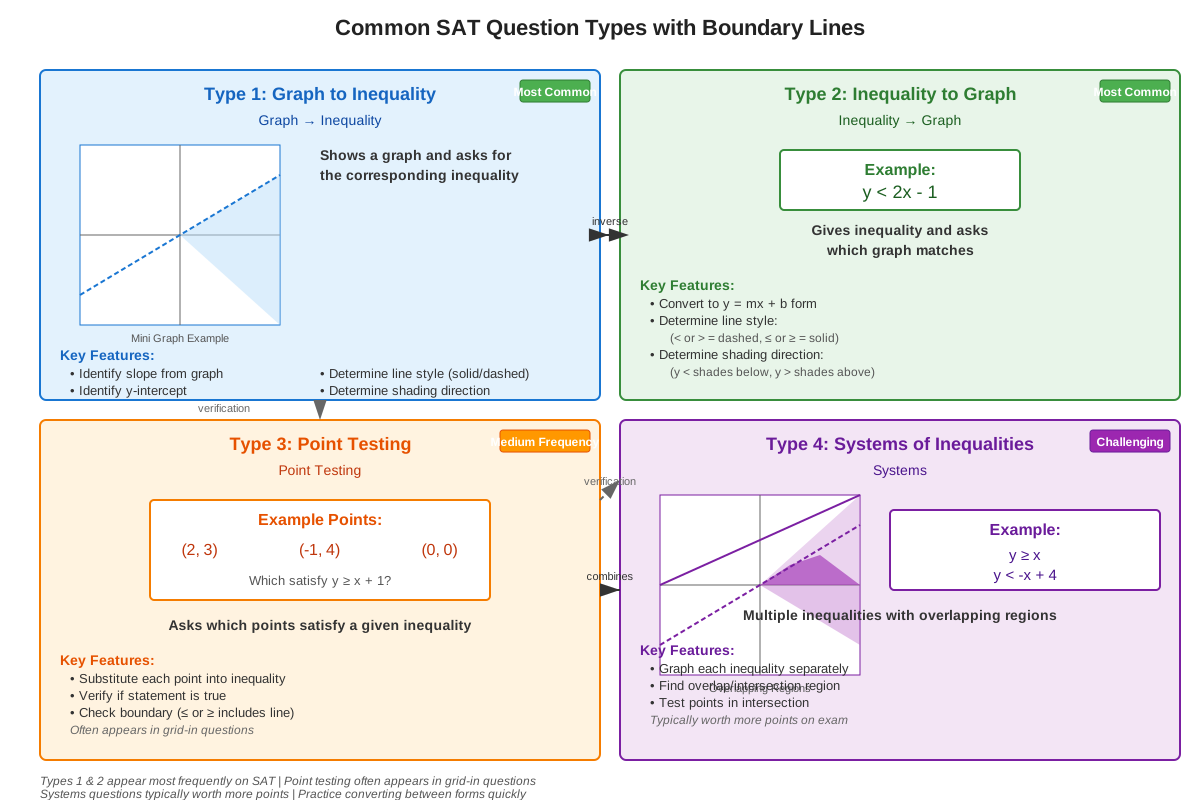
On the SAT, boundary lines appear in approximately 3-5 questions per test, making them a high-yield topic for focused study. These questions typically appear in the calculator-permitted section and account for roughly 5-8% of the total math score. The College Board frequently tests boundary lines in multiple formats: identifying the correct graph for a given inequality, selecting the inequality that matches a graph, determining solution sets for systems of inequalities, and solving word problems that require setting up and interpreting inequality constraints.
Common SAT question types include: graphical interpretation questions where students must match inequalities to their graphs; systems of inequalities where students identify the overlapping solution region; word problems involving constraints (such as budget limitations or capacity restrictions) that require translating verbal descriptions into inequality graphs; and questions asking students to determine whether specific points satisfy given inequalities. The topic frequently appears integrated with other concepts such as linear functions, systems of equations, and real-world modeling scenarios.
Core Concepts
Definition and Basic Properties of Boundary Lines
A boundary line is the line that results from replacing the inequality symbol in a linear inequality with an equals sign. For example, the inequality y > 2x + 3 has the boundary line y = 2x + 3. This line serves as the dividing line between the solution region (where the inequality is true) and the non-solution region (where the inequality is false). The boundary line itself may or may not be part of the solution set, depending on whether the original inequality includes equality.
The boundary line possesses all the standard properties of linear equations: it has a constant slope, extends infinitely in both directions, and can be expressed in various forms (slope-intercept, point-slope, or standard form). On the SAT, boundary lines most commonly appear in slope-intercept form (y = mx + b) because this format makes graphing straightforward and allows for quick identification of key features.
Solid vs. Dashed Boundary Lines
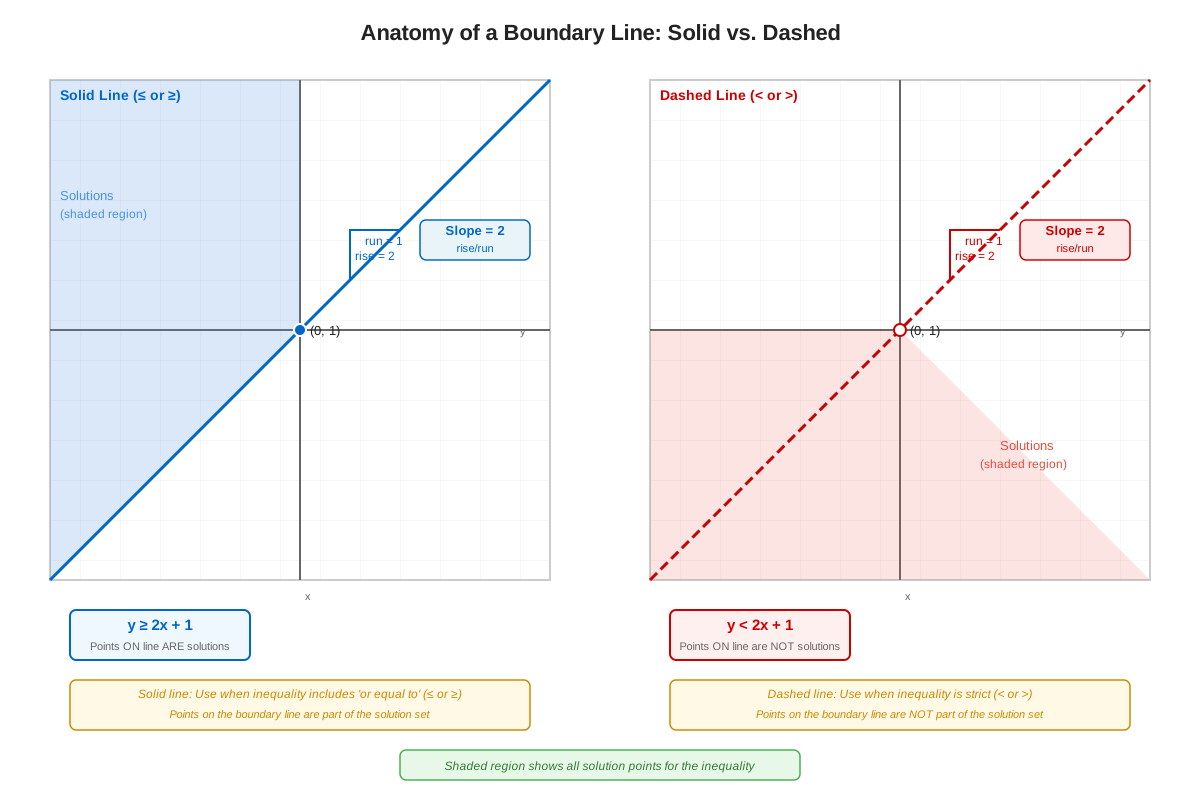
One of the most critical distinctions in working with boundary lines is determining whether the line should be solid or dashed. This visual feature communicates essential information about the solution set:
- Solid boundary lines are used when the inequality includes equality (≤ or ≥). The solid line indicates that points on the line itself are part of the solution set. For example, y ≤ 3x - 2 would be graphed with a solid boundary line because y can equal 3x - 2.
- Dashed boundary lines are used when the inequality is strict (< or >). The dashed line indicates that points on the line itself are NOT part of the solution set. For example, y > 3x - 2 would be graphed with a dashed boundary line because y cannot equal 3x - 2.
This distinction is frequently tested on the SAT, as students must recognize which type of line corresponds to which inequality symbol. A common trap involves graphs where the line type is the only difference between answer choices.
Shading and Solution Regions
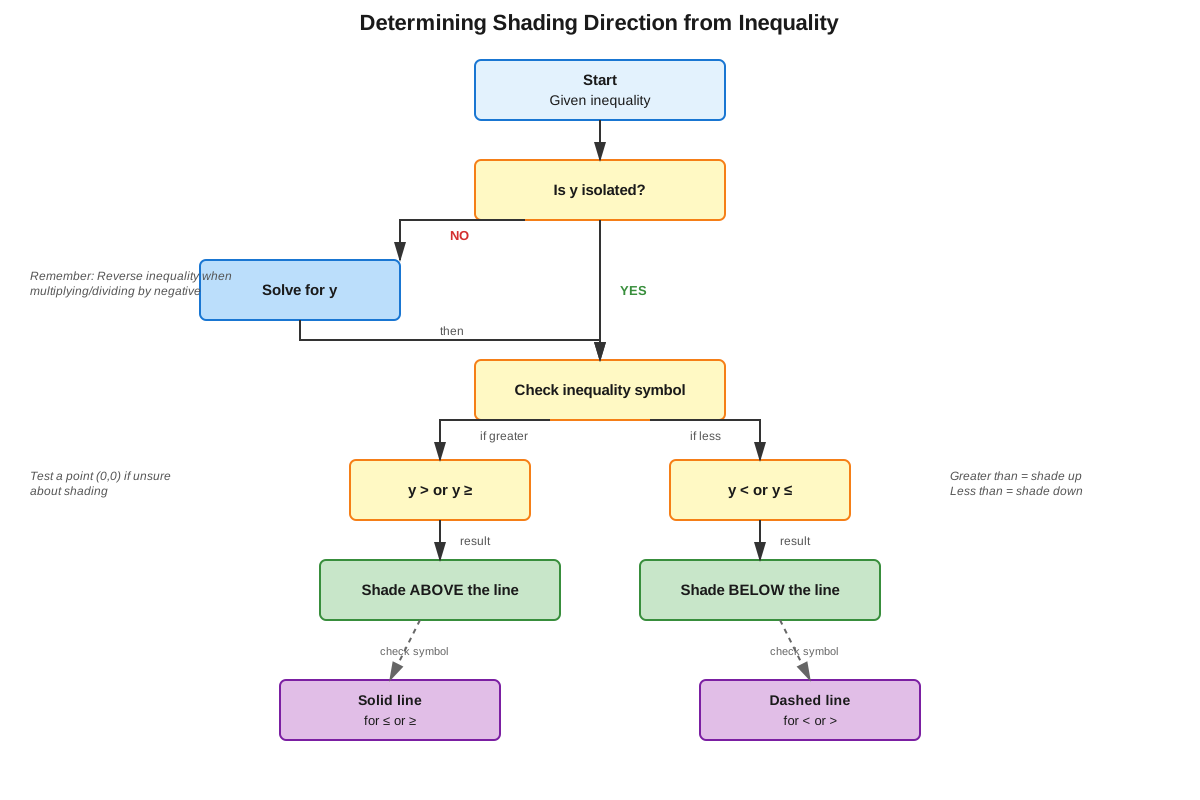
After drawing the boundary line, the next step is determining which side of the line to shade. The shaded region represents all points (x, y) that satisfy the inequality. The process for determining the correct shading direction follows these steps:
- Graph the boundary line (solid or dashed as appropriate)
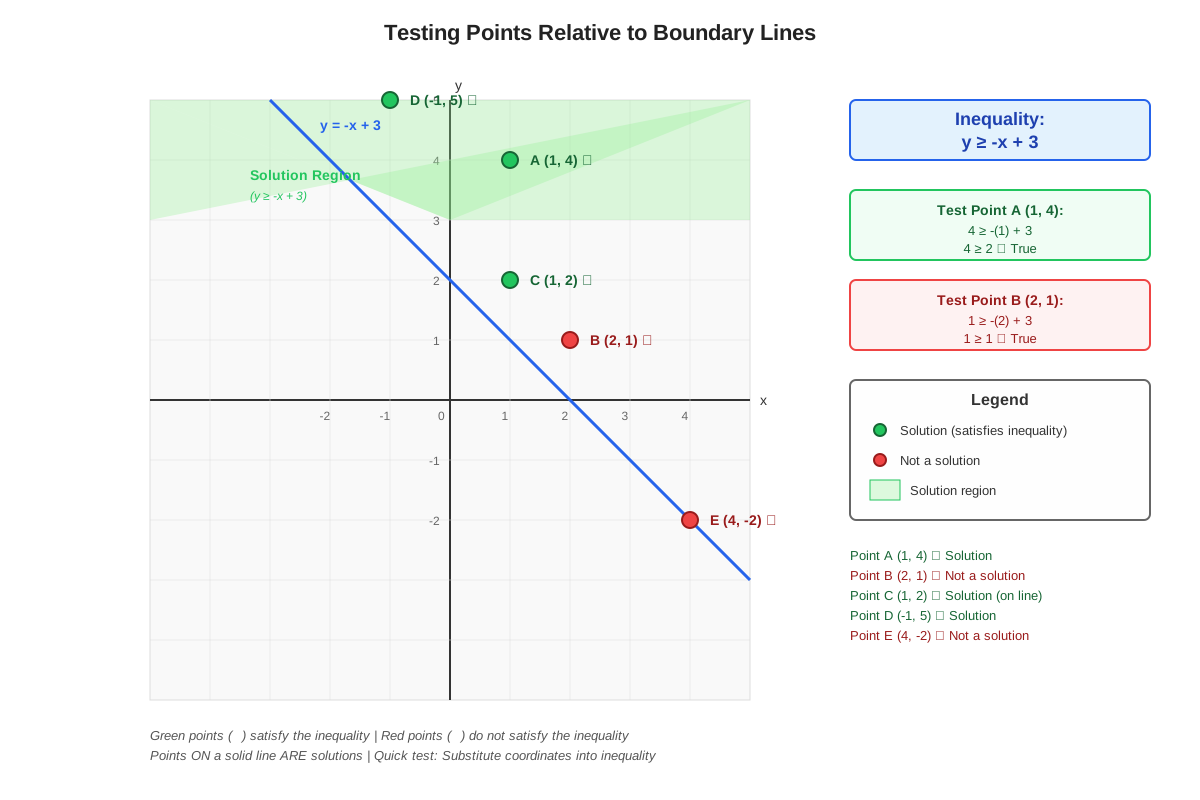
- Choose a test point not on the line (the origin (0, 0) is usually easiest if the line doesn't pass through it)
- Substitute the test point coordinates into the original inequality
- If the inequality is true, shade the side containing the test point; if false, shade the opposite side
For inequalities in the form y > mx + b or y ≥ mx + b, the shading is above the boundary line. For inequalities in the form y < mx + b or y ≤ mx + b, the shading is below the boundary line. This pattern provides a quick check: "greater than" means "above," and "less than" means "below."
Converting Inequalities to Boundary Line Form
Many SAT questions present inequalities in forms that require manipulation before graphing. The standard approach involves solving for y to obtain slope-intercept form:
Standard form to slope-intercept form:
- Given: 3x + 2y ≤ 12
- Subtract 3x: 2y ≤ -3x + 12
- Divide by 2: y ≤ -3/2 x + 6
- Boundary line: y = -3/2 x + 6 (solid line, shade below)
Important consideration: When multiplying or dividing by a negative number, the inequality symbol must be reversed. This is a common source of errors on the SAT.
Interpreting Boundary Lines from Graphs
SAT questions frequently provide a graph and ask students to identify the corresponding inequality. The systematic approach involves:
- Identify the boundary line equation: Determine the slope and y-intercept from the graph
- Determine if the line is solid or dashed: This tells you whether to use ≤/≥ (solid) or (dashed)
- Identify the shaded region: Determine if shading is above or below the line
- Combine the information: Write the complete inequality
| Graph Feature | Inequality Symbol |
|---|---|
| Solid line, shading above | y ≥ mx + b |
| Solid line, shading below | y ≤ mx + b |
| Dashed line, shading above | y > mx + b |
| Dashed line, shading below | y < mx + b |
Systems of Inequalities and Boundary Lines
When multiple inequalities are graphed simultaneously, each has its own boundary line, and the solution set is the region where all shaded areas overlap. On the SAT, these questions often involve finding points that satisfy all constraints or determining the maximum/minimum values within the feasible region. The key steps include:
- Graph each boundary line separately
- Shade the appropriate region for each inequality
- Identify the overlapping region (often using different shading patterns or colors conceptually)
- Test points or evaluate the question requirements within this feasible region
Concept Relationships
Boundary lines serve as the visual manifestation of linear inequalities, directly connecting algebraic expressions to geometric representations. The relationship flows as follows: Linear equations → provide the foundation for → Boundary lines → which define → Solution regions → which can be analyzed to solve → Systems of inequalities.
The slope and y-intercept concepts from linear equations transfer directly to boundary lines, with the added layer of determining line type (solid vs. dashed) and shading direction. This connection means that students who struggle with graphing linear equations will also struggle with boundary lines, making prerequisite mastery essential.
Boundary lines connect forward to more advanced topics including linear programming, optimization problems, and piecewise functions. On the SAT, boundary lines often appear integrated with function notation, where students must evaluate whether f(x) > g(x) or similar relationships. The concept also relates to absolute value inequalities, which can be rewritten as compound inequalities with two boundary lines.
The relationship between algebraic manipulation and graphical interpretation is bidirectional: students must be able to convert from inequality to graph (by creating the boundary line and shading) and from graph to inequality (by reading the boundary line features and shading direction). This dual fluency is what the SAT tests most frequently.
Quick check — test yourself on Boundary lines so far.
Try Flashcards →High-Yield Facts
⭐ A solid boundary line indicates the inequality includes equality (≤ or ≥); a dashed line indicates strict inequality (< or >)
⭐ For inequalities in the form y > mx + b, shade above the boundary line; for y < mx + b, shade below
⭐ The boundary line equation is found by replacing the inequality symbol with an equals sign
⭐ When multiplying or dividing an inequality by a negative number, the inequality symbol must be reversed
⭐ The test point method (usually using (0,0)) determines which side of the boundary line to shade
- Boundary lines extend infinitely in both directions unless the problem specifies a restricted domain
- In systems of inequalities, the solution region is where all shaded areas overlap
- Vertical boundary lines (x = k) and horizontal boundary lines (y = k) follow the same solid/dashed rules
- Points exactly on a dashed boundary line are NOT solutions to the inequality
- The slope of the boundary line is the same as the coefficient of x when the inequality is in slope-intercept form
Common Misconceptions
Misconception: All boundary lines are solid lines. → Correction: Boundary lines are solid only when the inequality includes equality (≤ or ≥). Strict inequalities (< or >) require dashed lines to show that points on the line itself are not part of the solution set.
Misconception: Shading always goes above the boundary line. → Correction: Shading direction depends on the inequality symbol. For y > mx + b or y ≥ mx + b, shade above; for y < mx + b or y ≤ mx + b, shade below. The inequality symbol determines the shading direction.
Misconception: When converting 2x + y > 5 to slope-intercept form, the result is y > 2x + 5. → Correction: Subtracting 2x from both sides gives y > -2x + 5. The coefficient of x becomes negative, and students must be careful with signs during algebraic manipulation.
Misconception: If a point is in the shaded region, it's on the boundary line. → Correction: The boundary line is only the line itself, not the entire shaded region. Points in the shaded region satisfy the inequality but are not necessarily on the boundary line unless they make the equation (not inequality) true.
Misconception: The inequality y > 3 has a vertical boundary line. → Correction: The inequality y > 3 has a horizontal boundary line at y = 3 (a dashed line with shading above). Vertical lines have the form x = k, not y = k.
Worked Examples
Example 1: Graphing an Inequality
Problem: Graph the inequality 2x - 3y ≤ 6 and identify three points in the solution region.
Solution:
Step 1: Convert to slope-intercept form by solving for y.
2x - 3y ≤ 6
-3y ≤ -2x + 6
y ≥ (2/3)x - 2  [Note: inequality reverses when dividing by -3]
Step 2: Identify the boundary line equation: y = (2/3)x - 2
Step 3: Determine line type. Since the inequality is ≥ (includes equality), use a solid line.
Step 4: Determine shading direction. Since y ≥ (2/3)x - 2, shade above the line.
Step 5: Graph the line with y-intercept at -2 and slope 2/3 (rise 2, run 3).
Step 6: Identify solution points. Any point in the shaded region works:
- (0, 0): Check: 0 ≥ (2/3)(0) - 2 → 0 ≥ -2 ✓
- (3, 2): Check: 2 ≥ (2/3)(3) - 2 → 2 ≥ 0 ✓
- (0, 5): Check: 5 ≥ (2/3)(0) - 2 → 5 ≥ -2 ✓
Connection to learning objectives: This example demonstrates converting an inequality to graphable form, identifying boundary line features (solid line, shading above), and verifying solutions—all key SAT skills.
Example 2: Identifying an Inequality from a Graph
Problem: A graph shows a dashed line passing through points (0, 4) and (2, 0), with shading below the line. Which inequality does this represent?
Solution:
Step 1: Find the slope using the two points.
m = (0 - 4)/(2 - 0) = -4/2 = -2Step 2: Identify the y-intercept from the point (0, 4): b = 4
Step 3: Write the boundary line equation: y = -2x + 4
Step 4: Determine the inequality symbol:
- Dashed line means strict inequality (< or >)
- Shading below means "less than"
- Therefore: y < -2x + 4
Step 5: Verify with a test point in the shaded region, such as (0, 0):
0 < -2(0) + 4
0 < 4 ✓Answer: y < -2x + 4
Alternative forms that might appear in answer choices:
- 2x + y < 4 (standard form)
- y + 2x < 4 (rearranged)
Connection to learning objectives: This example shows how to work backward from a graph to identify the inequality, a common SAT question type that tests understanding of all boundary line features simultaneously.
Exam Strategy
When approaching sat boundary lines questions on the SAT, use this systematic process:
For graphing inequalities:
- Immediately convert to y = mx + b form (solve for y)
- Watch for negative multiplication/division that reverses the inequality
- Draw the boundary line first, then determine solid vs. dashed
- Use the quick rule: "greater than" = shade above, "less than" = shade below
- If uncertain, test the point (0, 0) unless the line passes through the origin
For identifying inequalities from graphs:
- Find the slope and y-intercept by reading the graph carefully
- Check if the line is solid (≤ or ≥) or dashed (< or >)
- Identify shading direction to determine the specific symbol
- Write the inequality and verify with a point from the shaded region
Trigger words and phrases to watch for:
- "At least" or "no less than" → ≥ (solid line)
- "At most" or "no more than" → ≤ (solid line)
- "More than" or "greater than" → > (dashed line)
- "Less than" or "fewer than" → < (dashed line)
- "Satisfies the inequality" → point must be in shaded region or on solid boundary line
- "Solution set" or "feasible region" → the shaded area
Process of elimination tips:
- Eliminate answer choices with the wrong line type (solid vs. dashed) first
- If two choices have the same boundary line but different shading, test one point to eliminate one option
- For systems of inequalities, eliminate any choice that doesn't include a point clearly shown in the solution region
- Watch for answer choices that differ only in the inequality symbol—these require careful attention to shading
Time allocation:
Boundary line questions should take 45-90 seconds each. If a question involves graphing, sketch quickly but accurately. If it involves systems of inequalities, spend up to 2 minutes but don't get stuck—mark for review if needed and return after completing easier questions.
Memory Techniques
Mnemonic for line type: "Solid = Includes" — Solid lines include the boundary (≤ or ≥), dashed lines exclude it (< or >).
Visualization for shading: Picture the inequality symbol as an arrow pointing toward the shading:
- y > mx + b: The symbol points up → shade above
- y < mx + b: The symbol points down → shade below
Acronym for graphing steps: "CBSD" — Convert (to slope-intercept form), Boundary (draw the line), Solid/Dashed (choose line type), Direction (shade the correct side)
Memory hook for reversing inequalities: "Negative flip" — When you multiply or divide by a negative, the inequality symbol flips like a pancake.
Spatial memory technique: Visualize the coordinate plane divided by a fence (the boundary line). The fence is either solid (you can stand on it) or dashed (you can't stand on it). The solution region is the "yard" on one side of the fence where the inequality is true.
Summary
Boundary lines are the graphical representation of linear inequalities, serving as the dividing line between solution and non-solution regions on the coordinate plane. The boundary line itself is created by replacing the inequality symbol with an equals sign, and its appearance (solid or dashed) communicates whether points on the line are included in the solution set. Solid lines correspond to inequalities with ≤ or ≥, while dashed lines correspond to strict inequalities with < or >. The shaded region indicates all points satisfying the inequality, with shading above the line for "greater than" inequalities and below for "less than" inequalities. Mastery of boundary lines requires fluency in converting between algebraic and graphical representations, identifying key features from graphs, and applying these concepts to systems of inequalities. On the SAT, boundary line questions test both technical graphing skills and conceptual understanding of how inequalities constrain solution sets, making this a high-yield topic that integrates multiple mathematical competencies.
Key Takeaways
- Boundary lines are created by replacing inequality symbols with equals signs, and they divide the coordinate plane into solution and non-solution regions
- Solid boundary lines (≤ or ≥) include points on the line in the solution set; dashed lines (< or >) exclude them
- Shading direction follows a simple rule: shade above for y > or y ≥, shade below for y < or y ≤
- Converting inequalities to slope-intercept form (y = mx + b) makes graphing straightforward, but watch for inequality reversal when dividing by negatives
- The test point method (typically using the origin) provides a reliable way to verify shading direction
- SAT questions frequently test the ability to move between algebraic inequalities and their graphical representations in both directions
- Systems of inequalities require identifying the overlapping region where all constraints are simultaneously satisfied
Related Topics
Systems of Linear Equations: Understanding how multiple linear relationships interact prepares students for systems of inequalities, where boundary lines from multiple inequalities create a feasible region.
Linear Programming: This advanced application uses systems of inequalities and boundary lines to find optimal solutions within constrained regions, appearing occasionally in SAT word problems.
Absolute Value Inequalities: These can be rewritten as compound inequalities with two boundary lines, extending the boundary line concept to more complex scenarios.
Piecewise Functions: The boundaries between different function pieces share conceptual similarities with boundary lines, particularly regarding whether endpoints are included.
Mastering boundary lines provides the foundation for understanding how mathematical constraints work graphically, a skill that extends throughout algebra, precalculus, and applied mathematics.
Practice CTA
Now that you've mastered the core concepts of boundary lines, it's time to solidify your understanding through practice. Work through the practice questions to test your ability to graph inequalities, identify inequalities from graphs, and solve systems involving boundary lines. Use the flashcards to reinforce the key distinctions between solid and dashed lines, shading directions, and inequality symbols. Remember: boundary lines appear on nearly every SAT, so the time you invest in practice now will directly translate to points on test day. Approach each practice problem systematically using the strategies outlined above, and you'll build the confidence and speed needed to excel on these high-yield questions!
Sign up free to keep reading
Create a free AnvayaPrep account to finish this SAT guide on Boundary lines — plus flashcards and practice questions.