Overview
Compound inequalities are mathematical statements that combine two or more inequalities into a single expression, connected by the words "and" or "or." These powerful tools allow us to describe ranges of values that satisfy multiple conditions simultaneously or alternatively. On the SAT math section, compound inequalities appear frequently in both multiple-choice and grid-in questions, testing students' ability to solve, graph, and interpret solutions that involve multiple constraints. Understanding compound inequalities is essential for success on the SAT because they form the foundation for more complex algebraic reasoning and appear in approximately 3-5 questions per test administration.
The importance of mastering sat compound inequalities extends beyond simple algebraic manipulation. These problems require students to think critically about solution sets, understand interval notation, and visualize number line representations. Compound inequalities bridge the gap between basic linear inequalities and more sophisticated mathematical concepts like absolute value inequalities, systems of inequalities, and even optimization problems that appear in advanced SAT questions. Students who develop fluency with compound inequalities gain a significant advantage in tackling multi-step problems that involve constraints and conditions.
From a broader mathematical perspective, compound inequalities connect directly to fundamental concepts in algebra, including linear equations, inequality properties, and set theory. They serve as a practical application of logical reasoning (using "and" versus "or" statements) and prepare students for real-world problem-solving scenarios where multiple conditions must be satisfied simultaneously. The skills developed through working with compound inequalities—such as careful attention to inequality direction, proper handling of negative coefficients, and accurate interpretation of solution sets—transfer directly to other high-yield SAT topics and strengthen overall mathematical reasoning abilities.
Learning Objectives
- [ ] Identify key features of compound inequalities, including conjunction ("and") versus disjunction ("or") structures
- [ ] Explain how compound inequalities appears on the SAT, including common question formats and presentation styles
- [ ] Apply compound inequalities to answer SAT-style questions with accuracy and efficiency
- [ ] Translate between different representations of compound inequalities (algebraic, graphical, and interval notation)
- [ ] Solve compound inequalities involving multiple operations and determine complete solution sets
- [ ] Recognize when to use union versus intersection when combining solution sets
- [ ] Identify and avoid common errors in solving compound inequalities, particularly when multiplying or dividing by negative numbers
Prerequisites
- Basic inequality solving: Understanding how to solve single-variable linear inequalities is fundamental, as compound inequalities build directly on these skills by combining multiple inequality statements
- Number line graphing: The ability to represent solutions on a number line is essential for visualizing compound inequality solutions and understanding overlapping or separate solution regions
- Properties of inequalities: Knowledge of how inequalities behave under various operations (addition, subtraction, multiplication, division) ensures accurate manipulation when solving compound statements
- Set notation basics: Familiarity with concepts like union and intersection helps students understand how solution sets combine in compound inequalities
- Algebraic manipulation: Proficiency in isolating variables, combining like terms, and working with fractions and decimals enables efficient solving of compound inequality problems
Why This Topic Matters
Compound inequalities represent a critical intersection of algebraic reasoning and logical thinking that appears throughout higher mathematics and real-world applications. In practical contexts, compound inequalities model situations with multiple constraints: acceptable temperature ranges for chemical reactions, safe speed limits on highways (minimum and maximum), healthy blood pressure ranges, or acceptable dimensions for manufacturing specifications. These real-world applications demonstrate why understanding compound inequalities transcends academic exercise—they represent how we mathematically describe bounded conditions in everyday life.
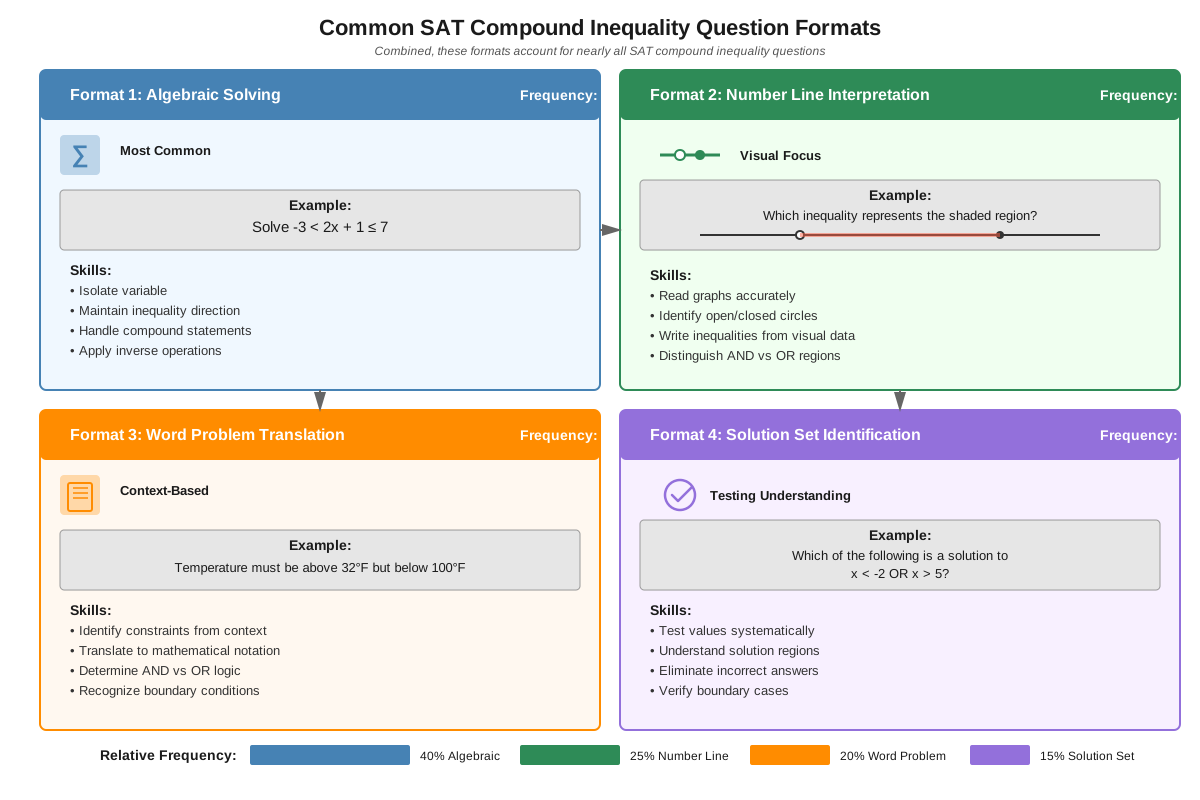
On the SAT, compound inequalities appear with remarkable consistency, typically showing up in 2-4 questions per test across both the calculator and no-calculator sections. The College Board frequently tests compound inequalities in several distinct formats: direct algebraic solving problems, word problems requiring translation from verbal descriptions to mathematical notation, questions involving absolute value that reduce to compound inequalities, and graphical interpretation problems where students must match inequalities to number line representations. Understanding these various presentations is crucial for maximizing SAT math scores.
The exam importance of compound inequalities extends beyond their direct appearance. Many SAT questions that initially seem unrelated to compound inequalities actually require this knowledge as an intermediate step. For example, optimization problems, range-finding questions, and certain function problems all rely on compound inequality reasoning. Additionally, the logical thinking required for compound inequalities—particularly understanding the difference between "and" (intersection) and "or" (union) conditions—strengthens performance on data analysis questions and even reading comprehension tasks that involve conditional logic.
Core Concepts
Definition and Structure of Compound Inequalities
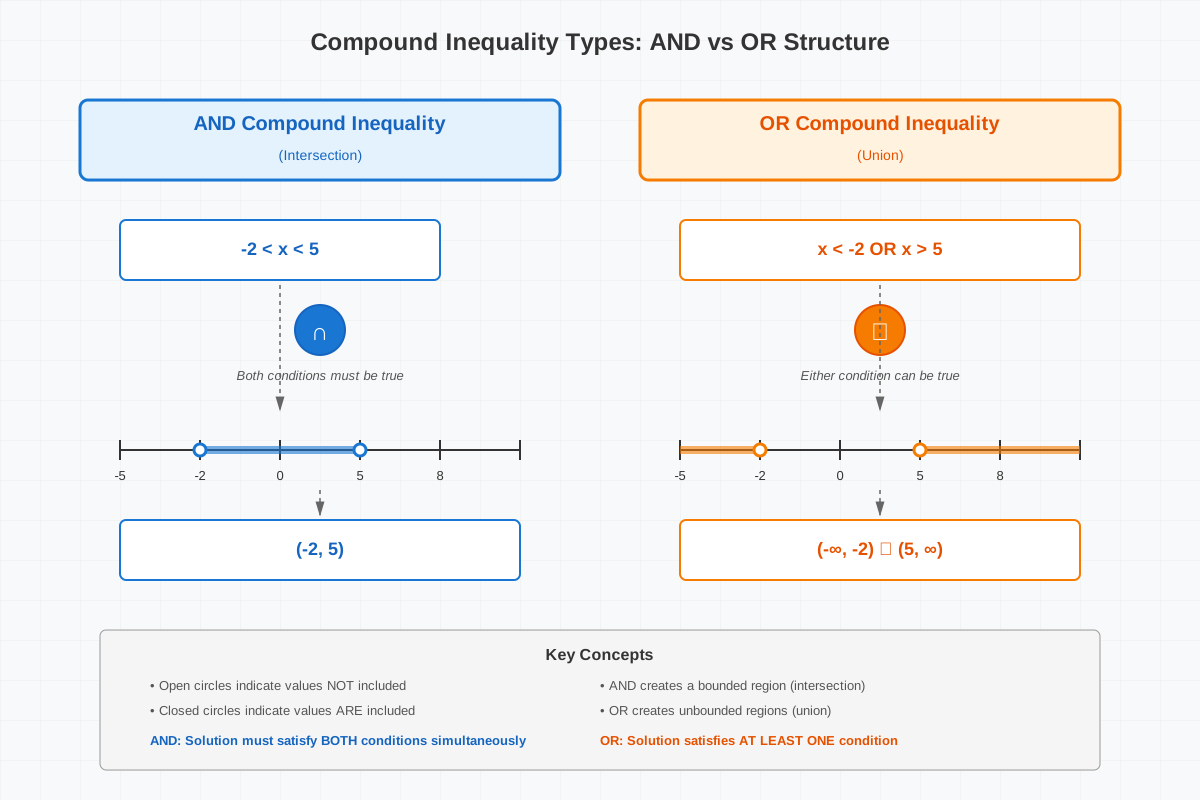
A compound inequality consists of two or more simple inequalities joined together by either the word "and" (conjunction) or the word "or" (disjunction). The fundamental structure determines how solution sets combine and what values satisfy the overall statement. When inequalities are connected by "and," the solution must satisfy both conditions simultaneously, creating an intersection of solution sets. When connected by "or," the solution satisfies at least one condition, creating a union of solution sets.
Compound inequalities appear in two primary formats. The three-part inequality format, such as -3 < x ≤ 5, represents an "and" statement where the variable is bounded between two values. This compact notation is equivalent to writing x > -3 AND x ≤ 5. The separate inequality format explicitly shows two distinct inequalities, such as x < -2 OR x ≥ 4, where solutions satisfy either condition independently.
Conjunction Compound Inequalities ("And" Statements)
Conjunction compound inequalities require that all conditions be satisfied simultaneously. The solution set is the intersection of individual solution sets—only values that work for every inequality in the compound statement belong to the final solution. On a number line, this typically appears as a single continuous interval.
The most common form is the three-part inequality: a < x < b or variations with ≤ symbols. To solve these efficiently, perform the same operation to all three parts simultaneously. For example, to solve 2 < 3x - 1 ≤ 11:
- Add 1 to all three parts:
3 < 3x ≤ 12 - Divide all three parts by 3:
1 < x ≤ 4
The solution set includes all real numbers strictly greater than 1 and less than or equal to 4. On a number line, this appears as an open circle at 1, a closed circle at 4, and shading between them.
Disjunction Compound Inequalities ("Or" Statements)
Disjunction compound inequalities are satisfied when at least one condition is met. The solution set is the union of individual solution sets—any value that works for any inequality in the compound statement belongs to the final solution. On a number line, this typically appears as two or more separate intervals.
For example, x < -3 OR x ≥ 2 creates two distinct solution regions. To solve compound "or" inequalities, solve each inequality separately, then combine the solutions. Consider 2x + 1 < -5 OR 3x - 2 ≥ 7:
First inequality: 2x + 1 < -5
- Subtract 1:
2x < -6 - Divide by 2:
x < -3
Second inequality: 3x - 2 ≥ 7
- Add 2:
3x ≥ 9 - Divide by 3:
x ≥ 3
The complete solution is x < -3 OR x ≥ 3, representing all numbers less than -3 or greater than or equal to 3.
Solving Techniques and Critical Rules
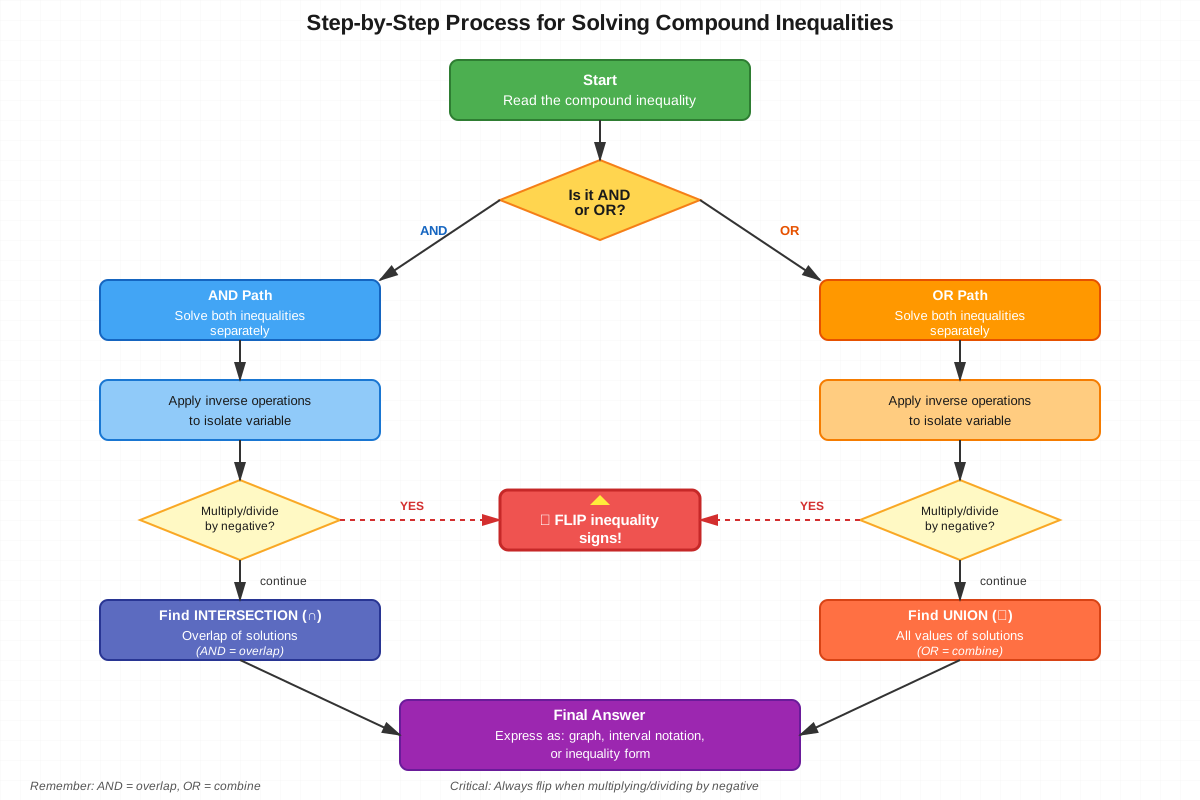
When solving compound inequalities, several critical rules ensure accuracy:
- Inequality reversal rule: When multiplying or dividing by a negative number, reverse the inequality symbol direction
- Simultaneous operations: For three-part inequalities, perform identical operations to all three parts
- Separate solving: For "or" statements, solve each inequality independently before combining solutions
- Boundary checking: Always verify whether boundary points are included (≤, ≥) or excluded (<, >)
Consider this example requiring careful attention to negative coefficients: -4 < -2x + 6 ≤ 10
- Subtract 6 from all parts:
-10 < -2x ≤ 4 - Divide by -2 (reverse inequalities):
5 > x ≥ -2 - Rewrite in standard form:
-2 ≤ x < 5
Graphical Representation and Interval Notation
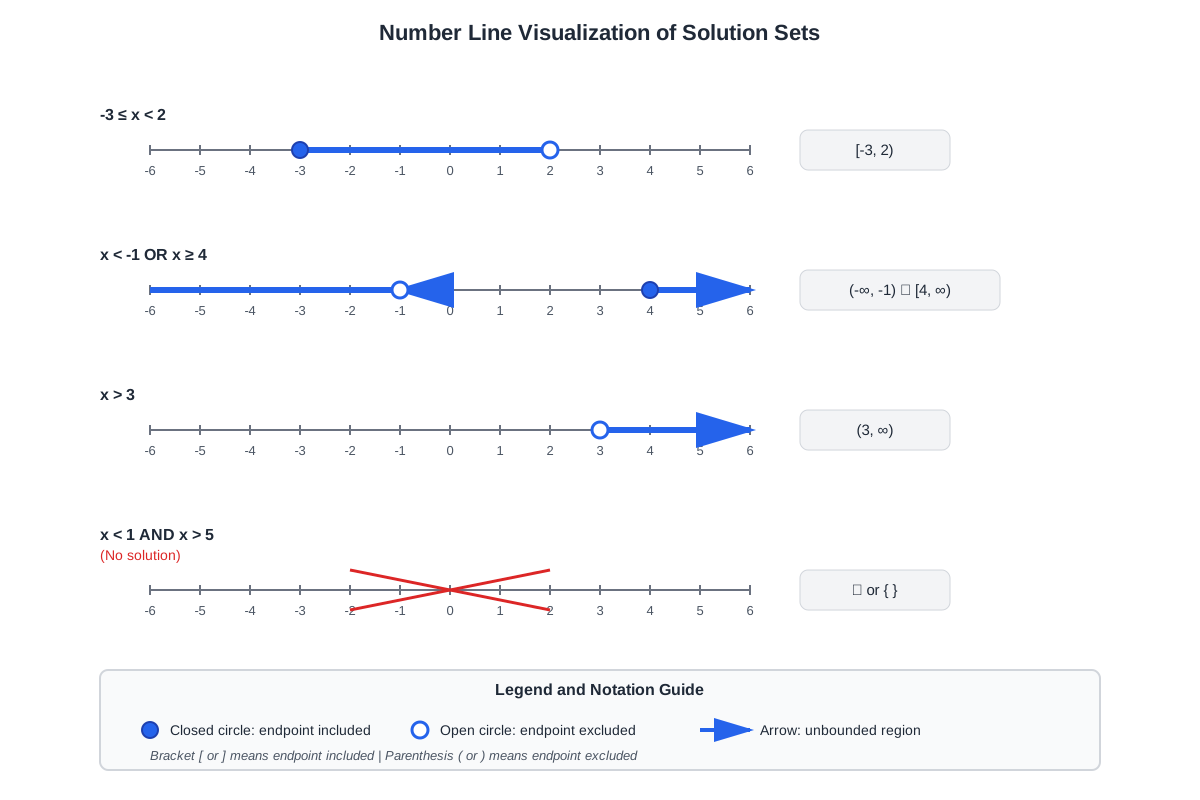
Representing compound inequalities visually reinforces understanding and provides a quick verification method. On a number line:
- Open circles (○) indicate values NOT included (<, >)
- Closed circles (●) indicate values included (≤, ≥)
- Shading shows all values in the solution set
- Multiple shaded regions indicate "or" statements
- Single shaded region indicates "and" statements
Interval notation provides a compact algebraic representation:
| Inequality | Interval Notation | Description |
|---|---|---|
a < x < b | (a, b) | Open interval, excludes endpoints |
a ≤ x ≤ b | [a, b] | Closed interval, includes endpoints |
a < x ≤ b | (a, b] | Half-open interval |
x < a OR x > b | (-∞, a) ∪ (b, ∞) | Union of two intervals |
x ≤ a OR x ≥ b | (-∞, a] ∪ [b, ∞) | Union with closed endpoints |
The union symbol (∪) represents "or" relationships, while intersection (∩) represents "and" relationships, though intersection is less commonly written explicitly.
Absolute Value Connection
Many SAT compound inequality problems involve absolute value inequalities, which naturally decompose into compound inequalities. The absolute value represents distance from zero, creating two-sided conditions:
|x| < atranslates to-a < x < a(conjunction/"and")|x| > atranslates tox < -a OR x > a(disjunction/"or")
For example, |2x - 3| ≤ 5 becomes:
-5 ≤ 2x - 3 ≤ 5-2 ≤ 2x ≤ 8-1 ≤ x ≤ 4
This connection makes compound inequalities essential for solving absolute value problems on the SAT.
Concept Relationships
Compound inequalities serve as a central hub connecting multiple mathematical concepts. At the foundational level, basic linear inequalities provide the building blocks—each component of a compound inequality is itself a simple inequality requiring standard solving techniques. The properties of inequalities (transitive property, addition property, multiplication property) apply throughout compound inequality work, making mastery of these fundamentals essential.
The relationship flows as follows: Simple inequalities → combine via logical connectors → Compound inequalities → can be represented as → Interval notation and graphs → connect to → Absolute value inequalities → extend to → Systems of inequalities.
Within compound inequalities themselves, the concepts interconnect hierarchically. Understanding conjunction versus disjunction determines whether solutions use intersection or union. This logical foundation then influences graphical representation (single interval versus multiple intervals) and interval notation (single bracket pair versus union symbol). The solving process depends on recognizing the structure (three-part versus separate inequalities), which then dictates the appropriate technique (simultaneous operations versus independent solving).
Compound inequalities also connect forward to more advanced SAT topics. They form the foundation for systems of inequalities graphed in the coordinate plane, where multiple linear inequalities create bounded regions. They relate to function domain and range problems, where acceptable input or output values are described using compound inequalities. Additionally, they appear in optimization problems where constraints must be satisfied, and in data analysis questions involving acceptable ranges for measurements or statistics.
High-Yield Facts
⭐ Conjunction ("and") compound inequalities require ALL conditions to be satisfied simultaneously; the solution is the intersection of individual solution sets, typically appearing as a single continuous interval on a number line.
⭐ Disjunction ("or") compound inequalities require AT LEAST ONE condition to be satisfied; the solution is the union of individual solution sets, typically appearing as two or more separate intervals on a number line.
⭐ When multiplying or dividing by a negative number, the inequality symbols MUST be reversed in direction; this applies to all parts of a three-part inequality.
⭐ Three-part inequalities like a < x < b are always "and" statements and should be solved by performing identical operations to all three parts simultaneously.
⭐ Absolute value inequalities convert to compound inequalities: |x| < a becomes -a < x < a (and), while |x| > a becomes x < -a OR x > a (or).
- Open circles on number lines indicate values NOT included in the solution set (<, >), while closed circles indicate values that ARE included (≤, ≥).
- Interval notation uses parentheses ( ) for excluded endpoints and brackets [ ] for included endpoints; the union symbol ∪ combines separate intervals in "or" statements.
- The solution to
x < a AND x > bwherea < bis the empty set (no solution), as no number can simultaneously be less than a smaller value and greater than a larger value.
- When solving compound inequalities from word problems, "between" typically indicates an "and" statement, while "less than [value] or greater than [value]" indicates an "or" statement.
- The SAT frequently tests compound inequalities through multiple representations: students must translate between algebraic notation, number line graphs, interval notation, and verbal descriptions.
Quick check — test yourself on Compound inequalities so far.
Try Flashcards →Common Misconceptions
Misconception: When solving three-part inequalities, operations only need to be applied to the middle expression containing the variable.
Correction: All three parts of a three-part inequality must receive identical operations simultaneously. For example, when solving 5 < 2x + 1 < 9, subtracting 1 must be done to all three parts: 4 < 2x < 8, then dividing by 2 gives 2 < x < 4. Failing to apply operations to all parts produces incorrect solutions.
Misconception: "Or" compound inequalities create a single continuous interval on the number line.
Correction: "Or" statements typically create two or more separate, non-overlapping intervals. For example, x < -2 OR x > 3 has two distinct solution regions with a gap between -2 and 3. Only "and" statements typically produce single continuous intervals (when they have solutions at all).
Misconception: The inequality symbols in a three-part inequality can point in different directions, such as 5 > x < 10.
Correction: In standard three-part inequality notation, both inequality symbols must point the same direction. The expression 5 > x < 10 is ambiguous and should be rewritten as either 5 > x AND x < 10 (which simplifies to x < 5 AND x < 10, or just x < 5) or corrected to 5 < x < 10 if that was the intended meaning.
Misconception: When an "and" compound inequality has no overlap between the two conditions, the answer should include both original conditions.
Correction: If the conditions in an "and" statement don't overlap, there is no solution (empty set). For example, x < 3 AND x > 7 has no solution because no number can simultaneously be less than 3 and greater than 7. The answer is "no solution" or ∅, not both conditions listed separately.
Misconception: Reversing inequality symbols is only necessary when dividing by a negative number, not when multiplying.
Correction: Inequality symbols must be reversed when multiplying OR dividing by any negative number. For example, multiplying x > 5 by -2 gives -2x < -10 (symbol reversed). This rule applies to all multiplication and division by negative values, not just division.
Misconception: The solution to |x| < -3 is -3 < x < 3.
Correction: Absolute value represents distance and is always non-negative, so |x| < -3 has no solution. An absolute value can never be less than a negative number. Similarly, |x| > -3 is true for all real numbers since absolute value is always greater than any negative number.
Worked Examples
Example 1: Three-Part Inequality with Multiple Operations
Problem: Solve and graph: -6 ≤ 4 - 2x < 10
Solution:
Step 1: Identify this as a three-part "and" compound inequality. We need to isolate x in the middle by performing identical operations to all three parts.
Step 2: Subtract 4 from all three parts:
-6 - 4 ≤ 4 - 2x - 4 < 10 - 4
-10 ≤ -2x < 6
Step 3: Divide all three parts by -2. Critical: Since we're dividing by a negative number, we must reverse both inequality symbols:
-10 ÷ (-2) ≥ -2x ÷ (-2) > 6 ÷ (-2)
5 ≥ x > -3
Step 4: Rewrite in standard form (smaller value on left):
-3 < x ≤ 5Step 5: Interpret and graph:
- The solution includes all real numbers strictly greater than -3 and less than or equal to 5
- On a number line: open circle at -3, closed circle at 5, shading between them
- In interval notation:
(-3, 5]
Connection to learning objectives: This example demonstrates solving compound inequalities with multiple operations, proper handling of negative coefficients with inequality reversal, and translation between algebraic and graphical representations—all essential SAT skills.
Example 2: Disjunction Compound Inequality from Word Problem
Problem: A manufacturing company requires that metal rods be rejected if they are either shorter than 14.5 cm or longer than 15.5 cm. Write and solve a compound inequality to find the acceptable lengths, then express the unacceptable lengths as a compound inequality.
Solution:
Step 1: Translate the problem. Let x = length of rod in cm.
- Acceptable rods:
14.5 ≤ x ≤ 15.5(this is an "and" statement—rods must be at least 14.5 AND at most 15.5)
Step 2: The question asks for unacceptable lengths, which is the complement of acceptable lengths. Rods are rejected if they fail either condition:
- Too short:
x < 14.5 - Too long:
x > 15.5 - Combined:
x < 14.5 OR x > 15.5
Step 3: Verify the logic:
- A rod measuring 14 cm satisfies
x < 14.5(rejected) ✓ - A rod measuring 15 cm satisfies neither rejection condition (acceptable) ✓
- A rod measuring 16 cm satisfies
x > 15.5(rejected) ✓
Step 4: Express in multiple forms:
- Algebraic:
x < 14.5 OR x > 15.5 - Interval notation:
(-∞, 14.5) ∪ (15.5, ∞) - Number line: Two rays extending left from 14.5 (open circle) and right from 15.5 (open circle)
Connection to learning objectives: This example demonstrates translating real-world constraints into compound inequalities, understanding the relationship between "and" and "or" statements (including complements), and recognizing how SAT word problems present compound inequality scenarios. The manufacturing context mirrors typical SAT application problems.
Exam Strategy
When approaching SAT compound inequality questions, begin by identifying the logical connector: determine whether the problem involves "and" (intersection) or "or" (union) conditions. This fundamental distinction dictates your entire solution approach. Look for trigger words: "between," "from...to," and "both" typically signal "and" statements, while "less than [value] or greater than [value]," "outside the range," and "either...or" signal "or" statements.
For three-part inequalities, use the simultaneous operation method to save time. Rather than splitting into two separate inequalities, keep the three-part structure intact and perform each operation across all three parts at once. This reduces calculation steps and minimizes errors. Always write out each step clearly on your test booklet—rushing through mental math on compound inequalities frequently leads to sign errors or inequality reversal mistakes.
Process of elimination strategies work particularly well for compound inequality questions. When answer choices show different inequality symbols or different logical connectors, test boundary values to eliminate incorrect options quickly. For example, if solving yields x < 3 OR x > 7, test x = 3, x = 5, and x = 7 in the original problem. The value x = 5 should NOT satisfy the original inequality (it's in the gap), while values like x = 2 or x = 8 should satisfy it. This boundary testing catches errors in inequality direction or logical connector choice.
Watch for absolute value disguises: Many SAT compound inequality questions present as absolute value problems that require conversion to compound form. When you see |expression| < value, immediately recognize this as a three-part "and" inequality. When you see |expression| > value, recognize this as an "or" statement with two separate conditions. Making this translation quickly and accurately is a high-yield skill.
Time allocation: Straightforward compound inequality solving should take 45-60 seconds. Word problems requiring translation may take 90-120 seconds. If you find yourself exceeding these times, mark the question and return to it later. Often, a fresh look reveals a simpler approach or catches an error that was causing confusion.
Graphical answer choices: When the SAT presents number line graphs as answer choices, use the visual representation to your advantage. Solve the inequality algebraically first, then match to the graph rather than trying to work backward from the graphs. However, if you're stuck, eliminate graphs that show the wrong number of intervals (single interval versus multiple intervals) based on whether the problem is "and" or "or."
Memory Techniques
"AND means IN-between": For conjunction compound inequalities, remember that "and" creates a solution that's IN-between two values—a single continuous interval. Visualize the word "AND" with the "A" and "D" as boundary posts with the solution trapped between them.
"OR means OUTER regions": For disjunction compound inequalities, remember that "or" creates solutions in the OUTER regions—two separate intervals extending away from a gap in the middle. Visualize "OR" as two circles (the O and the O-shape of R) separated by space.
"Negative Flip": Create a mental image of a negative sign as a flip switch. Whenever you multiply or divide by a negative number, visualize flipping the inequality symbols like light switches. Some students find it helpful to draw actual arrows showing the flip: < becomes >, ≤ becomes ≥.
"Three-Part = Three-Way": When you see a three-part inequality, remember that operations go "three ways"—whatever you do to one part, you must do to all three parts. Visualize three connected gears that must all turn together.
Interval Notation Brackets: Remember that square brackets [ ] are SOLID (like closed circles—the endpoint is included), while parentheses ( ) are OPEN (like open circles—the endpoint is excluded). The visual similarity between bracket types and circle types on number lines reinforces this connection.
UNION acronym: For "or" statements, remember Union Needs Independent Options Not overlapping. This reminds you that "or" statements (unions) involve independent conditions that typically don't overlap, creating separate solution regions.
Summary
Compound inequalities represent a fundamental SAT math topic that combines multiple inequality conditions using logical connectors "and" or "or." Conjunction compound inequalities (using "and") require all conditions to be satisfied simultaneously, producing solution sets that are intersections of individual solutions—typically single continuous intervals on a number line. Disjunction compound inequalities (using "or") require at least one condition to be satisfied, producing solution sets that are unions of individual solutions—typically multiple separate intervals. The critical solving techniques include performing simultaneous operations on three-part inequalities, reversing inequality symbols when multiplying or dividing by negative numbers, and solving each component independently for "or" statements before combining results. Students must demonstrate fluency in translating between algebraic notation, number line graphs, and interval notation, as the SAT tests compound inequalities through all these representations. The connection to absolute value inequalities makes this topic even more essential, as absolute value problems frequently reduce to compound inequality solving. Mastery requires careful attention to inequality direction, proper identification of logical connectors, and systematic application of solving procedures while avoiding common errors like forgetting to reverse symbols or misidentifying "and" versus "or" structures.
Key Takeaways
- Compound inequalities combine multiple conditions using "and" (intersection—all conditions must be met) or "or" (union—at least one condition must be met), fundamentally changing the solution structure
- Three-part inequalities like
a < x < bare always "and" statements and should be solved by applying identical operations to all three parts simultaneously - Always reverse inequality symbols when multiplying or dividing by negative numbers—this is the most common source of errors in compound inequality problems
- "And" statements typically produce single continuous intervals, while "or" statements typically produce multiple separate intervals on number lines
- Absolute value inequalities convert directly to compound inequalities:
|x| < abecomes an "and" statement, while|x| > abecomes an "or" statement - Master translation between algebraic notation, number line graphs, and interval notation, as SAT questions test all three representations
- Use boundary value testing as a verification strategy—plug in values at boundaries and in gaps to confirm your solution is correct
Related Topics
Systems of Linear Inequalities: Building on compound inequalities in one variable, systems of inequalities involve multiple variables and are represented graphically in the coordinate plane. Mastering compound inequalities provides the foundation for understanding how solution regions are determined by the intersection or union of half-planes.
Absolute Value Equations and Inequalities: Absolute value problems frequently reduce to compound inequalities, making this topic a direct extension. Understanding the connection between absolute value and distance from zero deepens comprehension of why absolute value inequalities split into compound forms.
Quadratic Inequalities: While compound inequalities focus on linear expressions, quadratic inequalities introduce curved boundaries and require similar logical reasoning about solution intervals. The techniques for testing intervals and representing solutions transfer directly from compound inequality work.
Domain and Range of Functions: Determining acceptable input values (domain) and possible output values (range) often requires compound inequality notation. The skills developed in this topic enable precise mathematical description of function behavior and constraints.
Optimization and Linear Programming: Advanced applications of compound inequalities appear in optimization problems where multiple constraints must be satisfied simultaneously. This real-world application demonstrates the practical importance of compound inequality reasoning in business, engineering, and science contexts.
Practice CTA
Now that you've mastered the core concepts of compound inequalities, it's time to solidify your understanding through active practice. The practice questions and flashcards have been specifically designed to mirror actual SAT question formats and difficulty levels. Work through each problem systematically, applying the strategies and techniques covered in this guide. Pay special attention to questions involving inequality reversal and logical connector identification—these are the highest-yield skills for test day. Remember, compound inequalities appear on virtually every SAT administration, making your practice time here a direct investment in score improvement. Challenge yourself to complete the practice set, check your work carefully, and review any mistakes to identify patterns in your thinking. You've got this!
Sign up free to keep reading
Create a free AnvayaPrep account to finish this SAT guide on Compound inequalities — plus flashcards and practice questions.