Overview
Graphing inequalities is a fundamental skill in algebra that extends the concept of linear equations to represent ranges of solutions rather than single points. On the SAT math section, this topic appears regularly in both multiple-choice and grid-in questions, testing students' ability to visualize mathematical relationships and interpret solution sets on coordinate planes. Unlike equations that have discrete solutions, inequalities describe entire regions of the coordinate plane, requiring students to understand boundary lines, shading conventions, and the meaning of solid versus dashed lines.
Mastering sat graphing inequalities is essential because these questions frequently appear in the Heart of Algebra domain, which comprises approximately 33% of the SAT Math section. Students must be able to translate verbal descriptions into inequality notation, graph inequalities on coordinate planes, identify solution regions, and interpret graphs to write corresponding inequalities. This skill bridges multiple mathematical concepts including slope, y-intercepts, linear relationships, and systems of equations.
The ability to work with graphing inequalities connects directly to more advanced topics such as systems of inequalities, linear programming, and optimization problems. It also reinforces understanding of coordinate geometry, which appears throughout the SAT Math section. Students who master this topic gain a powerful visual tool for solving complex problems and can often use graphing as a verification method for algebraic solutions, making it a high-yield area for test preparation.
Learning Objectives
- [ ] Identify key features of graphing inequalities including boundary lines, shading regions, and line types
- [ ] Explain how graphing inequalities appears on the SAT in various question formats
- [ ] Apply graphing inequalities to answer SAT-style questions accurately and efficiently
- [ ] Determine whether to use solid or dashed boundary lines based on inequality symbols
- [ ] Translate between inequality notation, verbal descriptions, and graphical representations
- [ ] Identify solution sets by testing points within shaded regions
- [ ] Recognize and graph systems of inequalities with multiple constraints
Prerequisites
- Linear equations and graphing: Understanding how to graph y = mx + b is essential because inequalities use the same boundary lines with added shading conventions
- Slope and y-intercept: Identifying these features allows quick sketching of boundary lines before determining shading direction
- Coordinate plane navigation: Plotting points and understanding quadrants enables verification of solution regions
- Inequality symbols: Knowing the meaning of <, >, ≤, and ≥ is fundamental to determining line types and shading direction
- Solving linear equations: Manipulating inequalities follows similar algebraic rules with one critical exception regarding multiplication/division by negative numbers
Why This Topic Matters
Graphing inequalities represents real-world constraints and limitations that appear constantly in practical applications. Budget constraints, time limitations, capacity restrictions, and resource allocation problems all translate naturally into inequality relationships. For example, a business determining production levels with limited resources, a student planning study time across multiple subjects, or an engineer designing within safety parameters all use inequality thinking. The visual representation of these constraints through graphing provides immediate insight into feasible solutions and optimal choices.
On the SAT, graphing inequalities appears in approximately 2-4 questions per test, making it a high-frequency topic with significant point value. These questions typically appear in the Heart of Algebra domain and occasionally in Problem Solving and Data Analysis when combined with real-world scenarios. The College Board tests this concept through multiple question types: identifying the correct graph for a given inequality, writing an inequality from a graph, determining whether specific points satisfy an inequality, and solving systems of inequalities. Questions range from straightforward single-inequality graphs to complex scenarios involving multiple constraints.
Common SAT question formats include presenting a verbal scenario (such as fundraising goals or material constraints) and asking students to identify the correct inequality or graph, showing a graph and requesting the corresponding inequality, or providing multiple inequalities and asking which point satisfies all conditions. The visual nature of these questions makes them excellent candidates for process-of-elimination strategies, and students who can quickly sketch graphs often solve these problems faster than through pure algebraic manipulation.
Core Concepts
Understanding Inequality Symbols and Boundary Lines
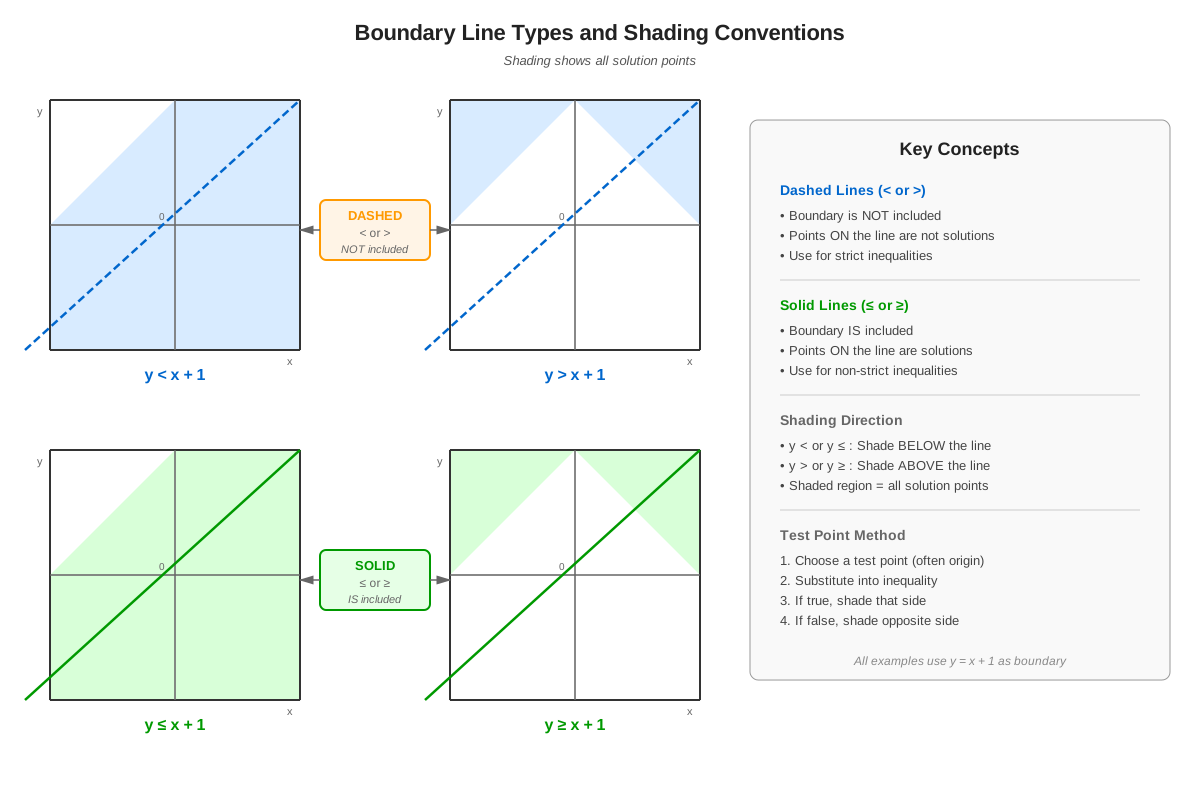
The foundation of graphing inequalities begins with understanding how inequality symbols translate to visual representations. The four primary inequality symbols each have specific graphical meanings:
- < (less than) and > (greater than): These strict inequalities use dashed or dotted boundary lines because points on the line itself are not included in the solution set
- ≤ (less than or equal to) and ≥ (greater than or equal to): These inclusive inequalities use solid boundary lines because points on the line are part of the solution set
The boundary line itself is graphed exactly as if the inequality were an equation. For example, y < 2x + 3 has the same boundary line as y = 2x + 3. This line divides the coordinate plane into two half-planes, only one of which contains the solution set.
Determining the Shaded Region
After drawing the boundary line, determining which side to shade requires understanding the inequality's meaning. For inequalities in the form y < mx + b or y > mx + b, the process follows clear rules:
- y > mx + b or y ≥ mx + b: Shade above the boundary line (the region where y-values are greater)
- y < mx + b or y ≤ mx + b: Shade below the boundary line (the region where y-values are smaller)
For inequalities not solved for y, such as x > 3 or x ≤ -2:
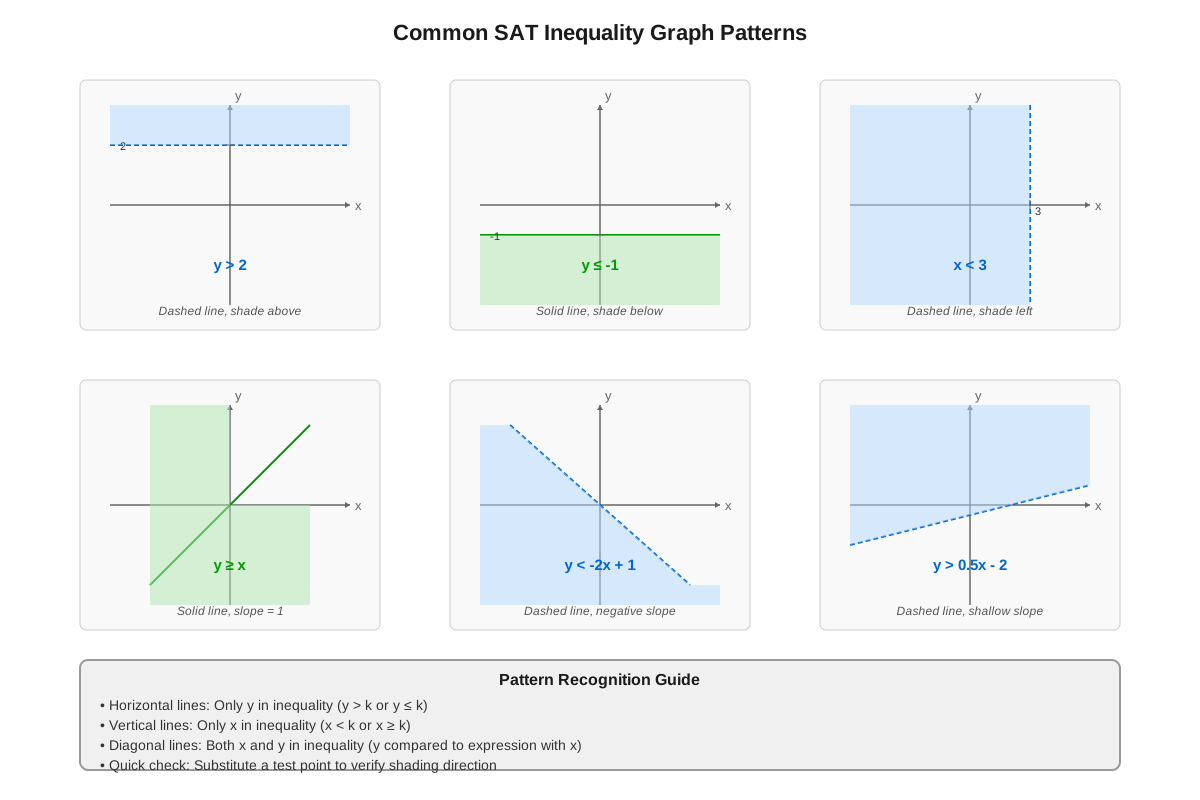
- x > a: Shade to the right of the vertical line x = a
- x < a: Shade to the left of the vertical line x = a
The Test Point Method
When the inequality form makes shading direction unclear, the test point method provides a reliable verification strategy:
- Choose a test point not on the boundary line (the origin (0,0) works well unless the line passes through it)
- Substitute the coordinates into the original inequality
- If the inequality is true, shade the region containing the test point
- If the inequality is false, shade the opposite region
For example, with 2x + 3y > 6, test (0,0): 2(0) + 3(0) > 6 becomes 0 > 6, which is false. Therefore, shade the region NOT containing the origin.
Standard Form vs. Slope-Intercept Form
Inequalities appear in multiple forms on the SAT, and recognizing each form aids quick graphing:
| Form | Example | Graphing Strategy |
|---|---|---|
| Slope-intercept | y < 2x - 3 | Plot y-intercept, use slope, shade based on symbol |
| Standard form | 2x + 3y ≤ 6 | Find intercepts, connect them, test point for shading |
| Vertical line | x > -2 | Draw vertical line, shade left or right |
| Horizontal line | y ≤ 4 | Draw horizontal line, shade above or below |
Systems of Inequalities
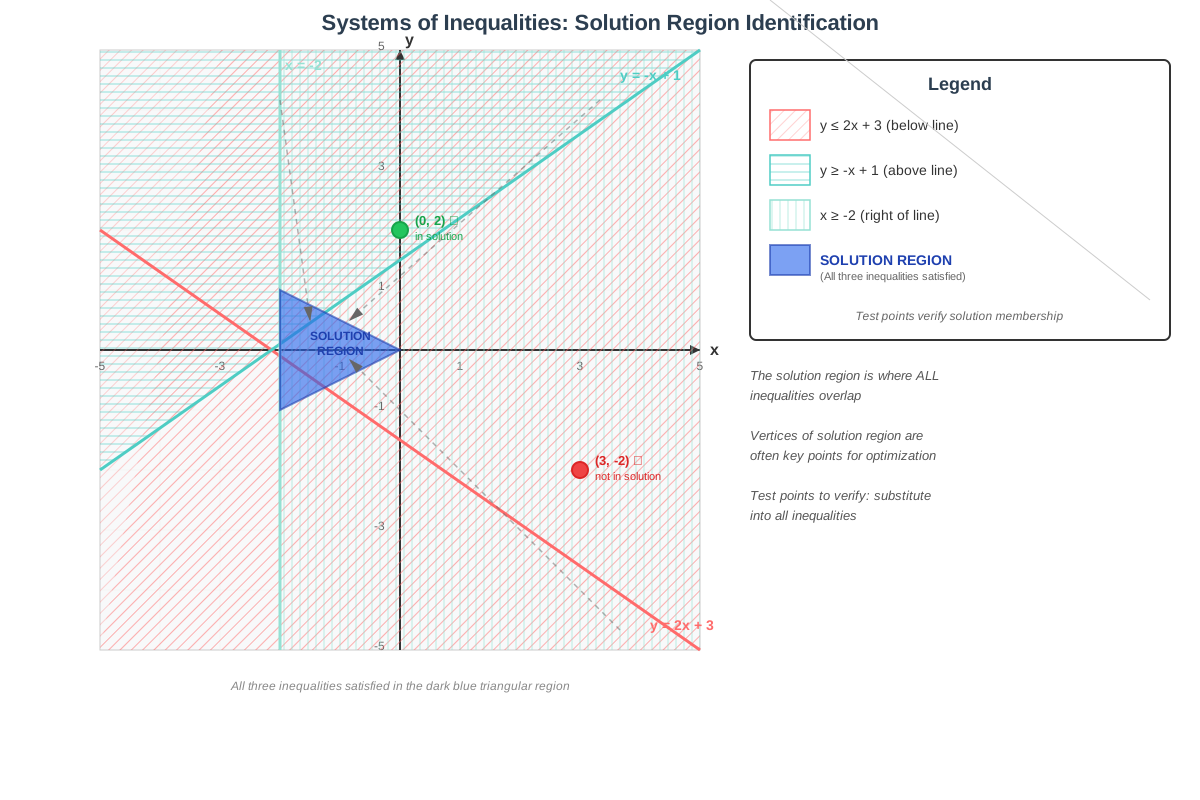
Systems of inequalities involve graphing multiple inequalities on the same coordinate plane. The solution set is the intersection (overlap) of all shaded regions—the area where all inequalities are simultaneously satisfied. To graph systems:
- Graph each inequality separately with its boundary line and shading
- Identify the region where all shadings overlap
- This overlapping region represents all points satisfying every inequality in the system
The boundary of the solution region may include portions of multiple boundary lines. Points on solid boundary lines within the solution region are included; points on dashed lines are not.
Writing Inequalities from Graphs
The SAT frequently presents a graph and asks students to identify the corresponding inequality. This reverse process requires:
- Identify the boundary line: Determine its equation using slope and y-intercept or two points
- Check the line type: Solid lines indicate ≤ or ≥; dashed lines indicate < or >
- Determine shading direction: Above the line suggests y > or y ≥; below suggests y < or y ≤
- Verify with a test point: Choose a point clearly in the shaded region and confirm it satisfies your inequality
Special Cases and Edge Scenarios
Certain inequality scenarios require special attention:
- Horizontal boundaries (y = k): These create inequalities like y > 3 or y ≤ -2, representing all points above or below a horizontal line
- Vertical boundaries (x = k): These create inequalities like x < 5 or x ≥ -1, representing all points left or right of a vertical line
- Inequalities with no solution: While rare on the SAT, contradictory systems (like y > 2 and y < 1) have no overlapping region
- Unbounded regions: Most inequality graphs extend infinitely in at least one direction
Concept Relationships
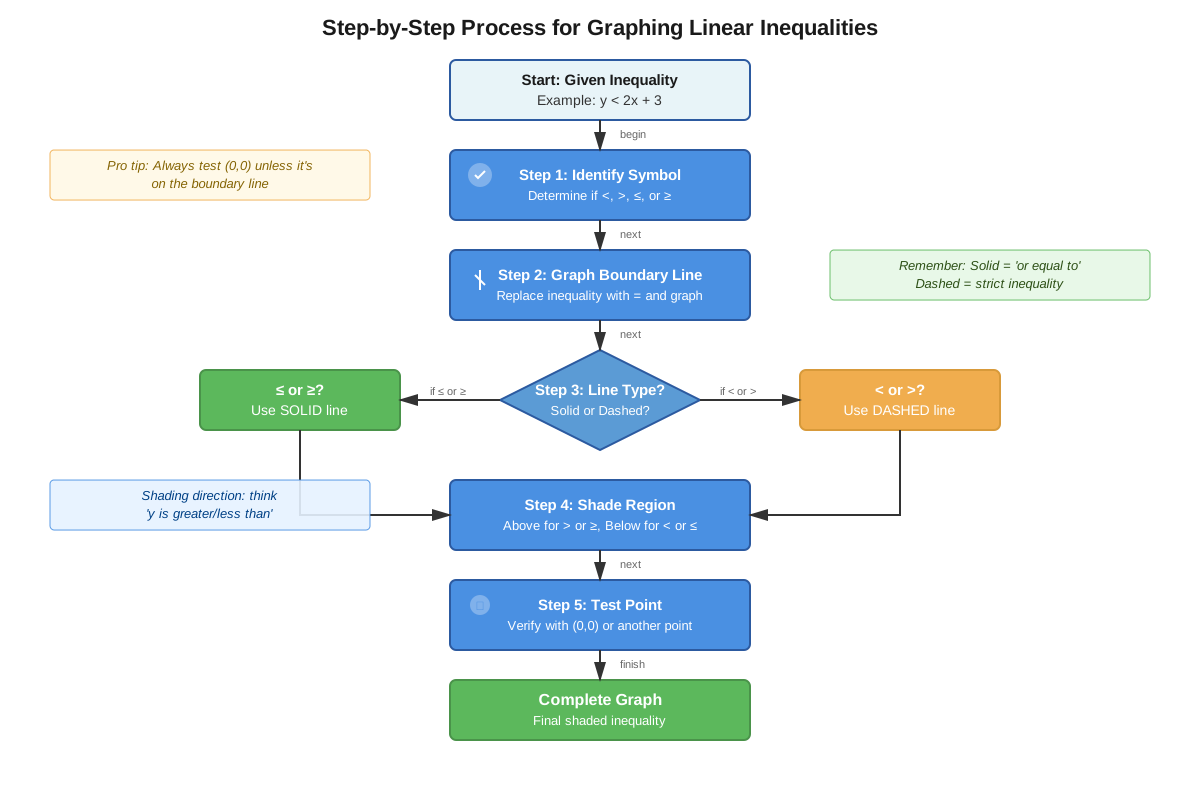
The concepts within graphing inequalities build upon each other in a logical progression. Understanding inequality symbols → determines boundary line type (solid vs. dashed) → which combines with boundary line graphing (using slope-intercept or standard form) → followed by shading direction determination (using inequality meaning or test point method) → culminating in complete inequality graphs. When multiple inequalities combine, this entire process repeats for each inequality, then systems of inequalities require identifying the intersection of solution regions.
Graphing inequalities connects directly to prerequisite knowledge of linear equations—the boundary line is simply the equation form of the inequality. The slope and y-intercept concepts transfer completely, making the primary new skill the determination of shading and line type. This topic also connects forward to optimization problems and linear programming, where systems of inequalities represent constraints and the solution region contains optimal points.
The relationship between algebraic and graphical representations is bidirectional: students must both graph given inequalities and write inequalities from given graphs. This dual fluency reinforces understanding of how mathematical notation translates to visual representation, a skill that appears throughout SAT Math in various contexts including functions, quadratics, and data interpretation.
Quick check — test yourself on Graphing inequalities so far.
Try Flashcards →High-Yield Facts
⭐ Solid boundary lines are used for ≤ and ≥ inequalities; dashed boundary lines are used for < and > inequalities
⭐ For inequalities in the form y > mx + b, shade above the line; for y < mx + b, shade below the line
⭐ The solution set of a system of inequalities is the overlapping region where all individual solution sets intersect
⭐ When testing points to verify shading, the origin (0,0) is the easiest choice unless the boundary line passes through it
⭐ Vertical line inequalities (x > a or x < a) shade right or left respectively, not above or below
- Multiplying or dividing an inequality by a negative number reverses the inequality symbol, but this doesn't affect graphing once the inequality is in standard form
- The boundary line of an inequality is graphed exactly as if it were an equation with an equals sign
- Points on a dashed boundary line are not solutions to the inequality, even if they're in the shaded region
- Every point in the shaded region, when substituted into the inequality, makes the inequality true
- Horizontal line inequalities (y > k or y < k) shade above or below respectively, not left or right
Common Misconceptions
Misconception: All boundary lines should be solid → Correction: Only inequalities with ≤ or ≥ use solid lines; strict inequalities (< or >) require dashed lines because points on the boundary are not included in the solution set
Misconception: Shading above the line always means "greater than" → Correction: Shading direction depends on which variable the inequality is solved for; y > mx + b shades above, but if rearranged to y - mx < b, the same region applies despite the < symbol
Misconception: The solution to a system of inequalities includes all shaded regions → Correction: Only the overlapping region where ALL inequalities are satisfied simultaneously represents the solution set; areas shaded by only some inequalities are not solutions
Misconception: When graphing x > 3, shade above the line x = 3 → Correction: Vertical line inequalities shade horizontally (left or right), not vertically; x > 3 shades to the right of the vertical line
Misconception: If a test point makes the inequality false, the inequality is wrong → Correction: A false test point simply indicates you should shade the opposite region; it's a tool for determining shading direction, not for verifying the inequality itself
Misconception: Boundary lines must always have positive slope → Correction: Boundary lines can have any slope (positive, negative, zero, or undefined) depending on the inequality's equation; the slope doesn't affect whether the inequality is valid
Worked Examples
Example 1: Graphing a Single Inequality
Problem: Graph the inequality 2x - 3y < 6
Solution:
Step 1: Convert to slope-intercept form to identify the boundary line
- Start with: 2x - 3y < 6
- Subtract 2x from both sides: -3y < -2x + 6
- Divide by -3 (remember to flip the inequality): y > (2/3)x - 2
Step 2: Identify the boundary line characteristics
- The boundary line is y = (2/3)x - 2
- Slope: 2/3 (rise 2, run 3)
- Y-intercept: -2
- Line type: dashed (because the inequality is >, not ≥)
Step 3: Graph the boundary line
- Plot the y-intercept at (0, -2)
- From there, rise 2 units and run 3 units right to plot (3, 0)
- Draw a dashed line through these points
Step 4: Determine shading direction
- Since the inequality is y > (2/3)x - 2, shade above the line
- Verification: Test point (0, 0): Is 0 > (2/3)(0) - 2? Is 0 > -2? Yes! ✓
- The origin is in the shaded region, confirming our shading is correct
Connection to Learning Objectives: This example demonstrates identifying key features (dashed line, shading above) and applying the graphing process to create an accurate visual representation.
Example 2: Writing an Inequality from a Graph
Problem: A graph shows a solid line passing through points (0, 4) and (2, 0), with shading below the line. Write the inequality represented by this graph.
Solution:
Step 1: Find the equation of the boundary line
- Calculate slope: m = (0 - 4)/(2 - 0) = -4/2 = -2
- Y-intercept: b = 4 (given point (0, 4))
- Boundary line equation: y = -2x + 4
Step 2: Determine the inequality symbol
- The line is solid, so the inequality includes "or equal to" (≤ or ≥)
- The shading is below the line, indicating y-values less than the boundary
- Therefore, use ≤
Step 3: Write the complete inequality
- The inequality is: y ≤ -2x + 4
Step 4: Verify with a test point
- Choose a point clearly in the shaded region, such as (0, 0)
- Test: Is 0 ≤ -2(0) + 4? Is 0 ≤ 4? Yes! ✓
- Choose a point clearly outside the shaded region, such as (0, 5)
- Test: Is 5 ≤ -2(0) + 4? Is 5 ≤ 4? No! ✓
- Both tests confirm our inequality is correct
Alternative form: The inequality could also be written in standard form as 2x + y ≤ 4
Connection to Learning Objectives: This example demonstrates the reverse process of identifying features from a graph and translating visual information into algebraic notation, a common SAT question type.
Exam Strategy
When approaching sat graphing inequalities questions, begin by identifying the question type: are you graphing a given inequality, writing an inequality from a graph, or working with a system? Each type has an optimal approach strategy.
For graphing questions, first determine if the inequality is already in slope-intercept form (y isolated). If not, quickly rearrange it, being careful to flip the inequality symbol if dividing by a negative. Before drawing anything, decide whether the line should be solid or dashed by checking for the "or equal to" component. Then use the y-intercept and slope to sketch the boundary line efficiently—you don't need perfect precision, just clear enough to distinguish answer choices. Finally, shade using the inequality direction or test the origin if uncertain.
For writing inequalities from graphs, work backwards systematically. First identify two clear points on the boundary line to calculate slope and y-intercept. Check whether the line is solid (≤ or ≥) or dashed (< or >). Observe the shading direction relative to the line, then construct your inequality. Always verify with a test point from the shaded region before selecting your answer.
Exam Tip: When answer choices show different inequalities, you can often eliminate options by checking just the line type (solid vs. dashed) or shading direction without fully graphing each option.
Trigger words and phrases to watch for include: "at least" (≥), "at most" (≤), "more than" (>), "less than" (<), "no more than" (≤), "no less than" (≥), "maximum" (≤), and "minimum" (≥). These verbal cues directly translate to inequality symbols and help you set up the correct inequality from word problems.
For time management, allocate approximately 60-90 seconds for straightforward single-inequality questions and up to 2 minutes for systems of inequalities or complex word problems. If you're stuck on determining shading direction, use the test point method with (0,0)—this takes only 5-10 seconds and provides certainty. On the digital SAT, use the annotation tools to mark your boundary line and shade lightly to visualize the solution region.
Process of elimination works exceptionally well for graphing inequality questions. Quickly check each answer choice's line type against the inequality symbol—this alone often eliminates 2-3 options. Then check shading direction to narrow further. For systems of inequalities, eliminate any answer showing regions that violate even one of the given inequalities.
Memory Techniques
Mnemonic for line types: "Solid means Same or Satisfied" - Solid lines include the boundary (≤ or ≥), meaning points on the line satisfy the inequality
Mnemonic for shading direction: "Greater goes Higher" - When y is greater (y > or y ≥), shade the higher region (above the line)
Visual memory technique: Picture inequality symbols as arrows pointing toward the shaded region:
- y > mx + b: The symbol opens upward like an arrow pointing up → shade above
- y < mx + b: The symbol opens downward like an arrow pointing down → shade below
Acronym for graphing steps: BLTS (like the sandwich)
- Boundary line (graph it)
- Line type (solid or dashed)
- Test point (if needed)
- Shade (the correct region)
Vertical vs. Horizontal memory aid: "X marks the spot horizontally on a treasure map" - x inequalities (x > a or x < a) shade horizontally (left or right), while y inequalities shade vertically (up or down)
System of inequalities visualization: Think of overlapping spotlights—only the area where ALL lights shine simultaneously is the solution. This mental image helps remember that systems require intersection, not union, of solution sets.
Summary
Graphing inequalities extends linear equation concepts to represent solution regions on the coordinate plane rather than single lines. The fundamental skills include translating inequality symbols to visual features (solid vs. dashed boundary lines), graphing boundary lines using slope-intercept or standard form, and determining shading direction through inequality interpretation or test point methods. On the SAT, these questions test both directions of translation: graphing given inequalities and writing inequalities from graphs. Systems of inequalities require identifying overlapping solution regions where all constraints are simultaneously satisfied. Success requires fluency with inequality symbols (< uses dashed lines, ≤ uses solid lines), understanding that y > mx + b shades above while y < mx + b shades below, and recognizing that vertical line inequalities (x > a) shade horizontally while horizontal line inequalities (y > k) shade vertically. The test point method provides reliable verification, with the origin serving as the most convenient test point when not on the boundary line. Mastering these concepts enables quick, accurate responses to high-frequency SAT questions worth significant points.
Key Takeaways
- Inequality symbols determine boundary line type: < and > use dashed lines; ≤ and ≥ use solid lines
- Shading direction for y-inequalities: y > shades above, y < shades below the boundary line
- The test point method using (0,0) reliably determines correct shading when inequality form is unclear
- Systems of inequalities solutions are the overlapping region where all individual solution sets intersect
- Vertical line inequalities (x > a or x < a) shade horizontally (right or left), not vertically
- Writing inequalities from graphs requires identifying the boundary line equation, line type, and shading direction
- SAT questions frequently use verbal cues like "at least" (≥), "at most" (≤), "more than" (>), and "less than" (<) that directly translate to inequality symbols
Related Topics
Systems of Linear Inequalities with Real-World Applications: Building on single inequality graphing, this topic explores optimization problems and constraint-based scenarios common in SAT word problems, where multiple inequalities represent budget limits, time constraints, or resource restrictions.
Absolute Value Inequalities: These combine inequality concepts with absolute value, creating compound inequalities that often require graphing two boundary lines and understanding union vs. intersection of solution sets.
Quadratic Inequalities: Extending inequality graphing to parabolas, this advanced topic uses similar shading principles but with curved boundaries, appearing occasionally on SAT questions testing multiple concept integration.
Linear Programming: This application-focused topic uses systems of inequalities to find optimal solutions within constrained regions, representing the practical culmination of inequality graphing skills.
Mastering graphing inequalities provides the foundation for all these advanced topics and strengthens overall algebraic reasoning essential for SAT Math success.
Practice CTA
Now that you've mastered the core concepts of graphing inequalities, it's time to solidify your understanding through practice! Attempt the practice questions to apply these strategies to SAT-style problems, and use the flashcards to reinforce key facts and procedures. Remember, graphing inequalities appears on virtually every SAT, making this practice time a high-yield investment in your score. The visual nature of these problems means that with focused practice, you can develop quick pattern recognition that saves valuable time on test day. Challenge yourself to graph each inequality accurately and efficiently—your future SAT score will thank you!
Sign up free to keep reading
Create a free AnvayaPrep account to finish this SAT guide on Graphing inequalities — plus flashcards and practice questions.