Overview
Inequalities with negatives represent a critical skill area within SAT Math that tests students' understanding of how negative numbers interact with inequality symbols. This topic appears frequently on the SAT because it combines algebraic manipulation with conceptual understanding of number properties—two areas the College Board consistently emphasizes. The fundamental challenge lies in recognizing when and why the inequality sign must be reversed during problem-solving, particularly when multiplying or dividing both sides by a negative value.
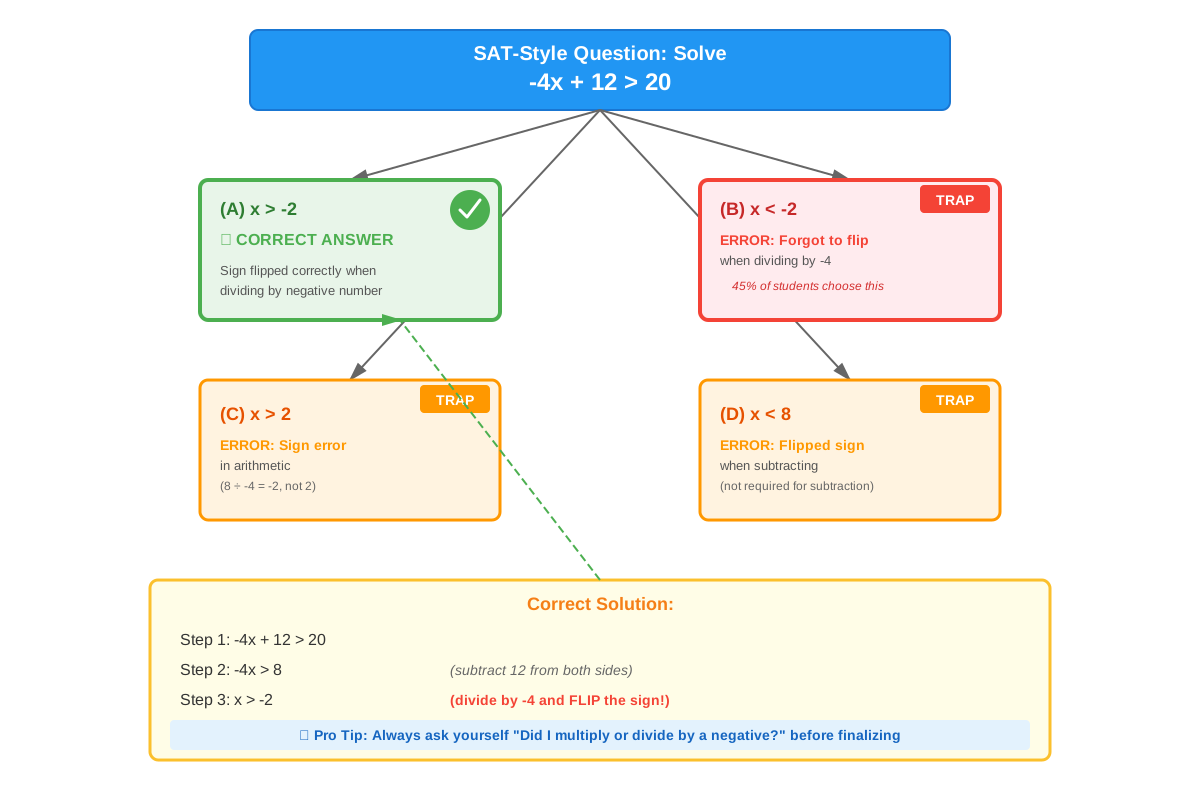
Mastering inequalities with negatives is essential for SAT success because these problems appear in multiple contexts: solving single-variable inequalities, analyzing compound inequalities, interpreting word problems, and working with absolute value expressions. Students who fail to properly handle negative coefficients or negative multipliers often select trap answers specifically designed to catch this error. The SAT deliberately constructs questions where the most common mistake—forgetting to flip the inequality sign—leads directly to one of the incorrect answer choices.
This topic connects directly to foundational algebra concepts including equation-solving, number line representations, and interval notation. It also serves as a gateway to more advanced topics such as systems of inequalities, quadratic inequalities, and optimization problems. Understanding how negatives affect inequalities strengthens overall algebraic reasoning and builds the careful, step-by-step problem-solving approach that characterizes high-scoring SAT test-takers.
Learning Objectives
- [ ] Identify key features of inequalities with negatives, including when the inequality sign reverses
- [ ] Explain how inequalities with negatives appears on the SAT in various question formats
- [ ] Apply inequalities with negatives to answer SAT-style questions accurately and efficiently
- [ ] Determine the correct direction of an inequality symbol after performing operations with negative numbers
- [ ] Translate word problems involving constraints and limits into inequalities with negative coefficients
- [ ] Verify solutions to inequalities with negatives using test values and number line analysis
Prerequisites
- Basic inequality symbols and notation (>, <, ≥, ≤): Understanding these symbols is fundamental to interpreting and solving any inequality problem
- Properties of negative numbers: Knowing how negatives behave in arithmetic operations provides the foundation for understanding sign reversal rules
- One-step and two-step equation solving: The mechanical skills of isolating variables transfer directly to inequality solving
- Number line representation: Visualizing solutions on a number line helps verify answers and understand solution sets
- Order of operations: Correctly sequencing mathematical operations ensures proper application of the sign-reversal rule
Why This Topic Matters
In real-world applications, inequalities with negatives model countless practical scenarios: temperature ranges below zero, debt and financial constraints, elevation below sea level, and any situation involving limits or thresholds with negative values. Engineers use these concepts when designing systems with tolerance ranges, economists apply them when analyzing profit margins and losses, and scientists employ them when establishing experimental parameters.
On the SAT, inequalities with negatives appear in approximately 3-5 questions per test, representing roughly 5-9% of the math section. These questions typically appear as:
- Direct algebraic inequality-solving problems (most common)
- Word problems requiring inequality setup and solution
- Questions involving absolute value inequalities
- Compound inequalities with negative coefficients
- Graph interpretation problems showing solution sets
The College Board frequently embeds this concept within multi-step problems, making it a high-yield topic that can impact performance across multiple question types. Students who master sat inequalities with negatives gain confidence in tackling complex algebraic reasoning questions and avoid common trap answers that exploit sign-reversal errors.
Core Concepts
The Fundamental Rule: When to Reverse the Inequality Sign
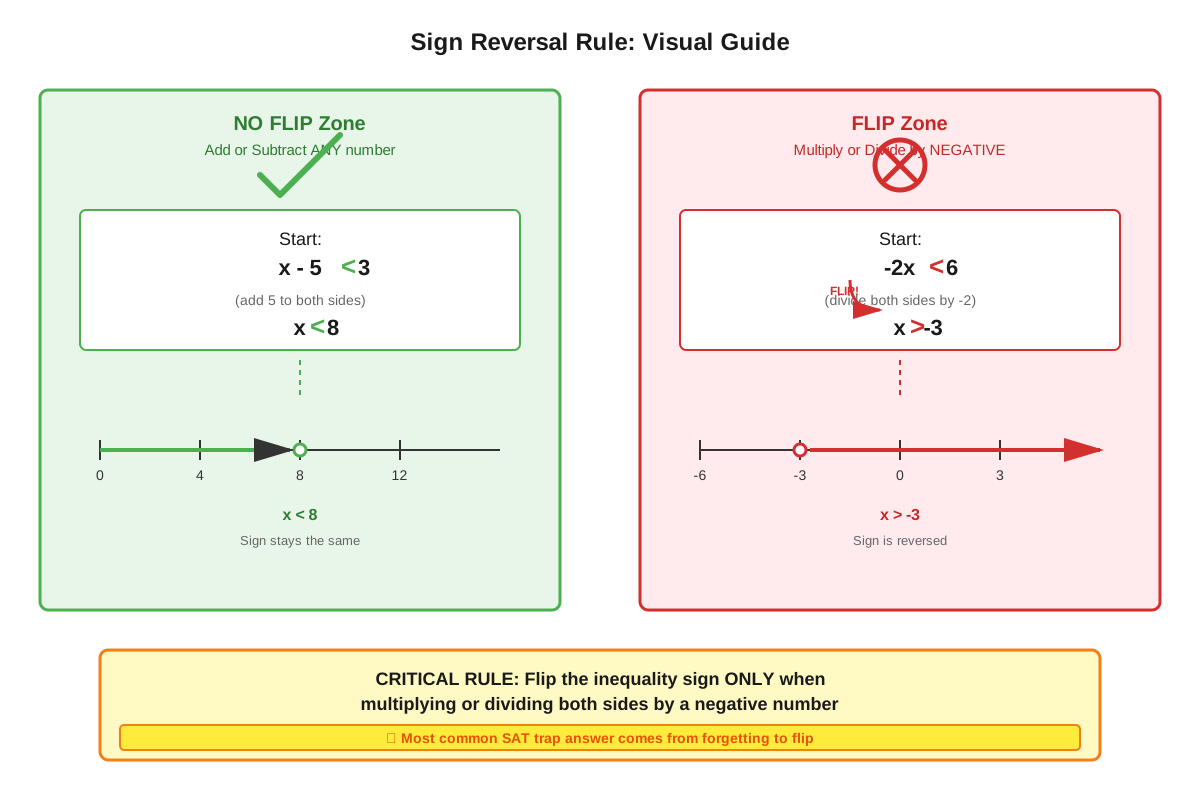
The cornerstone principle of inequalities with negatives states: when multiplying or dividing both sides of an inequality by a negative number, the inequality sign must be reversed. This rule stems from the properties of the real number line and how negative multiplication reflects values across zero.
Consider the true statement: 5 > 3. If we multiply both sides by -1, we get -5 and -3. On the number line, -5 lies to the left of -3, making -5 < -3. The inequality direction reversed because negative multiplication flips the relative positions of numbers around zero.
Critical distinction: The sign reversal rule applies ONLY when multiplying or dividing by a negative number. Adding or subtracting negative numbers does NOT require reversing the inequality sign.
Operations That Require Sign Reversal
If a > b and c < 0, then:
ac < bc (multiplying by negative)
a/c < b/c (dividing by negative)
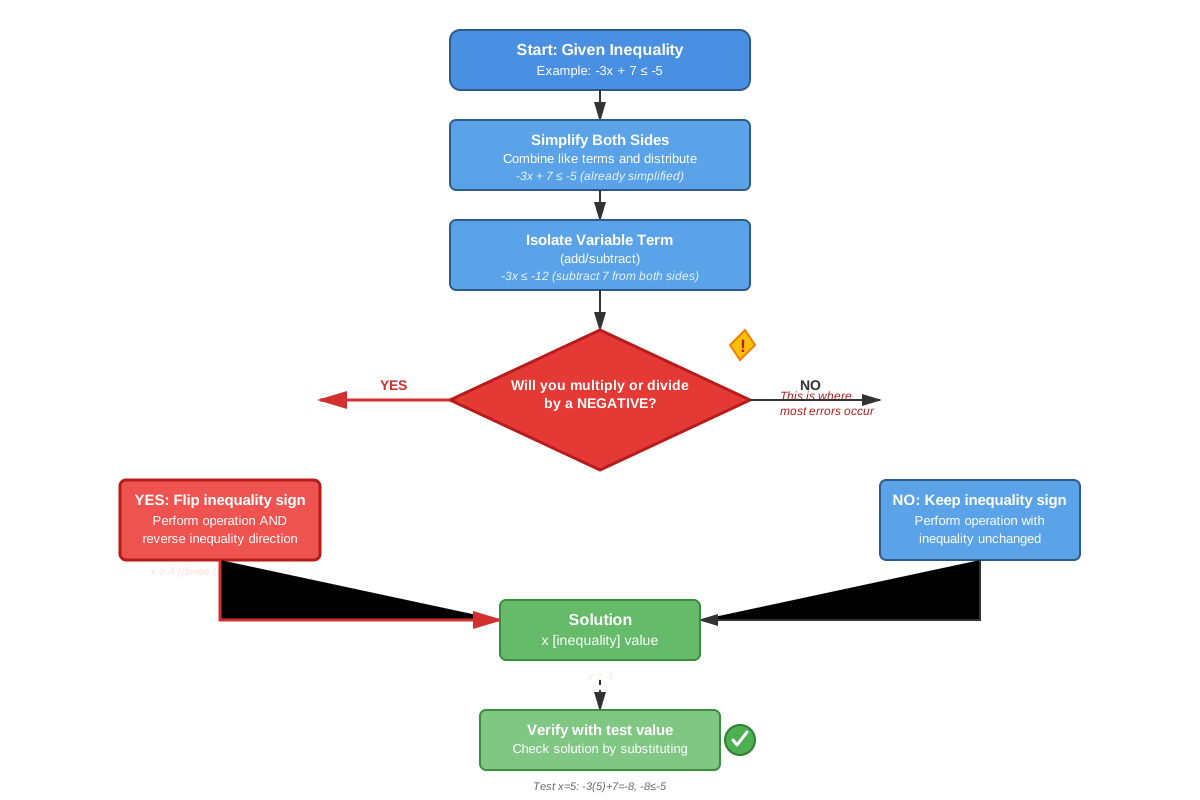
Step-by-step process for solving inequalities with negative coefficients:
- Identify all terms and coefficients in the inequality
- Use addition/subtraction to isolate the variable term (no sign reversal needed)
- Identify whether the coefficient of the variable is negative
- If dividing/multiplying by a negative to isolate the variable, reverse the inequality sign
- Verify the solution using a test value
Operations That Do NOT Require Sign Reversal
Adding or subtracting any number (positive or negative) to both sides preserves the inequality direction:
If a > b, then:
a + c > b + c (for any value of c)
a - c > b - c (for any value of c)
This distinction is crucial for SAT success because test-makers design trap answers based on students incorrectly reversing signs when adding/subtracting negatives.
Solving Multi-Step Inequalities with Negatives
Consider the inequality: -3x + 7 ≤ -5
Solution process:
- Subtract 7 from both sides: -3x ≤ -12 (no sign reversal)
- Divide both sides by -3: x ≥ 4 (sign reversal required)
The final solution is x ≥ 4, meaning all values greater than or equal to 4 satisfy the original inequality.
Compound Inequalities with Negative Coefficients
Compound inequalities present two constraints simultaneously. When solving compound inequalities with negative coefficients, apply the reversal rule to the entire compound statement:
-12 < -2x ≤ 8Dividing all three parts by -2 (and reversing both inequality signs):
6 > x ≥ -4Rewritten in standard form: -4 ≤ x < 6
Comparison Table: Operations and Sign Reversal
| Operation | Example | Sign Reversal Required? | Result |
|---|---|---|---|
| Add positive | x - 3 > 5 → x > 8 | No | Same direction |
| Add negative | x + 4 < 2 → x < -2 | No | Same direction |
| Subtract positive | x + 6 ≥ 1 → x ≥ -5 | No | Same direction |
| Subtract negative | x - (-3) ≤ 7 → x ≤ 4 | No | Same direction |
| Multiply by positive | x/2 > 3 → x > 6 | No | Same direction |
| Multiply by negative | -x < 4 → x > -4 | Yes | Reversed |
| Divide by positive | 3x ≤ 12 → x ≤ 4 | No | Same direction |
| Divide by negative | -5x ≥ 15 → x ≤ -3 | Yes | Reversed |
Absolute Value Inequalities with Negatives
Absolute value inequalities often involve negative numbers in their solutions. The inequality |x| < a (where a > 0) translates to -a < x < a, introducing negative bounds naturally.
When solving |2x + 3| ≤ 5, the compound inequality becomes:
-5 ≤ 2x + 3 ≤ 5
Solving yields: -4 ≤ x ≤ 1, demonstrating how negative values emerge in solution sets.
Graphing Solutions with Negative Boundaries
Number line representations of inequalities with negative solutions require careful attention to:
- Open circles (○) for strict inequalities (< or >)
- Closed circles (●) for inclusive inequalities (≤ or ≥)
- Shading direction indicating the solution set
For x ≤ -2, place a closed circle at -2 and shade leftward (toward more negative values).
Concept Relationships
The core concepts within inequalities with negatives form a hierarchical structure. The fundamental sign-reversal rule serves as the foundation, supporting all other concepts. Understanding when operations require reversal (multiplication/division by negatives) versus when they don't (addition/subtraction) creates the decision-making framework for solving any inequality problem.
Conceptual flow:
Basic inequality properties → Sign-reversal rule → Single-variable inequalities with negatives → Multi-step inequalities → Compound inequalities → Absolute value inequalities → Word problem applications
This topic connects backward to prerequisite knowledge of equation-solving (the mechanical steps are nearly identical) and number properties (understanding how negatives behave). It connects forward to systems of inequalities, where multiple constraints with negative coefficients must be satisfied simultaneously, and to quadratic inequalities, where factoring and sign analysis become more complex.
The relationship between algebraic manipulation and graphical representation reinforces conceptual understanding: every algebraic step corresponds to a transformation of the solution set on the number line. This dual representation helps students verify their work and catch sign-reversal errors.
High-Yield Facts
⭐ When multiplying or dividing both sides of an inequality by a negative number, the inequality sign MUST be reversed
⭐ Adding or subtracting any number (positive or negative) to both sides does NOT require reversing the inequality sign
⭐ The inequality -x > 5 solves to x < -5 (divide by -1, reverse the sign)
⭐ For compound inequalities with negative coefficients, reverse BOTH inequality signs when dividing/multiplying by a negative
⭐ Test values are the most reliable way to verify solutions to inequalities with negatives
- Multiplying both sides of an inequality by -1 reverses the inequality direction
- The solution to -ax > b (where a > 0) is x < -b/a
- Absolute value inequalities |x| < a produce compound inequalities with negative bounds: -a < x < a
- When isolating a variable with a negative coefficient, the final step always requires sign reversal
- Graphing solutions helps visualize whether the solution set makes logical sense
- The inequality x/-3 ≥ 2 is equivalent to x ≤ -6 (multiply by -3, reverse sign)
- Negative coefficients in word problems often indicate decreasing quantities or constraints below a reference point
- Double negatives in inequalities (like -(-x) > 5) simplify to positive expressions (x > 5)
- The solution set to an inequality with negatives can be verified by testing any value within the proposed solution range
- SAT questions often place the correct answer after sign reversal in position D or E to catch students who forget the rule
Quick check — test yourself on Inequalities with negatives so far.
Try Flashcards →Common Misconceptions
Misconception: When adding a negative number to both sides of an inequality, the sign must be reversed.
Correction: Adding or subtracting any value (positive or negative) never requires reversing the inequality sign. Only multiplication or division by a negative requires reversal. For example, x + 3 > 7 becomes x > 4 by subtracting 3 (adding -3), with no sign change.
Misconception: The inequality -x < 5 means x is less than -5.
Correction: To solve -x < 5, divide both sides by -1 (or multiply by -1), which requires reversing the sign, yielding x > -5. The negative coefficient must be eliminated through an operation that triggers the reversal rule.
Misconception: In compound inequalities, only one inequality sign needs to be reversed when dividing by a negative.
Correction: When dividing all parts of a compound inequality by a negative number, ALL inequality signs must be reversed. For -6 < -2x < 10, dividing by -2 gives 3 > x > -5, which should be rewritten as -5 < x < 3.
Misconception: Multiplying an inequality by a negative variable doesn't require sign reversal because the variable's value is unknown.
Correction: If multiplying by a variable that could be negative, the inequality relationship becomes conditional on the variable's sign. However, when multiplying by a known negative constant (like -2 or -5), the sign MUST be reversed regardless of other variables present.
Misconception: The solution to -3x ≥ -12 is x ≥ 4.
Correction: Dividing both sides by -3 requires reversing the inequality sign, so the correct solution is x ≤ 4. This is one of the most common errors on the SAT, and trap answers exploit this mistake.
Misconception: Negative numbers in an inequality always mean the solution will be negative.
Correction: The presence of negative coefficients or constants doesn't determine whether solutions are positive or negative. For example, -2x < -10 solves to x > 5, a positive solution despite the negative numbers in the original inequality.
Worked Examples
Example 1: Multi-Step Inequality with Negative Coefficient
Problem: Solve for x: -4x + 9 ≤ -7
Solution:
Step 1: Subtract 9 from both sides (no sign reversal for addition/subtraction)
-4x + 9 - 9 ≤ -7 - 9
-4x ≤ -16
Step 2: Divide both sides by -4 (MUST reverse the inequality sign)
x ≥ 4Step 3: Verify with a test value. Choose x = 5 (which should satisfy x ≥ 4):
-4(5) + 9 = -20 + 9 = -11
-11 ≤ -7 ✓ (True)
Choose x = 3 (which should NOT satisfy x ≥ 4):
-4(3) + 9 = -12 + 9 = -3
-3 ≤ -7 ✗ (False)Answer: x ≥ 4
Connection to learning objectives: This example demonstrates identifying when sign reversal is required (division by -4) and applying the rule to solve an SAT-style inequality problem.
Example 2: Compound Inequality with Negative Coefficient
Problem: Solve for x: -15 ≤ -3x + 6 < 9
Solution:
Step 1: Subtract 6 from all three parts (no sign reversal)
-15 - 6 ≤ -3x + 6 - 6 < 9 - 6
-21 ≤ -3x < 3
Step 2: Divide all three parts by -3 (MUST reverse BOTH inequality signs)
7 ≥ x > -1Step 3: Rewrite in standard form (smallest to largest)
-1 < x ≤ 7Step 4: Verify with test values. Choose x = 0 (within the solution range):
-3(0) + 6 = 6
-15 ≤ 6 < 9 ✓ (True)
Choose x = 8 (outside the solution range):
-3(8) + 6 = -24 + 6 = -18
-15 ≤ -18 < 9 ✗ (False, because -18 is not greater than or equal to -15)Answer: -1 < x ≤ 7
Connection to learning objectives: This example shows how to handle compound inequalities with negative coefficients, requiring reversal of both inequality signs, and demonstrates verification techniques essential for SAT accuracy.
Example 3: Word Problem Application
Problem: A submarine is descending at a constant rate. Its depth d (in meters below sea level, represented as negative numbers) must satisfy the inequality -2t - 50 ≥ -200, where t is time in minutes. For how many minutes can the submarine continue descending before reaching the depth limit?
Solution:
Step 1: Recognize that depth below sea level is negative, and we're solving for time t
-2t - 50 ≥ -200Step 2: Add 50 to both sides
-2t ≥ -150Step 3: Divide by -2 (reverse the inequality sign)
t ≤ 75Answer: The submarine can descend for up to 75 minutes before reaching the depth limit.
Connection to learning objectives: This demonstrates translating real-world constraints into inequalities with negatives and applying solution techniques to practical SAT word problems.
Exam Strategy
When approaching sat inequalities with negatives questions, follow this systematic process:
Step 1: Identify the operation required to isolate the variable
Before performing any operation, determine whether you'll need to multiply or divide by a negative number. If yes, mentally prepare to reverse the sign.
Step 2: Watch for trigger phrases in word problems
- "At most" → ≤
- "At least" → ≥
- "Less than" → <
- "Greater than" → >
- "Below zero," "debt," "loss" → negative values
- "Decrease," "descending," "cooling" → negative rates of change
Step 3: Use the answer choices strategically
If you're unsure whether to reverse the sign, test a simple value in both your answer and the answer with the reversed sign. The SAT always includes the "forgot to reverse" answer as a trap choice.
Step 4: Verify with boundary values
After solving, test the boundary value and one value on each side. For x ≥ 4, test x = 4 (should work), x = 5 (should work), and x = 3 (should not work).
Exam Tip: If you see a negative coefficient on the variable and the answer choices differ only in inequality direction, the question is specifically testing sign reversal. Double-check your work.
Time allocation: Spend 45-60 seconds on straightforward inequality problems, up to 90 seconds on compound inequalities or word problems. If you're uncertain about sign reversal, the 10-15 seconds spent verifying with a test value is time well invested.
Process of elimination: Eliminate answers that would result from common errors:
- The answer with the wrong inequality direction (forgot to reverse)
- The answer with the wrong sign on the constant (arithmetic error)
- Answers that don't make logical sense in word problem contexts
Memory Techniques
Mnemonic for sign reversal: "Negative Multiplication/Division = Flip"
When you multiply or divide by a negative, think "NMD-Flip" to remember the sign reverses.
Visual memory technique: The Number Line Flip
Imagine the number line physically flipping around zero when you multiply by a negative. Numbers that were on the right (greater) move to the left (lesser), and vice versa. Visualize 3 and 5 flipping to -3 and -5, with their order reversed.
Acronym: SAND (Sign reversal for Addition? NO, Division? YES)
- Sign reversal?
- Addition/subtraction: No
- Division/multiplication by negative: Yes
The "Opposite Day" Rule
When dividing or multiplying by a negative, it's "opposite day" for the inequality sign: greater becomes less, less becomes greater, ≥ becomes ≤, and ≤ becomes ≥.
Finger technique for compound inequalities
When solving compound inequalities, use your fingers to track both inequality signs. When you divide by a negative, physically flip both hands to remind yourself to reverse both signs.
Summary
Inequalities with negatives represent a high-yield SAT Math topic that tests both mechanical skill and conceptual understanding. The fundamental principle—reversing the inequality sign when multiplying or dividing by a negative number—stems from how negative multiplication reflects values across zero on the number line. This reversal rule applies exclusively to multiplication and division; adding or subtracting negative numbers never requires changing the inequality direction. Students must systematically identify when operations involve negative multipliers or divisors, execute the reversal correctly, and verify solutions using test values. Compound inequalities require reversing all inequality signs when dividing by negatives, and word problems often embed negative coefficients within real-world contexts like debt, temperature below zero, or descending motion. Mastery requires recognizing the specific operation triggering reversal, avoiding the common trap of reversing signs during addition/subtraction, and developing verification habits that catch errors before selecting an answer. The SAT deliberately constructs trap answers based on sign-reversal mistakes, making this topic essential for achieving top scores.
Key Takeaways
- The inequality sign reverses ONLY when multiplying or dividing both sides by a negative number—never when adding or subtracting
- To solve -ax > b (where a is positive), divide by -a and reverse the sign: x < -b/a
- Compound inequalities require reversing ALL inequality signs when dividing/multiplying by a negative
- Always verify solutions by testing boundary values and values on both sides of the boundary
- SAT trap answers consistently include the result of forgetting to reverse the sign—double-check operations with negatives
- Word problems involving decrease, debt, below zero, or loss often require inequalities with negative coefficients
- The mechanical steps for solving inequalities mirror equation-solving, with the critical addition of the sign-reversal rule
Related Topics
Systems of Linear Inequalities: Building on single inequalities with negatives, systems require solving multiple inequalities simultaneously and graphing solution regions. Mastering inequalities with negatives provides the foundation for handling negative coefficients in systems.
Absolute Value Inequalities: These problems naturally produce compound inequalities with negative bounds, directly applying the sign-reversal concepts when solving expressions like |x + 3| < 5.
Quadratic Inequalities: More advanced inequality problems involving parabolas require understanding sign changes across multiple intervals, extending the number line analysis developed in linear inequalities.
Linear Programming: Optimization problems use systems of inequalities (often with negative coefficients) to model constraints, representing a practical application of these foundational skills.
Rational Inequalities: Solving inequalities with variables in denominators requires careful sign analysis, building on the conceptual understanding of how negatives affect inequality relationships.
Practice CTA
Now that you've mastered the core concepts of inequalities with negatives, it's time to cement your understanding through active practice. The practice questions and flashcards are specifically designed to target the most common SAT question types and trap answers. Each practice problem reinforces the sign-reversal rule and builds the automatic recognition skills you need for test day. Remember: understanding the concept is the first step, but fluency comes from repeated application. Challenge yourself with the practice materials, and you'll develop the confidence and accuracy that lead to top SAT Math scores. You've got this!
Sign up free to keep reading
Create a free AnvayaPrep account to finish this SAT guide on Inequalities with negatives — plus flashcards and practice questions.