Overview
Inequality interpretation is a critical skill on the SAT Math section that requires students to translate mathematical inequalities into real-world contexts and vice versa. Unlike straightforward equation-solving, inequality interpretation demands that students understand what inequality symbols represent in practical scenarios, recognize constraints and boundaries, and determine which values satisfy given conditions. This topic bridges abstract mathematical notation with concrete situations involving budgets, measurements, capacities, and other quantitative relationships that appear throughout the exam.
Mastering sat inequality interpretation is essential because these questions appear consistently across both the calculator and no-calculator portions of the SAT Math section. Students encounter inequality interpretation in word problems, data analysis contexts, and modeling scenarios where they must identify which inequality correctly represents a described situation or determine what a given inequality means in context. The College Board frequently tests whether students can move fluidly between symbolic mathematical language and verbal descriptions, making this a high-yield area for score improvement.
This topic connects deeply to other fundamental math concepts including linear equations, coordinate geometry, and algebraic modeling. Understanding inequality interpretation provides the foundation for more advanced topics like systems of inequalities, optimization problems, and function analysis. Students who excel at inequality interpretation demonstrate mathematical reasoning skills that extend beyond computation—they show they can analyze relationships, evaluate constraints, and make logical conclusions based on mathematical models.
Learning Objectives
- [ ] Identify key features of inequality interpretation including inequality symbols, boundary conditions, and solution sets
- [ ] Explain how inequality interpretation appears on the SAT in word problems, graphs, and modeling contexts
- [ ] Apply inequality interpretation to answer SAT-style questions involving real-world scenarios
- [ ] Translate verbal descriptions of constraints into correct mathematical inequalities
- [ ] Determine whether specific values satisfy given inequalities in context
- [ ] Distinguish between strict inequalities (< and >) and inclusive inequalities (≤ and ≥) in practical situations
Prerequisites
- Basic inequality symbols and notation: Understanding what <, >, ≤, and ≥ mean is fundamental to interpreting inequalities in any context
- Linear equations and expressions: Inequalities build directly on equation concepts, with the added dimension of ranges rather than single solutions
- Variable representation: The ability to assign variables to unknown quantities is necessary for translating word problems into mathematical statements
- Number line concepts: Visualizing inequalities on a number line helps students understand solution sets and boundary points
Why This Topic Matters
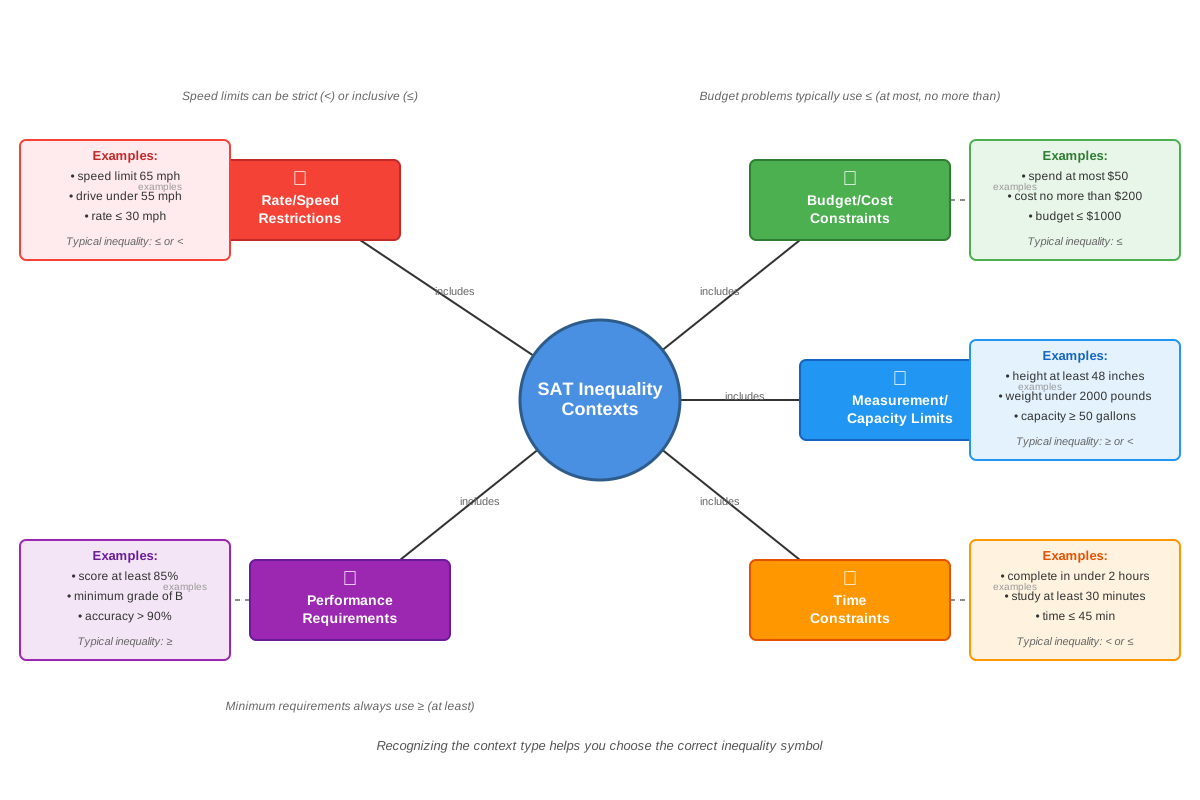
Inequality interpretation appears in everyday decision-making far more frequently than most mathematical concepts. Budget constraints ("spend no more than $50"), capacity limits ("the elevator holds at most 2000 pounds"), minimum requirements ("you must be at least 48 inches tall to ride"), and speed restrictions ("drive under 65 mph") all involve inequality relationships. Understanding how to model and interpret these constraints mathematically empowers students to analyze real-world situations quantitatively and make informed decisions based on multiple competing factors.
On the SAT, inequality interpretation questions appear in approximately 10-15% of Math section problems, making this a high-frequency topic that directly impacts scores. These questions typically appear as word problems requiring students to select the correct inequality from multiple choices, determine what values satisfy a given constraint, or identify what an inequality means in a specific context. The College Board particularly favors questions that combine inequality interpretation with other skills like unit conversion, rate problems, or algebraic manipulation.
Common SAT question formats include: selecting which inequality models a described scenario; determining the maximum or minimum value that satisfies multiple constraints; interpreting what a variable represents in a given inequality; identifying whether boundary values are included in solution sets; and analyzing graphs of inequalities to answer contextual questions. Questions often involve practical contexts like pricing, measurements, time constraints, or resource allocation to test whether students can apply mathematical reasoning to realistic situations.
Core Concepts
Understanding Inequality Symbols
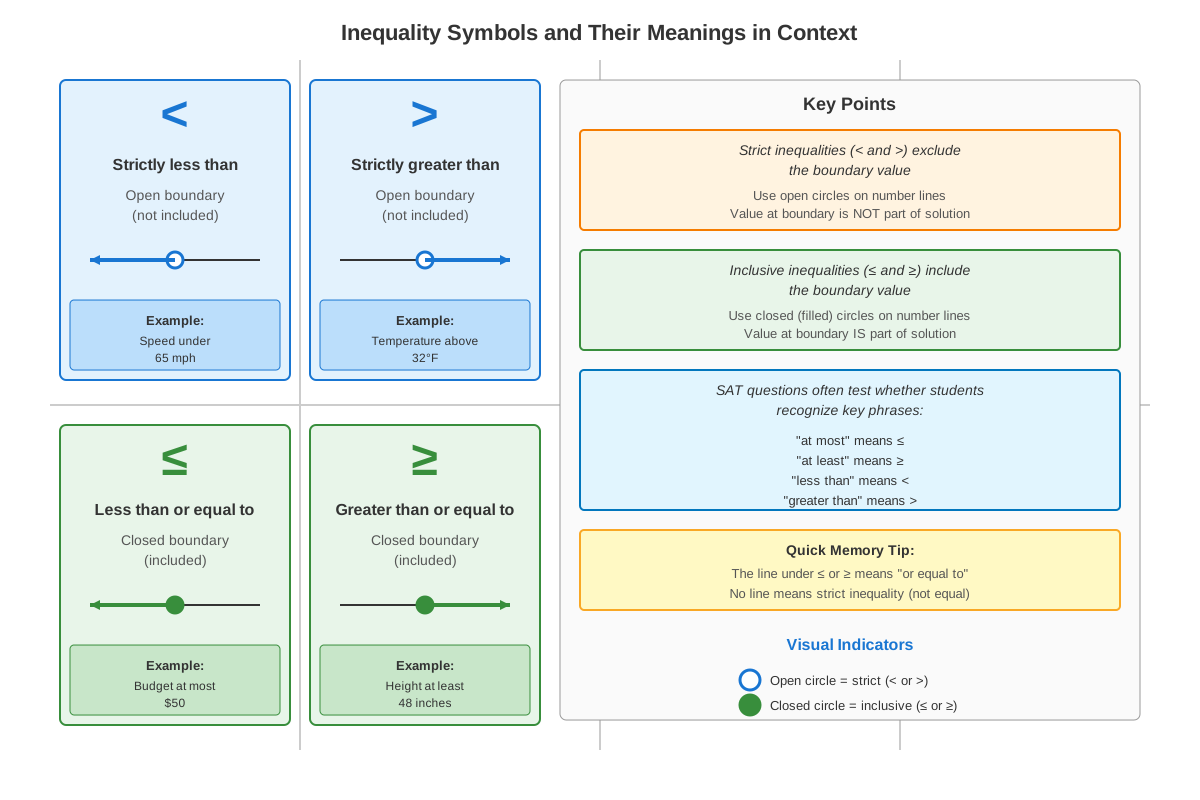
The four primary inequality symbols each convey specific mathematical relationships. The symbol < means "less than" and indicates that the value on the left is strictly smaller than the value on the right, excluding the boundary value itself. The symbol > means "greater than" and indicates the left value strictly exceeds the right value. The symbol ≤ means "less than or equal to" and includes the boundary value in the solution set. The symbol ≥ means "greater than or equal to" and also includes the boundary value.
The distinction between strict inequalities (< and >) and inclusive inequalities (≤ and ≥) is crucial for SAT questions. Strict inequalities exclude the boundary point—if x < 5, then x cannot equal 5. Inclusive inequalities include the boundary point—if x ≤ 5, then x can equal 5. Context clues in word problems indicate which type applies: phrases like "at most," "no more than," "at least," and "no less than" signal inclusive inequalities, while "less than," "greater than," "under," and "over" typically indicate strict inequalities.
Translating Words to Symbols
Inequality interpretation requires recognizing verbal cues that indicate specific mathematical relationships. The following table shows common phrases and their corresponding inequality symbols:
| Verbal Phrase | Inequality Symbol | Example |
|---|---|---|
| At most, no more than, maximum | ≤ | "At most 50 people" → x ≤ 50 |
| At least, no less than, minimum | ≥ | "At least 18 years old" → x ≥ 18 |
| Less than, fewer than, under | < | "Under 100 calories" → x < 100 |
| Greater than, more than, over | > | "More than 5 hours" → x > 5 |
| Between (exclusive) | Combined | "Between 10 and 20" → 10 < x < 20 |
| Between (inclusive) | Combined | "From 10 to 20" → 10 ≤ x ≤ 20 |
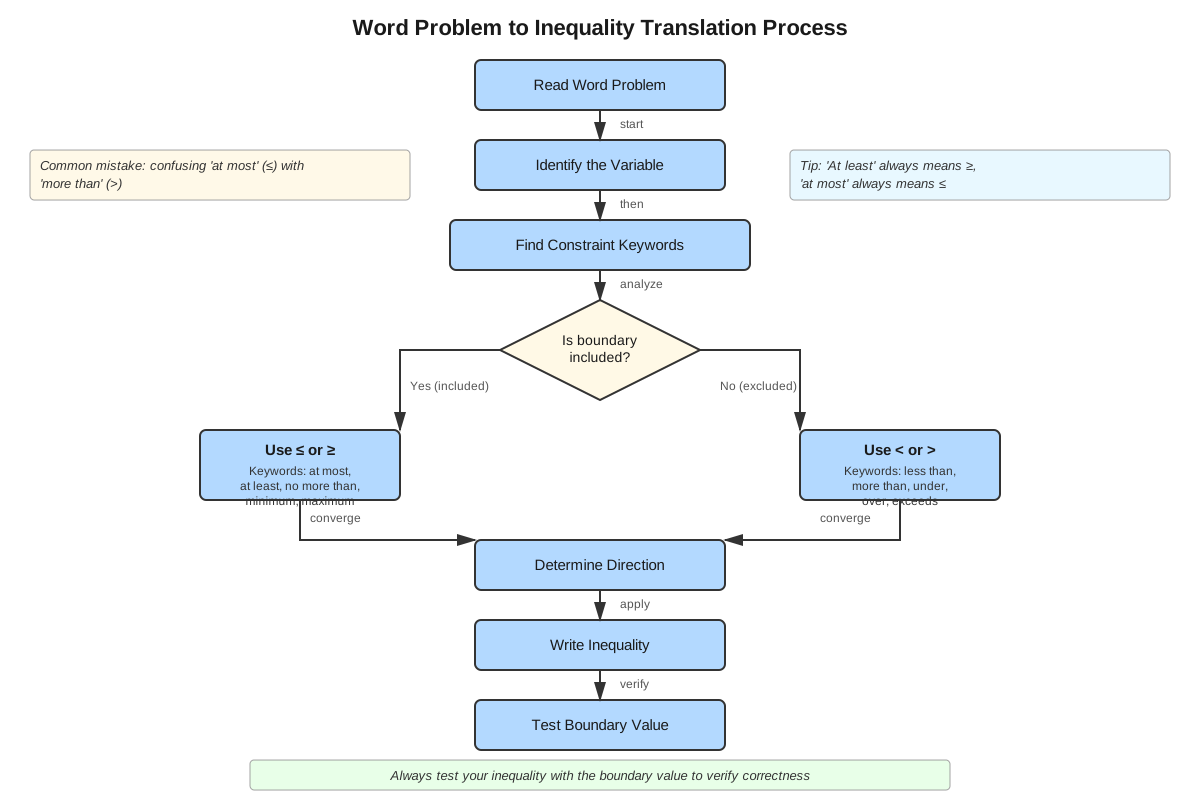
When translating word problems, students must identify the variable being constrained, determine the boundary value, and select the appropriate inequality symbol based on whether the boundary is included. For example, "A taxi charges $3 plus $0.50 per mile, and Sarah has at most $20 to spend" translates to 3 + 0.5m ≤ 20, where m represents miles traveled.
Boundary Values and Solution Sets
The boundary value in an inequality is the number that separates values that satisfy the inequality from those that don't. In x ≥ 7, the boundary value is 7. Understanding whether this boundary is included in the solution set (all values that make the inequality true) is essential for correct interpretation.
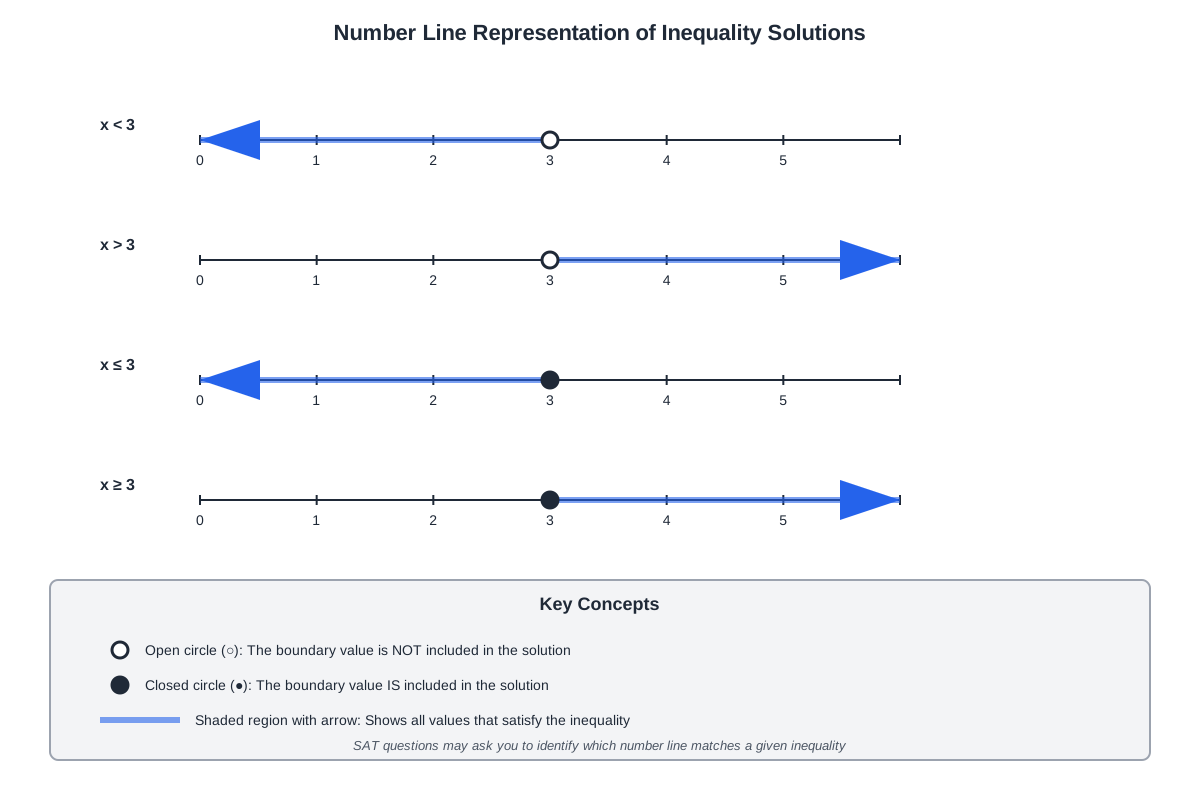
On a number line, inclusive inequalities use closed circles (●) at boundary points, while strict inequalities use open circles (○). For x ≤ 3, a closed circle appears at 3 with shading extending left. For x > -2, an open circle appears at -2 with shading extending right. SAT questions may present number line graphs and ask students to identify the corresponding inequality or context.
Compound Inequalities
Compound inequalities involve two inequality statements connected by "and" or "or." The most common SAT format is the "and" type, written as a ≤ x ≤ b, meaning x is simultaneously greater than or equal to a AND less than or equal to b. For example, "The temperature must be between 65°F and 75°F, inclusive" translates to 65 ≤ T ≤ 75.
When interpreting compound inequalities, students must recognize that "and" creates an intersection (values must satisfy both conditions), while "or" creates a union (values satisfy at least one condition). The phrase "between" typically indicates an "and" relationship, though context determines whether boundaries are included.
Contextual Interpretation
Contextual interpretation requires students to understand what an inequality means in a specific situation. Given the inequality h ≥ 48 in the context of a roller coaster height requirement, students must recognize this means riders must be at least 48 inches tall, that someone exactly 48 inches tall can ride, and that someone 47 inches tall cannot ride.
SAT questions frequently ask "What does the inequality represent?" or "Which statement is true based on the inequality?" Students must connect the mathematical symbols to the real-world constraints they model. This requires understanding both the mathematical relationship and the practical implications of that relationship in context.
Inequality Manipulation and Preservation
When solving inequalities algebraically, most operations preserve the inequality direction: adding or subtracting the same value from both sides, multiplying or dividing both sides by a positive number. However, multiplying or dividing both sides by a negative number reverses the inequality symbol. While SAT inequality interpretation questions rarely require extensive algebraic manipulation, understanding this principle helps students verify whether proposed inequalities are equivalent.
Concept Relationships
Inequality interpretation builds directly on understanding basic inequality symbols and notation, which students learn as prerequisites. The core skill of translating verbal phrases into mathematical symbols connects to broader algebraic modeling abilities used throughout SAT Math. Specifically, inequality interpretation → enables → solving linear inequalities → which supports → systems of inequalities and optimization problems.
The relationship between strict and inclusive inequalities connects to the concept of boundary values, which in turn relates to solution sets and number line representations. Understanding these connections helps students move fluidly between different representations: verbal descriptions ↔ symbolic notation ↔ graphical representations ↔ numerical examples.
Compound inequalities extend single inequality interpretation by combining two constraints, requiring students to understand logical connectors ("and"/"or") and how multiple conditions interact. This concept relationship flows as: single inequality interpretation → compound inequality interpretation → systems of inequalities → linear programming.
Contextual interpretation ties inequality concepts to real-world applications, connecting abstract mathematical relationships to practical scenarios involving budgets, measurements, capacities, and constraints. This relationship demonstrates how mathematical modeling translates real situations into symbolic form for analysis: real-world problem → mathematical model (inequality) → solution → interpretation back to context.
High-Yield Facts
⭐ The phrase "at most" translates to ≤ (less than or equal to), while "at least" translates to ≥ (greater than or equal to)
⭐ Strict inequalities (< and >) exclude the boundary value; inclusive inequalities (≤ and ≥) include the boundary value
⭐ "Between" typically indicates a compound inequality; context determines whether boundaries are included
⭐ On number lines, closed circles indicate included boundaries (≤ or ≥), while open circles indicate excluded boundaries (< or >)
⭐ The inequality x < 5 means x can be 4.9, 4.99, or 4.999, but never 5 or greater
- "No more than" and "maximum" both indicate an upper limit using ≤
- "No less than" and "minimum" both indicate a lower limit using ≥
- The solution set of an inequality includes all values that make the inequality true
- Compound inequalities like a ≤ x ≤ b require x to satisfy both conditions simultaneously
- Context clues in word problems determine which inequality symbol correctly models the situation
Quick check — test yourself on Inequality interpretation so far.
Try Flashcards →Common Misconceptions
Misconception: "At most 10" means exactly 10 → Correction: "At most 10" means 10 or any value less than 10; it represents an upper limit that includes 10 itself, written as x ≤ 10
Misconception: The inequalities x < 5 and x ≤ 5 are essentially the same → Correction: These inequalities have different solution sets; x < 5 excludes 5, while x ≤ 5 includes 5, making this distinction critical for determining whether boundary values satisfy the condition
Misconception: "Between 10 and 20" always means 10 < x < 20 → Correction: The word "between" requires careful attention to context; "between" alone often excludes endpoints (10 < x < 20), but phrases like "from 10 to 20" or "between 10 and 20, inclusive" include endpoints (10 ≤ x ≤ 20)
Misconception: If x > 3, then the smallest value x can be is 4 → Correction: Since x > 3 is a strict inequality over real numbers, x can be any value greater than 3, including 3.1, 3.01, or 3.001; there is no "smallest value" that satisfies the inequality
Misconception: The inequality 2x + 5 < 15 means the same thing regardless of context → Correction: While the mathematical relationship remains constant, the interpretation depends entirely on what x represents; if x is hours worked, the inequality means something different than if x represents items purchased
Misconception: "More than 5" and "at least 5" mean the same thing → Correction: "More than 5" means x > 5 (excluding 5), while "at least 5" means x ≥ 5 (including 5); this one-value difference can determine whether an answer is correct on the SAT
Worked Examples
Example 1: Translating a Word Problem to an Inequality
Problem: A parking garage charges $8 for the first hour and $3 for each additional hour. If Marcus has at most $25 to spend on parking, which inequality represents the number of additional hours, h, he can park?
Solution:
Step 1: Identify what the variable represents. Here, h represents the number of additional hours beyond the first hour.
Step 2: Determine the cost expression. The total cost is $8 (first hour) + $3h (additional hours), which gives us 8 + 3h.
Step 3: Identify the constraint phrase. "At most $25" means the cost must be less than or equal to $25.
Step 4: Write the inequality. Since the total cost must be at most $25, we write: 8 + 3h ≤ 25
Step 5: Verify the boundary. If h = 5.67 (approximately), then 8 + 3(5.67) = 8 + 17 = 25. Since "at most" includes the boundary value, the ≤ symbol is correct.
Answer: 8 + 3h ≤ 25
This example demonstrates the learning objective of translating verbal descriptions into correct mathematical inequalities by identifying the variable, building the expression, recognizing the constraint phrase, and selecting the appropriate inequality symbol.
Example 2: Interpreting an Inequality in Context
Problem: A scientist studying plant growth uses the inequality 18 ≤ T ≤ 24, where T represents temperature in degrees Celsius. Which of the following statements must be true?
A) The plant cannot survive at 17°C
B) The plant grows optimally at exactly 21°C
C) The plant can tolerate temperatures up to 25°C
D) The temperature must be at least 18°C
Solution:
Step 1: Interpret the compound inequality. The inequality 18 ≤ T ≤ 24 means T must be greater than or equal to 18 AND less than or equal to 24.
Step 2: Evaluate each statement against the inequality.
Statement A: At T = 17, we have 17 < 18, so 17 does not satisfy 18 ≤ T. While the inequality doesn't explicitly state the plant "cannot survive" outside this range, it does indicate 17°C is outside the acceptable range. This could be true, but the wording "cannot survive" is stronger than what the inequality states.
Statement B: The inequality shows 21°C is within the acceptable range (18 ≤ 21 ≤ 24), but nothing indicates this is "optimal"—it's simply one value in the acceptable range. This is not necessarily true.
Statement C: At T = 25, we have 25 > 24, so 25 does not satisfy T ≤ 24. The plant cannot tolerate 25°C according to this inequality. This is false.
Statement D: The inequality 18 ≤ T explicitly states that T must be greater than or equal to 18, which is the definition of "at least 18°C." This must be true.
Answer: D
This example addresses the learning objective of explaining how inequality interpretation appears on the SAT by demonstrating how students must connect symbolic notation to verbal statements and evaluate which interpretations are logically valid based on the mathematical relationship.
Exam Strategy
When approaching SAT inequality interpretation questions, begin by identifying what the variable represents in the given context. Circle or underline the variable definition in the problem, as confusion about what quantity is being measured leads to selecting incorrect inequalities. Next, locate constraint phrases like "at most," "at least," "more than," or "less than," which directly indicate which inequality symbol to use.
Trigger words to watch for include: "maximum" and "at most" (both indicate ≤), "minimum" and "at least" (both indicate ≥), "under" and "below" (typically indicate <), "over" and "above" (typically indicate >), "between" (indicates compound inequality), and "inclusive" or "including" (indicates ≤ or ≥ rather than < or >). Highlighting these phrases helps prevent misinterpretation.
For process-of-elimination, test boundary values in answer choices. If a problem states "at most 50," check whether the inequality allows exactly 50—if an answer choice uses x < 50, eliminate it because "at most" requires ≤. Similarly, if a problem describes a strict constraint like "more than 100," eliminate any answer using ≥ instead of >. Testing extreme values (very large or very small numbers) can also reveal which inequalities don't match the described situation.
Exam Tip: When translating word problems, write the inequality symbol in the same direction as you read the constraint. "x is less than 10" naturally becomes x < 10, while "10 is greater than x" also means x < 10 but requires mental reversal.
Time allocation for inequality interpretation questions should be approximately 45-60 seconds for straightforward translation problems and up to 90 seconds for complex contextual interpretation questions. If a problem requires extensive algebraic manipulation beyond basic interpretation, consider marking it for review and returning after completing quicker questions.
Watch for questions that ask "which of the following must be true" versus "which could be true"—these require different levels of certainty. For "must be true," the statement needs to be valid for all values in the solution set. For "could be true," the statement only needs to work for at least one value in the solution set.
Memory Techniques
Mnemonic for "at most" and "at least": Think "Most = Maximum = ≤" and "Least = Lowest acceptable = ≥". The word "most" contains the letter M like "maximum," reminding you it's an upper limit. The word "least" contains L like "lowest acceptable," reminding you it's a lower limit.
Visualization for strict vs. inclusive: Picture a velvet rope at a club. A strict inequality (< or >) is like "you must be OVER 21"—if you're exactly 21, you're still outside the rope. An inclusive inequality (≤ or ≥) is like "21 and over welcome"—exactly 21 gets you in. The closed circle on a number line is like a checkpoint where you're allowed to stand.
Acronym for boundary inclusion: COIN = Closed circle means On the boundary is INcluded (≤ or ≥). Conversely, an open circle means the boundary is excluded (< or >).
Phrase reversal technique: When you see "5 is greater than x," mentally flip it to "x is less than 5" before writing the inequality. This prevents writing the inequality backward. Always put the variable on the left when possible to maintain consistency.
The "between" rule: If a problem says "between A and B" without additional words, assume boundaries are excluded (A < x < B). If it says "from A to B," "between A and B inclusive," or "A through B," boundaries are included (A ≤ x ≤ B). Remember: plain "between" = Boundaries Excluded.
Summary
Inequality interpretation is a high-yield SAT Math topic that requires students to translate between verbal descriptions, symbolic notation, and real-world contexts. The core skill involves recognizing constraint phrases like "at most" (≤), "at least" (≥), "less than" (<), and "greater than" (>), then correctly representing these relationships mathematically. Students must distinguish between strict inequalities that exclude boundary values and inclusive inequalities that include them, understanding that this single-value difference can determine whether an answer is correct. Compound inequalities extend these concepts by combining two constraints, typically representing ranges where values must satisfy both conditions simultaneously. Contextual interpretation requires connecting mathematical symbols to practical situations, determining what inequalities mean in specific scenarios, and evaluating whether particular values satisfy given constraints. Success on SAT inequality interpretation questions depends on careful attention to language, systematic translation of verbal phrases to symbols, and verification that selected inequalities match both the mathematical relationship and the real-world context described in the problem.
Key Takeaways
- Inequality symbols have precise meanings: < and > exclude boundaries (strict), while ≤ and ≥ include boundaries (inclusive)
- Constraint phrases directly indicate which symbol to use: "at most/maximum" → ≤, "at least/minimum" → ≥, "less than" → <, "greater than" → >
- Boundary values determine whether specific numbers satisfy inequalities; testing boundary values helps verify correct interpretation
- Compound inequalities like a ≤ x ≤ b represent ranges where values must satisfy both conditions simultaneously
- Context matters: the same inequality can mean different things depending on what the variable represents in a given situation
- Translation accuracy is critical—one word difference ("at least" vs. "more than") changes which inequality symbol is correct
- Verification strategy: always test boundary values in your selected inequality to confirm it matches the described constraint
Related Topics
Solving Linear Inequalities: Building on interpretation skills, this topic covers algebraic techniques for isolating variables in inequalities, including the critical rule about reversing inequality symbols when multiplying or dividing by negative numbers. Mastering inequality interpretation provides the conceptual foundation for understanding what solutions mean.
Systems of Inequalities: This advanced topic involves working with multiple inequalities simultaneously, often represented graphically as shaded regions. Strong inequality interpretation skills enable students to understand what each inequality in the system represents and how their intersection creates feasible solution regions.
Absolute Value Inequalities: These combine inequality interpretation with absolute value concepts, requiring students to understand how distance relationships translate into compound inequalities. The interpretation skills developed here extend naturally to this more complex topic.
Linear Programming and Optimization: Real-world applications often involve maximizing or minimizing quantities subject to multiple inequality constraints. Inequality interpretation forms the foundation for setting up these problems correctly before applying optimization techniques.
Practice CTA
Now that you've mastered the core concepts of inequality interpretation, it's time to solidify your understanding through practice. Attempt the practice questions to apply these skills to SAT-style problems, testing your ability to translate constraints, identify correct inequalities, and interpret mathematical relationships in context. Use the flashcards to reinforce key phrases and their corresponding symbols, ensuring you can quickly recognize constraint language under timed conditions. Remember: inequality interpretation appears on virtually every SAT Math section, making this practice time a high-yield investment in your score improvement. Each problem you work through strengthens your pattern recognition and builds the confidence you need to tackle these questions efficiently on test day.
Sign up free to keep reading
Create a free AnvayaPrep account to finish this SAT guide on Inequality interpretation — plus flashcards and practice questions.