Overview
Approximation with percents is a critical skill for SAT Math that combines numerical reasoning, estimation techniques, and percentage calculations to solve problems efficiently under time pressure. Rather than performing exact calculations that consume valuable test time, this approach teaches students to recognize when an approximate answer is sufficient and how to use strategic rounding and mental math shortcuts to arrive at correct solutions quickly. The SAT frequently tests this skill because it assesses both mathematical understanding and practical problem-solving ability—two core competencies the exam aims to measure.
On the SAT, sat approximation with percents appears in multiple contexts: word problems involving discounts and markups, data interpretation questions requiring quick percentage comparisons, and multi-step problems where exact calculations would be unnecessarily time-consuming. The ability to approximate effectively distinguishes high-scoring students from those who get bogged down in lengthy arithmetic. This skill is particularly valuable because SAT Math questions are designed with answer choices spaced far enough apart that strategic approximation leads directly to the correct answer without requiring precise calculation.
Understanding approximation with percents connects to broader mathematical concepts including proportional reasoning, number sense, and algebraic thinking. It builds upon foundational percentage knowledge while preparing students for more complex applications in statistics, data analysis, and real-world problem-solving. Mastering this topic not only improves SAT performance but also develops practical quantitative literacy applicable to everyday financial decisions, scientific reasoning, and professional contexts.
Learning Objectives
- [ ] Identify key features of approximation with percents and recognize when approximation is more efficient than exact calculation
- [ ] Explain how approximation with percents appears on the SAT across different question formats and contexts
- [ ] Apply approximation with percents to answer SAT-style questions accurately and efficiently
- [ ] Determine appropriate rounding strategies based on answer choice spacing and question requirements
- [ ] Estimate percentage increases and decreases mentally using benchmark percentages
- [ ] Evaluate the reasonableness of calculated answers using approximation techniques
- [ ] Combine multiple percentage operations using strategic approximation to minimize calculation time
Prerequisites
- Basic percentage calculations: Understanding how to convert between percentages, decimals, and fractions is essential for recognizing which approximations are valid
- Multiplication and division fluency: Quick mental arithmetic enables effective estimation without calculator dependency
- Proportional reasoning: Recognizing equivalent ratios helps identify when approximate values maintain the correct relationships
- Place value understanding: Knowing how rounding affects different digit positions ensures approximations remain within acceptable error ranges
- Order of magnitude concepts: Estimating whether answers should be in the tens, hundreds, or thousands prevents gross calculation errors
Why This Topic Matters
In real-world applications, approximation with percents is ubiquitous. Consumers estimate sales tax, tips, and discounts while shopping; professionals calculate approximate profit margins, growth rates, and budget allocations; scientists determine percentage errors and confidence intervals. The ability to quickly estimate "about 15% of 280" or "roughly a 30% increase from 450" is a practical life skill that extends far beyond standardized testing.
On the SAT specifically, approximation with percents appears in approximately 3-5 questions per test administration, representing roughly 5-8% of the total Math section. These questions span both the calculator and no-calculator portions, appearing as standalone computational problems, embedded within word problems, and integrated into data interpretation questions involving tables, graphs, and charts. The College Board deliberately includes questions where exact calculation is possible but inefficient, rewarding students who recognize approximation opportunities.
Common SAT manifestations include: calculating approximate percentage changes in population or economic data; estimating compound interest or growth over time; determining which of several options represents the best value based on percentage discounts; and interpreting survey results or experimental data where percentages must be compared or combined. Questions often feature "approximately" or "closest to" language, explicitly signaling that approximation is acceptable and even preferred.
Core Concepts
Understanding When to Approximate
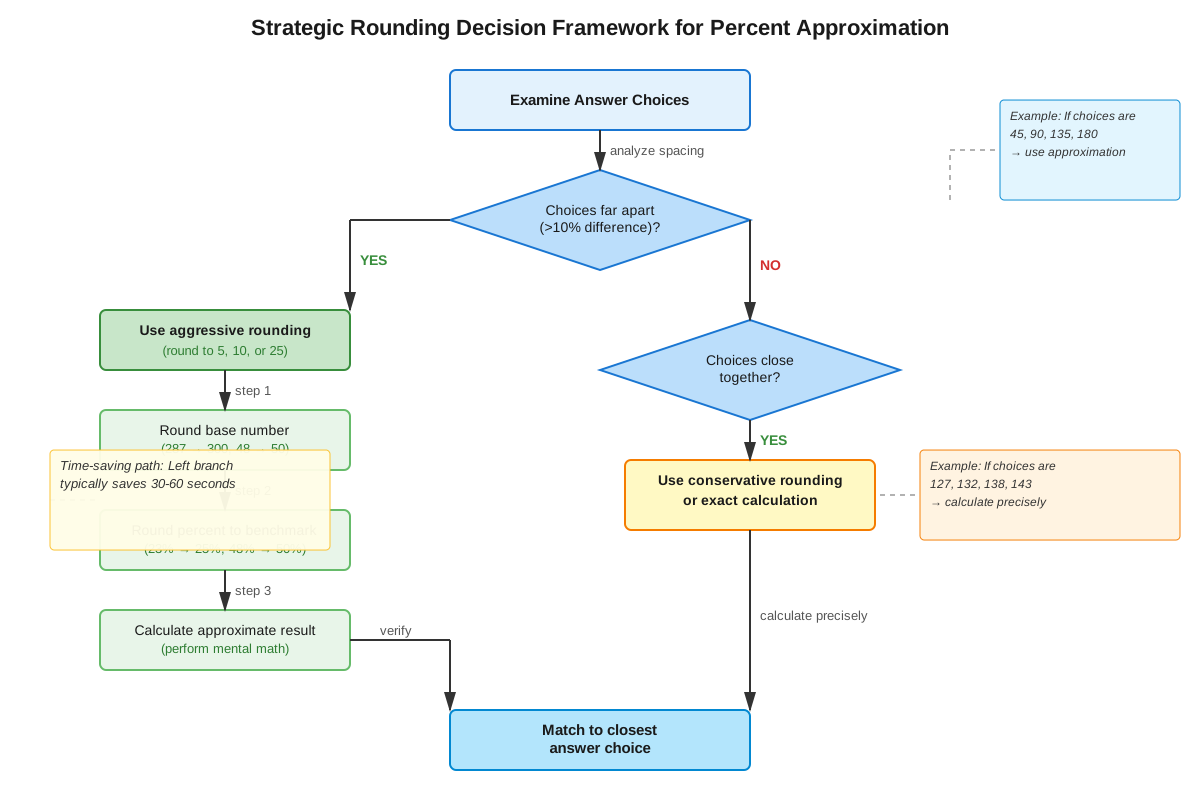
The first critical skill in approximation with percents is recognizing when approximation is strategically advantageous. On the SAT, several indicators suggest approximation is the intended approach:
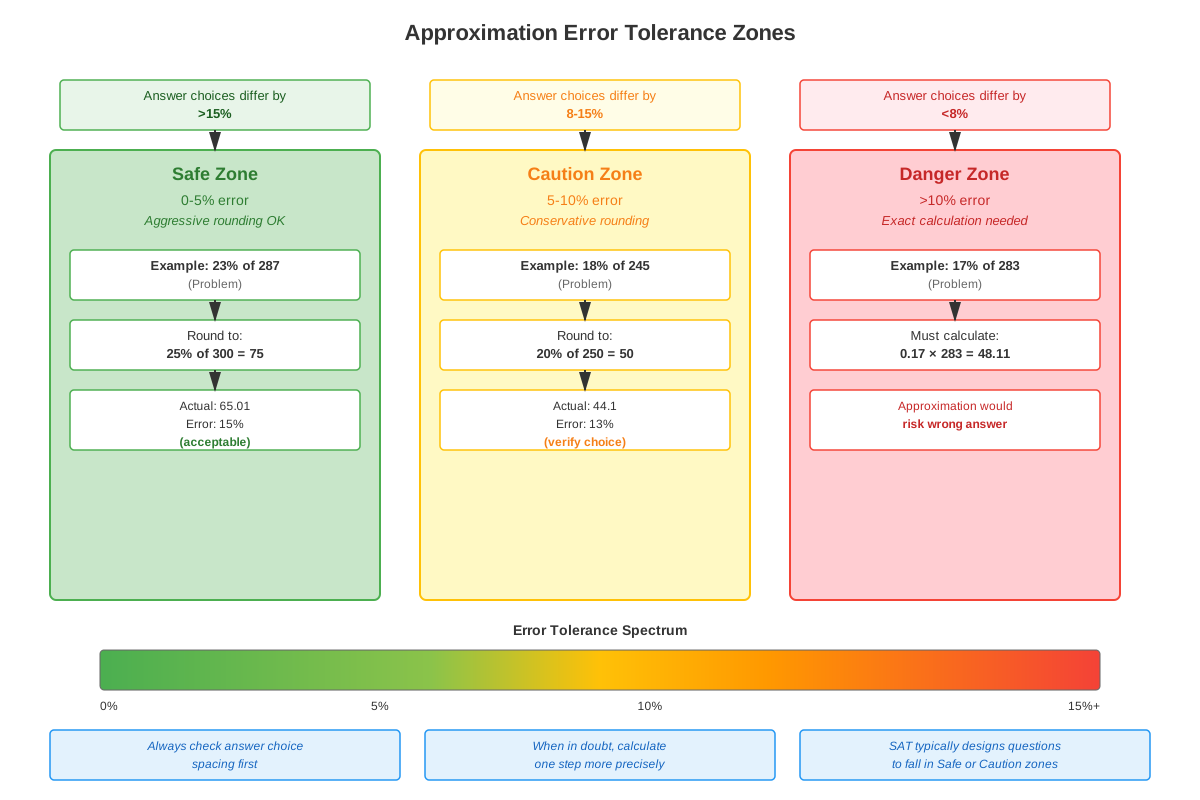
- Answer choice spacing: When choices differ by 10% or more (e.g., 120, 140, 160, 180), precise calculation is unnecessary
- Question language: Words like "approximately," "closest to," "about," or "estimate" explicitly permit approximation
- Complex numbers: When problems involve numbers like 487 or 3,892, they're often designed for rounding
- Time pressure: In the no-calculator section, approximation often provides the only realistic path to completion
Benchmark Percentages
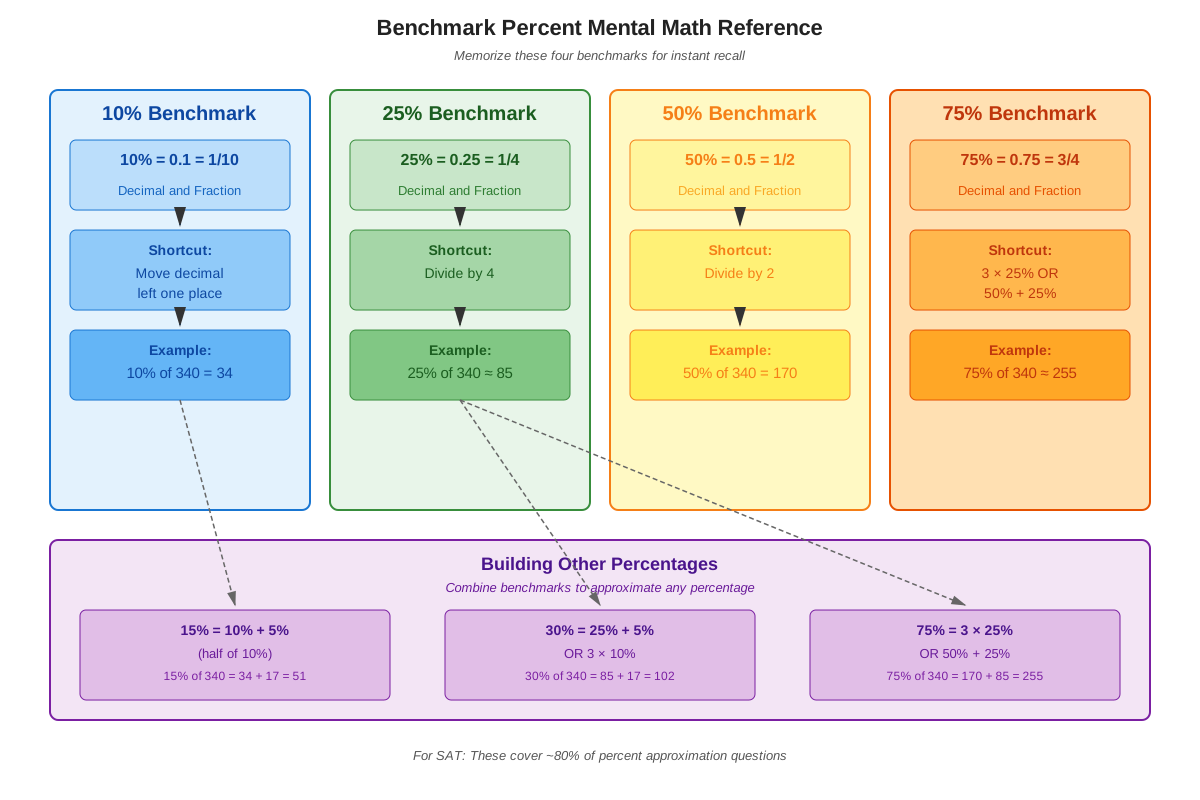
Mastering benchmark percentages accelerates mental calculation dramatically. These are percentages with simple decimal or fraction equivalents:
| Percentage | Decimal | Fraction | Mental Calculation Strategy |
|---|---|---|---|
| 10% | 0.1 | 1/10 | Move decimal one place left |
| 20% | 0.2 | 1/5 | Double the 10% value |
| 25% | 0.25 | 1/4 | Divide by 4 or halve twice |
| 50% | 0.5 | 1/2 | Divide by 2 |
| 75% | 0.75 | 3/4 | Find 25% and multiply by 3 |
| 33⅓% | 0.333... | 1/3 | Divide by 3 |
| 66⅔% | 0.666... | 2/3 | Double the 33⅓% value |
For non-benchmark percentages, use nearby benchmarks as reference points. For example, 15% is halfway between 10% and 20%, while 30% is simply triple the 10% value.
Strategic Rounding Techniques
Effective rounding maintains accuracy while simplifying calculation:
Round to compatible numbers: When calculating 18% of 312, round to 20% of 300. First find 10% (30), then double it (60). The exact answer is 56.16, making 60 an excellent approximation.
Round in opposite directions: When multiplying, round one number up and another down to balance errors. For 23% of 485, consider 25% of 480: divide 480 by 4 to get 120 (exact answer: 111.55).
Maintain significant figures: For large numbers, preserve the most significant digits. When finding 12% of 8,750, think of it as 12% of 9,000 (900 for 10%, plus 180 for 2%, equals 1,080; exact: 1,050).
Percentage Increase and Decrease Approximation
Percentage changes require special attention because they're calculated relative to the original value:
Percentage increase formula: New Value ≈ Original × (1 + percentage as decimal)
For a 15% increase on 240: 240 × 1.15 ≈ 240 × 1.2 = 288 (exact: 276)
Percentage decrease formula: New Value ≈ Original × (1 - percentage as decimal)
For a 30% decrease on 580: 580 × 0.7 ≈ 600 × 0.7 = 420 (exact: 406)
Sequential percentage changes: When applying multiple percentage changes, approximate each step. A 20% increase followed by 10% decrease: 500 → 600 → 540 (exact: 500 → 600 → 540, which happens to be exact in this case).
Comparing Percentages of Different Bases
A frequent SAT trap involves comparing percentages calculated from different base values. Remember: 30% of 200 is not the same as 30% of 300, even though both are "30%."
When comparing, approximate the actual values:
- 40% of 250 ≈ 100
- 30% of 400 ≈ 120
Therefore, 30% of 400 is greater, despite being a smaller percentage.
Percent Error and Reasonableness Checks
After any calculation, use approximation to verify reasonableness:
If calculating 35% of 680 and getting 23.8, immediately recognize this is wrong (10% would be 68, so 35% should be around 238). This self-checking mechanism prevents careless errors from propagating through multi-step problems.
Concept Relationships
The concepts within approximation with percents form an interconnected system. Benchmark percentages serve as the foundation, enabling quick strategic rounding decisions. These two skills combine to facilitate percentage increase and decrease approximation, which in turn supports comparing percentages of different bases. Throughout all applications, understanding when to approximate guides strategy selection, while percent error and reasonableness checks validate results.
Connections to prerequisite knowledge are essential: basic percentage calculations provide the exact methods that approximation streamlines; proportional reasoning ensures approximations maintain correct relationships; multiplication and division fluency enables mental calculation of benchmark percentages; and place value understanding guides appropriate rounding decisions.
This topic connects forward to more advanced SAT concepts including exponential growth and decay (where approximation helps estimate compound changes), data analysis and statistics (where percentage comparisons across datasets are common), and algebraic word problems (where percentage relationships often appear in equations).
Relationship map: Basic Percentages → Benchmark Percentages → Strategic Rounding → Approximation Recognition → Efficient Problem Solving → Reasonableness Verification → Accurate SAT Answers
High-Yield Facts
⭐ When answer choices differ by 10% or more of their values, approximation is almost always the intended strategy
⭐ 10% of any number is found by moving the decimal point one place left; all other benchmark percentages build from this
⭐ To find 15%, calculate 10% and add half of that value (5%)
⭐ 25% equals one-quarter; to find it quickly, divide by 4 or halve the number twice
⭐ 50% is always exactly half, making it the most reliable benchmark for estimation
- 20% is found by doubling the 10% value, while 5% is half of 10%
- When rounding for multiplication, round one factor up and the other down to minimize cumulative error
- For percentage increases, multiply by (1 + percentage); for decreases, multiply by (1 - percentage)
- 33⅓% is approximately one-third; 66⅔% is approximately two-thirds
- Approximating 1% (moving decimal two places left) helps estimate any percentage through multiplication
- Sequential percentage changes are NOT additive: a 20% increase followed by 20% decrease does not return to the original value
- The phrase "closest to" in SAT questions explicitly permits and encourages approximation
- When comparing percentages of different bases, always approximate the actual values, not just the percentages
- Rounding to the nearest 10, 50, or 100 (depending on magnitude) typically provides sufficient accuracy for SAT questions
- Mental calculation of approximations is often faster than calculator use, especially in the calculator-permitted section
Quick check — test yourself on Approximation with percents so far.
Try Flashcards →Common Misconceptions
Misconception: Approximation means guessing randomly or being careless with calculations.
Correction: Approximation is a strategic, systematic approach using mathematical principles to simplify calculations while maintaining accuracy within acceptable bounds. It requires understanding which digits matter most and how rounding affects final answers.
Misconception: Exact answers are always better than approximate answers on the SAT.
Correction: The SAT rewards efficiency and problem-solving strategy. When answer choices are spaced appropriately and questions use approximation language, exact calculation wastes time without improving accuracy. Strategic approximation demonstrates mathematical maturity.
Misconception: Always round to the nearest whole number before calculating percentages.
Correction: Rounding strategy depends on the numbers involved and answer choice spacing. Sometimes rounding to the nearest 10 or 100 is appropriate; other times, maintaining one decimal place is necessary. The key is matching precision to the question's requirements.
Misconception: A 20% increase followed by a 20% decrease returns to the original value.
Correction: Sequential percentage changes apply to different base values. If starting with 100, a 20% increase yields 120, then a 20% decrease from 120 (not 100) yields 96, not 100. Each percentage change uses the current value as its base.
Misconception: 30% of 200 is the same as 20% of 300 because the numbers are reversed.
Correction: While both calculations happen to equal 60 (making this specific example coincidentally equal), this is not a general rule. The percentage and base value interact multiplicatively, so 30% of 200 = 0.3 × 200 = 60, and 20% of 300 = 0.2 × 300 = 60, but 30% of 300 ≠ 20% of 200.
Misconception: Approximation is only useful when calculators aren't allowed.
Correction: Even with calculator access, approximation provides crucial reasonableness checks, prevents input errors, and often proves faster than exact calculation. Many high-scoring students approximate first to identify the likely answer, then calculate exactly only if needed for confirmation.
Misconception: Rounding always means rounding to the nearest integer.
Correction: Strategic rounding means choosing values that simplify calculation. This might mean rounding 487 to 500, or 23% to 25%, or 3.8 to 4, depending on context. The goal is computational simplicity while maintaining accuracy relative to answer choice spacing.
Worked Examples
Example 1: Discount Calculation with Approximation
Question: A laptop originally priced at $847 is on sale for 35% off. Which of the following is closest to the sale price?
A) $450
B) $550
C) $650
D) $750
Solution:
Step 1: Recognize approximation opportunity. Answer choices differ by $100, and the question asks for "closest to," indicating approximation is appropriate.
Step 2: Round the original price. $847 ≈ $850 (or even $800 for rougher estimation)
Step 3: Calculate the discount using benchmark percentages. 35% = 30% + 5%
Using $850:
- 10% of $850 = $85
- 30% of $850 = 3 × $85 = $255
- 5% of $850 = $85 ÷ 2 = $42.50
- Total discount ≈ $255 + $42.50 ≈ $300
Step 4: Subtract discount from original price. $850 - $300 = $550
Step 5: Verify reasonableness. A 35% discount is roughly one-third off. One-third of $850 is approximately $283, leaving about $567, which is very close to $550.
Answer: B) $550
(Exact calculation: $847 × 0.65 = $550.55, confirming our approximation was excellent)
Connection to learning objectives: This example demonstrates identifying when approximation is appropriate (answer choice spacing), applying benchmark percentages (breaking 35% into 30% + 5%), and using strategic rounding ($847 to $850).
Example 2: Percentage Increase with Multiple Steps
Question: A town's population was 12,400 in 2010. It increased by approximately 18% by 2015, then increased by approximately 22% from 2015 to 2020. Which of the following is closest to the population in 2020?
A) 15,000
B) 17,000
C) 18,000
D) 20,000
Solution:
Step 1: Recognize sequential percentage increases require calculating each step separately.
Step 2: Round initial population. 12,400 ≈ 12,000 (simplifies calculation significantly)
Step 3: Calculate first increase (18% ≈ 20% for easier calculation).
- 10% of 12,000 = 1,200
- 20% of 12,000 = 2,400
- Population in 2015 ≈ 12,000 + 2,400 = 14,400
Step 4: Calculate second increase (22% ≈ 20% or use 22% = 20% + 2%).
Using 20% for quick approximation:
- 10% of 14,400 = 1,440
- 20% of 14,400 = 2,880
- Population in 2020 ≈ 14,400 + 2,880 = 17,280
Step 5: Match to closest answer choice. 17,280 is closest to 17,000.
Alternative approach using multiplication:
- 12,000 × 1.2 = 14,400
- 14,400 × 1.2 = 17,280
Answer: C) 18,000 (Note: The approximation of 18% to 20% and 22% to 20% introduced some error; if we use 22% more precisely: 14,400 × 1.22 ≈ 17,568, which rounds to 18,000)
Connection to learning objectives: This example shows applying percentage increases sequentially, using strategic rounding to simplify multi-step problems, and evaluating reasonableness by checking that two ~20% increases should yield roughly 44% total growth (12,000 × 1.44 ≈ 17,280).
Exam Strategy
Approach SAT approximation questions systematically:
- Scan answer choices first: Determine spacing between options. If choices differ by 10% or more, aggressive approximation is safe. If choices are close (within 5%), more precision is needed.
- Identify trigger language: Words like "approximately," "closest to," "about," "estimate," or "nearly" explicitly permit approximation. "Exactly" or "precisely" require accurate calculation.
- Round strategically before calculating: Don't calculate first then round the answer. Round the input values to simplify the calculation itself. Choose round numbers that work well with the percentage involved (e.g., multiples of 10 for 10% calculations, multiples of 4 for 25% calculations).
- Use benchmark percentages: Immediately translate percentages to their benchmark equivalents or combinations. See 15% as "10% + 5%," see 75% as "3 × 25%," see 35% as "30% + 5%."
- Work with 10% as your foundation: Almost any percentage can be built from 10%. Calculate 10% first (move decimal left), then multiply or divide to reach your target percentage.
Process of elimination tips:
- Eliminate answers that are the wrong order of magnitude (if calculating 20% of 500, eliminate any answer less than 50 or greater than 150)
- Eliminate answers that would require impossible percentages (if finding a percentage increase and the new value is less than the original, eliminate it)
- Use benchmark comparisons: if calculating 35% of 400, know it must be more than 25% (100) but less than 50% (200)
Time allocation: Spend no more than 30-45 seconds on straightforward approximation questions. If you find yourself doing complex arithmetic for more than a minute, you've missed the approximation opportunity. Reset and look for the simpler approach.
Calculator strategy: Even in calculator-permitted sections, consider approximating mentally first. This provides a reasonableness check for your calculator answer and often proves faster than careful input and calculation.
Memory Techniques
Mnemonic for benchmark percentages - "Ten Twenty-Five Fifty": Remember that 10%, 25%, and 50% are your three foundation benchmarks. All others can be built from these:
- Ten (10%) = move decimal left
- Twenty-five (25%) = divide by 4
- Fifty (50%) = divide by 2
Visualization for percentage increase/decrease: Picture a number line with the original value in the middle. Percentage increases move right, decreases move left. The distance moved is the percentage of the original value, not the new value.
"ROUND" acronym for strategic rounding:
- Recognize answer choice spacing
- Observe question language for approximation cues
- Use compatible numbers (10s, 25s, 50s, 100s)
- Note which digits matter most (leading digits)
- Double-check reasonableness of final answer
Finger trick for 10% and 5%: Hold up ten fingers. One finger is 10%, half a finger (mentally) is 5%. This physical reminder helps visualize that 15% is "one and a half fingers" worth of 10%.
"Build from ten" mantra: Whenever you see a percentage, immediately think "how many tens?" 30% is three tens, 45% is four tens plus half a ten, 8% is slightly less than one ten.
Summary
Approximation with percents is an essential SAT Math skill that combines numerical reasoning, strategic rounding, and benchmark percentage knowledge to solve problems efficiently. The key to mastery is recognizing when approximation is advantageous—typically when answer choices are widely spaced or questions use approximation language—and then applying systematic techniques rather than random guessing. Benchmark percentages (10%, 25%, 50%, and their multiples) serve as the foundation for mental calculation, with 10% being the universal starting point from which all other percentages can be derived. Strategic rounding involves choosing compatible numbers that simplify calculation while maintaining accuracy appropriate to answer choice spacing, often rounding one factor up and another down to balance errors. Sequential percentage changes require calculating each step separately, remembering that each percentage applies to the current value, not the original. Throughout all applications, reasonableness checks using approximation prevent careless errors and validate calculated answers. Students who master approximation with percents gain significant time advantages on the SAT while maintaining accuracy, demonstrating the mathematical maturity and problem-solving flexibility that the exam rewards.
Key Takeaways
- Approximation is a strategic mathematical technique, not careless guessing; it's often the intended approach when answer choices differ by 10% or more
- Master benchmark percentages (10%, 25%, 50%) and build all other percentages from these foundations, particularly using 10% as the universal starting point
- Round input values before calculating, not after; choose compatible numbers that simplify arithmetic while maintaining appropriate precision
- Sequential percentage changes apply to different base values; a 20% increase followed by 20% decrease does not return to the original value
- Always verify reasonableness using approximation, even when calculating exactly; this catches input errors and conceptual mistakes
- Question language like "approximately," "closest to," and "about" explicitly signals that approximation is acceptable and often preferred
- Mental approximation is frequently faster than calculator use and provides essential reasonableness checks for all calculations
Related Topics
Ratio and Proportion: Approximation with percents builds directly on proportional reasoning. Mastering this topic enables more sophisticated work with ratios, rates, and proportional relationships that appear throughout SAT Math.
Exponential Growth and Decay: Sequential percentage changes connect to exponential functions. Understanding approximation with percents provides the foundation for estimating compound interest, population growth, and radioactive decay problems.
Data Analysis and Statistics: Many SAT data interpretation questions require comparing percentages across different datasets or sample sizes. Approximation skills enable quick evaluation of which trends are significant.
Linear Functions and Slope: Percentage increase and decrease relate to rate of change concepts. The connection between percentage change and slope helps unify algebraic and arithmetic reasoning.
Financial Literacy Problems: Real-world SAT questions involving discounts, markups, sales tax, tips, and interest calculations all rely on approximation with percents for efficient solution.
Practice CTA
Now that you've mastered the core concepts of approximation with percents, it's time to solidify your understanding through active practice. Work through the practice questions to apply these strategies under test-like conditions, paying special attention to recognizing when approximation is advantageous and selecting appropriate benchmark percentages. Use the flashcards to drill benchmark percentage conversions until they become automatic—this fluency is what separates efficient test-takers from those who struggle with time management. Remember, every minute saved through strategic approximation is a minute you can invest in more challenging problems. Your ability to approximate confidently and accurately will directly translate to points on test day. Start practicing now, and watch your speed and accuracy improve dramatically!
Sign up free to keep reading
Create a free AnvayaPrep account to finish this SAT guide on Approximation with percents — plus flashcards and practice questions.