Overview
Compound interest basics represents one of the most practical and frequently tested concepts in the SAT Math section. Unlike simple interest, which calculates earnings or charges only on the principal amount, compound interest accounts for interest earned on both the principal and previously accumulated interest. This exponential growth pattern appears in real-world scenarios ranging from savings accounts and investment portfolios to loan repayments and population growth models. Understanding compound interest is essential not only for achieving a high SAT score but also for making informed financial decisions throughout life.
On the SAT, compound interest problems typically appear as word problems that require students to set up and solve exponential equations. These questions test multiple mathematical skills simultaneously: reading comprehension, algebraic manipulation, understanding of exponential functions, and practical application of percentage concepts. The College Board includes these problems because they assess both mathematical reasoning and real-world problem-solving abilities—core competencies that predict college readiness.
Compound interest connects directly to broader mathematical concepts including exponential growth, percentage calculations, and algebraic modeling. It serves as a bridge between basic arithmetic operations and more advanced topics like exponential functions and logarithms. Mastering compound interest basics strengthens foundational skills in working with percentages while introducing students to the power of exponential relationships—a concept that appears throughout higher mathematics and science courses.
Learning Objectives
- [ ] Identify key features of compound interest basics, including principal, rate, time, and compounding frequency
- [ ] Explain how compound interest basics appears on the SAT in word problems and application contexts
- [ ] Apply compound interest basics to answer SAT-style questions using the compound interest formula
- [ ] Distinguish between simple interest and compound interest in problem scenarios
- [ ] Calculate final amounts using different compounding frequencies (annually, semi-annually, quarterly, monthly)
- [ ] Interpret and manipulate the compound interest formula to solve for different variables
- [ ] Analyze real-world scenarios to determine appropriate compound interest models
Prerequisites
- Basic percentage calculations: Converting between percentages, decimals, and fractions is essential for working with interest rates in formulas
- Algebraic equation solving: Students must isolate variables and perform operations on both sides of equations to solve compound interest problems
- Exponent rules: Understanding how to evaluate expressions with exponents is necessary since compound interest involves exponential growth
- Order of operations: Correctly applying PEMDAS ensures accurate calculation of compound interest formulas with multiple operations
Why This Topic Matters
Compound interest represents one of the most powerful financial concepts students will encounter in their lives. Whether saving for college, investing for retirement, or understanding credit card debt, compound interest directly impacts personal financial health. The principle that "money makes money" through compounding creates exponential growth that can work either for or against individuals depending on whether they're earning or paying interest. Financial literacy experts consistently cite understanding compound interest as foundational to making sound economic decisions.
On the SAT, compound interest questions appear with moderate frequency—typically 1-2 questions per test—but carry significant weight because they integrate multiple mathematical skills. These problems often appear in the calculator-permitted section and may be presented as multiple-choice or grid-in questions. The College Board values these questions because they assess practical mathematical reasoning rather than pure computational ability. Students who master compound interest demonstrate readiness for college-level quantitative thinking and real-world problem-solving.
Common SAT presentations include: comparing investment options with different compounding frequencies, calculating loan balances after specified time periods, determining how long it takes for an investment to reach a target value, and analyzing the effect of different interest rates on final amounts. Questions may also ask students to identify which formula correctly models a described situation or to interpret the meaning of variables within a compound interest context.
Core Concepts
The Compound Interest Formula
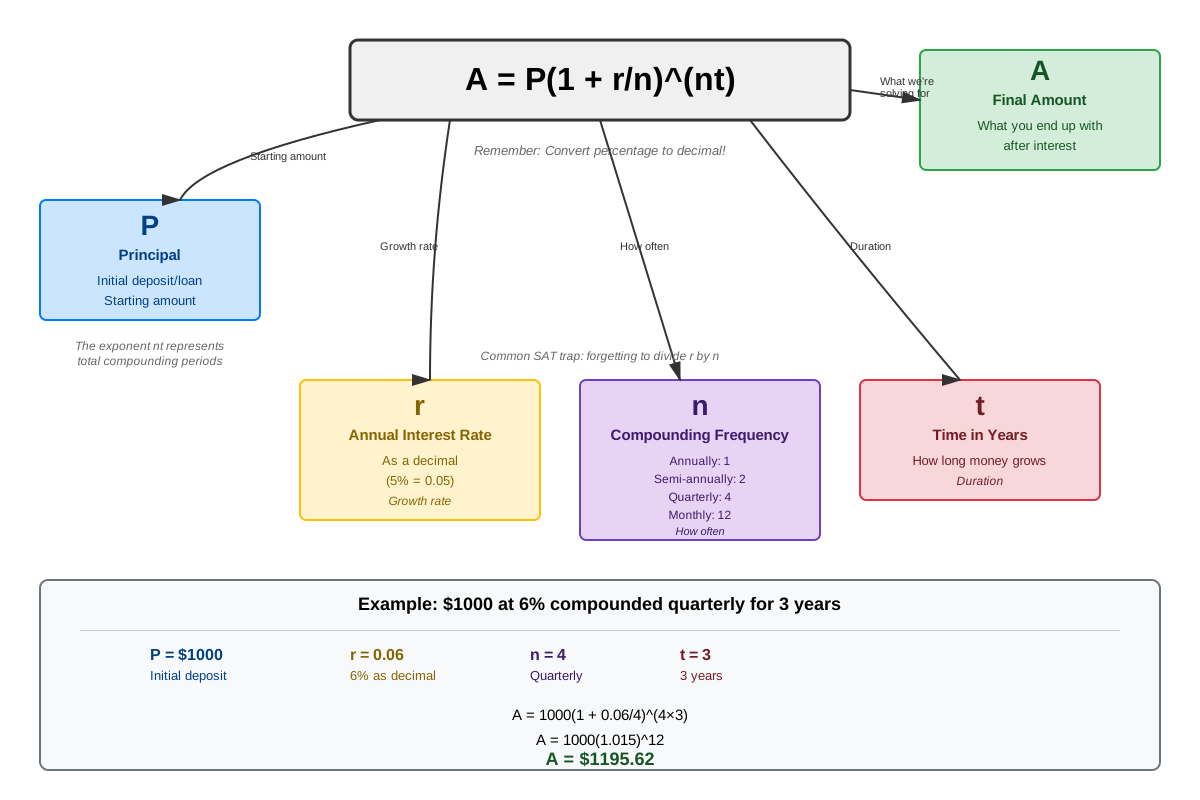
The fundamental compound interest formula is:
A = P(1 + r/n)^(nt)Where:
- A = the final amount (principal plus interest)
- P = the principal (initial amount invested or borrowed)
- r = the annual interest rate (expressed as a decimal)
- n = the number of times interest is compounded per year
- t = the time in years
This formula calculates the total value of an investment or loan after interest has been applied multiple times over a specified period. Each variable plays a crucial role in determining the final outcome, and SAT questions may ask students to solve for any of these variables given the others.
Understanding Each Variable
Principal (P): The starting amount before any interest is applied. This could be money deposited in a savings account, the initial investment in a bond, or the original loan amount. The principal remains constant throughout the calculation—it's the baseline from which all growth occurs.
Rate (r): The annual interest rate must be converted from a percentage to a decimal by dividing by 100. For example, a 5% annual interest rate becomes 0.05 in the formula. This rate represents the percentage of the current balance that will be added as interest during each compounding period, adjusted for the frequency of compounding.
Compounding Frequency (n): This critical variable determines how many times per year the interest is calculated and added to the principal. Common compounding frequencies include:
| Compounding Period | Value of n |
|---|---|
| Annually | 1 |
| Semi-annually | 2 |
| Quarterly | 4 |
| Monthly | 12 |
| Daily | 365 |
Time (t): Always expressed in years, even if the problem provides information in months or days. Students must convert other time units to years (e.g., 6 months = 0.5 years, 18 months = 1.5 years).
Compound Interest vs. Simple Interest
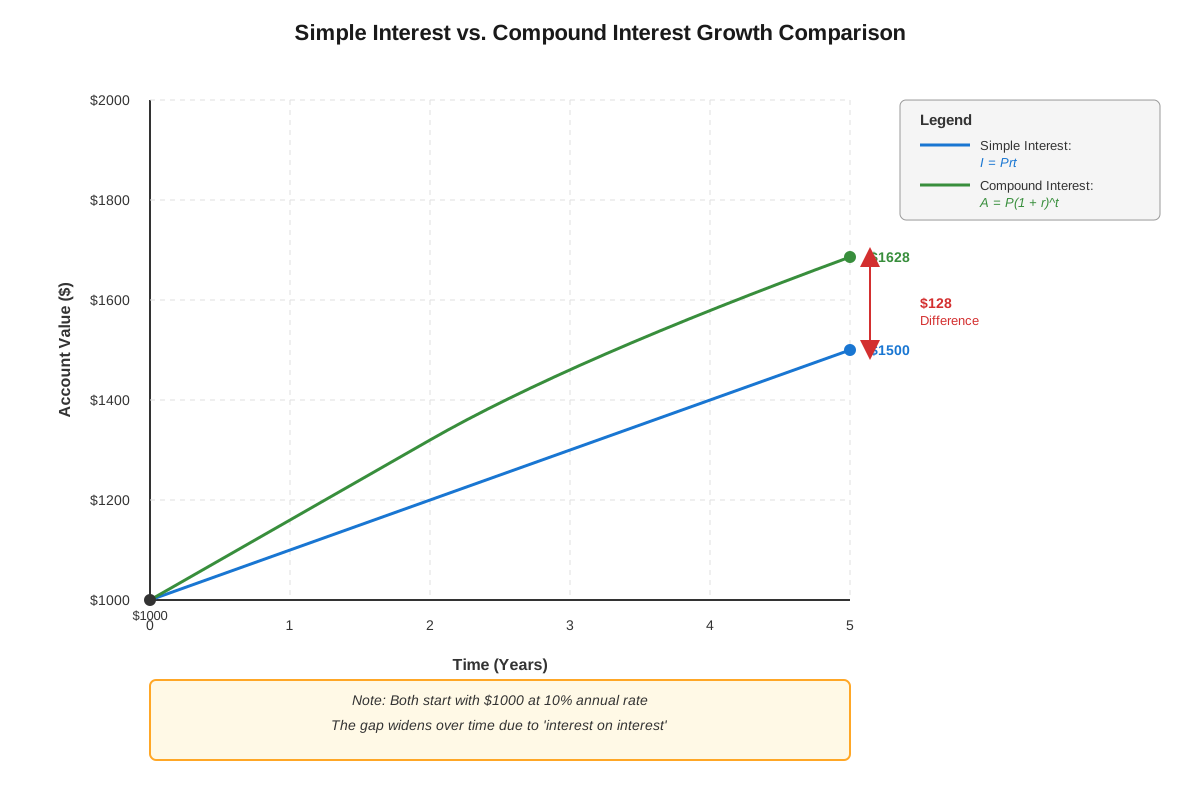
Understanding the distinction between compound and simple interest is essential for SAT success. Simple interest calculates interest only on the original principal using the formula I = Prt, where the interest earned remains constant each period. Compound interest, however, calculates interest on the growing balance, creating exponential rather than linear growth.
For example, $1,000 invested at 10% annual interest for 3 years:
- Simple interest: $1,000 + ($1,000 × 0.10 × 3) = $1,300
- Compound interest (annually): $1,000(1.10)³ = $1,331
The $31 difference represents "interest on interest"—the defining characteristic of compound interest. This gap widens dramatically over longer time periods and with more frequent compounding.
The Power of Compounding Frequency
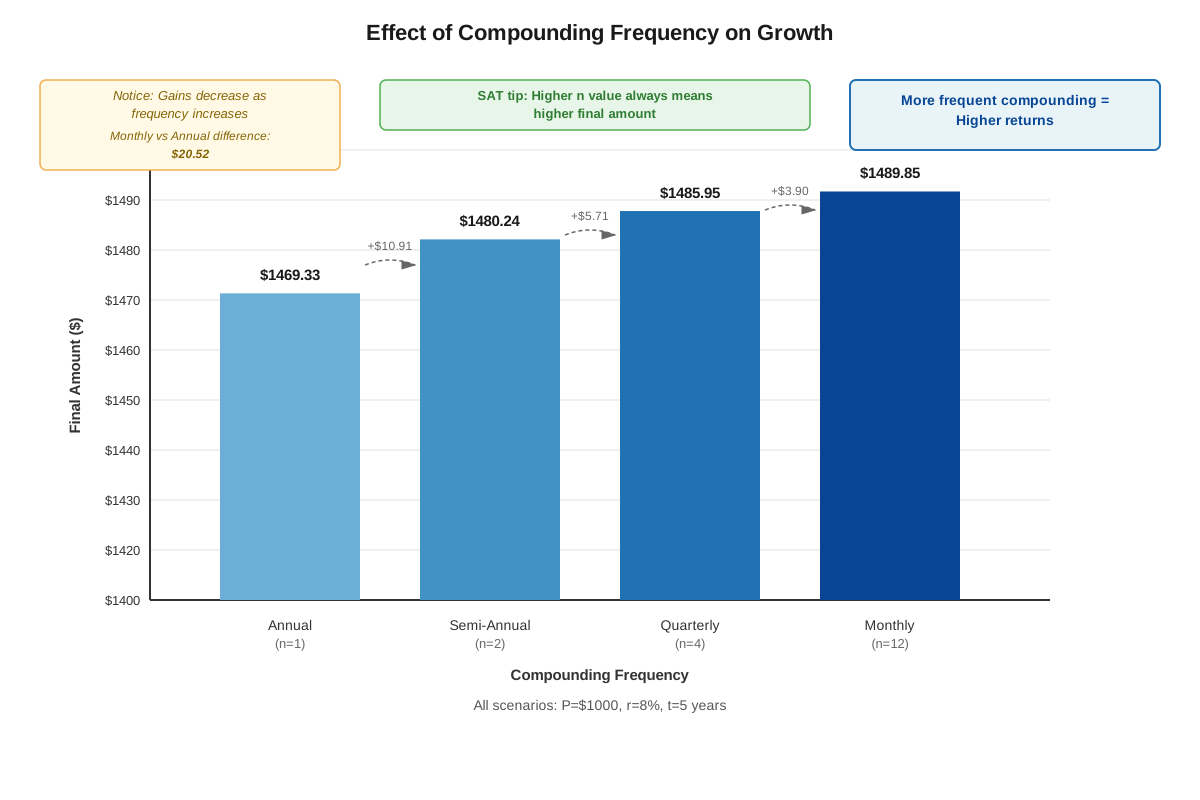
The compounding frequency significantly impacts the final amount. More frequent compounding results in higher returns because interest is calculated and added to the principal more often, creating more opportunities for "interest on interest" to accumulate.
Consider $10,000 invested at 6% annual interest for 5 years with different compounding frequencies:
- Annually (n=1): $10,000(1.06)⁵ = $13,382.26
- Semi-annually (n=2): $10,000(1.03)¹⁰ = $13,439.16
- Quarterly (n=4): $10,000(1.015)²⁰ = $13,468.55
- Monthly (n=12): $10,000(1.005)⁶⁰ = $13,488.50
While the differences may seem small, they become substantial with larger principals, higher rates, or longer time periods.
Solving for Different Variables
SAT questions may require solving for any variable in the compound interest formula. When solving for variables other than A, algebraic manipulation is necessary:
Solving for P: Divide both sides by (1 + r/n)^(nt)
P = A / (1 + r/n)^(nt)Solving for t: Requires logarithms (less common on SAT, but possible)
t = [log(A/P)] / [n × log(1 + r/n)]Solving for r: Also requires logarithms and algebraic manipulation
Most SAT questions focus on calculating A or P, as these require straightforward substitution and calculation rather than advanced algebraic techniques.
Concept Relationships
The compound interest formula represents a specific application of exponential functions, where the base (1 + r/n) remains constant and the exponent (nt) varies with time. This connects compound interest to the broader topic of exponential growth studied in algebra and precalculus courses.
Within the topic itself, the relationships flow as follows: Principal → serves as the base amount → Interest rate determines the growth factor → Compounding frequency modifies how often growth occurs → Time determines how many growth cycles occur → Final amount represents the cumulative result.
Compound interest builds directly on percentage concepts, as students must understand that interest rates represent percentages of the current balance. It also requires facility with exponents, since the formula involves raising expressions to powers. The connection to simple interest provides a comparison point that highlights the exponential nature of compound growth.
Looking forward, mastering compound interest prepares students for more advanced topics including continuous compounding (using the formula A = Pe^(rt)), present value calculations in finance, and exponential modeling in science contexts like population growth and radioactive decay. The same mathematical structure appears in these diverse applications, making compound interest a gateway to understanding exponential relationships across disciplines.
Quick check — test yourself on Compound interest basics so far.
Try Flashcards →High-Yield Facts
⭐ The compound interest formula is A = P(1 + r/n)^(nt), where each variable must be in the correct units
⭐ The interest rate r must always be expressed as a decimal, not a percentage (divide by 100)
⭐ More frequent compounding always results in a higher final amount for the same rate and time period
⭐ Time t must be expressed in years; convert months to years by dividing by 12
⭐ The exponent nt represents the total number of compounding periods over the entire time span
- Compound interest grows exponentially while simple interest grows linearly
- When n = 1 (annual compounding), the formula simplifies to A = P(1 + r)^t
- Doubling the interest rate more than doubles the final amount due to exponential growth
- The principal P represents the starting amount before any interest is applied
- To find only the interest earned (not the total amount), calculate A - P
- Semi-annual compounding means n = 2; quarterly means n = 4; monthly means n = 12
- The expression (1 + r/n) represents the growth factor for each compounding period
Common Misconceptions
Misconception: The interest rate can be used directly as a percentage in the formula (e.g., using 5 instead of 0.05 for 5%)
Correction: The rate must always be converted to decimal form by dividing the percentage by 100. Using 5 instead of 0.05 would result in a final amount that's astronomically incorrect.
Misconception: Compounding frequency n represents the number of years
Correction: The variable n represents how many times per year interest is compounded, not the total time period. The total number of compounding periods is found by multiplying n by t.
Misconception: Compound interest and simple interest produce similar results for short time periods
Correction: While the difference is smaller for shorter periods, compound interest always produces a higher return than simple interest (except in the first compounding period). The distinction is important even for short-term calculations.
Misconception: Doubling the time period doubles the final amount
Correction: Due to exponential growth, doubling the time period more than doubles the final amount because interest compounds on previously earned interest. The relationship is exponential, not linear.
Misconception: The principal P changes as interest is earned
Correction: In the formula, P always represents the original starting amount. While the account balance grows, P remains constant as the initial value. The growing balance is represented by A.
Misconception: Higher compounding frequency (like daily vs. annually) makes a dramatic difference in the final amount
Correction: While more frequent compounding does increase returns, the difference between very frequent compounding periods (like daily vs. monthly) is typically small. The most significant jump occurs between annual and more frequent compounding.
Worked Examples
Example 1: Standard Compound Interest Calculation
Problem: Sarah invests $5,000 in a savings account that pays 4% annual interest compounded quarterly. How much money will be in the account after 3 years?
Solution:
Step 1: Identify the variables from the problem
- P = $5,000 (initial investment)
- r = 4% = 0.04 (convert percentage to decimal)
- n = 4 (quarterly compounding means 4 times per year)
- t = 3 years
Step 2: Write the compound interest formula
A = P(1 + r/n)^(nt)Step 3: Substitute the values
A = 5000(1 + 0.04/4)^(4×3)Step 4: Simplify inside the parentheses
A = 5000(1 + 0.01)^(12)
A = 5000(1.01)^12
Step 5: Calculate the exponent
(1.01)^12 ≈ 1.126825Step 6: Multiply by the principal
A = 5000 × 1.126825 ≈ $5,634.13Answer: After 3 years, Sarah will have approximately $5,634.13 in her account.
Connection to Learning Objectives: This example demonstrates the application of the compound interest formula to a standard SAT-style problem, requiring identification of key features (principal, rate, time, compounding frequency) and correct substitution into the formula.
Example 2: Comparing Compounding Frequencies
Problem: Marcus has $8,000 to invest for 2 years at an annual interest rate of 6%. He's comparing two options: Bank A compounds interest semi-annually, while Bank B compounds interest monthly. How much more money will Marcus have by choosing Bank B?
Solution:
Step 1: Calculate the final amount with Bank A (semi-annual compounding)
- P = $8,000, r = 0.06, n = 2, t = 2
A₁ = 8000(1 + 0.06/2)^(2×2)
A₁ = 8000(1.03)^4
A₁ = 8000 × 1.125509
A₁ ≈ $9,004.07
Step 2: Calculate the final amount with Bank B (monthly compounding)
- P = $8,000, r = 0.06, n = 12, t = 2
A₂ = 8000(1 + 0.06/12)^(12×2)
A₂ = 8000(1.005)^24
A₂ = 8000 × 1.127160
A₂ ≈ $9,017.28
Step 3: Find the difference
Difference = $9,017.28 - $9,004.07 = $13.21Answer: Marcus will have $13.21 more by choosing Bank B with monthly compounding.
Connection to Learning Objectives: This problem requires students to apply the compound interest formula with different compounding frequencies and compare results—a common SAT question type that tests understanding of how compounding frequency affects final amounts.
Exam Strategy
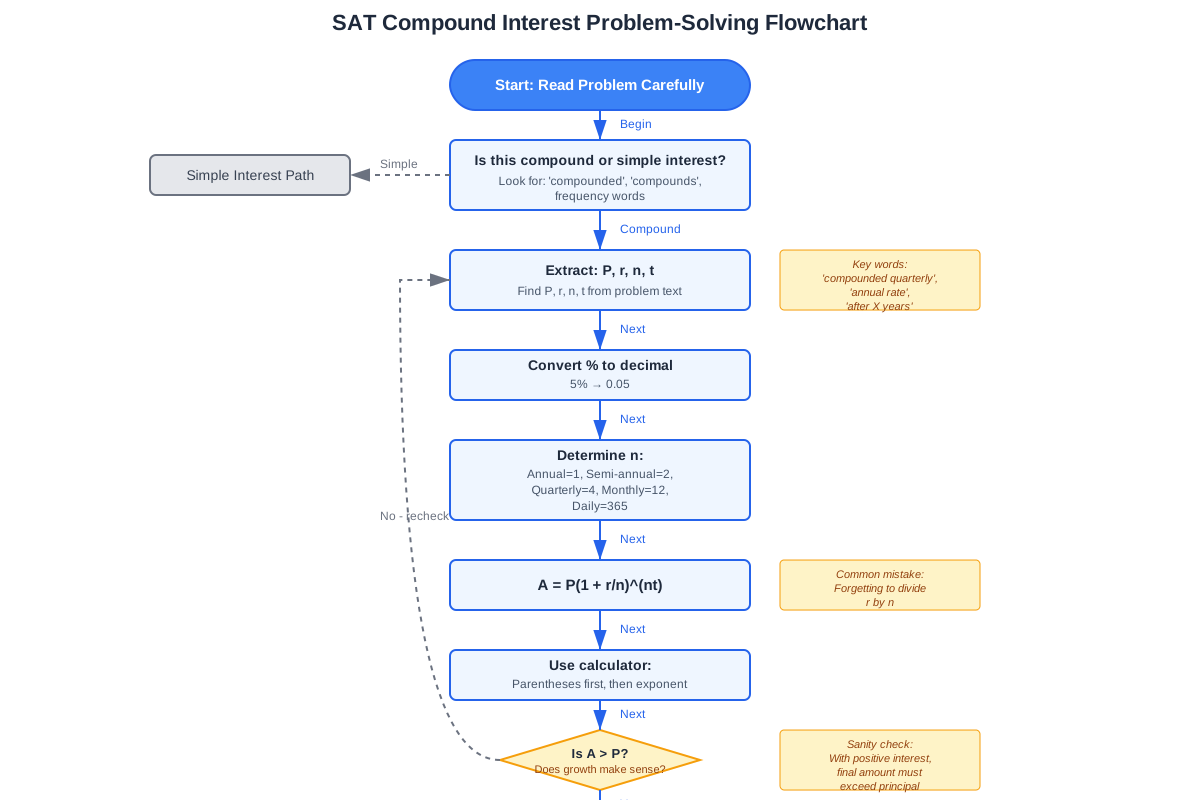
When approaching SAT compound interest basics questions, begin by carefully reading the problem to identify all five variables. Create a small table or list noting P, r, n, t, and which variable you're solving for. This organized approach prevents confusion and ensures you don't miss critical information.
Trigger words and phrases to watch for include:
- "Compounded quarterly/monthly/semi-annually" → determines n value
- "Annual interest rate" → this is your r value (remember to convert to decimal)
- "Initial investment/deposit" → this is your principal P
- "After X years/months" → this is your time t (convert months to years if necessary)
- "Total amount/final balance" → this is A, what you're typically solving for
For process-of-elimination on multiple-choice questions, use these strategies:
- Eliminate answers that are less than the principal (unless the problem involves decay or fees)
- Eliminate answers that equal simple interest calculations (compound interest always yields more)
- Check if answers make sense with the magnitude of the rate and time (10% for 10 years should roughly double the principal)
- Verify that your answer is greater than what you'd get with less frequent compounding
Time allocation: Compound interest problems typically require 1.5-2 minutes. Spend 30 seconds identifying variables and setting up the formula, 60 seconds calculating (use your calculator efficiently), and 30 seconds checking your answer's reasonableness. If a problem asks you to solve for an unusual variable like t or r, it may require more time—consider marking it and returning if needed.
Exam Tip: Always double-check that you've converted the interest rate to decimal form and that time is in years. These are the two most common errors on SAT compound interest questions.
Memory Techniques
Formula Memory: Remember "All People Really Need Time" to recall the variables in order: A, P, r, n, t.
Compounding Frequency: Use the mnemonic "Ants Sometimes Quickly March Daily" to remember the common frequencies and their n values:
- Annually = 1
- Semi-annually = 2
- Quarterly = 4
- Monthly = 12
- Daily = 365
Visualization Strategy: Picture compound interest as a snowball rolling down a hill. The snowball (principal) starts small, but as it rolls (time passes), it picks up more snow (interest). The snow it picks up also picks up more snow (interest on interest), making it grow exponentially faster. More frequent compounding is like a steeper hill—the snowball grows faster.
Rate Conversion Reminder: Think "Percent to Decimal: Divide by 100" (PD = D/100). The alliteration helps cement this crucial conversion step.
Summary
Compound interest represents exponential growth where interest is calculated on both the principal and previously accumulated interest, distinguishing it fundamentally from linear simple interest growth. The formula A = P(1 + r/n)^(nt) encapsulates this relationship, with each variable playing a specific role: P establishes the starting point, r determines the growth rate, n controls how frequently growth occurs, t extends the growth period, and A represents the final accumulated value. Success on SAT compound interest questions requires accurate identification of these variables from word problems, proper unit conversions (percentages to decimals, months to years), and careful calculation using the exponential formula. Understanding that more frequent compounding produces higher returns and that compound interest grows exponentially rather than linearly enables students to estimate reasonable answers and catch calculation errors. This topic integrates percentage concepts, algebraic manipulation, and exponential functions while testing practical mathematical reasoning—making it a high-value area for SAT preparation.
Key Takeaways
- The compound interest formula A = P(1 + r/n)^(nt) is essential to memorize with all variables clearly understood
- Always convert interest rates from percentages to decimals by dividing by 100
- Compounding frequency (n) significantly impacts final amounts: more frequent compounding yields higher returns
- Time must be expressed in years; convert months by dividing by 12
- Compound interest grows exponentially, not linearly, creating "interest on interest" that accelerates growth over time
- The exponent nt represents the total number of compounding periods throughout the investment or loan term
- SAT questions typically require straightforward substitution and calculation, though some may ask for comparisons between different scenarios
Related Topics
Exponential Functions: Compound interest is a specific application of exponential growth functions. Mastering compound interest provides concrete context for understanding abstract exponential relationships, including growth and decay models used in science and economics.
Logarithms: Solving for time or rate in compound interest problems requires logarithmic functions. While less common on the SAT, understanding this connection prepares students for advanced mathematics and demonstrates the inverse relationship between exponentials and logarithms.
Simple Interest: Comparing simple and compound interest reinforces understanding of linear versus exponential growth. This comparison frequently appears on the SAT and in real-world financial decisions.
Percentage Applications: Compound interest builds on foundational percentage skills including percent increase, percent decrease, and successive percentage changes—all common SAT topics that share underlying mathematical principles.
Financial Mathematics: Beyond the SAT, compound interest forms the foundation for understanding present value, future value, annuities, and loan amortization—essential concepts for personal finance and business mathematics.
Practice CTA
Now that you've mastered the core concepts of compound interest, it's time to solidify your understanding through active practice. Attempt the practice questions to apply these formulas to diverse SAT-style scenarios, and use the flashcards to reinforce key definitions and relationships. Remember, compound interest questions integrate multiple mathematical skills, so each practice problem strengthens not just this topic but your overall mathematical reasoning. The investment you make in practice now will compound into higher scores on test day—just like the interest you've learned to calculate!
Sign up free to keep reading
Create a free AnvayaPrep account to finish this SAT guide on Compound interest basics — plus flashcards and practice questions.