Overview
Simple interest is a fundamental financial mathematics concept that appears regularly on the SAT and forms the foundation for understanding how money grows over time. Unlike compound interest, where interest accumulates on both principal and previously earned interest, simple interest calculates earnings based solely on the original principal amount throughout the entire investment or loan period. This straightforward calculation method makes it an ideal entry point for students learning about financial mathematics and percentage applications.
Understanding simple interest is essential for SAT success because it bridges multiple mathematical domains tested on the exam. Questions involving simple interest require students to manipulate algebraic formulas, work with percentages, solve for unknown variables, and interpret real-world scenarios—all core competencies the SAT assesses. The College Board frequently embeds simple interest problems within word problems that test both mathematical reasoning and reading comprehension, making this topic a high-yield area for score improvement.
The concept connects directly to broader math topics including linear relationships, proportional reasoning, and algebraic equation solving. Simple interest problems often appear in the calculator and no-calculator sections of the SAT Math test, typically as part of the Problem Solving and Data Analysis or Heart of Algebra domains. Mastering this topic not only helps students answer direct simple interest questions but also builds the foundational understanding needed for more complex financial mathematics, including compound interest, exponential growth, and investment analysis that may appear in advanced problems.
Learning Objectives
- [ ] Identify key features of simple interest including principal, rate, time, and total interest earned
- [ ] Explain how simple interest appears on the SAT in various question formats and contexts
- [ ] Apply simple interest formulas to answer SAT-style questions accurately and efficiently
- [ ] Solve for any variable in the simple interest formula when given the other three values
- [ ] Distinguish between simple interest and compound interest scenarios in word problems
- [ ] Calculate total amount (principal plus interest) after a specified time period
- [ ] Convert between different time units (months, years) and interest rate formats (decimal, percentage)
Prerequisites
- Percentage calculations: Converting between decimals, fractions, and percentages is essential since interest rates are expressed as percentages but used as decimals in calculations
- Basic algebra: Solving linear equations for unknown variables is required to find principal, rate, time, or interest when other values are given
- Unit conversion: Understanding how to convert between time units (days, months, years) ensures accurate calculations across different problem formats
- Proportional reasoning: Recognizing direct proportional relationships helps students understand how interest scales with principal, rate, and time
Why This Topic Matters
Simple interest calculations appear in everyday financial decisions that students will encounter throughout their lives. From understanding credit card minimum payments to evaluating savings account returns, car loans, student loans, and short-term investments, the ability to calculate simple interest empowers informed financial decision-making. Banks, credit unions, and lending institutions frequently use simple interest for short-term loans, making this knowledge immediately practical for young adults entering the financial world.
On the SAT, simple interest questions appear with moderate frequency—typically 1-2 questions per test administration. These questions most commonly appear in the Problem Solving and Data Analysis domain but can also surface in Heart of Algebra sections. The College Board values simple interest problems because they assess multiple competencies simultaneously: algebraic manipulation, percentage fluency, real-world problem interpretation, and logical reasoning. Questions may ask students to calculate interest earned, determine the principal amount needed to reach a savings goal, find the interest rate required for specific returns, or calculate the time needed for an investment to generate target earnings.
Common SAT presentations include: word problems describing savings accounts or loans; tables showing investment scenarios requiring calculation of missing values; multi-step problems where simple interest is one component of a larger question; and comparison problems asking students to evaluate different investment or loan options. The topic frequently appears in questions worth 1 point in both calculator-permitted and no-calculator sections, making it accessible yet valuable for score improvement.
Core Concepts
The Simple Interest Formula
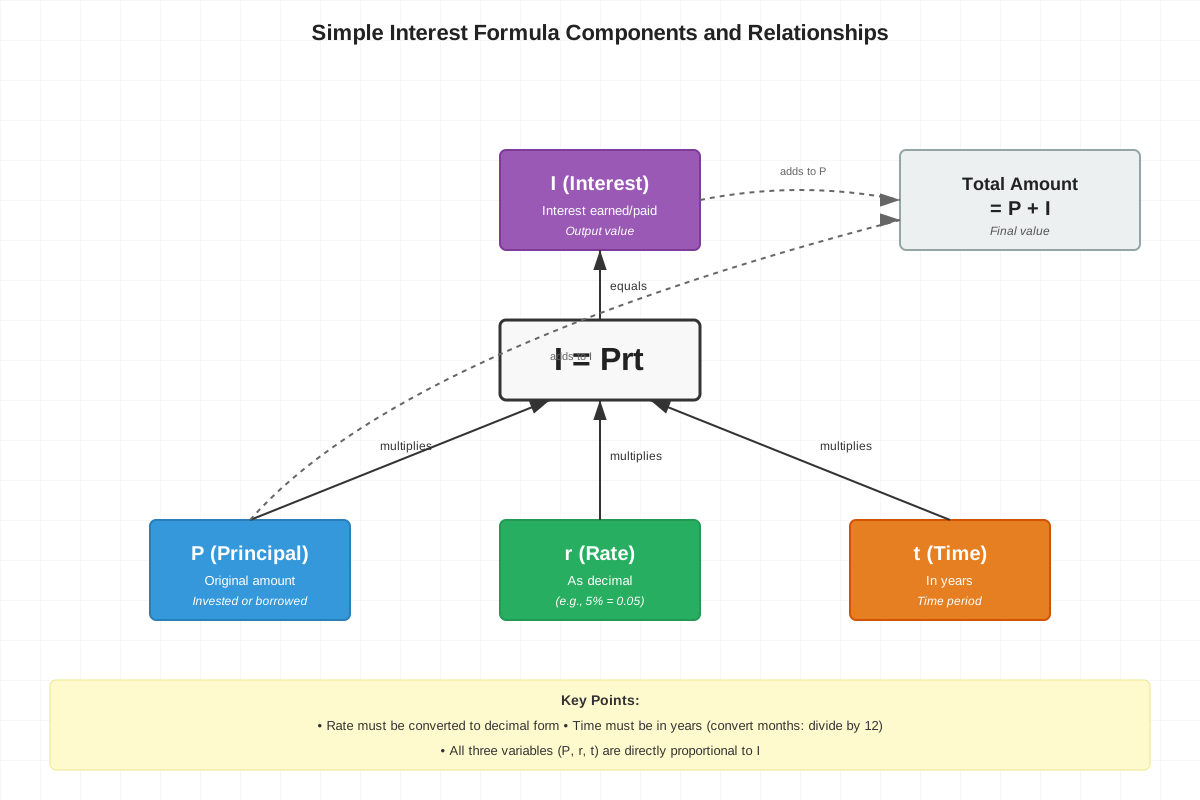
The foundation of all simple interest calculations is the simple interest formula:
I = P × r × tWhere:
- I = Interest earned (or paid)
- P = Principal (the original amount invested or borrowed)
- r = Annual interest rate (expressed as a decimal)
- t = Time (expressed in years)
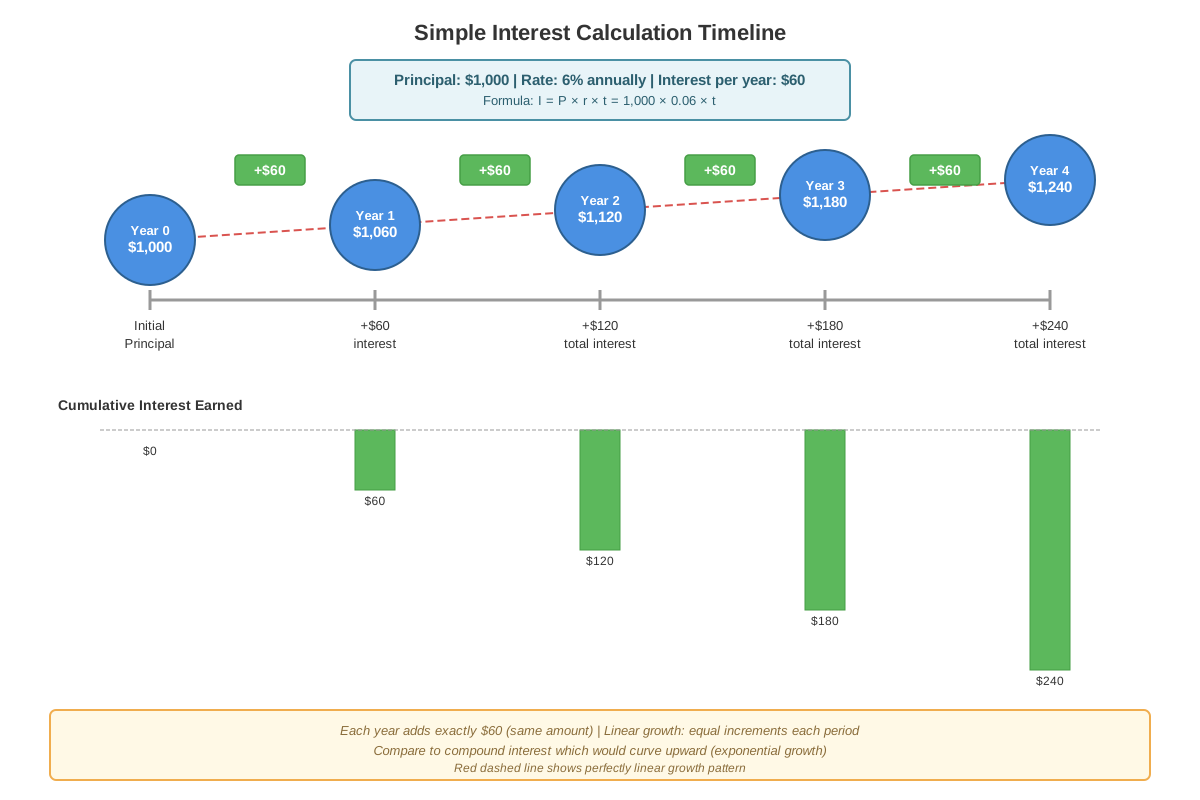
This formula calculates only the interest amount, not the total value of the investment. The interest earned remains constant for each time period because it's always calculated on the original principal, never on accumulated interest. This linear relationship distinguishes simple interest from exponential compound interest growth.
Understanding Each Variable
Principal (P): The principal represents the initial amount of money invested, deposited, or borrowed. On the SAT, this might be described as "initial investment," "starting balance," "loan amount," or "original deposit." The principal never changes throughout the simple interest calculation period—it remains constant regardless of how much interest accumulates.
Rate (r): The interest rate indicates the percentage of the principal earned (or charged) per year. Critical for SAT success: rates are given as percentages (like 5%) but must be converted to decimals (0.05) before using the formula. The rate is always annual unless explicitly stated otherwise. If a problem mentions "5% annual interest rate," convert 5% to 0.05 by dividing by 100.
Time (t): Time represents the duration the money is invested or borrowed, measured in years for the standard formula. When problems give time in months, convert to years by dividing by 12. For days, divide by 365. Maintaining consistent time units is crucial for accurate calculations. If the rate is annual, time must be in years; if the rate is monthly, time must be in months.
Interest (I): The interest is the amount earned on the investment or charged on the loan. This is separate from the total amount. Students often confuse interest with total value, but interest represents only the earnings, not the principal plus earnings.
Total Amount Formula
To find the total amount (A) after earning interest, add the interest to the principal:
A = P + ISubstituting the simple interest formula:
A = P + (P × r × t)Factoring out P:
A = P(1 + rt)This combined formula allows direct calculation of the final account balance or total loan repayment amount. On the SAT, questions may ask for either the interest earned or the total amount, so recognizing which value the question requests is essential.
Solving for Different Variables
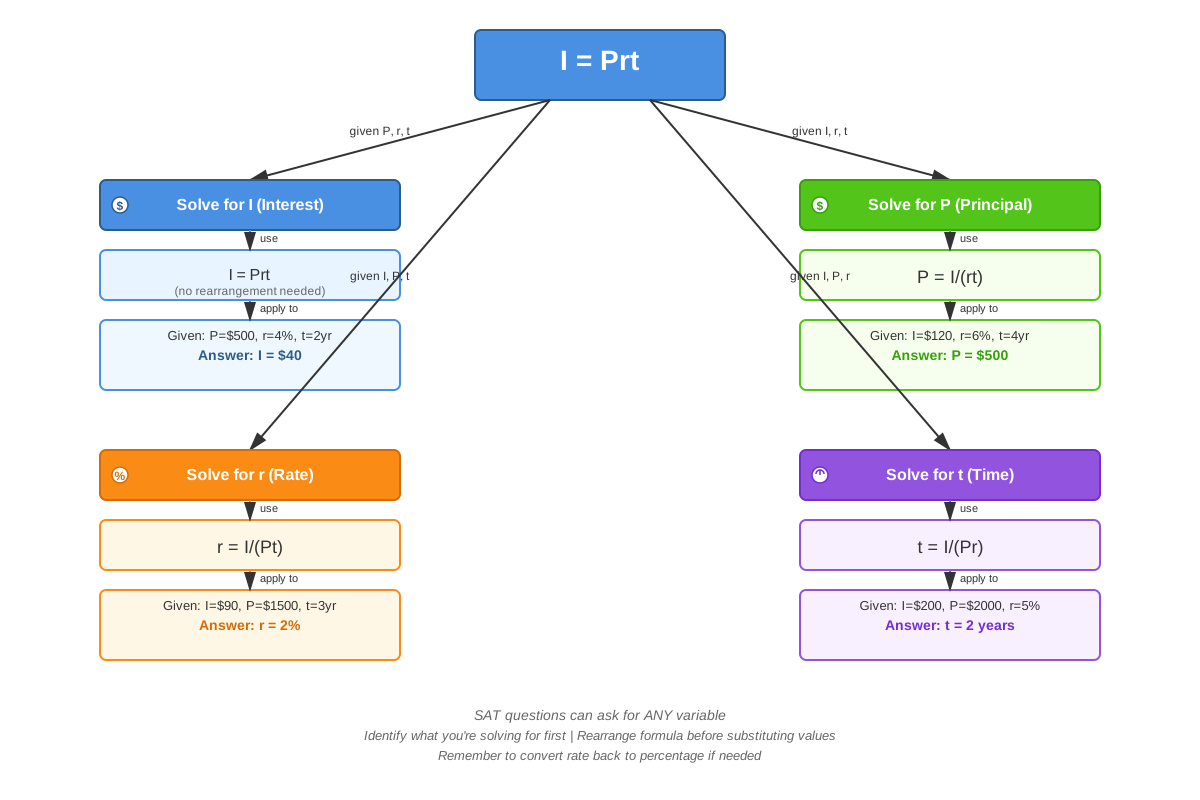
The simple interest formula can be rearranged to solve for any variable when the other three are known:
| To Find | Formula | When to Use |
|---|---|---|
| Interest (I) | I = P × r × t | Given principal, rate, and time |
| Principal (P) | P = I ÷ (r × t) | Given interest earned, rate, and time |
| Rate (r) | r = I ÷ (P × t) | Given interest earned, principal, and time |
| Time (t) | t = I ÷ (P × r) | Given interest earned, principal, and rate |
SAT questions frequently test whether students can manipulate the formula algebraically to isolate the desired variable. Practice rearranging the formula before test day to build fluency and confidence.
Time Period Conversions
Since the standard simple interest formula uses annual rates and time in years, converting time periods is a frequent requirement:
- Months to years: Divide months by 12 (6 months = 6/12 = 0.5 years)
- Days to years: Divide days by 365 (180 days = 180/365 ≈ 0.493 years)
- Quarters to years: Divide quarters by 4 (3 quarters = 3/4 = 0.75 years)
Alternatively, if working with monthly rates, convert time to months and use the monthly rate (annual rate ÷ 12). However, the SAT typically provides annual rates, making year-based calculations standard.
Linear Growth Pattern
Simple interest creates a linear growth pattern because the same amount of interest is earned each period. If an investment earns $50 interest per year, it will earn exactly $50 every year regardless of how long the money remains invested. Graphing total amount versus time produces a straight line with slope equal to P × r. This linear relationship contrasts sharply with compound interest's exponential curve, a distinction the SAT may test through comparison questions.
Concept Relationships
The simple interest formula demonstrates a direct proportional relationship among its variables. If the principal doubles while rate and time remain constant, the interest earned doubles. Similarly, doubling the rate or time doubles the interest. This multiplicative relationship means students can use proportional reasoning to check answers or solve problems mentally.
Simple interest connects to percentage calculations because the rate represents a percentage of the principal. Every simple interest problem is fundamentally a percentage problem: "What is r% of P for t years?" This connection reinforces percentage fluency, a high-yield SAT skill across multiple question types.
The topic builds directly on algebraic equation solving. When SAT questions ask students to find the principal needed to earn specific interest, they're testing the ability to set up and solve equations: I = P × r × t becomes P = I/(r × t). This algebraic manipulation skill transfers to countless other SAT math problems.
Relationship map:
Percentages → convert to decimals → plug into simple interest formula → calculate interest → add to principal → find total amount. Alternatively: Given total amount → subtract principal → find interest → use algebra to solve for unknown variable (P, r, or t).
Simple interest also connects to linear functions in algebra. The total amount formula A = P(1 + rt) is a linear function of time when P and r are constants, with y-intercept P and slope P × r. Recognizing this connection helps students understand why simple interest graphs as a straight line.
High-Yield Facts
⭐ The simple interest formula is I = P × r × t, where I is interest, P is principal, r is rate (as a decimal), and t is time in years
⭐ Interest rates must be converted from percentages to decimals before using the formula (divide by 100)
⭐ Total amount equals principal plus interest: A = P + I or A = P(1 + rt)
⭐ Time must be expressed in years when using an annual interest rate; convert months by dividing by 12
⭐ Simple interest is calculated only on the original principal, never on accumulated interest
- The interest earned per year remains constant throughout the investment period (linear growth)
- To find principal when given interest, rate, and time: P = I/(r × t)
- To find rate when given interest, principal, and time: r = I/(P × t)
- To find time when given interest, principal, and rate: t = I/(P × r)
- Simple interest problems often appear as word problems requiring translation of real-world scenarios into mathematical formulas
- A 6-month investment at an annual rate uses t = 0.5 years in the formula
- Doubling the principal, rate, or time doubles the interest earned (direct proportion)
- The SAT may present simple interest in tables requiring calculation of missing values
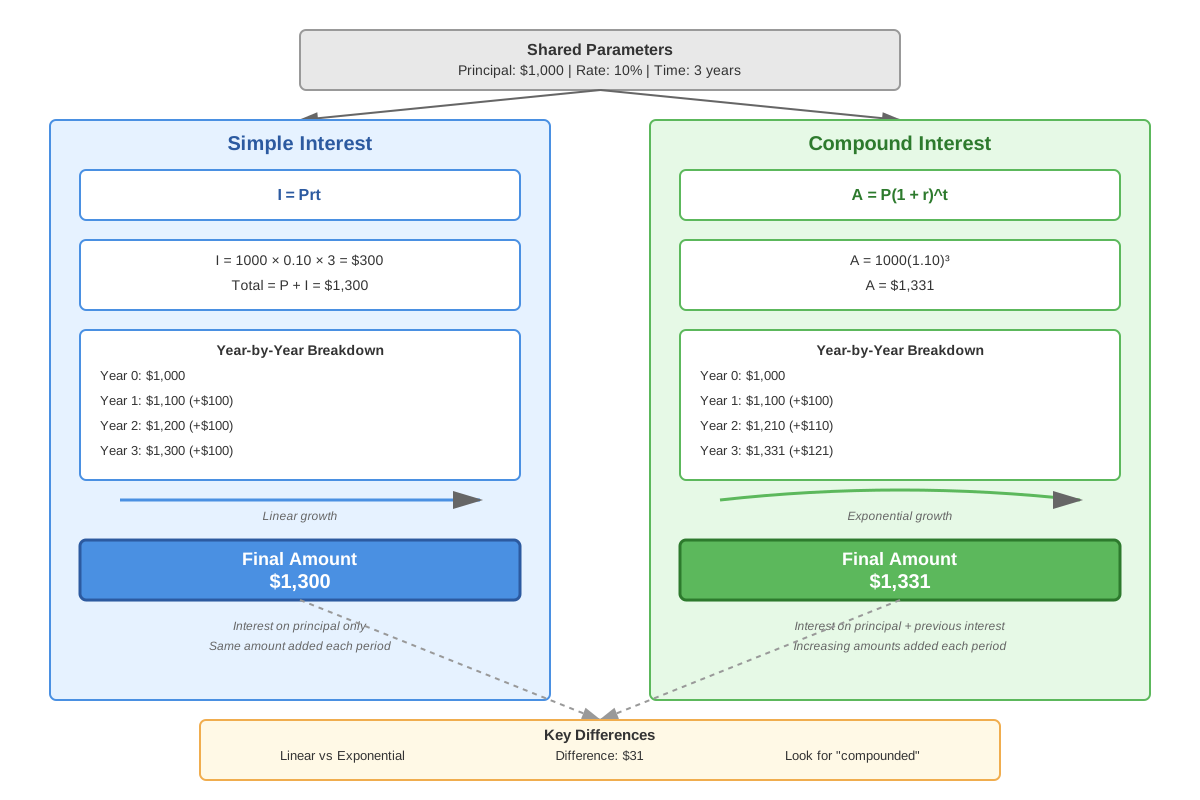
- Simple interest differs from compound interest, which calculates interest on interest
- Reading carefully to distinguish between "interest earned" and "total amount" prevents common errors
Quick check — test yourself on Simple interest so far.
Try Flashcards →Common Misconceptions
Misconception: The interest rate can be used directly as given in percentage form (e.g., using 5 instead of 0.05 for 5%)
Correction: Interest rates must always be converted to decimal form before using the simple interest formula. Divide the percentage by 100: 5% becomes 0.05, 12% becomes 0.12, and 0.5% becomes 0.005.
Misconception: The formula calculates the total amount in the account after earning interest
Correction: The formula I = P × r × t calculates only the interest earned, not the total. To find the total amount, add the interest to the principal: A = P + I. Many SAT questions specifically ask for total amount, making this distinction critical.
Misconception: Time can be used in any unit (months, days) without conversion
Correction: When using an annual interest rate, time must be converted to years. Six months must be expressed as 0.5 years (6/12), not as 6. Failing to convert time units is one of the most common errors on SAT simple interest problems.
Misconception: Simple interest and compound interest are the same thing
Correction: Simple interest calculates interest only on the original principal throughout the entire period, creating linear growth. Compound interest calculates interest on the principal plus previously earned interest, creating exponential growth. The SAT may test whether students recognize which type applies to a given scenario.
Misconception: The principal changes as interest is earned
Correction: In simple interest calculations, the principal remains constant. The same principal amount is used to calculate interest for every time period. Even though the total account value increases, the principal used in the formula never changes.
Misconception: A higher interest rate always means more money earned
Correction: While a higher rate increases interest when other factors are equal, the actual interest earned depends on all three variables (P, r, and t). A lower rate on a larger principal for a longer time can yield more interest than a higher rate on a smaller principal for a shorter time.
Worked Examples
Example 1: Finding Interest Earned
Problem: Sarah invests $2,500 in a savings account that pays 4% simple interest per year. How much interest will she earn after 3 years?
Solution:
Step 1: Identify the given values
- Principal (P) = $2,500
- Rate (r) = 4% = 0.04 (convert to decimal)
- Time (t) = 3 years
Step 2: Apply the simple interest formula
I = P × r × t
I = 2,500 × 0.04 × 3
I = 2,500 × 0.12
I = 300
Step 3: Interpret the result
Sarah will earn $300 in interest after 3 years.
Connection to learning objectives: This problem demonstrates the fundamental application of the simple interest formula, requiring students to identify key features (principal, rate, time) and apply the formula correctly—core SAT skills.
Example 2: Finding Principal with Time Conversion
Problem: Marcus wants to earn $180 in interest over 8 months. If the annual simple interest rate is 6%, how much money must he invest?
Solution:
Step 1: Identify and convert given values
- Interest (I) = $180
- Rate (r) = 6% = 0.06 (convert to decimal)
- Time (t) = 8 months = 8/12 years = 2/3 years ≈ 0.667 years
Step 2: Rearrange the formula to solve for P
I = P × r × t
P = I ÷ (r × t)
Step 3: Substitute and calculate
P = 180 ÷ (0.06 × 2/3)
P = 180 ÷ (0.06 × 0.667)
P = 180 ÷ 0.04
P = 4,500
Step 4: Interpret the result
Marcus must invest $4,500 to earn $180 in interest over 8 months at 6% annual simple interest.
Connection to learning objectives: This problem requires solving for an unknown variable (principal), converting time units (months to years), and demonstrates how SAT questions test multiple skills simultaneously. Students must recognize that the question asks for principal, not interest, and must algebraically manipulate the formula.
Example 3: Finding Total Amount
Problem: A loan of $8,000 charges 5.5% simple interest annually. What is the total amount that must be repaid after 2.5 years?
Solution:
Step 1: Identify given values
- Principal (P) = $8,000
- Rate (r) = 5.5% = 0.055
- Time (t) = 2.5 years
Step 2: Calculate interest earned
I = P × r × t
I = 8,000 × 0.055 × 2.5
I = 8,000 × 0.1375
I = 1,100
Step 3: Calculate total amount
A = P + I
A = 8,000 + 1,100
A = 9,100
Alternatively, using the combined formula:
A = P(1 + rt)
A = 8,000(1 + 0.055 × 2.5)
A = 8,000(1 + 0.1375)
A = 8,000(1.1375)
A = 9,100
Step 4: Interpret the result
The total amount to be repaid is $9,100.
Connection to learning objectives: This problem distinguishes between interest earned and total amount, a critical distinction on SAT questions. It also demonstrates the alternative formula A = P(1 + rt), which can save time on certain problems.
Exam Strategy
When approaching SAT simple interest questions, begin by carefully reading the problem to identify what the question asks for: interest earned, total amount, principal, rate, or time. Circle or underline the target variable to maintain focus throughout the calculation. Many students calculate interest when the question asks for total amount, or vice versa—a preventable error that costs points.
Trigger words and phrases to watch for:
- "Interest earned" or "interest paid" → calculate I only
- "Total amount," "final balance," or "amount repaid" → calculate A = P + I
- "Initial investment," "original deposit," or "loan amount" → identifies principal (P)
- "Annual rate," "yearly rate," or "per year" → confirms rate is annual
- "After X months" → requires time conversion to years
Create a systematic approach: (1) List all given values with their variable names, (2) Convert percentages to decimals and time to years, (3) Identify which variable to solve for, (4) Write the appropriate formula, (5) Substitute and calculate, (6) Check that your answer makes logical sense.
For process-of-elimination on multiple-choice questions, use estimation. If $1,000 is invested at 5% for 2 years, the interest should be approximately $100 (1,000 × 0.05 × 2). Eliminate answers that are wildly different. Also eliminate answers that are smaller than the principal when the question asks for total amount—the total must always exceed the principal.
Time allocation: Simple interest problems typically require 1-2 minutes. If a problem involves only direct formula application, aim for 60-90 seconds. Multi-step problems requiring algebraic manipulation may take 2-3 minutes. If you're stuck after 2 minutes, mark the question and return to it later—don't let one problem consume excessive time.
Use the calculator strategically. For the calculator section, let the calculator handle decimal multiplication, but set up the problem correctly first. For no-calculator sections, look for opportunities to simplify before multiplying (e.g., 2,500 × 0.04 × 3 = 2,500 × 0.12 = 250 × 1.2 = 300).
Memory Techniques
Formula mnemonic: Remember "I PeRT" to recall I = P × r × t. Think of "I'm PERT" (alert and lively) about earning interest on my money.
Rate conversion reminder: "Percent to Decimal: Divide by 100" or use the phrase "Percent Drops Two" (the decimal point moves two places left: 5% → 0.05).
Time conversion visualization: Picture a calendar with 12 months. When converting months to years, you're asking "how many 12-month groups?" This reinforces dividing by 12.
Interest vs. Total Amount: Use the phrase "Interest is Extra" to remember that interest is only the earnings, not the total. The total is Principal Plus the Prize (interest is the prize for investing).
Variable relationships: Create a mental image of a multiplication chain: Principal × Rate × Time = Interest. Each link must be present for the chain to work. If one link is missing, you can find it by dividing the product by the other two links.
Acronym for problem-solving steps: WRITE
- What is the question asking for?
- Record all given values
- Identify the formula needed
- Transform (convert percentages and time units)
- Evaluate and check your answer
Summary
Simple interest represents one of the most straightforward yet high-yield topics on the SAT Math section, testing students' ability to apply the formula I = P × r × t to calculate interest earned on investments or charged on loans. Success requires fluency in converting percentages to decimals, expressing time in years, and algebraically manipulating the formula to solve for any variable. The distinction between interest earned (I) and total amount (A = P + I) is critical, as SAT questions deliberately test whether students recognize which value is requested. Simple interest creates linear growth because interest is calculated only on the original principal, never on accumulated interest, differentiating it from compound interest's exponential pattern. Mastery involves not just memorizing the formula but understanding the proportional relationships among variables, efficiently converting units, and systematically approaching word problems that embed simple interest within real-world financial scenarios. Students who can quickly identify given values, select the appropriate formula variation, and accurately calculate while avoiding common pitfalls will confidently handle the 1-2 simple interest questions that typically appear on each SAT administration.
Key Takeaways
- The simple interest formula I = P × r × t calculates only the interest earned, not the total amount; add interest to principal for total: A = P + I
- Always convert percentage rates to decimals by dividing by 100 before using the formula (5% becomes 0.05)
- Time must be expressed in years when using annual rates; convert months by dividing by 12
- The formula can be algebraically rearranged to solve for any variable: P = I/(rt), r = I/(Pt), or t = I/(Pr)
- Simple interest creates linear growth with constant interest per period, distinguishing it from compound interest
- Carefully read whether questions ask for interest earned or total amount—this distinction appears frequently on the SAT
- Use proportional reasoning to check answers: doubling principal, rate, or time should double the interest
Related Topics
Compound Interest: After mastering simple interest, compound interest represents the next level of financial mathematics, where interest is calculated on both principal and previously earned interest, creating exponential growth. Understanding simple interest provides the foundation for grasping why compound interest grows faster.
Exponential Functions: Compound interest problems connect to exponential functions of the form A = P(1 + r)^t, extending the linear simple interest model to exponential growth patterns frequently tested in SAT algebra questions.
Percent Increase and Decrease: Simple interest reinforces percentage calculations in a financial context, building skills that transfer to percent change problems, markup/discount scenarios, and data analysis questions throughout the SAT Math section.
Linear Functions and Graphing: The total amount formula A = P(1 + rt) represents a linear function, connecting simple interest to coordinate geometry and function interpretation questions that may appear on the SAT.
Systems of Equations: Advanced SAT problems may present scenarios with multiple investments at different rates, requiring students to set up and solve systems of equations using simple interest formulas.
Practice CTA
Now that you've mastered the core concepts of simple interest, it's time to solidify your understanding through active practice. Attempt the practice questions to apply these formulas to SAT-style problems, testing your ability to identify variables, convert units, and solve for unknowns under timed conditions. Use the flashcards to reinforce the formula, conversion techniques, and common pitfalls until they become automatic. Remember: understanding the concept is the first step, but fluency comes from repeated application. Every practice problem you solve builds the confidence and speed you'll need to excel on test day. You've got this—simple interest questions are highly predictable and completely conquerable with focused practice!
Sign up free to keep reading
Create a free AnvayaPrep account to finish this SAT guide on Simple interest — plus flashcards and practice questions.