Overview
Data percent questions are among the most frequently tested problem types in the SAT math section, appearing in both the calculator and no-calculator portions of the exam. These questions require students to interpret numerical information presented in various formats—including tables, charts, graphs, and written descriptions—and then calculate percentages, percent changes, or proportions based on that data. Unlike straightforward percentage calculations, sat data percent questions integrate data literacy with computational skills, testing both the ability to extract relevant information from complex presentations and the mathematical reasoning needed to solve multi-step problems.
Mastering data percent questions is essential for SAT success because they represent a convergence of several mathematical competencies: proportional reasoning, data interpretation, and algebraic manipulation. The College Board consistently includes 3-5 questions of this type on each SAT administration, making them high-yield content for test preparation. These questions often appear in the Problem Solving and Data Analysis domain, which comprises approximately 29% of the total math score. Students who struggle with data percent questions typically lose points not because they lack percentage calculation skills, but because they misinterpret the data source, select incorrect values, or fail to recognize what the question is actually asking.
The relationship between data percent questions and broader mathematical concepts is significant. These problems build upon foundational percentage skills while incorporating elements of ratio and proportion, statistical reasoning, and real-world modeling. They serve as a bridge between pure computational mathematics and applied problem-solving, preparing students for the data-rich environments they'll encounter in college coursework and professional settings. Additionally, proficiency with these questions strengthens skills needed for other SAT math topics, including linear relationships, scatterplots, and two-way tables.
Learning Objectives
- [ ] Identify key features of data percent questions, including data sources, question types, and common formats
- [ ] Explain how data percent questions appear on the SAT, including typical contexts and presentation styles
- [ ] Apply data percent questions strategies to answer SAT-style questions accurately and efficiently
- [ ] Distinguish between percent of a quantity, percent change, and percent comparison problems
- [ ] Extract relevant numerical information from tables, graphs, and text-based data presentations
- [ ] Execute multi-step calculations involving percentages while maintaining accuracy with units and context
- [ ] Evaluate answer choices using estimation and reasonableness checks specific to percentage problems
Prerequisites
- Basic percentage calculations: Understanding how to convert between percentages, decimals, and fractions is fundamental to solving any data percent question efficiently
- Proportional reasoning: The ability to set up and solve proportions underlies all percentage work, as percentages are fundamentally ratios out of 100
- Reading tables and graphs: Since data percent questions present information visually, students must be comfortable extracting specific values from various data displays
- Order of operations: Multi-step percentage problems require careful sequencing of calculations to avoid errors
- Basic algebra: Many data percent questions involve setting up equations with variables to represent unknown quantities
Why This Topic Matters
Data percent questions reflect real-world quantitative literacy skills that extend far beyond standardized testing. In everyday life, people encounter percentage-based information constantly: sales discounts, tax calculations, investment returns, population statistics, survey results, and scientific data. The ability to interpret data presentations and calculate meaningful percentages is essential for informed citizenship, financial decision-making, and professional competence across virtually all career fields. Medical professionals calculate dosage adjustments, business analysts track growth rates, scientists report experimental results, and policy makers interpret demographic trends—all using the exact skills tested in SAT data percent questions.
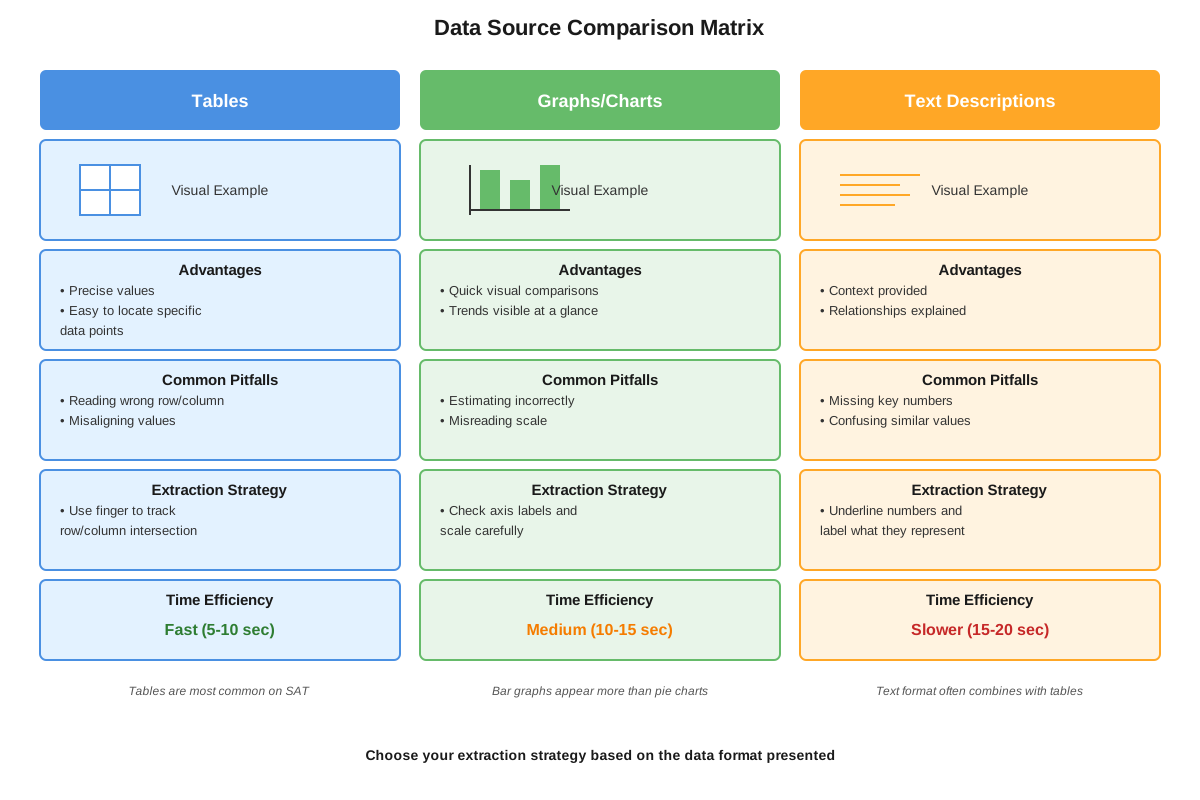
On the SAT specifically, data percent questions appear with remarkable consistency. Approximately 3-5 questions per test directly assess these skills, accounting for roughly 5-8% of the total math score. These questions appear in both multiple-choice and student-produced response (grid-in) formats, with the majority being multiple-choice. The College Board favors certain contexts repeatedly: consumer scenarios (prices, discounts, sales), demographic data (population changes, survey results), scientific measurements (experimental outcomes, statistical studies), and business metrics (revenue, profit margins, growth rates). Questions typically present data in tables (40% of the time), bar graphs (25%), text descriptions (20%), or circle graphs (15%).
The exam frequently combines data percent questions with other mathematical skills, creating compound problems that test multiple competencies simultaneously. A single question might require students to read a two-way table, calculate a percentage, and then use that result in a proportion. This integration makes data percent questions particularly valuable for score improvement—mastering them enhances performance across multiple problem types and demonstrates the mathematical maturity that distinguishes high-scoring students.
Core Concepts
Understanding Data Percent Question Types
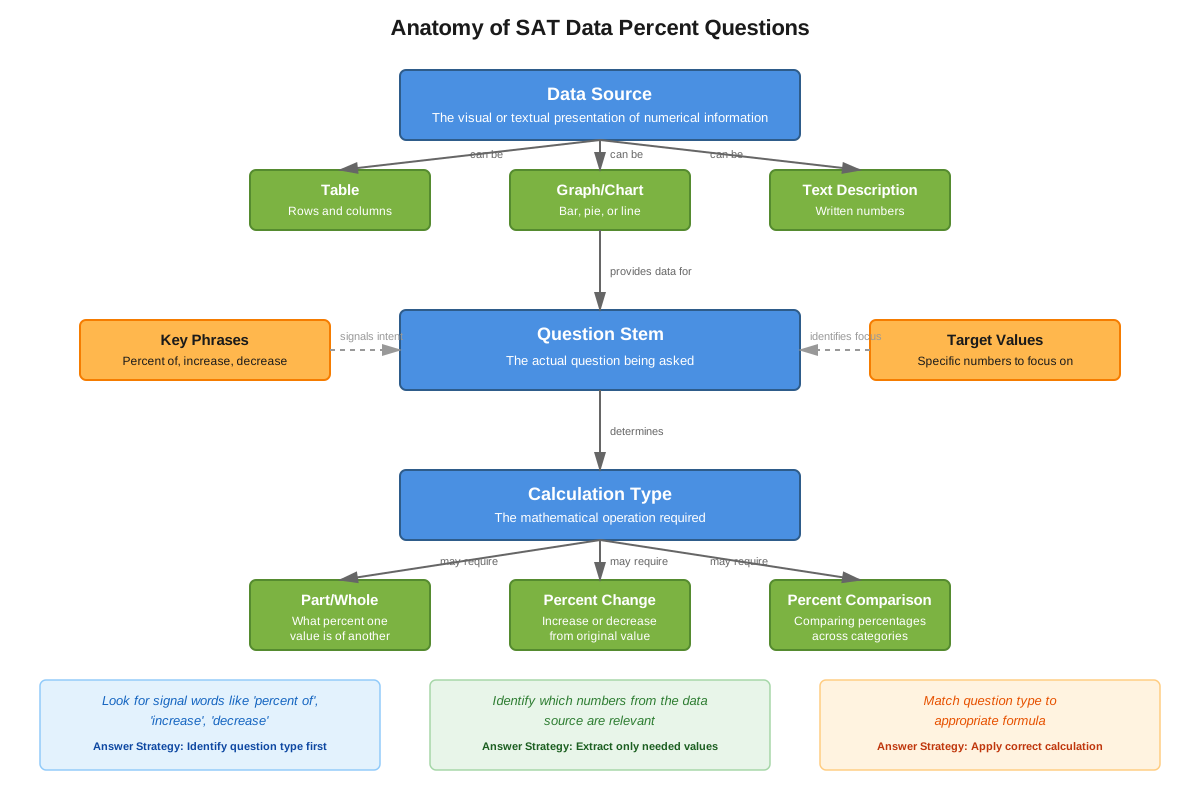
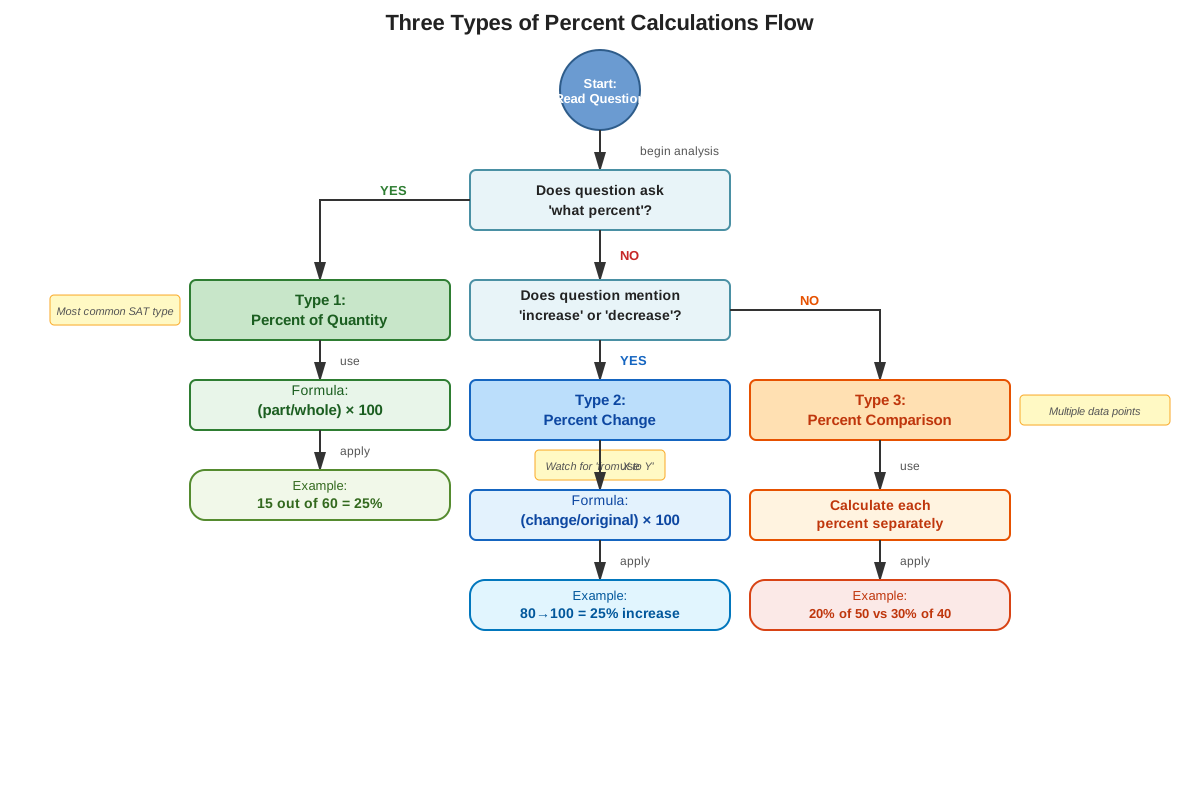
Data percent questions on the SAT fall into three primary categories, each requiring distinct approaches. Percent of a quantity problems ask students to find what percentage one value represents of another. For example, if a table shows that 45 out of 180 students chose pizza, the question might ask what percent of students made that choice. The calculation involves dividing the part by the whole and multiplying by 100: (45/180) × 100 = 25%.
Percent change problems require calculating the relative increase or decrease between two values. The formula is: [(New Value - Original Value) / Original Value] × 100. If enrollment increased from 200 to 250 students, the percent change is [(250 - 200) / 200] × 100 = 25% increase. Critically, the denominator must always be the original value, not the new value—this is one of the most common errors students make.
Percent comparison problems involve finding relationships between percentages or comparing percentages across different categories. These might ask which group has the highest percentage, how much greater one percentage is than another, or what percentage of a percentage represents (compound percentages). For instance, if 60% of students are female and 40% of female students play sports, then 24% of all students are female athletes (0.60 × 0.40 = 0.24 = 24%).
Data Source Interpretation
The SAT presents data in multiple formats, and recognizing the structure of each is crucial for accuracy. Tables organize data in rows and columns, often with category labels and numerical values. Students must identify which row and column intersection contains the needed value, paying careful attention to headers and units. Two-way tables (also called contingency tables) show relationships between two categorical variables and are particularly common on the SAT.
Bar graphs display categorical data using rectangular bars whose lengths represent quantities. Students must read the scale carefully, noting whether it starts at zero and what intervals are used. Circle graphs (pie charts) show parts of a whole, with each sector representing a percentage or proportion. The entire circle always represents 100%, making these ideal for percentage questions. Line graphs show trends over time and may require students to calculate percent change between two points.
The Percentage Calculation Framework
All percentage problems follow a fundamental relationship: Part = Percent × Whole. This equation can be rearranged to solve for any unknown component:
- To find the part: Part = (Percent/100) × Whole
- To find the percent: Percent = (Part/Whole) × 100
- To find the whole: Whole = Part / (Percent/100)
Understanding this framework allows students to approach any percentage problem systematically. When the question asks "What percent of X is Y?", the setup is (Y/X) × 100. When it asks "What is 30% of X?", the calculation is 0.30 × X. When it asks "45 is 60% of what number?", the equation is 45 = 0.60 × Whole, so Whole = 45/0.60 = 75.
Multi-Step Data Percent Problems
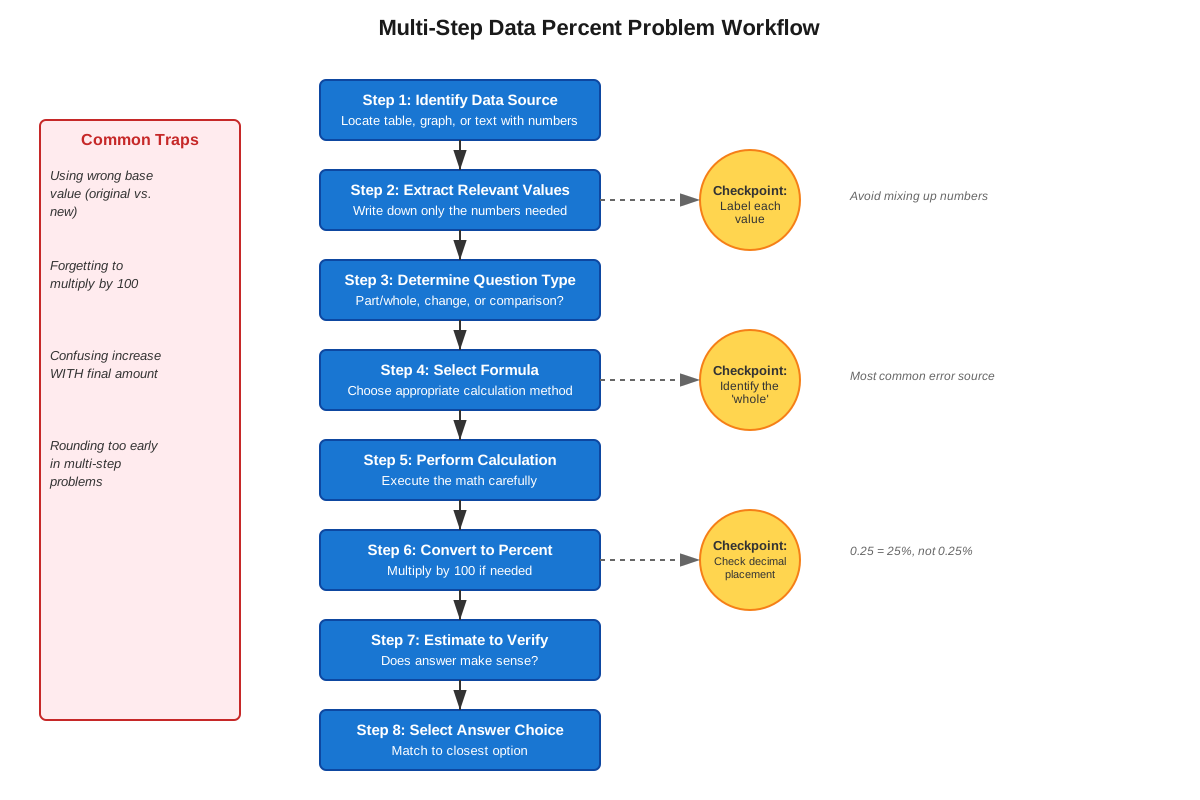
Many SAT questions require combining multiple operations. A typical multi-step problem might present a table showing sales data for different products across multiple months, then ask what percent increase the best-selling product experienced from January to March. This requires:
- Identifying the best-selling product (comparing totals)
- Extracting the January and March values for that product
- Calculating the percent change using the formula
- Selecting the correct answer choice
The key to success with multi-step problems is organization: write down intermediate results, label what each number represents, and verify that the final answer addresses the actual question asked. Students often calculate correctly but answer the wrong question—for example, finding the percent change when the question asked for the final percentage.
Percent Greater Than vs. Percent Of
A critical distinction that frequently appears on the SAT involves the difference between "percent greater than" and "percent of" language. If Value A is 50 and Value B is 75, then Value B is 50% greater than Value A because (75-50)/50 = 0.50 = 50%. However, Value B is 150% of Value A because 75/50 = 1.50 = 150%. These are different calculations answering different questions, and the SAT deliberately includes both phrasings to test careful reading.
Similarly, "percent less than" requires attention. If Value A is 100 and Value B is 80, then Value B is 20% less than Value A because (100-80)/100 = 0.20 = 20%. But Value B is 80% of Value A because 80/100 = 0.80 = 80%. The complement relationship (20% less means 80% of) is useful for checking answers.
Working with Percentages in Context
SAT data percent questions always occur within realistic contexts that provide meaning to the numbers. Common contexts include:
| Context Type | Typical Scenarios | Key Considerations |
|---|---|---|
| Consumer | Discounts, sales tax, tips, price changes | Original vs. sale price, multiple discounts |
| Demographics | Population changes, survey results, group compositions | Sample sizes, subgroup percentages |
| Scientific | Experimental results, measurement changes, success rates | Control vs. experimental groups, accuracy |
| Business | Revenue, profit margins, market share, growth rates | Gross vs. net, year-over-year comparisons |
| Academic | Test scores, grade distributions, enrollment changes | Weighted averages, passing rates |
Understanding the context helps students identify which values represent the "part" and which represent the "whole," reducing calculation errors and improving answer verification.
Concept Relationships
The concepts within data percent questions form an interconnected system where mastery of foundational skills enables success with more complex applications. Basic percentage calculations serve as the foundation, supporting both percent change calculations and percent comparison problems. These three calculation types all depend on data source interpretation skills—the ability to extract correct values from tables, graphs, and text.
Data source interpretation → enables → identifying relevant values → which feeds into → selecting the appropriate calculation type → leading to → executing multi-step solutions → culminating in → answer verification through reasonableness checks.
The relationship to prerequisite topics is direct: proportional reasoning underlies all percentage work, as percentages are ratios expressed per hundred. Basic algebra enables students to set up equations when the unknown is the whole or when working with percent change. Graph and table reading skills from earlier mathematics courses provide the data literacy foundation these questions require.
Connections to related SAT topics include ratio and proportion problems (percentages are special ratios), linear functions (percent change can be modeled with linear equations), scatterplots (which may require calculating percentages of data points meeting certain criteria), and statistics (percentages frequently describe distributions and probabilities). Mastering data percent questions strengthens skills needed across the entire Problem Solving and Data Analysis domain.
Quick check — test yourself on Data percent questions so far.
Try Flashcards →High-Yield Facts
⭐ The percent change formula always uses the original value as the denominator: [(New - Original) / Original] × 100
⭐ When a question asks "what percent," the answer should be a number without the percent sign in grid-in questions (enter 25, not 25%)
⭐ "Percent of" means multiply: 30% of 80 = 0.30 × 80 = 24
⭐ A value that is 20% less than the original is 80% of the original: these are complementary relationships
⭐ In two-way tables, always verify whether the question asks for a percentage of the row total, column total, or grand total
- Percent increase followed by the same percent decrease does not return to the original value (e.g., increase by 50% then decrease by 50% results in a net 25% decrease)
- When comparing percentages across different-sized groups, the larger percentage does not necessarily represent more individuals
- Circle graphs always total 100%, so if some sectors are given, the remaining sectors can be found by subtraction
- The phrase "what percent greater" requires calculating the difference first, then dividing by the original
- Discount problems may involve successive discounts, which are not additive (30% off then 20% off is not 50% off)
- Survey questions often ask for percentages of subgroups, requiring careful identification of the correct denominator
- When data is presented in thousands or millions, maintain consistent units throughout calculations
- Percent change can be negative (decrease) or positive (increase), and the sign matters for the answer
- The most common wrong answers in data percent questions result from using the wrong denominator or answering a different question than what was asked
- Estimation is particularly powerful for data percent questions because percentages have intuitive benchmarks (10%, 25%, 50%, 75%)
Common Misconceptions
Misconception: When calculating percent change, students can use either the original or new value as the denominator. → Correction: The denominator must always be the original value. Using the new value produces a different calculation that doesn't represent percent change. For example, going from 50 to 100 is a 100% increase [(100-50)/50 × 100], not a 50% increase.
Misconception: "30% more than X" and "30% of X" mean the same thing. → Correction: These are completely different calculations. "30% of X" means 0.30X, while "30% more than X" means X + 0.30X = 1.30X. If X = 100, then 30% of X is 30, but 30% more than X is 130.
Misconception: Two successive discounts of 20% each equal a 40% total discount. → Correction: Successive percentage changes are multiplicative, not additive. A 20% discount means paying 80% of the price. Two 20% discounts mean paying 0.80 × 0.80 = 0.64 = 64% of the original price, which is a 36% total discount, not 40%.
Misconception: If Group A has a higher percentage than Group B, then Group A has more individuals. → Correction: Percentages are relative to the total size of each group. If 80% of 50 students (40 students) chose pizza and 60% of 100 students (60 students) chose pizza, the second group has more individuals despite the lower percentage.
Misconception: In a two-way table, the percentage can be calculated using any total. → Correction: The denominator must match what the question asks for. If asked "what percent of males chose option A," the denominator is the total number of males, not the total number who chose option A or the grand total.
Misconception: When a value increases by 100%, it doubles, so when it increases by 200%, it triples. → Correction: A 100% increase means adding 100% of the original (doubling), but a 200% increase means adding 200% of the original, resulting in 300% of the original (tripling). The final value is always the original plus the increase.
Misconception: Percent change and percent difference are the same thing. → Correction: Percent change compares a new value to an original value with direction (increase or decrease). Percent difference compares two values without implying which came first, often using the average of the two values as the denominator in scientific contexts, though SAT questions typically use percent change.
Worked Examples
Example 1: Multi-Step Table Interpretation
Question: The table below shows the number of students enrolled in three sports across two years. What was the approximate percent increase in total enrollment from 2022 to 2023?
| Sport | 2022 | 2023 |
|---|---|---|
| Soccer | 45 | 52 |
| Basketball | 38 | 41 |
| Tennis | 27 | 34 |
Solution:
Step 1: Calculate the total enrollment for 2022.
Total 2022 = 45 + 38 + 27 = 110 students
Step 2: Calculate the total enrollment for 2023.
Total 2023 = 52 + 41 + 34 = 127 students
Step 3: Apply the percent change formula.
Percent change = [(New - Original) / Original] × 100
Percent change = [(127 - 110) / 110] × 100
Percent change = [17 / 110] × 100
Percent change = 0.1545... × 100
Percent change ≈ 15.5%
Step 4: Verify reasonableness.
The enrollment increased by 17 students from a base of 110. Since 17 is between 10% of 110 (11) and 20% of 110 (22), an answer around 15% makes sense.
Answer: Approximately 15.5% or 15% depending on answer choices.
Connection to Learning Objectives: This problem requires identifying key features (table format, year-over-year comparison), extracting relevant data (totals for each year), and applying the percent change formula—demonstrating all three primary learning objectives.
Example 2: Percentage of a Subgroup
Question: A survey of 500 students found that 320 students have a pet. Of those students with pets, 40% have dogs. How many students in the survey have dogs?
Solution:
Step 1: Identify what the question asks.
The question asks for the number of students with dogs, not a percentage.
Step 2: Identify the relevant whole.
The 40% refers to students with pets (320 students), not all surveyed students (500 students). This is a critical distinction.
Step 3: Calculate 40% of the pet-owning students.
Number with dogs = 40% of 320
Number with dogs = 0.40 × 320
Number with dogs = 128 students
Step 4: Verify reasonableness.
40% is less than half, so the answer should be less than 160 (half of 320). 128 is reasonable.
Alternative approach (common error to avoid):
If a student incorrectly calculated 40% of 500 (all students), they would get 200, which is wrong because not all students have pets.
Answer: 128 students
Connection to Learning Objectives: This problem demonstrates the importance of identifying the correct reference group (the "whole" in percentage calculations) and shows how data percent questions test careful reading and multi-step reasoning.
Exam Strategy
When approaching SAT data percent questions, begin by reading the question carefully before examining the data. Identify exactly what the question asks: Is it asking for a percentage, a count, a percent change, or a comparison? Underline or circle key phrases like "percent of," "percent increase," "percent greater than," or "what percent." This prevents the common error of calculating correctly but answering the wrong question.
Exam Tip: Always identify the "whole" before calculating. Ask yourself: "Percent of what?" The answer to this question determines your denominator.
Next, examine the data source systematically. For tables, identify row and column headers and verify units. For graphs, check the scale, starting point, and intervals. Mark or write down the specific values you need before beginning calculations. This reduces errors from misreading data or using wrong numbers.
Trigger words and phrases to watch for:
- "Percent of" → multiply (0.30 × value)
- "What percent" → divide and multiply by 100 (part/whole × 100)
- "Percent increase/decrease" → use change formula [(new-original)/original × 100]
- "Percent greater/less than" → calculate difference first, then divide by reference value
- "Approximately" → estimation is acceptable and often faster
- "Of those who..." → signals a subgroup calculation requiring a different denominator
For process of elimination, use estimation aggressively. If calculating 47 out of 183, recognize this is slightly more than 25% (which would be 45.75 out of 183) but less than 33% (which would be about 60 out of 183). Eliminate answer choices outside this range immediately. Benchmark percentages (10%, 25%, 50%, 75%) provide quick reference points for reasonableness checks.
Time allocation advice: Data percent questions typically require 60-90 seconds each. If a problem involves multiple steps or complex data interpretation, allocate up to 2 minutes. If you cannot identify the correct approach within 30 seconds, mark the question and return to it later—these questions reward careful reading, and rushing increases error rates significantly.
When working with percent change, always verify the direction (increase or decrease) and ensure your answer's sign matches. A common trap answer will have the correct magnitude but wrong sign. For grid-in questions, remember to enter just the number without the percent symbol—enter 25, not 25%.
Memory Techniques
Mnemonic for Percent Change Formula: "New Over Original" → NOO (like saying "no" with emphasis). The formula is (New - Original) / Original, and the denominator is always Original.
Visualization for "Percent Of" vs. "Percent More Than": Picture a bar representing 100%. "Percent of" means taking a piece of that bar (30% of 100 is 30). "Percent more than" means adding an extra piece to the whole bar (30% more than 100 is 130). The first shrinks or takes a portion; the second grows or adds.
Acronym for Data Interpretation Steps: READ
- Read the question first
- Examine the data source
- Analyze what's being asked
- Determine the calculation needed
Memory aid for successive discounts: "Discounts multiply, they don't add-ify." Two 20% discounts mean you pay 80% × 80% = 64%, not 100% - 40% = 60%.
Benchmark percentage visualization: Memorize that 1/10 = 10%, 1/4 = 25%, 1/3 ≈ 33%, 1/2 = 50%, 2/3 ≈ 67%, 3/4 = 75%. When you see fractions in data, immediately recognize these equivalents for faster estimation.
The "Whole" identification technique: Circle or underline the phrase that comes after "of" in the question. "What percent of the students chose pizza?" → students is the whole. "What percent of those who have pets have dogs?" → those who have pets is the whole.
Summary
Data percent questions represent a high-yield SAT math topic that combines computational percentage skills with data interpretation abilities. Success requires mastering three core calculation types: percent of a quantity (part/whole × 100), percent change [(new-original)/original × 100], and percent comparisons. Students must accurately extract information from tables, graphs, and text, then apply the appropriate formula while maintaining careful attention to what the question actually asks. The most common errors stem from using incorrect denominators, confusing "percent of" with "percent more than," misidentifying the reference group in subgroup calculations, and answering a different question than what was asked. Strategic approaches include reading the question before examining data, identifying the "whole" explicitly, using estimation for rapid answer elimination, and verifying that final answers are reasonable in context. These questions appear 3-5 times per SAT administration and are highly predictable in format, making them excellent targets for score improvement through focused practice.
Key Takeaways
- Data percent questions combine percentage calculations with data interpretation, requiring both computational accuracy and careful reading of tables, graphs, and text
- The percent change formula [(new-original)/original × 100] always uses the original value as the denominator, and this is one of the most frequently tested concepts
- "Percent of" means multiply (30% of 80 = 24), while "percent more than" means multiply and add (30% more than 80 = 104)
- Always identify the correct "whole" or reference group before calculating—in subgroup questions, the denominator is the subgroup size, not the total population
- Estimation using benchmark percentages (10%, 25%, 50%, 75%) enables rapid elimination of incorrect answer choices and verification of calculated results
- Multi-step problems require organization: write down intermediate results, label what each number represents, and verify the final answer addresses the actual question
- These questions appear 3-5 times per SAT with predictable contexts (consumer, demographic, scientific, business), making them high-yield content for focused preparation
Related Topics
Ratio and Proportion: Percentages are special ratios (per hundred), and many SAT questions require converting between ratios, fractions, and percentages. Mastering data percent questions strengthens proportional reasoning skills applicable to mixture problems, scale factors, and rate problems.
Two-Way Tables and Conditional Probability: Advanced data percent questions often involve two-way tables where students must calculate percentages of specific subgroups. This connects directly to conditional probability concepts tested in the Problem Solving and Data Analysis domain.
Linear Functions and Modeling: Percent change over time can be modeled with linear functions, and some SAT questions combine these topics by asking students to interpret slopes as percent changes or to calculate percent changes from linear models.
Statistics and Data Analysis: Understanding percentages is fundamental to interpreting statistical measures like percentiles, percentage distributions, and margin of error. Data percent questions build the quantitative literacy needed for more advanced statistical reasoning.
Scatterplots and Data Trends: Some SAT questions present scatterplots and ask what percentage of data points meet certain criteria or how to interpret percent changes shown in the data, combining graphical analysis with percentage calculations.
Practice CTA
Now that you've mastered the core concepts, strategies, and common pitfalls of data percent questions, it's time to solidify your understanding through active practice. Complete the practice questions associated with this topic, focusing on applying the systematic approaches outlined in this guide. Pay special attention to identifying the correct "whole" in each problem and verifying that your answers are reasonable in context. Use the flashcards to reinforce key formulas, trigger words, and common misconceptions until they become automatic. Remember: data percent questions are highly predictable and appear consistently on every SAT—your focused practice on this high-yield topic will directly translate to points on test day. You've got this!
Sign up free to keep reading
Create a free AnvayaPrep account to finish this SAT guide on Data percent questions — plus flashcards and practice questions.